
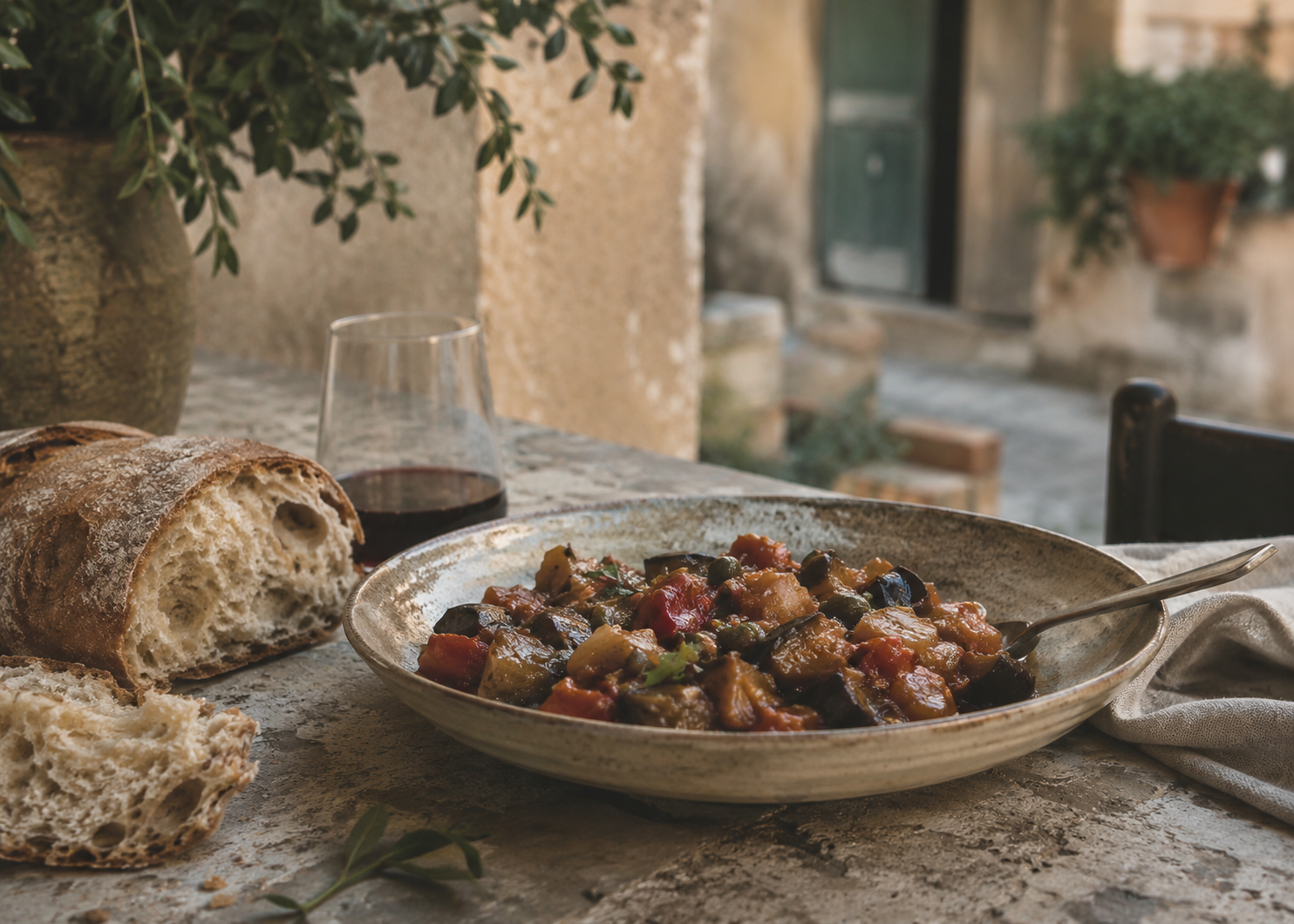
In Sicily, caponata is the dish that proves vegetables can be as complex and satisfying as anything with meat in it. It is a sweet and sour eggplant relish, served at room temperature, that balances the richness of fried eggplant against the tang of vinegar and the sweetness of sugar, with capers and olives and celery threaded through, and it tastes like the whole sun-baked island in a single forkful. It is also, in its American versions, almost always rushed, and the rushing shows up most in one step that nobody outside Sicily seems willing to take seriously.
From a kitchen in Spain, where the Mediterranean instinct for treating vegetables properly is shared, the American caponata problem is easy to spot. The dish depends on the eggplant being right, and getting the eggplant right depends on salting it properly, drawing out its moisture and bitterness before it ever hits the pan, and this is the step American recipes cut in half or skip entirely. A caponata made with un-salted or barely-salted eggplant is a soggy, bitter, oily disappointment. A caponata made with eggplant salted properly is a revelation, and the difference is almost entirely in that one patient step.
The Salting Step That Makes Or Breaks It
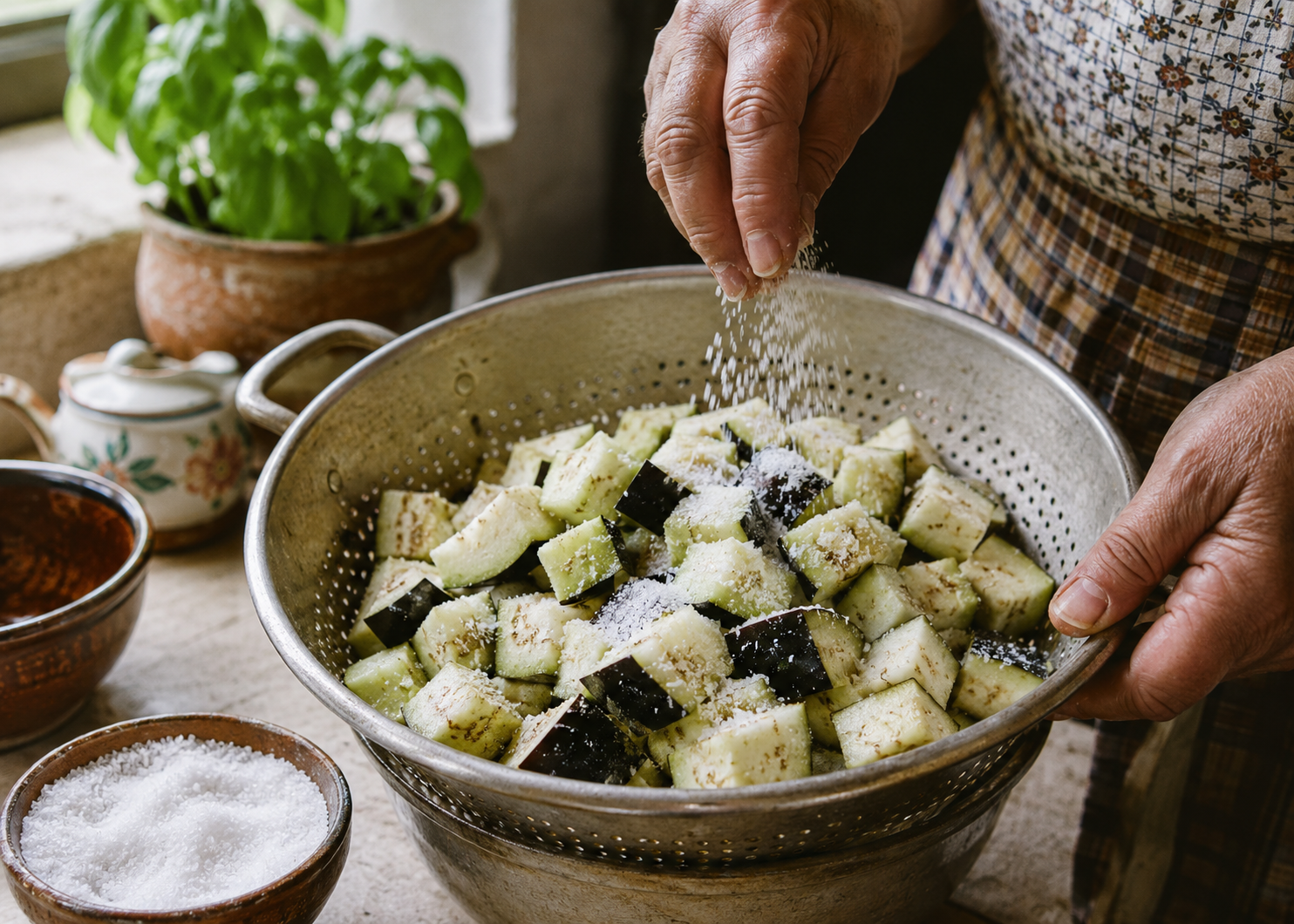
Here is the step that American recipes shortchange, and it is the foundation of the whole dish. The eggplant must be salted and left to drain, properly and for long enough, before it is cooked.
The reason is in the nature of the eggplant itself. Raw eggplant is full of moisture and has a spongy, porous structure, and if you fry it without dealing with that moisture first, two bad things happen. The water in the eggplant fights the hot oil, steaming rather than frying, so the eggplant turns soggy instead of developing the golden, almost creamy texture it should have. And the porous flesh soaks up enormous quantities of oil, so the eggplant becomes greasy and heavy rather than rich and tender. Salting solves both problems at once, drawing the moisture out of the eggplant through osmosis over a period of time, collapsing the sponge so it absorbs less oil, and seasoning the flesh from within.
The American shortcut is to salt the eggplant for ten or fifteen minutes, or to skip the salting entirely on the theory that modern eggplant is less bitter than it used to be and the step is no longer necessary. This is the error. The salting needs real time, ideally an hour or close to it, for the moisture to genuinely draw out, the eggplant to release its liquid, and the structure to change, and rushing it to a few minutes does almost nothing. Yes, modern eggplant is generally less bitter than older varieties, so the bitterness-removal function matters less than it once did, but the moisture-removal and oil-control functions matter just as much as ever, and those require the full salting time regardless of bitterness. The Sicilian cook salts the eggplant properly and waits, because that wait is what makes the eggplant cook into the tender, non-greasy, flavorful thing the dish needs.
Why Caponata Is Worth The Effort
Before the rest of the method, it is worth understanding what makes caponata special, because it explains why the effort matters.
Caponata is a masterpiece of agrodolce, the sweet-and-sour principle that runs through Sicilian cooking, a legacy of the many cultures, Arab, Spanish, Italian, that shaped the island’s kitchen over centuries. The Arab influence brought the love of combining sweet and sour, fruit and savory, and caponata is one of its clearest expressions, the sweetness of sugar and sometimes raisins playing against the sourness of vinegar, the whole thing balanced on a knife edge between the two. This agrodolce balance is what makes caponata more than just cooked vegetables, a genuinely complex flavor that keeps revealing itself as you eat, and it is the reason the dish has survived and spread far beyond Sicily.
The dish is also a triumph of making vegetables luxurious, which is the deeper Sicilian and Mediterranean genius. Caponata takes humble ingredients, eggplant, celery, onion, tomato, olives, capers, and through technique and balance turns them into something rich and special enough to serve to guests, a dish nobody would call a sad vegetable side. It is traditionally served at room temperature, as an antipasto, a side, or part of a spread, and it actually improves after a day in the refrigerator as the flavors meld, which makes it ideal for entertaining and for the heat, a dish made ahead and served cool. Understanding that caponata is meant to be a complex, balanced, make-ahead celebration of vegetables, rather than a quick sautéed side, frames why each step deserves care.
Here is how it comes together. This makes a generous bowl, enough as part of a spread or as a side for several, and it is better made a day ahead.
Ingredients
- 2 large eggplants, about 800 g, cut into 2 cm cubes
- salt, for drawing out the eggplant, about 1 tbsp
- 100 ml extra virgin olive oil, for frying, plus more as needed
- 1 large onion, chopped
- 3 celery stalks, in 1 cm pieces
- 400 g chopped tomatoes, or a few fresh ripe tomatoes
- 100 g green olives, pitted and roughly chopped
- 2 tbsp capers, rinsed
- 3 tbsp red wine vinegar
- 2 tbsp sugar
- salt and black pepper, to taste
- a handful of fresh basil, to finish
Method
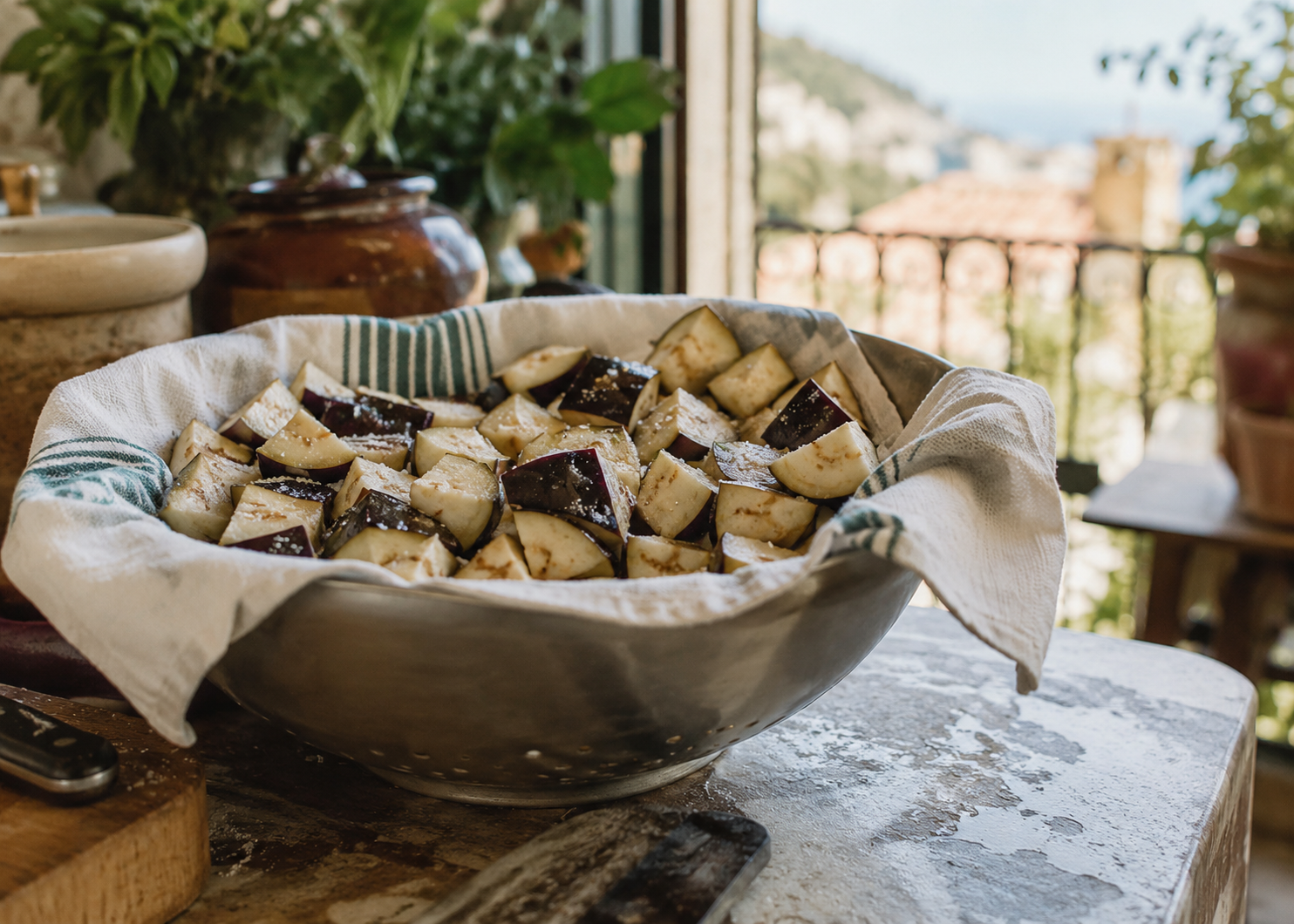
- Salt the eggplant, the step that makes the dish. Put the eggplant cubes in a colander, toss thoroughly with the salt, and leave to drain for about an hour. The salt draws out the moisture and collapses the spongy structure so the eggplant fries golden instead of soggy and absorbs far less oil. Do not rush this to a few minutes. After draining, pat the cubes dry with a towel.
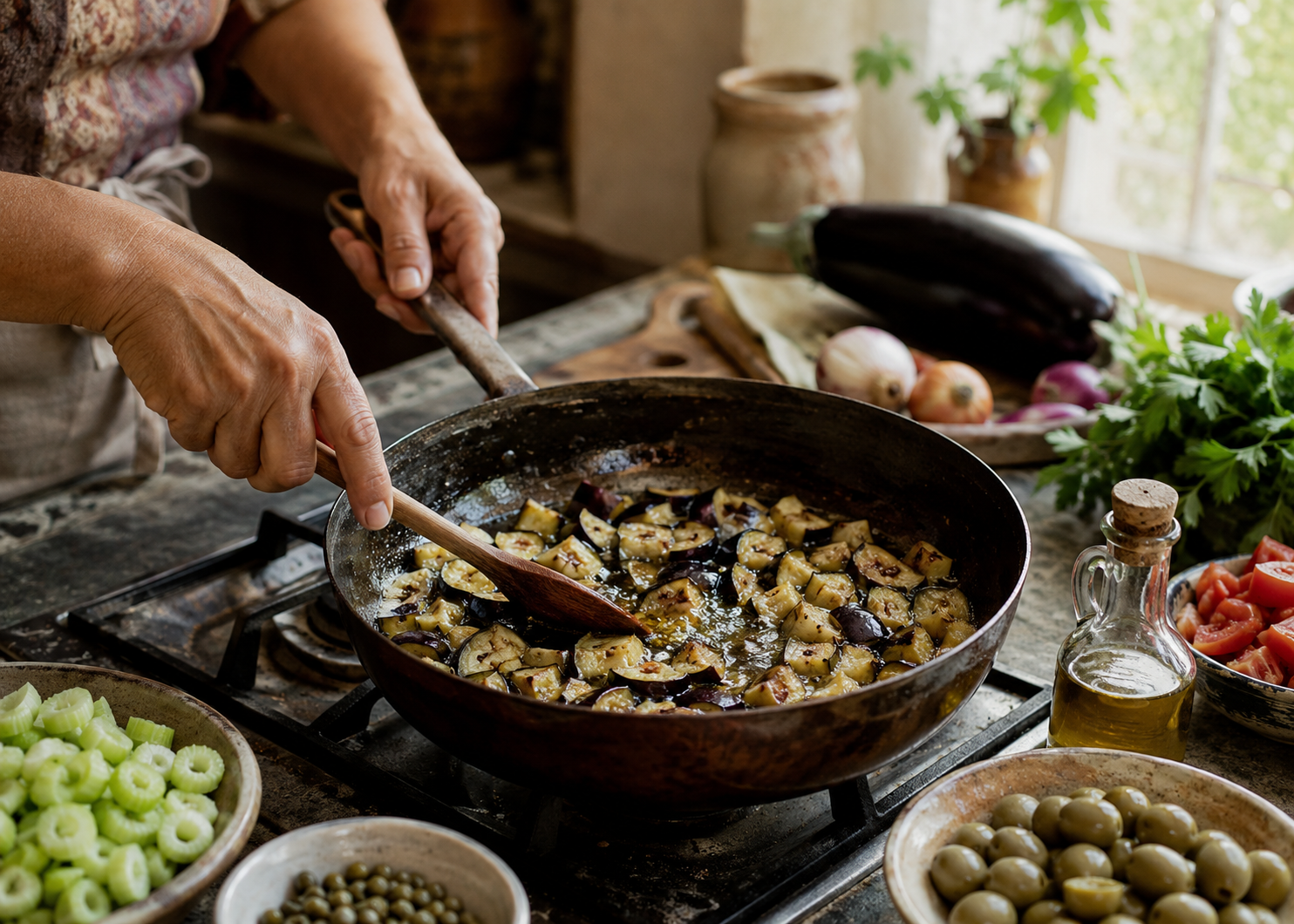
- Fry the eggplant. Heat the olive oil in a large pan over medium-high heat and fry the eggplant cubes, in batches so they are not crowded, until golden and tender on all sides. Remove with a slotted spoon and set aside on paper towels. The properly salted eggplant will turn golden and creamy rather than greasy.
- Cook the celery. In the same pan, with a little more oil if needed, cook the celery until just tender, a few minutes, then set aside with the eggplant.
- Make the base. Add the onion to the pan and cook until soft and golden. Add the chopped tomatoes and cook down for several minutes until thickened and the raw smell is gone.
- Combine and build the agrodolce. Return the eggplant and celery to the pan. Add the olives and capers. Stir in the vinegar and sugar, then taste and adjust, building the sweet-and-sour balance so it is lively but neither sharply sour nor cloying. Cook together gently for about 10 minutes so the flavors marry. Season with salt and pepper.
- Rest, then serve. Let the caponata cool, then refrigerate for at least a few hours and ideally overnight, since it is much better the next day once the flavors meld. Bring back to room temperature before serving, and finish with torn fresh basil.
A note on the eggplant. Everything depends on the salting and the frying. Salt it for the full hour, fry it properly golden, and the dish has its soul. Skip the salting and no amount of agrodolce will save the soggy, oily result.
Frying, Not Sautéing
Beyond the salting, the second technique that separates real caponata from the rushed version is how the eggplant is cooked, and here too the shortcut shows.
In a proper caponata, the salted and drained eggplant is fried, in a decent amount of olive oil, until golden and tender, rather than sautéed in a thin film of oil or, worse, roasted as a low-fat substitute. The frying is what gives the eggplant its characteristic richness and its almost creamy interior, the texture that makes caponata feel indulgent, and it is only possible because the salting has already collapsed the eggplant’s structure so it absorbs a reasonable rather than ruinous amount of oil. Fry un-salted eggplant and it drinks the oil like a sponge and turns greasy. Fry properly salted eggplant and it cooks to golden tenderness while staying relatively light, which is the whole reward of the salting step paying off in the pan.
The components are also cooked separately and combined, rather than all thrown into one pot, which is the other mark of a caponata made properly. The eggplant is fried and set aside. The celery is cooked until tender. The onion is softened into a sofrito-like base with the tomato. And then everything is combined with the vinegar and sugar, the olives and capers, and cooked together briefly so the flavors marry and the agrodolce balance comes together. Cooking the elements separately means each is cooked correctly, the eggplant golden, the celery tender but not mushy, the onion sweet, rather than the compromise that results from cooking everything together. It is more work, more pans, more steps, but it is the difference between a caponata where every element is right and one where everything has collapsed into the same texture.
The Agrodolce Balance
The heart of caponata is the sweet-and-sour balance, and getting it right is the final skill, the one that turns good components into a great dish.
The agrodolce is created by adding vinegar and sugar near the end of cooking, and the art is in the balance between them, enough vinegar for a real tang, enough sugar to round it, the two in a tension that should taste neither sharply sour nor cloyingly sweet but poised between them. The exact proportions are a matter of taste and tradition, varying from cook to cook and town to town across Sicily, and the way to get it right is to add cautiously, taste, and adjust, building the balance rather than dumping in a fixed amount. A good caponata has a definite sweet-sour character that announces itself, present and lively, not a timid hint, but it stays balanced, the sweet and the sour holding each other in check.
The balance also develops and settles with time, which is why caponata is better the next day. When freshly made, the vinegar can taste sharp and the elements separate, but after a rest in the refrigerator the flavors meld, the agrodolce rounds and integrates, and the dish comes into its own. This is why the Sicilian cook makes caponata ahead, never to serve immediately, giving it at least a few hours and ideally a full day to come together. Tasting it straight from the pan and tasting it the next day are almost two different experiences, and the next-day version is the one the dish is really aiming for, which makes caponata one of the most convenient dishes for entertaining, since it must be made in advance to be at its best.
How To Serve It And What Goes With It
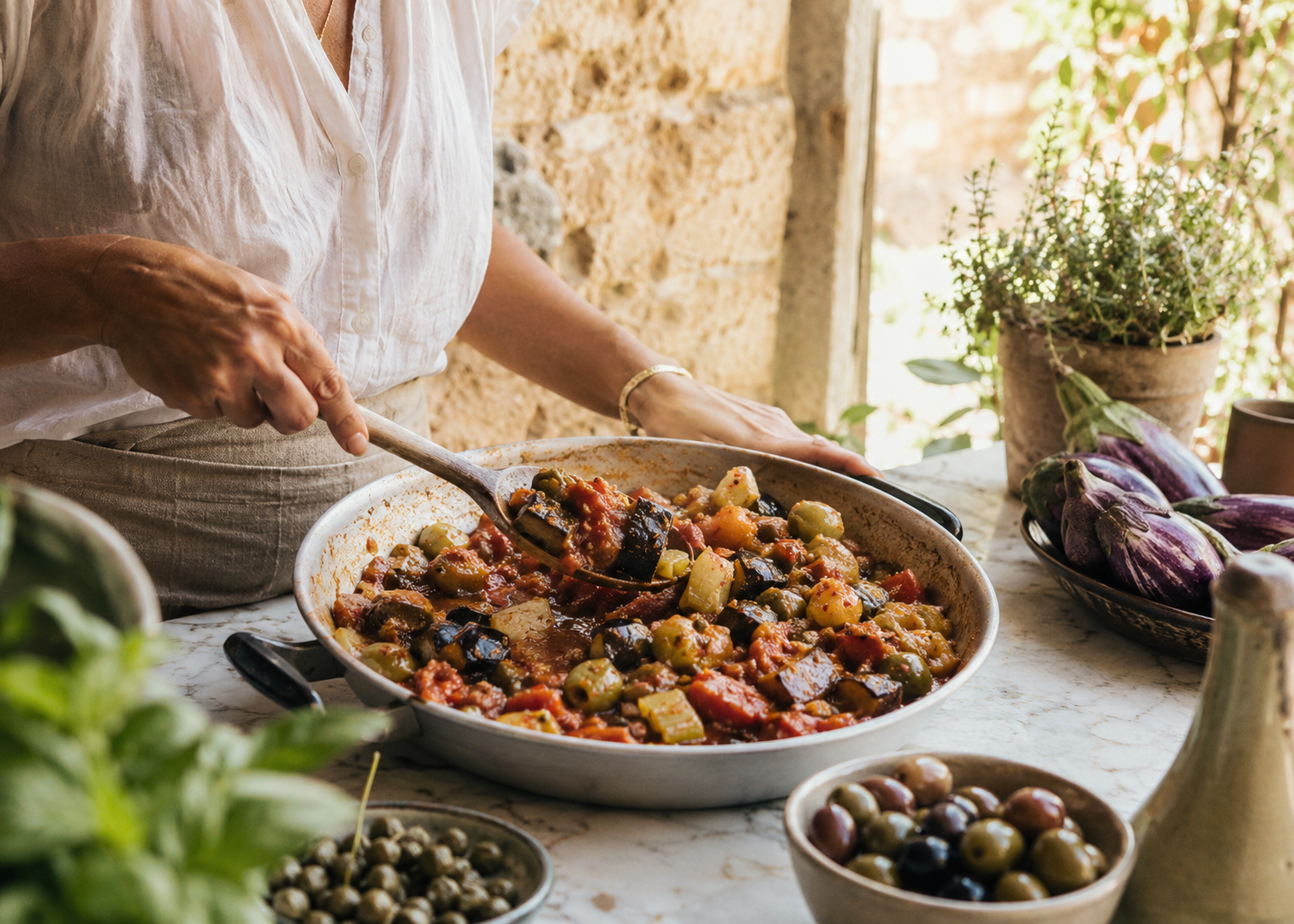
Caponata is versatile in a way that surprises people who first meet it as a single dish, and knowing its range makes it far more useful in a kitchen.
It is most traditionally served as an antipasto or a side, at room temperature, spooned onto a plate or into a bowl as part of a spread, alongside good bread to scoop it up. But it is equally at home as a topping for crostini or bruschetta, as a relish alongside grilled fish or meat where its tangy richness cuts through, as a filling or a pasta sauce, or simply eaten on its own as a light meal with bread and cheese. Its room-temperature, make-ahead nature makes it ideal for warm weather and for entertaining, a dish that sits happily on a table through a long lunch without needing to be kept hot, and that can be made days before it is needed. In Sicily it appears as part of the antipasto spread, on the table for people to help themselves, and that informal, communal serving suits it perfectly.
The flavors that go with caponata follow from its agrodolce character. It loves the company of bread and of mild cheeses that set off its tang, of grilled and roasted things whose char it complements, of other Mediterranean antipasti in a shared spread. To drink, a crisp Sicilian white or a light red suits it, nothing too heavy or too fine, since this is honest food that wants honest wine. The one thing to avoid is serving it cold straight from the refrigerator, since the cold mutes the flavors, so a caponata made ahead should be brought back to room temperature before serving, which lets the agrodolce and the richness of the eggplant come fully forward. Served at the right temperature, as part of a generous table, caponata is one of the great pleasures of the Sicilian kitchen and one of the most useful dishes a cook can have in their repertoire.
The Regional Variations Worth Knowing
Like every great traditional dish, caponata is not one fixed recipe but a family of versions, and knowing the variations helps a cook understand the dish rather than just follow one set of instructions.
The base of fried eggplant in agrodolce with celery, onion, tomato, olives, and capers is the common thread, but from there the versions diverge by town and by family across Sicily. Some add pine nuts and raisins, leaning further into the sweet, Arab-influenced direction, which adds texture and a deeper sweetness. Some include peppers, some add a little cocoa or chocolate in the most traditional Baroque versions of the Catania area, an unexpected note that deepens the savory complexity. Coastal versions sometimes add seafood, octopus or other fish, turning the vegetable dish into something more substantial. The proportions of sweet to sour shift from one part of the island to another, and every Sicilian cook is convinced their family’s version is the correct one.
This variation is not a problem to be resolved but the natural state of a dish that has been made in thousands of kitchens for centuries, each adapting it to local taste and what was on hand. For a cook outside Sicily, the lesson is to learn the base version first, the fried salted eggplant, the celery and onion and tomato, the olives and capers, the agrodolce balance, and then to feel free to lean it sweeter or more sour, to add the pine nuts and raisins or not, to make it personal once the foundation is understood. The one thing that does not vary, across every version and every town, is the importance of treating the eggplant properly, the salting and the frying that give the dish its soul. Get that right and the rest is a matter of taste, but get the eggplant wrong and no amount of regional flourish can save it, which is why the salting step the American versions skip is the one that truly matters.

About the Author: Ruben, co-founder of Gamintraveler.com since 2014, is a seasoned traveler from Spain who has explored over 100 countries since 2009. Known for his extensive travel adventures across South America, Europe, the US, Australia, New Zealand, Asia, and Africa, Ruben combines his passion for adventurous yet sustainable living with his love for cycling, highlighted by his remarkable 5-month bicycle journey from Spain to Norway. He currently resides in Spain, where he continues sharing his travel experiences with his partner, Rachel, and their son, Han.