
In the Netherlands, New Year’s Eve has a smell, and it is hot oil and powdered sugar. All over the country, on the last day of the year, the air carries the scent of oliebollen frying, from street stalls on every corner and from kitchens in every home.
Oliebollen, which means oil balls, are the Dutch New Year’s treat: deep-fried dough balls, crisp on the outside and soft within, studded with raisins and buried under a snowdrift of icing sugar. They are messy, warm, and utterly beloved, and no Dutch New Year’s Eve is complete without them.
The messiness is non-negotiable and much of the charm. You cannot eat an oliebol tidily; the powdered sugar goes everywhere, down your front and onto the floor, and that slight chaos is simply part of the experience. These are not a refined, fork-and-plate dessert but a hands-on, sugar-dusted, eaten-standing-up kind of treat, which suits a loud, happy New Year’s Eve perfectly.
For a few weeks each winter they are everywhere, sold from stalls that appear on the streets and fried by the dozen in family kitchens for the turning of the year. Here is what oliebollen are, their many forms, the stalls that fry them in the street, the New Year’s tradition they belong to, their surprising link to the American doughnut, and how to make them yourself. They are one of the great cozy food rituals of a European winter, and a genuinely fun thing to fry at home.
The Taste of New Year’s Eve
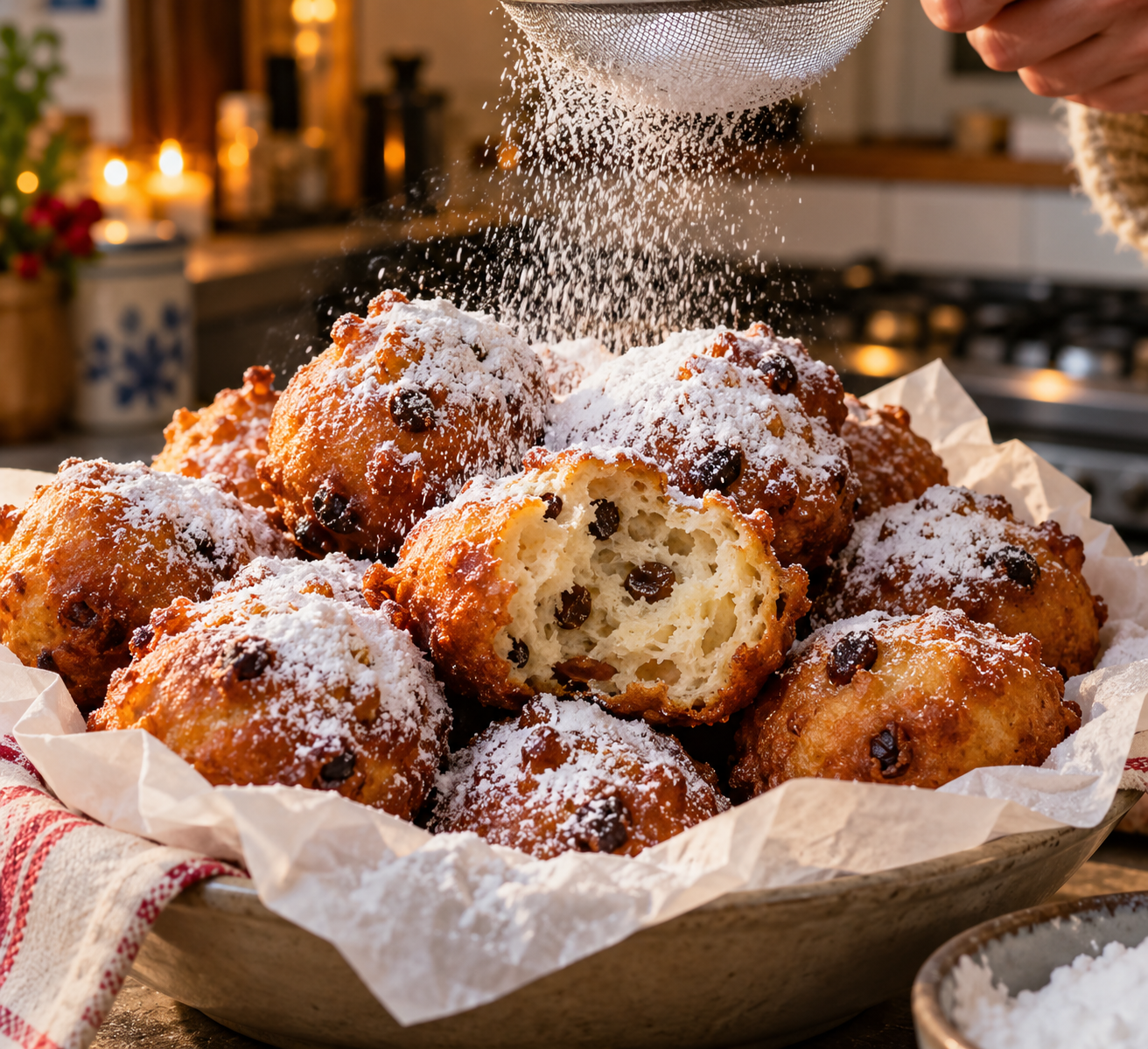
An oliebol is a simple, glorious thing: a ball of yeasted dough, deep-fried until golden, crisp and crunchy on the outside and soft, airy, and slightly chewy within. The classic version has raisins or currants folded through the dough, and some add pieces of apple, though plain ones are popular too.
The finishing touch is the powdered sugar, and it is not optional in spirit. A freshly fried oliebol gets a heavy, generous dusting of icing sugar, so much that it drifts down your front with every bite, which is simply part of the experience.
They are best eaten warm, within minutes of frying, when the outside still has its crunch and the inside is still soft and steaming. Served from a paper bag with sugar everywhere, an oliebol is not an elegant food, but it is a deeply satisfying one.
That, in a way, is the whole point of it. This is honest, warming, unfussy winter comfort, the kind of food made to be eaten with cold fingers against a dark December sky, and it tastes, to anyone Dutch, like the end of the year itself.
More Than Just Oil Balls
The classic raisin oliebol is the heart of the tradition, but it has company. The most common companion is the appelbeignet, an apple fritter made by dipping a ring of apple in batter and frying it, which is sold at the same stalls and eaten at the same table on New Year’s Eve.
Oliebollen themselves come in several forms. There are the plain ones, the raisin and currant ones, and versions studded with pieces of apple, and in recent years the stalls have branched out into fancier filled kinds, stuffed with cream or other sweet surprises. Purists, of course, tend to insist that the traditional raisin oliebol needs no improving.
The idea is not uniquely Dutch, either. Belgium has its own close relatives, and fried balls of sweet dough dusted with sugar turn up in various forms across the region. But it is the Netherlands that has made the oliebol into a true national institution, tied inseparably to the turning of the year.
Fried in the Street
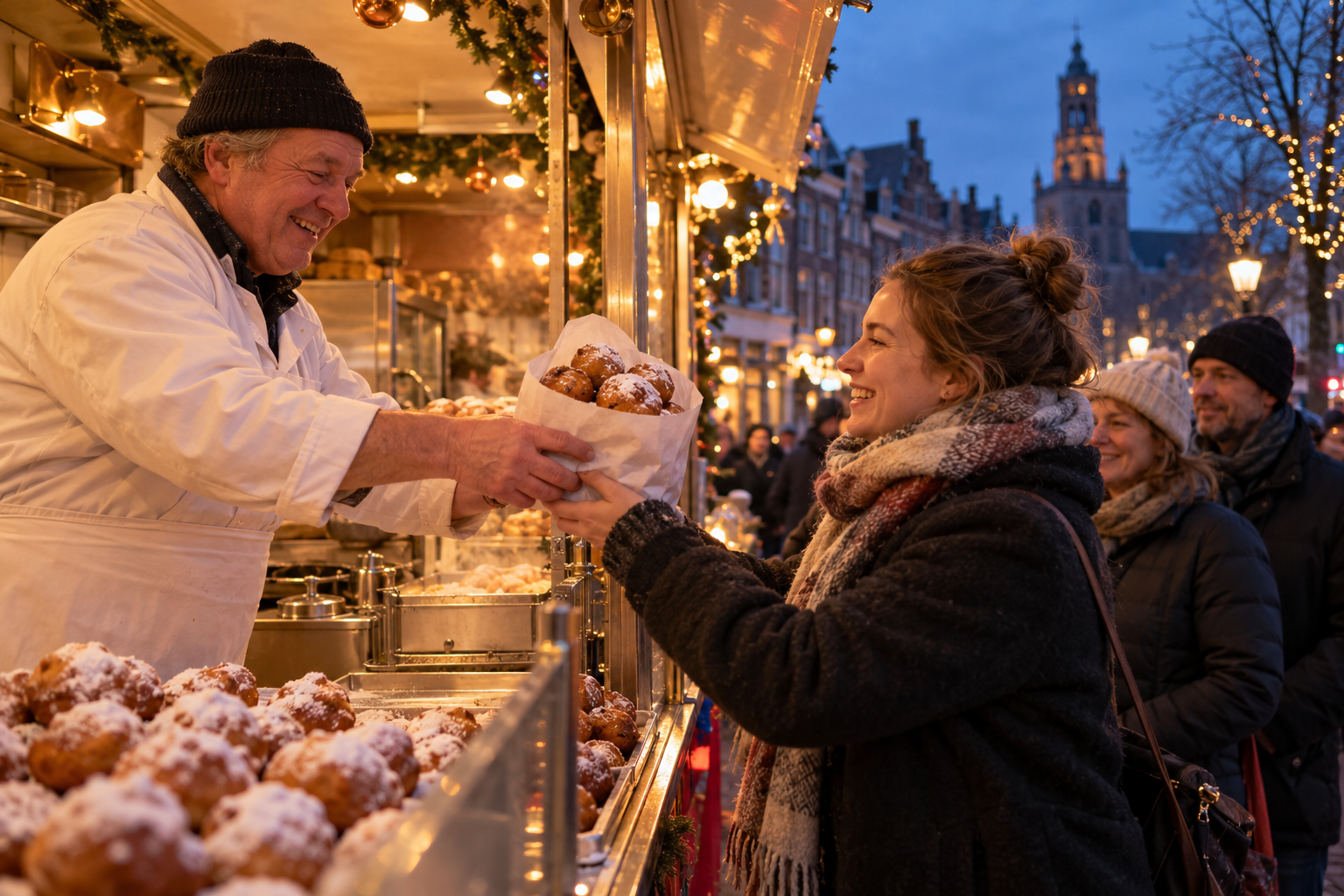
Much of the magic of oliebollen is that they are, above all, a street food of winter. From around November, temporary stalls known as the oliebollenkraam appear all over Dutch towns and cities, and at funfairs, frying oliebollen fresh to order.
As New Year’s Eve approaches, these stalls do a roaring trade, and it is not unusual to see lines stretching down the block, everyone waiting for a warm paper bag of oliebollen to carry home.
The smell of them frying, drifting down a cold Dutch street, is one of the sure signs that the year is ending. For many Dutch people, that scent is as evocative of New Year’s as fireworks, instantly conjuring up every December thirty-first they have ever known.
The Dutch take the quality of their oliebollen seriously, too. For many years, a national newspaper ran an annual oliebollen test, ranking the stalls to crown the best in the country, and people still debate fiercely over which kraam fries the finest. Buying your oliebollen from a trusted stall, or frying your own at home, is a small but real part of how a Dutch family marks the season.
A New Year’s Tradition
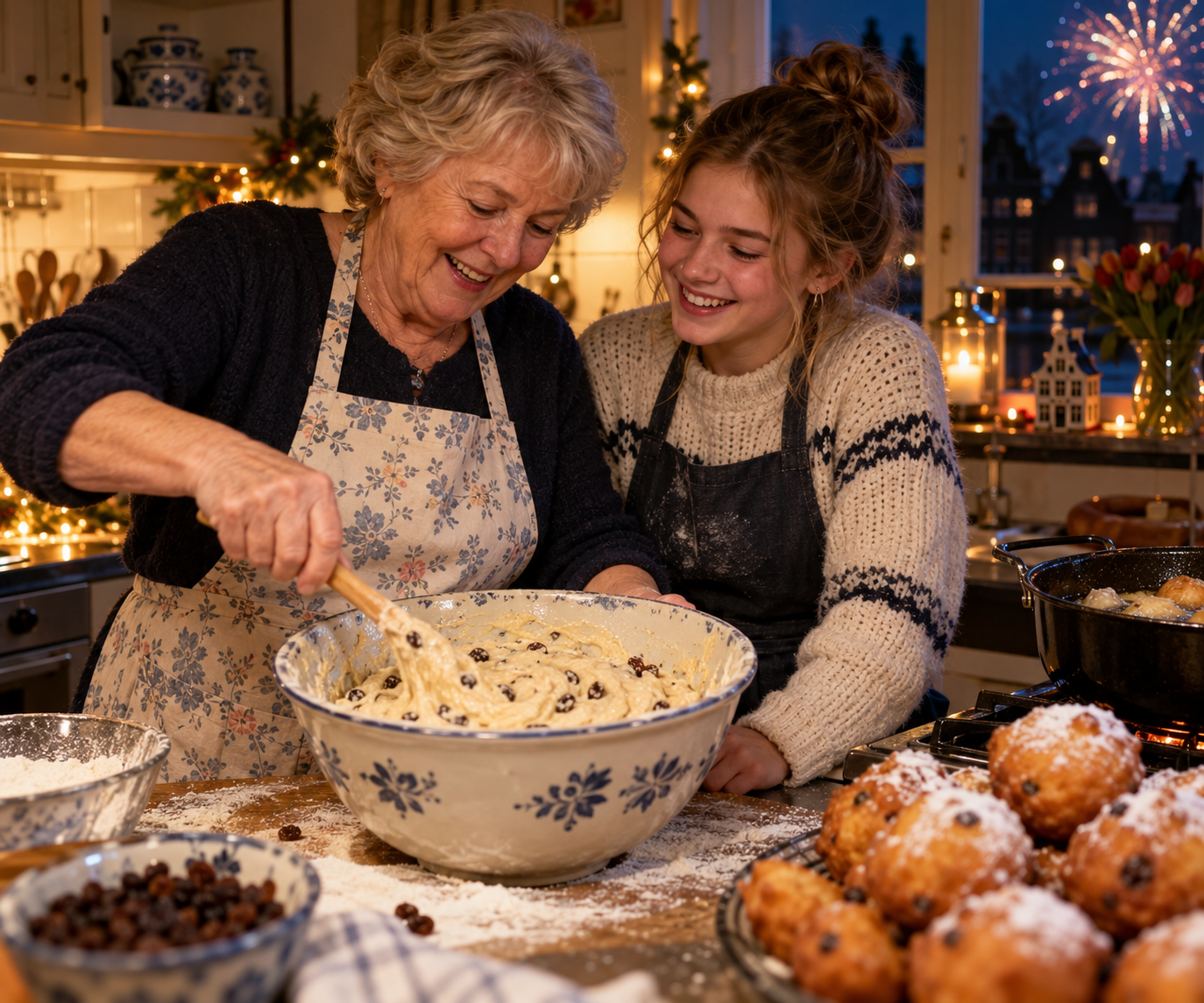
While you can find oliebollen through the winter, their true home is Oudjaarsavond, New Year’s Eve, the thirty-first of December. This is the night they are eaten in earnest, by families gathered at home to see the old year out.
The ritual is a cozy one. Oliebollen are fried or bought in quantity, piled high and dusted with sugar, and eaten through the evening, often alongside a glass of champagne or prosecco as midnight approaches. They are comfort food and celebration food at once, the sweet, warm, slightly indulgent heart of a Dutch New Year’s Eve.
There is something fitting about ending the year with them, too. A food that is best shared, made in a big batch, and eaten warm with the people closest to you is exactly the right note on which to see out one year and welcome in the next.
For Dutch people, the taste is woven through with nostalgia. Oliebollen are a childhood memory, a family tradition, the flavor of countless New Year’s Eves stretching back through the generations, and eating them is as much about remembering as it is about the treat itself.
The Doughnut’s Ancestor
Here is a lovely piece of history that connects this Dutch tradition to breakfast tables across America. Oliebollen are widely considered to be an ancestor of the modern American doughnut.
The story goes that Dutch settlers carried their oil-fried dough balls across the Atlantic to the New World, to the colony of New Amsterdam that would become New York. There, over time, the Dutch oliebol is thought to have evolved into the doughnut that America took to its heart and made its own.
So the next time you eat an American doughnut, there is a good chance you are tasting a distant descendant of the Dutch oliebol. The humble New Year’s oil ball of the Netherlands may well be the grandparent of one of the most famous foods in the world.
That is not a bad legacy for a sugar-dusted ball of fried dough. It is also a reminder of how much of American food came over on ships with the immigrants who built the country, carrying their winter traditions with them.
A New Year’s Eve Institution
Oliebollen are not just a treat in the Netherlands; they are practically a required part of seeing out the year, as fixed a feature of Dutch New Year’s Eve as fireworks and champagne. On the thirty-first of December, the whole country seems to be frying, buying, and eating them.
The scene is a particular one. Families gather at home for the long evening, and oliebollen are there throughout, fried fresh in home kitchens or carried in by the bagful from the street stalls, piled high and dusted with sugar. As midnight approaches and the fireworks begin, there is usually a plate of them within reach, the sweet, warm counterpoint to the cold night and the noise outside.
The tradition is so ingrained that the weeks before New Year become a kind of oliebollen season all their own, with stalls appearing everywhere and informal debates breaking out over which one fries the best. For a Dutch person abroad, the absence of oliebollen can be one of the sharpest pangs of homesickness as the year turns, which is exactly why so many of them learn to fry their own wherever in the world they end up.
Making them at home turns out to be half the pleasure. Frying your own oliebollen on New Year’s Eve, the kitchen warm and smelling of hot oil and sugar, the first ones eaten too hot straight from the pan, is a cozy ritual in itself. It is messy and indulgent and entirely in keeping with the spirit of the night, which is about comfort and togetherness as the old year runs out.
However you make them, the golden rule is to eat them fresh. An oliebol is at its glorious best within minutes of leaving the oil, when the outside still crackles and the inside is soft and warm; left to sit, it loses much of its magic. So fry them in batches, dust them in sugar, and eat them straight away, hot from the pan, which is exactly how the Dutch have always done it as the year counts down to midnight. Serve them with a glass of something fizzy, let the sugar go everywhere, and you have brought a genuine piece of a Dutch New Year’s Eve to wherever you happen to be seeing out the year.
Make It: Oliebollen

Here is a traditional version with raisins, making about twenty. The key is a wet, sticky batter rather than a stiff dough, which is what gives the light, airy inside; resist the urge to add more flour.
Ingredients
- 2 cups (250g) plain flour
- 1 packet (about 7g) instant yeast
- 1 tablespoon sugar
- 1/2 teaspoon salt
- 1 cup (250ml) lukewarm milk
- 1 egg
- 3/4 cup raisins (and/or currants)
- zest of half a lemon, optional
- oil, for deep frying
- powdered (icing) sugar, for dusting
Instructions
- If using raisins, soak them in warm water for about 15 minutes, then drain.
- In a large bowl, mix the flour, yeast, sugar, and salt. Add the egg and the lukewarm milk and stir into a smooth, thick, sticky batter. Do not add extra flour; the batter should be wet.
- Fold in the drained raisins and the lemon zest. Cover the bowl and let the batter rise in a warm place until doubled and bubbly, about an hour.
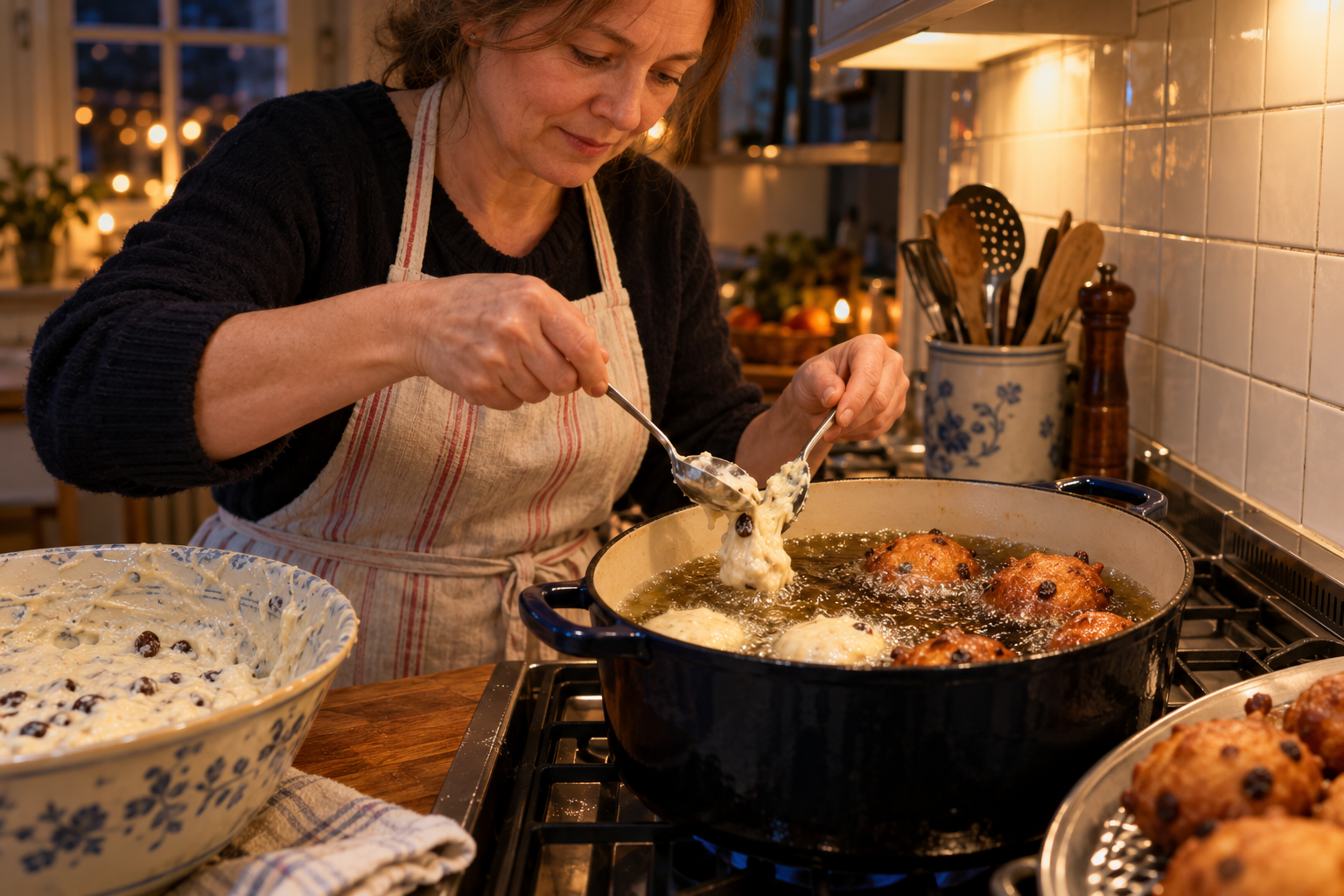
- Heat a deep pot of oil to about 170 degrees Celsius (340 Fahrenheit). Using two spoons or an ice-cream scoop, scoop balls of batter and carefully drop them into the hot oil, a few at a time.
- Fry, turning as needed, until the oliebollen are deep golden brown all over and cooked through, about 5 to 7 minutes. Lift them out and drain on paper towels.
- Dust the warm oliebollen generously with powdered sugar and serve straight away, ideally with a glass of something fizzy as the year turns.

About the Author: Ruben, co-founder of Gamintraveler.com since 2014, is a seasoned traveler from Spain who has explored over 100 countries since 2009. Known for his extensive travel adventures across South America, Europe, the US, Australia, New Zealand, Asia, and Africa, Ruben combines his passion for adventurous yet sustainable living with his love for cycling, highlighted by his remarkable 5-month bicycle journey from Spain to Norway. He currently resides in Spain, where he continues sharing his travel experiences with his partner, Rachel, and their son, Han.