
In Sicily, on a hot July morning, breakfast is a cup of ice and a soft sweet bun. This is not a treat or an indulgence to feel guilty about. It is simply how the island eats when the heat arrives, a bowl of granita and a brioche taken at a café table or standing at a bar, and it is one of the most civilized breakfasts anywhere in the world. You tear off a piece of the warm, eggy bun, dip it into the cold, granular ice, and eat the two together while the morning is still bearable.
Granita is a semi-frozen ice, somewhere between a sorbet and a slush, made from water and sugar carrying a single strong flavor, then frozen slowly and scraped into crystals. It is refreshing in a way a rich dessert never is, and in the Sicilian summer it does double duty as both a breakfast and a way to survive the heat, eaten at all hours from morning coffee to the passeggiata at dusk.
Here is what granita really is, how to make it at home with nothing more than a pan and a fork, and how to eat it the way Sicilians do, with a brioche, for breakfast, in the middle of July.
What Granita Really Is
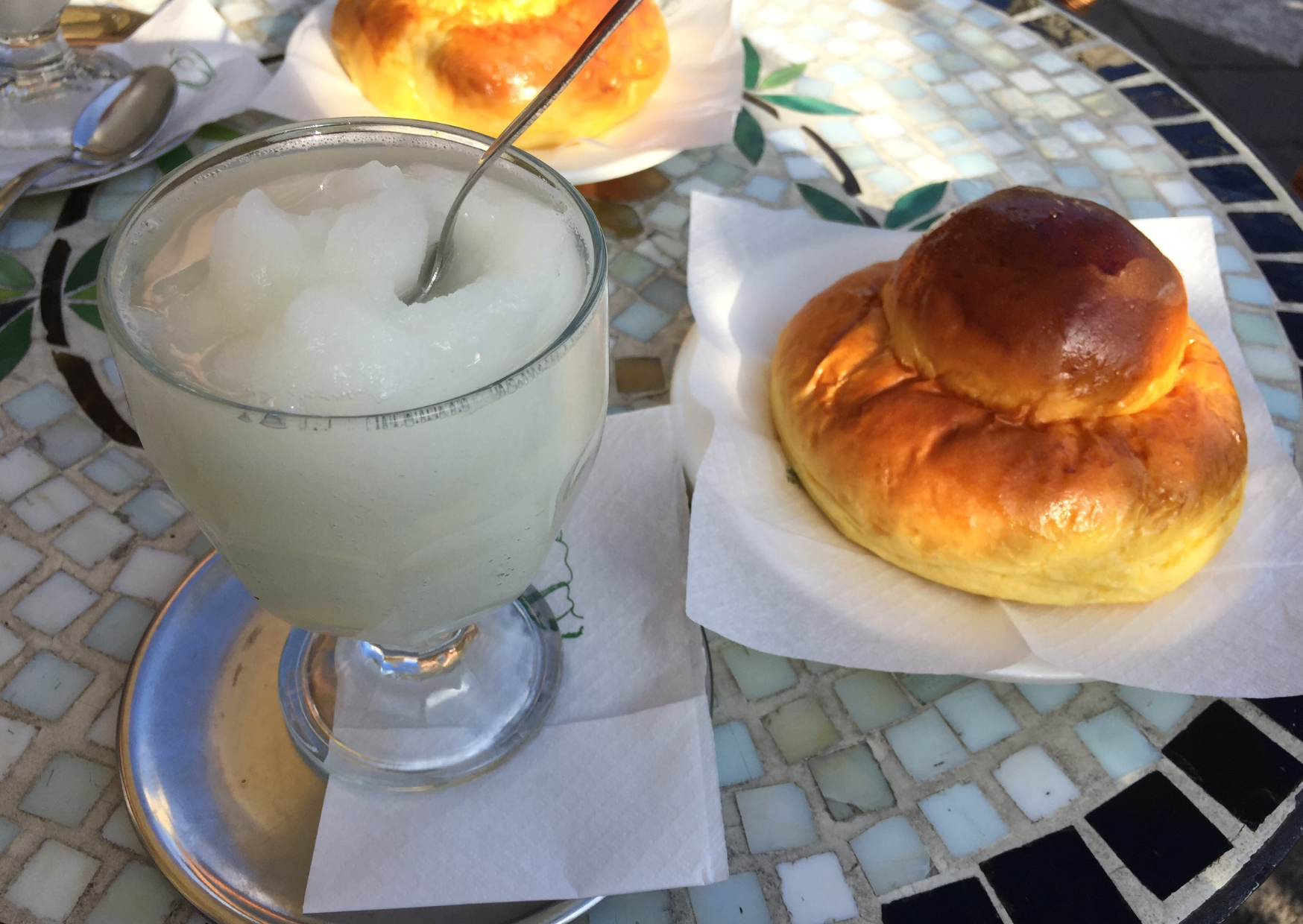
Granita is defined by its texture, which is the whole point and the thing most imitations miss. It is not a smooth sorbet and it is not a machine-blitzed slushie. It is a loose mass of small, distinct ice crystals, granular and crunchy on the tongue, that you eat with a spoon and that melts almost the moment it reaches your mouth. The name comes from grana, meaning grain, after exactly that crystalline texture.
The crystals are made, not frozen solid. A flavored, sweetened liquid is put into the freezer and then broken up repeatedly as it freezes, so that instead of setting into a single hard block it forms countless tiny ice grains held loosely together. That repeated breaking-up is the entire technique, and it is why granita has a texture nothing else quite matches, cold and crunchy and yielding at once.
There is a real regional divide in how coarse those crystals should be. In eastern Sicily, around Catania and Messina, granita runs coarser and icier, closer to true crystals. In the west, around Palermo, it is made smoother and denser, nearer to a sorbet. Neither is more correct than the other, and Sicilians from the two ends of the island will defend their own version cheerfully, but the eastern, grainier style is the one most people picture when they think of granita.
What granita is not is the sugary slushie sold from a machine at a fairground, and the difference is worth insisting on. That drink is spun smooth and cloyingly sweet, built on syrup and artificial flavor. Real granita is made from actual coffee, actual lemons, actual almonds, lightly sweetened so the flavor leads, and its crystals are formed by hand and patience rather than by a paddle. They share a temperature and almost nothing else.
The Flavors
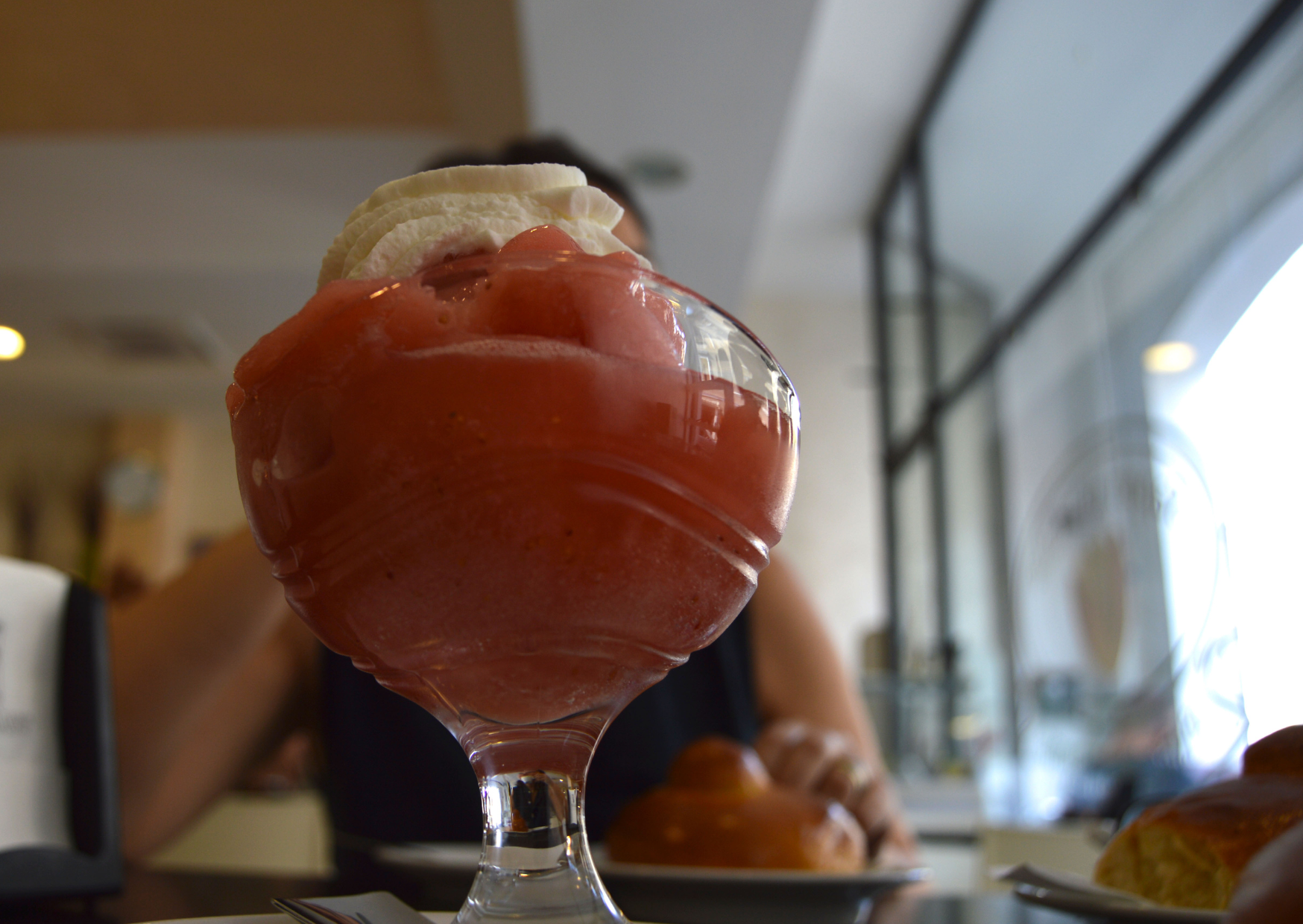
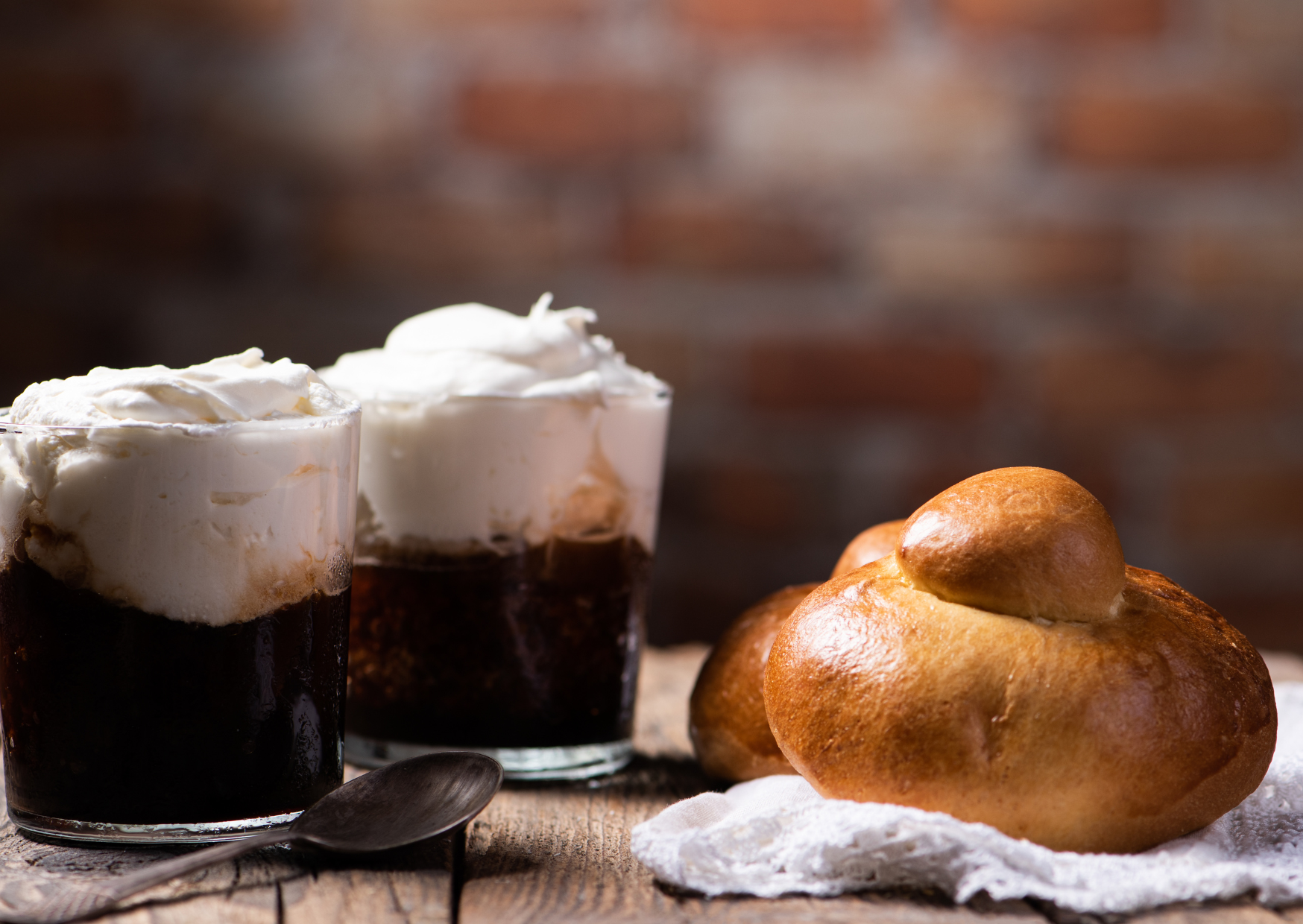
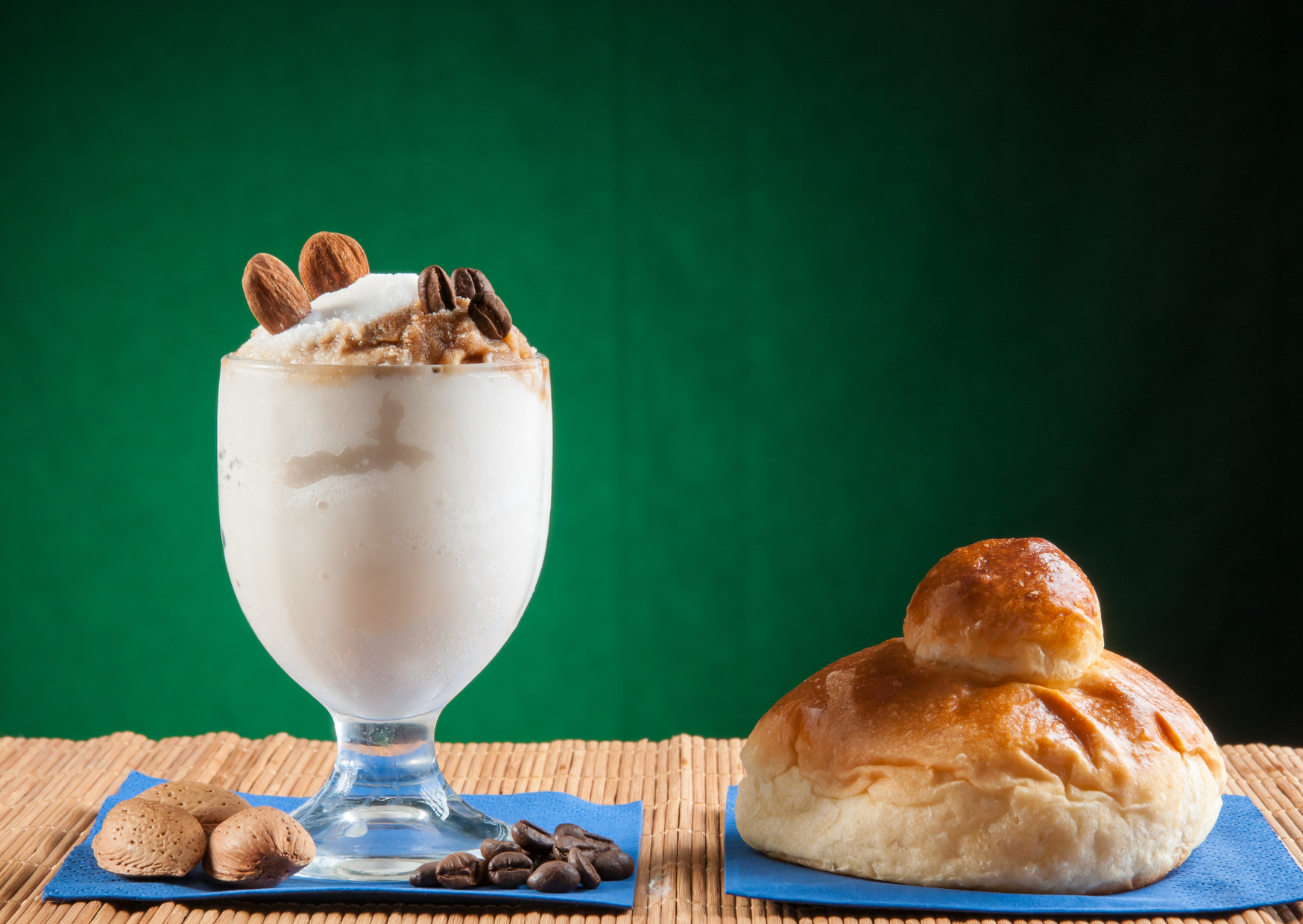
The classic granita flavors are a short, iconic list, and each is tied to real Sicilian ingredients rather than to a syrup bottle. Caffè, coffee granita, is perhaps the most beloved, made from strong espresso and eaten for breakfast with the brioche, often crowned with a spoonful of unsweetened whipped cream. It is coffee and ice and nothing else, and on a hot morning it is close to perfect.
Limone, lemon granita, is the brightest and most refreshing, made from the juice of Sicily’s famous lemons cut with water and a little sugar, sharp and clean and reviving in the heat. Mandorla, almond granita, is the soft, milky, faintly floral one, made from latte di mandorla, almond milk pressed from local almonds, and it is many Sicilians’ idea of the finest of all. Between coffee, lemon, and almond you have the holy trinity of Sicilian granita, the three you will find in every café on the island.
Beyond the classics lie the treasures. Gelso, mulberry granita, deep purple and intensely fruity, is a seasonal jewel made when the mulberries ripen. Pistacchio, made from the prized green pistachios of Bronte on the slopes of Etna, is rich and nutty and unmistakable. There are strawberry and mandarin and jasmine versions, and almost any fruit or nut Sicily grows well can become a granita. But start with lemon, coffee, or almond, because those are the soul of the thing.
The seasonal ones are worth chasing when they surface. Mulberry granita lasts only as long as the mulberries do, a few short weeks in early summer, and in parts of the island you will find a jasmine granita, gelsomino, delicately floral and unlike anything else, or a granita of fresh figs or watermelon at the very peak of their season. Granita follows the Sicilian harvest as faithfully as any dish on the island, which is part of why it tastes so completely of the moment you eat it in.
How to Make It
Making granita at home needs no special equipment, only a shallow metal pan, a fork, and a couple of hours during which you visit the freezer now and then. The principle is identical for every flavor: make a flavored, lightly sweetened liquid, freeze it in a shallow layer, and scrape it with a fork as it freezes to build the crystals.
Take lemon granita as the model, because it is the simplest and the most forgiving. Stir together roughly five hundred milliliters of water, a hundred and fifty grams of sugar, and the juice of several lemons, tasting as you go, since it should be bright and only lightly sweet, a touch sharper than you think, because freezing dulls both sweetness and acidity. Pour this into a wide, shallow metal pan, which freezes faster and more evenly than a deep one, and slide it into the freezer.
Now the ritual begins. After about thirty minutes, when the edges have started to freeze, drag a fork through the whole pan, breaking the forming ice into the liquid. Return it to the freezer, and repeat every twenty to thirty minutes, scraping and stirring the crystals each time, for around two to three hours, until the entire pan is a bed of loose, glittering, granular ice with no liquid left. That is granita. The scraping is the work, and skipping it gives you a solid block instead of crystals, so the fork visits are not optional.
The other flavors follow the same path with a different base. For coffee granita, use strong, sweetened espresso in place of the lemon mixture. For almond, use almond milk sweetened to taste. In each case the rule holds: a shallow pan, a lightly sweetened flavorful liquid, and a fork through it every half hour until it is all crystals. Serve it at once, because granita waits for no one and turns to soup within minutes of leaving the freezer.
Lemon Granita
Serves 4
Ingredients:
- 500ml water
- 150g sugar
- 150ml fresh lemon juice (about 4 lemons)
Method:
- Stir the water and sugar together until the sugar dissolves, then mix in the lemon juice. It should taste bright and only lightly sweet, since freezing dulls both.
- Pour into a wide, shallow metal pan and slide it into the freezer.
- After about 30 minutes, when the edges have begun to freeze, drag a fork through the whole pan to break up the ice.
- Return it to the freezer and repeat every 20 to 30 minutes, scraping each time, for 2 to 3 hours, until the whole pan is a bed of loose, granular crystals.
- Serve at once in chilled glasses, with a brioche col tuppo alongside if you like.
For coffee granita, replace the lemon mixture with strong, sweetened espresso. For almond granita, use almond milk sweetened to taste. The method is identical in both cases.
Getting the Texture Right
The one real skill in granita is managing the crystals, and a few small adjustments fix almost any problem. If your granita freezes into a solid block, you scraped it too rarely, and the cure is simply more frequent visits, every fifteen or twenty minutes rather than every thirty, especially near the end when it sets fastest. If it stays slushy and never firms up, the freezer may be too warm or the pan too deep, so turn the freezer down and reach for the widest, shallowest metal pan you own, since a thin layer freezes far more evenly than a deep one.
The sugar matters more than it looks. Too little and the granita freezes rock hard, because sugar is what keeps the crystals from locking into one solid mass. Too much and it never freezes properly, staying syrupy and slack. The target is a lightly sweet liquid, sweeter than you would want to drink but never cloying, and it pays to taste the mix before it goes in, remembering that cold mutes sweetness, so it should taste a shade too sweet at room temperature.
A granita machine or an ice-cream maker will do the churning for you and gives a smoother, more uniform result, closer to the western Palermo style. But the fork-and-pan method is the traditional one, it needs no equipment at all, and it produces the coarser, more crystalline texture of the east that many people prefer. For a first attempt the fork is all you need, and there is real satisfaction in building the crystals by hand.
Serve granita the instant it is ready, in a chilled glass or cup, because it has no patience whatsoever. Within a few minutes out of the freezer it starts to melt and slump back toward a drink, which is why Sicilian cafés make it fresh through the day and serve it fast. If you have to hold it, keep it in the freezer and give it a brisk scrape to loosen the crystals again just before it goes to the table.
The Brioche and the Breakfast
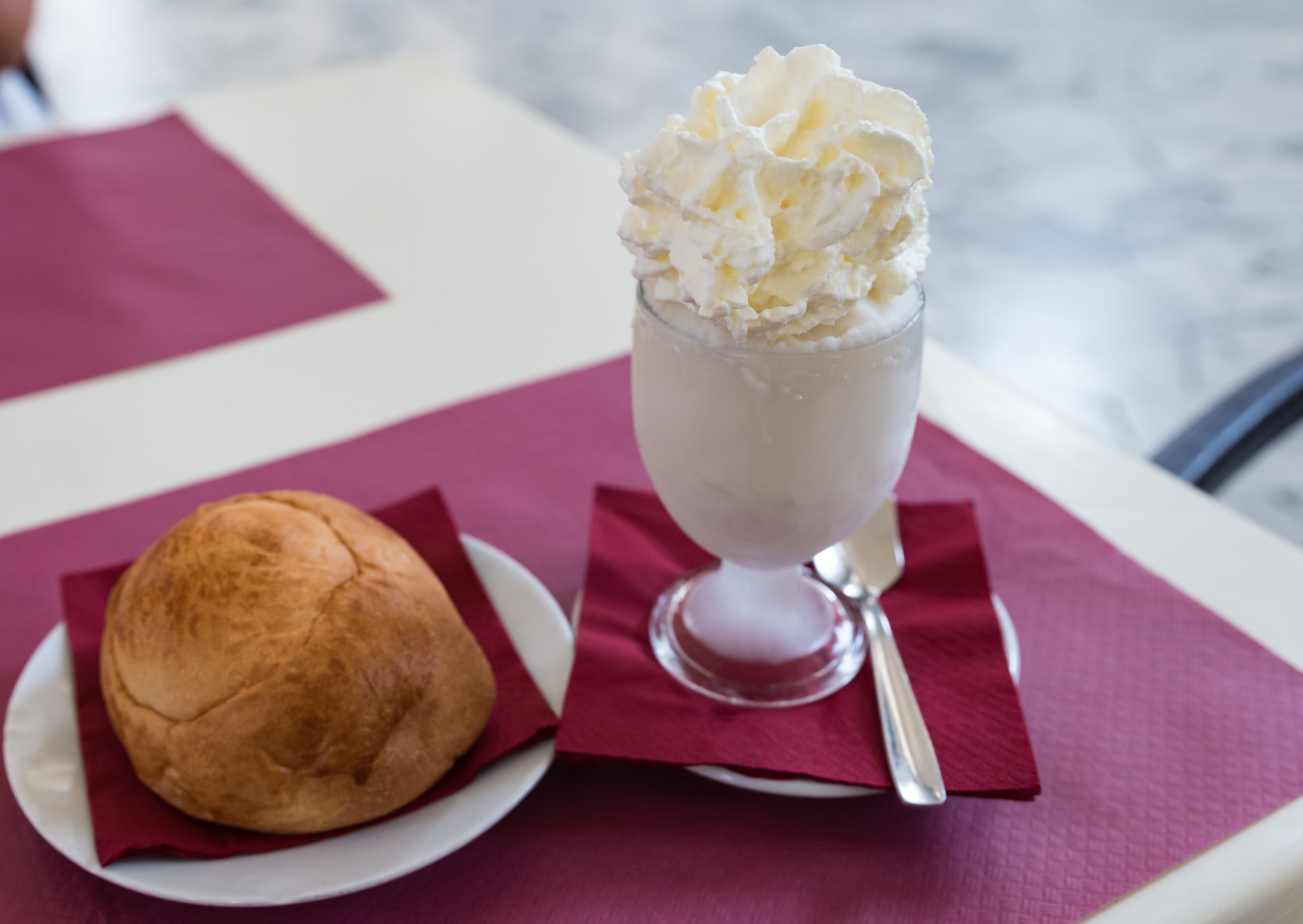
To eat granita the Sicilian way, you need the brioche col tuppo, and the two are inseparable in summer. This is a soft, round, enriched bun with a little topknot of dough on top, the tuppo, named for the old-fashioned bun of hair it resembles. It is light and slightly sweet and faintly citrus-scented, and it exists, in the Sicilian summer, largely to be eaten with granita.
The method is the pleasure. You take the brioche, tear or bite off pieces, and dip them into the granita, or spoon the granita on and eat them together, so that each mouthful is warm soft bread and cold sharp ice at once. Some people split the bun and fill it with the granita like a sandwich. Others eat the granita with a spoon and the brioche alongside, breaking off bites between spoonfuls. There is no wrong method, only the constant of bread and ice together.
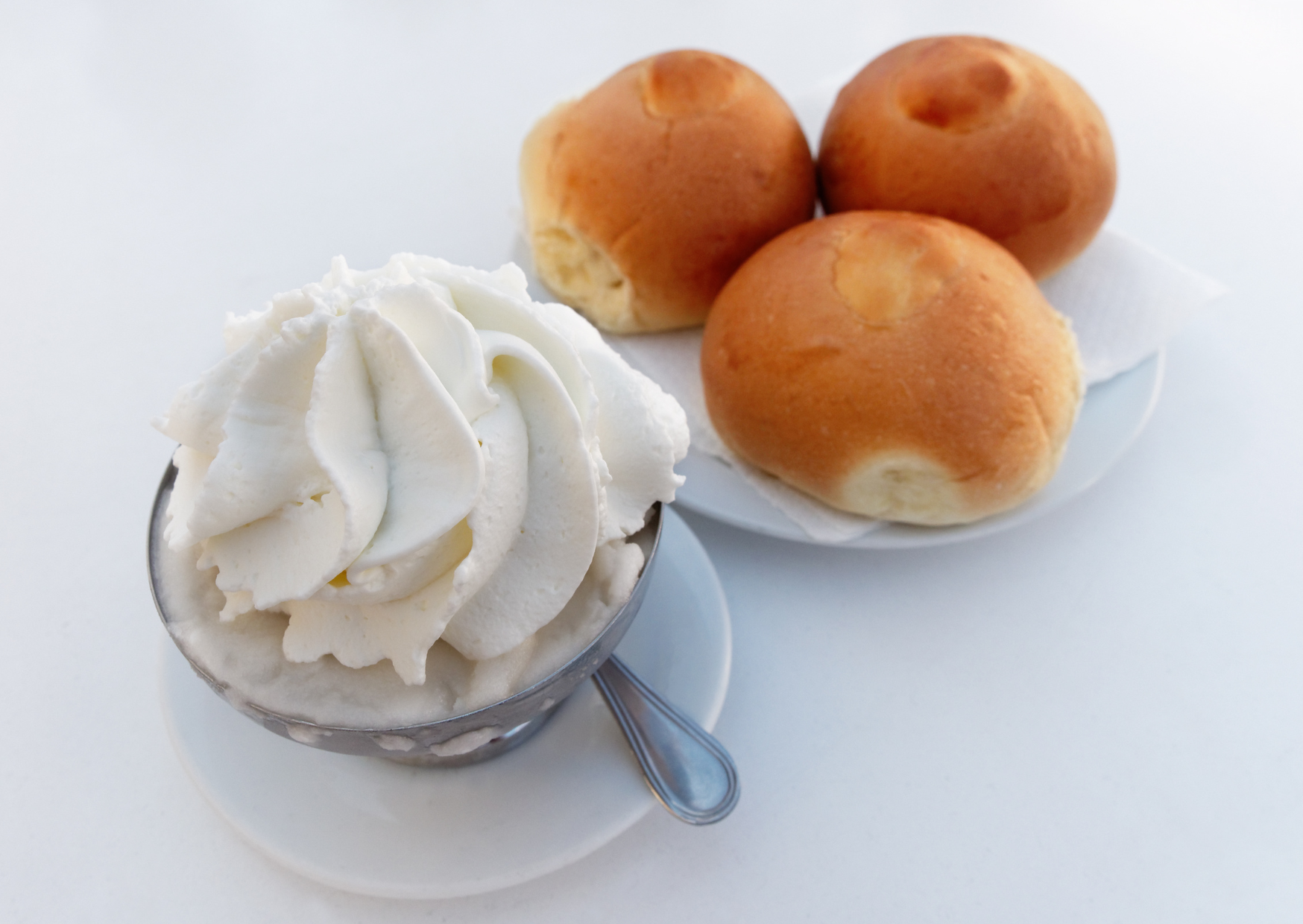
This is genuinely breakfast, not dessert, and that is the part outsiders find hardest to believe. Across eastern Sicily especially, through the hot months, people start the day with a coffee or almond granita and a brioche, at the café on the way to work or at a table watching the town wake up. It is cooling, it is filling enough, and it turns the miserable business of eating in the heat into one of the small glories of a Sicilian summer. If you want a spoonful of panna, lightly sweetened whipped cream, on your coffee granita, no one will stop you, and many would insist. In a Sicilian café in July the same scene repeats all morning. People stop at the bar, order a granita and a brioche, and eat standing or at a small outdoor table, unhurried, before the day’s heat arrives in full. It is fast food in the most literal sense, quick and cheap and eaten on the move, and yet it is nothing at all like fast food in spirit, being fresh and simple and tied to the season and the place.
Ice From the Mountain
Granita is old, far older than the freezer, and its story runs straight up the side of a volcano. Its ancestor is the flavored iced drink the Arabs brought to Sicily more than a thousand years ago, the sharbat that gives us the word sorbet, sweetened water chilled with snow and ice. Sicily, with its long Arab period and its convenient mountain, took to it completely.
The mountain is Etna, the great volcano that dominates eastern Sicily, and its snow was the original secret. Through the winter, snow and ice collected in caves and pits high on Etna and on the other mountains, packed down and insulated with ash and straw, and it kept, astonishingly, deep into the summer. A trade grew up around it, run by men called the nivaroli, the snow-men, who harvested the mountain ice and carried it down to the towns to be shaved and sweetened and flavored into the earliest granita.
That is the deep history behind the cup of coffee ice you eat for breakfast: a volcano, a thousand-year-old Arab drink, and centuries of men hauling snow down a mountainside so that Sicilians could have something cold in the heat. The freezer has replaced the nivaroli, but the thing itself, sweetened ice scraped into crystals and eaten cold in the summer, has barely changed at all.
Make It, and Eat It for Breakfast
The practical lesson is that granita is one of the easiest and most rewarding things you can make in a hot kitchen, needing no machine and no skill beyond the patience to visit the freezer with a fork a few times. Start with lemon, which is nearly foolproof, then try coffee, then almond, and you will have the heart of the Sicilian repertoire in an afternoon.
And when you make it, eat it the way the island does. Make a batch the night before or early in the morning, buy or bake a soft brioche, and have the two together for breakfast on the hottest day of the year, out on a balcony or by an open window while the heat gathers. It sounds strange to anyone who has not done it, and it makes perfect sense the moment you have. There is a reason it has outlasted a thousand years and every kitchen gadget invented since. Granita solves a real problem, how to enjoy the day when the heat makes everything else unbearable, and it solves it with almost nothing, a little sugar and fruit and ice and the patience to drag a fork through a pan. Few dishes give back so much for so little effort.
That is the real gift of Sicilian granita, beyond how good it tastes. It is a whole way of meeting the summer, of turning the worst of the heat into a pleasure rather than an ordeal, worked out over a thousand years on an island that knows more about surviving July than almost anywhere. Make it, dip your brioche, and you are eating breakfast the way Sicily has taught itself to, one cold, crunching, sunlit spoonful at a time.

About the Author: Ruben, co-founder of Gamintraveler.com since 2014, is a seasoned traveler from Spain who has explored over 100 countries since 2009. Known for his extensive travel adventures across South America, Europe, the US, Australia, New Zealand, Asia, and Africa, Ruben combines his passion for adventurous yet sustainable living with his love for cycling, highlighted by his remarkable 5-month bicycle journey from Spain to Norway. He currently resides in Spain, where he continues sharing his travel experiences with his partner, Rachel, and their son, Han.