
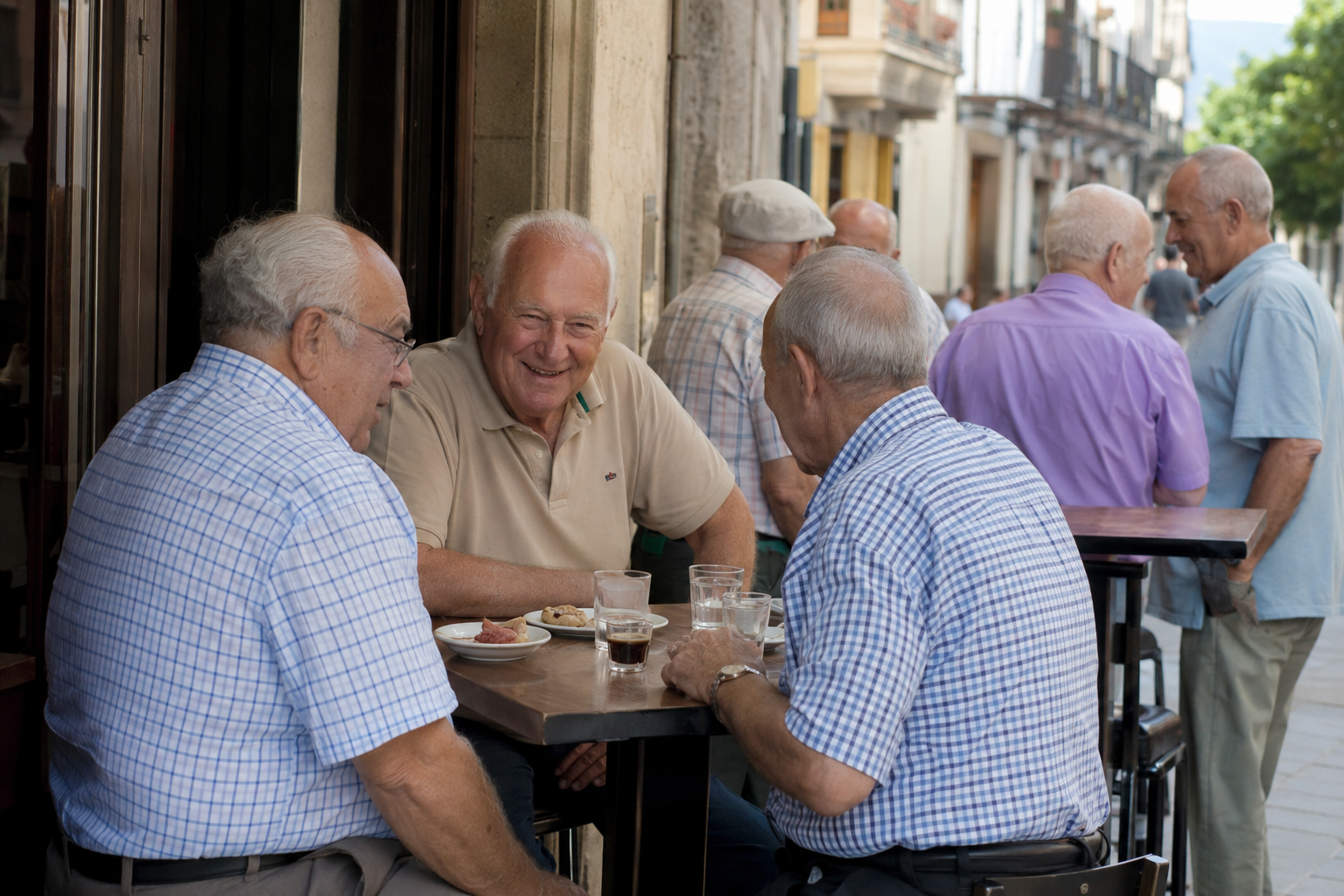
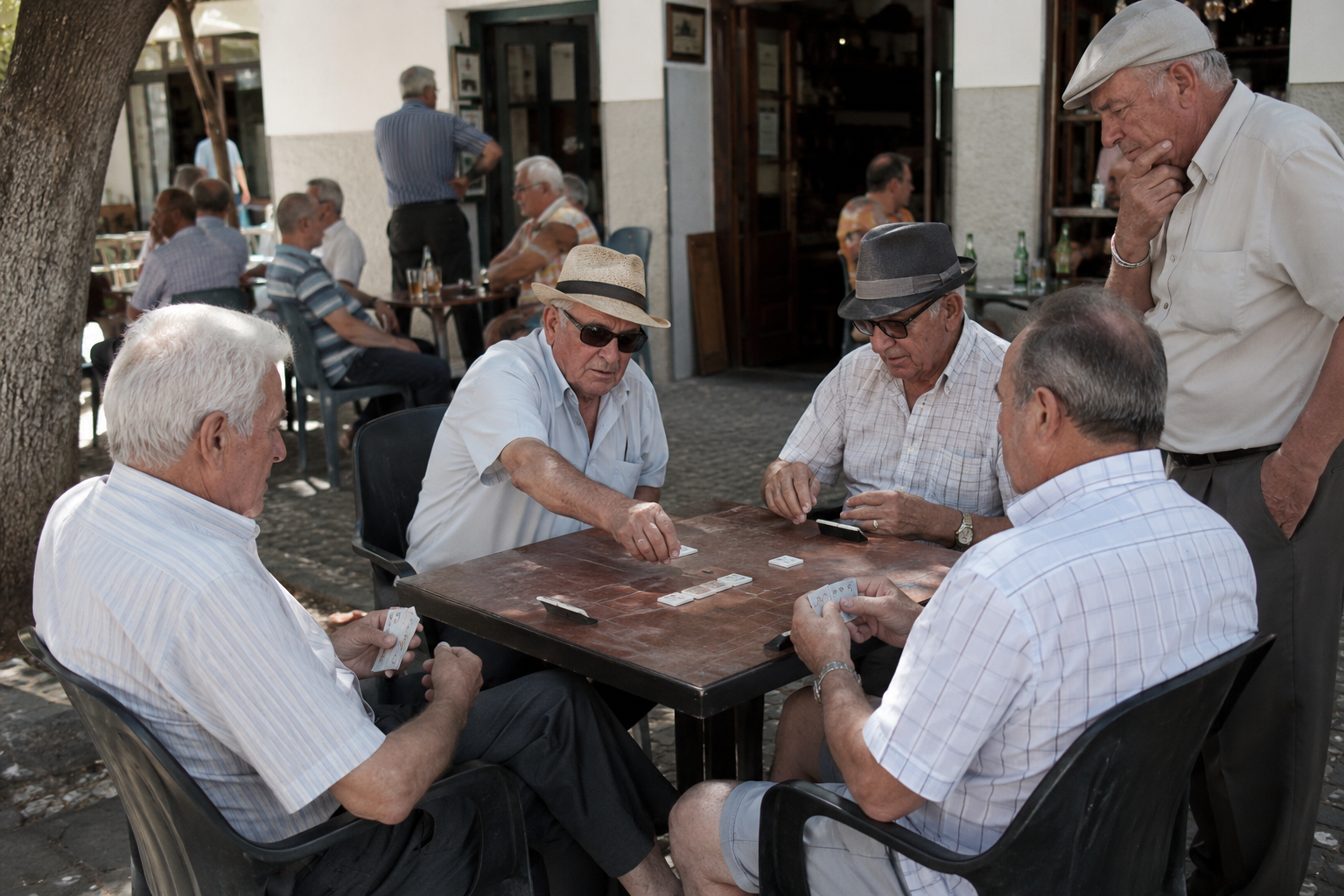
Look into any neighborhood bar in Spain on a weekday morning and you will find them. Men in their seventies and eighties, settled at the counter or a small table, nursing a coffee or a small beer, arguing over the newspaper, slapping down dominoes, greeting everyone who walks in by name. They will be there again in the evening. To an American eye it can look like a portrait of idleness, and yet these are some of the longest-living men on earth.
Spanish men live years longer than American men, and the daily bar is not a sign of a wasted retirement but a window into why. What looks like sitting around doing nothing is, on closer inspection, one of the healthiest routines a person can keep, built on the ingredients that longevity research keeps pointing to. The bar is the visible tip of a whole way of growing old, and it is worth understanding what that routine really contains.
Here is the gap between Spanish and American men, what the daily bar really provides, and the routine behind one of the world’s great longevity stories. None of this is medical advice, and the alcohol in particular deserves a careful word, but the pattern is real.
The Gap Is Real
Start with the numbers, because they are striking. By recent United Nations figures, life expectancy for men in Spain is around 81 years, against roughly 77 years for men in the United States, a gap of about four to five years depending on the measure and the year. On some national figures, with American male life expectancy dragged down further in recent years, the gap has looked wider still.
Four or five years is an enormous difference between two wealthy countries, and it has been growing rather than shrinking. American life expectancy stagnated and then fell through parts of the last decade, hit by what researchers call deaths of despair, the overdoses, suicides and alcohol-related deaths that cluster among the isolated and the disconnected, alongside high rates of obesity and heart disease. The American losses are concentrated in exactly the areas the Spanish routine guards against. Isolation, a sedentary car-bound life, poor diet and the despair that follows disconnection are what drive the American numbers down, and they are precisely what the Spanish day, with its walking and its company and its structure, quietly holds at bay. The two countries can look almost like mirror images, one accidentally engineering isolation and the other accidentally engineering connection, and the gap in life expectancy is in large part the result of that difference.
Spain, meanwhile, has quietly climbed to the top of the global rankings, among the very longest-living nations on earth. It spends far less per person on healthcare than the United States does, which rules out the easy explanation that Spain simply buys more medicine. Something about the way Spanish men live, rather than the way they are treated when sick, is keeping them alive longer, and the daily bar is a clue to what it is. That distinction matters, because it means the advantage is not locked inside an expensive medical system that other countries cannot copy, but lives instead in ordinary daily habits, the kind anyone can in principle adopt, which is precisely what makes the Spanish example worth studying rather than simply envying.
The Bar Is Not About Drinking
The first thing to understand is that the Spanish neighborhood bar bears little resemblance to what the word suggests to an American. It is not a place people go to drink heavily. It is the social living room of the street, a cafe as much as a bar, where the coffee flows more than the wine and the main business is company.
A Spanish man’s visit to the bar is a ritual of connection rather than consumption. He might have a café con leche in the morning and a small caña of beer or a vermut before lunch, but these are slow, social and modest, taken over an hour or two of conversation, cards and the general life of the place. The drink is almost an excuse. The point is to be there, among people, part of the day’s flow.
This is a genuinely different institution from anything most Americans have, a public place where an older person is expected and welcome every single day, where they are known and greeted and drawn into the talk. To spend two hours there is not to waste the morning but to keep a standing appointment with one’s own community, and that appointment turns out to be a kind of medicine. The bar also crosses generations and classes in a way little in American life does. The retired laborer and the retired professor drink their coffee at the same counter, the young come in for a quick caña, and the old man is never shut away with only other old people, but stays folded into the ordinary mixed life of his street.
The Real Medicine Is Company
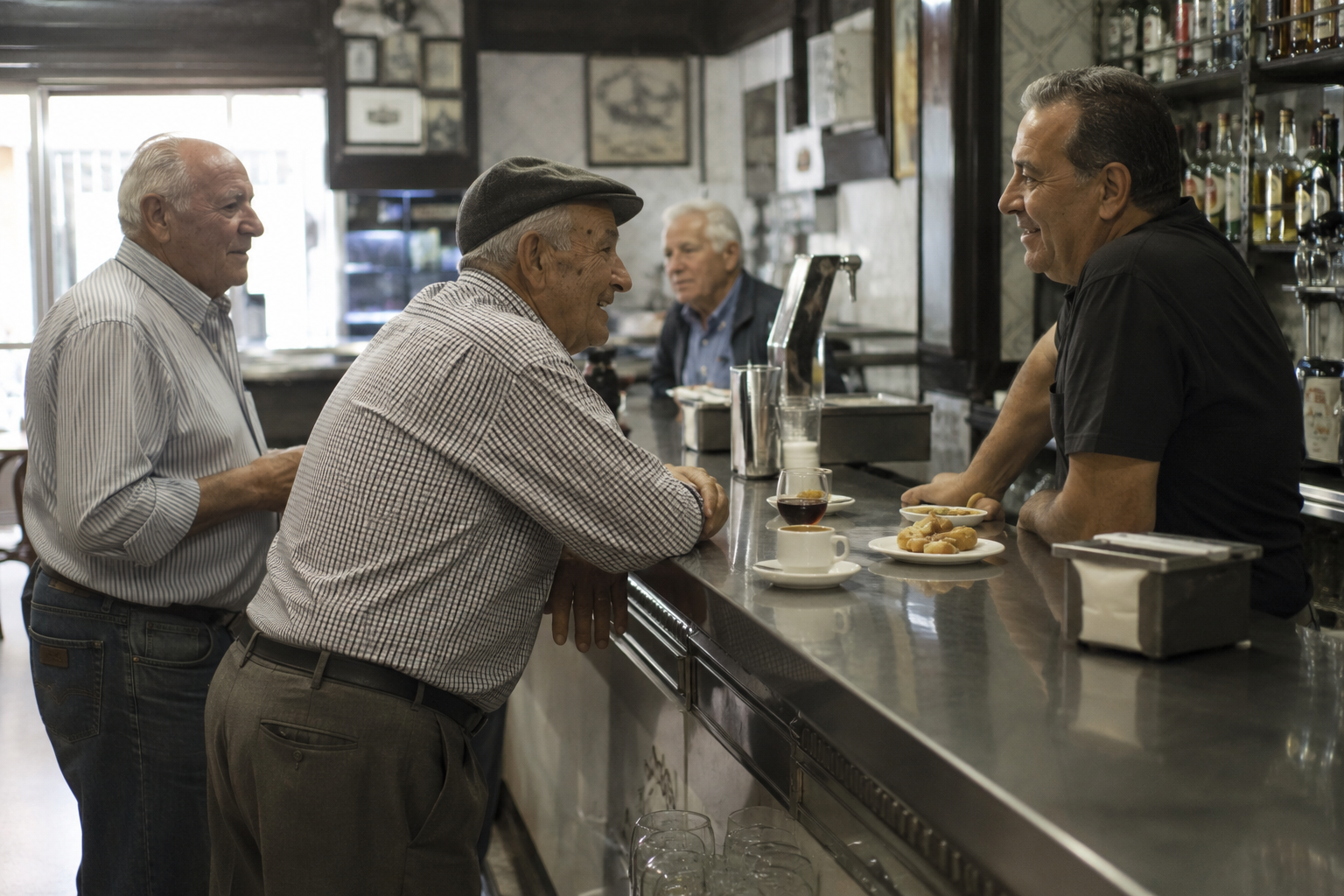
Of everything the bar provides, the most powerful is the one that costs nothing, which is daily human contact. Loneliness and social isolation are now understood to be among the most serious health risks there are, linked in study after study to higher rates of heart disease, dementia and early death, with an effect on mortality that researchers have compared to smoking. Connection is not a nicety. It is a biological necessity.
The Spanish bar delivers that connection automatically, every day, without anyone having to arrange it. An older man does not have to plan a social life or fight the drift into isolation, because his social life is structural, built into the geography of his street and the habit of a lifetime. He gets up, he goes to the bar, and he is instantly among people who know him.
This is exactly what tends to collapse in American retirement, where the end of work can mean the end of daily contact, and where an older man can go days speaking to almost no one. The Spanish routine solves that problem so completely that no one even names it as a problem, and in doing so it protects health in a way no pill can match. The company at the bar may quite literally be adding years to these men’s lives. What makes it so effective is that it asks nothing of willpower. In cultures without such places, staying connected in old age takes real and constant effort, phone calls to make and outings to plan, and that effort is exactly what tends to fail. The Spanish man simply walks downstairs into a social life that is already there and waiting.
A Life Lived on Foot
The bar is not just a destination but a reason to move, and movement is the second pillar of the routine. The Spanish man walks to the bar, and he walks home, and later he walks back, threading through a dense, walkable town where the shops, the church, the square, and the homes of friends are all a stroll away. His day is stitched together by short walks, and none of it feels like exercise.
There is also the paseo, the traditional evening stroll, when whole towns come out to walk slowly through the streets in the cool of the day, greeting neighbors and taking the air. It is social and gentle and universal, another daily ritual that happens to keep aging bodies moving. Between the walks to the bar and the evening paseo, a Spanish man covers a surprising amount of ground on foot without ever thinking of it as fitness.
This constant, low-level walking is precisely the kind of activity that research links to long, healthy lives, far more sustainable into old age than any gym routine. Compare it with the American pattern of driving everywhere, where an older person may barely walk at all in a day, and the contrast in built-in movement is stark. The Spanish town is a machine for keeping its old people on their feet. This is not vigorous exercise, and that is part of why it lasts. Hard workouts tend to fall away with age and injury, while a gentle walk to the bar and back is something a person can keep doing into their nineties. The movement is spread across the whole day in small doses rather than concentrated into one demanding session, which is closer to how the human body is built to move.
The Shape of the Day
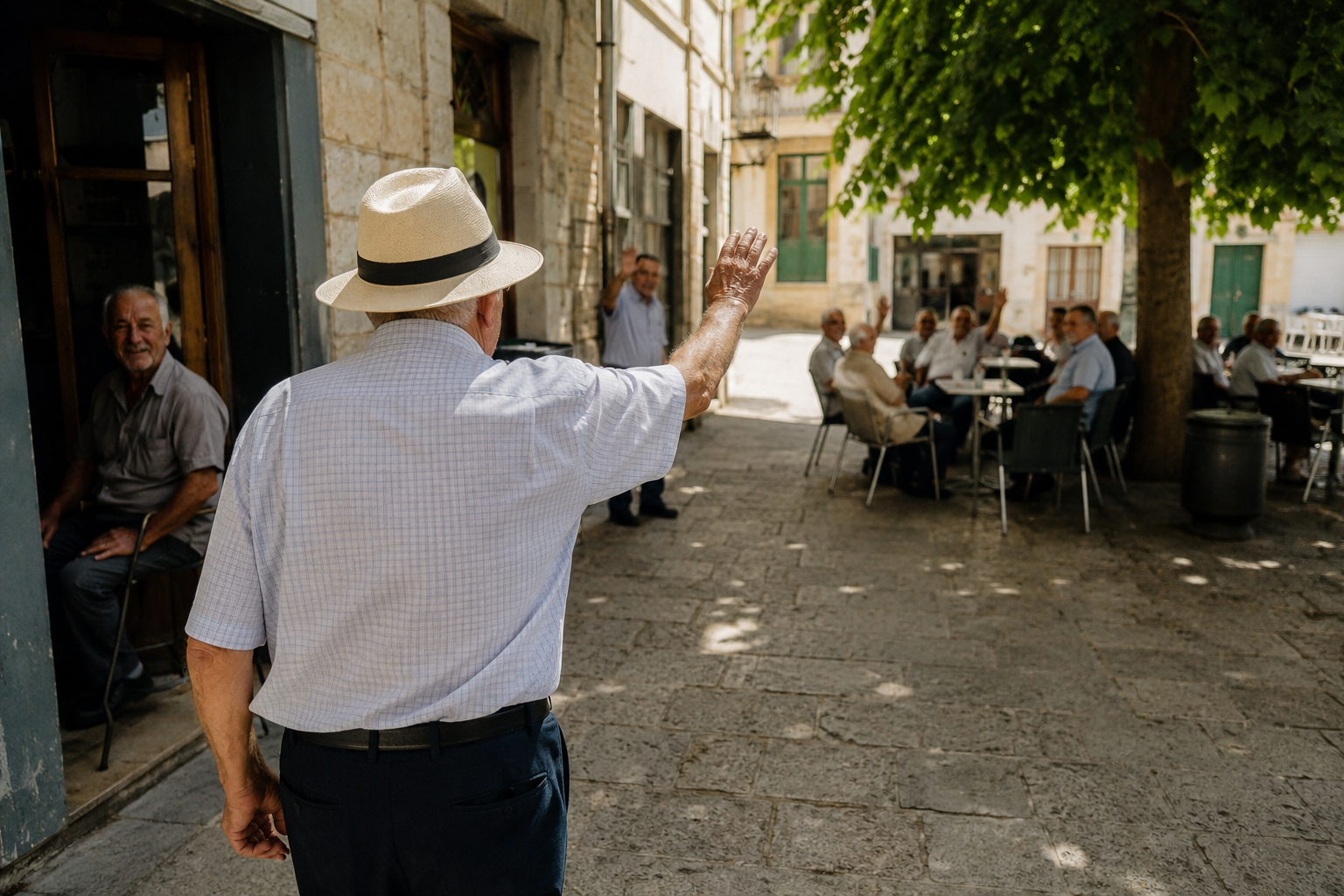
Beneath the individual habits lies something researchers increasingly value on its own, which is a day with structure. The Spanish man over seventy has a clear shape to his time, a set of fixed points that give the day rhythm and meaning long after work has ended. Morning brings the walk and the coffee at the bar. Midday brings the long lunch. The afternoon brings rest, and the evening brings the paseo and perhaps a return to the bar before a late dinner.
That structure matters more than it sounds. One of the quiet dangers of retirement is the loss of the framework that work once gave the day, and with it the loss of reasons to get up, get dressed and go out. Without those anchor points a person can drift into inactivity and isolation, and the decline that often follows is as much about lost structure as lost health.
The Spanish routine supplies that structure automatically, through culture rather than effort. Each day has its appointments and its rituals, its reasons to be up and out and among people, and that steady rhythm keeps an older person engaged with the world. There is always somewhere to be and someone to see, and the sense of a day worth showing up for is itself protective.
Purpose runs through all of it. These men remain part of their families and their neighborhoods, consulted and included, grandfathers and fixtures of the square rather than people quietly set aside. A life with daily structure, a clear place in a community, and the feeling of still mattering is exactly the kind of life that longevity research ties to aging well, and the Spanish day delivers it as a matter of course.
Wine, Food, and the Alcohol Question
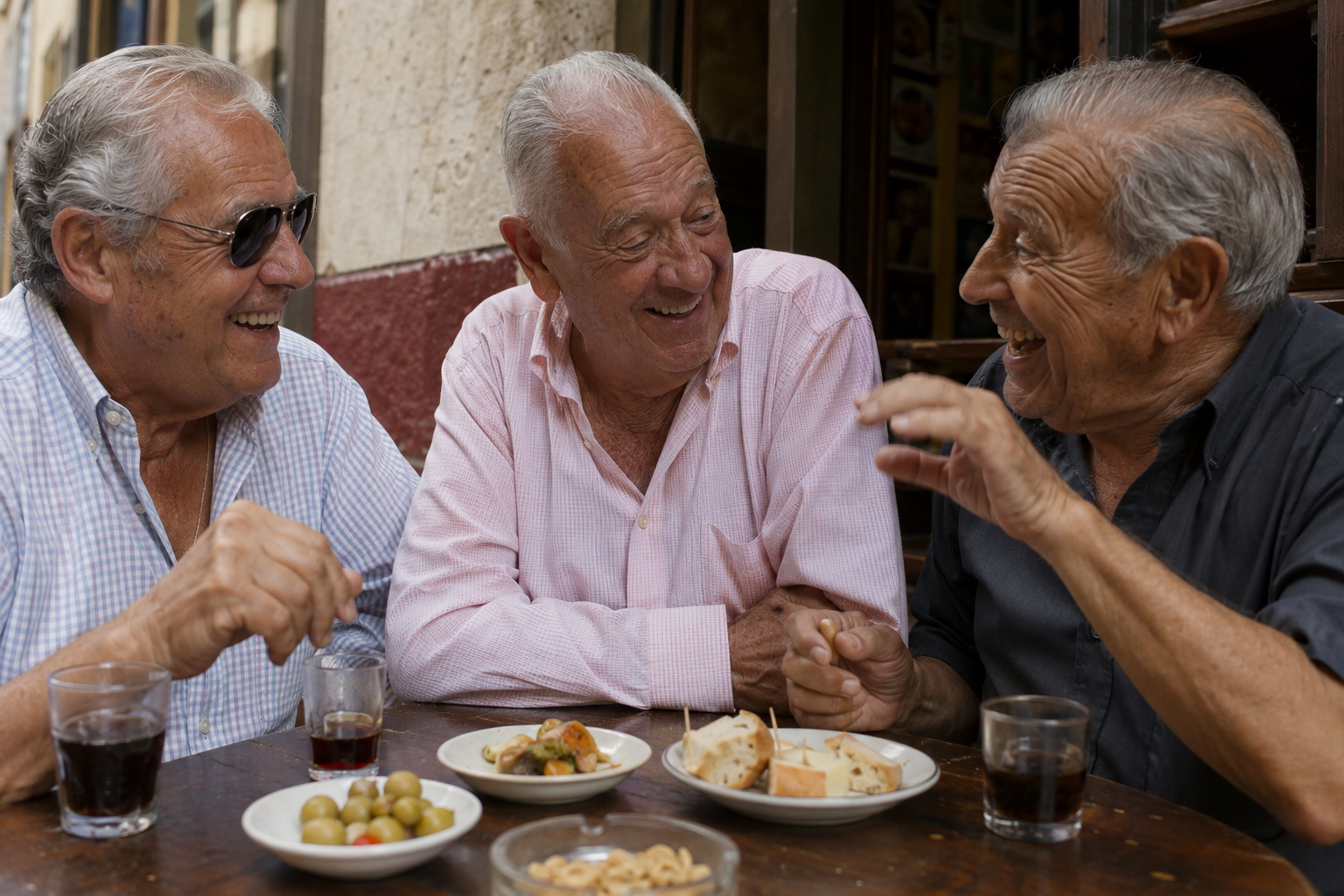
The food matters too, and it is worth being clear about the drink. The traditional Spanish diet is the Mediterranean one, rich in fish, olive oil, vegetables and legumes, often eaten as a proper sit-down menú del día at midday, and that pattern of eating is strongly associated with lower rates of heart disease and longer life. The long, shared lunch is itself a social and healthy ritual.
The alcohol is more complicated, and the honest position is that the benefit lies in the context, not the bottle. Spanish men who reach old age tend to drink modestly and almost always alongside food and company, a small beer or a glass of wine with a meal rather than heavy solitary drinking. Recent science has grown far more skeptical of the idea that alcohol itself extends life, and heavy drinking clearly shortens it. What protects these men is the social meal and the moderate, ritualized pattern, not the alcohol as such, and this is not a routine to copy by drinking more.
Read correctly, the lesson of the Spanish bar is emphatically not that drinking is healthy. It is that eating real food slowly, in company, at regular hours, and treating a drink as a small social accompaniment rather than a goal, fits into a way of living that supports a long life. The drink is incidental. The meal, the company, and the rhythm are the point. This is the part of the story most easily misread, and it is worth stating plainly. The healthiest older Spaniards are not heavy drinkers, and the drink is the least important thing at the table. Strip the alcohol away entirely and the long shared lunch, the fresh food and the daily company would still deliver most of the benefit, which tells you where the real value lies.
What America Gets Wrong About Retirement
Step back, and the Spanish routine exposes something painful about the American model of growing old. American retirement is too often a slide into isolation and inactivity, spent alone at home in a car-dependent place, cut off from daily contact and from the ordinary walking and structure that a working life once provided. The very design of American suburbs can make the Spanish routine almost impossible to reproduce. Zoning that separates homes from shops, a culture that treats driving as the only real way to get anywhere, and a housing pattern that scatters families across a continent all work against the dense, walkable, connected life the Spanish routine depends on. An American who wants to age this way often has to swim against the whole design of the place, deliberately choosing a walkable town, keeping a daily social habit and building structure into days that no longer come with any of their own. It can absolutely be done, but it takes real intention where the Spanish man simply inherits it from the street he lives on.
The Spanish man over seventy has, without planning it, assembled the exact combination that longevity researchers would prescribe: constant social connection, daily gentle movement, a Mediterranean diet, a strong sense of belonging, and a life with shape and purpose. He did not read the studies. He simply kept the habits of his culture, and those habits happen to be close to ideal.
That is the real routine behind the longevity, and the good news is that its ingredients travel even if the Spanish town does not. Build daily contact into your life, walk instead of drive where you can, eat real food slowly and in company, keep a shape to your days, and stay woven into a community, and you are borrowing the essence of what keeps these men alive so long. None of it guarantees anything, and genes and healthcare and luck all play their part, but the Spanish bar quietly holds one of the clearest lessons in healthy aging that exists, hiding in plain sight behind a cup of coffee. The men at that counter are not wasting their days at all, but doing, without ever quite knowing it, almost everything right.

About the Author: Ruben, co-founder of Gamintraveler.com since 2014, is a seasoned traveler from Spain who has explored over 100 countries since 2009. Known for his extensive travel adventures across South America, Europe, the US, Australia, New Zealand, Asia, and Africa, Ruben combines his passion for adventurous yet sustainable living with his love for cycling, highlighted by his remarkable 5-month bicycle journey from Spain to Norway. He currently resides in Spain, where he continues sharing his travel experiences with his partner, Rachel, and their son, Han.