
Picture a Japanese breakfast and you probably picture rice. A neat bowl of white rice, maybe some fish, a little pickle. It is the image the word conjures, and for most of Japan it is roughly right.
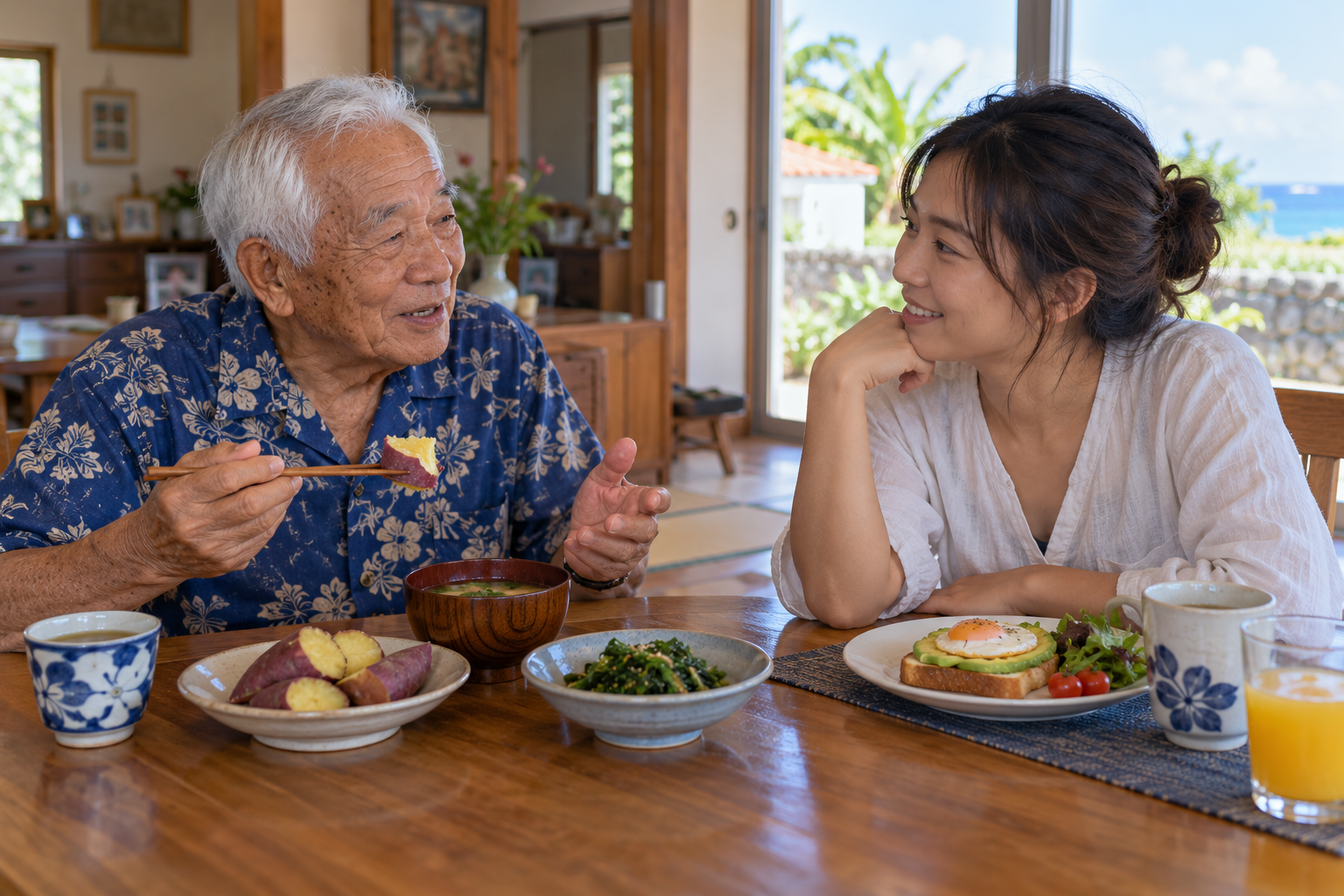
But on Okinawa, the string of subtropical islands at Japan’s southern edge and the home of some of the longest-lived people on earth, the traditional breakfast is not built on rice at all. The plate that fed the island’s famous old men and women for generations starts somewhere else entirely, with sweet potato, miso soup, vegetables, and tofu.
It is a warm, savory, plant-heavy plate, and an American man looking at it over his usual cereal or eggs might reasonably mistake it for dinner. Which is exactly the point, and part of why it is worth understanding. Here is what the Okinawan morning plate actually is, why it is not rice, the longevity story behind it, and how to build a version of it in your own kitchen.
Not Rice. Sweet Potato.
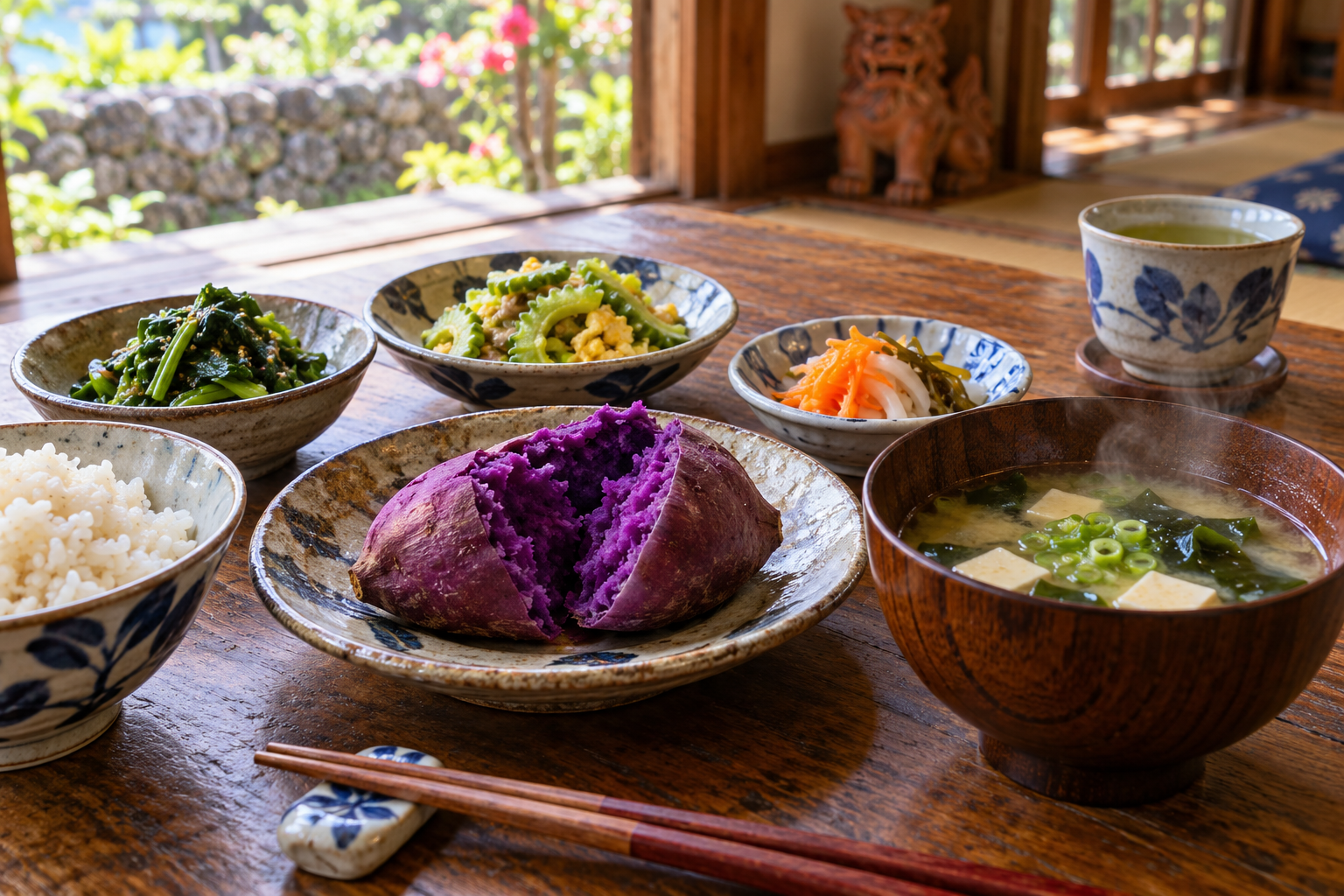
The single biggest surprise about the traditional Okinawan diet is that rice was never its foundation. Rice grew poorly on these islands, and from the 1600s onward it was supplanted by a crop far better suited to the subtropical climate and the two growing seasons: the sweet potato.
And not as a side dish, either. For centuries, the sweet potato was the staple, providing the overwhelming bulk of the islanders’ calories. Historical records suggest it once made up something like two-thirds or more of everything Okinawans ate, an almost unimaginable share for a single food. Where mainland Japan ran on rice, Okinawa ran on the sweet potato.
The variety matters, too. The famous Okinawan sweet potato, known as beni imo, comes in deep purple and orange, and that intense color is a sign of how rich it is in antioxidants, with the purple kind carrying even more of the pigment compounds than blueberries. So the thing at the center of the Okinawan plate is not a bland starch but one of the more nutrient-dense foods a person can eat. When an old Okinawan sat down to breakfast, this, not rice, was the heart of it.
The Plate That Looks Like Dinner
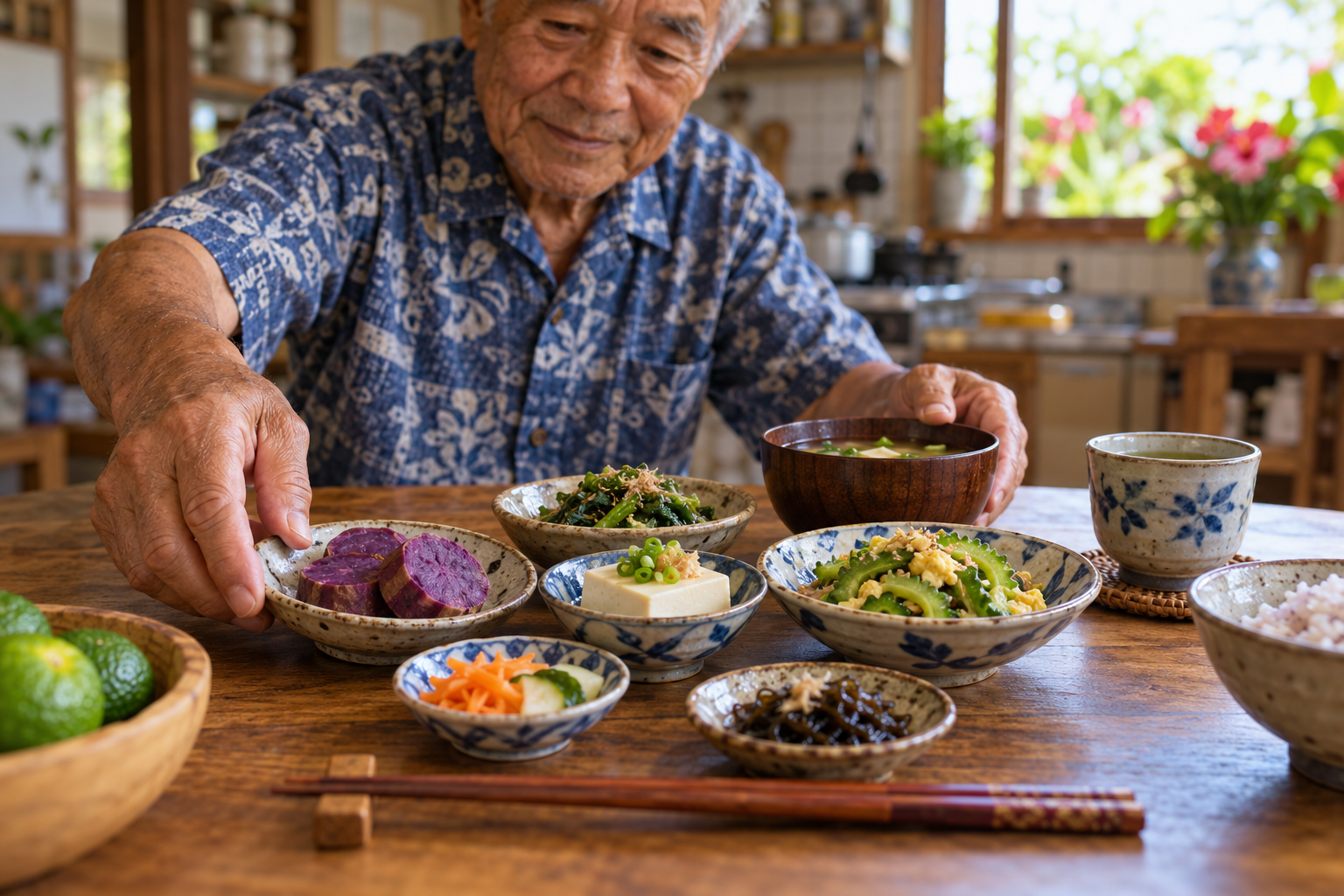
Build out from that sweet potato and you get a breakfast that looks nothing like the Western idea of a morning meal. The traditional Okinawan breakfast is a small spread of savory, warm, mostly plant-based dishes, eaten together.
There is miso soup, the warm, salty, fermented-soybean broth that anchors so many Japanese meals. There is the sweet potato itself, or sometimes a small amount of rice alongside it. There are vegetables, green and yellow ones, often including the island’s beloved bitter melon, and pickled vegetables for sharpness. There is tofu, the island’s main protein, and seaweed, and perhaps a small piece of fish, all washed down with green or jasmine tea.
To an American accustomed to cereal, toast, a pastry, or eggs and bacon, this reads as a lunch or a dinner plate, not a breakfast one. There is nothing sweet about it in the Western sense, nothing built around sugar or refined grain, just a warm, savory, vegetable-forward collection of small dishes. That difference, savory and plant-centered rather than sweet and grain-centered, is one of the quiet distinctions between how the longest-lived people on earth started their day and how most of us start ours.
And it is worth sitting with how normal this felt to them. Nobody on old Okinawa thought of this as a health breakfast or a diet; it was simply breakfast, the same warm savory plate their parents and grandparents had eaten, as ordinary to them as a bowl of cereal is to us.
The Longevity Island
The reason any of this gets attention is that Okinawa is one of the world’s so-called blue zones, the handful of places where people have historically lived exceptionally long and healthy lives, with a remarkable concentration of centenarians, and some of the longest-lived women ever recorded.
The traditional diet is widely counted as part of the reason, and it is easy to see why. It is overwhelmingly plant-based, rich in vegetables and antioxidant-heavy sweet potato, built on whole rather than refined carbohydrates, light on meat and sugar, and full of soy and fermented foods. It is, more or less, exactly the kind of eating pattern that modern nutrition science keeps arriving at by other routes.
It is important to be honest and careful here, though, because diet is only one piece of the longevity story, and the science is a matter of association rather than proof. The researchers who study these communities are quick to point out that genes, constant daily physical activity, strong social ties, and a deep sense of purpose all matter too, and that no single food or plate can be credited with long life. The Okinawan diet is best understood as one strand in a whole way of living, not a magic formula you can bottle.
With that caveat firmly in place, the pattern is still genuinely striking. The food the old Okinawans ate lines up remarkably well with what we now understand to support a long, healthy life, and their morning plate is a small, concrete window into it.
Eat Until You Are 80 Percent Full
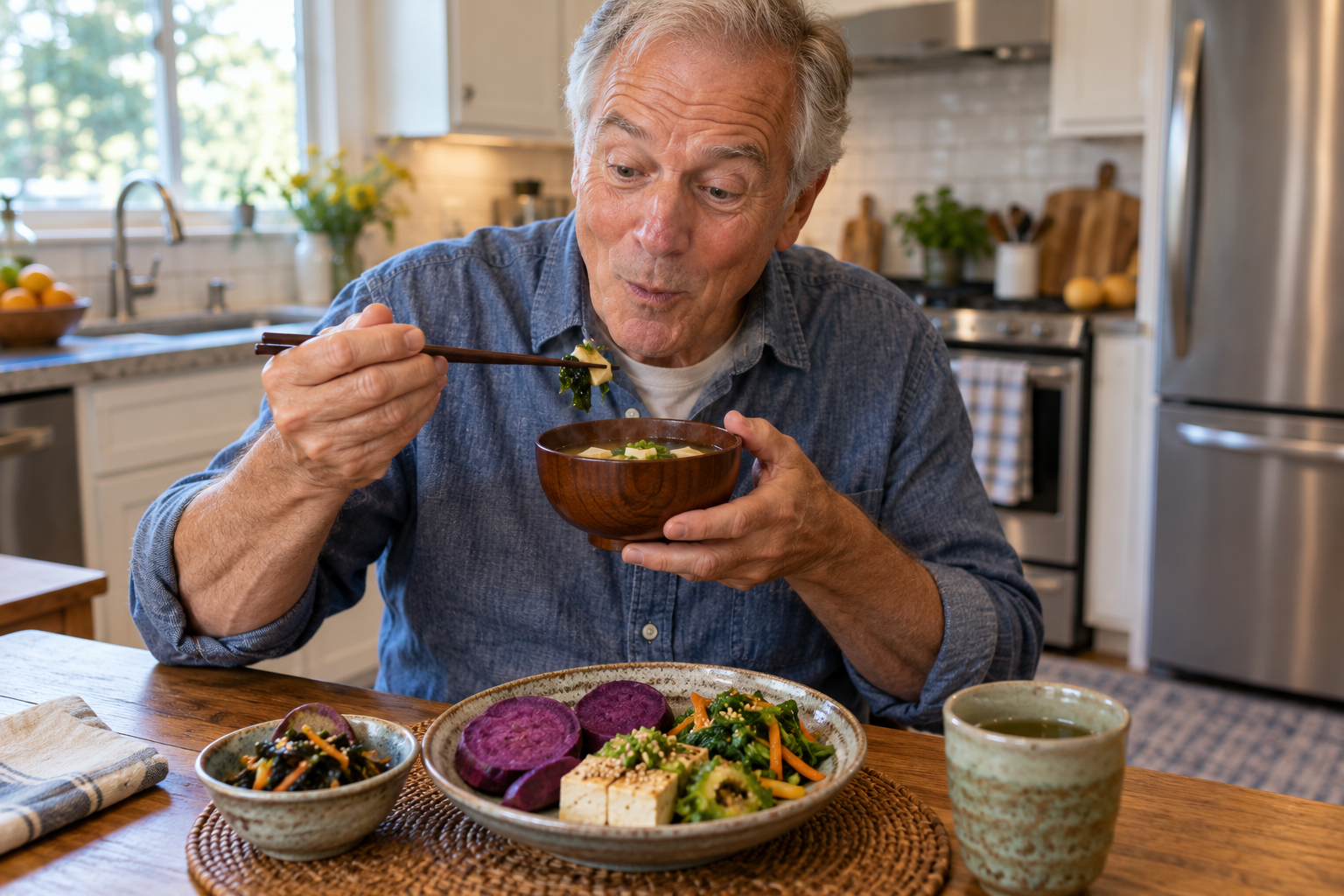
There is one more Okinawan habit worth knowing, because it shapes how the food is eaten as much as what the food is. The islanders have a saying, hara hachi bu, which is a reminder to stop eating when you are about eighty percent full rather than completely stuffed.
It is a small practice with a large effect. Rather than eating until they feel full, traditional Okinawans eat until they are simply no longer hungry, and then they stop, leaving a little room. Over a lifetime, that gentle, built-in moderation means they tend to eat fewer calories without ever going hungry or dieting in the way we understand it.
Paired with a plate that is already low in calories and high in nutrients, this adds up to a way of eating that is naturally light without being restrictive. The sweet potato, the vegetables, and the soup fill you up on fiber and water rather than on dense, caloric food, and the hara hachi bu habit stops you before you overdo it. It is moderation designed into the culture rather than imposed by willpower, which is exactly the kind of approach that tends to last.
The Star Ingredients
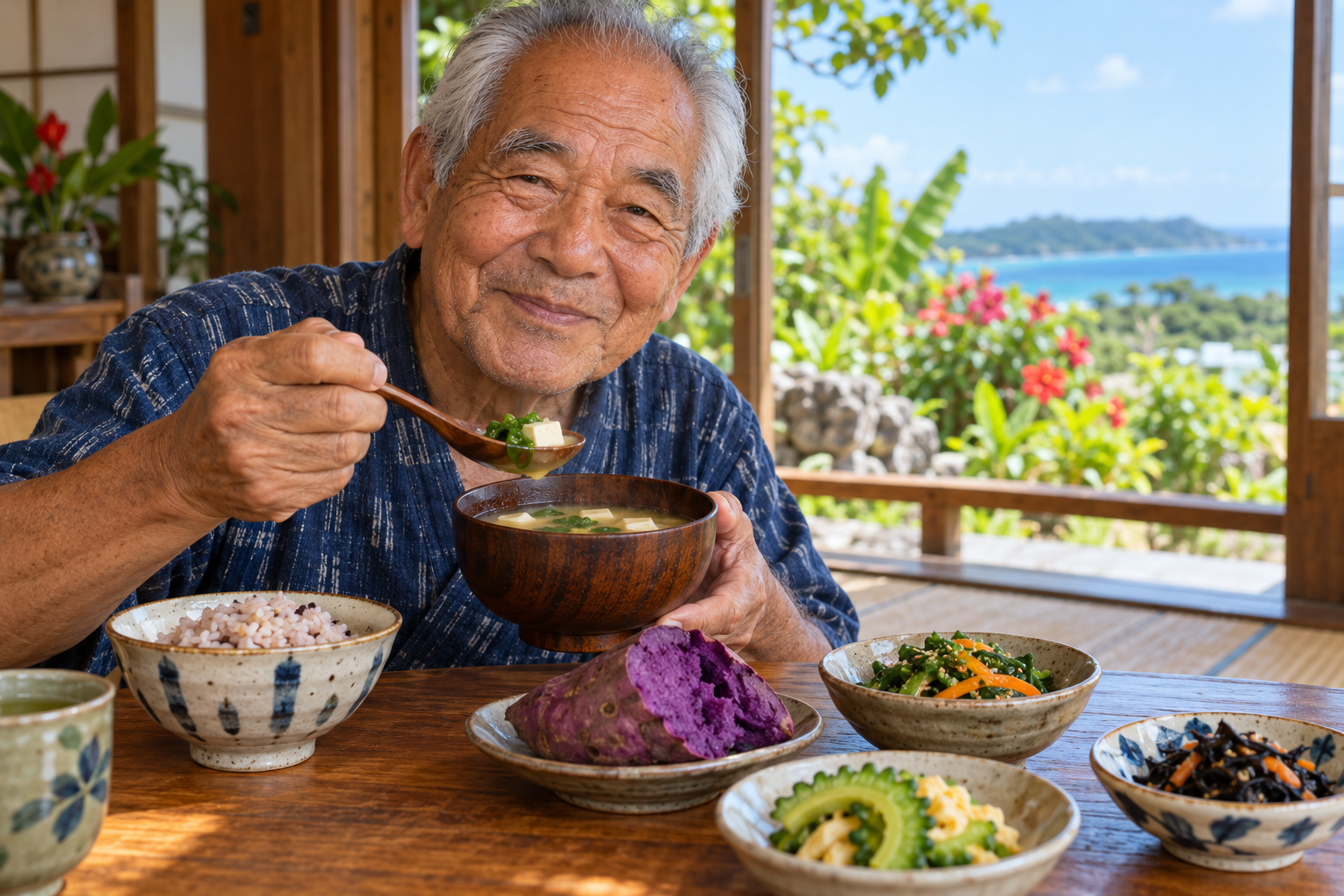
A few foods do the heavy lifting on the Okinawan plate, and each one is worth knowing in its own right. Together they are the building blocks of the whole pattern.
The purple and orange sweet potato is the foundation, prized for its antioxidants and slow-digesting, fiber-rich carbohydrate. Soy is the main protein, in the form of tofu, miso, and fermented soybeans, and Okinawan tofu is reputed to be firmer and more protein-rich than most. The signature vegetable is goya, the bitter melon, an acquired taste that turns up in the island’s famous stir-fry, goya champuru, and is valued for its distinctive compounds.
Rounding it out are seaweed in several varieties, prized for its minerals, and turmeric and green tea, both antioxidant-rich and woven through the daily diet. None of these is exotic or hard to find in most places today, which is part of what makes the Okinawan pattern so portable. You do not need special supplements or rare superfoods; you need vegetables, sweet potato, soy, seaweed, and tea.
The Tradition Is Fading
Here is the honest and slightly sad part of the story: the traditional Okinawan diet, and the longevity advantage that came with it, is disappearing. The plate described here is the old one, the one that fed the generation now in their eighties, nineties, and beyond, not necessarily what young Okinawans eat today.
After the Second World War, the islands’ food culture shifted sharply toward Western and mainland Japanese patterns. The beloved sweet potato was pushed aside by white rice and white bread, fat intake climbed dramatically, and processed and fast foods arrived. The younger generations, raised on this changed diet, no longer show the same remarkable health as their elders, and Okinawa’s famous longevity edge has been narrowing as a result.
This matters for how you read the whole story. The lesson of Okinawa is not in some magical island air or genes, but in the specific, old-fashioned way the long-lived generation actually ate, a way their own grandchildren have largely left behind. If anything, the fading of the tradition is the clearest evidence that the diet, not the island, was doing the work. The good news is that the old plate is not lost; it is just a set of foods and habits anyone, anywhere, can choose to put back on their table.
Build Your Own Okinawan Morning
You do not need to move to Okinawa, or even to love bitter melon, to borrow the shape of its morning plate. The principle is simple and portable: a warm, savory, plant-forward breakfast built on whole carbohydrates, vegetables, and soy, eaten in moderation.
In practice, that might mean swapping the cereal or pastry for a roasted sweet potato, a bowl of miso soup with seaweed and tofu, some simple green vegetables, and a cup of green tea. It will feel strange at first, because it looks like dinner, but that strangeness is exactly the Western habit the Okinawans never had. Lean into savory and plant-based first thing, keep the portions moderate in the hara hachi bu spirit, and you have the essence of it.
None of this is a promise of a longer life, and it should not be read as one, because longevity has many causes and no breakfast can guarantee it. But a warm, savory, vegetable-and-soy breakfast is a genuinely pleasant and nourishing way to start the day whatever the long-run truth, and it is one of the simplest habits to borrow from the people who have lived the longest. If you want a single place to start, start with the soup. This piece is general information, not medical advice; diet is one of many factors in health and longevity, and you should talk to a doctor about your own needs.
Make It: Okinawan-Style Miso Soup
Here is the warm, savory soup that anchors the whole plate, in a simple version that serves about four. It takes only minutes once your broth is ready, and it is the easiest piece of the Okinawan breakfast to adopt.
Ingredients
- 4 cups dashi (Japanese stock), or water with a little dashi powder
- 3 to 4 tablespoons miso paste
- 200g firm tofu, cut into small cubes
- 2 tablespoons dried wakame seaweed
- 1 handful green or yellow vegetables (such as spinach, bok choy, or thinly sliced carrot)
- 2 green onions, sliced
Instructions
- Soak the dried wakame in a little water for about 5 minutes until it softens, then drain.
- Heat the dashi (or water with dashi powder) in a saucepan until it is hot but not boiling hard.
- Add the tofu cubes and any firmer vegetables, such as sliced carrot, and simmer gently for a few minutes until just tender.
- Lower the heat. Put the miso paste in a small bowl, ladle in a little of the hot broth, and stir until the miso dissolves into a smooth paste, then stir it back into the pot. Do not let the soup boil after adding the miso, as boiling dulls its flavor.
- Add the softened wakame and any quick-cooking greens, such as spinach or bok choy, and warm through for a minute.
- Serve hot, scattered with the sliced green onions, alongside a roasted sweet potato and some vegetables for a breakfast in the Okinawan style.

About the Author: Ruben, co-founder of Gamintraveler.com since 2014, is a seasoned traveler from Spain who has explored over 100 countries since 2009. Known for his extensive travel adventures across South America, Europe, the US, Australia, New Zealand, Asia, and Africa, Ruben combines his passion for adventurous yet sustainable living with his love for cycling, highlighted by his remarkable 5-month bicycle journey from Spain to Norway. He currently resides in Spain, where he continues sharing his travel experiences with his partner, Rachel, and their son, Han.