
Ask most Americans what goes into spaghetti carbonara and the answer comes back quickly and confidently, bacon, eggs, cream, maybe some garlic. Ask a Roman the same question and you may set off a small crisis, because almost every part of that answer is wrong. Real carbonara contains no bacon, no cream, and no garlic. What it does contain, the ingredient that makes it what it is, is guanciale, cured pork jowl, and the difference between guanciale and bacon is the difference between authentic carbonara and a rich but entirely different dish wearing its name.
This is not culinary snobbery for its own sake, but a real matter of what the dish actually is. Carbonara is one of the most misunderstood dishes in the world outside Italy, its true simplicity buried under decades of well-meaning substitutions that quietly changed it into something else. At the heart of the confusion sits the pork, because the single most important thing to know about carbonara is that it was born with guanciale, and that guanciale, not bacon, is the ingredient doing the real work.
Here is what guanciale really is, why it and not bacon is the key to carbonara, what else the authentic dish does and does not contain, and where to find guanciale so you can make the real thing. This is a piece of food knowledge and technique rather than a full recipe, and if you want the complete method you can follow our carbonara recipe, but understanding the guanciale question is what separates a real carbonara from an impostor, however delicious the impostor may be.
What Guanciale Actually Is
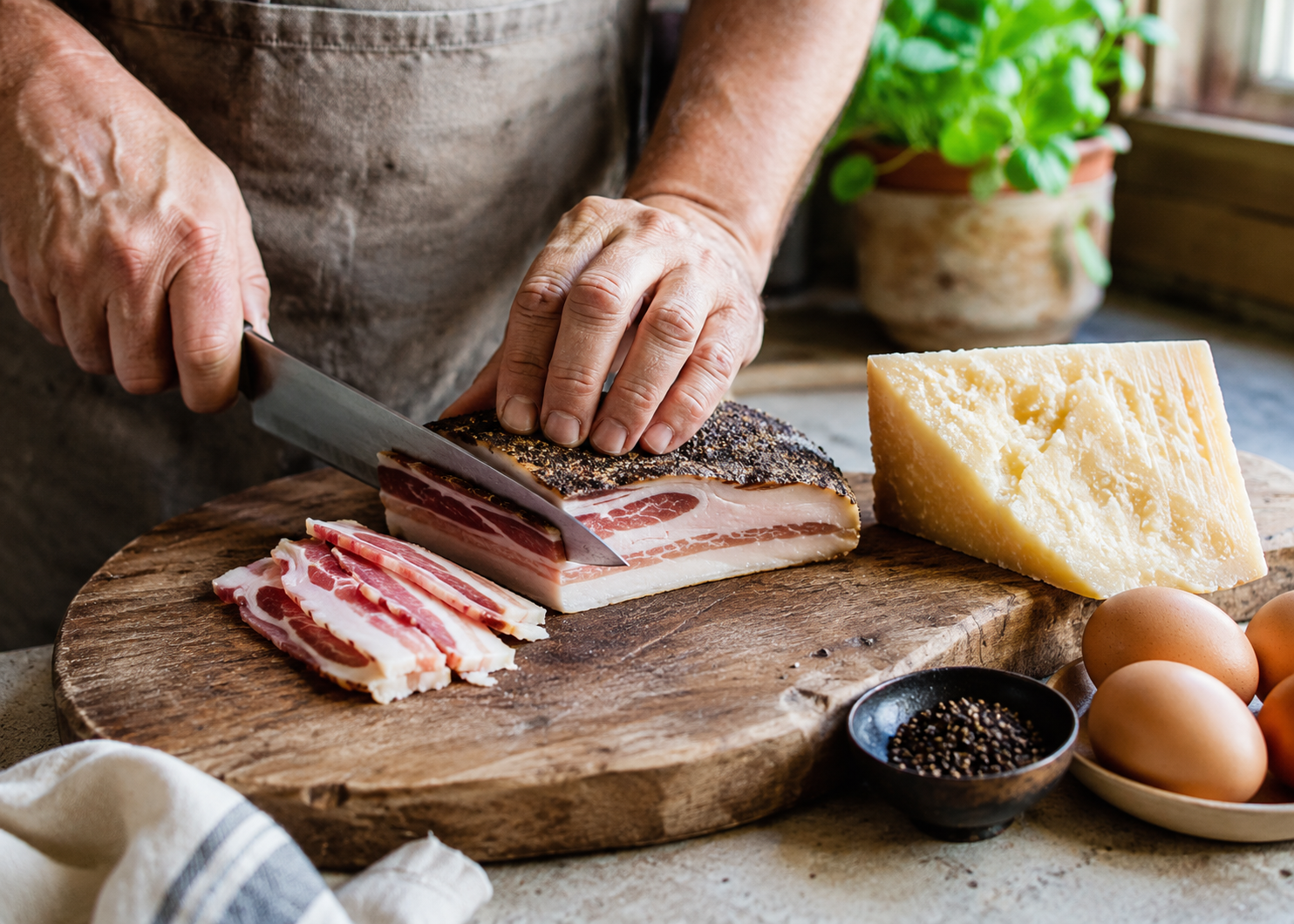
Guanciale is the cured jowl of the pig, and everything about carbonara flows from that fact. The word comes from guancia, the Italian for cheek, and guanciale is made from the pork cheek and jowl, the triangular cut that runs from the cheekbone to the throat, which is a very different thing from the belly that gives us bacon and pancetta. The cut is the whole story.
The jowl is prized for a specific reason, which is its fat. The cheek muscles are worked constantly throughout the pig’s life, and this produces a fat that is unusually firm, dense and richly marbled, quite different from the softer fat of the belly, and it is this hard, concentrated, silky fat that makes guanciale so valuable in cooking. The fat is not a byproduct here but the point.
The making of guanciale is simple and slow. The jowl is rubbed with salt and generously with black pepper, sometimes with a little garlic or local herbs, and then air-dried and aged for at least three months, with no smoking at any stage, so that it emerges as a firm, intensely flavored, unsmoked cured meat. Crucially, it is never smoked, which turns out to be one of the two things that most distinguish it from the bacon Americans would substitute. The same slow, unsmoked, salt-cured method gives guanciale its distinctive flavor as well as its texture. Where the cure concentrates the pork over those months of aging, the result is a taste often described as deeper and sweeter than bacon, funky and savory without any smoke to mask it, so guanciale brings a pure, intense cured-pork character to whatever it touches. That clean intensity is exactly what a dish as spare as carbonara needs, since there is nowhere for a muddled or smoky flavor to hide.
Why Bacon Ruins It

The reason bacon does not belong in carbonara comes down to two features of bacon that guanciale lacks, and the first is smoke. American bacon is smoked, and that smokiness, delicious in its own right, is powerful and dominant, so when bacon goes into carbonara its smoke takes over the dish, overwhelming the delicate balance of pork, egg, cheese and pepper that carbonara is built on. The smoke does not add to carbonara but conquers it.
The second problem is the fat itself. Bacon comes from the pork belly, and its fat is softer and leaner than the dense, firm fat of the jowl, so it renders differently, melting too fast and yielding less of the rich, aromatic fat that carbonara depends on. Where guanciale’s firm fat renders slowly into a clear, sweet, aromatic pool that coats the pasta, bacon’s fat behaves differently and delivers a thinner, less luxurious result.
Together these two differences change the dish entirely. With bacon, carbonara becomes a smoky, leaner, coarser thing, pleasant enough but no longer carbonara, its defining silky richness and its clean balance of flavors both lost, which is why Romans consider bacon simply the wrong ingredient rather than a fair substitute. The dish an American makes with bacon may taste good, but it is not the dish, and the guanciale is the reason. It is worth being clear that this is not about one ingredient being better than another in the abstract. Bacon is a wonderful thing in its proper place, and nobody is arguing it should vanish from the breakfast table. The point is narrower and more precise, that carbonara is a specific dish with a specific character, and bacon changes that character into something else, so using it is less a matter of quality than of making a different dish under a borrowed name.
The Fat Is the Whole Secret
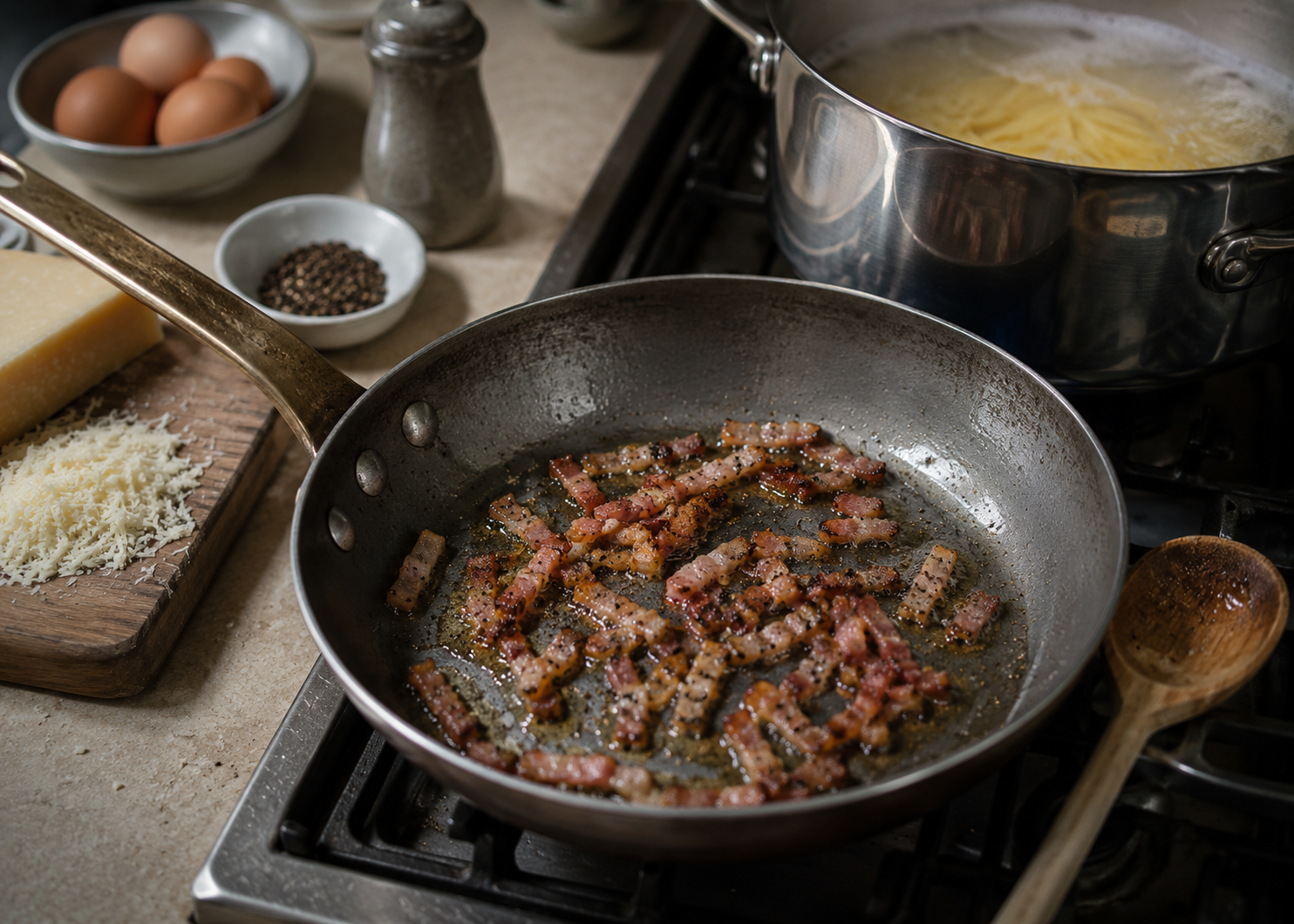
To understand why guanciale matters so much, you have to understand that in carbonara, the rendered fat of the guanciale is a load-bearing ingredient, not a seasoning. When guanciale is cooked gently, its firm fat renders out slowly into the pan as a clear, sweet, aromatic fat, and this rendered fat becomes one of the foundations of the sauce, carrying deep cured-pork flavor and providing the richness that makes carbonara so satisfying.
This rendered fat plays a technical role that nothing else quite replicates. The sauce of a real carbonara is an emulsion, a silky, glossy coating created when egg yolks, grated cheese and starchy pasta water come together, and the guanciale fat is central to that emulsion, helping bind it into the velvety, cohesive sauce that clings to every strand of pasta. The fat is not just flavor but structure.
This is precisely where bacon and even pancetta fall short. Because their fat is softer, leaner and rendered less richly, they cannot provide the same concentrated, slow-melting fat that guanciale contributes, so the sauce made with them tends to be thinner and less luxurious, lacking the deep porky richness and the perfect emulsion of the real thing. The guanciale fat is the quiet engine of the whole dish, which is why no substitute fully captures it. This also explains why so many home cooks, using bacon and cream, conclude that authentic carbonara must be difficult, when in truth they have simply never had the real version. Their creamy, smoky result is easy to make and pleasant to eat, but it sidesteps the actual technique entirely, leaning on cream to do what the guanciale fat and the egg emulsion are supposed to do. Master the real method once and it is no harder than the shortcut, and the result is incomparably better.
The Other Things Carbonara Doesn’t Have
Once you understand the guanciale, the other great carbonara myths fall quickly, and the first and most important is cream. Authentic carbonara contains no cream whatsoever, and the belief that it does is perhaps the most widespread carbonara error of all. The creaminess of a real carbonara comes not from cream but from the emulsion of egg yolks, cheese, guanciale fat and starchy pasta water, whipped together into a sauce that is luxuriously creamy without a drop of actual cream.
The cream myth has a history worth knowing. Cream was never part of the original dish but was added as a shortcut in the mid-twentieth century, particularly outside Italy, as a way to make the sauce reliably creamy without mastering the tricky egg emulsion, and it has clung to the dish ever since despite being entirely foreign to it. To a Roman, cream in carbonara is not a variation but a mistake, a crutch that produces a heavier, duller sauce than the real technique yields.
The other banished ingredient is garlic, and here too authenticity is strict. Real carbonara contains no garlic, because its flavor is built precisely on just four elements, the pork, the egg, the cheese and the pepper, and adding garlic muddies that clean, deliberate balance, which is why Italians are famously appalled by garlicky carbonara. The dish is an exercise in doing a great deal with very little, and every unnecessary addition, cream or garlic alike, works against it.
What the Real Dish Contains
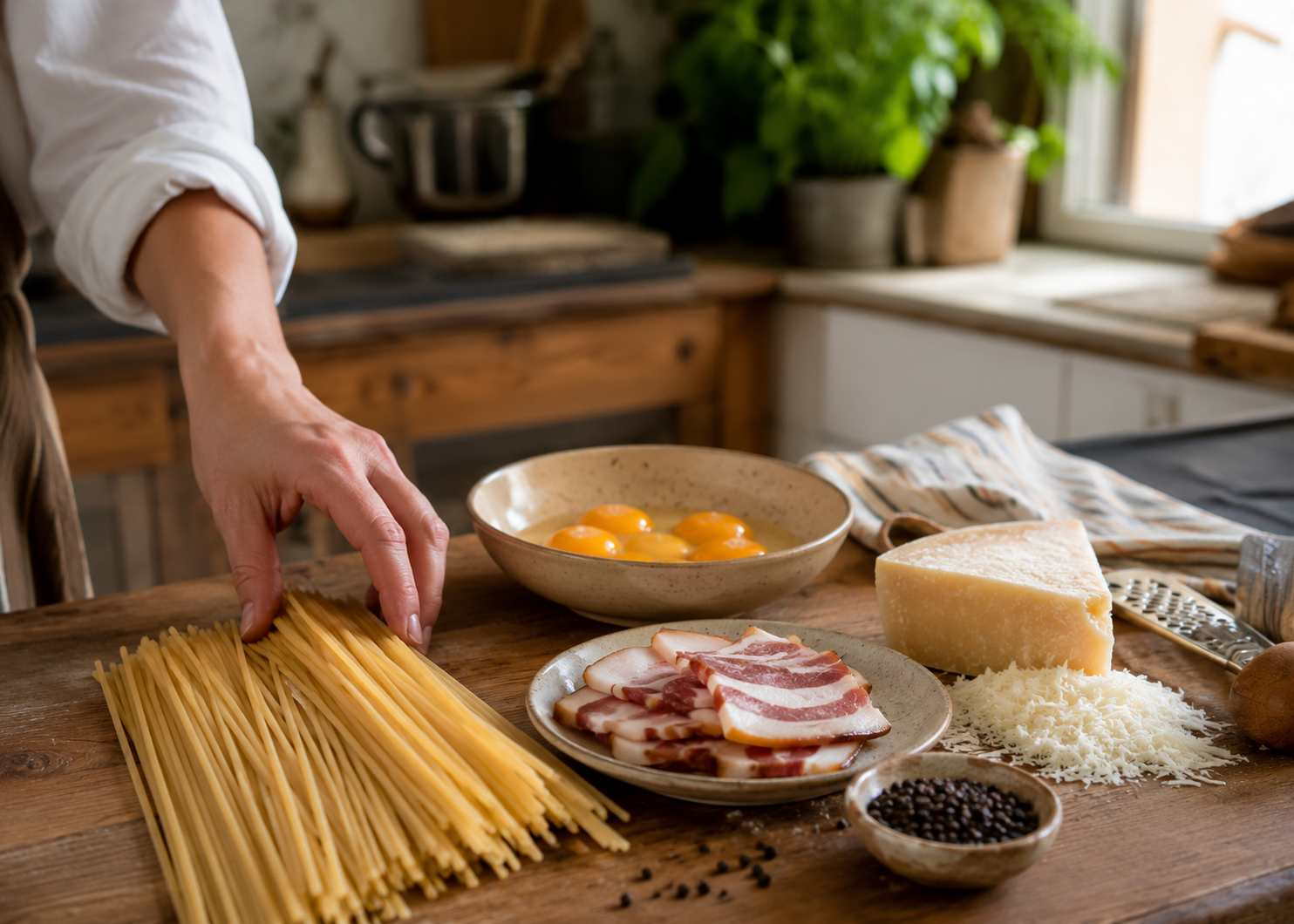
Stripped of the myths, authentic carbonara is startlingly simple, built from just five ingredients, and naming them is the clearest way to understand the dish. Real Roman carbonara consists of guanciale, eggs, Pecorino Romano cheese, black pepper and pasta, and nothing else, a spare and precise combination in which each of the five elements plays an essential part.
Each ingredient is specific and matters. The guanciale provides the pork and the crucial fat, the eggs, often just the yolks, create the sauce, the Pecorino Romano, a sharp, salty sheep’s-milk cheese, brings the savory depth, the black pepper gives the dish its gentle heat and its name’s very character, and the pasta and its starchy water complete the emulsion. Change any of these and you change the dish. The precision can sound intimidating, but it is really a kind of liberation, because a five-ingredient dish is one anybody can afford to make well. There is no long shopping list, no obscure technique beyond the emulsion, and no expensive equipment, only the demand that each of the five things be good and handled with a little care. Carbonara is proof that restraint, not abundance, is often the mark of the finest cooking.
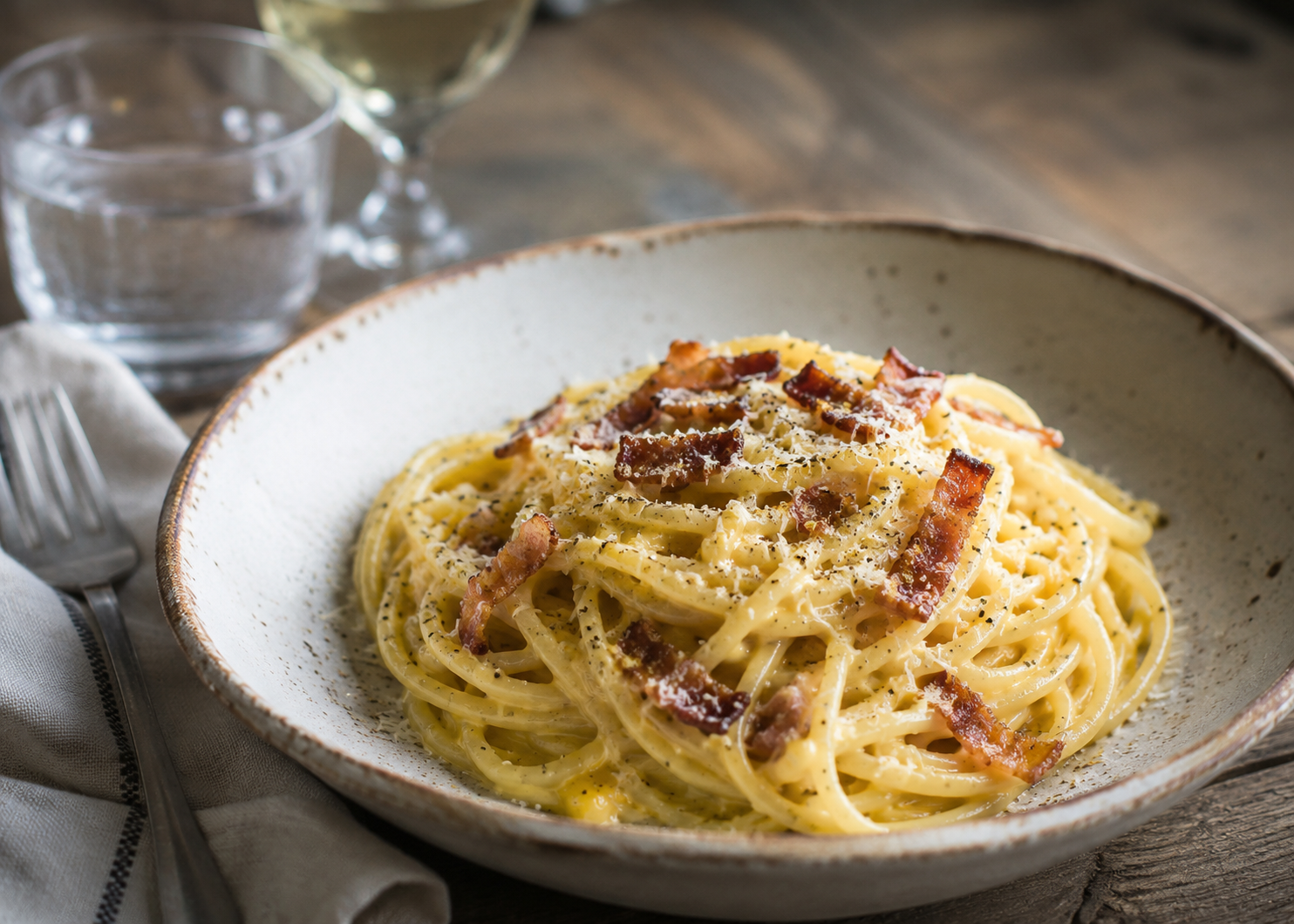
The magic is in how these few things combine. Hot pasta is tossed with the rendered guanciale and its fat, then with a mixture of egg yolks and grated pecorino, the residual heat cooking the eggs just enough to thicken them into a silky sauce without scrambling, loosened with a little starchy pasta water into a glossy, clinging coating. The single greatest danger is heat, since eggs added to a too-hot pan will scramble into something closer to breakfast than to sauce, which is why the best cooks pull the pan from the flame before the eggs ever go in. It is a dish of technique rather than ingredients, and its whole character depends on getting those five simple things right, above all the guanciale.
Where to Find Guanciale
The practical question, especially for an American cook, is where to find guanciale, since it is far less common than bacon on the average shelf. The good news is that it has become increasingly available, and the places to look are Italian delis and specialty food shops, well-stocked gourmet grocers, and online retailers who ship cured meats, any of which is likely to carry it. A knowledgeable Italian delicatessen is the surest bet, since the staff will know exactly what you mean and will often slice or portion it for you, and increasingly even mainstream gourmet grocers stock it in their cured-meat cabinets alongside the prosciutto and the pancetta.
There is a wrinkle for American cooks worth knowing. Imported Italian guanciale has at times been restricted from entering the United States, which historically made it hard to find, but domestic producers have stepped in, so American-made guanciale is now produced by artisan and specialty butchers and is increasingly available in good shops and online. You may be buying American guanciale rather than Italian, but a good one does the job beautifully, and the artisan versions coming out of small US producers now rival the imported original.
If you truly cannot find guanciale, there is a hierarchy of substitutes worth knowing, though none is perfect. The best substitute is pancetta, cured pork belly that shares guanciale’s unsmoked, salt-cured character even if its fat is leaner and softer, giving a result closer to the real thing than anything else, while bacon should be a genuine last resort, and if you must use it, blanching it briefly first helps strip some of the smoke that would otherwise dominate. But the real thing is worth seeking out, because with carbonara, the guanciale truly is the difference.
Authentic Spaghetti alla Carbonara
The real Roman carbonara, built on guanciale and nothing it doesn’t need. No cream, no garlic, no bacon. Just guanciale, eggs, Pecorino Romano, black pepper and pasta, brought together into a silky, glossy sauce by technique rather than shortcuts. The guanciale is the heart of it, so this recipe treats it with the care it deserves, rendering its firm cured-jowl fat slowly and saving every drop for the sauce.
Spaghetti alla Carbonara serves 4
Ingredients:
- 400g spaghetti
- 150g guanciale, cured pork jowl, in one piece
- 4 large egg yolks
- 1 whole large egg
- 60g Pecorino Romano, finely grated, plus more to finish
- freshly ground black pepper, generously
- salt, for the pasta water
Method:
- Trim the rind from the guanciale and cut the meat into short, thick strips or small cubes, roughly the size of your little fingertip.
- Put the guanciale into a cold, dry, wide pan with no oil, then set it over medium-low heat so the firm fat renders out slowly as the pan warms.
- Cook gently, stirring now and then, until the fat runs clear and the guanciale turns golden and lightly crisp at the edges, about eight to ten minutes, then take the pan off the heat and leave the guanciale in its rendered fat.
- Meanwhile, bring a large pot of water to the boil and salt it lightly, remembering that the guanciale and the Pecorino are both salty.
- In a bowl, whisk the egg yolks, the whole egg and the grated Pecorino Romano into a thick paste, then add a very generous grind of black pepper.
- Cook the spaghetti until just al dente, then reserve a mugful of the starchy cooking water before draining.
- Add the drained hot pasta to the pan of guanciale and its fat, off the heat, and toss well so every strand is coated in the fat.
- Let the pan cool for a few seconds, then pour in the egg and cheese mixture, tossing quickly and constantly so the residual warmth thickens the eggs into a silky sauce without scrambling them.
- Loosen the sauce with splashes of the reserved pasta water, tossing all the while, until it turns glossy and clings to the pasta.
- Serve at once, finished with more grated Pecorino Romano and a final grind of black pepper.
Notes:
- The single greatest danger is heat. Add the egg mixture only once the pan is off the flame and slightly cooled, since a pan that is too hot will scramble the eggs into something closer to breakfast than to sauce.
- Starting the guanciale in a cold pan is deliberate, letting its dense fat render out slowly and fully rather than seizing and burning.
- If you cannot find guanciale, pancetta is the closest substitute, though the sauce will be a little leaner. Bacon is a last resort, and blanching it briefly first helps strip the smoke that would otherwise dominate.
- No cream is needed or wanted. The creaminess comes entirely from the emulsion of egg, cheese, guanciale fat and starchy water.
Making the Real Thing
Understanding all of this transforms carbonara from a mysterious restaurant dish into something you can make properly at home, and it comes down to respecting the guanciale and the simplicity around it. Buy or track down good guanciale, cut it into small strips or cubes, and render it gently in a dry pan until the fat runs clear and the meat turns golden, saving every drop of that precious rendered fat for the sauce.
From there the technique is about the emulsion, and it rewards care. Toss hot, just-drained pasta with the guanciale and its fat off the heat, then quickly with a mixture of egg yolks and grated Pecorino Romano, adding splashes of starchy pasta water and tossing constantly so the residual warmth thickens the eggs into a silky sauce rather than scrambling them, finishing with plenty of black pepper. For the full method and quantities, our carbonara recipe walks through every step.
The deeper lesson is that carbonara is a dish where authenticity and deliciousness point the same way, so making it correctly is also making it better. The guanciale gives a depth and richness that bacon cannot, the absence of cream lets the true silky emulsion shine, and the strict simplicity of the five ingredients produces a dish far greater than its humble parts, which is exactly why the Romans guard it so fiercely. Once you have made a real carbonara with real guanciale, the bacon-and-cream version will taste like what it is, a well-meaning imitation of one of the great simple dishes of the world. The name on the menu will be the same. The dish on the plate will not.

About the Author: Ruben, co-founder of Gamintraveler.com since 2014, is a seasoned traveler from Spain who has explored over 100 countries since 2009. Known for his extensive travel adventures across South America, Europe, the US, Australia, New Zealand, Asia, and Africa, Ruben combines his passion for adventurous yet sustainable living with his love for cycling, highlighted by his remarkable 5-month bicycle journey from Spain to Norway. He currently resides in Spain, where he continues sharing his travel experiences with his partner, Rachel, and their son, Han.