
In Rome in August, at the fry shops and the market stalls and the neighborhood trattorias, a small ritual repeats itself all day long. Someone orders fiori di zucca, the fried zucchini flowers, and a few minutes later receives a plate of golden, blistered, delicate fritters, each one hiding a molten secret inside, so hot and so fleetingly perfect that they are eaten almost the instant they arrive. These are one of the great treats of the Italian summer, a delicacy so beloved that Romans will happily queue for them, and the remarkable thing is that they are entirely within reach of a home cook willing to handle the flowers with a little care.
The fried zucchini flower is a small masterpiece of Italian cooking, crisp and airy on the outside, soft and often molten within, made from the beautiful yellow-orange blossom of the zucchini plant that appears in high summer. It is a dish born of thrift and turned into a delight, a humble flower transformed by a light batter and hot oil into something people cross the city for, and it captures the whole genius of Italian cooking, which is to take the simplest seasonal thing and make it unforgettable.
Here is what fried zucchini flowers are, where to find the blossoms, how to clean and stuff and batter and fry them, and how to serve them the way the Romans do. This is a real recipe with real technique, and the technique matters because the flowers are delicate and the timing is quick, but none of it is difficult, and the reward is a taste of the Italian summer that few dishes can match.
What Zucchini Flowers Are
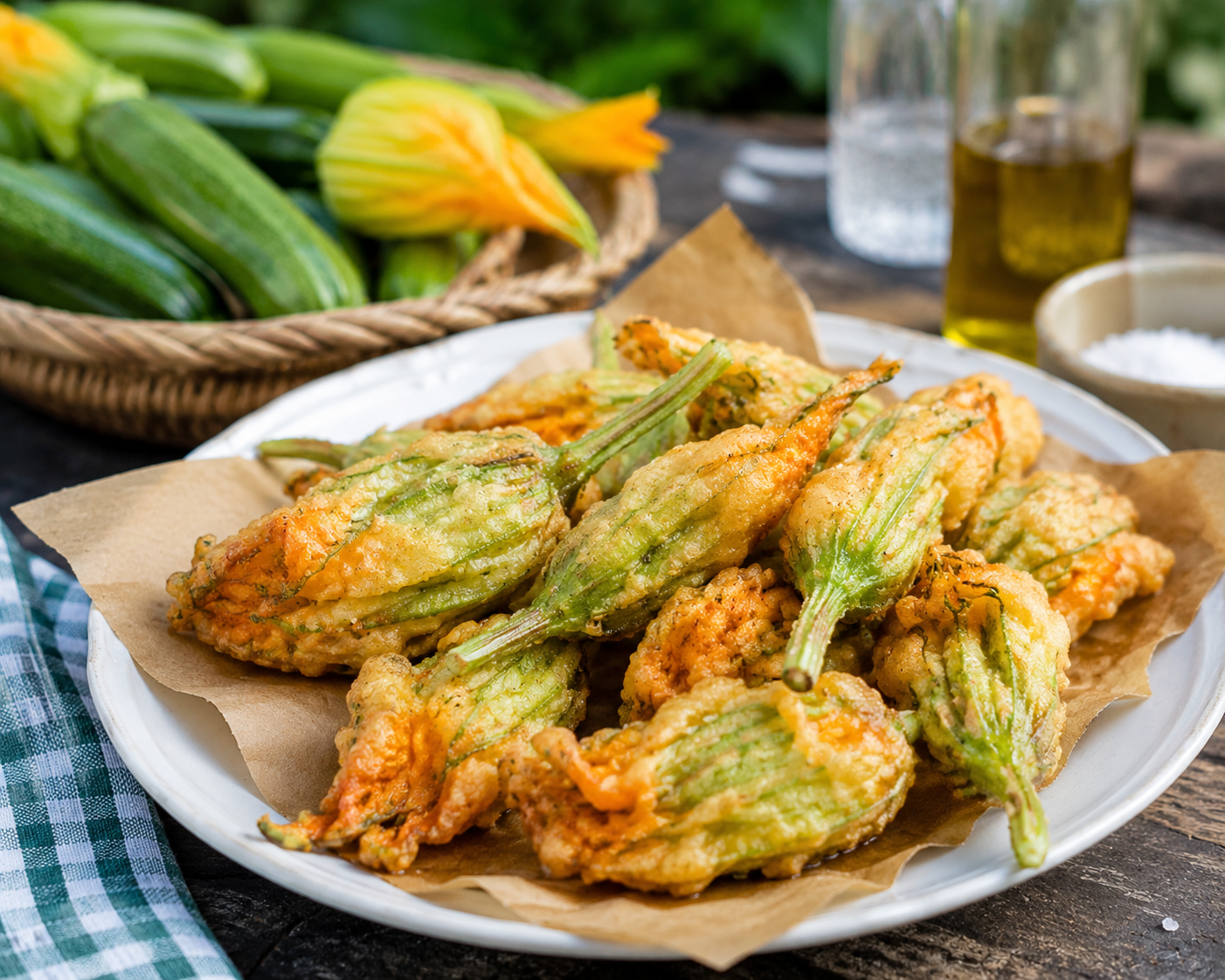
Zucchini flowers, or squash blossoms, are exactly what they sound like, the flowers of the zucchini plant, a genuine seasonal delicacy available only in the warm months when the plants are in bloom. Bright yellow shading to orange, delicate and slightly sweet, they are a summer treasure prized across Italy and especially in Rome, where they are a fixture of the markets and the summer table.
The dish has humble and specific roots. Fried zucchini flowers trace back centuries in Rome, particularly to the kitchens of the historic Jewish Ghetto, where cooks made a virtue of thrift, and because the zucchini themselves were valuable, the blossoms, once thought less useful, were turned into a delicacy of their own. What began as a way to waste nothing became one of the city’s most treasured dishes, a classic case of Italian cucina povera, the cooking of the poor, elevated to something exquisite.
Today the flowers are enjoyed throughout Italy in many forms, but the Roman version is the icon. In its classic form the blossom is stuffed, battered and fried, producing a crisp shell around a soft, savory, melting center, though a plain unstuffed version, simply battered and fried, is also traditional and lovely. Either way, the flower itself, delicate and faintly sweet, is the star, and everything else serves to frame it. The taste is worth describing, because people who have never eaten one imagine it must be grassy or bitter, and it is neither. A good fried zucchini flower is mild and gently sweet, its flavor almost more a matter of tender texture than of any assertive taste, so the blossom offers a soft, delicate canvas that the crisp batter and the savory filling paint upon. That subtlety is exactly why the flower must not be drowned in a heavy coating or an overpowering stuffing.
Finding and Handling the Blossoms
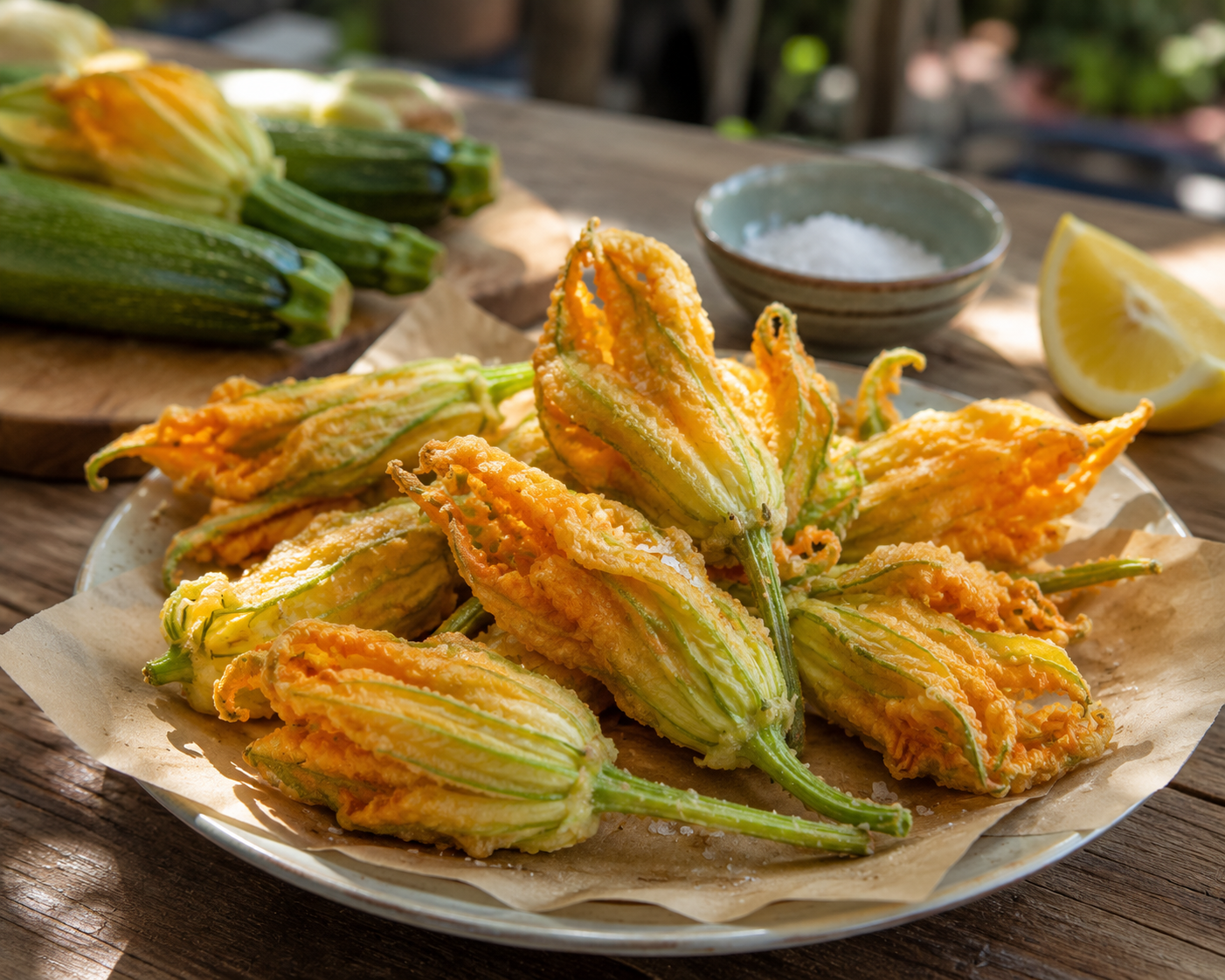
The first challenge for a home cook is simply getting the flowers, since they are seasonal and delicate and do not keep. In summer, look for zucchini blossoms at farmers markets, at Italian and specialty grocers, or from anyone growing zucchini in a garden, where the flowers are abundant and often given away, and choose blossoms that are fresh, bright and not wilted, using them as soon as possible after buying.
There is a small botanical point worth knowing about the two kinds of flower. Zucchini plants produce both male and female blossoms, the male flowers on thin stems and the female ones attached to a tiny developing zucchini, and both can be used for frying, though the male flowers, being more plentiful and borne on slender stems, are the ones most often used for this dish. Either will make a fine fritter, so take whichever you can find.
The crucial thing is that the flowers are extremely delicate and must be handled gently. The blossoms are fragile and tear easily, wilt quickly, and cannot be roughly washed, so they demand a light touch at every stage, from carrying them home to cleaning them to stuffing them. Treat them as the delicate things they are, work with care and reasonable speed, and they will reward you, but handle them roughly and they will fall apart before they reach the pan.
Cleaning the Flowers
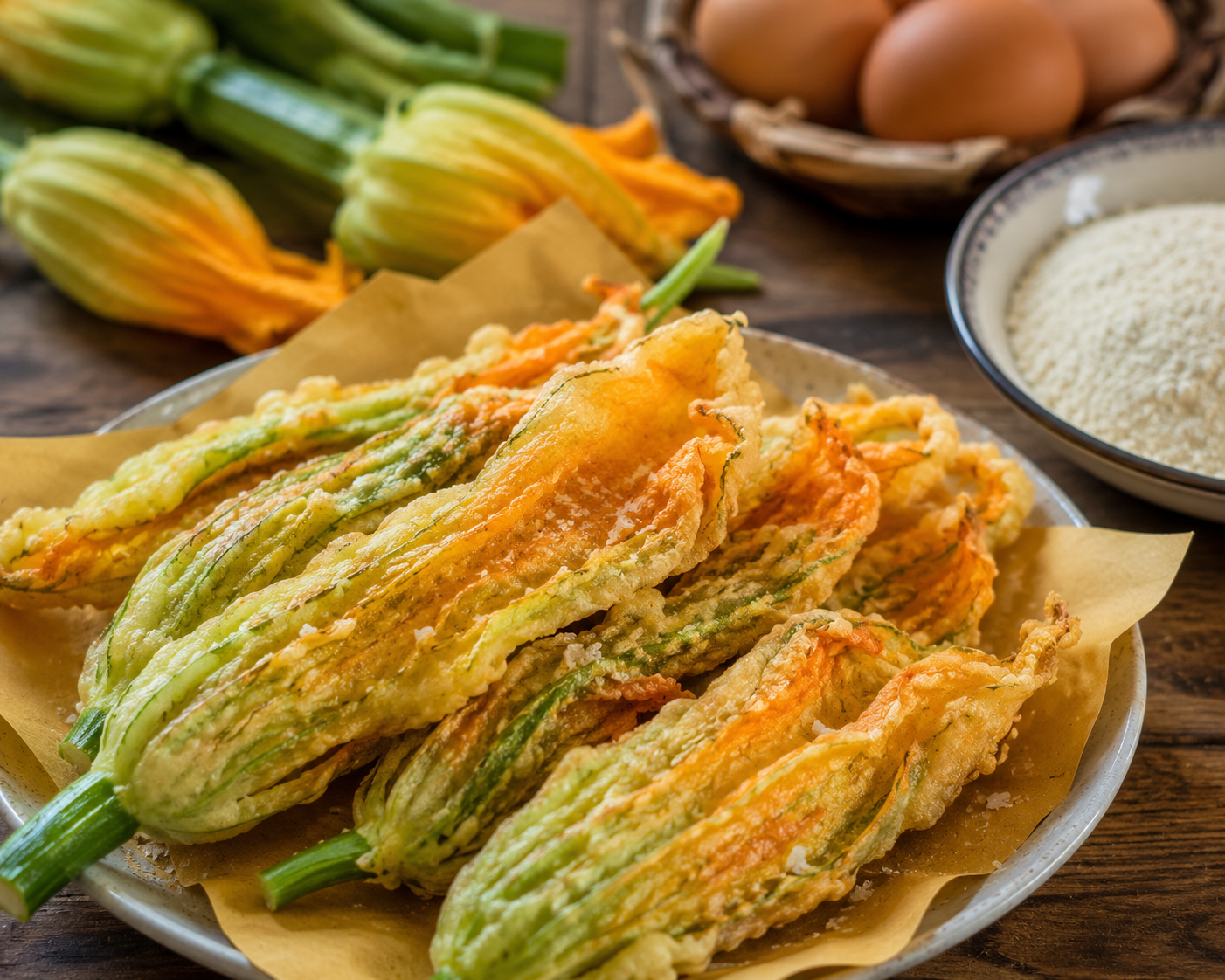
Cleaning the flowers properly is the single most important preparation step, and it centers on removing the pistil inside. Each blossom contains a pistil or stamen at its center, which can be bitter and is traditionally removed, so the first task is to gently open each flower and pull out that inner part, either with your fingers or with a small pair of scissors, taking care not to tear the petals.
The rest of the cleaning is a matter of gentleness. Once the pistil is out, remove any tough or spiny bits at the base of the flower where it meets the stem, and clean the blossoms of any dirt or the occasional insect, which is best done not by washing them under a strong tap but by wiping them gently with a damp cloth or paper towel, or rinsing very briefly and delicately under cool water. Water is the enemy of a crisp result, so use as little as possible.
Drying is the final and easily forgotten step. However you clean them, the flowers must be dried thoroughly before they are battered, patted carefully with paper towels or laid on a clean cloth, because any water left on the petals will make the batter slide off and the oil spit dangerously. A clean, dry, pistil-free flower is a flower ready to stuff and fry, and getting this preparation right is most of the battle. It helps to prepare all the flowers before you heat any oil, cleaning and drying and stuffing the whole batch first, because once the frying begins it moves fast and there is no time to be fiddling with delicate petals. Lay the prepared flowers out on a tray, have the batter mixed and rested, and only then bring the oil up to temperature, so that the actual frying becomes the quick, smooth finale to work already done.
The Classic Roman Stuffing
The most beloved version of the dish is the stuffed one, and the classic Roman filling is a simple, bold, perfect pair, which is mozzarella and anchovy. Into each cleaned flower goes a small piece of fresh mozzarella and a piece of anchovy fillet, and when fried the mozzarella melts into a molten, stringy center while the anchovy dissolves into a deep savory note, so that biting through the crisp batter releases a soft salty heart.
The details of the filling matter for a good result. The mozzarella should be well drained and patted very dry, since excess moisture will make the flower soggy and the oil spit, and a low-moisture or well-drained fresh mozzarella cut into small sticks or cubes works best, while just half an anchovy fillet per flower is enough to season without overwhelming. A little grated parmesan mixed in adds a savory complexity if you like.
Stuffing is done gently, like everything with these flowers. Open each blossom carefully, tuck in the mozzarella and anchovy, and then twist or fold the tips of the petals closed to seal the filling inside, taking care not to overfill, since too much cheese will burst out during frying. The sealed, stuffed flower is now ready for its batter, and if you prefer the plain version, you simply skip this step and batter the cleaned flowers as they are.
Fiori di Zucca Fritti serves 4 as a starter
Ingredients:
- 12 fresh zucchini flowers
- 125g fresh mozzarella, well drained and patted dry
- 6 anchovy fillets in oil, halved
- 100g plain flour
- about 150ml very cold sparkling water
- 1 pinch of salt, plus more to finish
- neutral oil, for frying
Method:
- Clean each flower by gently removing the inner pistil and any tough base, then wipe clean and dry thoroughly.
- Cut the mozzarella into small sticks and pat them very dry with paper towel.
- Tuck a piece of mozzarella and half an anchovy fillet into each flower, then twist the petal tips to seal.
- Whisk the flour, a pinch of salt and the cold sparkling water into a light, smooth batter, then rest it for ten minutes.
- Heat the oil in a deep pan to about 180C, deep enough to float the flowers.
- Holding each flower by the tip, dip it into the batter to coat lightly, letting the excess drip off.
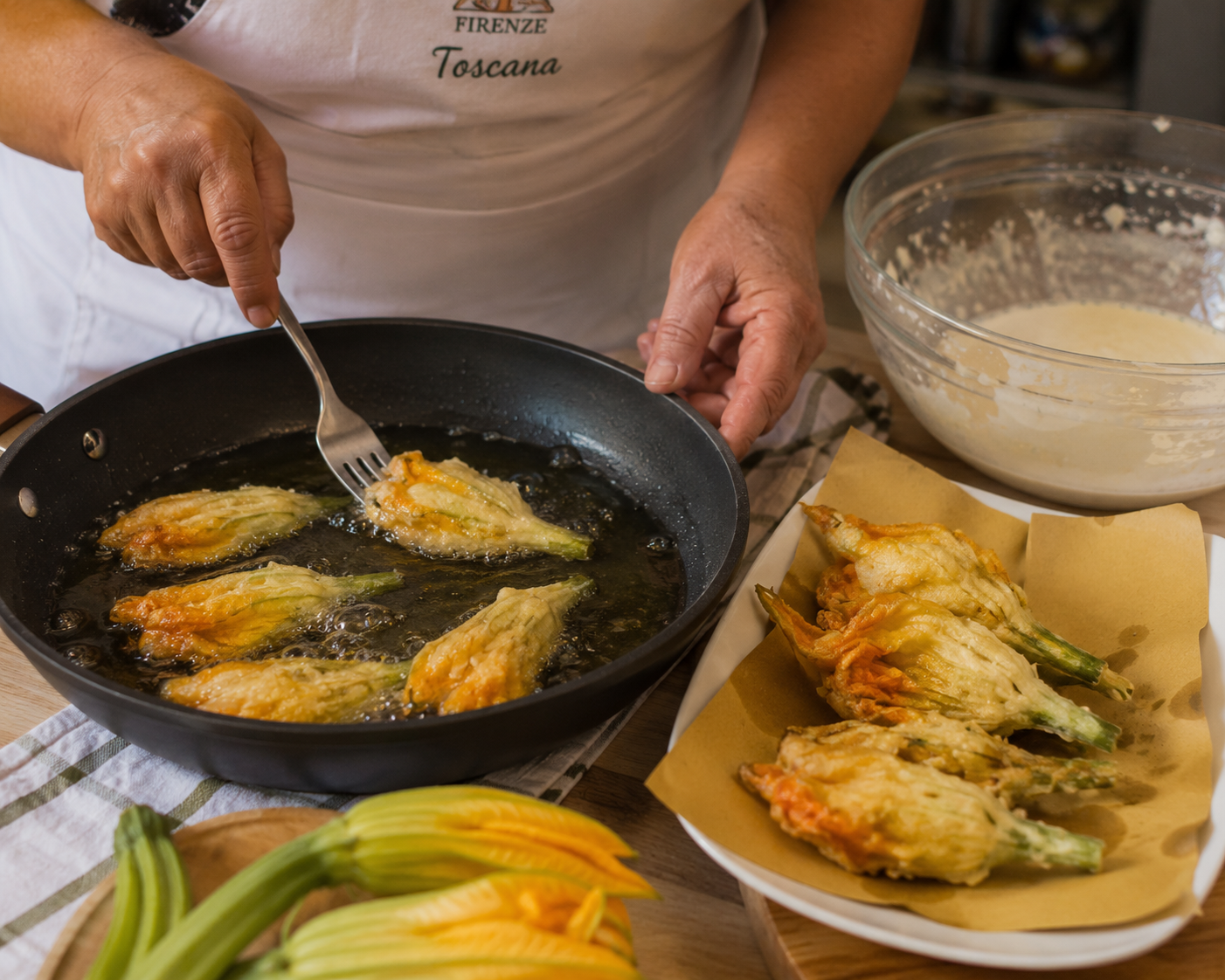
- Fry the flowers a few at a time until golden and crisp, turning once, about two minutes.
- Lift out with a slotted spoon, drain on paper, sprinkle with salt, and serve at once.
The Light Batter and the Hot Oil
The batter is where fried zucchini flowers are won or lost, and the guiding principle is lightness. The batter should be thin and delicate, just enough to form a crisp shell without masking the flower, and the secret to that lightness is using very cold sparkling water, or beer, whose bubbles keep the batter airy, whisked into flour with a pinch of salt to a smooth, fluid consistency.
A few tricks make the batter better. Keeping everything cold, cold water straight from the fridge, helps produce a crisper result, resting the batter for ten or fifteen minutes lets it relax, and some cooks add a little cornstarch or rice flour to the wheat flour for extra crispness and a lighter finish. The batter should coat the flower in a thin veil, not a thick armor, so if it seems too thick, thin it with a splash more sparkling water.
The frying must be hot and fast. Heat a good depth of neutral oil to around 180 degrees Celsius, hot enough that a flower dipped in batter sizzles and puffs immediately, then dip each stuffed flower in the batter and lower it straight into the oil, frying only a few at a time so the temperature does not drop. In a couple of minutes they turn golden and crisp, at which point they are lifted out, drained on paper, and salted, ready to eat while blazing hot.
Serving Them the Roman Way
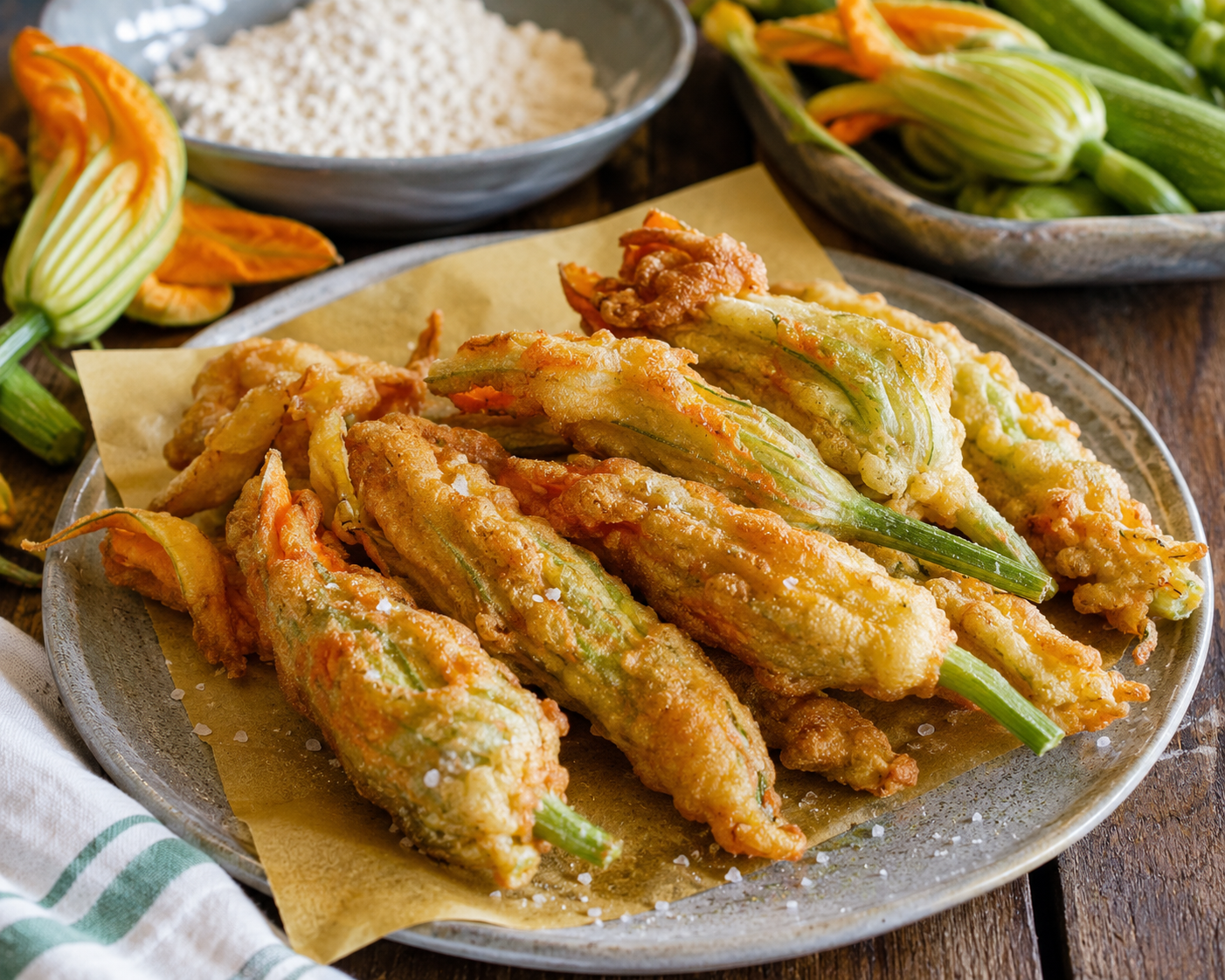
Fried zucchini flowers are meant to be eaten immediately, and this is the single most important rule of serving them. Straight from the oil, drained, salted and served at once, they are at their glorious best, crisp and hot with the cheese still molten inside, and every minute of waiting diminishes them, so they are a dish to fry and eat, not to hold. This is precisely why they are so prized fresh from the fryer in Rome.
The traditional presentation is charmingly humble. In Rome the flowers are often served simply piled on a plate lined with yellow paper, the classic vessel for the city’s fried foods, eaten with the fingers as an antipasto or a snack, sometimes with a wedge of lemon though the classic mozzarella-and-anchovy version needs nothing more. At home you can serve them just as simply, hot from the pan, with a little extra salt.
They fit into a meal as a starter or an aperitivo, and they call for the right drink. Fried zucchini flowers make a perfect antipasto to open a summer meal or a delicious bite with drinks before dinner, and they pair beautifully with something cold and sparkling, a chilled glass of prosecco or a cold beer, whose crispness cuts the richness of the fried, cheesy flower. Serve them the moment they are ready, and you recreate at home the very thing Romans queue for on an August afternoon. It is worth frying in small batches for exactly this reason, resisting the temptation to crowd the pan in order to finish faster. A crowded pan drops the oil temperature and leaves the flowers greasy rather than crisp, and it also means the first ones sit and soften while the last ones cook, so the patient cook who fries a few at a time and serves each batch straight away will always outdo the hurried one.
A Taste of the Italian Summer
The lasting appeal of fried zucchini flowers is that they turn a fleeting seasonal ingredient into one of the great pleasures of the table, a dish that exists only in the warm months and tastes entirely of summer. There is something special about a delicacy tied so closely to its season, available only when the zucchini bloom, which makes each plate of them feel like a small celebration of the moment, exactly the kind of eating the Italian summer is built on.
What makes them so satisfying to make at home is that they deliver a restaurant-worthy, queue-worthy result from the humblest of ingredients and a little care. A flower, some cheese, an anchovy, a light batter and hot oil become something people travel and wait for, which is a wonderful thing to be able to produce in your own kitchen, and the technique, once learned, is quick and endlessly repeatable through the summer. The care is all in the handling, not in any difficulty.
So when the zucchini flowers appear at the market this summer, seize them, because their season is short and their reward is great. Clean them gently, stuff them with mozzarella and anchovy, coat them in a light cold batter, fry them fast in hot oil, and eat them at once while they blister and steam, and you will taste for yourself why Romans queue in the August heat for this small golden delicacy. Few dishes give back so much summer for so little effort, and few are as fleetingly, gloriously perfect as a fried zucchini flower eaten the moment it leaves the pan.

About the Author: Ruben, co-founder of Gamintraveler.com since 2014, is a seasoned traveler from Spain who has explored over 100 countries since 2009. Known for his extensive travel adventures across South America, Europe, the US, Australia, New Zealand, Asia, and Africa, Ruben combines his passion for adventurous yet sustainable living with his love for cycling, highlighted by his remarkable 5-month bicycle journey from Spain to Norway. He currently resides in Spain, where he continues sharing his travel experiences with his partner, Rachel, and their son, Han.