
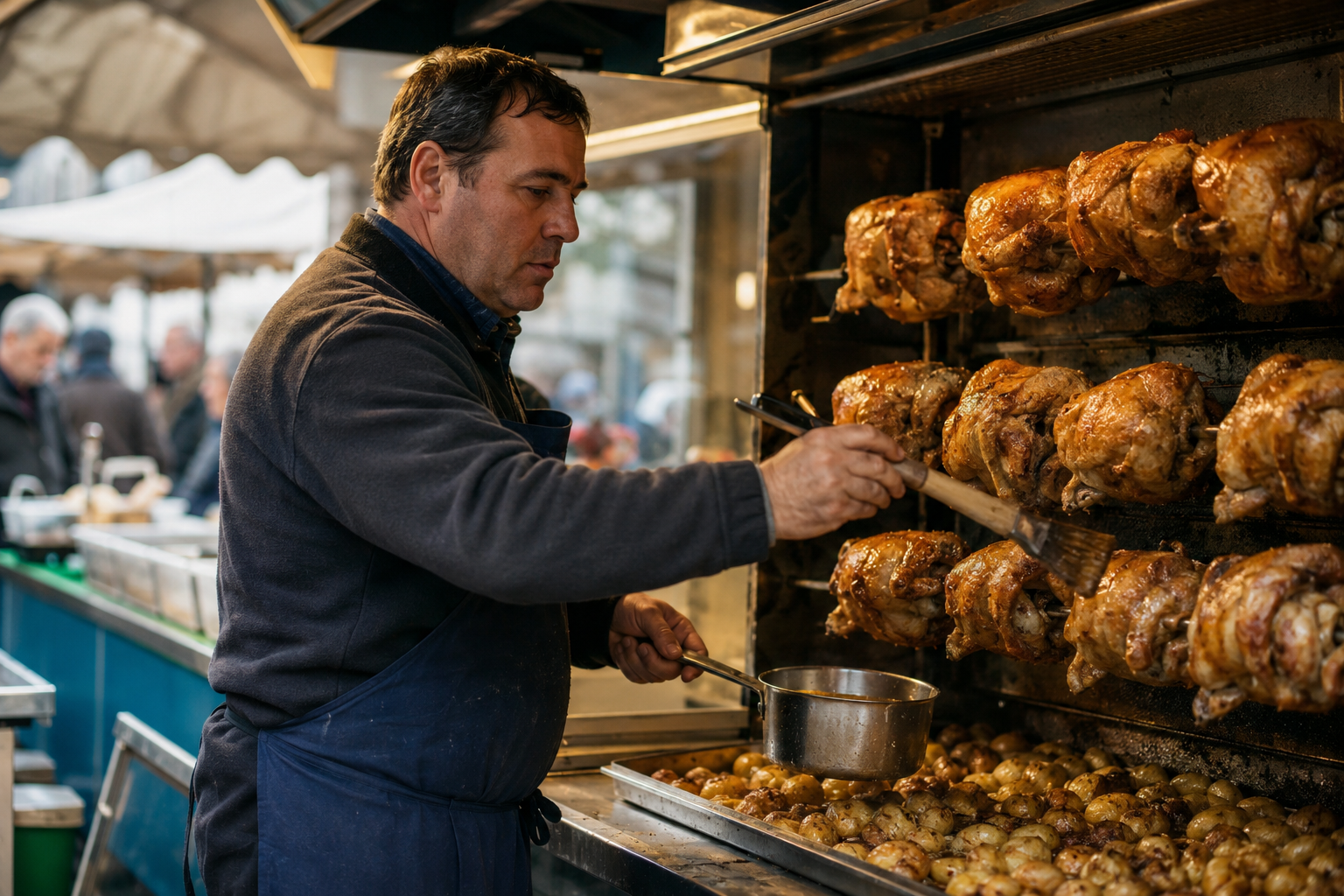
There is a smell that means Sunday in France, and once you have known it you never forget it. It drifts across the market square from a battered truck with a rack of golden birds turning slowly over a low flame, their fat and juices raining down onto a bed of potatoes below, and it is so good that people do not even look at the stand. They just follow their noses, baskets in hand, and join the queue. This is poulet rôti, the French market rotisserie chicken, and it is one of the great everyday glories of French life.
The rotisserie chicken is a fixture of the French Sunday, a golden, crackling, herb-scented bird bought hot from the market to be carried home for lunch, and the potatoes roasted in its dripping fat beneath it are very nearly as prized as the chicken itself. It is affordable, it is glorious, and it is woven so deeply into French life that the smell of it on a Sunday morning is practically the smell of the week’s best meal beginning. And the wonderful thing is that you can make it beautifully at home.
Here is what the French market rotisserie tradition really is, why it holds such a place in the country’s heart, what makes the chicken and those famous potatoes so good, and how to roast a proper poulet rôti in your own oven, with a full recipe to follow. This is a beloved and living tradition, and recreating it at home brings a little of the French Sunday to any kitchen anywhere in the world.
The Sunday Ritual of the Market Chicken
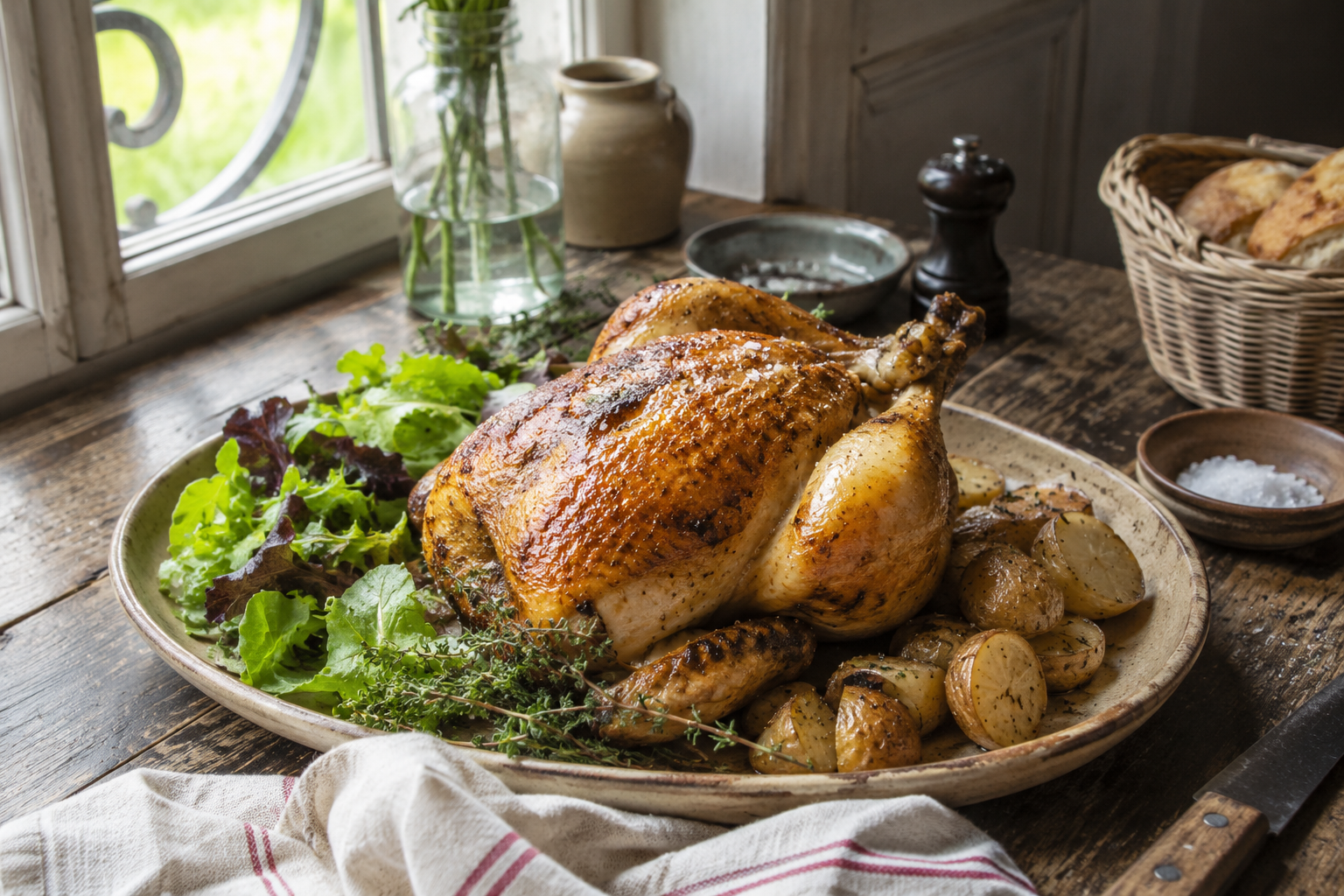
To understand poulet rôti you have to picture the French Sunday market, where it is a central character. Across France, in town squares and village markets, the rotisserie stands are a fixture, great rotating ovens stacked with rows of chickens turning and browning, and buying one for Sunday lunch is a ritual millions of French families keep week after week.
The scene has a particular magic. The birds turn in their racks, burnished and dripping, while beneath them the potatoes roast in the falling fat, and a queue forms of people who followed the smell across the market with their baskets and their canvas totes. You do not need to inspect the chicken or read a sign, because the aroma does all the advertising, pulling the hungry toward the stand from streets away. It is, in the best sense, the original fast food, glorious and ready and waiting.
This is affordable everyday luxury, which is part of its charm. A whole rotisserie chicken from the market costs only a handful of euros, feeds a family, and arrives hot and perfect with no work at all, which makes it one of the great value pleasures of French life. For a modest sum you carry home a magnificent Sunday lunch, and the tradition endures precisely because it delivers so much joy for so little money and effort.
The Word Comes From the Craft
The rotisserie chicken carries more history than its humble price suggests, and the word itself tells the story. The rôtisseurs, the roasters, were their own trade in old France, with a guild that ranks among the oldest in the country’s culinary history, dedicated to the craft of roasting meats on the turning spit. The very word rotisserie that English borrows so casually comes directly from their name and their art.
That heritage lives on in every market stand. When you buy a poulet rôti from a rotisserie truck today, you are the inheritor of a craft centuries old, the modern descendant of the medieval rôtisseur turning his spit before the fire, and the technology has changed while the essential act has not. The bird still turns, the fat still bastes it as it goes, and the result is still the same golden, self-basted perfection the roasters perfected long ago.
There is a deeper compliment buried in the tradition too. A perfectly roasted chicken is regarded by many of the greatest cooks, from Julia Child to Joël Robuchon, as one of the ultimate tests of a cook’s skill, a dish whose very simplicity leaves nowhere to hide. That such an everyday food carries such prestige tells you something about how seriously France takes it, and about how much art hides inside the humble market bird. What makes roast chicken such a test is precisely that it cannot be rescued by garnish or sauce or cleverness. With so few ingredients and no disguise, every choice shows, the quality of the bird, the seasoning, the heat of the oven, the timing of the rest, so that a truly great one is the mark of a cook who has mastered the fundamentals. The market rôtisseur, turning out perfect birds by the dozen, is a quiet master of that art.
The Chicken and the Famous Potatoes
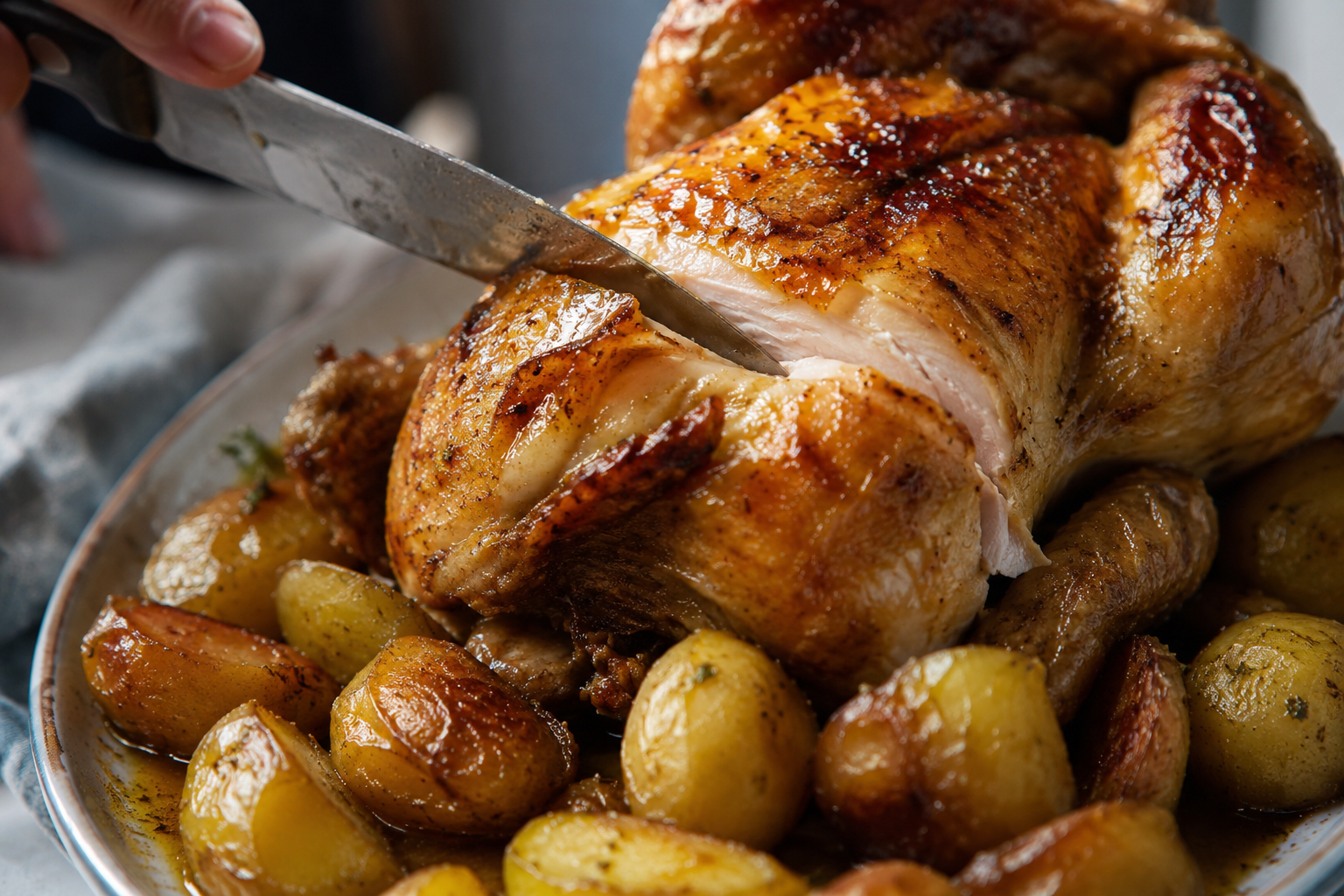
At the heart of the dish are two things, the bird and the potatoes beneath it, and the relationship between them is the whole secret. The chicken roasts above, turning and browning and rendering its fat and juices, and those precious drippings fall onto a bed of potatoes waiting below, so that the potatoes cook in pure chicken fat and savory juice, absorbing all of that flavor as they crisp and soften.
Those potatoes are the stuff of legend. Roasted in the falling fat of the chicken above them, they emerge crisp and golden outside and meltingly tender within, saturated with the savory, herby, chicken-rich flavor of everything that dripped onto them, and many people quietly consider them the best part of the whole meal. A poulet rôti without its fat-roasted potatoes underneath is only half the dish, because the two were designed to be made together.
The chicken itself is a study in how little it takes to make something sublime. A good bird, well seasoned with salt and herbs and often a great deal of butter, roasted until the skin is crisp and burnished and the meat is juicy and tender, needs nothing more, since the magic is in the quality of the chicken and the care of the roasting rather than in any elaborate technique. It is proof that the simplest food, done well, can be the most satisfying of all. This is the deep lesson the French take from their Sunday chicken, that excellence lies less in complication than in doing plain things beautifully. A perfectly roasted bird with crisp skin and juicy meat, its potatoes drinking up the drippings, needs no reinvention and tolerates no shortcut, and it satisfies precisely because it is exactly what it should be. In an age of culinary showmanship, the humble poulet rôti is a reminder that the plainest dishes are often the ones we love most.
Recreating It at Home
The happy truth is that you can bring this whole experience into your own kitchen, because while nothing perfectly replicates the market spit, a home oven comes remarkably close. The trick that turns an ordinary roast chicken into a real poulet rôti is to roast the bird directly above the potatoes, so that the fat and juices drip down onto them exactly as they do at the market stand, giving you both the golden chicken and those extraordinary potatoes in a single pan.
The flavor is unmistakably French and beautifully simple. The classic seasoning is butter, garlic, lemon and herbes de Provence, the sun-warmed herb blend that carries the taste of the French south, rubbed over and under the skin so the whole bird is perfumed and the flesh stays moist. Butter is the great French secret here, slathered generously under the skin to baste the meat from within as it melts, giving the chicken its rich taste and its crisp, browned skin.
A few techniques make the difference between good and magnificent. Drying the skin well before roasting helps it crisp, seasoning the cavity as well as the outside prevents blandness, tucking butter and herbs under the skin keeps the breast juicy, and basting the bird as it roasts builds up that deep golden color. Rest the chicken before carving so the juices settle back into the meat, and deglaze the pan with a splash of white wine to make a quick jus from the caramelized drippings. None of it is hard, and all of it rewards a little attention.
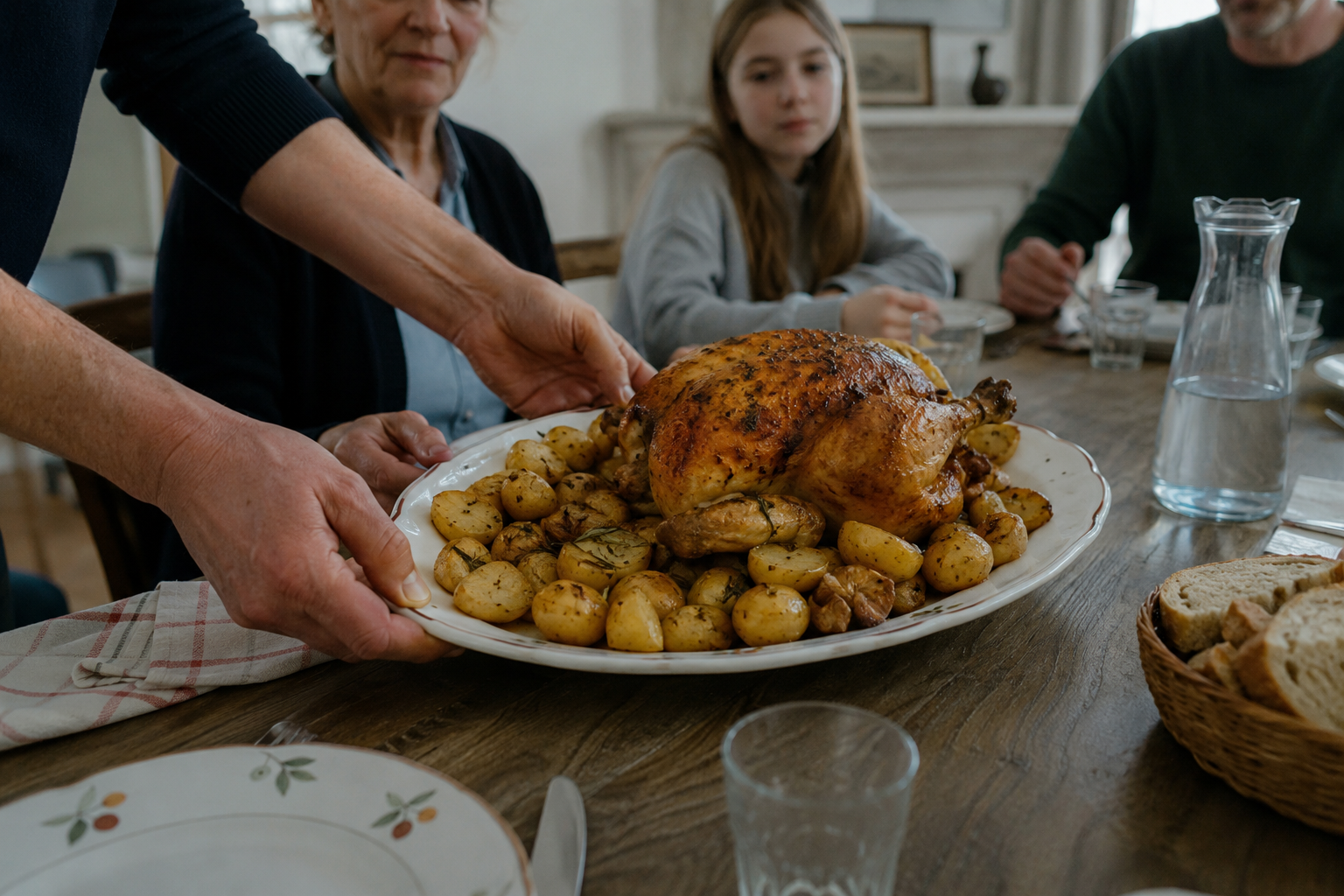
Poulet Rôti with Potatoes serves 4
Ingredients:
- 1 whole chicken, about 1.8kg
- 60g softened butter
- 1 whole head of garlic, halved crosswise, plus 3 cloves
- 1 lemon, halved
- 2 tablespoons herbes de Provence
- 1kg small potatoes, halved
- 2 tablespoons olive oil
- 120ml dry white wine
- salt and black pepper
Method:
- Preheat the oven to 220C and pat the chicken thoroughly dry with paper towels, which is the key to crisp skin.
- Mash the softened butter with the herbes de Provence, the 3 minced garlic cloves, and a good pinch of salt and pepper.
- Gently loosen the skin over the breast with your fingers and push half the herb butter underneath, then rub the rest all over the outside of the bird.
- Season the chicken well inside and out with salt, and place the lemon halves and the halved head of garlic inside the cavity.
- Toss the halved potatoes with the olive oil and salt, and spread them in a single layer in a roasting pan.
- Set a wire rack over the potatoes and place the chicken on top, breast up, so its juices will drip onto them as it roasts.
- Roast for about 1 hour and 20 minutes, basting once or twice, until the skin is deep golden and the juices run clear from the thigh.
- Lift the chicken onto a board and let it rest for 15 minutes while the potatoes finish crisping in the oven.
- Set the roasting pan over medium heat, pour off excess fat, add the white wine, and scrape up the browned bits to make a quick jus.
- Carve the chicken and serve with the fat-roasted potatoes, the pan jus, and a crisp green salad.
Choosing and Serving the Bird
If you want your home poulet rôti to taste like the market’s, it starts at the butcher rather than the oven. A good chicken is the whole foundation of the dish, and since the seasoning is so simple there is nowhere for a poor bird to hide, so it pays to buy the best you can, ideally a free-range or label rouge style chicken with real flavor and firm flesh. The French take the provenance of their poultry seriously for exactly this reason.
Size and freshness matter too. A bird of around one and a half to two kilos roasts evenly and stays juicy, larger than that and the breast tends to dry before the legs are done, and a fresh chicken at room temperature before it goes in the oven cooks more evenly than one straight from the fridge. These are small things, but in a dish this bare they are the difference between good and unforgettable.
When it comes to the table, the French keep the accompaniments as honest as the chicken. The classic partners are the fat-roasted potatoes from beneath the bird, a crisp green salad dressed simply with a sharp vinaigrette to cut the richness, and good bread for mopping the juices, with perhaps some haricots verts or roasted roots alongside. Nothing fancy is needed, because the chicken and its potatoes are the stars.
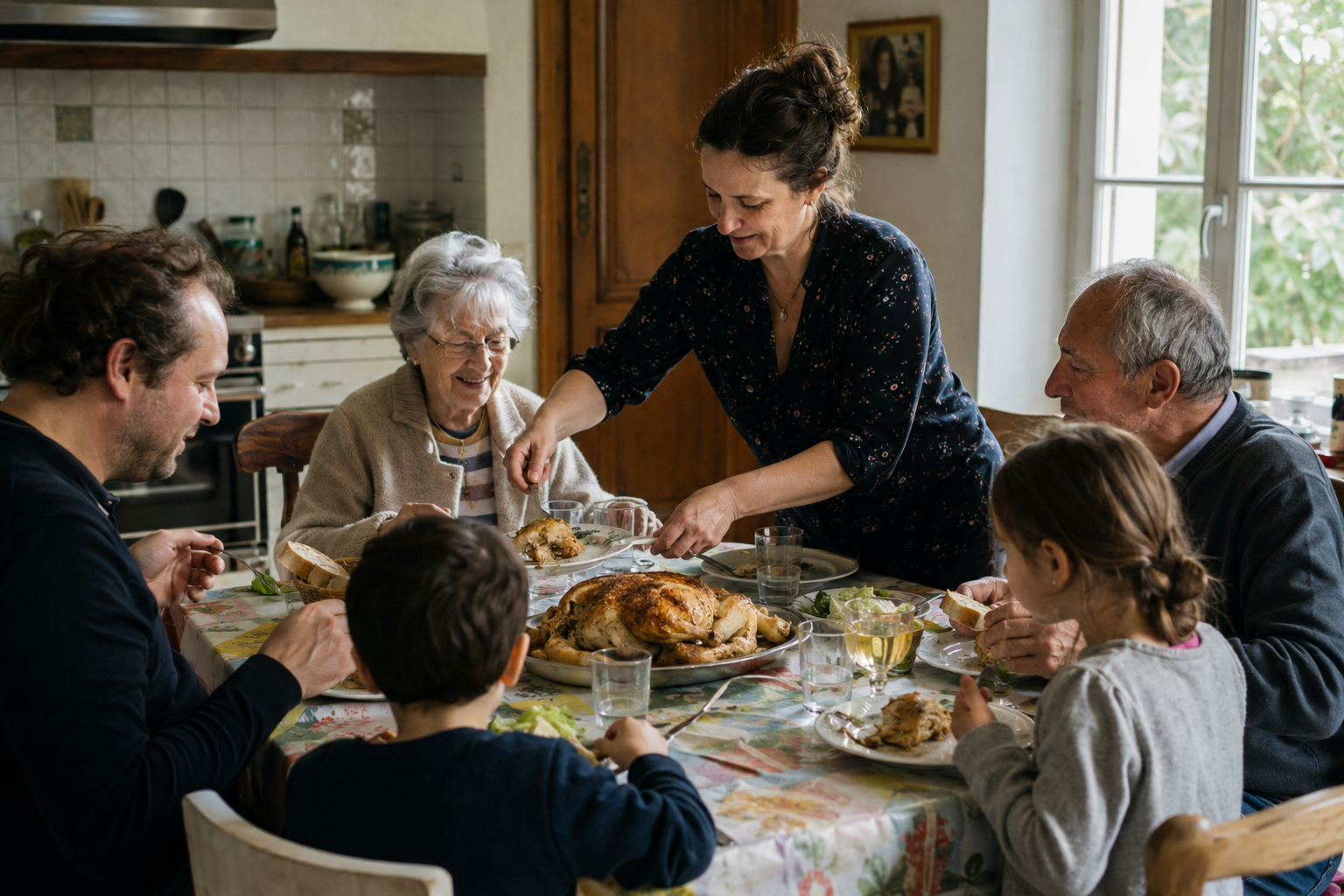
There is a rhythm to serving it that is part of the pleasure. The bird is carried whole to the table and carved there, the potatoes heaped alongside, the jus poured over, and everyone helps themselves, which turns a simple meal into a small communal event. This is Sunday food in the deepest sense, generous and unhurried and meant to be shared, the kind of meal that holds a family at the table long after the plates are clean.
The Chicken That Keeps On Giving
Part of the genius of the poulet rôti is what happens after the first meal, because a whole roast chicken is really several meals in one. The Sunday bird is generous, and the leftovers carry through the days that follow, the remaining meat pulled for salads and sandwiches and soups, so that a single chicken quietly feeds a family well beyond its first appearance at the table.
Nothing goes to waste in the French way of it. The carcass becomes stock, simmered with vegetables into a golden broth that forms the base of countless later dishes, so that even the bones give one last gift after the meat is gone. This thrift is part of the tradition’s wisdom, a single affordable chicken stretched across a week of good eating through nothing more than a little care and a stockpot.
The leftover potatoes and jus have their afterlives too. Cold roast chicken with those fat-crisped potatoes is a fine lunch the next day, the jus saved to moisten and flavor whatever the meat becomes next, and the whole thing embodies a way of cooking that wrings maximum pleasure and nourishment from simple, humble ingredients. The market chicken is not just a Sunday lunch but the start of a week’s worth of good, easy food.
Bringing the French Sunday Home
The rotisserie chickens of the French market are one of those small, perfect things that a whole culture has quietly gotten exactly right, an affordable, glorious, communal pleasure that turns an ordinary Sunday into something to look forward to. The smell of them across a market square is the smell of the week’s best meal beginning, and the sight of the golden birds turning over their bed of potatoes is one of the enduring images of French life.
You do not have to be in France to have it. With a bird, some butter and herbs, a handful of potatoes and a hot oven, you can fill your own kitchen with that same unmistakable aroma and set down that same golden chicken and those same extraordinary potatoes on a Sunday of your own. It is simple, it is affordable, it is deeply satisfying, and it carries a little of the French market into any home that makes it.
So this Sunday, follow the tradition rather than your nose to a market truck, and roast a poulet rôti of your own. Rub the butter and herbs into the skin, set the bird over its potatoes, let the oven fill the house with that heavenly smell, and gather people around the table when it is done. You will understand, as you carve into the crisp golden skin and reach for a fat-roasted potato beneath, exactly why Sunday morning in France smells the way it does, and why it is a smell worth carrying home.

About the Author: Ruben, co-founder of Gamintraveler.com since 2014, is a seasoned traveler from Spain who has explored over 100 countries since 2009. Known for his extensive travel adventures across South America, Europe, the US, Australia, New Zealand, Asia, and Africa, Ruben combines his passion for adventurous yet sustainable living with his love for cycling, highlighted by his remarkable 5-month bicycle journey from Spain to Norway. He currently resides in Spain, where he continues sharing his travel experiences with his partner, Rachel, and their son, Han.