
Americans understand, deep in their bones, that salt makes sweet things better. It is why salted caramel took over dessert menus, why chocolate-covered pretzels exist, why kettle corn is addictive. The salt-sweet contrast is one of the great pleasures of eating. And yet Americans mostly confine it to candy and dessert.
Greeks apply the same rule somewhere Americans rarely think to: fresh fruit and cheese. All summer long, across the country, Greeks eat cold watermelon with salty, briny feta, the two together in a single bite. It is one of the most refreshing things you can eat in the heat, it could not be simpler, and it uses exactly the salt-sweet logic behind a caramel, just pointed at a slice of fruit instead of a candy bar.
The Great Greek Summer Pairing
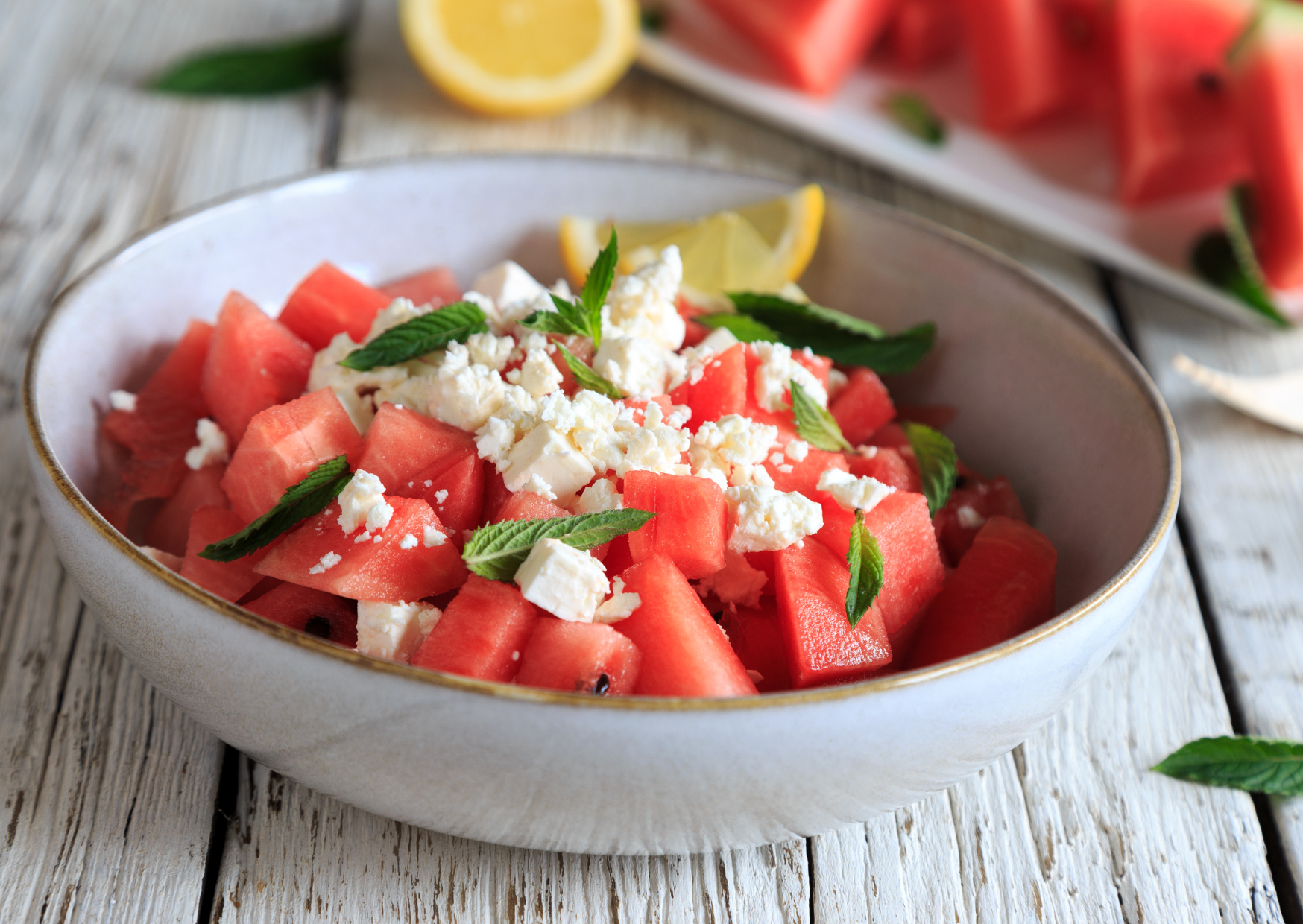
In Greece, watermelon and feta is not a trendy restaurant invention but an everyday summer staple, so ordinary that many Greeks would be surprised anyone finds it novel. Watermelon, karpouzi, is everywhere in the Greek summer, sold whole and enormous, hauled through village streets by vendors calling out from open-bed trucks.
The fruit is so beloved that many tavernas simply bring out a plate of cold watermelon as a free dessert at the end of a meal, a small gift to finish on something sweet and cooling. Somewhere along the way, Greeks discovered that a piece of feta alongside that watermelon was even better than the watermelon alone. The pairing became a fixture, eaten as a light snack, a meze, a starter, or a dessert, on hot days when nobody wants to cook and everybody wants something cold.
It is a genuinely old habit, woven into the fabric of the Greek summer rather than dreamed up by a chef. The combination shows up on family tables, at beachside gatherings, and in seaside tavernas alike, wherever the heat calls for something that refreshes without weighing you down. For a dish of just two ingredients, it carries an enormous amount of cultural comfort, the taste of summer itself for a great many Greeks.
Part of what makes it so distinctly Greek is the quality of the raw materials. Greek summer watermelons, ripened under a relentless sun, are intensely sweet, and Greek feta is among the best in the world, tangy and rich from sheep’s milk. With ingredients that good, the pairing barely needs help; the country almost stumbled into a perfect dish simply by putting two of its finest summer staples on the same plate.
Why Salt and Sweet Work
The magic of the pairing is the same principle behind salted caramel, and it is worth understanding because it explains why something so odd-sounding tastes so right. Salt does not just add saltiness; it heightens and rounds out sweetness, making sweet things taste more intensely and more pleasantly sweet.
When you eat sweet watermelon with salty feta, the salt in the cheese amplifies the fruit’s sugar, so the watermelon tastes even sweeter and more vivid than it would on its own. At the same time, the cool, clean sweetness of the melon softens and balances the sharp, tangy saltiness of the feta, so each one improves the other. Neither overwhelms; they meet in the middle. It is a two-way trade that leaves both ingredients tasting better than they did apart.
Texture plays its part too, and it is a big part of the pleasure. The watermelon is crisp, cold, and dripping with juice, while good feta is creamy, dense, and a little crumbly. That contrast, juicy against creamy, is as satisfying in the mouth as the flavour contrast is on the palate. Add the aromatic lift of fresh mint and the richness of a little olive oil, and a two-ingredient idea becomes a genuinely sophisticated bite, all without a stove ever being turned on.
It is the same reason a pinch of salt goes into nearly every dessert recipe, from cookies to caramel. Salt is not the opposite of sweet but its partner, the thing that keeps sweetness from turning flat and one-dimensional. Greeks simply took that partnership out of the oven and into the fruit bowl, where it works every bit as well.
The Salted-Caramel Paradox
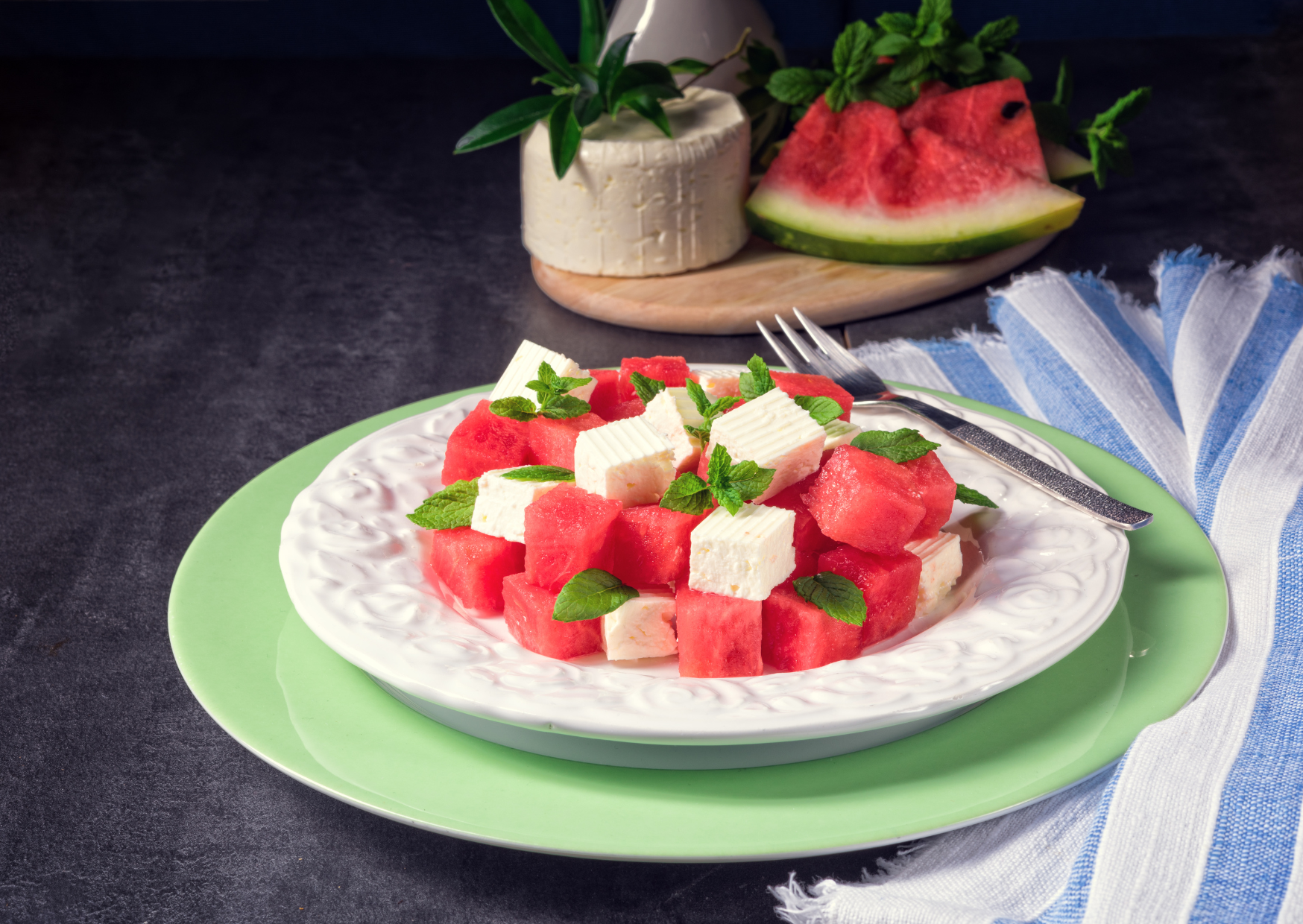
Here is what makes the Greek habit so interesting from an American point of view. Americans are, if anything, obsessed with salt-sweet, but they have drawn an invisible line around where it belongs, and fresh fruit with savoury cheese sits firmly on the far side of it.
Think about where Americans happily embrace the combination: salted caramel, chocolate-dipped pretzels, sweet-and-salty trail mix, kettle corn, bacon on a maple doughnut, a salted nut bar. Almost all of it lives in the world of sweets, snacks, and dessert. The salt is added to candy. What Americans do far less often is take a piece of ripe, sweet fruit and deliberately pair it with a salty cheese as a savoury bite, even though the underlying principle is identical. The instinct that reaches for flaky salt on a caramel somehow does not reach for feta on a watermelon.
There is one classic exception that proves the rule, and it comes from just across the Mediterranean: Italian prosciutto e melone, sweet melon draped with salty cured ham. That pairing has crossed over and is genuinely loved in America, which shows the appetite is absolutely there. Watermelon and feta is simply the same idea in a different accent, sweet fruit meeting salty savouriness, and once Americans try it, the usual reaction is to wonder why they had been keeping their salt-sweet love locked up in the dessert course all along.
A Wider Mediterranean Habit

Greece is not alone in this, and seeing watermelon and feta as part of a broader Mediterranean instinct helps explain why it feels so natural everywhere but the American fruit bowl. Around the Mediterranean, pairing sweet fruit with salty, savoury elements is simply normal.
Italy has its prosciutto e melone, and also pears with pecorino or gorgonzola. Spain pairs membrillo, sweet quince paste, with salty Manchego, and serves melon with jamón. Across the region, fresh and dried figs turn up alongside cheese and cured meats, dates are stuffed with cheese, and honey is poured over salty, tangy cheeses without a second thought. The savoury-sweet border that feels so firm on an American table barely exists here.
Watermelon and feta, then, is not a quirky one-off but Greece’s entry in a long Mediterranean tradition of letting sweet and salty share a plate. That context is part of what makes it so easy to love. You are not being asked to accept a bizarre novelty, only to join a way of eating that stretches back centuries and spans an entire sea, one that treats the line between sweet and savoury as far more of a suggestion than a rule.
How Greeks Actually Eat It
The beauty of watermelon and feta is that in its purest form it is not even a recipe, just cold watermelon and a piece of feta eaten together. But the version that has spread as a summer salad dresses the idea up just slightly, and a few well-chosen additions turn it into something special.
The classic modern salad is cubed watermelon tossed with cubed or crumbled feta, plenty of fresh mint, and a drizzle of good olive oil, with a pinch of salt and a grind of black pepper. From there, the common additions are thinly sliced red onion for bite, a handful of kalamata olives for a deeper salty note, and sometimes cucumber for extra crunch and coolness. A little acidity, a squeeze of lemon or a drizzle of sweet balsamic, lifts the whole thing, and a touch of Greek honey can push the sweet-salty balance further if you like.
The single most important choice is the feta. This dish lives or dies on it, so use real Greek feta, made from sheep’s milk and stored in brine, which is creamy, tangy, and properly salty rather than the dry, bland blocks sometimes sold under the name. Cut it into generous cubes rather than a fine crumble so you get real, satisfying pieces of cheese against the fruit. Everything else is flexible, but good feta and good ripe watermelon are non-negotiable, because with only a handful of ingredients, each one has nowhere to hide.
Putting It Together
There is almost nothing to making watermelon and feta salad, which is exactly the point, since it is meant for the laziest, hottest days of summer when cooking feels impossible. Cube the watermelon, add the feta and mint, dress it lightly, and you are done in the time it takes to say it.
The only real cautions are to salt with a light hand, because the feta and olives are already salty, and to assemble it shortly before serving, since the watermelon releases juice as it sits and can turn a beautiful salad watery. Keep everything cold, taste as you go, and let the fruit and cheese lead. Serve it as a starter, a side to grilled fish or lamb, or a refreshing bite on its own, and you will have borrowed one of the smartest, simplest tricks of the Greek summer table. The salt-sweet rule was never meant only for caramel.
Greek Watermelon and Feta Salad (Karpouzi me Feta)
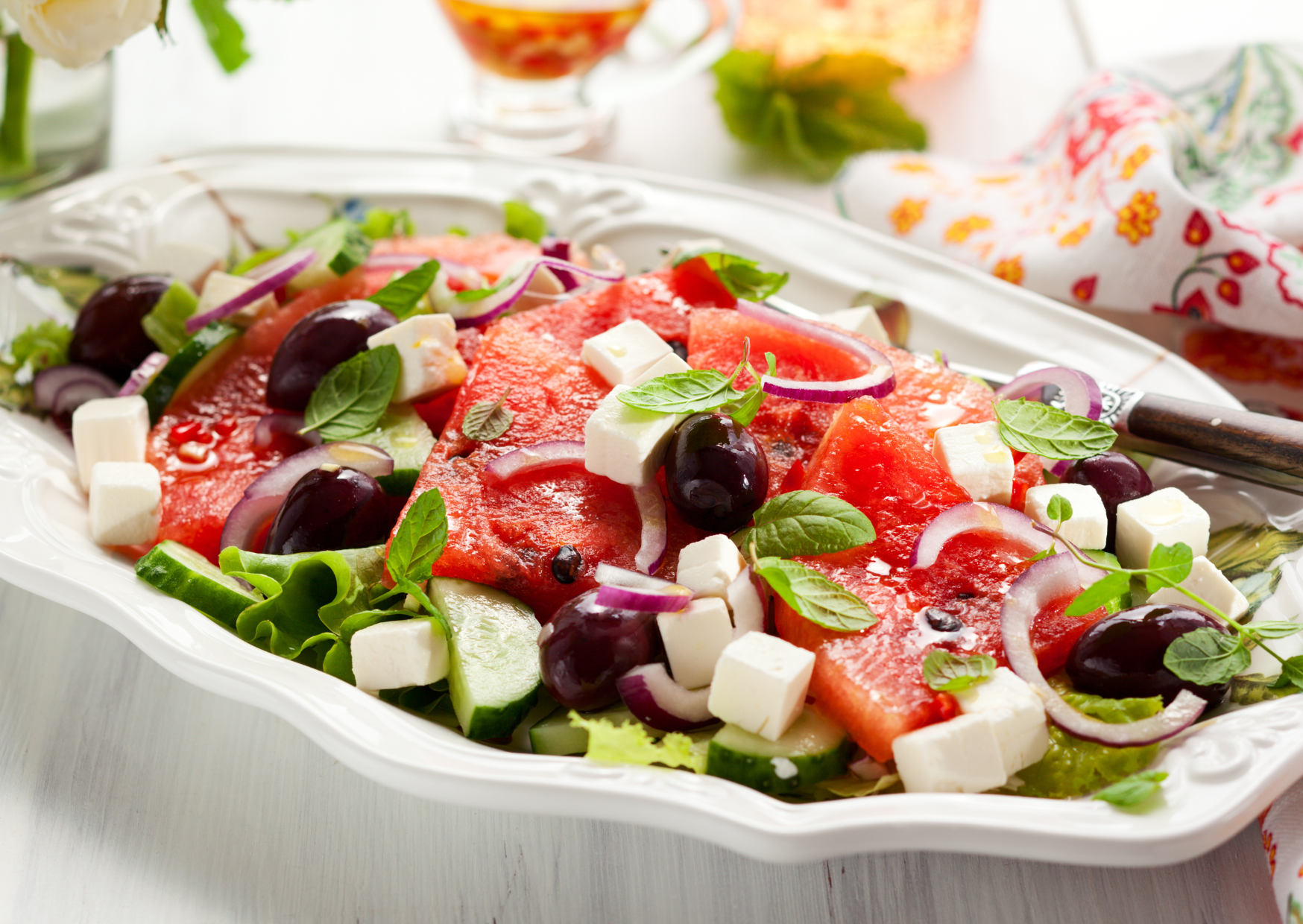
The Greek summer classic: cold cubed watermelon with brined feta, fresh mint, and olive oil. A perfect salt-sweet contrast, ready in ten minutes with no cooking.
Serves: 4 · Prep: 10 minutes · Cook: none
Ingredients
- 800 g (about 5 cups) cold watermelon, rind removed, cut into 2 cm cubes
- 200 g (7 oz) Greek feta, in brine, cut into cubes
- Small handful fresh mint leaves, torn
- 2 tbsp extra-virgin olive oil
- ½ small red onion, very thinly sliced (optional)
- Handful of kalamata olives (optional)
- Squeeze of lemon or drizzle of balsamic vinegar (optional)
- Flaky salt and freshly ground black pepper
Method
- If using red onion, soak the thin slices in cold water (or a little lemon juice) for 10 minutes to soften their bite, then drain.
- Put the cubed watermelon in a large serving bowl. Add the onion, if using.
- Drizzle with the olive oil, add a small pinch of flaky salt and a grind of black pepper, and toss gently.
- Scatter the feta, mint, and olives over the top. Add a squeeze of lemon or a drizzle of balsamic if you like.
- Serve immediately, while cold, before the watermelon releases too much juice.
Notes
- Use real Greek feta made from sheep’s milk and kept in brine; it is creamy and properly salty. Avoid dry, bland blocks.
- Salt lightly, since the feta and olives are already salty.
- Assemble just before serving; watermelon weeps as it sits and can make the salad watery.
- A close cousin is Italian prosciutto e melone, the same sweet-salty idea with cured ham and melon.

About the Author: Ruben, co-founder of Gamintraveler.com since 2014, is a seasoned traveler from Spain who has explored over 100 countries since 2009. Known for his extensive travel adventures across South America, Europe, the US, Australia, New Zealand, Asia, and Africa, Ruben combines his passion for adventurous yet sustainable living with his love for cycling, highlighted by his remarkable 5-month bicycle journey from Spain to Norway. He currently resides in Spain, where he continues sharing his travel experiences with his partner, Rachel, and their son, Han.