
In Impruneta, a terracotta town in the hills south of Florence, the beef arrives almost black. It has spent four hours in a pot with red wine and an amount of black pepper that looks like a typing error, and it went into that pot raw. No searing, no crust, no thermometer. Every American beef rule broken in one dish, and it is one of the best things you will eat in Tuscany.
American beef education is a list of commandments. Sear hard for flavor. Never boil. Medium rare or you have ruined it. A steak is thick, heavily seasoned, and yours alone. Raw will hurt you. Italy, a country that takes food as seriously as anyone alive, cooks beef in near-perfect opposition to all of it.
Working down the list explains a lot about both kitchens.
The Boiled Beef Italians Serve At Celebrations
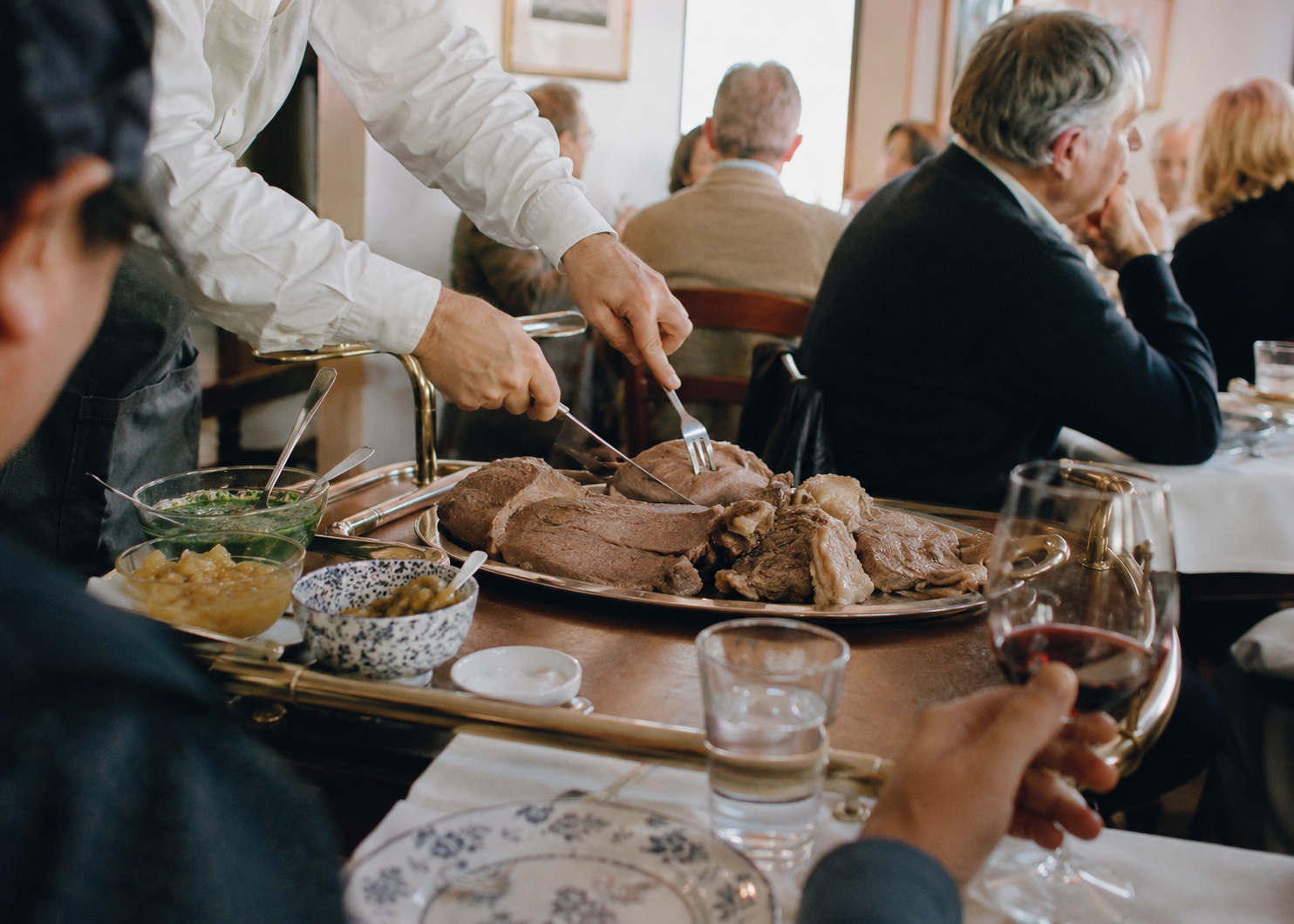
Piedmont and Emilia-Romagna treat boiled beef as festive cooking. Bollito misto, the mixed boil, is a procession of beef cuts, tongue, cotechino sausage, and sometimes a whole hen, simmered for hours and wheeled to the table on a trolley in the grand old restaurants, carved to order, served with salsa verde sharp with capers and anchovy. The codified grand version, the gran bollito misto alla piemontese, runs to seven cuts of beef plus its ornaments and a bench of sauces, and it is what Piedmont eats to celebrate.
Alongside the salsa verde comes mostarda di Cremona, whole candied fruit in a mustard syrup that sounds wrong and works completely, sweetness and heat against plain simmered meat.
Even the leftovers have a name and a following. La francesina is what Florence does with yesterday’s boiled beef, shredded and stewed with slow-cooked onions and a little tomato until it turns sweet and collapsing, and plenty of Tuscans will tell you it beats the original dish. A cuisine that plans a second recipe for its boiled beef is not apologizing for boiling it.
The American rule says boiling washes flavor out, and it is half right. The flavor goes into the broth, which is the point. The broth becomes tortellini in brodo, the meat comes off the trolley tender, and the sauces do the sharpening. Nothing is lost. The dish just refuses to make one pot do only one job.
Stracotto Means Overcooked, On Purpose
Italian has a beef dish whose name literally means overcooked, and the name is a compliment. Stracotto is beef braised until it gives up and collapses, hours past the end of any American doneness chart. Its cousins run across the north: brasato al Barolo in Piedmont, a whole cut cooked slowly in a bottle of the region’s most serious wine, and the peposo of Tuscany, which closes this piece.
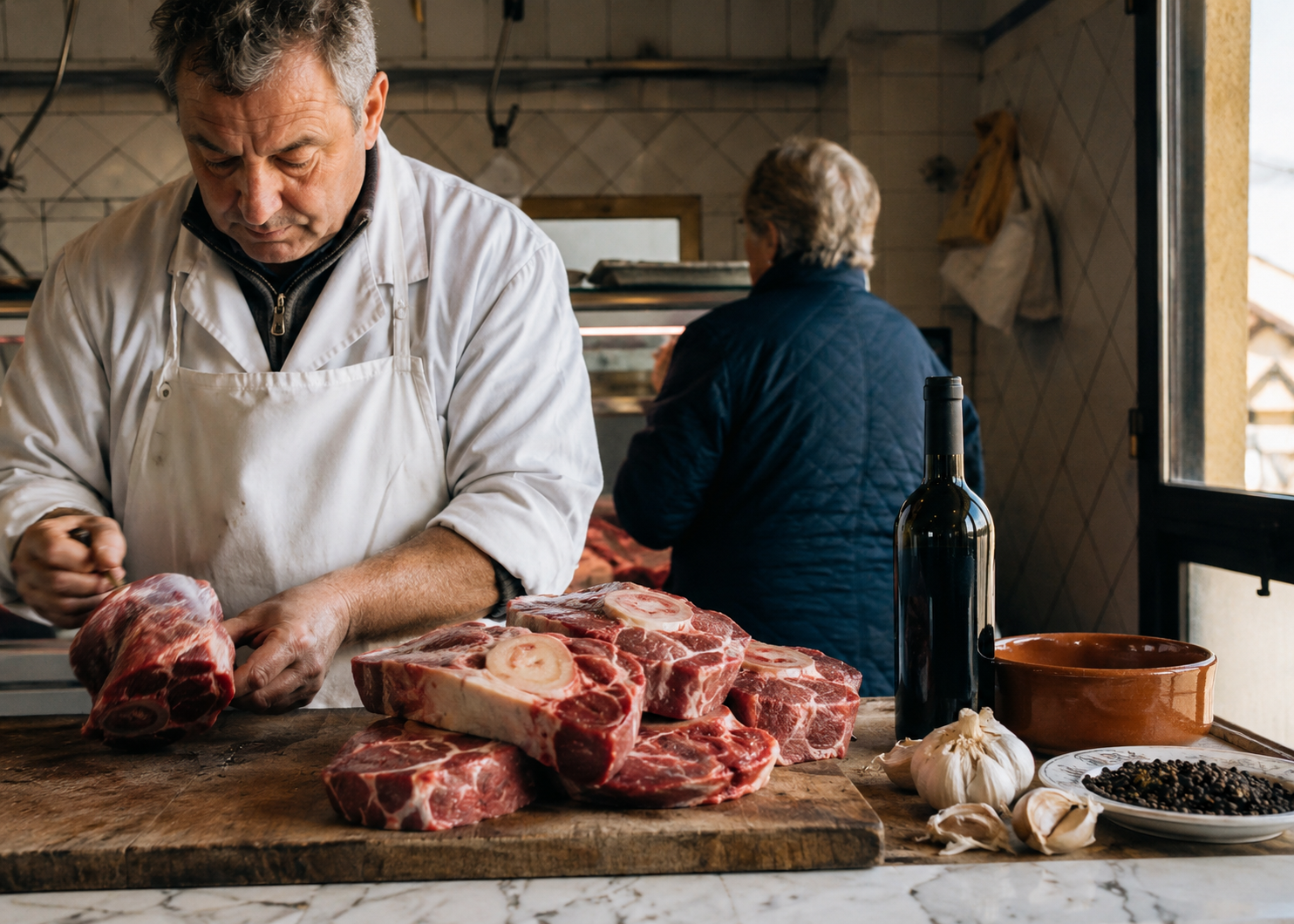
Milan adds the most famous member of the family. Ossobuco, the crosscut veal shin braised until the marrow loosens in the bone, is finished with gremolata, a raw scatter of lemon zest, garlic, and parsley, and served with a small spoon for the marrow because the marrow is the point. An American butcher counter treats shin as soup bones. Milan built one of the world’s great dishes on it and put the bone in the name.
The logic is the cut. These dishes use shin, cheek, and chuck, the working muscles full of collagen that medium rare turns to rubber. Time and low heat melt that collagen into gelatin, which is where the silk in a great braise comes from. The American doneness chart is correct for a ribeye and useless for a shin. Italy never confused the two.
The braises also live a second life as pasta. Leftover stracotto gets shredded into its own sauce and folded through pappardelle, and Piedmont pinches yesterday’s brasato into agnolotti del plin, the tiny hand-sealed parcels that turn one Sunday pot into a second dinner nobody complains about. One braise, in the Italian kitchen, opens a whole week.
A Steak Sold By Weight And Shared By The Table
When Italy does grill a steak, it flips a different set of rules. Bistecca alla fiorentina is cut thick from the Chianina, the enormous white Tuscan breed that pulled plows for two thousand years before anyone grilled it, and it is sold by weight, priced by the hundred grams, chosen at the counter. A proper fiorentina weighs a kilo or more and feeds the table. Nobody orders their own.
The seasoning would offend a competition pitmaster: essentially nothing. No marinade, no rub, no butter baste. The steak meets the fire naked, takes salt at the end and maybe a thread of olive oil on the plate, and it comes one way, charred outside and nearly raw at the bone. Ask for it well done in Florence and plenty of kitchens will politely decline. The famous butchers of the region, like Dario Cecchini in Panzano, have built careers on exactly this refusal to complicate good meat.
The cooking itself is fast and physical: five minutes a side over hard coals, then the steak is stood upright on its bone for a few final minutes so the heat climbs through the thickest part. Twenty minutes of fire for a kilo of beef, against the American hours of smoking and basting, and then it is carved off the bone and passed around.
There are two more house rules. The steak is cut alta tre dita, three fingers thick, never less, and it comes up to room temperature on the counter while the coals burn down. A cold, thin steak off a fierce fire gives you the gray band under the crust that Italians consider a defect and American steakhouses consider Tuesday.
Raw Beef From A Venice Bar
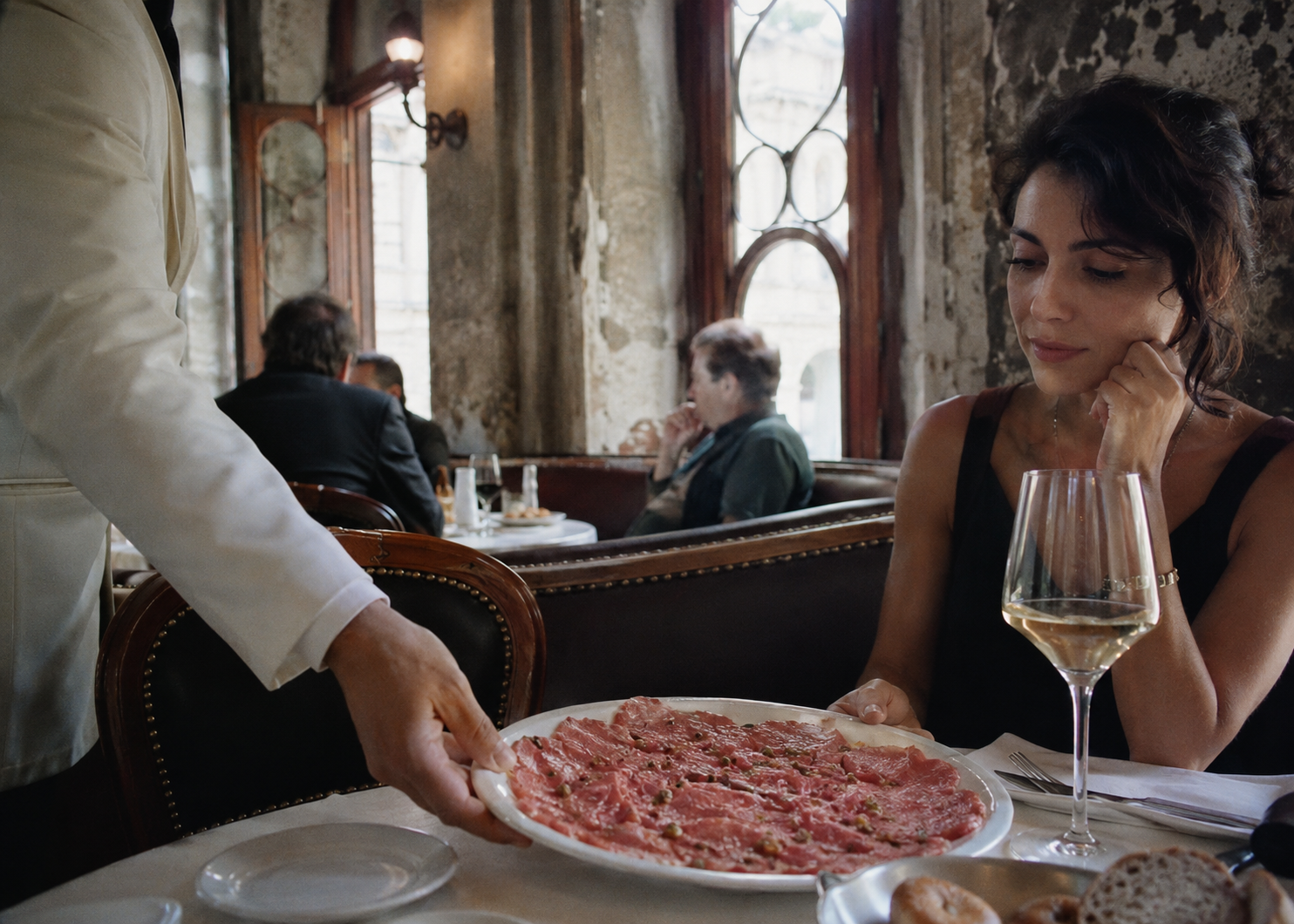
Carpaccio, the dish American menus still treat as cheffy and modern, was invented in 1950 at Harry’s Bar in Venice. Giuseppe Cipriani sliced raw beef paper-thin for the countess Amalia Nani Mocenigo, whose doctor had ordered her off cooked meat, and named the plate for Vittore Carpaccio, the Renaissance painter whose reds it matched.
At Harry’s Bar the dish still arrives the original way, the raw slices cross-hatched with a thin mayonnaise-based sauce Cipriani called the universal sauce, though most of Italy now serves carpaccio simpler, with lemon, olive oil, arugula, and parmesan shavings.
Piedmont goes further with carne cruda all’albese, hand-chopped raw veal or beef dressed with lemon, olive oil, and garlic, eaten as a starter in completely ordinary trattorias, sometimes under shaved white truffle in autumn. The lesson is not that raw meat carries no risk. It is that Italy’s food-safety system was the butcher’s reputation rather than the thermometer, and in a country of small shops where the customer knows the shopkeeper, that system worked.
Salt, Oil, Lemon, And Very Little Else
The American spice-cabinet approach, the rubs and marinades and compound butters, treats beef as a canvas. The Italian approach treats it as the painting.
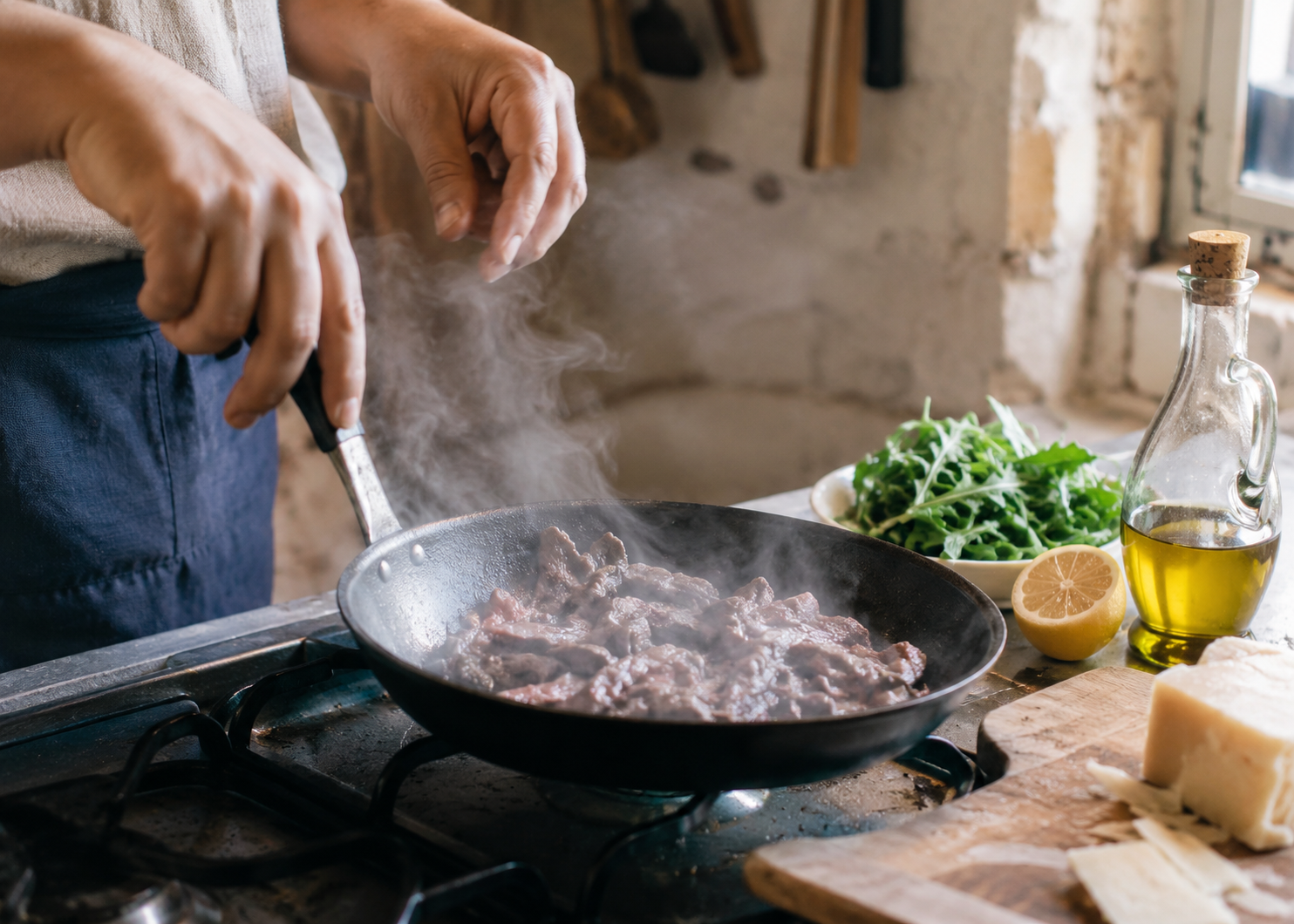
Tagliata, the everyday steak dish, is seared, rested, sliced against the grain, and laid over arugula with lemon, olive oil, and parmesan shavings. Straccetti, “little rags,” goes further: beef sliced almost thin enough to read through, cooked for one minute in a screaming pan, finished the same way. Ten minutes start to plate, and the seasoning never grows past salt, oil, lemon, sometimes rosemary.
The one technique straccetti demands is heat discipline. The pan must be genuinely smoking before the beef touches it, the strips go in without crowding, and they come out the moment they lose their raw color, because thirty extra seconds turns rags into rubber. Cook in two batches rather than one crowded one. It is the fastest beef dish in the Italian repertoire and the easiest to ruin by caution.
The shopping translates easily. Straccetti wants any tender, quick-cooking cut, sirloin or rump sliced as thin as your knife allows, and it is the best possible use of a smaller amount of good beef, which was always the Italian math.
The restraint is not minimalism for style points. Italian beef dishes are built to taste like beef, and everything else on the plate exists to sharpen that, never to cover it.
Why Italy Ended Up Opposite
The history is thrift. Cattle in Italy were working animals first, and beef was what happened at the end of a long working life, which meant tough, which meant the braise and the long pot. Tender prime cuts for casual weeknight grilling is a rich country’s habit, and Italy got rich late.
The habit survives in the numbers. Italians still eat far less beef per person than Americans, roughly half, and much of it arrives as an ingredient, the ragù, the braise, the filling, rather than as a slab in the center of the plate.
The economics still hold today, and they are the most practical reason to steal the Italian playbook. At a Spanish or Italian butcher counter, shin runs around 8 to 9 euros a kilo (about $4 to $5 a pound) while ribeye costs three times that, and the American spread is similar. A peposo feeds six people generously for roughly 15 euros of beef, less than one restaurant burger a head, and it does it with the cut the doneness-chart cooking cannot use at all. The rules you were taught quietly steer you toward the most expensive third of the animal. The Italian rules unlock the other two thirds.
So the peasant kitchen learned to win with time instead of tenderness, and the celebration kitchen learned to make one great animal feed a whole table. The American rules were written for abundant corn-fed beef eaten steak-first. The Italian rules were written for scarcity, and scarcity turns out to be an excellent cooking teacher.
The strange part is that America’s own best beef tradition already agrees. Texas brisket runs on the same collagen arithmetic as a stracotto, a tough cut taken far past well done until it surrenders, and no pitmaster alive would serve it medium rare. The knowledge was always there, parked out back in the barbecue pit. Italy just applied it to the whole animal, on a stovetop, without the smoker or the twelve-hour vigil.
Peposo, The Braise That Breaks Every Rule At Once
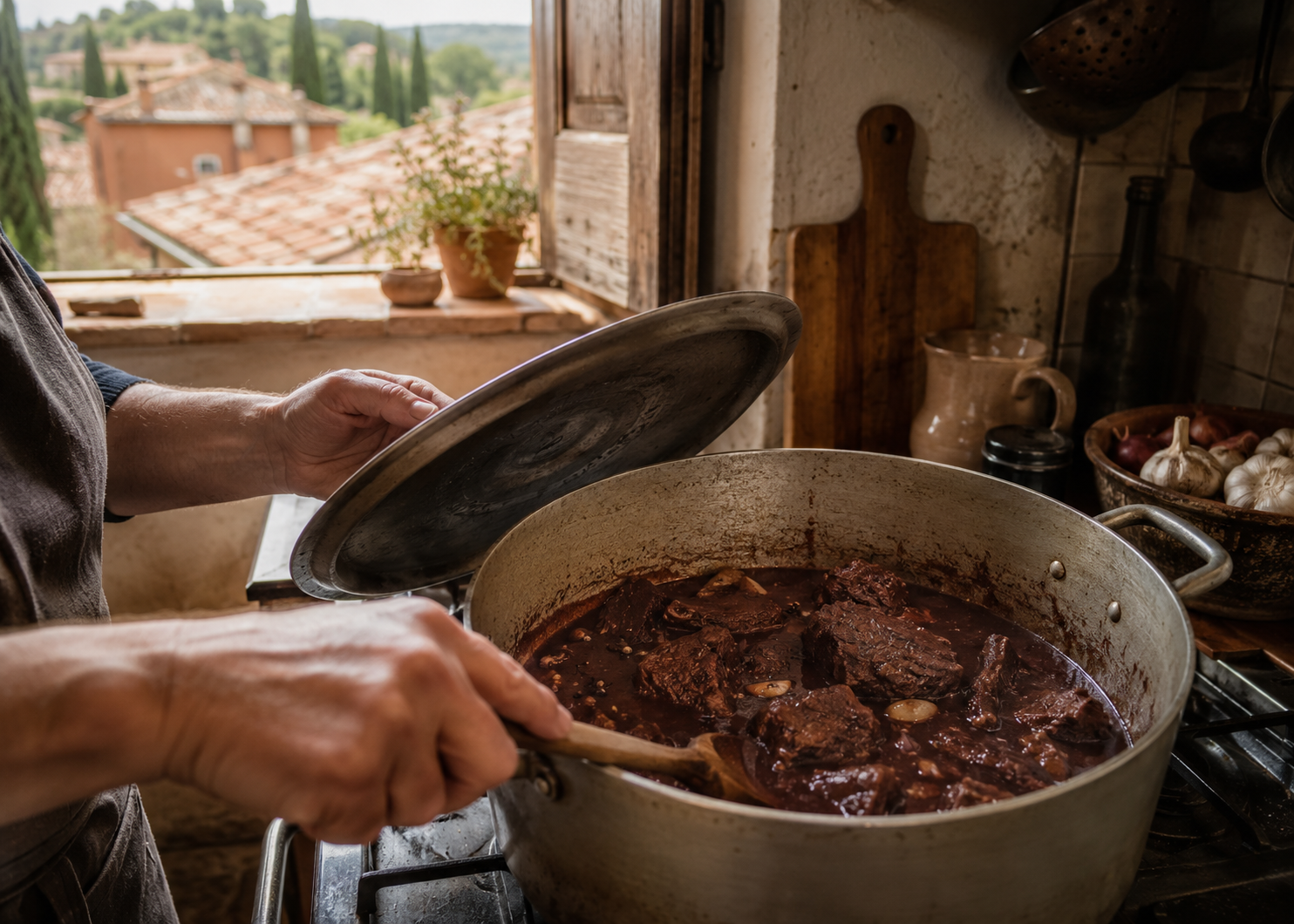
The proof dish is peposo dell’Impruneta, and the story locals tell is that the kiln workers of Impruneta, who fired the terracotta for Brunelleschi’s dome in Florence, cooked it at the mouths of their kilns, beef and wine and pepper left to mind itself through a work shift. The legend may be polished. The dish is not.
Four ingredients: beef shin, a whole bottle of Chianti, an amount of black pepper that will worry you, garlic, salt. No browning, no soffritto, no flour, no stock. Everything goes into the pot cold and the pot goes low for three to four hours. What comes out is glossy, black-purple, peppery, spoon-tender beef that costs a fraction of a steak dinner and tastes like it took skill you did not need to have.
Ingredients (serves 6)
- 1.5kg (3.3 lb) beef shin or chuck, in large 5cm chunks
- 1 bottle (750ml) Chianti or another dry red wine
- 2 tablespoons whole black peppercorns, plus 1 tablespoon coarsely ground
- 6 garlic cloves, unpeeled, lightly crushed
- 2 teaspoons salt
- Bread or polenta, to serve
Method
- Put the beef in a heavy pot with the garlic, salt, ground pepper, and whole peppercorns. Do not brown anything.
- Pour in the wine. It should nearly cover the meat; top up with a little water if it does not.
- Bring just to a simmer, then cover and drop to the lowest heat, barely bubbling.
- Cook 3 to 4 hours, stirring now and then, until the beef is spoon-tender and the sauce is dark and glossy.
- Uncover for the last 30 minutes if the sauce needs to thicken. Taste for salt.
- Rest 15 minutes and serve over toasted bread or polenta. It is better the next day.
It also quietly buries the oldest rule of all. Generations of American cooks were taught that searing seals in the juices, and food science put that one down decades ago: a crust adds flavor, but it seals nothing, and a braise loses no moisture worth mourning either way. Peposo is the practical proof. Its depth comes from the wine reducing for hours, the pepper blooming into the fat, and the collagen turning to gelatin, three sources of flavor the sear-first commandment never mentions. The crust was always optional. Nobody in Impruneta misses it.
The other thing peposo removes is anxiety. There is no window to miss, no thermometer to consult, and no five-degree band between perfect and ruined, because a braise that gets an extra half hour simply gets better. For anyone who has stood over an expensive steak feeling tested, cooking beef the Italian way is the discovery that the meat can be the relaxed part of the evening.
Peposo also has two camps, and both are legitimate. The purist Impruneta version is nothing but the four ingredients, while plenty of Tuscan home cooks add a spoonful of tomato paste or a few chopped tomatoes for color and roundness. Cook it pure the first time, so you taste what pepper and wine can do on their own, and then join whichever camp your table votes for.
One note on the wine: it does not need to be Chianti. Any dry red you would pour into a glass works, and in Impruneta they use whatever the year gave them. Tuscans eat peposo with their famous saltless bread, which finally makes sense with a sauce this assertive.
Where To Start Tonight
If it is a weeknight, start with straccetti. Any quick-cooking steak sliced thin, one minute in a hot pan, arugula, lemon, oil, salt, and dinner is done before pasta water boils.
The braise also scales without punishment. Doubling a peposo costs nothing but a bigger pot and feeds twelve as easily as six, which makes it the rare impressive dish that gets cheaper per person the more people come, and it reheats so well that Tuscan cooks consider day two the real serving day, when the pepper has settled into the sauce and the whole thing has turned a shade darker.
If it is Sunday, buy the cheapest beef shin at the counter, open a bottle of wine you would drink, and put the peposo on after lunch. By evening the house smells like a Tuscan kiln town, and one unbrowned pot will have taught you more about beef than the rules ever did.

About the Author: Ruben, co-founder of Gamintraveler.com since 2014, is a seasoned traveler from Spain who has explored over 100 countries since 2009. Known for his extensive travel adventures across South America, Europe, the US, Australia, New Zealand, Asia, and Africa, Ruben combines his passion for adventurous yet sustainable living with his love for cycling, highlighted by his remarkable 5-month bicycle journey from Spain to Norway. He currently resides in Spain, where he continues sharing his travel experiences with his partner, Rachel, and their son, Han.