
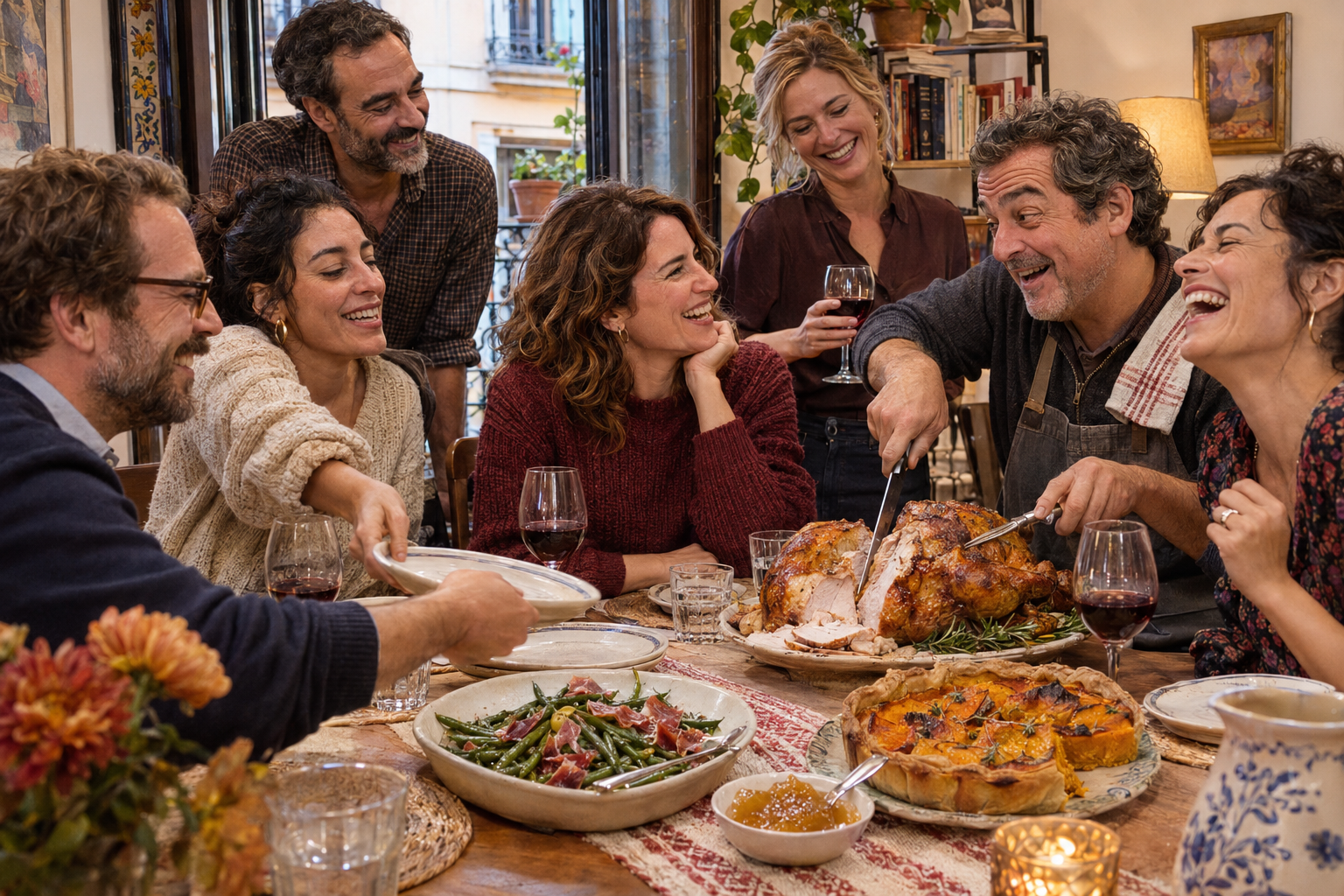
Every November, we order our Thanksgiving turkey from our butcher here in Spain, the same carnicero who has set aside a fresh bird for us for years now. And every year, when we pick it up, there is the same small, funny moment.
He hands over the turkey, wishes us well, and admits, cheerfully, that he has never once cooked one himself. Not this one, not any turkey, not ever. Because here, in his world, nobody does.
That little fact, our Thanksgiving turkey coming from a man who has no idea how to roast a turkey, tells you almost everything about what Thanksgiving abroad actually looks like. It is not the Thanksgiving of the movies and the memories, the whole country pausing together, the extended family around a groaning table, the holiday woven into the very air. It is something cobbled together at the edges of an ordinary foreign day, improvised, adapted, and, in its own way, better than we expected.
Here is what our Thanksgiving in Spain is really like, from the bemused butcher to the ordinary Thursday to the table we build and the people we build it with. It is not the Thanksgiving we grew up with, and after all these years, we would not trade it. If you are facing your own first holiday far from home, perhaps some of it will sound familiar.
The Butcher Who Has Never Roasted a Turkey
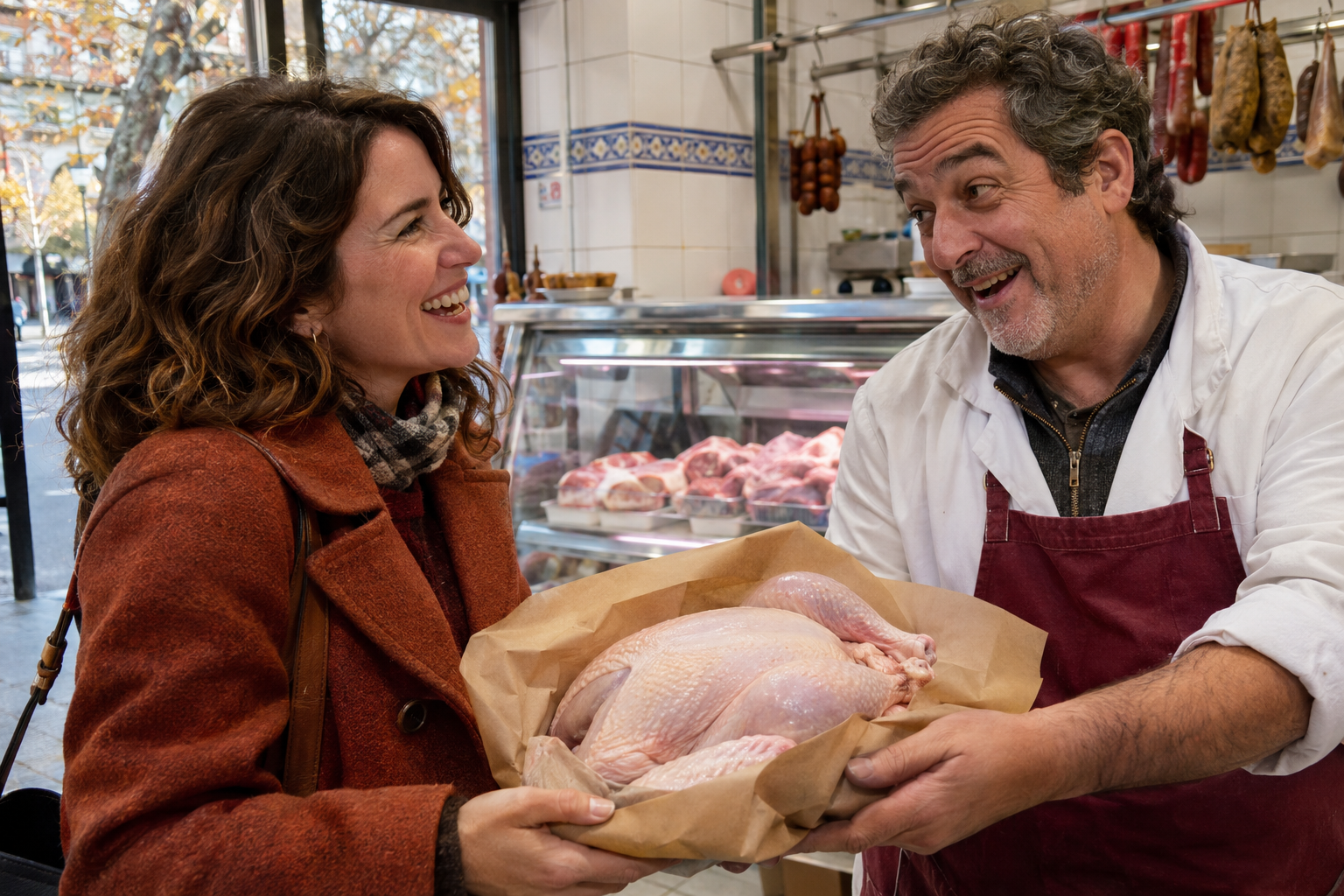
Our butcher is a lovely man, and the turkey ritual has become a small yearly comedy between us. We order the pavo in advance, he gets us a good fresh one, and when we collect it, he always asks, with genuine curiosity, how exactly we are going to cook this enormous bird. The idea of roasting a whole turkey strikes him as a slightly exotic undertaking, because to him it is.
This is the thing Americans do not realize until they live here: the roast turkey, that absolute centerpiece of the American table, is simply not a Spanish tradition. Spaniards eat turkey now and then, and it turns up around their own Christmas in some homes, but the great American ritual of the whole roasted bird, stuffed and basted and carried out in triumph, is foreign to them. So our butcher sells us the raw material of our most sacred food holiday with no personal experience of what we do with it, which never stops being funny to all of us.
And yet that bemused butcher is also, quietly, part of what makes our Thanksgiving work. Because we buy the bird fresh from him rather than frozen from a supermarket freezer that does not exist here, we start with a far better turkey than we ever did back home, and we have learned to cook it the simpler European way, without the whole brining ordeal. The man who has never cooked a turkey gives us a better one than we used to buy, and the small yearly joke with him has become one of the warm, rooted parts of our holiday, a sign that we belong to this place and this neighborhood now, turkey and all.
It Is Just Thursday
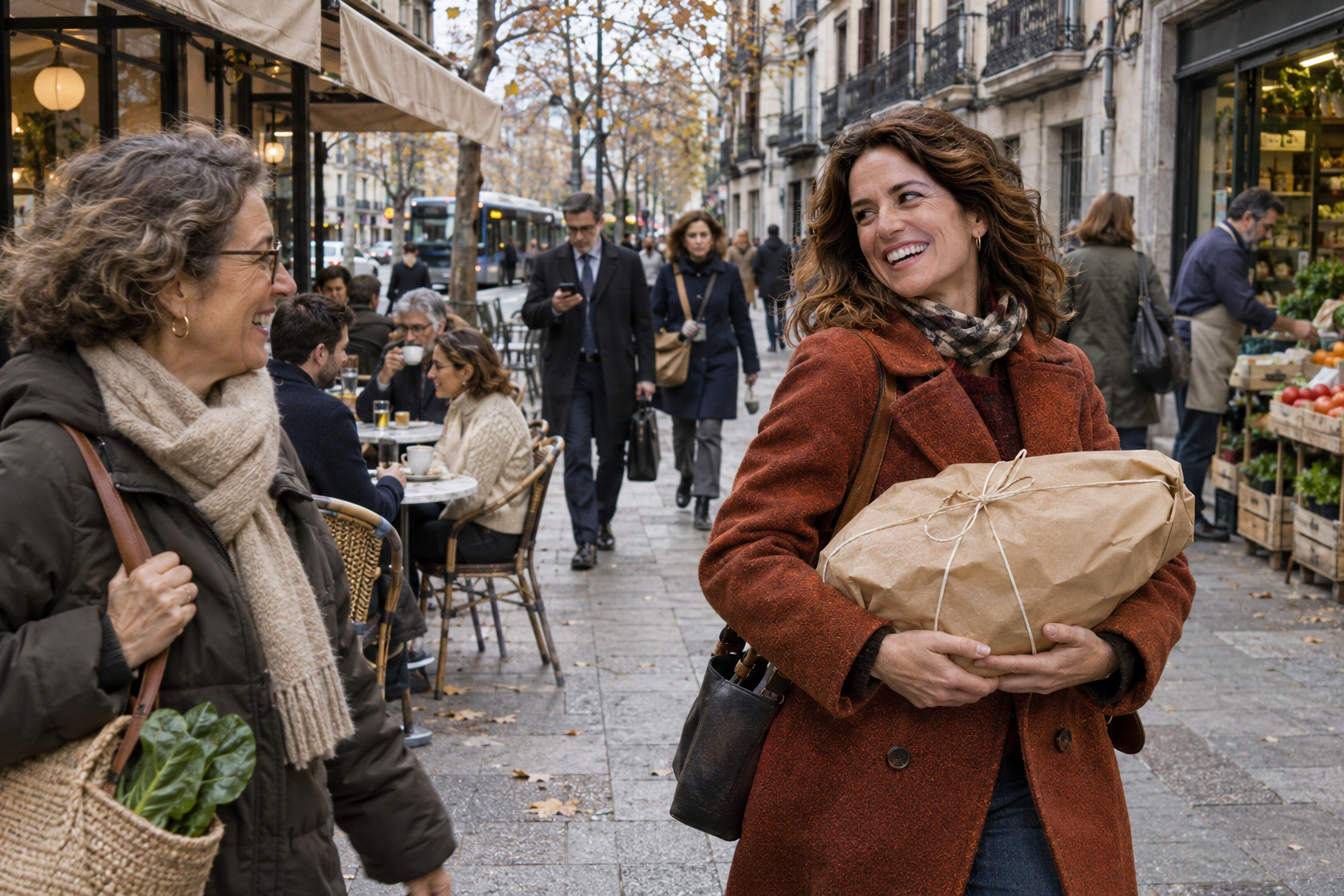
The next thing that defines Thanksgiving abroad is the simplest and the strangest: here, it is just Thursday. The fourth Thursday of November is not a holiday in Spain, not a day off, not a thing the country marks in any way. It is an ordinary working day, and the world outside our door goes on exactly as it does on any other.
This is genuinely disorienting, even after years of it. Back home, Thanksgiving is inescapable; the whole nation leans into it together, the schools and offices close, the airports fill, the air itself feels like the holiday.
Here, none of that happens. The shops are open, the streets are normal, the day carries on with its ordinary Spanish rhythm, and the biggest food holiday of our American year passes completely unremarked by everyone around us. We are celebrating a holiday that, for the country we live in, does not exist, which means we carry the whole thing ourselves, in our own home, against the backdrop of a completely ordinary day.
So our Thanksgiving happens around the edges of real life rather than in a space cleared out for it. There is no long holiday weekend wrapping it in calm; there is a regular Thursday with its regular obligations, and the feast gets fitted into and around all of that. It is a small act of will, really, to make a holiday out of a day that the entire country treats as nothing special, and that act of deliberately choosing to celebrate, rather than being swept along by a national current, turns out to change the whole character of the thing.
The Table We Build
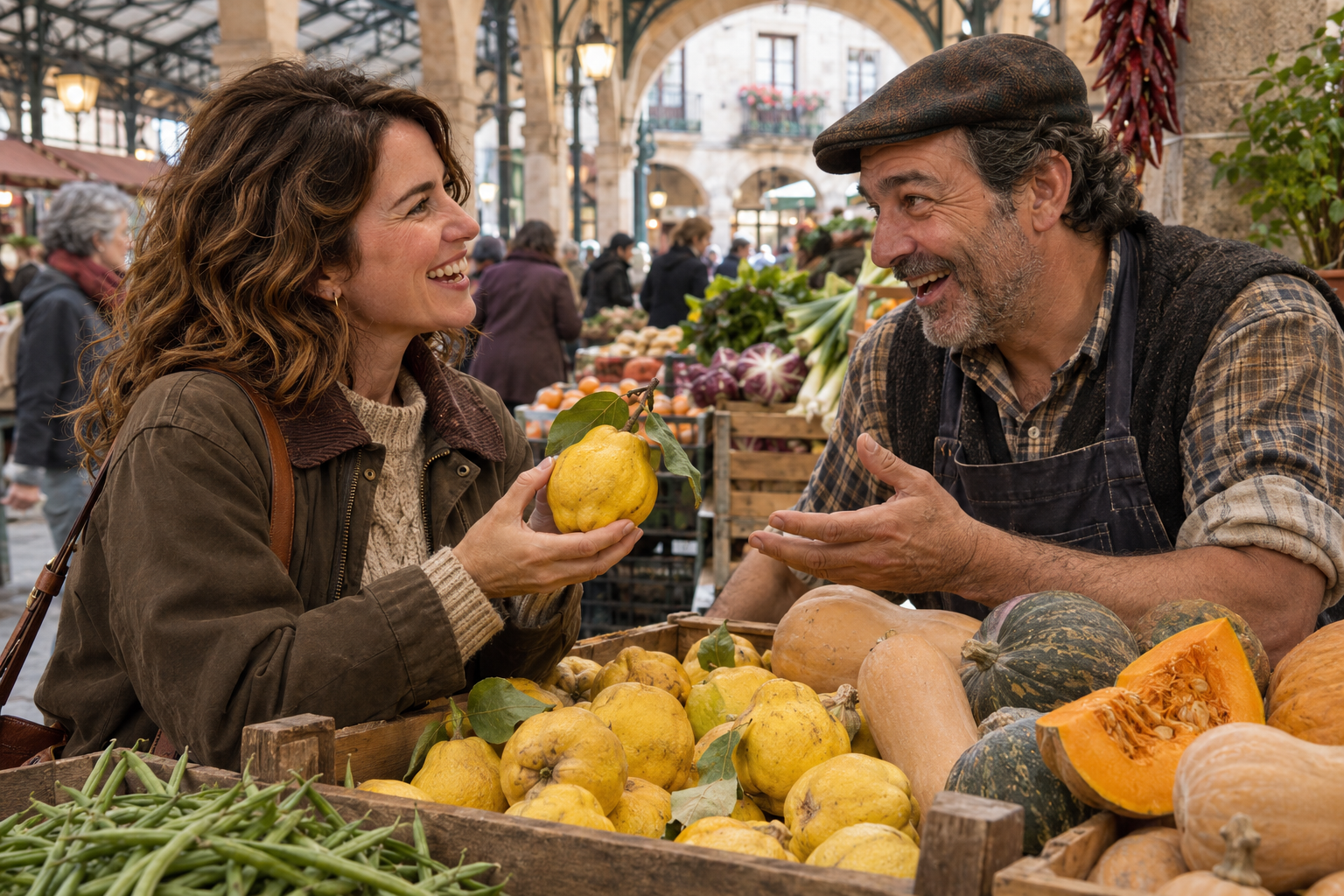
When the day does arrive, the Thanksgiving table we build is recognizably American and yet unmistakably shaped by where we live, because it is assembled almost entirely from a Spanish pantry. We cannot simply recreate the exact spread from home, so over the years we have rebuilt it, dish by dish, from what Spain actually offers.
The turkey, of course, comes from our butcher, roasted the simpler local way. But the sides have all been quietly reinvented out of necessity and, it turns out, improved in the process.
There are no cranberries anywhere in Spain, so cranberry sauce has become a tart quince sauce instead, made from the fragrant quinces that fill the markets in autumn. There is no canned pumpkin, so the pie is made from fresh roasted squash the way the local cooks do it, and it is better for it. The green bean casserole, built on canned soup we cannot buy, has given way to Spanish green beans with jamon, which is frankly a superior dish. Each gap in the shops became an adaptation, and the adaptations became our traditions.
The result is a table that is ours in a way the old one never quite was. It is Thanksgiving translated into the language of a Spanish kitchen, the familiar shapes of the holiday filled in with fresh, local, often better ingredients, and it looks a little different every year as we refine it. It is not the table we grew up with, and at first that felt like a loss, but it has become something we are proud of, an American holiday rebuilt lovingly from a foreign pantry, and it tastes, now, like home.
The People Around It
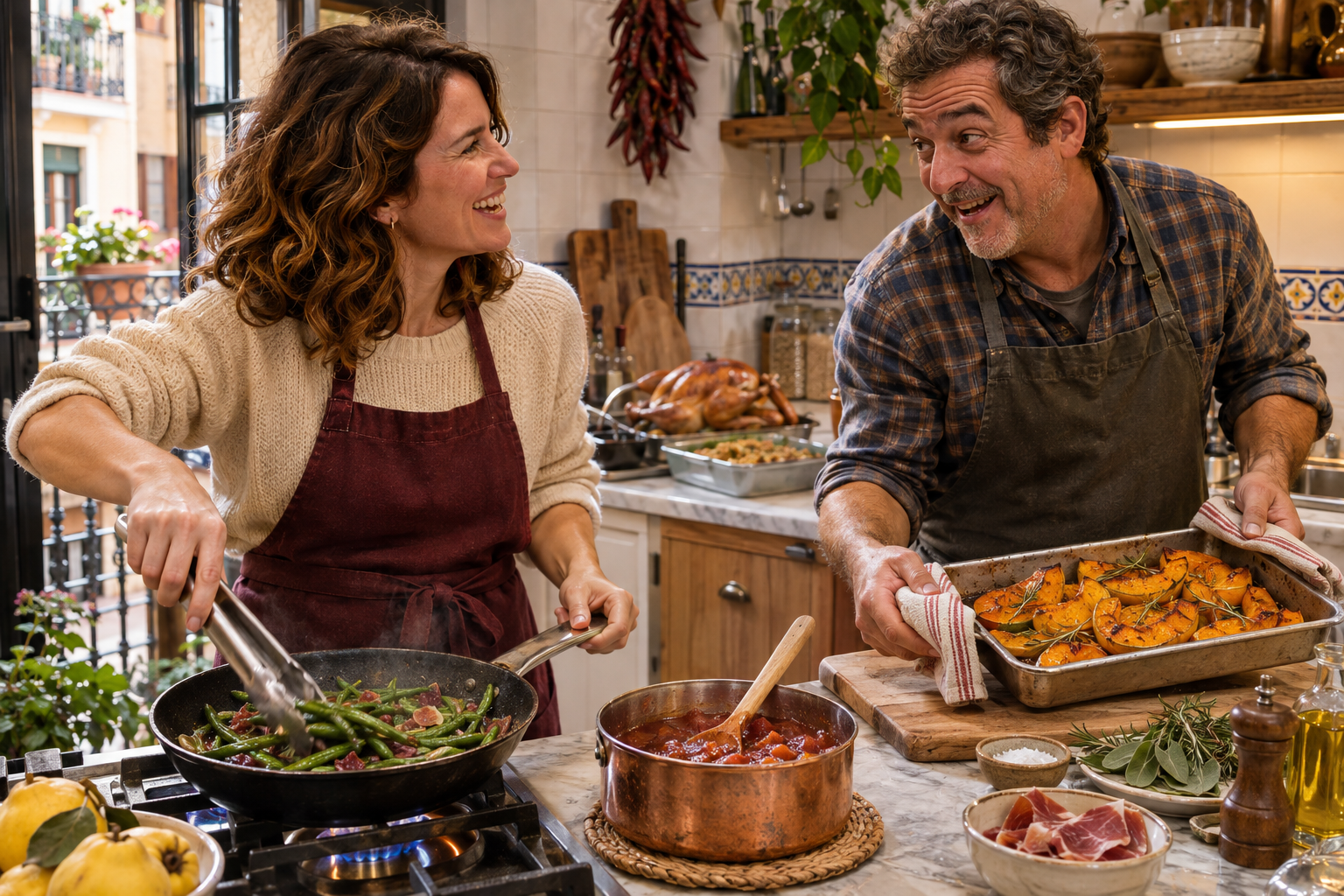
A Thanksgiving table is nothing without the people around it, and here, too, our holiday looks very different from the one back home, because the people are not the ones we would have had. Our extended family, the big gathering of relatives that is the whole point of the American holiday, is an ocean away, and we cannot simply drive to them for the day.
So we have built a different kind of gathering, from a different kind of family. It took a few years to find them, and a few quiet, small Thanksgivings before the table filled out, but it filled out. Around our table on Thanksgiving are the people our life abroad has given us: other expats far from their own homes, friends we have made here, neighbors, and sometimes a curious Spaniard or two, baffled and delighted to be invited into this strange American ritual. It is an improvised, international, slightly random assembly, bound together not by blood but by the shared circumstance of being here, far from wherever each of us started, and glad of somewhere to belong on a day that means so much.
This found family has become one of the most unexpectedly moving parts of the whole thing. We gather people who, like us, are a long way from their own tables, and in doing so we have made a new table that is entirely our own, a chosen family assembled over years of life abroad. It is not the family we were born into, and we miss that family keenly on this day. But there is a particular warmth in a holiday spent with people who chose to be there, who had somewhere else they could have been and came to us instead, and it has taught us something real about what the day is actually for.
What We Miss
It would be dishonest to paint all this as pure gain, because Thanksgiving abroad comes with a genuine ache, and we feel it most on exactly this day. There is real homesickness woven through our Spanish Thanksgiving, and pretending otherwise would be a lie.
We miss the family most of all. However lovely our found family here, there is no replacing the parents, the siblings, the cousins, the whole web of people back home who are gathering around their own tables while we are around ours, and the distance is never sharper than on the day built for being together.
We miss the small familiar things too, the specific foods we cannot get, the exact tastes of childhood holidays that no Spanish substitute quite matches. And we miss, strangely, the simple sense of the whole country celebrating at once, the feeling of being carried along by a national holiday rather than carving one out alone in a place that does not share it. There is a loneliness to celebrating a holiday nobody around you is celebrating, and it is real.
This is the honest half of Thanksgiving abroad, and we would not want to hide it, because it is part of the truth of the day for us and for everyone who does this. The holiday that is most about home is, for the expat, also the holiday that most reminds you how far from home you are. We have made our peace with that ache, and we hold it alongside the joy rather than instead of it, but it is there every year, the bittersweet shadow of a beautiful day, and anyone who tells you expat Thanksgiving is pure sunshine has left out the part that matters most.
What We Gained
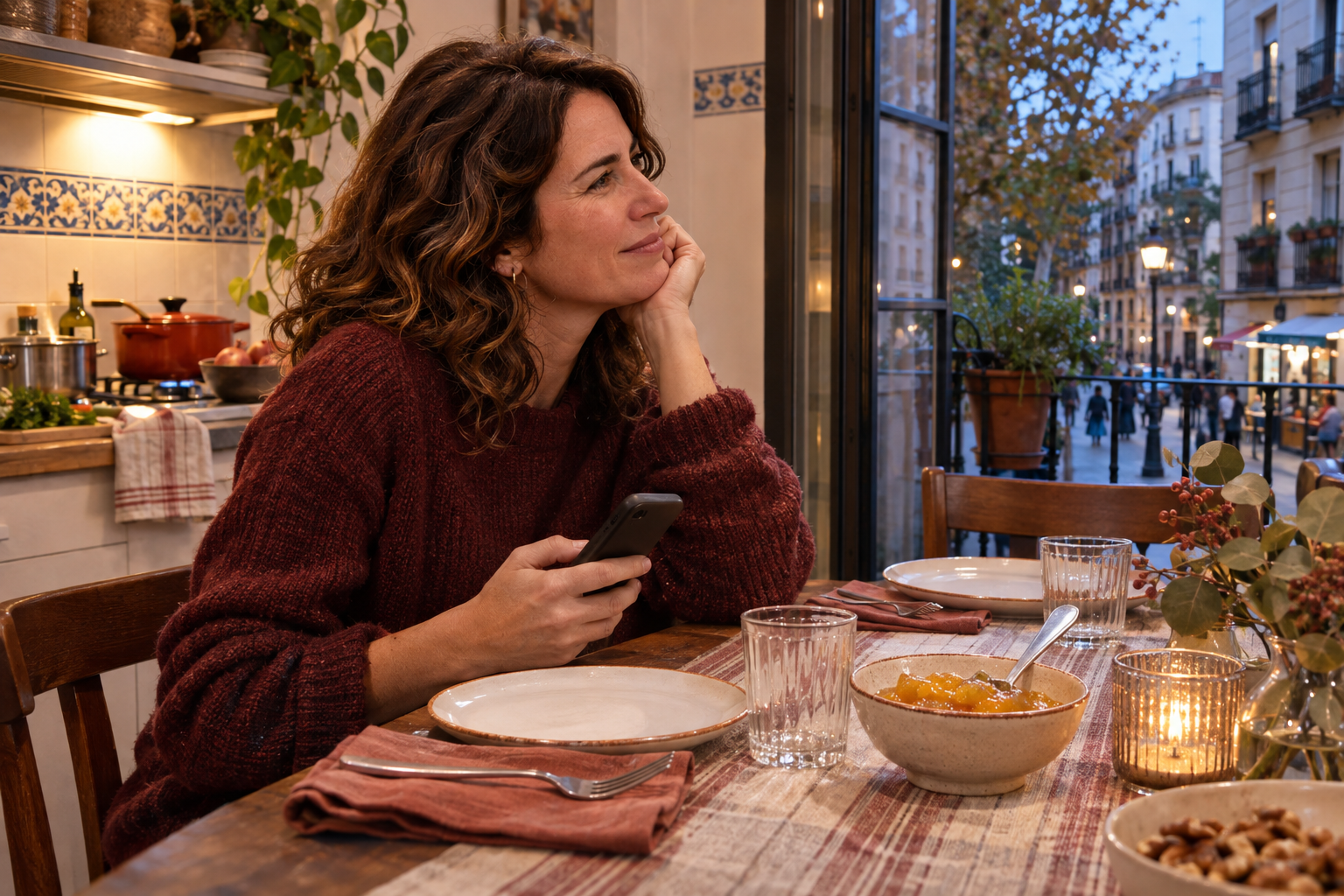
And yet, held up against that honest ache, there is a real and surprising list of things that Thanksgiving abroad has given us, things we never would have found if we had stayed home and kept doing it the easy, automatic way. The holiday we were forced to rebuild turned out, in the rebuilding, to become something richer.
We gained a better table, for one, reinvented from fresh Spanish ingredients into something that genuinely tastes better than the canned-and-frozen original. We gained the found family, that warm, international, chosen gathering that has become one of the treasures of our life here. And most of all, we gained a Thanksgiving stripped down to its essentials, because when you lose the automatic momentum of the holiday, the day off, the whole country celebrating, the extended family simply showing up, what is left is only what you deliberately choose to do, which forces the question of what the day is actually about. And the answer, it turns out, is gratitude and gathering, the two things at the very heart of it, now chosen on purpose rather than carried along by habit.
That is the real gift of doing Thanksgiving far from home. It takes a holiday that can run on autopilot and makes you build it, every piece of it, by hand and on purpose, and in doing so it hands back to you the meaning that the easy version can bury under logistics and tradition. We work harder for our Thanksgiving now than we ever did back home, and because we have to choose every part of it, we understand it better. The effort is the point, and the effort is what turned a borrowed holiday into a truly ours one.
The Real Thanksgiving
So here is what Thanksgiving abroad actually looks like, in the end: a turkey from a butcher who has never cooked one, ordered in a country that does not know it is a holiday, roasted on an ordinary Thursday, set on a table rebuilt from a foreign pantry, and shared with a family we chose rather than the one we were born into. On paper, it sounds like a diminished, improvised, lonely version of the real thing.
In practice, it has become, for us, the truer one. Stripped of everything automatic, our Spanish Thanksgiving has had to justify itself every single year, to be deliberately made rather than passively received, and in surviving that test it has revealed what it was always really about. Not the specific foods, not the day off, not even the familiar faces, lovely as all of those were, but the simple, chosen act of gathering the people you love, or the people you have found, around a table, and giving thanks for them and for the strange, rich life that brought you all to this unlikely place. That is a Thanksgiving worth crossing an ocean for.
Our butcher still has not cooked a turkey, and he probably never will, and every November he will hand us ours with the same bemused good cheer and the same gentle question about how on earth we plan to cook it.
And every year we will carry that bird home through the ordinary streets of an ordinary Thursday, and build our strange, adapted, chosen Thanksgiving once more, and be more grateful for it than we ever managed to be back home. It is not the Thanksgiving we left. It is, somehow, a better one. This is our own experience of the holiday abroad, offered warmly; everyone’s version is different, and the heart of it travels wherever you build your table.

About the Author: Ruben, co-founder of Gamintraveler.com since 2014, is a seasoned traveler from Spain who has explored over 100 countries since 2009. Known for his extensive travel adventures across South America, Europe, the US, Australia, New Zealand, Asia, and Africa, Ruben combines his passion for adventurous yet sustainable living with his love for cycling, highlighted by his remarkable 5-month bicycle journey from Spain to Norway. He currently resides in Spain, where he continues sharing his travel experiences with his partner, Rachel, and their son, Han.