
Every year around the eleventh of November, a particular smell drifts from German kitchens and the ovens of traditional restaurants: a goose, roasting slowly to deep, crackling gold. It is Martinstag, Saint Martin’s Day, and the Martinsgans, Saint Martin’s goose, is the feast at its center, a rich, festive meal eaten all across Germany and Austria as autumn tips toward winter.
It is a tradition with everything a good food custom should have: a specific day, a hearty seasonal dish, a charming legend to explain it, and a warm, lantern-lit ritual wrapped around the meal. The goose arrives as a full plate, the bird itself surrounded by braised red cabbage and dumplings, and it is one of the great comforting feasts of the German autumn.
Here is the Martinsgans: the gentle, slightly comic legend of why a saint is honored with a goose, the older harvest tradition underneath it, the lantern processions that go with it, and, at the end, a proper recipe so you can roast one yourself.
The Goose That Gave Him Away
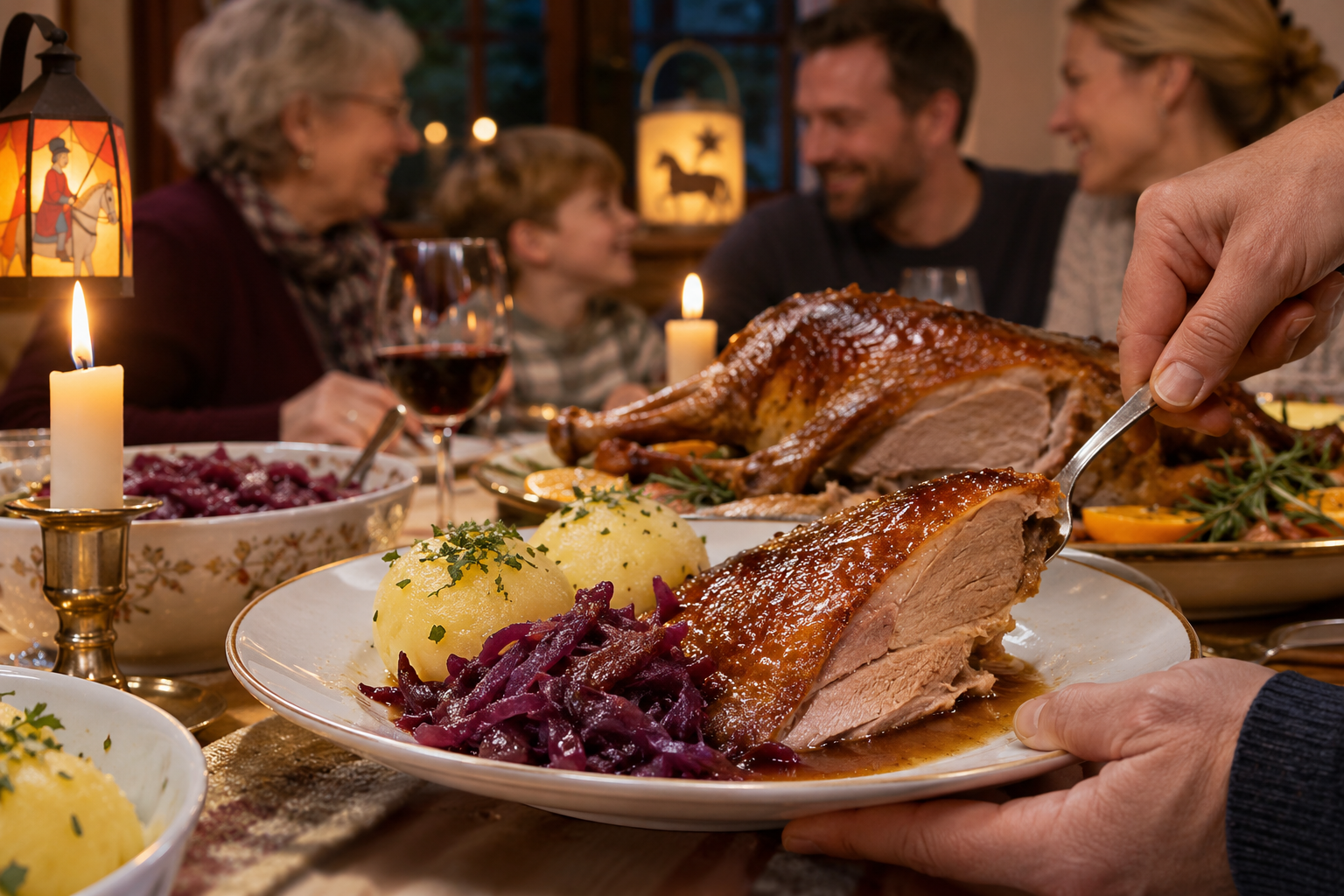
The charming legend that explains the goose is worth telling, because it gives the whole feast its character. Saint Martin, so the story goes, was a famously humble man, and when the people wished to make him a bishop, an honor he felt unworthy of, he did not want the role at all.
To escape being named bishop, the modest Martin hid himself away, and the place he chose to hide was a pen full of geese. But the geese, disturbed by their unexpected guest, set up such a loud cackling and honking that they gave away his hiding place, and Martin was found and duly made a bishop after all. The goose, having betrayed the saint, became forever associated with him, and eating a goose on his feast day became the custom, in his honor and, with a wink, in gentle revenge for the bird that could not keep a secret.
It is a lovely, slightly comic little story, exactly the kind of homely legend that attaches itself to the best food traditions, and it is the tale most Germans will tell you to explain why the goose is eaten. Whether or not it is the true origin hardly matters; it has become the story of the day, and it gives the Martinsgans a warmth and a smile that a purely practical explanation never could. The saint, the honking geese, the betrayed hiding place, all of it turns a seasonal roast into something with a story worth retelling at the table.
The Feast at the Turn of the Year
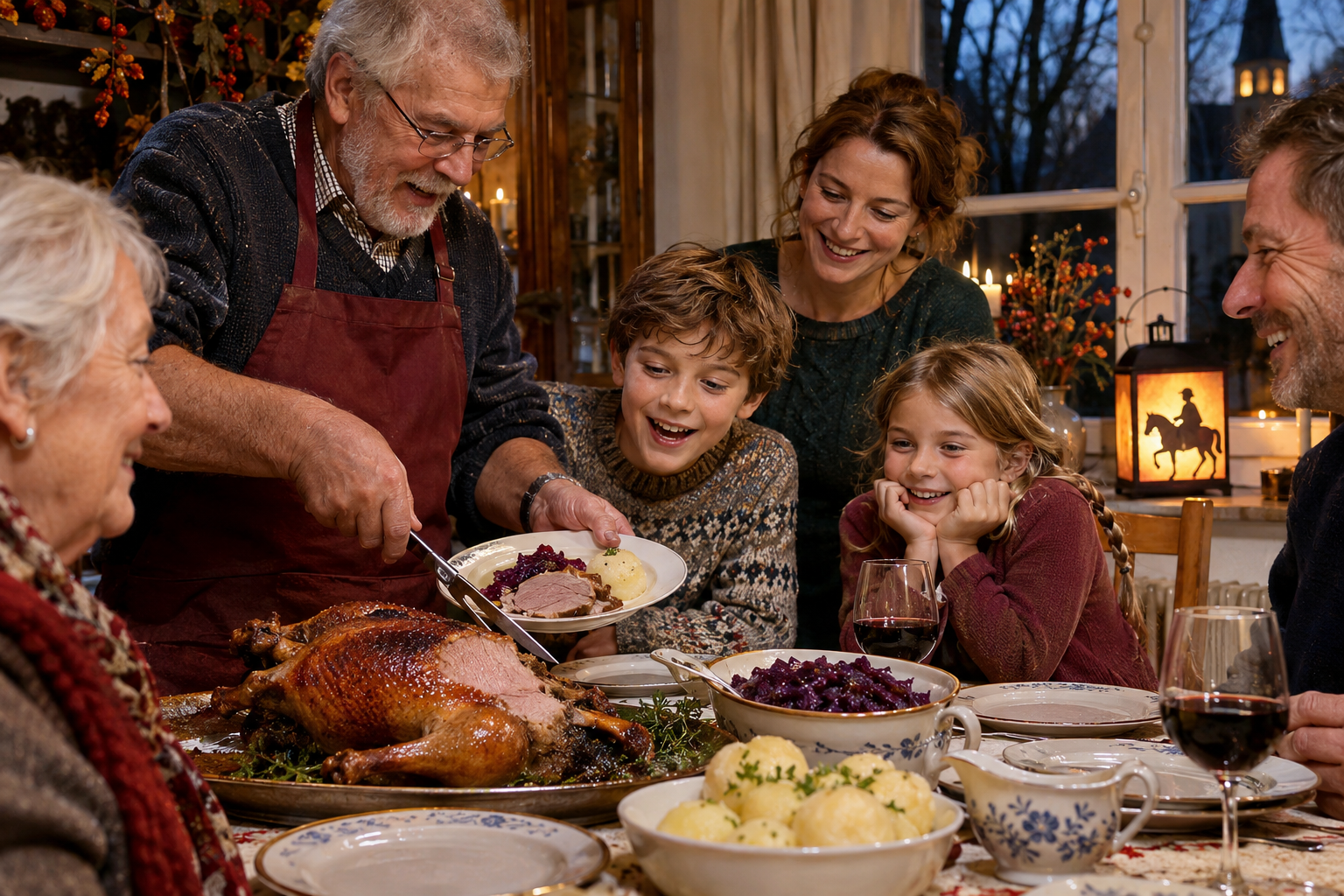
Underneath the charming legend lies a more practical origin, and knowing it deepens the tradition rather than spoiling it. Saint Martin’s Day, the eleventh of November, fell at a significant point in the old agricultural calendar, and the goose feast grew up around that timing as much as around the saint.
This was the time of year when the farming year came to a close, when accounts were settled and rents were paid, and when the autumn slaughter took place before winter. Geese, fattened over the autumn, were at their plump best right around now, ready for the table, which made the Martinmas goose a natural centerpiece for a feast at this turning point. It was a moment of plenty before the lean months, the last great eating before winter’s scarcity, and the goose crowned it. A common old saying captured the spirit, warning, more or less, that whoever does not eat goose on Saint Martin’s Day will go hungry for the rest of the year.
So the Martinsgans sits at the meeting point of the saint and the season, the religious feast and the agricultural one. The legend of the honking geese gives it its story, but the deeper reason the goose appears now is that this was simply when geese were ready and when the farming year called for a feast. The two explanations do not compete; they layer, the way they so often do in these old festivals, giving the goose both a charming tale and a practical root, and making the feast feel both merry and meaningful.
Lanterns in the Dark
The goose does not stand alone on Saint Martin’s Day, because the feast is wrapped in one of the most enchanting traditions of the German autumn: the lantern procession. On the evening of the eleventh, and the nights around it, children walk through the darkening streets carrying lanterns they have made themselves, singing songs about Saint Martin as they go.
These processions, the Laternenumzug, are a beloved part of German and Austrian childhood. The handmade paper lanterns glow in the November dark, the children sing their Martin songs, and in many places the procession is led by a figure representing Saint Martin himself, often on horseback, reenacting the famous moment of cutting his cloak to share with a beggar. Bonfires, the Martinsfeuer, are frequently lit as well, and the whole event has a magical, communal, light-against-the-darkness quality that children remember all their lives.
And then, after the lanterns and the songs and the fire, comes the goose. The traditional order of the evening is the procession first and the feast after, so that the Martinsgans is the warm, delicious reward at the end of a cold, glowing, ceremonial walk through the dark. This pairing of the children’s lantern parade with the family goose dinner is what makes Saint Martin’s Day so complete as a celebration: light and warmth, story and feast, the whole community out in the November night and then gathered around a laden table. It is a festival that feeds the imagination and the stomach alike.
The Full Plate
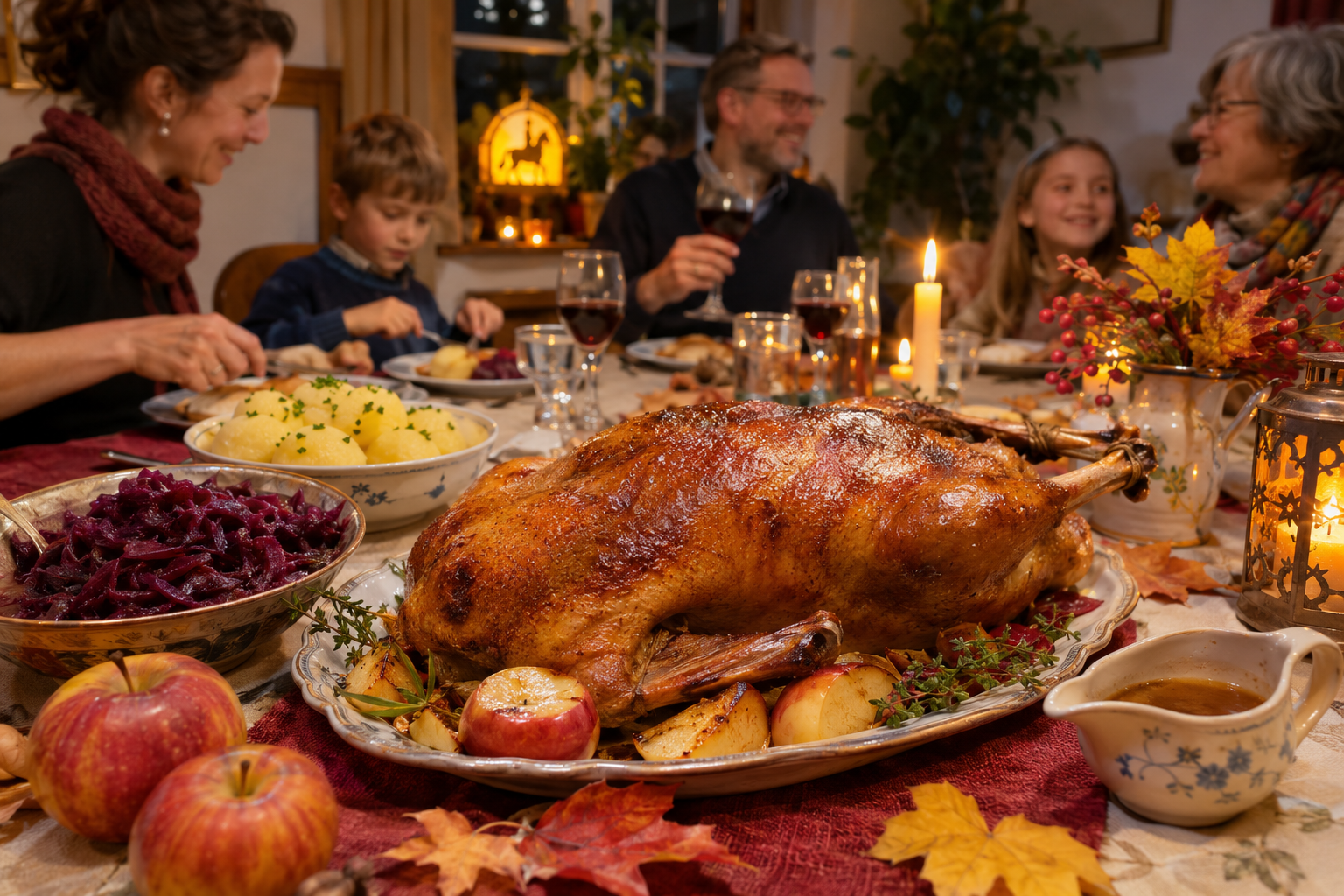
When the Martinsgans arrives at the table, it comes not as a lone roast bird but as a full, generous, traditional plate, and knowing the classic accompaniments is part of knowing the dish. The goose is the centerpiece, but it is served in the company of a few equally important partners.
The standard plate is roast goose with braised red cabbage and dumplings. The red cabbage, Rotkohl or Blaukraut, is cooked down with apple and spices into a sweet-sour, deep-purple braise that cuts beautifully through the richness of the goose.
The dumplings are either potato dumplings, Kartoffelknodel, or bread dumplings, Semmelknodel, round and soft and perfect for soaking up the gravy. And the gravy itself is made from the rich roasting juices of the bird, often rounded out with a little apple sauce served alongside. It is a hearty, rich, deeply satisfying plate, exactly the kind of food the cold demands.
There is often something sweet to follow, too, tied to the same day. The Martinshornchen is a pastry associated with Saint Martin, a horn or crescent shape said to recall the shape of the saint’s horse’s hooves, or to echo his divided cloak, a small sweet footnote to the great savory feast. But it is the goose and its traditional partners, the red cabbage and the dumplings, that define the Martinsgans, and it is that full, generous plate that Germans look forward to each November.
The Secret to a Good Goose
Roasting a goose well is a little different from roasting a chicken or a turkey, and understanding the one key difference is the secret to success. A goose is a fatty bird, far fattier than a turkey, and the whole art of cooking it lies in managing that fat so you end up with crisp skin and succulent, not greasy, meat.
The techniques all serve that goal. You prick or score the skin all over, especially where the fat sits thickest, so that as the bird roasts, the abundant fat can render out and escape rather than staying trapped under the skin. You roast the goose long and slow, giving that fat time to melt away, and you pour off or spoon out the rendered fat as it collects in the pan during cooking. Done right, this leaves you with beautifully crisp, golden skin and tender meat that is rich but not fatty, which is the whole point of a good goose.
There is a lovely bonus hidden in all that rendered fat, too, which no German cook would dream of wasting. The goose fat you pour off is a treasure in its own right, saved and used as Schmalz, a deeply flavorful cooking fat and spread that will enrich your cooking for weeks to come. Between the crisp-skinned bird, the rich gravy from the juices, and the jar of precious goose fat set aside for later, a well-roasted goose gives back far more than one meal, which is part of what makes it such a satisfying thing to cook. Patience and attention to the fat are all it really asks.
A Feast Worth Keeping

It is worth saying that the Martinsgans, like many of these old feasts, has become more of a special occasion than an everyday one, which is all the more reason to cherish it. Many Germans today eat their Martinsgans at a Gasthaus or a traditional restaurant, where it appears as a seasonal special in the weeks around the eleventh, rather than roasting a whole goose at home.
That is perfectly in keeping with the tradition, and a restaurant goose with all the trimmings is a wonderful thing. But there is something special about roasting one yourself, filling the whole house with the smell of it, and bringing the great golden bird to the table surrounded by its red cabbage and dumplings, especially after a lantern walk through the cold. It is a project, certainly, a feast that takes time and care, but that is exactly what makes it feel like an occasion worth marking.
So whether you eat it out or make it at home, the Martinsgans is one of the warmest and most complete of the European November traditions, a feast with a story, a lantern-lit ceremony, and a plate of genuinely wonderful food. If you would like to roast your own, here is how to go about it, from the stuffing to the all-important crisping of the skin. This piece is general information; traditions and recipes vary by region and family, so treat it as a warm introduction rather than the last word.
Make It: Martinsgans
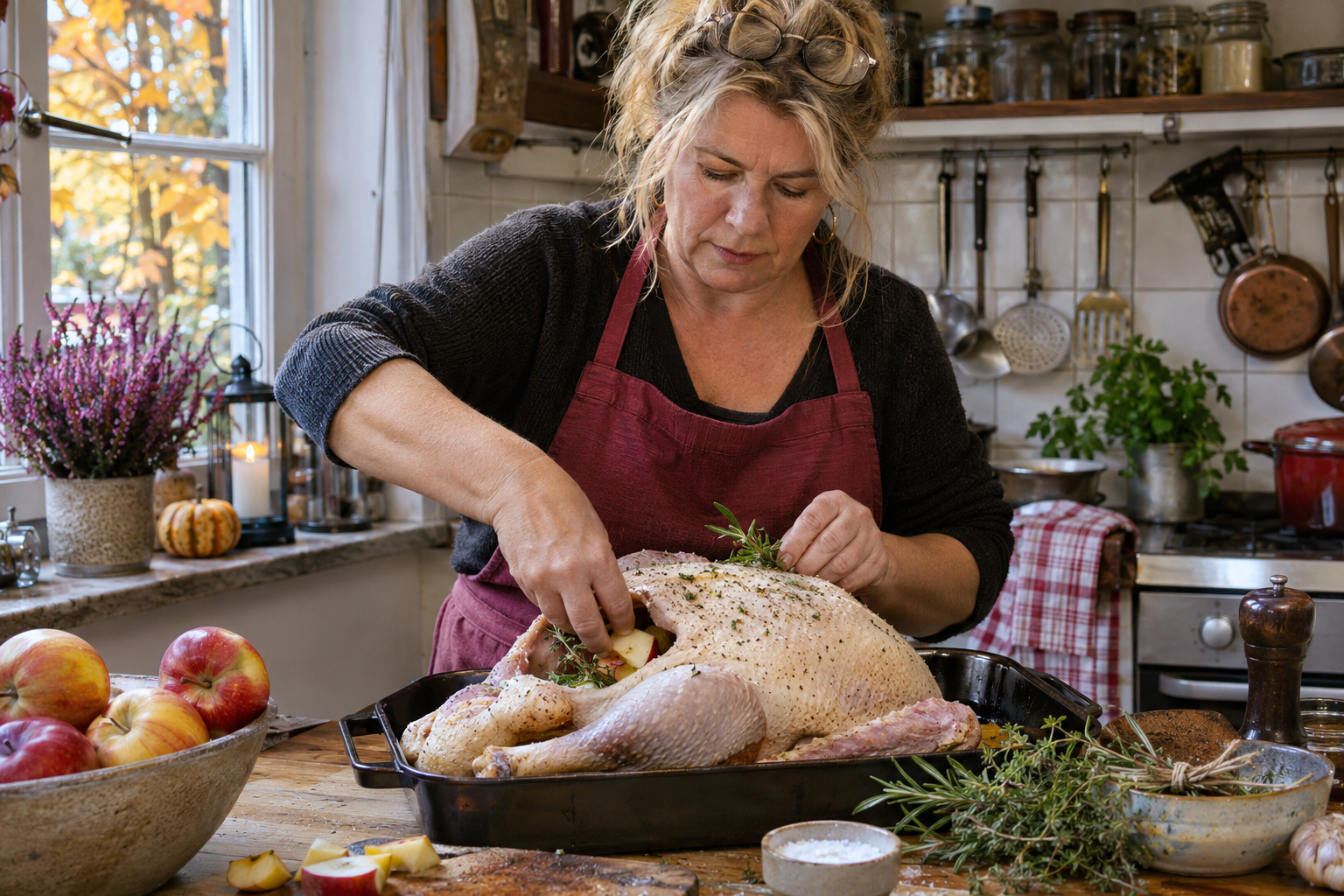
Here is a traditional roast goose for Saint Martin’s Day, serving about six. It is a long, slow roast, so give it plenty of time, and plan to serve it with braised red cabbage and potato or bread dumplings, the classic accompaniments.
Ingredients
- 1 whole goose, about 4 to 5 kg, with giblets
- salt and black pepper
- 2 apples, cored and quartered
- 2 onions, peeled and quartered
- a small handful of chestnuts, peeled, optional
- a few sprigs of fresh herbs (such as thyme or marjoram), or a little dried mugwort if you can find it
- 500ml water or stock, for the pan
- 1 tablespoon cornstarch or flour, for the gravy (optional)
Instructions
- Heat the oven to about 160 degrees Celsius (325 Fahrenheit). Pat the goose thoroughly dry, inside and out, and season it generously all over with salt and pepper.
- Prick the skin all over with a sharp fork or score it lightly, especially around the thighs and breast where the fat is thickest, taking care to pierce the skin but not the meat. This lets the fat render out and is the key to crisp skin.
- Stuff the cavity loosely with the quartered apples and onions, the chestnuts if using, and the herbs. Place the goose breast side up on a rack in a deep roasting pan, and pour the water or stock into the bottom of the pan.
- Roast slowly for about 3 to 4 hours, allowing roughly 45 minutes per kilogram. Every 30 to 45 minutes, spoon or pour off the fat that collects in the pan (saving it, as it is precious), and baste the goose with a little of the pan juices.
- For the final 20 to 30 minutes, turn the oven up to about 220 degrees Celsius (425 Fahrenheit) to crisp and brown the skin to a deep golden color. Watch it closely so it does not burn. The goose is done when the juices run clear and a leg moves easily in its socket.
- Rest the goose, loosely covered, for at least 20 minutes before carving. Meanwhile, make a gravy from the defatted pan juices, thickening with a little cornstarch or flour if you like. Serve the carved goose with braised red cabbage and potato or bread dumplings.

About the Author: Ruben, co-founder of Gamintraveler.com since 2014, is a seasoned traveler from Spain who has explored over 100 countries since 2009. Known for his extensive travel adventures across South America, Europe, the US, Australia, New Zealand, Asia, and Africa, Ruben combines his passion for adventurous yet sustainable living with his love for cycling, highlighted by his remarkable 5-month bicycle journey from Spain to Norway. He currently resides in Spain, where he continues sharing his travel experiences with his partner, Rachel, and their son, Han.