
Cancun is one of the easiest first trips abroad an American can take. The flights are short and cheap, the beaches are postcard-perfect, the resorts are built for exactly this, and almost everyone you deal with speaks English. It is, for good reason, where a huge number of people take their very first international vacation.
But easy does not mean effortless. The difference between a smooth Cancun trip and a stressful one usually comes down to a handful of small things you sort out before you fly, not after you land. Get those few details arranged in advance, and you step off the plane relaxed, with everything already handled.
Here is the short, practical list of what is actually worth taking care of ahead of time, so your first time in Cancun starts the way a vacation should. None of this is complicated, and most of it takes only a few minutes from your couch before you go.
Your Documents Are Simpler Than You Think
Let us start with the paperwork, because people worry about it far more than they need to. For a US citizen heading to Cancun as a tourist, the entry requirements are genuinely light.
You need a valid passport book, not a passport card, since the card only works for land and sea crossings and you are flying. You do not need a visa for a tourist stay; Americans can visit for up to 180 days without one. And the old paper tourist card, the FMM that travelers used to fill out, has been done away with at Cancun airport. These days you simply get a stamp in your passport, or pass through an electronic gate that prints a receipt, and that is your proof of entry.
One small thing to check before you go: your passport’s validity. Officially the US only requires it to be valid at the time of entry, but many airlines still enforce a six-month rule of their own and may give you trouble at check-in if your passport is close to expiring. So glance at that expiration date well before your trip, and renew if it is cutting things close. When you do arrive and get that entry stamp, keep it; hold onto whatever receipt or stamp you are given, because it is your official record of entry.
The Tourist Tax Nobody Warns You About

Here is one that catches a lot of first-timers by surprise, because nobody mentions it: the Visitax. It is a mandatory tourist tax charged by the state of Quintana Roo, which is the state Cancun sits in, and every international visitor is supposed to pay it.
The amount is small, around 283 Mexican pesos, which works out to roughly fifteen US dollars, and it is per person for your whole trip rather than per day. It covers the entire state, so it is the same whether you stay in Cancun, Playa del Carmen, Tulum, or Cozumel. The catch is that it is genuinely required, and it is checked when you leave, typically by scanning a QR code at the airport on departure.
The smart move is to pay it online before you travel, and to pay it on the official site, which is visitax.gob.mx. This matters, because the internet is full of copycat websites with similar-sounding names that charge you two, three, or four times the real amount for the same tax. Pay the genuine one in advance, save the QR code to your phone as a screenshot so it works even without signal, and you will breeze through the departure check without a second thought. It is a tiny task that saves a last-minute scramble at the end of your trip.
Getting From the Airport to Your Hotel

This is the one that makes or breaks your arrival, and it deserves the most attention, because the moment you clear customs in Cancun is where unprepared travelers most often come unstuck. The airport sits a good distance from the hotels, around twenty kilometers or more from the main Hotel Zone, and considerably farther if you are headed down the coast to Playa del Carmen or Tulum. You are not walking anywhere from here.
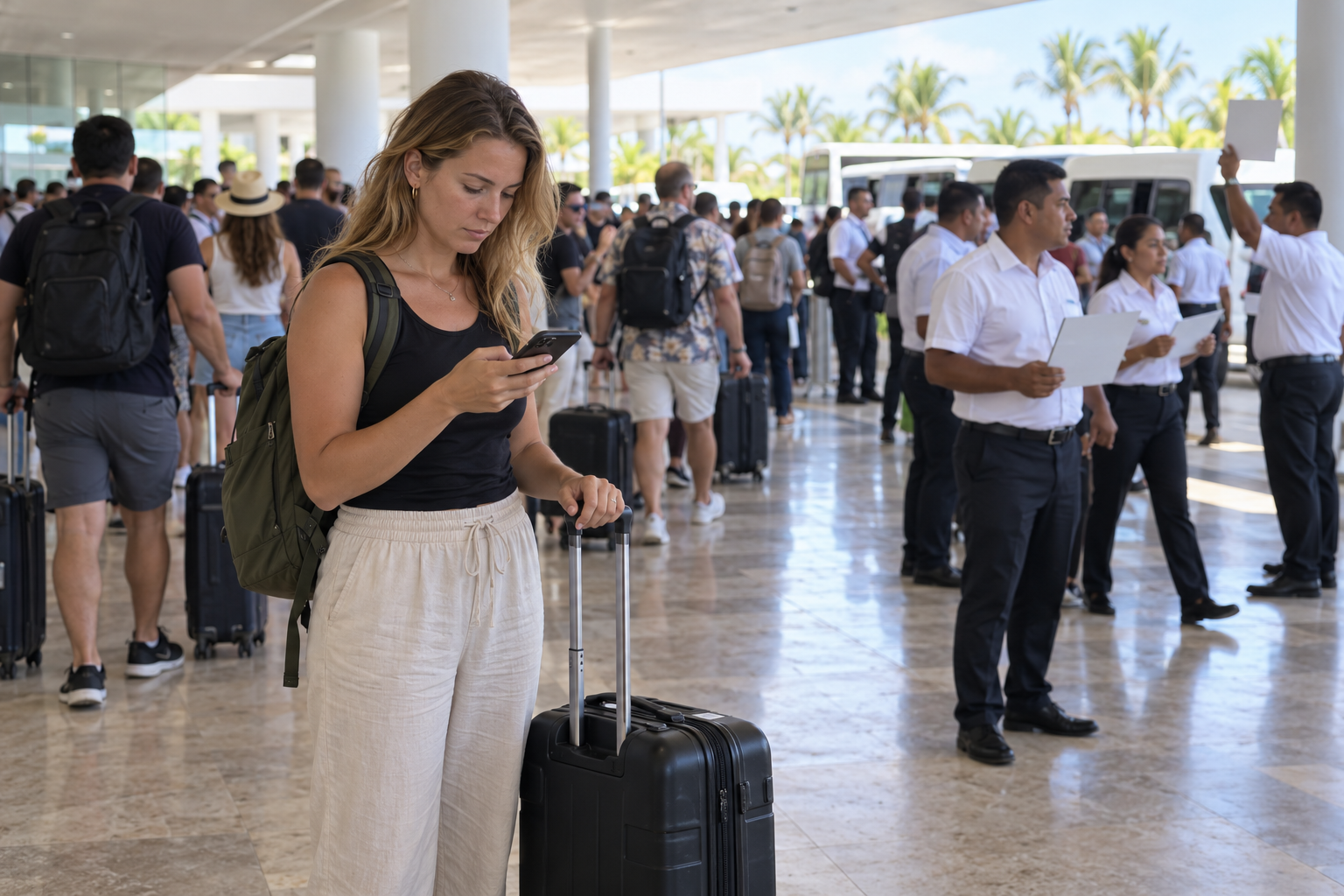
The trouble is the scene that greets you in the arrivals hall. It is famously crowded with aggressive timeshare sellers and transport hustlers, many of them dressed to look official, all competing to steer you toward their service or their sales pitch. After a long flight, tired and disoriented, it is genuinely hard to tell who is legitimate and who is not, and plenty of first-timers get talked into an overpriced ride or a timeshare presentation before they have even found the exit.
It is also worth knowing that the ridesharing apps do not rescue you here. Uber and DiDi are not allowed to pick up at Cancun airport, so the option you would reach for at home simply is not available on arrival. That leaves the official airport taxis, which are fixed by zone and can run anywhere from fifty to eighty dollars or more, and which you still have to locate and negotiate while fending off everyone else.
The easiest fix, by a wide margin, is to take the whole problem off the table before you ever board your flight by arranging a Cancun airport pickup with bilingual drivers and private vehicles in advance. When you book a private transfer ahead of time, a driver is waiting for you by name when you walk out, with a clean private vehicle and no sales pitch, and you go straight to your hotel. There is nothing to negotiate, nobody to fend off, and no guessing whether the person approaching you is real. For the price of a little forethought, you turn the most stressful moment of the trip into the easiest one, which, when you are arriving somewhere new for the first time, is worth a great deal.
Money: Pesos, Dollars, and Tipping

Cancun runs on tourism, so you can get by with US dollars in most resort areas, but it is not the smart way to pay. When you hand over dollars, you are usually given a poor exchange rate baked into the transaction, so you quietly lose money on every purchase.
The better approach is to use Mexican pesos and to pay by card where you can. Bring a credit or debit card that does not charge foreign transaction fees, use it for larger purchases, and pull pesos from a bank ATM when you need cash, declining the machine’s offer to convert to dollars for you, since that conversion is another bad rate. Keep some small peso notes on hand for tips and small vendors.
On tipping, Mexico broadly follows a tipping culture similar to the United States, so budget for it. Something in the range of ten to fifteen percent at restaurants is normal, and a few pesos or dollars for the people who help you along the way, from your transfer driver to the housekeeping staff, is both customary and appreciated. Sorting out a fee-free card before you leave, and understanding the dollars-versus-pesos trap, will save you more than you expect over a week.
Staying Connected
It is worth landing already connected rather than hunting for wifi the moment you arrive, especially if you need to find a transfer driver, pull up a map, or message your hotel. The simplest way to manage this now is an eSIM.
An eSIM is a digital SIM you buy and install on your phone before you travel, so that your phone connects to a local network the instant you land, with no physical card to swap and no expensive roaming charges from your home carrier. You can buy one online in a few minutes, choose a small data plan for the length of your trip, and have it ready to switch on when you touch down. Most hotels and resorts also have wifi, but having your own connection from the moment of arrival removes a lot of small friction, and it is cheap insurance against being stranded offline at exactly the wrong time.
Where You Stay Shapes the Whole Trip
One decision colors everything else, and it is worth making deliberately: where you base yourself. Cancun is really several different experiences depending on where you book.
The Hotel Zone is the classic choice, a long strip of beachfront resorts and all-inclusives with the famous turquoise water right outside, lively and convenient but very much a tourist bubble. Downtown Cancun, away from the beach, is cheaper, more local, and more authentically Mexican, better for travelers who want to eat where residents eat. And many people skip Cancun proper altogether in favor of the Riviera Maya down the coast, in Playa del Carmen for a walkable town feel or Tulum for a more boho, upscale scene.
Each of these sits a different distance from the airport, which directly affects your transfer time and cost, so it is worth factoring that in when you book both your room and your ride. Decide what kind of trip you actually want, a convenient resort week, a more local experience, or a particular coastal town, and let that guide where you stay. Getting this right matters more to your enjoyment than almost any other single choice.

Excursions Worth Booking Ahead
The best of the region is often a day trip away from your hotel, and the most popular outings do sell out, so a little advance booking goes a long way. If there is something you have your heart set on, reserve it before you go rather than hoping to arrange it on the day.
The headline excursion is Chichen Itza, the great Mayan pyramid complex inland, which is a long but unforgettable day. Closer to home are the cenotes, the stunning natural swimming holes in the jungle, and a boat trip to Isla Mujeres, the laid-back island just offshore. The clifftop Mayan ruins at Tulum and the big eco-parks like Xcaret and Xel-Ha round out the list. Booking the ones you really care about in advance secures your spot, often gets you a better price, and means your trip is not spent scrambling to organize things once you have arrived.
A Few Health and Packing Notes
A handful of practical odds and ends are worth handling before you fly, too. Travel insurance is the big one; a policy that covers medical care and trip disruption is cheap peace of mind, and well worth buying for any international trip.
On the ground, a few local realities shape what you pack. The sun is strong, and many of the cenotes and reefs require reef-safe sunscreen to protect the marine life, so bring some, and stick to bottled or filtered water rather than tap.
Two seasonal things are worth a glance when choosing your dates. Sargassum, a brown seaweed that can wash up on the beaches, is more common in the warmer months and can affect the look of the shoreline, and the official hurricane season runs through the summer and autumn. None of this should put you off, but knowing it in advance means you pack and plan accordingly rather than being caught out.
Arrive Ready, Relax Sooner
The beauty of Cancun is that it really is one of the simplest and most rewarding first trips abroad you can take, and it stays that way as long as you handle a few things before you go rather than figuring them out on the fly. Almost all of the stress that first-timers run into is avoidable, and almost all of it is avoided from home, in advance.
If you do nothing else, sort the three that matter most: make sure your passport is valid, pay your Visitax on the official site before you travel, and arrange your airport transfer ahead of time so a driver is waiting when you land. Those three remove the paperwork worry, the departure-day scramble, and the chaotic arrival, which together account for most of what goes wrong on a first Cancun trip.
Take care of them from your couch before you fly, and you will step off the plane into a vacation that has already, quietly, been smoothed out for you. That is exactly how a first time in Cancun should begin: with the hard part already done, and nothing left to do but enjoy it.

About the Author: Ruben, co-founder of Gamintraveler.com since 2014, is a seasoned traveler from Spain who has explored over 100 countries since 2009. Known for his extensive travel adventures across South America, Europe, the US, Australia, New Zealand, Asia, and Africa, Ruben combines his passion for adventurous yet sustainable living with his love for cycling, highlighted by his remarkable 5-month bicycle journey from Spain to Norway. He currently resides in Spain, where he continues sharing his travel experiences with his partner, Rachel, and their son, Han.