
In most of the world, eating on the go is simply how life works. You grab a coffee and a pastry, you walk and eat, you juggle a sandwich between meetings, and nobody gives it a second thought. It is one of the small, unremarkable freedoms of modern life, so ordinary that it never occurs to anyone it could be a problem. And that is exactly why it catches so many visitors to Japan off guard.
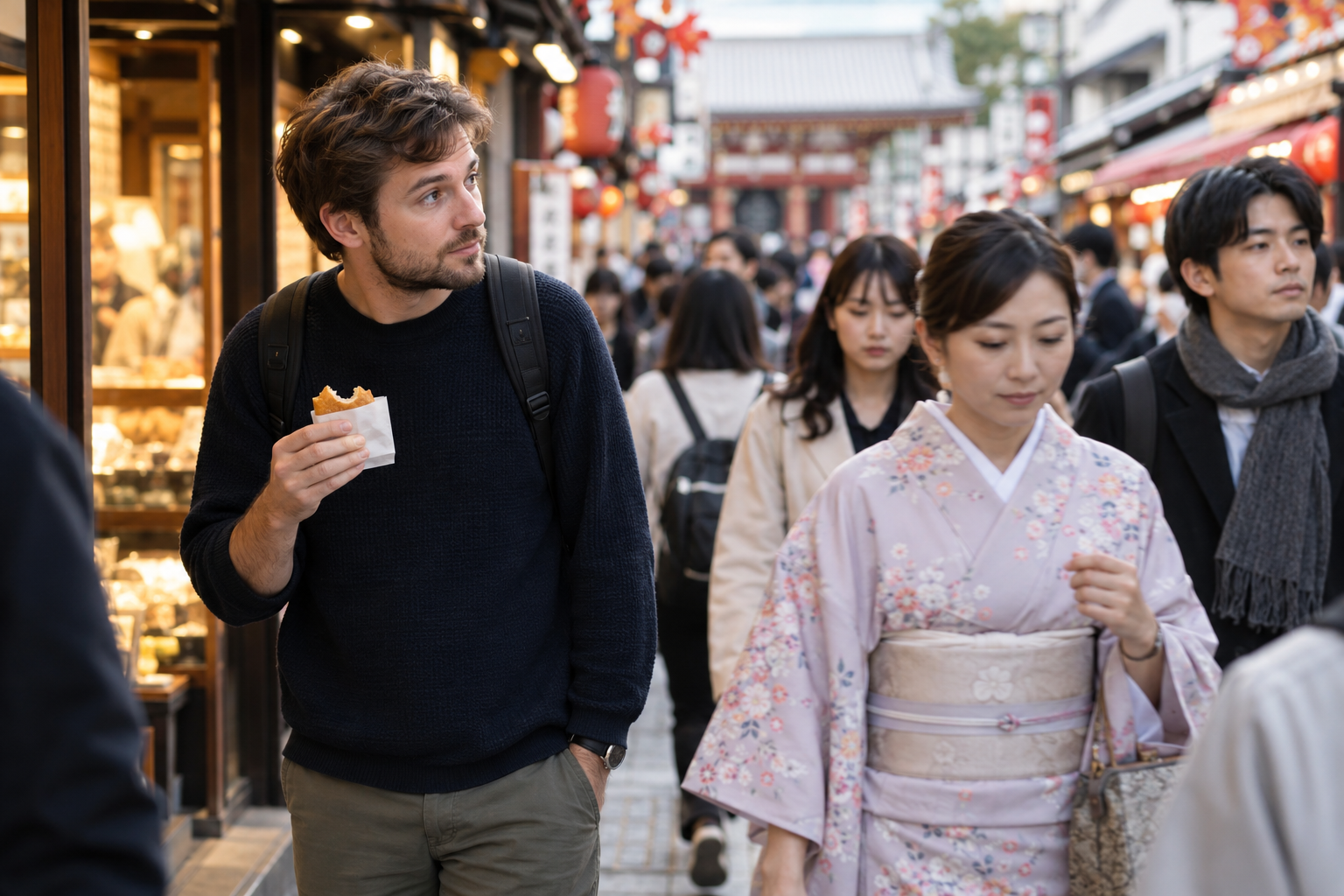
In Japan, it is quietly frowned upon. Walking down the street while eating is considered rude, a minor breach of manners that locals notice and politely disapprove of, even if they would never say a word.
What makes this so striking is that there is no law against it and no fine attached, and you cannot be ticketed for eating while you walk.
And yet the rule is observed almost universally, enforced not by police or penalties but by something far more powerful in Japan: social expectation. Here is what the custom actually is, why the Japanese consider it rude, where the exceptions lie, how a rule with no penalty achieves near-total compliance, and how to handle food in Japan without quietly marking yourself as the visitor who does not know the rules. It is one of the most revealing small customs in the whole country.
The Rule With No Fine

The custom has a name in Japanese, tabe-aruki, which translates roughly as eat-walking, and it refers to exactly the thing so many foreigners do without thinking: eating or drinking while on the move. In Japan, this is generally seen as bad manners.
There is nothing in the law books about it. No official is going to stop you, no sign threatens a penalty, and you will not find tabe-aruki listed among any set of fines. In that sense it is the opposite of the European tourist rules, with their precise euro figures and warden patrols. The Japanese approach needs none of that.
Instead, the enforcement is entirely social, and in Japan that turns out to be more than enough. Walk down a street eating a snack and you may notice people glance at you, a flicker of mild disapproval, a sense that you have done something slightly off. Most locals simply would not do it, and the collective weight of that shared expectation does the work that no fine ever could. It is a rule with total compliance and zero policing, which is a genuinely fascinating thing to witness.
For visitors from fine-happy countries, this takes some getting used to. There is no sign to read, no penalty to fear, nothing concrete to point to at all, and yet the expectation is real and nearly everyone meets it. You are left to absorb the rule from the behavior around you rather than from any posted notice, which is a very Japanese way of doing things.
Stand Still to Eat

The expected behavior, once you understand it, is easy and even pleasant. In Japan, eating is something you stop to do, not something you fold into another activity. So when you buy a snack from a stall or a convenience store, the done thing is to stand still and eat it right there, near where you bought it, before moving on.
You see this everywhere once you know to look. People buy a drink from a vending machine and stand beside it to finish it rather than walking off with it, often setting the empty can straight into the recycling bin that sits right beside the machine. They eat their convenience-store snack standing near the shop, often in a little designated spot, and only continue on their way once they are done. The act of eating is given its own small pause, rather than being rushed through on the move.
This is why the famous Japanese convenience stores, the konbini, are so central to how people eat on the go without actually eating on the go. You buy your food there, and you consume it there, standing at the counter or in the eating area, keeping the food and the walking firmly separate. The idea is simple: finish your food where you got it, then carry on with empty hands.
There is a certain calm in this, once you adjust to it. Rather than bolting a snack while rushing between places, you give it a minute of actual attention, standing still, tasting it, and only then moving on. It slows you down in a small, pleasant way, and it is of a piece with a culture that tends to do one thing at a time rather than everything at once.
Why It Is Considered Rude
The custom rests on several layers of reasoning, and together they explain why something so trivial in Western eyes carries real weight in Japan. The first is respect for the food itself. In Japanese culture, eating is treated as something that deserves your attention, not a task to be done absent-mindedly while hurrying somewhere else, and giving a meal or even a snack your focus is a small mark of respect.
The second is consideration for the people around you, which runs very deep in Japanese social life. Eating while walking through a crowd means carrying food and drink that could spill on someone, bumping into people, or waving a snack around in a packed space, all of which impose a small risk or nuisance on others. In a dense, crowded country, not inconveniencing the people around you is close to a sacred principle.
The third is cleanliness, which is bound up with the famous tidiness of Japanese public spaces. Eating on the move produces crumbs, drips, wrappers, and the temptation to litter, and a culture that prizes spotless streets views all of that warily. Standing still to eat, near a shop where you can dispose of your waste properly, keeps the streets clean in a way that walking and eating simply does not. Put these three things together, respect, consideration, and cleanliness, and the custom stops looking arbitrary and starts looking like good manners distilled.
There is also a subtler thread running through all of it, which is a general cultural distaste for doing things sloppily or half-heartedly. Eating while hurrying along, dropping crumbs and barely tasting your food, is a slightly slapdash way to go about something, and Japanese culture tends to value doing even small things properly and with care. The eating custom is partly an expression of that broader instinct toward neatness and intention.
The Cleanliness Connection
It is worth dwelling on that cleanliness point, because it ties into one of the things visitors find most remarkable about Japan: how astonishingly clean its streets are, despite a famous scarcity of public trash cans. The two facts are connected, and the eating custom sits right in the middle of them.
Because there are so few bins on Japanese streets, anyone eating on the move has nowhere to put their wrapper, and the result, in a less disciplined culture, would be litter everywhere. Japan solves this at the source. By eating where you bought your food, you are also eating where you can dispose of your rubbish properly, handing the wrapper back or binning it at the shop rather than carrying it off to drop somewhere later.
So the no-eating-while-walking custom and the spotless-streets phenomenon are two sides of the same coin. The streets stay clean partly because people do not generate litter by eating all over them, and because the Japanese habit is to carry your own rubbish home rather than expect a bin to appear. The eating rule is one thread in a whole tightly woven cultural fabric of cleanliness and personal responsibility, and pulling on it reveals the rest.
It is a system that works because nearly everyone participates in it. One person eating tidily makes little difference, but a whole society that stops to eat, carries its own rubbish, and declines to litter produces the famously immaculate streets that so astonish first-time visitors. The absence of mess is not an accident of national character; it is the sum of millions of small, shared habits like this one.
Where It Is Allowed
None of this is absolute, and it would be a mistake to think you can never eat outdoors in Japan. There are clear exceptions, and knowing them keeps you from being needlessly rigid about it.
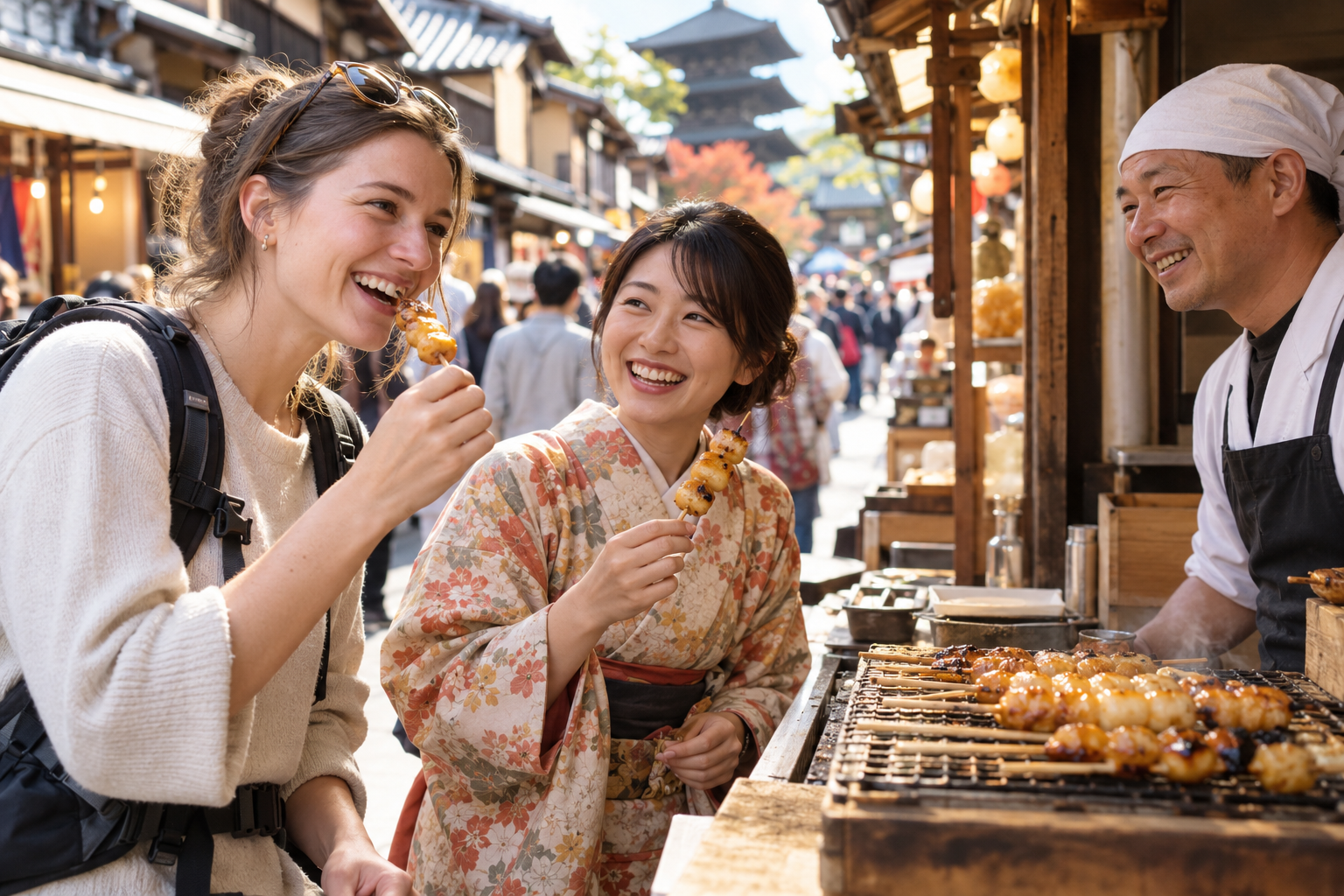
The biggest exception is the festival, the matsuri. At these events, the streets fill with food stalls, the yatai, selling grilled snacks and sweets, and eating as you wander among them is entirely normal and expected.
Festival food is meant to be enjoyed on your feet in the happy crowd, and the usual rule is suspended for the occasion. A summer matsuri, with its lantern-lit stalls and the smell of grilling food, is one of the great pleasures of Japan precisely because you get to wander and nibble without a second thought. The same relaxed spirit applies in certain designated food streets and markets, places like the famous market lanes of Kyoto or the approach to major temples, where street food is the whole point and nibbling as you browse is accepted.
Even in those places, though, a softer version of the custom often lingers, with many people choosing to stand and eat near the stall rather than wander far while munching. And some foods draw less disapproval than others; an ice cream cone on a hot day, for instance, is more readily forgiven than a full meal eaten on the march. The sensible approach is to read the setting: at a festival or a street-food market, relax and enjoy; on an ordinary city street, stop to eat.
When in doubt, the simplest tell is to look at what everyone else is doing. If the locals around you are strolling and eating, you are in a place where it is fine; if nobody is, take the hint and stand still. The custom is unwritten, but the people around you are a reliable guide to when it applies and when it relaxes.
Total Enforcement Without a Rulebook

The most interesting thing about the whole custom, to an outsider, is how completely it is observed without any formal enforcement at all. There is no fine, no officer, no sign, and yet near-total compliance, which is almost the inverse of how such things work in much of the West.
This points to something deep about Japanese society. Behavior is governed less by written rules and penalties than by a powerful, shared sense of not causing trouble or inconvenience to others. This idea is so central to Japanese life that it shapes countless small daily choices, from how you speak on the phone in public to how you carry an umbrella in a crowd. You do not eat while walking for the same reason you keep your voice down on the train and form an orderly line without being told: because consideration for the collective is simply how things are done, absorbed from childhood and reinforced by everyone around you.
It is a strikingly different model from the European one, where cities increasingly reach for fines to control behavior. Japan achieves the same end, and arguably more thoroughly, through social expectation alone. For a visitor, this is worth appreciating rather than resisting, because it means the rules you need to follow are written nowhere and everywhere at once, carried in the behavior of the people around you. Watch what the locals do, and do that, and you will almost never go wrong.
It is also a gentle reminder that this kind of self-governing social order is fragile, and that it depends on everyone, visitors included, playing along. As tourism grows, the custom has come under some strain, with travelers unaware of it eating freely on the streets, and locals quietly wishing they would not. Learning the rule and following it is a small way of helping to keep intact something rather special that no law protects.
How to Eat Like a Local
Putting it all into practice is genuinely simple, and doing so makes you a more welcome guest. When you buy a snack or a drink, step to the side and eat or finish it standing there, near the shop or the machine, before you carry on with empty hands. Treat eating as a small pause rather than something to do while moving. It is a tiny adjustment that quickly becomes second nature, and before long you will find yourself instinctively stepping aside to finish a drink the way the locals do.
Lean on the convenience stores and their eating spaces, which exist precisely for this, and save your walking-and-eating for the festivals and designated food streets where it belongs. And always, always carry your own rubbish with you until you find a proper place for it, rather than hunting for a street bin that will not be there. These small habits align you with the local rhythm almost instantly.
The deeper point is that the custom is really about attention and consideration, two things that cost nothing and that quietly improve the experience for everyone.
Following it is not a burden but a small act of respect, for the food, for the people around you, and for the spotless streets you are enjoying. It asks almost nothing of you and gives back a smoother, more courteous trip.
Do it, and you will move through Japan not as the oblivious visitor eating a sandwich in the crowd, but as someone who understood, and honored, one of the quiet rules that makes the country work. The Japanese will rarely say anything either way, but they notice, and a visitor who gets the small things right is quietly appreciated in a way that is hard to put into words.

About the Author: Ruben, co-founder of Gamintraveler.com since 2014, is a seasoned traveler from Spain who has explored over 100 countries since 2009. Known for his extensive travel adventures across South America, Europe, the US, Australia, New Zealand, Asia, and Africa, Ruben combines his passion for adventurous yet sustainable living with his love for cycling, highlighted by his remarkable 5-month bicycle journey from Spain to Norway. He currently resides in Spain, where he continues sharing his travel experiences with his partner, Rachel, and their son, Han.