
Walk past any pastry shop in Naples in the weeks around Christmas and you will see them in the window: glistening golden mounds of tiny dough balls, slicked with honey and scattered with colored sprinkles, piled up like edible treasure.
These are struffoli, the honey balls of Naples, and they are one of the most beloved Christmas desserts in all of southern Italy. In homes and bakeries across the city, hundreds of little balls of fried dough are coated in warm honey and built up into a mountain or a wreath, a sweet, sticky centerpiece of the Neapolitan Christmas.
Part of what makes them so beloved is that they are a communal food in every sense. They are made together, as a family, and they are eaten together, grazed on by everyone over the course of the season. There is no serving of individual portions, no formality; the mound sits out and the whole household helps itself, which turns the dessert into a small ongoing act of sharing all through Christmas.
Making them is a tradition in itself, a patient labor of love passed down through the generations, with each family guarding its own version. Here is what struffoli are, how they get built into their famous mountain, their place in the Neapolitan Christmas, the family tradition behind them, their surprisingly ancient roots, and how to make them yourself. Few desserts carry as much history or as much family feeling in such a small, sweet package.
Little Balls of Fried Dough
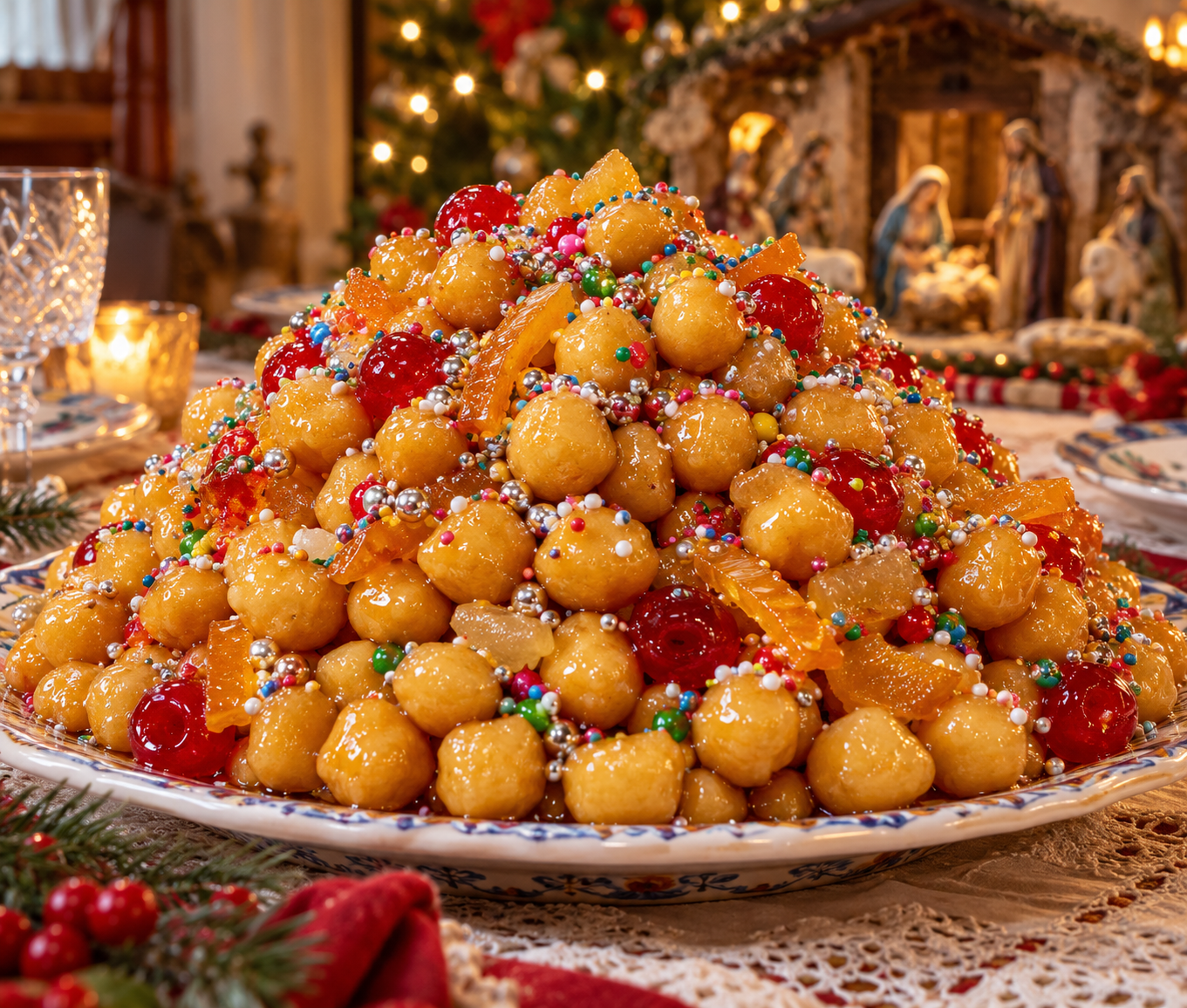
A struffolo, on its own, is a very small thing: a ball of sweet dough, a little smaller than a marble, deep-fried until golden, crunchy on the outside and light within. On its own it is pleasant but plain. The magic happens when you gather them by the hundred and bring in the honey.
The fried balls are tossed in warm honey, melted gently with a little sugar, until every one is glossy and coated. Then they are piled onto a plate and decorated, scattered with colored sprinkles, known in Naples as diavolilli, along with candied fruit like orange and cherries, and sometimes toasted nuts or silver dragees.
The finished dessert is as much a decoration as a food, bright and festive and glittering on the table.
You eat struffoli by picking the little balls off the mound with your fingers, one honey-soaked, crunchy, sweet bite at a time. There is no polite way to do it and no need for one; the informality of reaching in and plucking a few is part of why they feel so festive and communal.
Built Into a Mountain
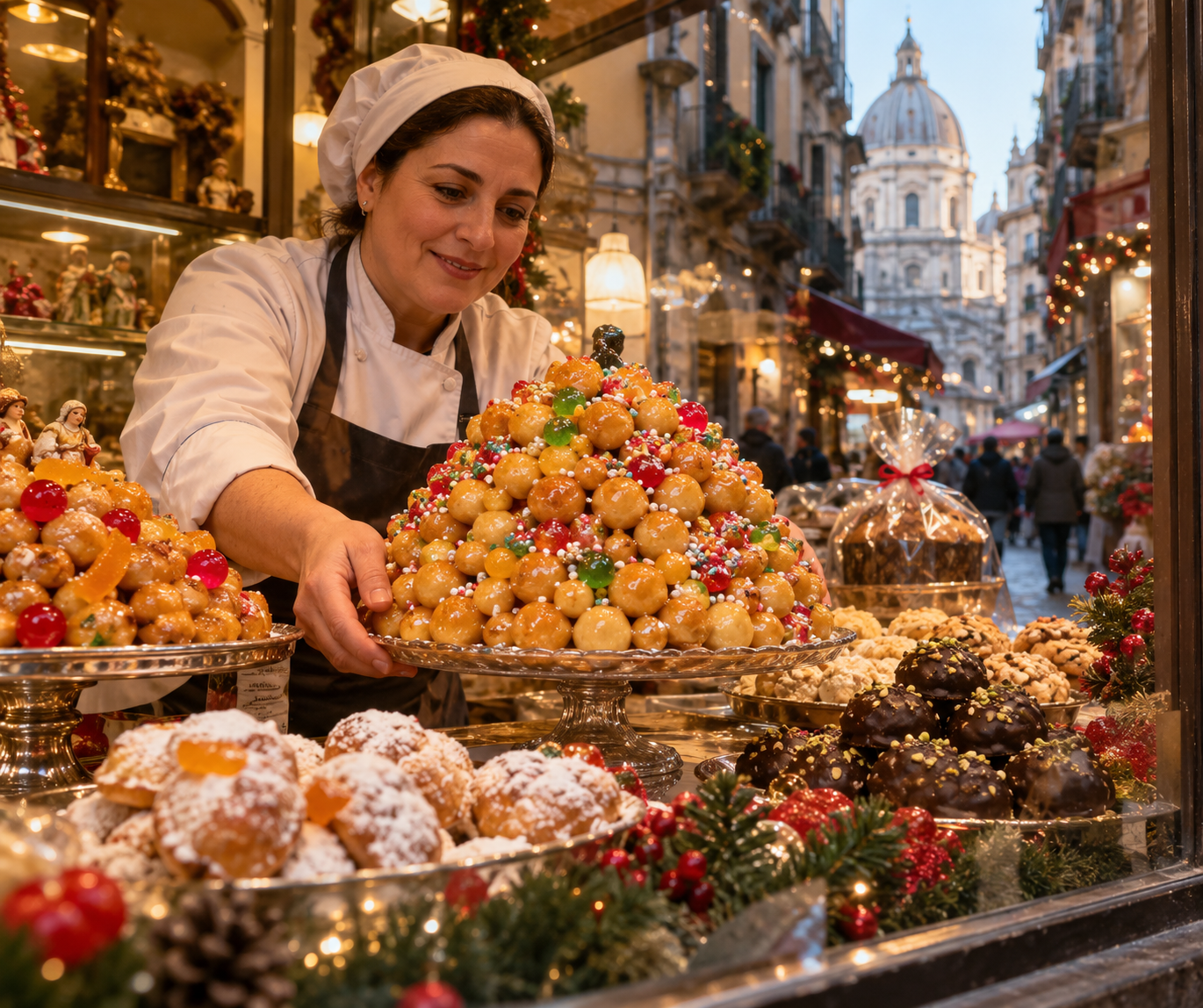
The shape is central to what struffoli are. Once coated in honey, the balls are built up into a form, most often a tall mound like a little mountain, or a ring shaped like a wreath, which the Neapolitans call a ciambella.
The honey is what makes this possible, acting as a sweet glue that holds the whole structure together as it cools and sets. To make the wreath, cooks often pile the honeyed balls around a glass placed in the center of the plate, then remove the glass once everything has set, leaving a perfect ring.
Then comes the decorating, which is half the fun and entirely the point. The mound or wreath is showered with those colored sprinkles and studded with jewel-like pieces of candied fruit, until it looks thoroughly festive. Struffoli are made to sit out on the table throughout the season, a glittering centerpiece that everyone picks at, a little more each day, until it is gone.
The Taste of a Neapolitan Christmas
In Naples, struffoli are not just one Christmas sweet among many; they are practically the symbol of the season on a plate. From the start of December through the New Year, they appear in every pastry shop window and on nearly every family table, as sure a sign of Christmas in Naples as the lights and the nativity scenes.
They belong to a whole family of Neapolitan Christmas sweets, sharing the table with hard spiced biscuits and other traditional treats, but it is the struffoli, glittering and golden, that tend to take pride of place. For a Neapolitan, the sight of that honeyed mound is Christmas itself.
Part of their charm is how they linger. A mound of struffoli is not eaten all at once but set out to be enjoyed over days, a few sticky balls plucked off whenever someone passes, slowly shrinking as the holiday goes on. They are the edible companion to the whole long Neapolitan Christmas, there on the table from the first celebrations to the last.
The Recipe Nonnas Guard
More than almost any other Christmas sweet, struffoli are a family affair, and the recipe is a treasured thing handed down from grandmother to grandchild. Every Neapolitan nonna has her own version, with her own touches in the dough and her own way of decorating, and she tends to be quietly convinced that hers is the best.
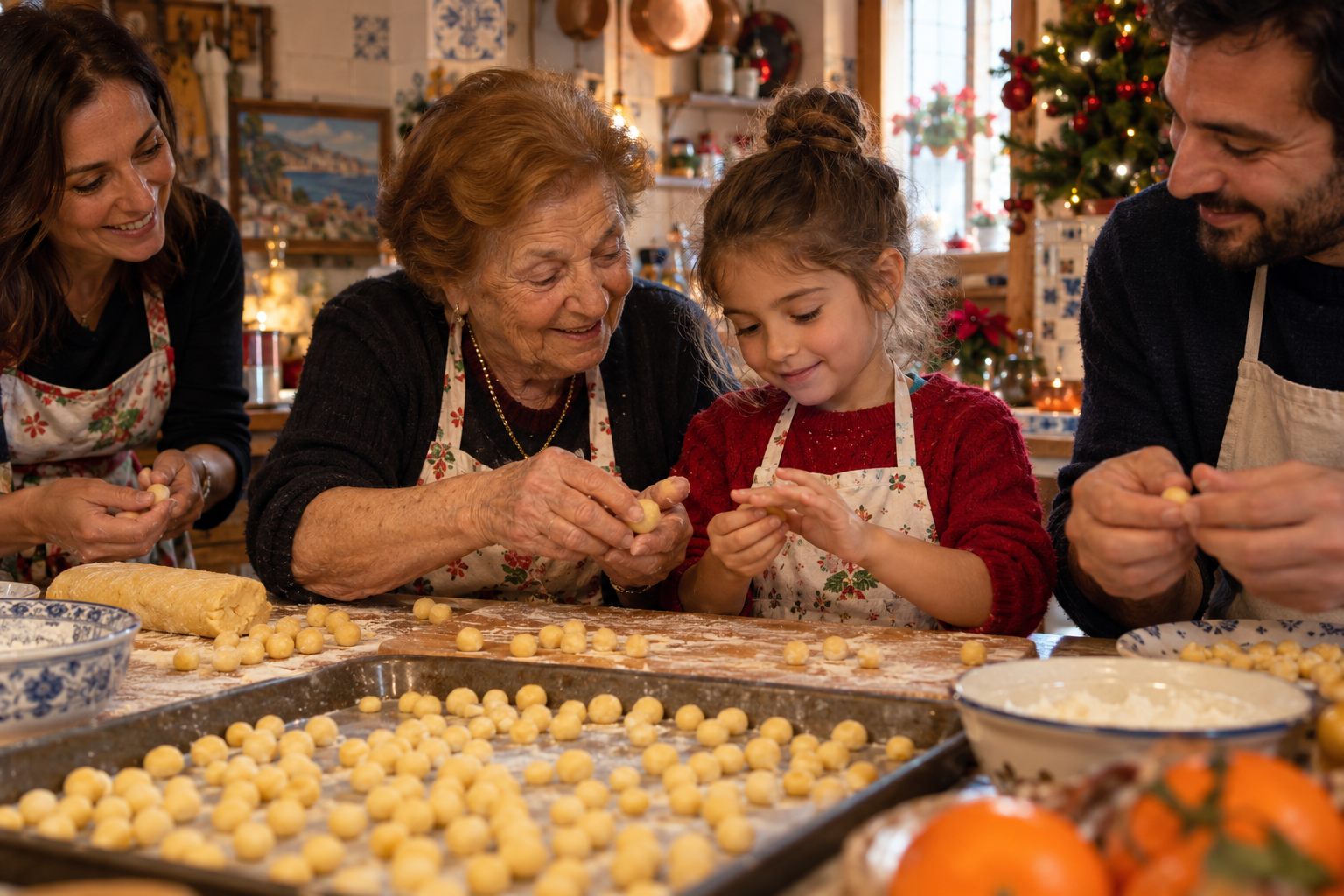
Part of why it is such a family tradition is that making struffoli takes real patience, and many hands help. All those tiny balls have to be rolled out one by one, which is slow work on your own but good fun with a crowd, and it is a classic job for children, who love rolling the little balls even if theirs come out a touch lopsided.
So the making of struffoli becomes a gathering in itself, generations in the kitchen together, rolling and frying and coating and decorating, talking and remembering as they go.
The dessert that emerges is delicious, but the real inheritance is the afternoon spent making it. That is why these recipes are guarded and passed on with such care, less as a set of measurements than as a way of keeping a family’s Christmases connected across the years.
An Ancient, Greek-Rooted Sweet
For all that struffoli feel quintessentially Neapolitan, their roots reach back thousands of years, long before Italy as we know it existed. Naples was once a Greek colony, part of what was called Magna Graecia, and struffoli are thought to descend from that ancient Greek past.
Even the name tells the story. Struffoli is believed to come from a Greek word meaning round, a nod to the shape of the little balls, and ancient Greek writers described a strikingly similar treat of dough balls fried in oil and served with honey. The dessert on the Neapolitan Christmas table is, in a real sense, an echo of something eaten in the ancient Mediterranean.
Over the centuries, the tradition was kept alive in Naples in part by the nuns of the city’s convents, who would make great batches of struffoli and give them as Christmas gifts to charitable noble families. Similar honey-ball sweets turn up elsewhere in southern Italy under other names, but struffoli remain the pride of Naples, a dessert that carries the layered history of a very old city in every honey-coated bite.
A Family With Cousins
Struffoli may be the most famous of the Italian honey-ball sweets, but it is far from the only one, and knowing its relatives puts it in context. The same basic idea, little balls or pieces of fried dough bound together with honey, turns up across southern and central Italy under different names and in different shapes.
In Abruzzo and the regions around it, there is cicerchiata, where the honeyed dough is formed into a ring. In Sicily and Calabria, pignolata takes a similar form, sometimes half-dipped in chocolate and lemon icing. Each region has made the honey-ball sweet its own, and families carry fierce loyalty to their local version.
What all of them share is an ancient Mediterranean lineage and a role as a festive, celebratory food, made in quantity and shared. Struffoli is Naples’s contribution to this old family, the glittering, sprinkle-covered mound that says Christmas in Campania, and recognizing it as one branch of a wider tradition only makes it more interesting to eat. You are tasting not just a Neapolitan treat but a whole region’s way with fried dough and honey.
Struffoli also keep remarkably well, which is part of why they suit the long Christmas season so perfectly. Coated in honey, the little balls stay good for days, sitting out on the table to be picked at whenever someone passes, slowly shrinking as the holiday goes on. A single batch, made in one patient afternoon, can see a family right through the festivities, which is exactly how the Neapolitans like it.
Making struffoli at home is a project rather than a quick bake, but that is part of the appeal. Set aside an afternoon, rope in whoever is around to help roll the endless little balls, and treat the whole thing as the festive ritual it is meant to be. The reward at the end is a glittering golden mound that looks genuinely spectacular on the table, far grander than the simple ingredients that went into it. Set it in the middle of the table, let it catch the light, and watch it slowly disappear over the days of Christmas, one honey-soaked ball at a time, exactly as it has on Neapolitan tables for generations.
Make It: Struffoli
Here is a traditional version, making one good-sized mound or wreath. The key is to roll the balls small, since they puff up as they fry, and to have patience with the rolling.
Ingredients
For the dough:
- 2 cups (250g) plain flour
- 2 tablespoons sugar
- 2 eggs
- 2 tablespoons butter, softened
- zest of 1 orange and 1 lemon
- 1 tablespoon anise or other liqueur (optional)
- a pinch of salt
- oil, for frying
For coating and decorating:
- 250g honey
- 2 tablespoons sugar
- colored sprinkles (diavolilli)
- candied fruit (orange, cherries) and/or toasted nuts
Instructions
- Make the dough: mix the flour, sugar, salt, and citrus zest, then work in the eggs, softened butter, and liqueur until you have a smooth dough. Rest it, covered, for about 30 minutes.
- Roll pieces of dough into thin ropes, then cut them into small pieces and roll each into a tiny ball, a little smaller than a marble. Keep them small.
- Heat a pot of oil and fry the balls in batches until golden and crisp, then drain them on paper towels.
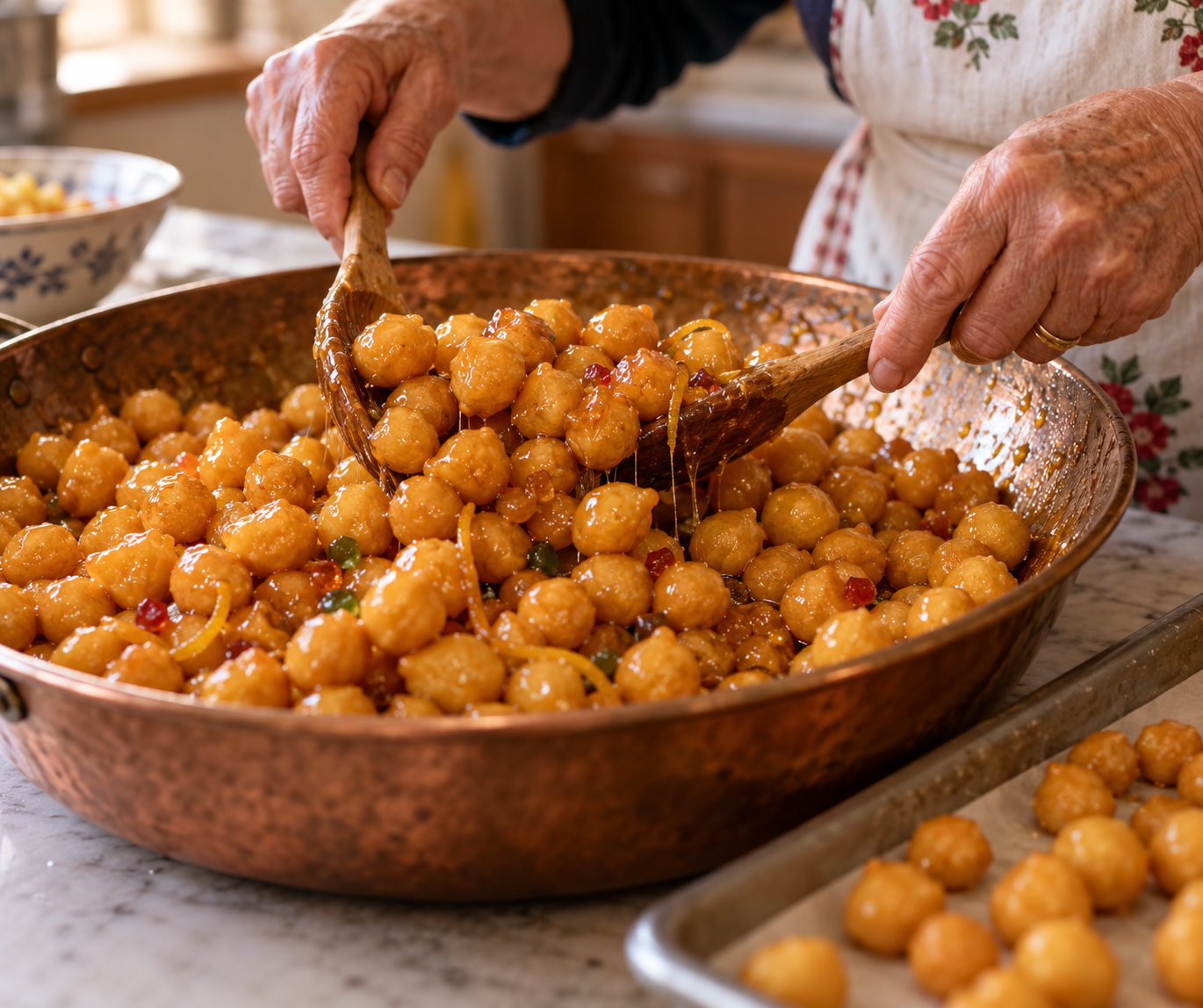
- In a wide pan, warm the honey with the sugar until it is melted and smooth. Add the fried struffoli and gently stir until every ball is coated.
- Pile the honey-coated balls onto a serving plate in a tall mound, or around a glass in the center to form a wreath, then remove the glass once set.
- While still warm and sticky, decorate generously with colored sprinkles, candied fruit, and nuts. Let it set, then serve, letting everyone pick at the mountain.

About the Author: Ruben, co-founder of Gamintraveler.com since 2014, is a seasoned traveler from Spain who has explored over 100 countries since 2009. Known for his extensive travel adventures across South America, Europe, the US, Australia, New Zealand, Asia, and Africa, Ruben combines his passion for adventurous yet sustainable living with his love for cycling, highlighted by his remarkable 5-month bicycle journey from Spain to Norway. He currently resides in Spain, where he continues sharing his travel experiences with his partner, Rachel, and their son, Han.