
You order an espresso at an Italian bar, drink it down in thirty seconds standing at the counter the way the locals do, and the barista hands you, along with it, a small printed receipt, the scontrino. You did not ask for it, you have no use for it, and yet there it is, issued with a kind of bureaucratic seriousness entirely out of proportion to a one-euro coffee, and tucked into your hand as though it mattered. Many tourists have also heard a darker version of the story: that you must keep that receipt, because Italy’s fiscal police can stop you outside and fine you if you cannot produce it.
The scontrino is one of the most confusing little rituals of Italian life for a visitor, wrapped in half-understood rules, outdated warnings, and a persistent myth that simply refuses to die no matter how long the rule behind it has been gone. So here is what the scontrino actually is, why Italy takes receipts so seriously, the truth about the famous fine that scares tourists, and the pay-first bar ritual that trips up everyone who does not know it. Once you understand it, the little slip of paper stops being a puzzle and becomes a small window into how the country runs.
What follows is the receipt the bar must give you, why Italy cares so much, the fine myth set straight, the pay-first system, and what it all means for a visitor.
The Receipt the Bar Must Give You
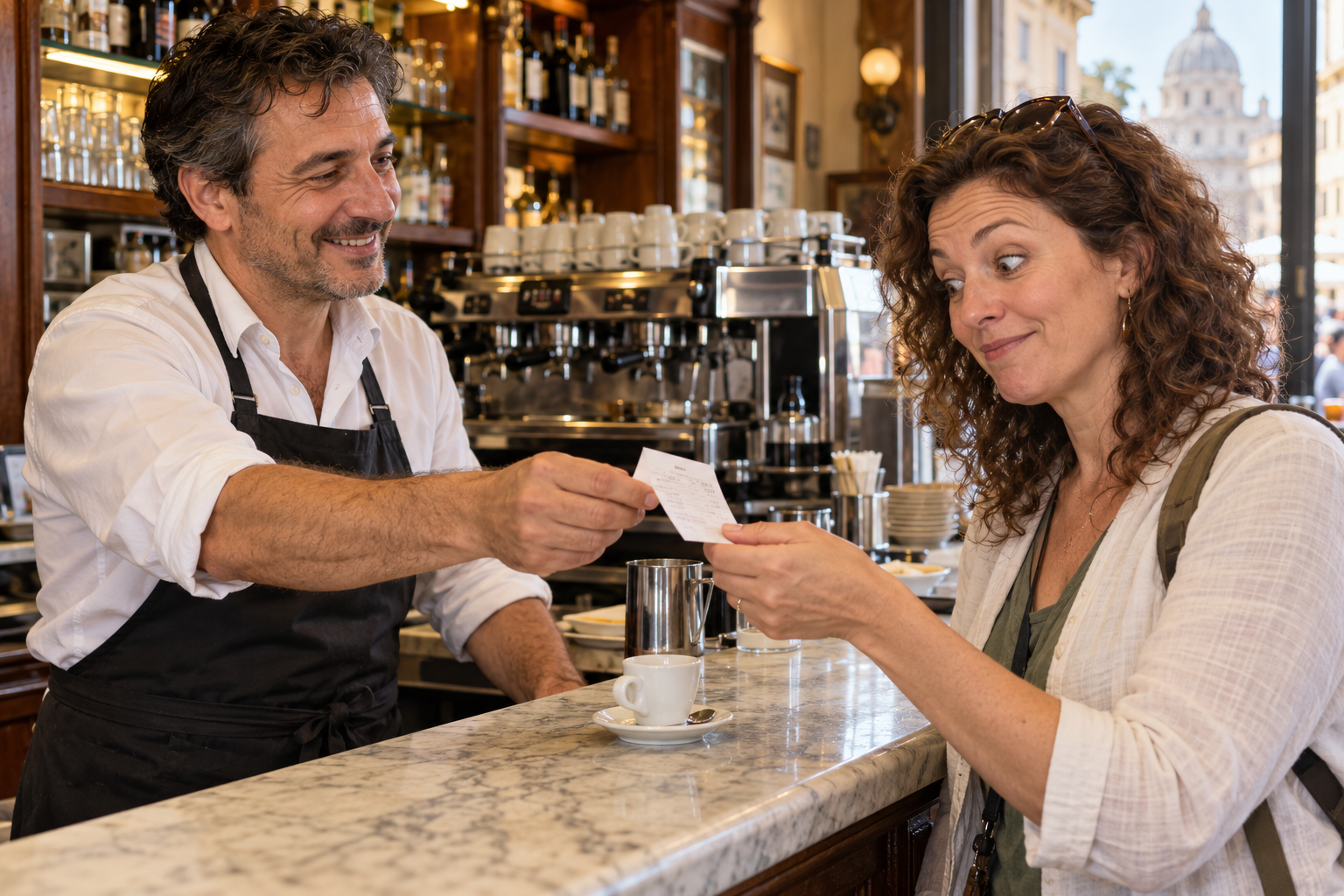
The starting fact, and the true one, is that in Italy the business is legally required to issue a receipt for every sale, no matter how small. That one-euro espresso, that bottle of water, that pastry, every transaction must be rung up and recorded, and a receipt, the scontrino, produced as proof that it was. There is no threshold below which it stops mattering; a single coffee is as much a recordable sale as a fifty-euro dinner. This is why you get a printed slip for even the most trivial purchase in Italy, something that strikes visitors from countries where a coffee is a cash-and-go affair as oddly formal. In much of the world a one-euro transaction leaves no trace at all; in Italy it generates a document, every single time. The receipt is not a courtesy or an afterthought; it is a legal document the seller is obliged to generate.
In its modern form, the scontrino has gone electronic. Since 2020, businesses must issue what is now called the documento commerciale, generated by a cash register connected directly to the tax authority and transmits the day’s sales to the government automatically.
So when the barista rings up your coffee, the sale is not just recorded on the slip in your hand but reported, electronically, to the Italian revenue service, usually before you have taken your first sip. The receipt you pocket is a souvenir of a transaction the government already knows about. The paper receipt you receive is really the visible end of an invisible system that logs the transaction with the state. What feels to you like a scrap to crumple in your pocket is, to the machine that printed it, the receipt for a message already sent to the tax office. Understanding that the receipt exists primarily for the tax authorities, and only incidentally for you, is the key that unlocks the whole strange ritual, because once you grasp that the scontrino is a fiscal instrument rather than a shopping receipt, everything else about it starts to make sense. You are not really being given a receipt so much as being handed your copy of a report filed with the government.
Why Italy Cares So Much About Receipts
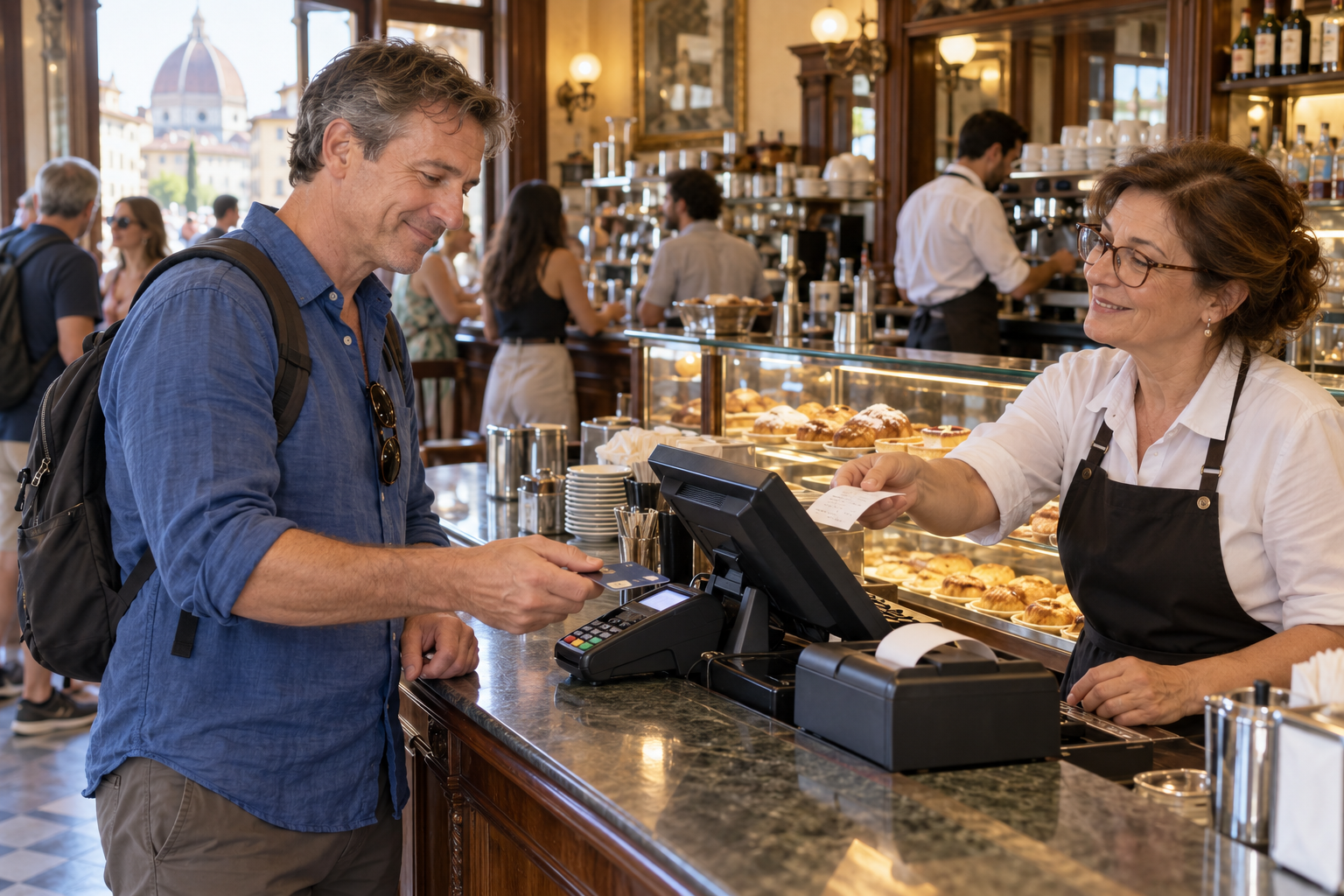
To understand why a one-euro coffee generates a legally mandated, electronically transmitted receipt, you have to understand Italy’s long and difficult relationship with tax evasion. Italy has long struggled with a large shadow economy, with businesses underreporting their income and pocketing the taxes they should have passed to the state, and the humble receipt is one of the government’s main weapons against it. Every scontrino issued is a sale recorded, a bit of income that cannot be hidden, which is exactly why the law forces businesses to produce one for every transaction.
The logic is simple and quietly clever. If a bar is required to ring up every coffee and issue a receipt, and that sale is transmitted to the tax authority, then the bar cannot easily pretend the coffee was never sold and keep the tax for itself.
Multiply that across millions of small cash transactions a day, and the receipt rule becomes a serious tool for pulling an entire shadow economy into view. The receipt, in other words, drags every small transaction into the daylight of the official economy, where it can be counted and taxed. A business that never issues receipts is a business whose true income no one can see, which is precisely the darkness the system is built to dispel. This is also why Italy maintains the Guardia di Finanza, a dedicated financial police force, whose job includes making sure businesses are issuing proper receipts and recording their sales. A receipt that is missing, or one marked “non fiscale,” meaning it is not an official fiscal receipt, is a sign that a sale may be slipping past the taxman, and it is the business, not you, that the system is designed to catch. The whole apparatus of mandatory receipts, connected cash registers, and fiscal police exists for one purpose: to force Italy’s businesses to record their income and pay their share, with your little coffee slip as a tiny cog in a vast anti-evasion machine.
The Fine Myth, Set Straight

Now for the part that frightens tourists, and the part where the popular story is simply out of date. For decades, travel lore has warned that in Italy you, the customer, must take and keep your receipt, because the fiscal police can stop you just outside the shop and fine you if you cannot produce it. It is a vivid story, repeated in guidebooks and travel forums to this day, and it makes nervous tourists clutch their coffee receipts as though they were passports. The trouble is that it is no longer true.
The warning was real once. Back in the 1980s and 1990s, Italian law did make the customer jointly responsible, and a shopper caught near a business without a receipt could indeed be fined. That draconian rule, introduced in the early 1980s as a desperate anti-evasion measure, is the source of the enduring legend, and stories of tourists being stopped outside shops by grey-uniformed officers have been passed down in guidebooks ever since, long after the rule behind them lapsed. But the customer penalty was abolished more than twenty years ago, around 2003, and for over two decades now the entire structure of fines relating to the scontrino has applied exclusively to the business, the bar or shop or restaurant, and not to the customer at all.
Today, you have no legal obligation to take the receipt, no obligation to keep it, and you cannot be fined for walking out of a bar without it. The story that persists in so much travel advice describes a rule that has been dead for a generation. It survives purely because it is memorable and a little frightening, which is exactly the kind of story that outlives the fact behind it. So you can let go of the anxiety entirely: take the receipt or leave it, keep it or toss it, and no fiscal policeman will ever trouble you over a missing coffee slip. The myth is sticky, but the fine, for you, is gone, and has been for longer than many of the travelers repeating it have been visiting Italy.
From Fine to Lottery
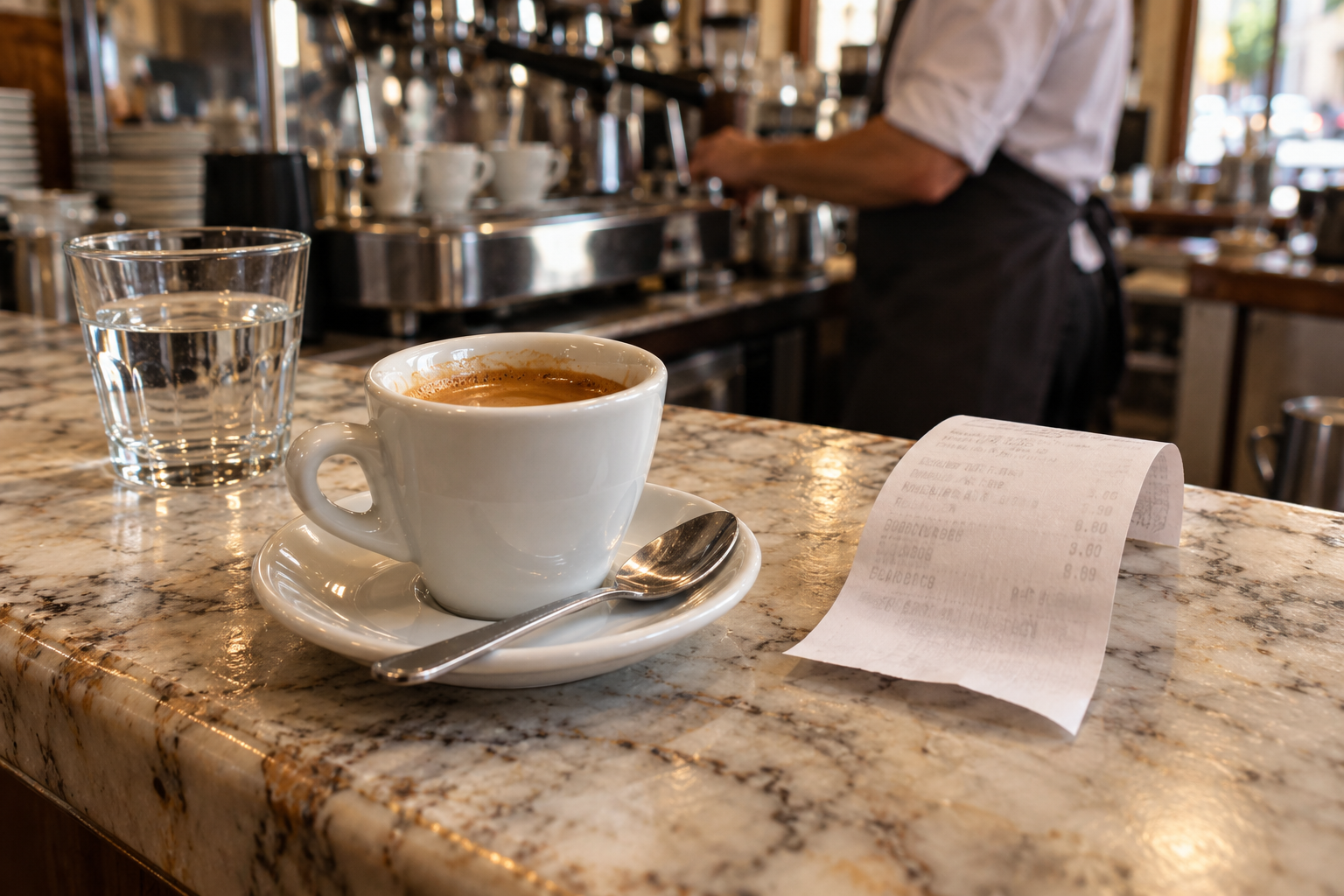
If Italy no longer punishes customers for failing to take their receipts, it has found a cleverer way to keep them on the side of the taxman: it rewards them instead. In 2021, Italy launched the lotteria degli scontrini, the receipt lottery, a genuine national prize draw tied to the humble receipt, and it neatly illustrates how the whole approach has shifted from stick to carrot. Where the old system threatened the customer with a fine for not having a receipt, the new one dangles the chance of winning money for making sure they get one.
The mechanics are straightforward and quietly ingenious. A resident registers for a personal lottery code, shows it at the till when paying electronically, and each euro spent earns a virtual ticket entered into regular draws, with prizes running up to very large sums, and winnings tax-free. Because the lottery only works with electronic, traceable payments and a properly issued electronic receipt, it gives ordinary shoppers a direct, selfish incentive to insist on a recorded, above-board transaction, which is exactly what the state wants in its fight against evasion. In effect, Italy has turned every customer into a potential ally, someone with a small personal stake in making sure the sale is rung up properly, and it is not alone, with similar receipt lotteries running in Portugal and elsewhere. For a visitor the lottery is mostly a curiosity, since you generally need to be a resident to play, but it is worth understanding because it explains the logic of the whole system: the receipt that once came with a threat now comes, for locals, with a lottery ticket, and the goal, dragging every sale into the light, is the same. It is a more cheerful way to run a tax crackdown, and a quietly revealing one.
Pay First, Then Order
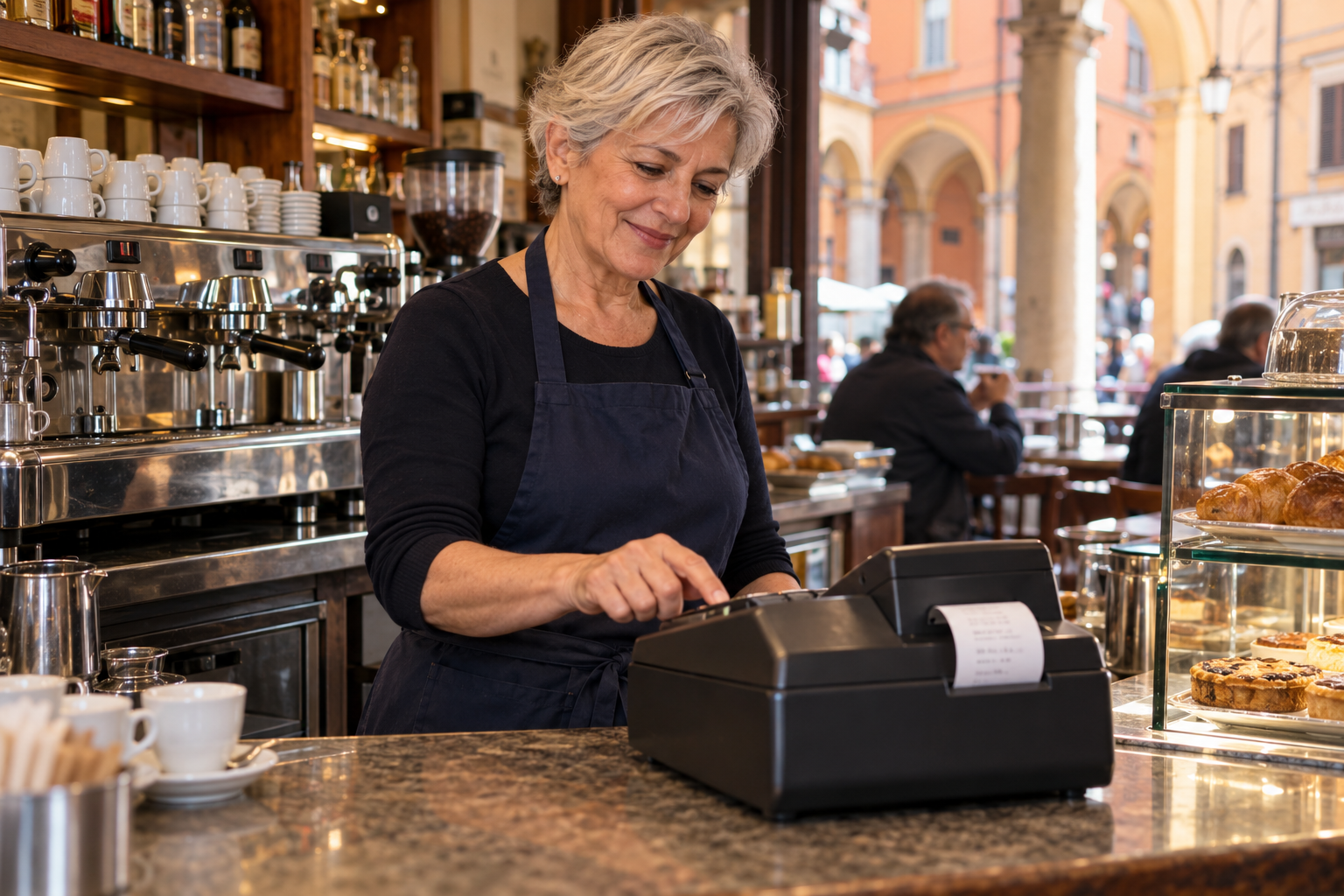
There is a second piece of scontrino confusion, and this one is about how you actually buy things, especially in a busy Italian bar, where the order of operations surprises almost every newcomer. In many Italian bars, particularly the busier city ones, you do not simply walk up to the counter and order. Instead you go first to the cassa, the cash register, usually staffed by a separate cashier, where you say what you want and pay for it, and you are given a scontrino. Only then do you take that receipt to the bar counter, where you hand it over or set it down, often with a small coin on top as a tip, and give your order to the barista, who makes your coffee on the spot.
This pay-first, order-second system baffles tourists who stride up to the bar, try to order a coffee, and are waved toward the cash register with a gesture they do not understand. The barista is not being rude; they simply cannot serve you until the sale has been rung up and you are holding the proof.
But it follows directly from the receipt rules: paying at the register first ensures the sale is rung up and the scontrino issued before the coffee is made, which keeps the transaction firmly inside the fiscal system. Once you know the ritual, it is easy: find the cassa, pay and get your receipt, then present the receipt at the counter and order. Not every bar works this way, smaller places and quiet neighborhood spots often let you order first and pay as you leave, but in any busy or city-center bar, the pay-first system is the norm, and knowing to look for the cash register before the counter marks you instantly as someone who understands how an Italian bar works. Watch what the locals do: if people are queueing at a register off to the side before drifting to the bar, that is your cue. It is the single most useful thing to know for ordering a coffee in Italy without confusion, and it spares you the small, universal embarrassment of being gestured away from the counter you just confidently approached.
What It All Means for a Visitor

So where does all this leave the ordinary traveler, standing at a bar with a coffee in one hand and a mysterious slip of paper in the other? The practical upshot is reassuringly simple. Take the receipt when it is handed to you, because it costs nothing and is occasionally useful, for a return, an exchange, or a warranty on something you have bought, and because it is the polite and normal thing to do. But do not treat it as a document you must guard, and do not for a moment believe you will be fined for not having it, because that rule died twenty years ago and the penalties now fall entirely on the business.
Beyond that, learn the pay-first ritual for busy bars, look for the cassa before you approach the counter, and you will order your espresso like a local rather than standing confused at the bar. And perhaps enjoy the small glimpse the scontrino offers into Italy, a country waging a long war against tax evasion one coffee receipt at a time, where even the tiniest purchase is dragged into the official record by a slip of paper and a cash register wired to the state. The receipt that seemed like a petty bureaucratic imposition turns out to be a tiny instrument of national policy, and the fine that frightened you turns out to be a ghost of a rule that died while you were still young. Neither the slip nor the story deserves the worry travelers give them. Take the slip, pay at the register, drink your coffee standing up at the bar like an Italian, and let the scontrino be what it is: not a trap to fear, but a quietly fascinating little window into how Italy actually works.

About the Author: Ruben, co-founder of Gamintraveler.com since 2014, is a seasoned traveler from Spain who has explored over 100 countries since 2009. Known for his extensive travel adventures across South America, Europe, the US, Australia, New Zealand, Asia, and Africa, Ruben combines his passion for adventurous yet sustainable living with his love for cycling, highlighted by his remarkable 5-month bicycle journey from Spain to Norway. He currently resides in Spain, where he continues sharing his travel experiences with his partner, Rachel, and their son, Han.