
Walk through almost any Spanish neighborhood on a Sunday morning and you will find, somewhere nearby, a small shop with a row of whole chickens turning slowly on spits behind the glass, golden and glistening, filling the whole street with the smell of roasting garlic and paprika. This is a polleria, a roast chicken shop, and the chickens are pollo asado, and around them has grown one of the most beloved and quietly essential rituals of Spanish life. On Sundays especially, the queues form, and families walk home carrying a hot, whole roast chicken in a bag, often with a portion of fries, to serve as the centerpiece of Sunday lunch without anyone having to cook. It is cheap, delicious, and deeply woven into how Spain does its day of rest. Here is the story of the Spanish roast chicken shop, why Sunday belongs to it, and how to make a proper Spanish pollo asado at home. It is the rare dish that is both a cheap convenience and a genuine tradition, and understanding the ritual is half the pleasure of recreating it.
What follows is the roast chicken shop on every corner, why Sunday is its day, the marinade that makes the chicken unmistakably Spanish, how to roast it over potatoes at home, and the recipe.
The Roast Chicken Shop on Every Corner
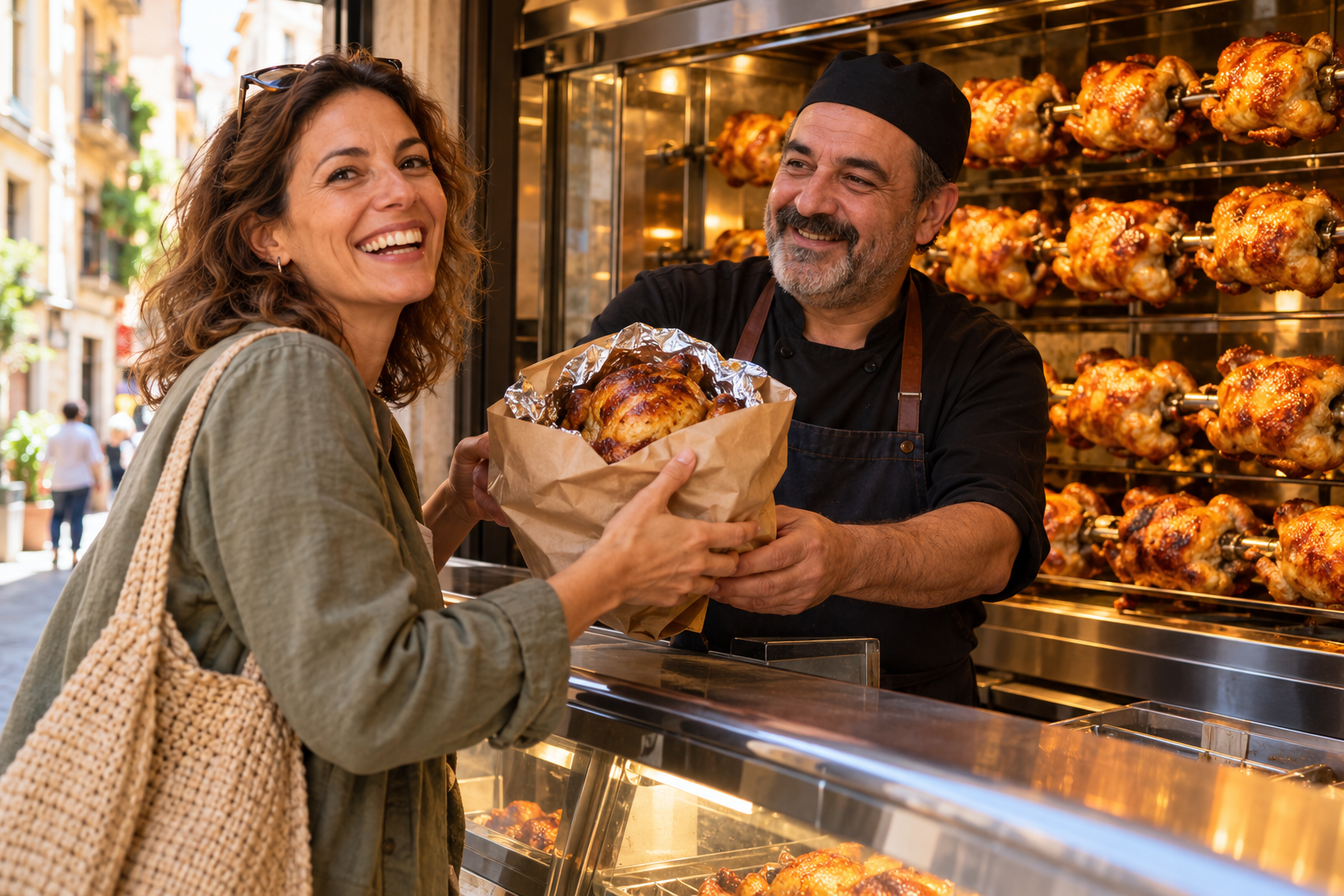
The polleria, or asador de pollos, is one of those humble fixtures of Spanish life that visitors notice and locals take completely for granted. These are small, often no-frills shops given over almost entirely to one thing: whole chickens roasted on rotating spits in full view, turning in rows behind the counter until the skin is deep golden and crackling. The sight of them spinning in the window, and above all the smell that pours out onto the pavement, is one of the most appetizing things in any Spanish town, and it does much of the shop advertising for it, drawing you in from half a block away before you have even decided that you are hungry.
What these shops sell is simplicity itself: a whole roasted chicken, or half of one, to take away, usually handed over hot in foil and a paper bag, often with a scoop of fries or some roast potatoes that have been catching the dripping juices beneath the spits.
They are inexpensive, a whole chicken feeding a family for a modest sum, and they are fast, since the chicken is already cooked and waiting, so you simply order, pay, and carry it home. This is Spanish convenience food at its best, not the industrial fast food of a drive-through but a freshly roasted, properly seasoned chicken from a shop that does little else, and it occupies a place in Spanish life somewhere between a takeaway and an institution. It is proof that convenience and quality need not be opposites, and that a whole culture can build a cheap, easy meal out of something genuinely good rather than something merely fast. Every neighborhood has its favored polleria, and people are loyal to the one whose chickens they judge the juiciest and best seasoned, the way they are loyal to a favorite baker. Ask a Spaniard where the best roast chicken in their area is and you will get a firm, considered answer, often with directions and an opinion about the sauce.
Why Sunday Belongs to the Roast Chicken
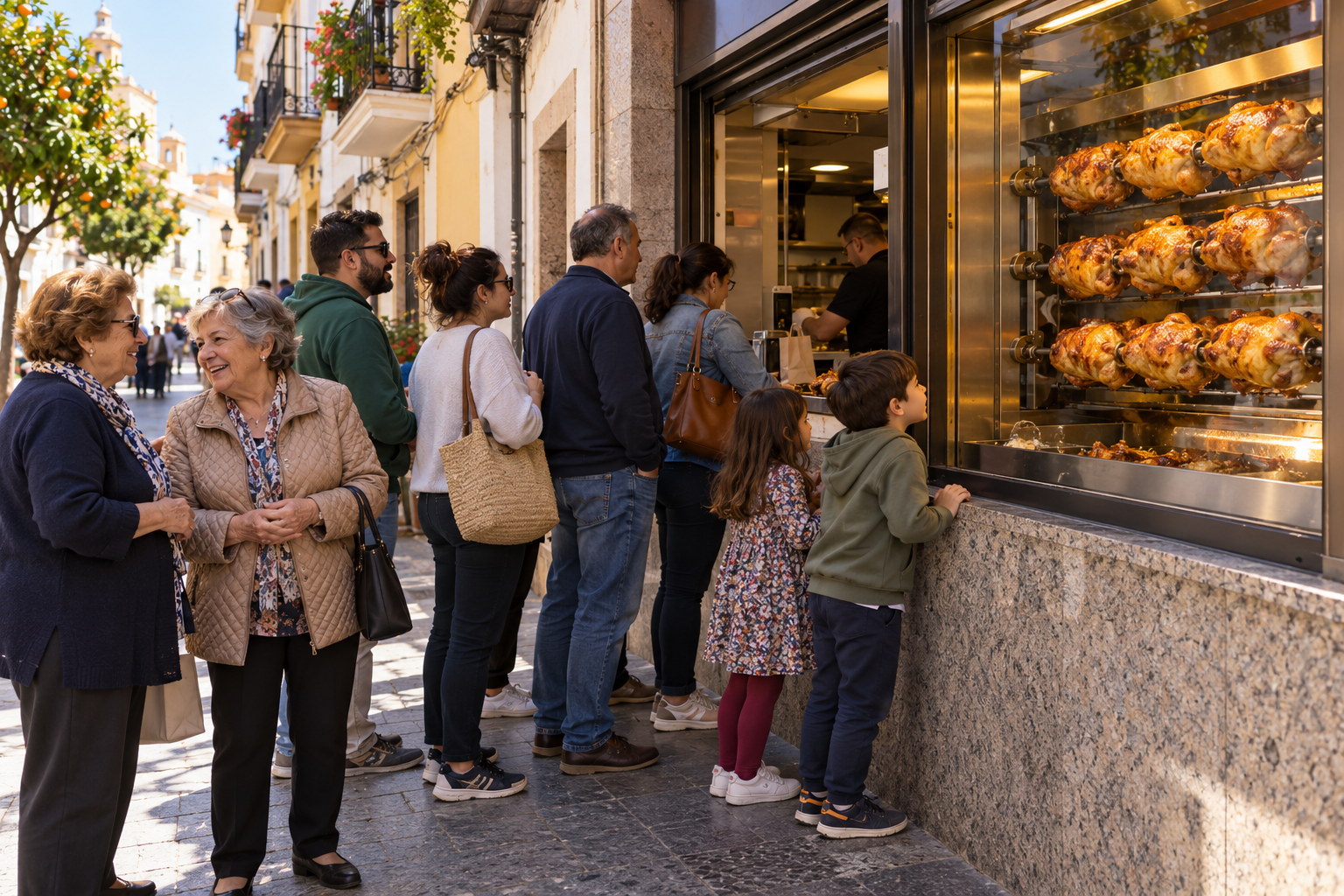
The roast chicken shop does business all week, but it is on Sundays that it comes into its own and reveals its real role in Spanish life. Sunday in Spain is traditionally the day of rest and of the big family lunch, the meal of the week when relatives gather, and it is also, understandably, a day when nobody much wants to spend the whole morning cooking. The roast chicken shop is the perfect answer to that tension, letting a family lay on a proper, hot, communal Sunday lunch without anyone being stuck at the stove, and so on Sundays the pollerias do a roaring trade, with queues out the door.
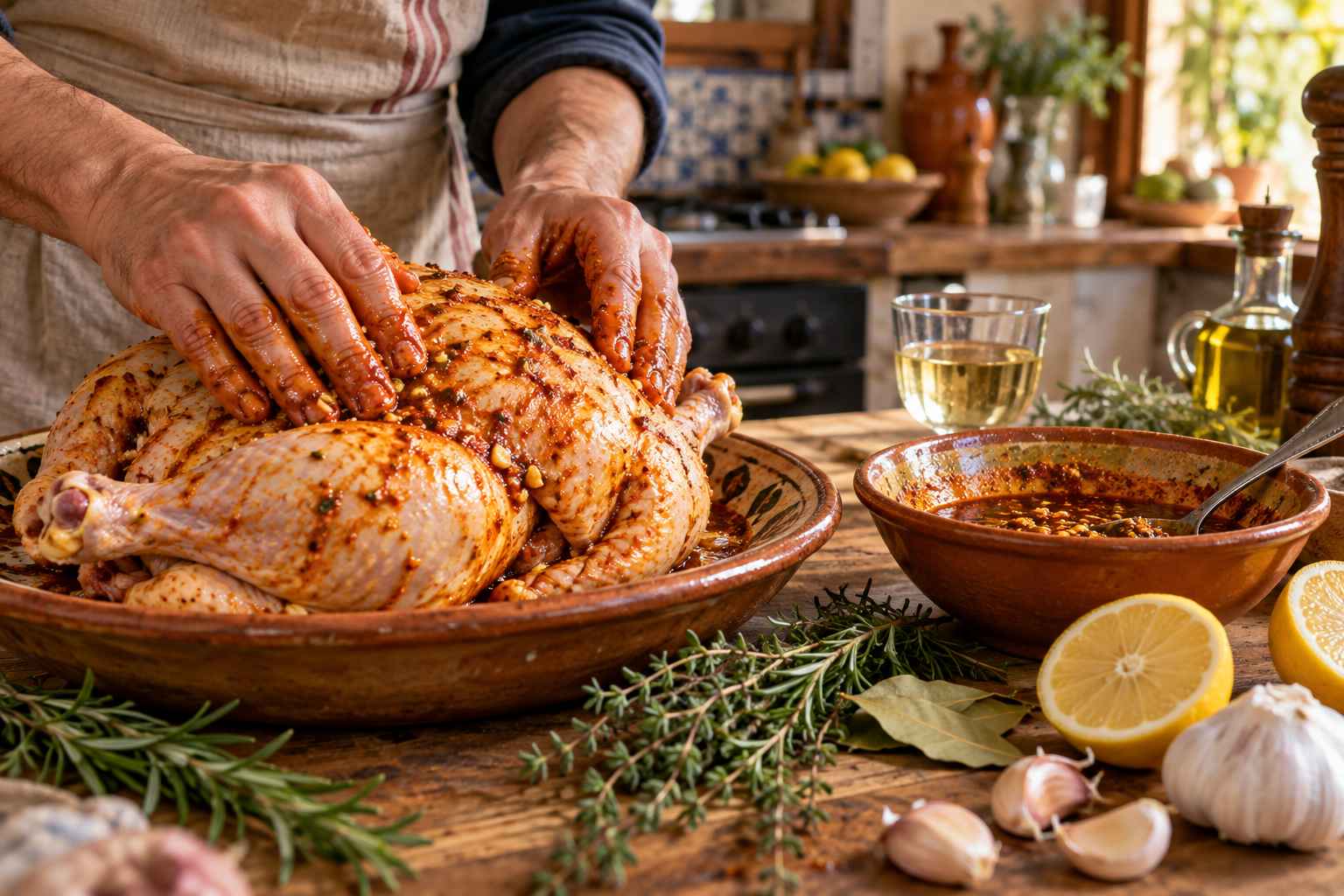
There is something lovely and practical about this as a solution, and it says a good deal about Spanish priorities. Rather than either laboring over a Sunday roast or resorting to something joyless, Spanish families simply outsource the cooking of a genuinely good, traditional dish to the neighborhood expert, and then gather around it at home exactly as they would a home-cooked one. The chicken, with its fries or potatoes, a salad thrown together, some bread and wine, and the whole family gathered around the table, together make a complete and deeply satisfying Sunday lunch for very little money and almost no effort at all, freeing the day for what it is actually for, which is being together. For a great many Spanish families, the Sunday pollo asado is a fixture as reliable as the meal itself, a small weekly ritual that a lot of people carry with real affection from childhood, the smell of the roast chicken bag coming through the door being, for them, the smell of Sunday itself. It is one of those humble food memories that turns out to be load-bearing, the kind of small weekly comfort that people miss keenly when they move away and cannot find a proper polleria.
The Marinade That Makes It Spanish
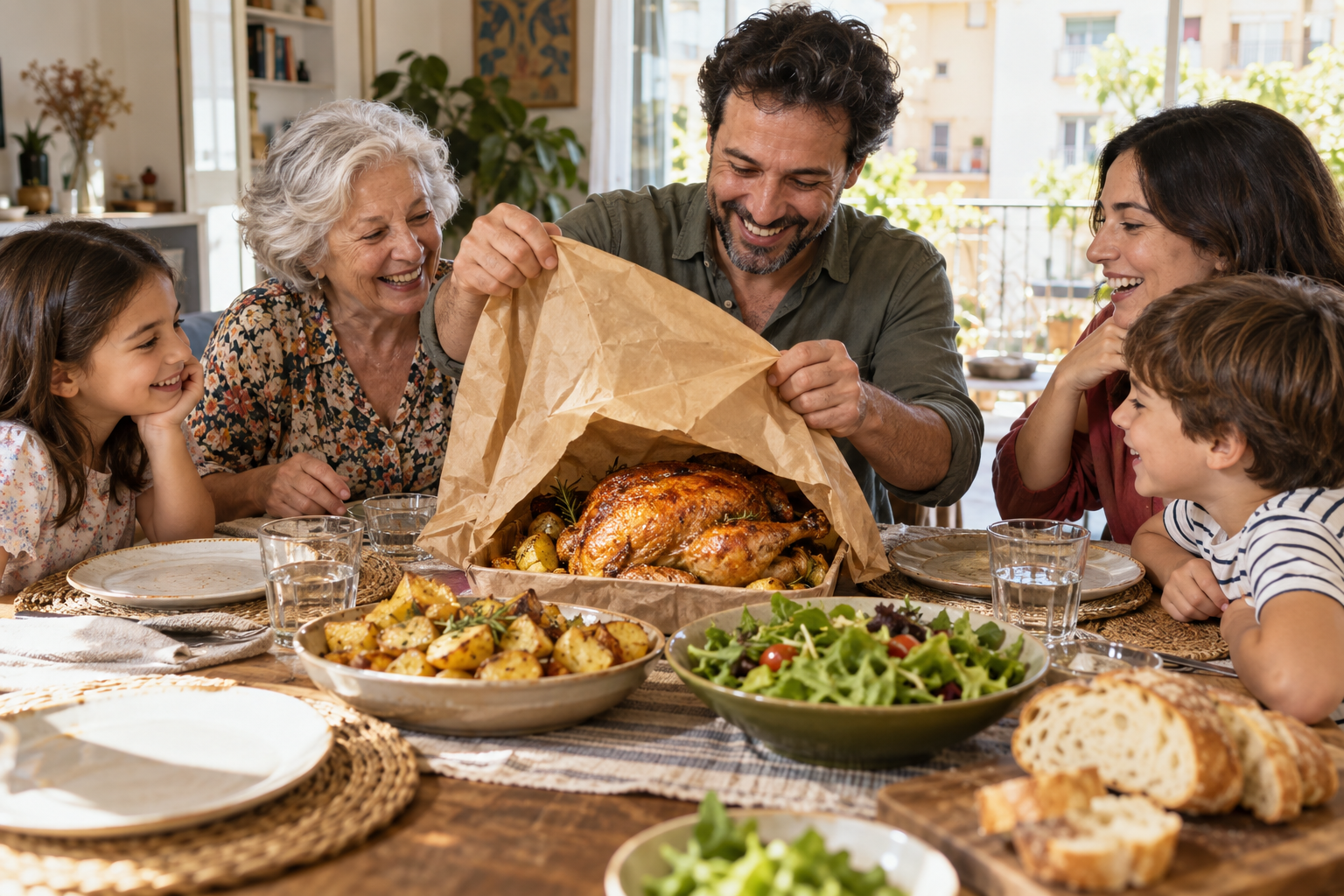
If you want to recreate the shop chicken at home, the first thing to understand is what makes a Spanish pollo asado specifically Spanish, because the name causes real confusion. Say pollo asado to many people and they picture the Mexican or Latin American dish, chicken marinated in citrus and achiote and grilled to a red-orange color, which is delicious but an entirely different thing. The Spanish pollo asado is a straightforward roast chicken, and its flavor comes not from achiote and lime but from a simple, savory Mediterranean seasoning built on garlic, olive oil, and often sweet Spanish paprika.
The classic Spanish approach is to rub the chicken, inside and out and under the skin where you can, with a paste of crushed garlic, olive oil, salt, and pepper, very often with sweet pimenton, Spanish paprika, for color and a gentle warmth, and with herbs such as thyme, rosemary, or bay.
A halved lemon goes into the cavity, its juice brightening the whole bird, and a good splash of white wine is poured into the roasting pan, where it mingles with the chicken’s own juices to make the makings of a light sauce. That is the whole flavor profile, garlicky, herby, lightly paprika-warmed, lemon-brightened, and moistened with white wine, and it is what gives Spanish roast chicken its particular, savory, unmistakably Mediterranean character. There is no long list of spices and no exotic ingredient, just good garlic, good paprika, lemon, wine, and herbs, which is exactly why it tastes of Spain rather than anywhere else. The restraint is the point; this is a dish that trusts a few good ingredients to do the work rather than burying the chicken under a dozen seasonings.
Roast It Over the Potatoes
The other secret of a proper Spanish pollo asado, and the thing that turns it from a good roast chicken into a genuinely great one-pan meal, is what happens underneath the bird. In the shops, the potatoes and fries sit below the turning spits precisely so they can catch the fat and juices dripping from the chickens above, and you can do the same thing at home to wonderful effect. You lay a bed of sliced or chunked potatoes, and often some onion, in the roasting pan, season them, and set the chicken on top or nestled among them, so that as the chicken roasts it bastes the potatoes below in its garlicky, winey juices.
The result is two dishes for the effort of one: a crisp-skinned, juicy roast chicken above, and beneath it a pan of potatoes that have slowly cooked in the best possible liquid, soft and savory and soaked with flavor, far better than any potato roasted on its own.
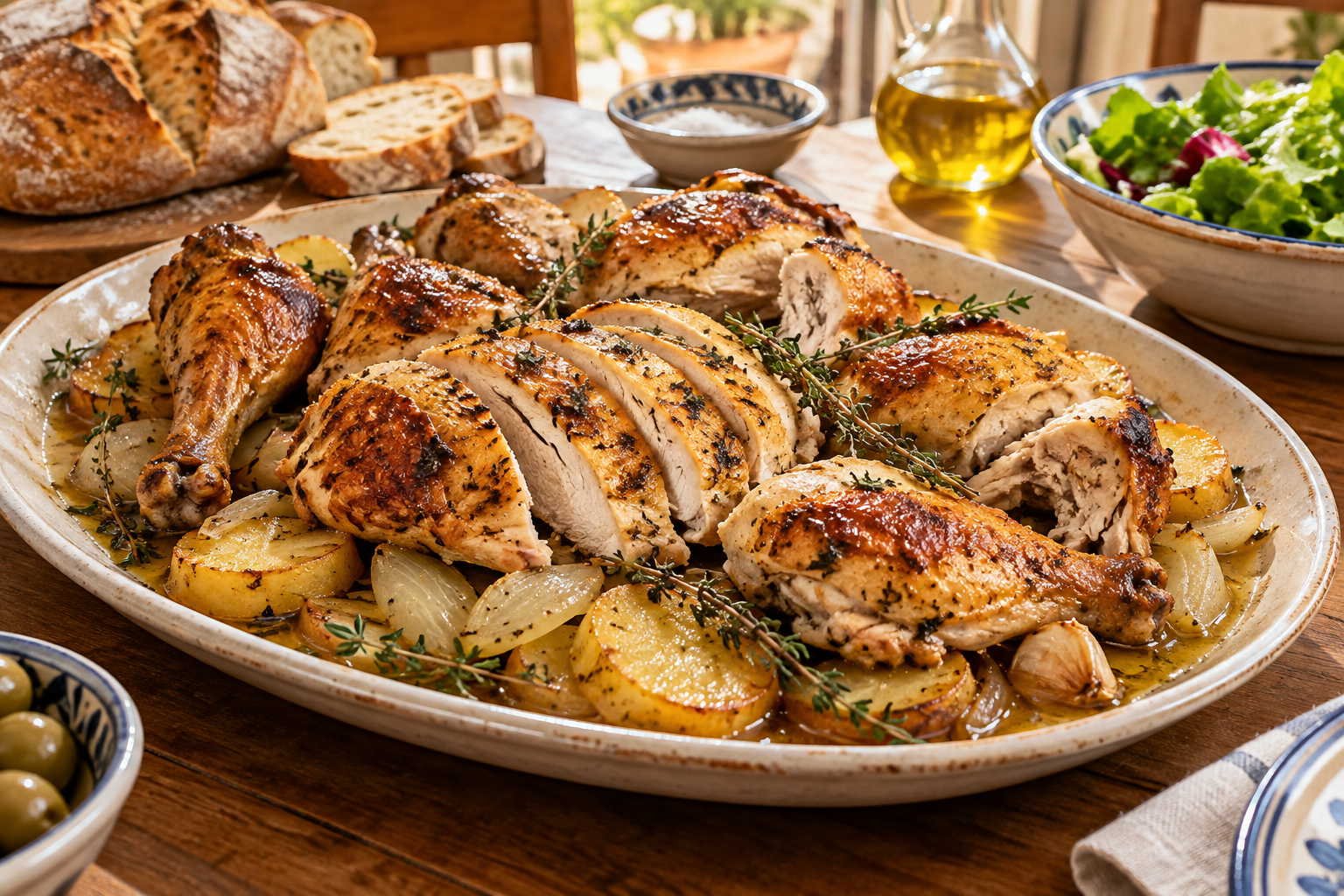
Roast it all in a hot oven until the skin is deep golden and crisp and the juices run clear, basting once or twice along the way, which takes somewhere in the region of an hour and a quarter to an hour and a half for a whole chicken, and let it rest a few minutes before carving. Serve the carved chicken on its bed of potatoes with the pan juices spooned over, a simple salad alongside, and you have brought the Sunday pollo asado home, the same generous, garlicky, golden-skinned bird that Spanish families carry back from the polleria every week, made with your own hands. It is honest, unfussy, deeply satisfying food, and once you have made it this way, over the potatoes, you will understand why Spain never tires of it. It is the sort of thing you will find yourself making again and again, on your own Sundays, until the smell of it roasting becomes a small ritual in your kitchen too.
Making Spanish Pollo Asado
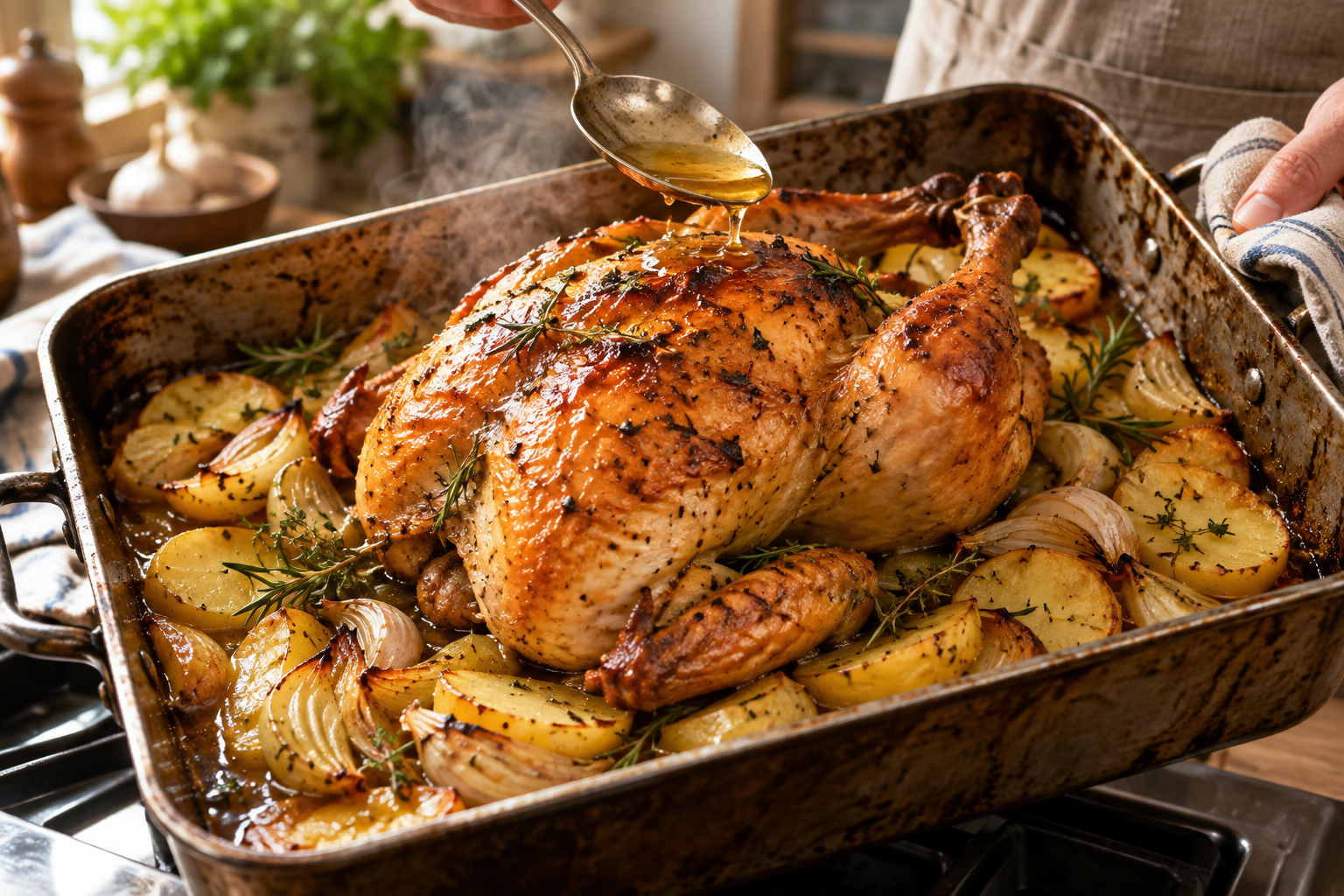
Here is a classic Spanish pollo asado con patatas, serving four. Roast the chicken over the potatoes so they catch the juices.
Ingredients
- 1 whole chicken, about 1.5 to 2 kg
- 4 cloves garlic, crushed
- 3 tablespoons olive oil
- 1 teaspoon sweet paprika (pimenton)
- 1 lemon, halved
- 125 ml white wine
- Fresh thyme or rosemary, and a bay leaf
- 1 kg potatoes, peeled and thickly sliced
- 1 onion, sliced
- Salt and pepper
Instructions
- Mix the crushed garlic, olive oil, paprika, salt, and pepper into a paste. Rub it all over the chicken, inside and out and under the skin where you can. Put the halved lemon in the cavity. Ideally leave to marinate for an hour or more.
- Preheat the oven to around 200 C, about 400 F.
- Spread the sliced potatoes and onion in a roasting pan, season them, and drizzle with a little olive oil. Pour the white wine over the potatoes and tuck in the herbs.
- Set the chicken on top of the potatoes, breast up.
- Roast for about 1 hour 15 minutes to 1 hour 30 minutes, until the skin is deep golden and crisp and the juices run clear, basting once or twice with the pan juices.
- Rest the chicken for a few minutes, then carve.
- Serve the chicken on the bed of potatoes, with the pan juices spooned over and a simple salad alongside.
And do use the potatoes underneath, since letting them roast in the chicken’s garlicky, winey juices is the whole trick that turns a good roast chicken into a proper Spanish pollo asado, so build your bed of potatoes, set the seasoned bird on top, and roast the two together the way the pollerias have always done it.

About the Author: Ruben, co-founder of Gamintraveler.com since 2014, is a seasoned traveler from Spain who has explored over 100 countries since 2009. Known for his extensive travel adventures across South America, Europe, the US, Australia, New Zealand, Asia, and Africa, Ruben combines his passion for adventurous yet sustainable living with his love for cycling, highlighted by his remarkable 5-month bicycle journey from Spain to Norway. He currently resides in Spain, where he continues sharing his travel experiences with his partner, Rachel, and their son, Han.