
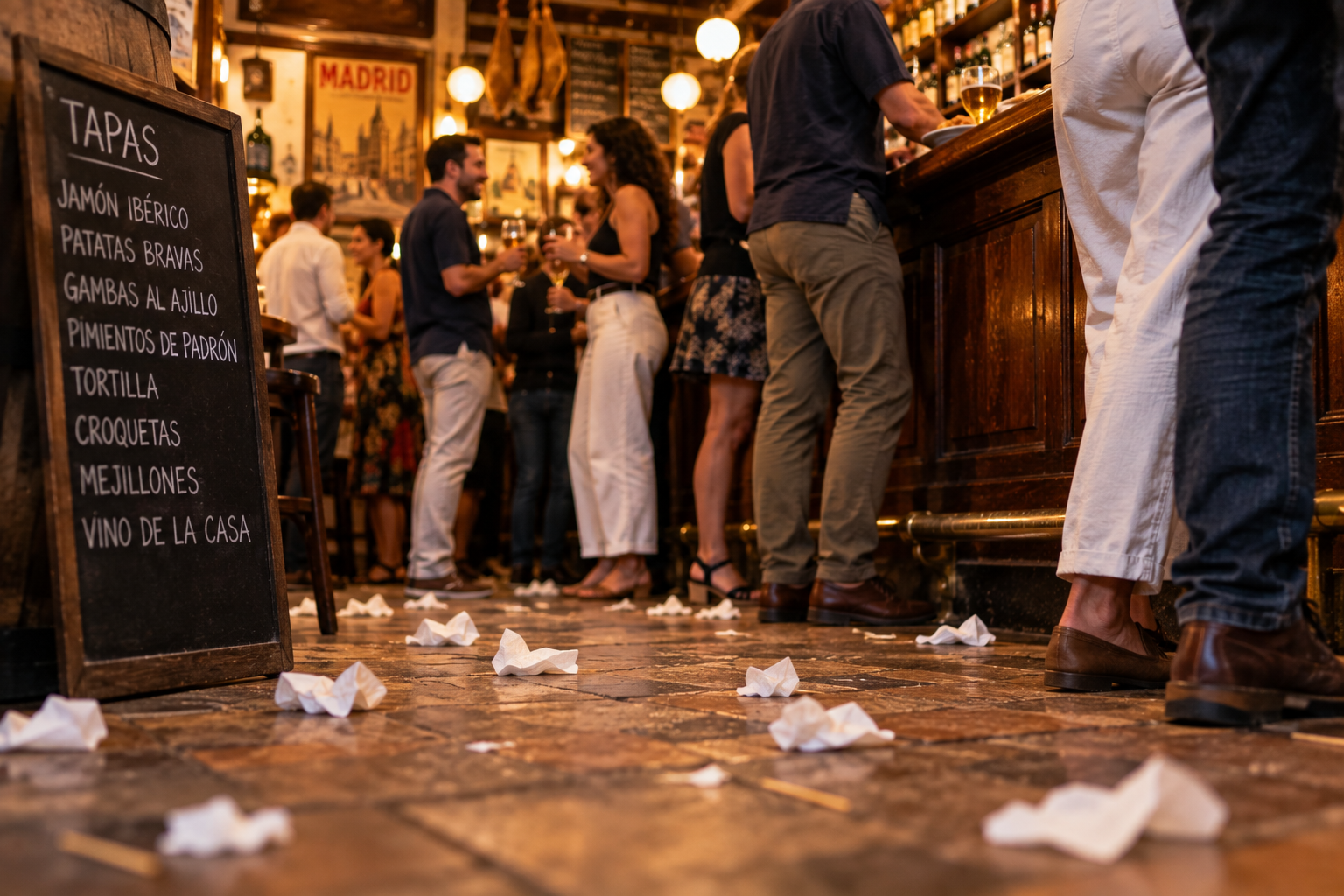
Walk into a busy bar in Spain, look down, and you may recoil. The floor around the bar is littered with crumpled paper napkins, olive pits, toothpicks, the odd shrimp shell or two, maybe a torn sugar wrapper, all of it dropped carelessly where people are standing and drinking. Your first instinct, trained by a lifetime of tidiness and tucked-away trash, is that this place is filthy and that nobody here ever cleans it.
You would be reading it exactly backwards. In Spain, and especially in its traditional tapas and pintxos bars, a floor strewn with napkins is not a sign of neglect but a badge of honor, the clearest possible evidence that you have found a good bar. It is one of the most delightful and counterintuitive customs in European life, a genuine compliment paid in mess, and once you understand it, the floor itself becomes the single most useful thing in the room. It is the sort of thing that perfectly captures how travel upends your assumptions, taking something you were certain meant one thing and revealing it to mean the opposite.
What follows is the custom itself, why a messy floor signals a good bar, where the tradition comes from, how to use it to find the best places, and how to take part without embarrassing yourself.
The Custom That Looks Like Chaos
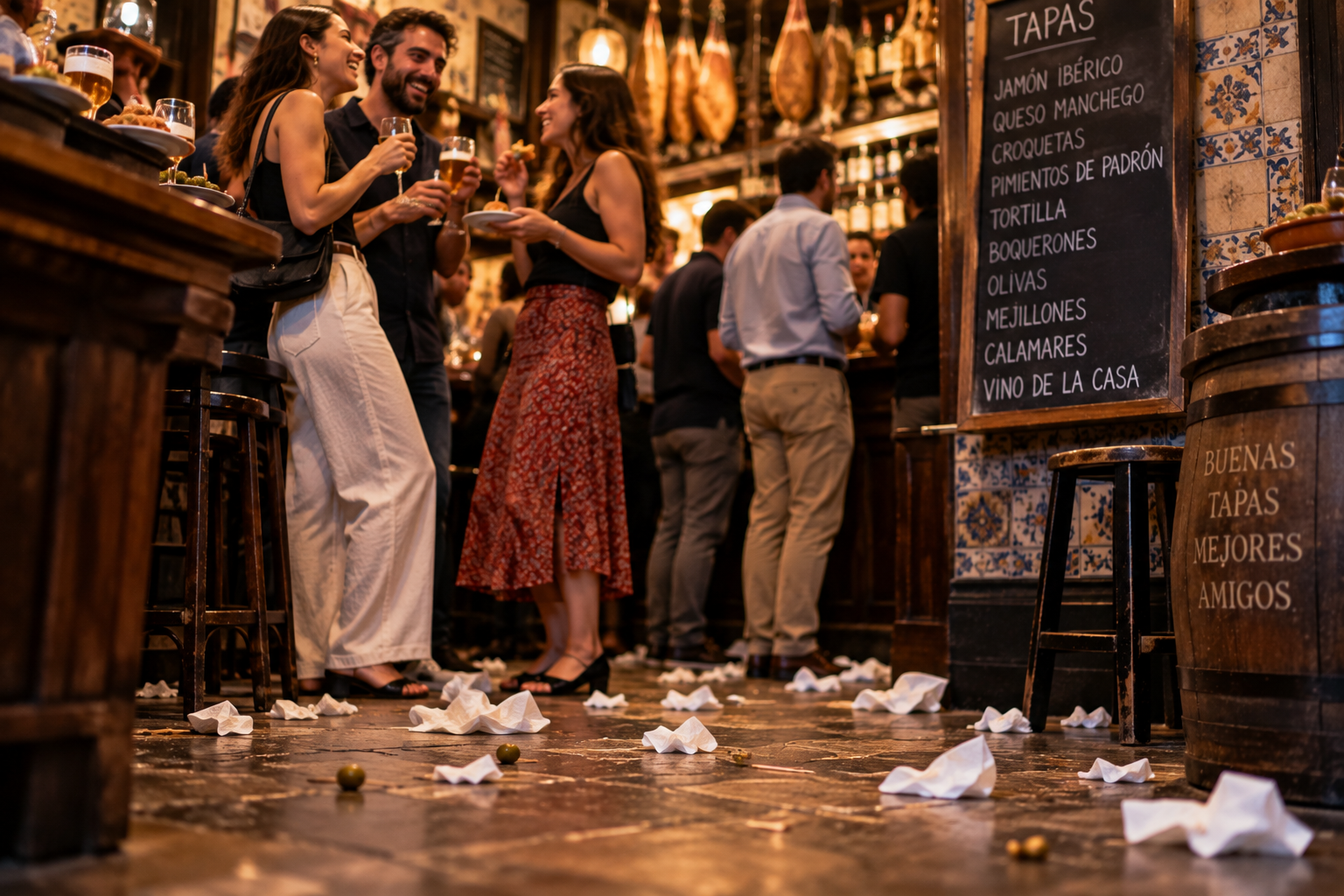
The thing to understand first is that this is a real and recognized custom, not simply careless littering. In many traditional Spanish bars, particularly the standing-room tapas and pintxos bars where people crowd up to the counter, the accepted thing to do with your used napkin is to drop it on the floor. Not on the bar, not on your plate, but down at your feet. The little paper napkins that come with each drink and each bite, along with olive pits, toothpicks, and the shells and rinds of what you have eaten, all go to the ground, and there they stay until the staff sweep up. Behind the bar the staff take it entirely in stride, sweeping through periodically with a broom as naturally as they pour a beer, so nothing about the accumulating mess troubles anyone who works there.
To a visitor from a culture of tidy tables and tucked-away trash, this looks like anarchy, and it is the single most disorienting thing many travelers encounter in a Spanish bar. But everyone in the room is doing it, calmly and without a second thought, because it is simply how these particular places work. There is something almost freeing about it once the initial shock passes, a permission to relax that runs against every tidy instinct you walked in with, and it fits the loose, convivial, elbow-to-elbow energy of a good tapas bar perfectly. The floor is understood by all present to be where the small waste of standing and snacking goes, and it will be cleared away in due course, often swept between rushes or at the end of the day. No one thinks twice about it, because it is simply the way the room has always worked. What looks to the outsider like a bar that has given up on cleanliness is, to the Spaniard, a bar operating exactly as a good bar should, and the mess on the floor is not a failure of the system but a working part of it.
The same person who drops napkins at their feet in a bar without a thought keeps an immaculate home, which is a contradiction that puzzles even the Spaniards who cheerfully live it.
Why a Messy Floor Means Good Food
Here is the logic that turns the mess from a warning into a recommendation, and it is beautifully simple. The napkins and debris on the floor are the accumulated evidence of customers, and lots of them. Every crumpled napkin is a person who stood there, ate something, and enjoyed it, so the deeper the drift of napkins, the more people have been through, and the busier the bar. A busy bar, in turn, is almost always a good bar, popular because the food is tasty, or cheap, or both, which is exactly why the crowds keep coming. In a country where people take their eating seriously and have endless choice, a bar does not get busy by accident; it earns its crowd, and the floor keeps the score.
Turn that around and the signal works just as clearly in reverse. A Spanish bar with a spotless, empty floor is not necessarily a well-run one, it may simply be a bar that nobody is going to, whose clean floor betrays a lack of customers rather than superior housekeeping. Locals know to be wary of a too-tidy floor for exactly this reason, reading it as a quiet warning that the food or the atmosphere is not drawing a crowd. It is a lovely inversion of the instinct most of us carry, where cleanliness signals quality, and it takes a conscious effort for a visitor to override that reflex and trust the mess instead. The mess, then, is a live popularity gauge, updated in real time by every customer, and it cannot be faked, since only genuine crowds produce it. It is a wonderfully honest signal in a way a slick sign or a good review never quite is, because it is made entirely of other people’s satisfied appetites, and that is why it is such a reliable guide to where the good eating is.
A sign can lie and a review can be gamed, but a floor deep in napkins is the unfaked verdict of a hundred people who voted with their feet and their forks.
Where the Tradition Comes From
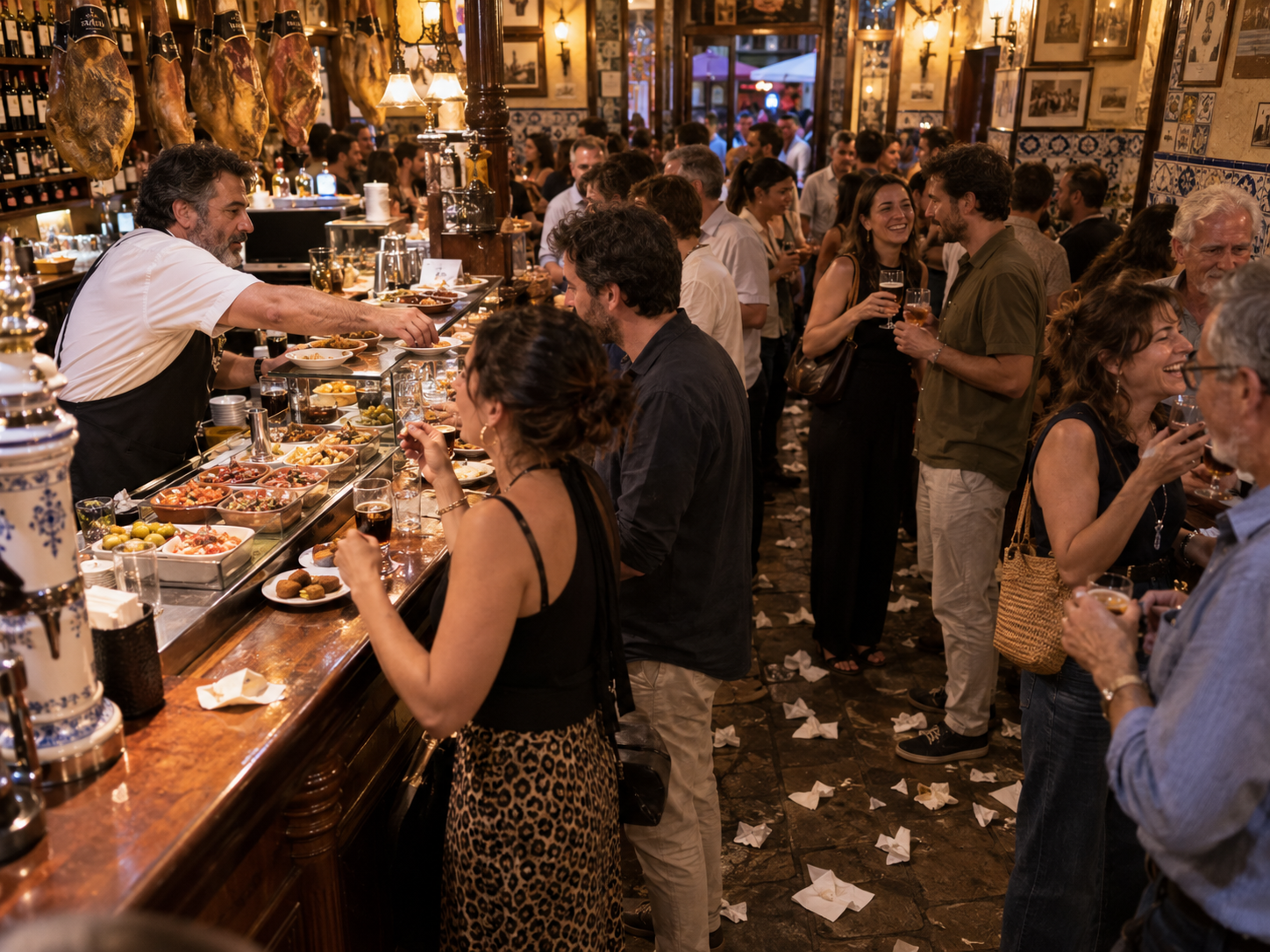
Like many such customs, this one has roots that go back further than you might guess. The practice is generally traced to the tapas bars of Madrid in the late nineteenth century, and it took particularly deep hold in the north, in the Basque Country, where the pintxos bars of San Sebastian, Bilbao, and the surrounding towns turned it into an established part of bar life. For well over a century, in other words, Spaniards have been dropping their napkins on the floor as a matter of course, and it remains a living tradition, not a quaint historical footnote. Generations have grown up understanding the floor this way, so that reading it and adding to it is second nature, learned without anyone ever quite being taught. A Spanish child in a bar with their parents absorbs it simply by watching, the way they absorb a hundred other unspoken rules of the place, and by adulthood the gesture is as automatic as reaching for the drink itself.
There is a small practical reason the napkins pile up so dramatically, too, which is worth knowing because it is quietly funny. The thin paper napkins traditionally used in Spanish bars are famously, almost uselessly, non-absorbent, more like slips of tracing paper than proper napkins, so cleaning your hands after a piece of oily jamon or a dripping olive takes not one napkin but a whole handful. Multiply that by every customer and every snack, and the floor fills up fast, which is part of why the drifts of servilletas become so impressively deep in a truly busy bar. First-time visitors often assume the flimsy napkins are a sign of a cheap establishment cutting corners, when in fact they are near-universal in Spanish bars, humble by design, and their very uselessness is quietly responsible for the whole spectacle underfoot. It is a custom born of crowds and cheap napkins, sustained by more than a hundred years of habit, and it is one of the small things that makes a Spanish bar feel unmistakably itself. Strip it away and something of the character goes with it, which is part of why the bars that keep it feel so alive.
Reading the Floor to Find the Best Bars
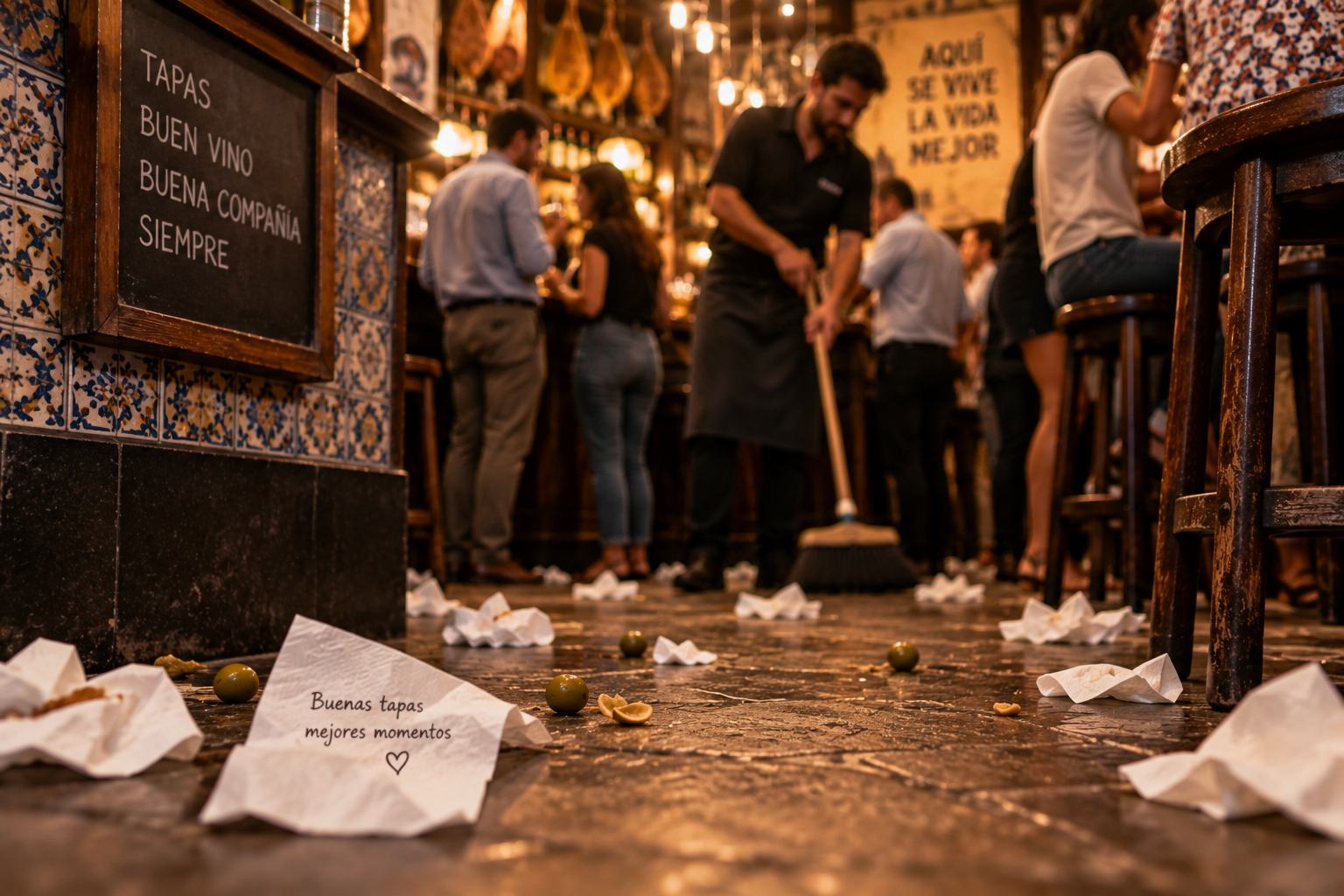
The genuinely useful upshot of all this, for a traveler, is that the floor becomes a tool, a way to find the best places to eat that cuts straight through the guesswork. When you are wandering an unfamiliar Spanish town, hungry and unsure which of a dozen bars to try, you can simply glance down as you pass or peer through the door, and the state of the floor will tell you a great deal. A bar with a good scattering of napkins and debris underfoot is one the locals are using, and that is very often the best possible recommendation. It saves you the trouble of deciphering a menu you cannot read or trusting reviews written by other tourists, offering instead the plain, honest testimony of the people who actually live there and eat there every day.
This is not some obscure theory but advice that seasoned travelers give in earnest. The idea of hunting for the bar with the messiest floor, the most locals, and perhaps a television blaring in the corner is a well-known way to sniff out an authentic Spanish tapas experience rather than a tourist trap. Put those three signals together, the strewn floor, the crowd of regulars, and the everyday hum of a television nobody is really watching, and you have as good a shortcut to a proper local bar as exists anywhere. A pristine, quiet bar with an immaculate floor, by contrast, may well be aimed at visitors who do not know the code, or simply may not be very good. It is the bar equivalent of an empty restaurant at the height of dinner, a small silent warning that the locals, who always know best, have chosen to be elsewhere.
So let go of your instinct to equate clean with quality here, and learn to read the floor the way a local does, as an honest, real-time map of where the food is worth eating. It is one of the most practical pieces of knowledge you can carry into a Spanish evening, and it will steer you right far more often than not.
The Same Mess, Slowly Fading
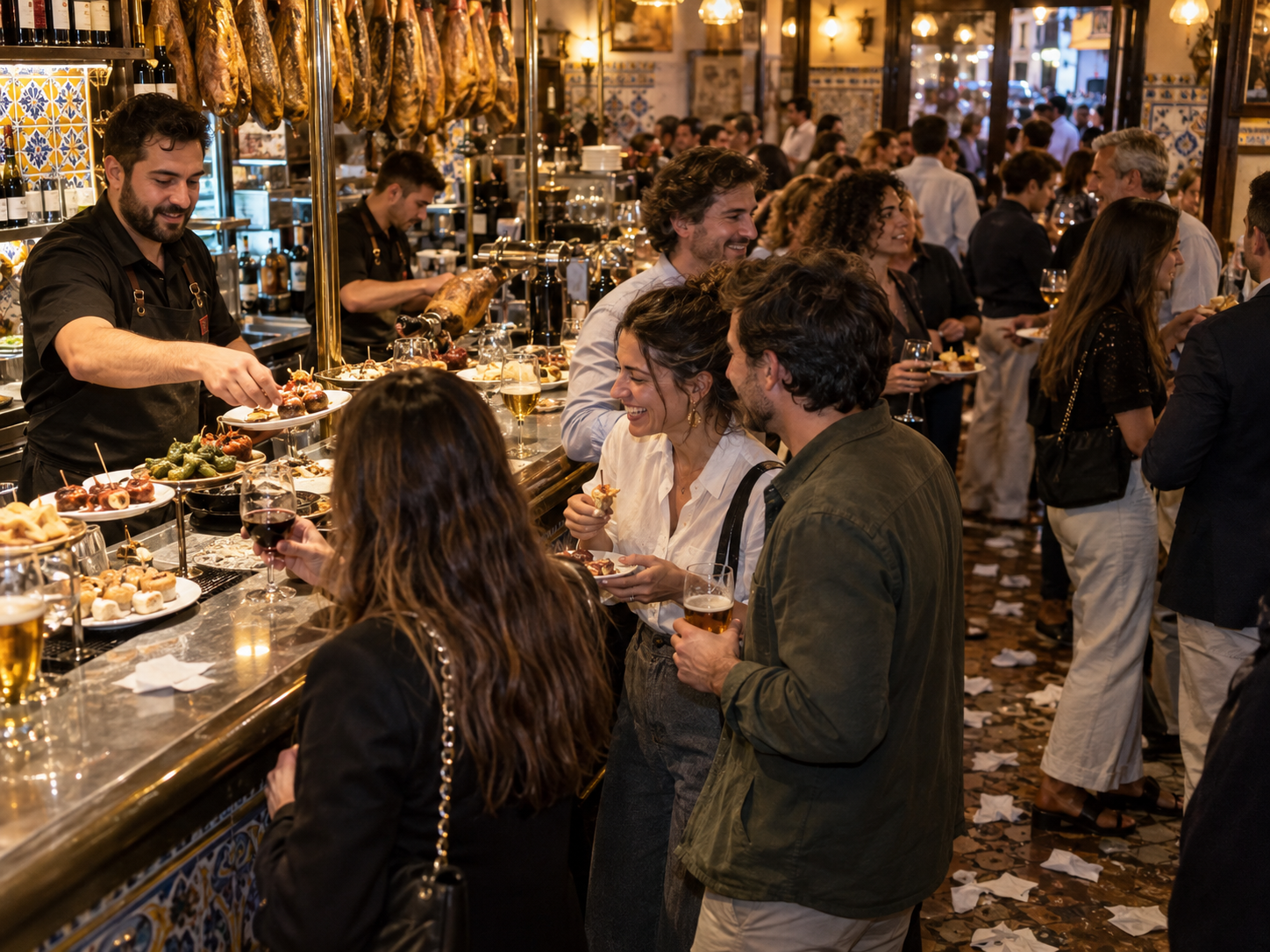
Honesty requires a note that this custom, for all its charm, is not quite as universal as it once was, and is gently in retreat. Modern hygiene sensibilities and a general tidying of the culture have thinned the drifts of napkins over the years, and plenty of newer, smarter, or more tourist-facing bars have quietly done away with the practice, keeping their floors clean as a matter of course. You will not find it everywhere, and in some polished city establishments a napkin dropped on the floor would draw a raised eyebrow rather than a nod of approval.
Where it survives, and it does survive, is in the older, traditional, unpretentious bars, the family-run tapas counters and the deep-rooted pintxos joints, especially in the north, that have kept the custom alive through generations. These are, not coincidentally, often exactly the bars worth seeking out, the ones with the best cheap food and the strongest local character, so the fading of the tradition is itself a rough guide, since the places that still embrace it tend to be the most authentic. It is worth being aware of the shift so you are not baffled by a spotless traditional-looking bar or, conversely, so you understand what you are seeing when you find a floor properly buried in napkins. The custom is not dead, but it is increasingly a marker of the old-school places rather than a universal rule, which for a traveler hunting authenticity is arguably even more useful than when everyone did it.
How to Join In Without Getting It Wrong
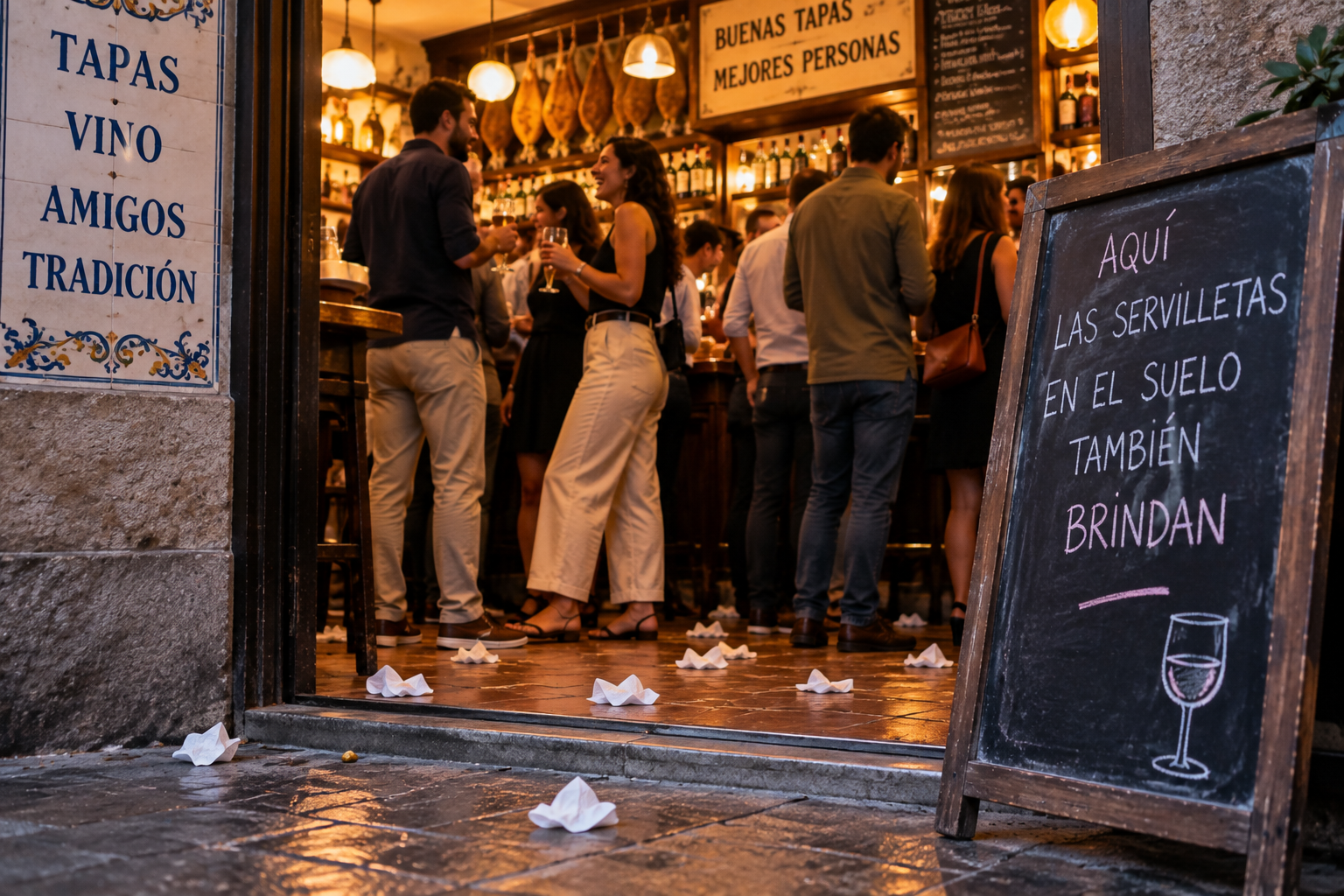
Once you understand the custom, you can take part in it yourself, which is half the fun, but there are a couple of important boundaries to respect so you do not overdo it. The crucial distinction is where you are. This floor-dropping is a custom of the traditional, casual, standing tapas and pintxos bar, the counter you crowd up to for a drink and a bite, and it applies there and only there. In a proper sit-down restaurant, or when you are seated at a table anywhere, it does not apply at all, and your napkin belongs on the table or your plate exactly as it would anywhere in the world. Dropping your rubbish on the floor of a nice restaurant will simply mark you as someone who has badly misread the room.
Within the right kind of bar, though, you can join in with confidence. When you have wiped your hands on one of those flimsy little napkins, or you are left with an olive pit or a toothpick, glance to see what everyone else is doing, and if the floor is already dotted with napkins, add yours to it without hesitation. There is a small pleasure in the moment you first drop a napkin at your feet on purpose and feel yourself cross from bewildered tourist to knowing participant. It is a tiny act of belonging, the sort of thing that makes you feel, however briefly, less like a spectator of a place and more like someone taking part in it.
Take your cue from the locals, keep it to the casual bars where it belongs, and remember that the mess is communal and temporary, swept away regularly by staff who expect exactly this. When in any doubt, simply watch for a moment before you drop anything, since the room will always tell you what it expects, and following what the people around you are doing has never once led a traveler wrong. Do that, and you are no longer staring in confusion at a dirty floor but taking part, with a napkin dropped and a drink in hand, in one of the most charming and delicious traditions Spain has to offer. It is a small thing, in the end, but travel is made of small things like this, the tiny local codes that separate looking at a place from actually being in it, and few are as easy or as enjoyable to learn as this one.

About the Author: Ruben, co-founder of Gamintraveler.com since 2014, is a seasoned traveler from Spain who has explored over 100 countries since 2009. Known for his extensive travel adventures across South America, Europe, the US, Australia, New Zealand, Asia, and Africa, Ruben combines his passion for adventurous yet sustainable living with his love for cycling, highlighted by his remarkable 5-month bicycle journey from Spain to Norway. He currently resides in Spain, where he continues sharing his travel experiences with his partner, Rachel, and their son, Han.