

Like most people, I had a firm and comforting belief about coffee and sleep: an afternoon cup does not affect me, because I fall asleep just fine at night. It is one of the most common things people say about caffeine, almost always with real confidence, and it is exactly what let me happily drink coffee at three or four in the afternoon for years on end without a second thought. Then I read enough about how caffeine actually works to become suspicious of my own certainty, so for thirty days I cut off all caffeine at noon, not a drop after, and wore a sleep tracker every night to see whether the little device agreed with me.
A month felt long enough to see past the nightly noise and let a real pattern show, if there was one, and short enough that I could stick to a rule as strict as no caffeine after midday. It did not. The numbers told a quietly humbling story about something I could not feel at all, and the honest version of it, including why your own results might differ, is worth telling. It is a small lesson in how confidently we can be wrong about our own bodies.
What follows is the belief I was testing, what caffeine really does long after the buzz fades, what the tracker actually recorded, why the effect varies so wildly between people, the honest caveats, and what I took from it.
The Comfortable Belief

The belief I set out to test is one you have almost certainly held or heard: that as long as you can fall asleep, your afternoon coffee is doing no harm. It is a seductive piece of reasoning, because falling asleep is the part of sleep we actually notice, so if we drop off without trouble we conclude the caffeine has worn off and all is well. It is the kind of everyday logic that feels airtight until you examine it, resting entirely on the one part of the night we happen to be conscious for. I genuinely believed this about myself, priding myself on being someone who could have a late-afternoon coffee and still be asleep by eleven. It felt like a mild superpower, proof of an unbothered constitution, and giving up the belief was oddly harder than giving up the coffee.
The trouble, I came to realize, is that this belief rests on a false assumption, that falling asleep and sleeping well are the same thing. They are not, and the gap between them is exactly where afternoon caffeine does its quiet damage. You can drop off perfectly easily and still spend the night getting worse, shallower sleep than you would have otherwise, without any conscious awareness that anything is wrong, because the harm happens in the deep stages you are not around to notice. That disconnect, between what you feel and what is actually happening in your sleeping brain, is the whole reason I wanted an impartial machine to check my confident assumption, since my own sense of sleeping fine was precisely the thing in question. You cannot referee your own game here, because the very faculty you would use to judge your sleep is asleep at the time, which is exactly the gap a tracker fills.
What Caffeine Really Does
To understand why the afternoon cup matters, you have to understand two things about caffeine that surprised me. The first is how long it lingers. Caffeine has a half-life of roughly five to six hours, meaning that many hours after you drink it, half of the dose is still circulating in your system, and a quarter is still there many hours after that. A coffee at three in the afternoon can leave a meaningful amount of caffeine in your blood at bedtime, still working, long after the pleasant alertness has long faded and you have completely forgotten you even had it. The buzz is only the short, visible part; the chemical hanging around in your system is the long, invisible one, and it is the invisible tail that reaches your sleep.
The second thing is what it is doing in there. Caffeine works by blocking adenosine, the molecule that builds up through your waking day and creates the growing pressure to sleep, so caffeine essentially masks your sleepiness rather than removing the underlying need.
Crucially, research has found that caffeine reduces the amount of deep, restorative slow-wave sleep you get, even when it does not stop you falling asleep at all. There is a well-known study showing that a dose of caffeine taken a full six hours before bed still measurably cut total sleep time. Six hours is a long time; a coffee finished at five in the afternoon is still, by that measure, potentially eating into an eleven o’clock bedtime, which reframes what counts as a safe hour for that last cup. So the late cup does not announce itself by keeping you staring at the ceiling; it lets you fall asleep and then quietly robs you of the deep sleep underneath, which is exactly the sort of damage a person cannot feel but a tracker can measure. This is why the reassuring line, that you sleep fine after coffee, is so misleading: you may indeed fall asleep fine, and still be shortchanged on the deepest, most restorative hours without any sign of it.
What the Tracker Recorded
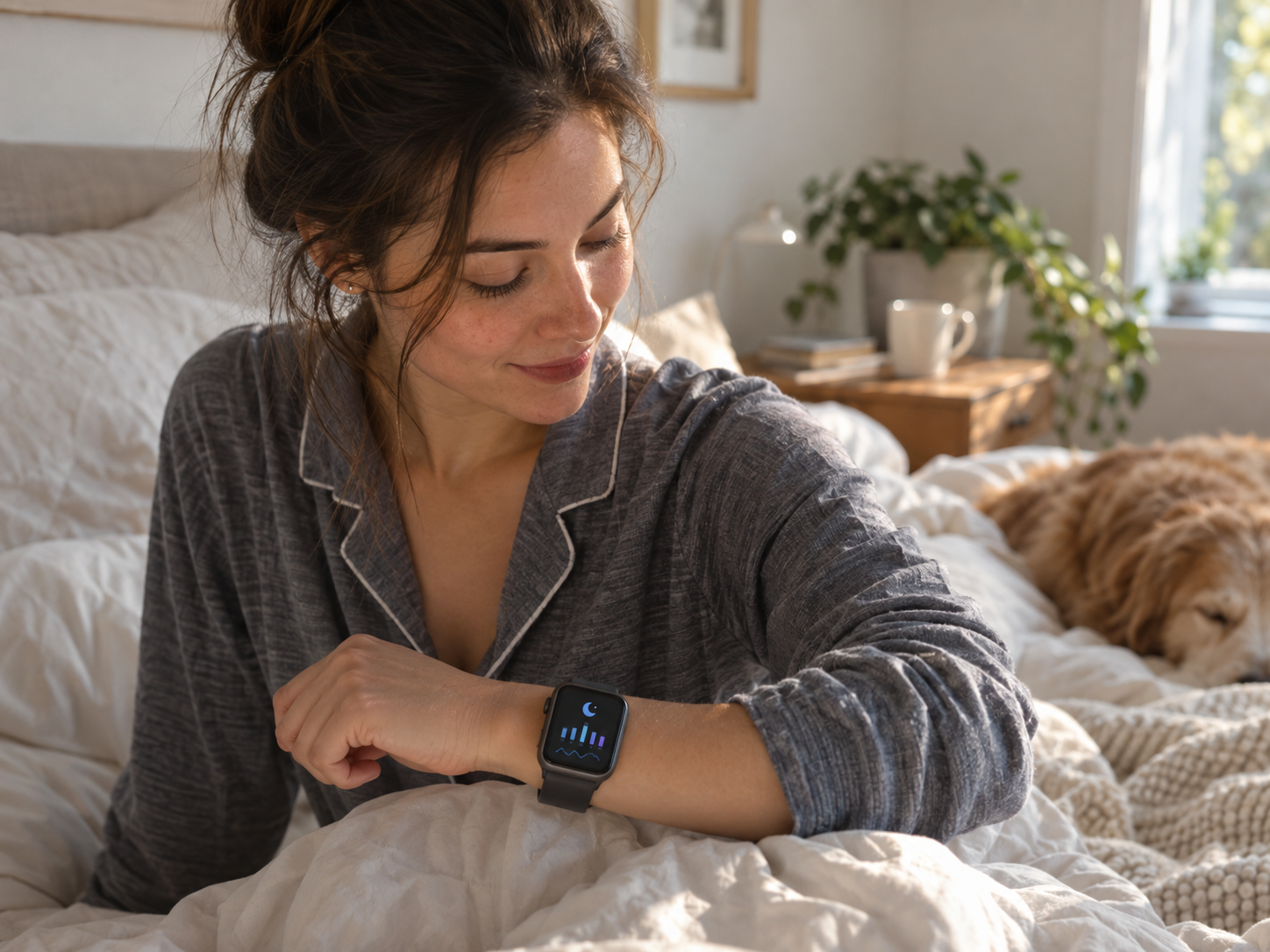
Once I cut my caffeine off at noon, the tracker’s numbers moved in a direction that was hard to argue with, and pointedly at odds with my old belief that afternoon coffee did nothing to me. Across the thirty days, the device recorded more deep sleep, the restorative slow-wave stage that afternoon caffeine is specifically known to suppress, along with a higher overall sleep quality score and, to my surprise, a faster time to fall asleep. That last one genuinely puzzled me at first, since I had never had trouble dropping off, but it seems the residual caffeine had been subtly delaying my sleep onset all along, just not enough for me to notice it as difficulty. The improvements were not enormous, but they were consistent, building over the weeks into a clear and steady difference from my caffeinated baseline. A single night proves nothing, since sleep bounces around for all sorts of reasons, but a month of the same gentle drift in the same direction is much harder to dismiss.
The most striking part was precisely that I had not expected to feel or see any difference, because I had been so sure the afternoon coffee was harmless. Yet here was a month of data gently insisting otherwise, showing better, deeper, more efficient sleep once the late caffeine was gone, exactly the improvement the science predicts and exactly the improvement I could not have detected on my own. Had I judged the experiment purely by how I felt, I might well have concluded it changed nothing, which is precisely the trap the tracker existed to catch me in. This is the whole value of letting the tracker judge rather than trusting your own impression, since the effect of caffeine on deep sleep is real but invisible from the inside, felt only as a vague, unattributable tiredness the next day rather than as an obvious bad night. The machine saw what I could not, and it did not agree with me. There is something both humbling and useful in being contradicted by your own data, since it replaces a comfortable assumption with an actual measurement, and you can only act on what you can see.
Why Your Results Might Differ
Here is the crucial piece of honesty, and the thing that makes this genuinely individual: how much afternoon caffeine affects you depends enormously on who you are, and your results could look quite different from mine. The single biggest factor is genetic, written into how your liver handles caffeine. People vary dramatically in how quickly they clear caffeine from their bodies, governed largely by a liver enzyme, and the difference between a fast metabolizer and a slow one is vast, with some people processing caffeine in a few hours and others taking many times longer.
If you are a fast metabolizer, you may genuinely be able to have an afternoon coffee and sleep soundly, your body clearing the caffeine well before it can touch your deep sleep, in which case your confident belief is actually true for you.
If you are a slow metabolizer, an afternoon cup may be quietly wrecking your sleep architecture night after night, and cutting it could transform your rest.
Slow metabolizers are also more common among certain groups, including people on some medications, so the odds that your afternoon coffee matters are not evenly spread across everyone. Most people sit somewhere between these extremes, and the only way to know where you fall is to test it, which is exactly why an experiment like this is worth running on yourself rather than taking my results, or anyone’s, as gospel. Your body is the only relevant test subject, and it will give you a clearer answer in a couple of weeks than any general article ever could. The number the studies report is an average, and almost nobody is exactly average, so your personal caffeine cutoff could be hours earlier or later than mine. Age, medications, tolerance, and how much you drink all shift it further, which is why the honest answer to when you should stop is always: it depends on you. Any blanket rule, including the popular one about stopping at two in the afternoon, is only a rough starting point that your own body may push earlier or later.
The Fine Print

Beyond the individual variation, a few caveats keep this in proportion. The first is the familiar one about the tool: a consumer sleep tracker is not a laboratory, and while these devices have grown genuinely good at spotting trends, they estimate sleep stages rather than measuring them with clinical precision, so I trust the clear, consistent direction of the change far more than any single night’s exact figures. The trend was convincing precisely because it was steady across a month, not because I take the deep-sleep minutes as gospel. The right way to read a tracker is as a rough compass rather than a precise ruler, trusting the direction it points far more than the exact numbers on its face.
There is also an honest cost to mention, which is that the first week or so was not entirely comfortable. Giving up the afternoon coffee meant facing the mid-afternoon slump without my usual crutch, and for the first several days I felt the dip more sharply and even had a mild caffeine-withdrawal headache once or twice as my body adjusted to less. The afternoon coffee, I realized, had partly been treating the very tiredness that the same coffee, taken earlier and disrupting my sleep, had helped to cause, a small vicious circle I had never noticed I was in. That passed within a week, and my daytime energy actually steadied out once my sleep improved, but it is worth knowing the adjustment is real. There is a mild irony in it, that better sleep eventually gives you steadier daytime energy than the very afternoon coffee you gave up was providing, but it takes a week or so of feeling worse before you feel better. And none of this is medical advice, only one person’s month with a wrist gadget, so anyone with real sleep problems should talk to a doctor rather than a blog, since persistent insomnia has many causes and caffeine is only one of them.
What I Took From It

So what did a month without afternoon caffeine actually teach me, beyond that my confident belief was wrong? Mostly it taught me not to trust my own sense of sleeping fine as a measure of how well I was actually sleeping, since the whole point was that the damage was invisible to me and obvious to the tracker. That alone was worth the experiment, a genuinely useful humility about the gap between how we feel and what is really happening in our bodies while we sleep. We are, it turns out, poor witnesses to our own sleep, and a cheap wrist gadget can sometimes see us more clearly than we see ourselves.
What I actually changed, though, was gentler than total abstinence, and this is the non-preachy part. I did not give up coffee, which I love, and I would never suggest anyone else has to. This is not a piece arguing that caffeine is bad or that you should quit it, since coffee is one of life’s genuine small pleasures and, taken at the right time, does no harm to your sleep at all. The point is only about timing, not abstinence.
I simply moved it earlier, keeping my coffee to the morning and switching to decaf or something caffeine-free in the afternoon when I want the ritual of a warm cup without the late dose. That small shift, coffee before noon and none after, gave me the better sleep the tracker recorded without asking me to give up anything I truly enjoy. The real lesson is not that afternoon coffee is forbidden but that it is not as free as it feels, and that a simple change of timing, rather than any grim sacrifice, can hand you back a measurable slice of deeper sleep. Whether that trade is worth it is yours to decide, ideally after letting your own tracker, and your own body, weigh in. Run your own thirty days if you are curious, and let the numbers, rather than your comfortable assumptions, settle the question for you.

About the Author: Ruben, co-founder of Gamintraveler.com since 2014, is a seasoned traveler from Spain who has explored over 100 countries since 2009. Known for his extensive travel adventures across South America, Europe, the US, Australia, New Zealand, Asia, and Africa, Ruben combines his passion for adventurous yet sustainable living with his love for cycling, highlighted by his remarkable 5-month bicycle journey from Spain to Norway. He currently resides in Spain, where he continues sharing his travel experiences with his partner, Rachel, and their son, Han.