
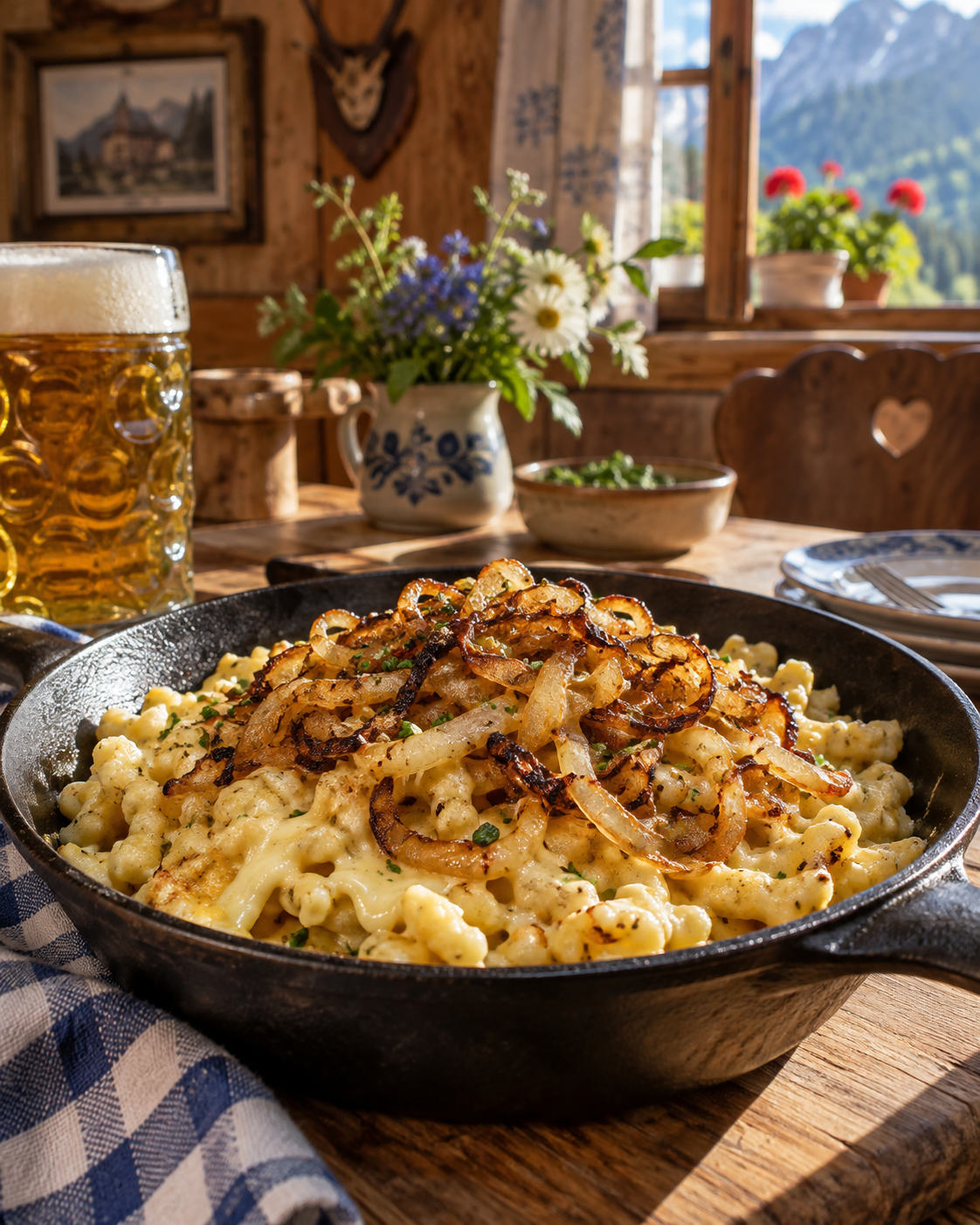
While the beer tents of Munich are full and the world is thinking about Germany for a few short weeks, there is one dish worth making at home that captures the whole cozy, hearty spirit of the season better than anything you could order from a menu. It is called kasespatzle, and it is, quite simply, Germany’s answer to macaroni and cheese, soft handmade egg noodles layered with melted Alpine cheese and buried under a heap of crispy fried onions. It is chewy, gooey, savory, and endlessly comforting, the kind of food that makes a cold evening feel like a celebration. It is the sort of thing you make once, watch disappear from the dish in minutes, and immediately plan to make again. And here is the fun claim to make at the table: this alpine classic has been comforting people for a very long time, arguably longer than the boxed American version it so resembles, which makes it a strong candidate for the original mac and cheese.
What follows is why it earns that title, how to make the little noodles that are the heart of it, the cheese and onions that finish it, and how to bring a taste of Oktoberfest to your own kitchen.
Germany’s Mac and Cheese, Only Older
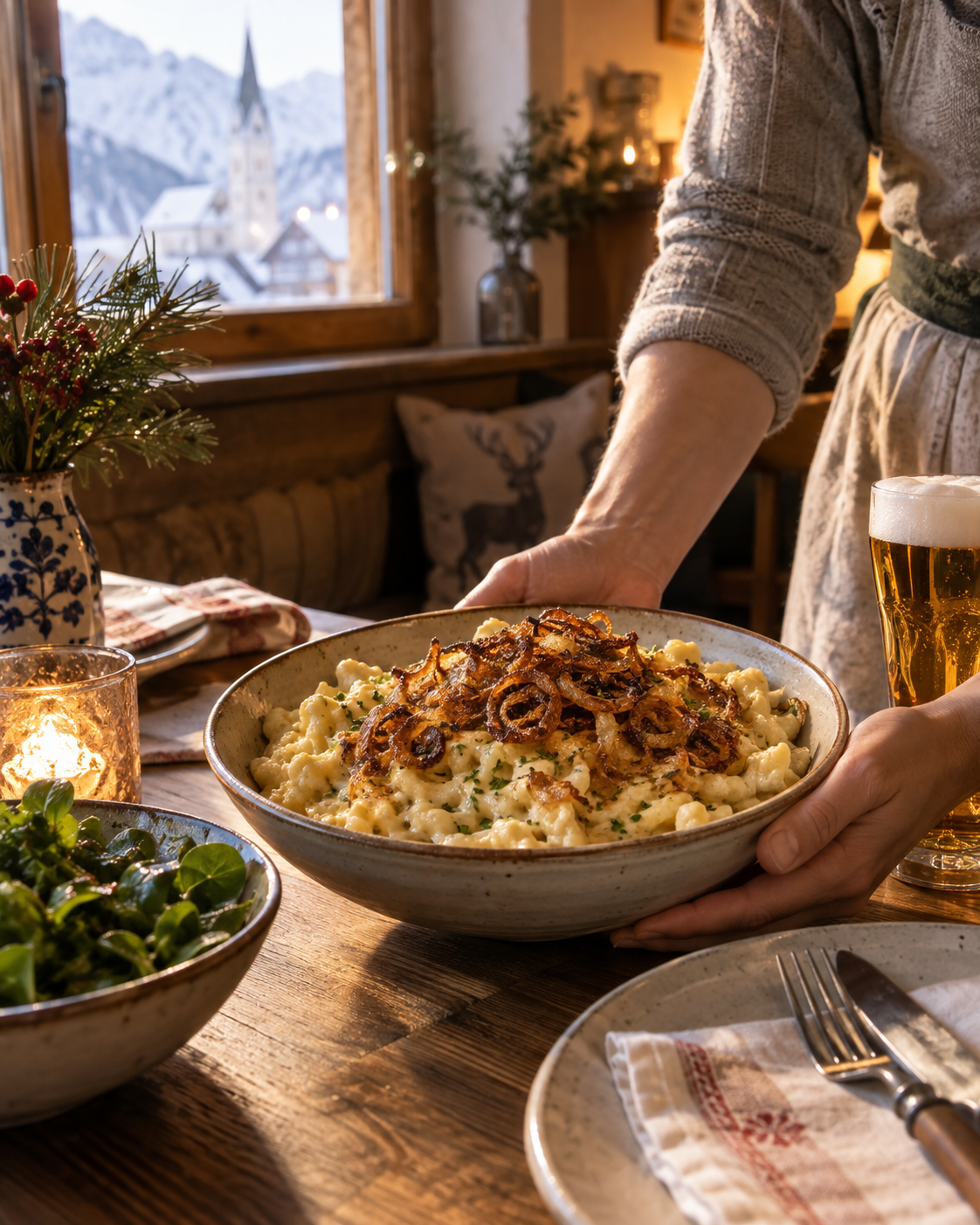
The comparison to macaroni and cheese is the fastest way to understand kasespatzle, and it is a fair one. At its core it is exactly that idea, a comforting tangle of noodles bound in melted cheese, the universal nursery food of the whole Western world. But where American mac and cheese leans on dried elbow macaroni and often a smooth cheese sauce, kasespatzle is built on fresh, handmade egg noodles and on cheese that simply melts between the layers, and it is finished with something the boxed version never dreamed of, a generous crown of sweet, crispy fried onions.
The claim that it is the original is a playful one, but not baseless. This is old food, a rustic dish of the alpine regions of southern Germany, Austria, and Switzerland, where flour, eggs, cheese, and onions were the affordable staples that a mountain kitchen always had to hand. Long before mac and cheese became an American convenience food sold in a blue box, cooks in the Allgau and Swabia were already turning those same humble ingredients into exactly this kind of cheesy, restorative comfort on cold mountain evenings. Whether or not it can truly claim to be the first, it belongs to that deep European tradition of making something genuinely wonderful out of almost nothing, and it stands up to any mac and cheese you have ever eaten. The parallel is a fun one to argue over a plate of it, and the honest answer is that both traditions arrived at the same happy idea, that noodles and melted cheese are one of the great comforts of the table. It is comfort food with centuries behind it, and it honestly tastes like it, hearty and deep in a way convenience food never is.
The Spatzle Are the Fun Part
The soul of the dish is the spatzle themselves, and making them is far easier and far more entertaining than it sounds. Spatzle are not a dried pasta you buy in a box but a fresh noodle you make from a simple wet batter, and the whole process takes minutes. You whisk together flour, eggs, a little milk or water, and salt into a thick, sticky, elastic batter, beat it well until it is smooth and stretchy, and let it rest briefly while a big pot of salted water comes to the boil.
Then comes the genuinely fun bit. Rather than rolling or cutting anything, you push the batter into the boiling water in little irregular pieces, either by scraping it off a board with a knife, pressing it through a colander or a special spatzle press, or forcing it through the wide holes of a grater. The batter drops into the water in short, knobbly strands, and within a couple of minutes the little noodles float to the surface, cooked and ready to scoop out.
It is oddly mesmerizing to watch, the raw batter transforming into a bobbing crowd of noodles almost at once, and it is the kind of small kitchen magic that makes children want to help. They are meant to be irregular and rustic, uneven little things, so there is genuinely no skill to master and nothing at all to get wrong, and their rough, craggy surface is exactly what makes them so good at catching and holding the melted cheese. If you would rather skip the step entirely, good dried spatzle from a German deli will do, but making them fresh is half the pleasure and genuinely worth it. There is a real satisfaction in watching the raw batter turn into a pot of little noodles in a couple of minutes, and it is the kind of low-stakes cooking that is surprisingly relaxing to do.
The Cheese and the Onions
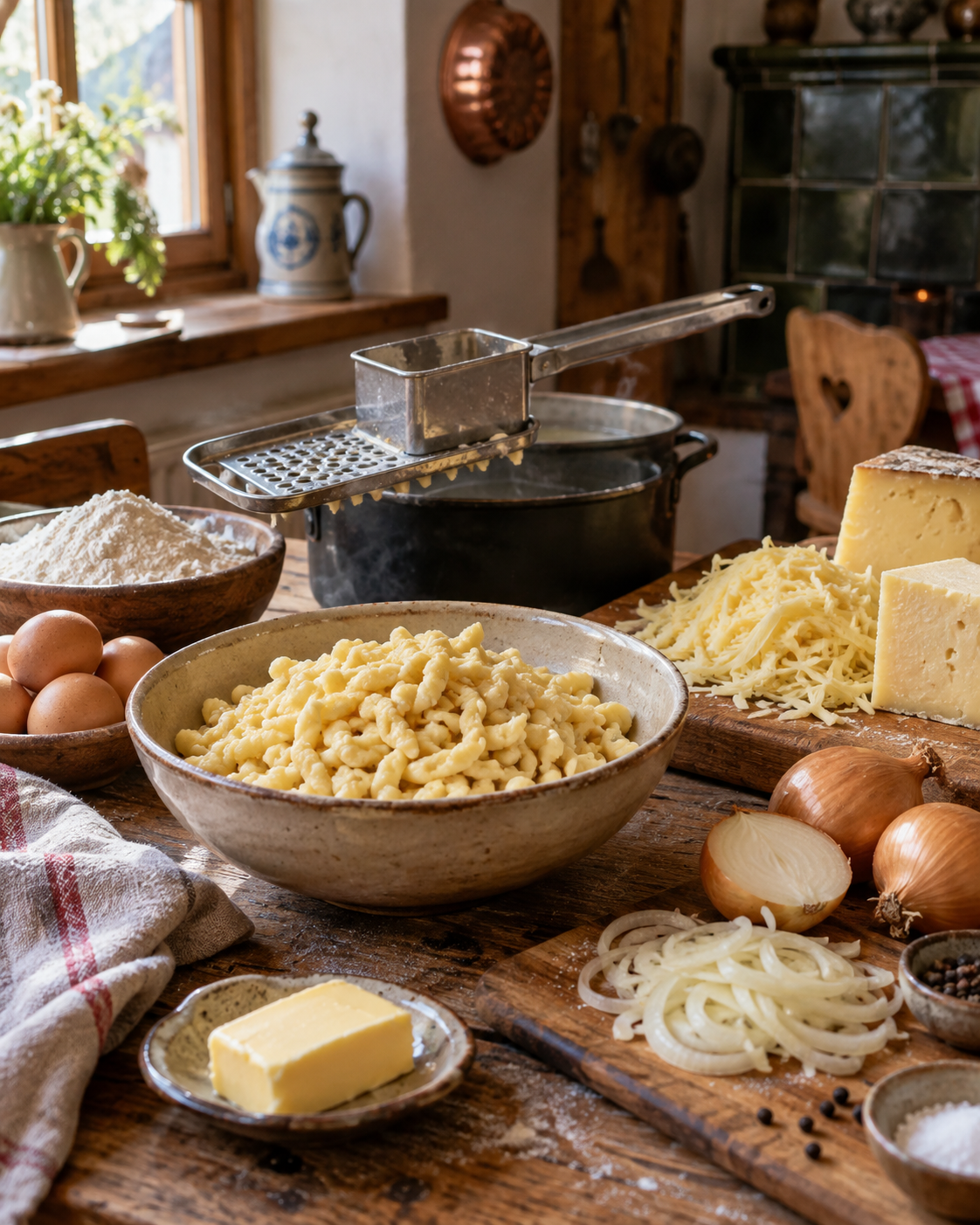
With the noodles made, the dish comes together on two more elements, and the first is the cheese. The traditional choice is an Alpine mountain cheese, Bergkase, whose very name means mountain cheese, prized for its deep, nutty, pronounced flavor, though it can be hard to find outside Europe. The easy and excellent answer is to reach for Emmentaler, the classic holey Swiss cheese, which melts into smooth, nutty strings, and many cooks use a mix of Emmentaler with a little Gruyere for extra depth. Whatever you choose, you want a good melting cheese with real flavor, grated generously, since this is not a dish for restraint. This is comfort food, not a light lunch, and it is meant to be rich, so err on the side of more cheese rather than less and do not go looking for a healthy version of it, because there isn’t really one, and there isn’t meant to be.
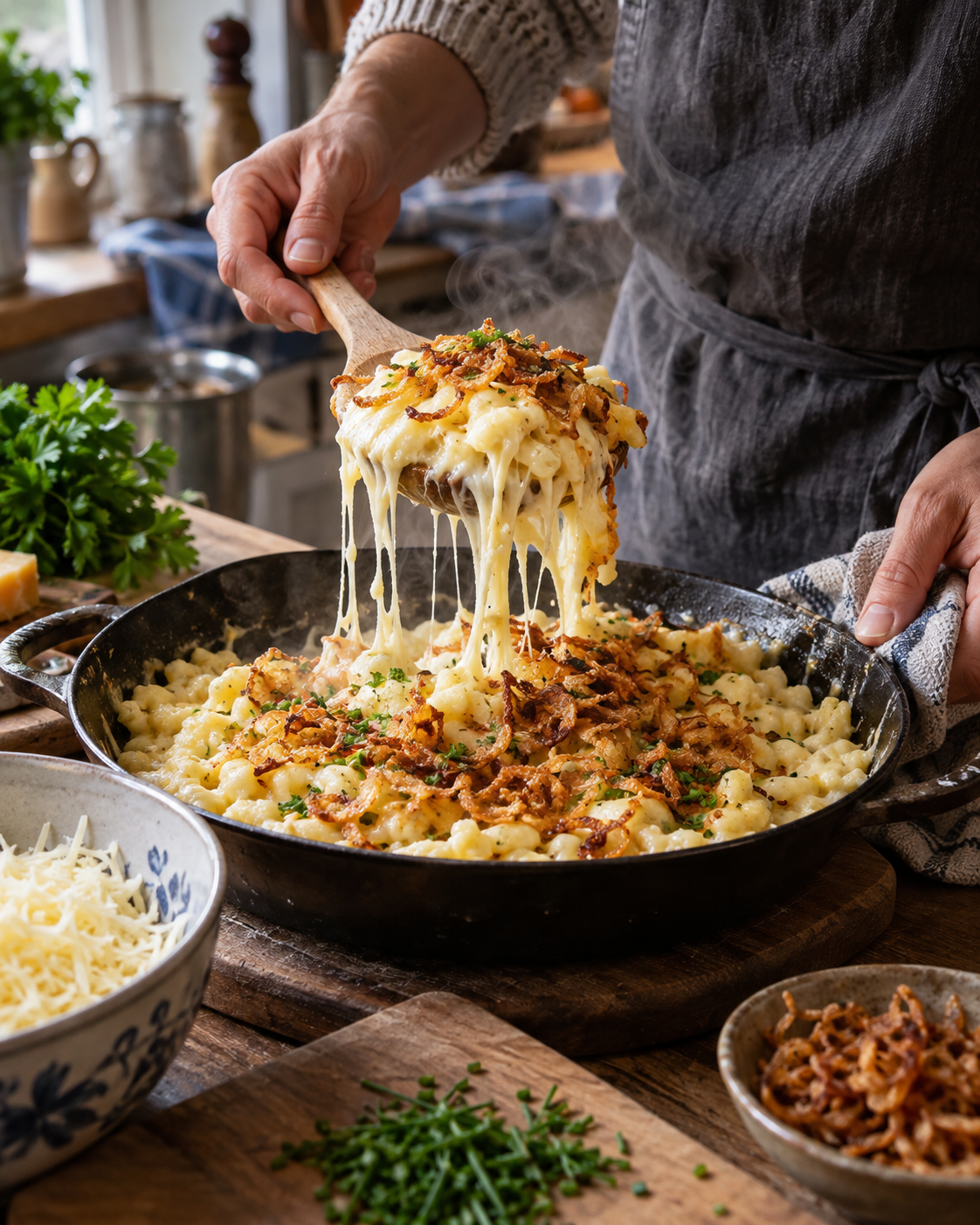
The onions are the other half, and they are not optional. A proper kasespatzle is finished with a thick layer of fried onions cooked slowly in butter until they are deeply golden, sweet, and crisp at the edges, the German rostzwiebeln that add a sweet-savory crunch against all that soft, cheesy richness. Do not be tempted to skip them or to rush them, because that contrast of textures, the crisp sweet onion against the gooey noodle, is what lifts the dish from merely cheesy to genuinely special.
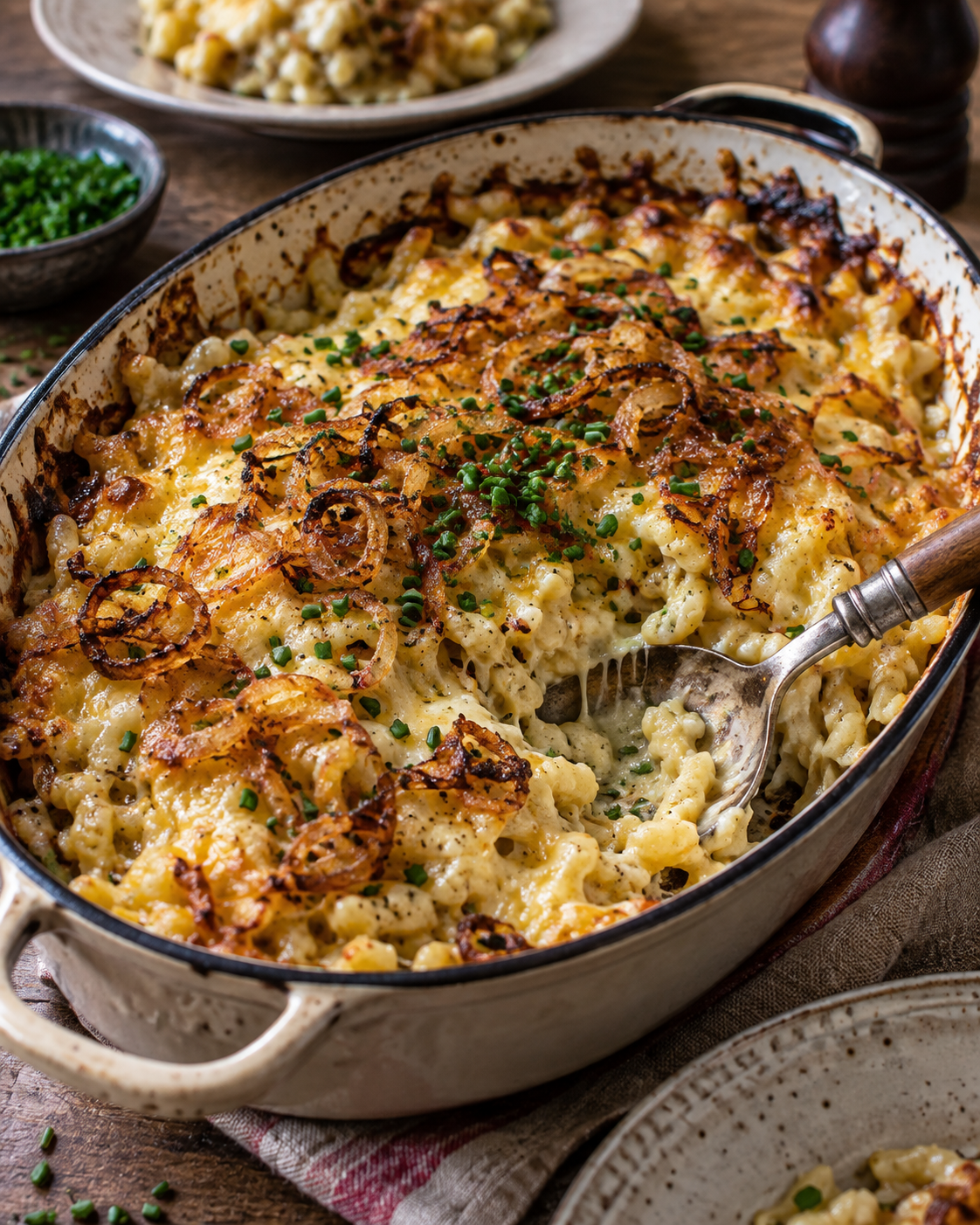
Cook the onions low and slow until they are truly golden and sweet, well past the point where you might think they are done, since it is that deep caramelization that gives them the flavor the dish depends on. You simply layer the hot noodles with the grated cheese so it melts through, pile the onions on top, and, if you like, give it a few minutes in a hot oven so the top turns golden and the edges crisp. That is the whole architecture of it, noodles, cheese, onions, and nothing more. Everything good about the dish comes from doing those three simple things well rather than from any clever trick, which is exactly what makes it such reliable, repeatable comfort food.
An Oktoberfest Table at Home
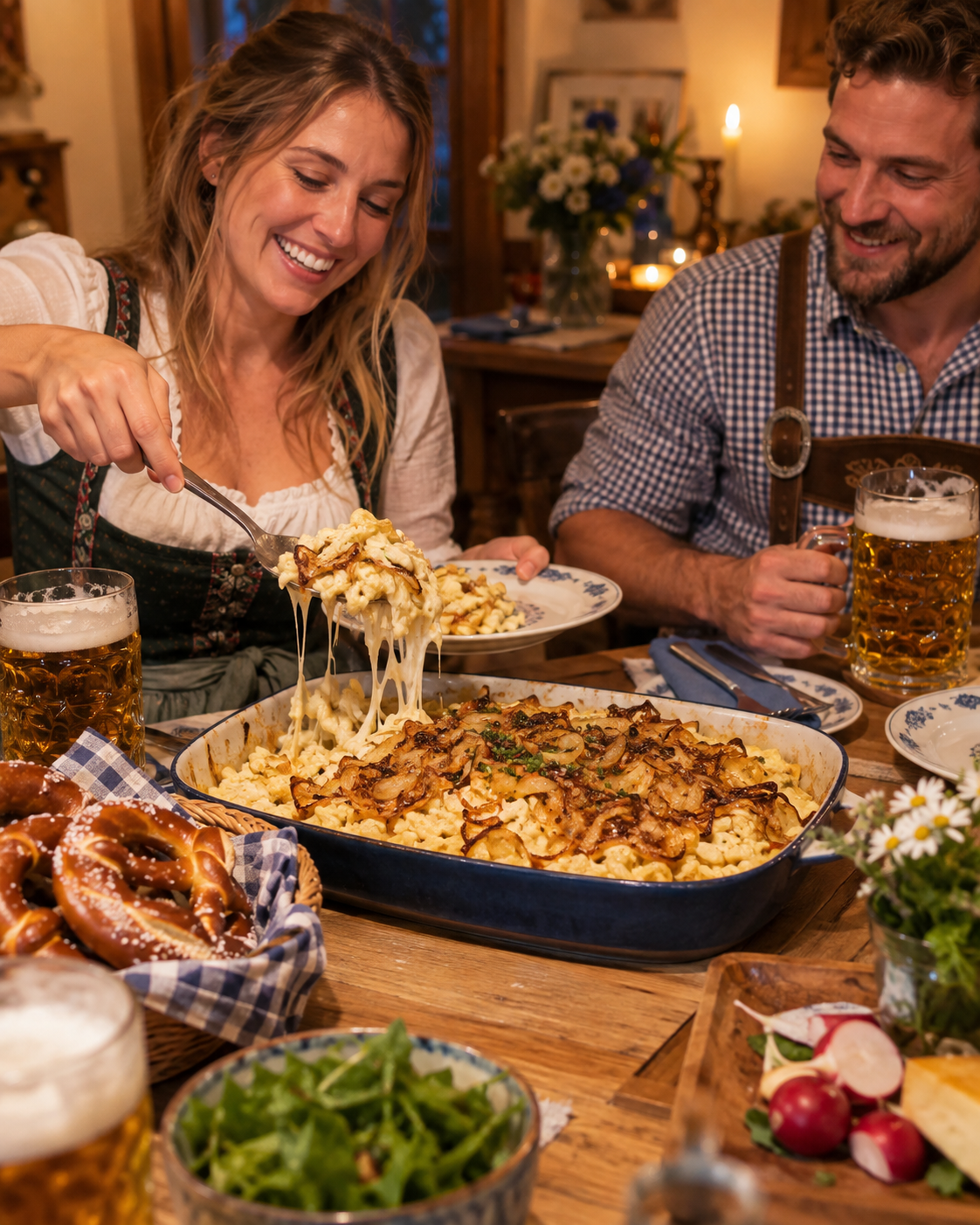
There could hardly be a better moment to make this than now, with Oktoberfest in full swing and the weather turning. Kasespatzle is exactly the sort of warm, hearty, celebratory food the festival is built around, and while most of us will never make it to a Munich beer tent, a big dish of it at home, shared with people you like, catches a real and generous piece of that same warm, boisterous spirit. It is festival food and comfort food at once, generous and unfussy and made for a crowd. It scales up easily for a table full of people, holds together happily while you wait for latecomers, and asks nothing of the cook but a bit of stirring and a willingness to make a glorious cheesy mess.
Serve it the way it is served in the alpine south, as a hearty main course in its own right, with nothing more than a sharp green salad alongside to cut the richness, or as a substantial side to a schnitzel or a plate of sausages if you are going all in. A cold German beer, naturally, is the traditional partner, and it suits the dish perfectly. However you serve it, this is food for gathering around, unpretentious and deeply satisfying, and if you set a steaming dish of it in the middle of the table on a cold October evening, you will understand exactly why the alpine countries have been making it for so long. It is a small, delicious way to bring the festival home. You do not need a dirndl or a brass band, only a pot, a good cheese, and an appetite, and the rest of the festival mood follows on its own, one warm cheesy forkful at a time.
Making Kasespatzle
Here is a classic kasespatzle, serving four as a main. Make the noodles fresh if you can, and never skip the onions.
Ingredients
For the spatzle:
- 400 g all-purpose flour
- 4 large eggs
- 150 ml milk or water, plus more as needed
- 1 teaspoon salt
- A pinch of nutmeg
For finishing:
- 3 large onions, thinly sliced
- 4 tablespoons butter
- 300 g Emmentaler or Bergkase, grated, or a mix with Gruyere
- Salt and pepper, to taste
- Chopped chives, to serve, optional
Instructions
- Make the batter: whisk the flour, eggs, milk, salt, and nutmeg together into a thick, smooth, sticky batter, beating well for several minutes until it is elastic. Add a splash more milk if too stiff. Let it rest for 15 minutes.
- Fry the onions: melt the butter in a large pan over medium heat and cook the sliced onions slowly, stirring often, until deeply golden and crisp at the edges, about 20 minutes. Set aside.
- Bring a large pot of salted water to a boil. Working in batches, press the batter into the water through a spatzle press, a colander, or by scraping it off a board with a knife.
- Cook each batch until the noodles float to the surface, about 2 to 3 minutes, then scoop them out with a slotted spoon and drain.
- In a warm serving dish or the onion pan, layer the hot spatzle with the grated cheese, adding it in stages so it melts through the noodles, seasoning with salt and pepper.
- For a crisp top, transfer to a buttered baking dish and bake at 400 F, about 200 C, for 10 minutes until melted and golden at the edges.
- Pile the fried onions over the top, scatter with chives if using, and serve immediately, while gloriously hot and gooey.
And do treat the cheese as flexible if the Alpine kinds are hard to find, since any good melting cheese with real flavor will make a wonderful dish, so long as you make the noodles with care and crown the whole thing with those essential crispy onions.

About the Author: Ruben, co-founder of Gamintraveler.com since 2014, is a seasoned traveler from Spain who has explored over 100 countries since 2009. Known for his extensive travel adventures across South America, Europe, the US, Australia, New Zealand, Asia, and Africa, Ruben combines his passion for adventurous yet sustainable living with his love for cycling, highlighted by his remarkable 5-month bicycle journey from Spain to Norway. He currently resides in Spain, where he continues sharing his travel experiences with his partner, Rachel, and their son, Han.