
There are dishes you cook to feed people, and there are dishes you cook to travel through time, and pollo en pepitoria is firmly the second kind. The first time I made it in my kitchen here in Spain, I understood why it has survived for centuries, because the smell alone, saffron and toasted almonds and slowly braising chicken, is the smell of old Spain itself. This is a dish with a queen’s name attached to it and a history that runs back through the courts of Madrid to the Moorish kitchens of al-Andalus, and yet it is humble enough to make on an ordinary weeknight. It is chicken, gently braised, cloaked in a golden sauce thickened not with cream or flour but with ground almonds and hard-boiled egg yolks, perfumed with saffron and white wine. It looks and tastes far grander than the modest list of ingredients would ever suggest. If you have never cooked Spanish food beyond a paella, let this be the dish that changes your mind, because it is one of the most quietly spectacular things you can put on a table, and far easier than its regal reputation implies. Paella gets all the attention abroad, but ask a Spanish cook for the dishes they actually make at home, on a cold evening for their own family, and pepitoria is the kind of answer you will hear. It belongs to the everyday poetry of Spanish kitchens rather than the tourist menu, and that is exactly why it is worth learning.
What I love about pepitoria is that it carries its whole history in its flavor, every spoonful a taste of the centuries and the cultures that shaped it. It is comfort food and heritage food at once, the kind of dish that makes people at the table go quiet for a moment and then ask what on earth is in the sauce. When I tell them it is almonds and egg yolk and a pinch of saffron, they never quite believe me, because the result tastes so much more complex and refined than that short list would suggest. That gap between the humble ingredients and the luxurious result is, I think, the whole magic of the dish, and it never fails to delight whoever I cook it for. It is the sort of cooking that makes you feel clever and generous at once, transforming a few pantry staples into something worthy of a celebration without ever announcing how little it truly cost you. Let me walk you through where it comes from, what makes it so special, and exactly how to make it yourself, so that you too can serve a plate of edible history without any fuss at all. None of the steps are difficult, and most of the ingredients are things you likely already keep in the house, with saffron being the one small splurge that pays you back in aroma and color a hundred times over. By the end you will see that a dish with a queen’s name and a thousand years of history behind it is, in your own kitchen, simply a very good pot of chicken.
A Dish Fit for a Queen
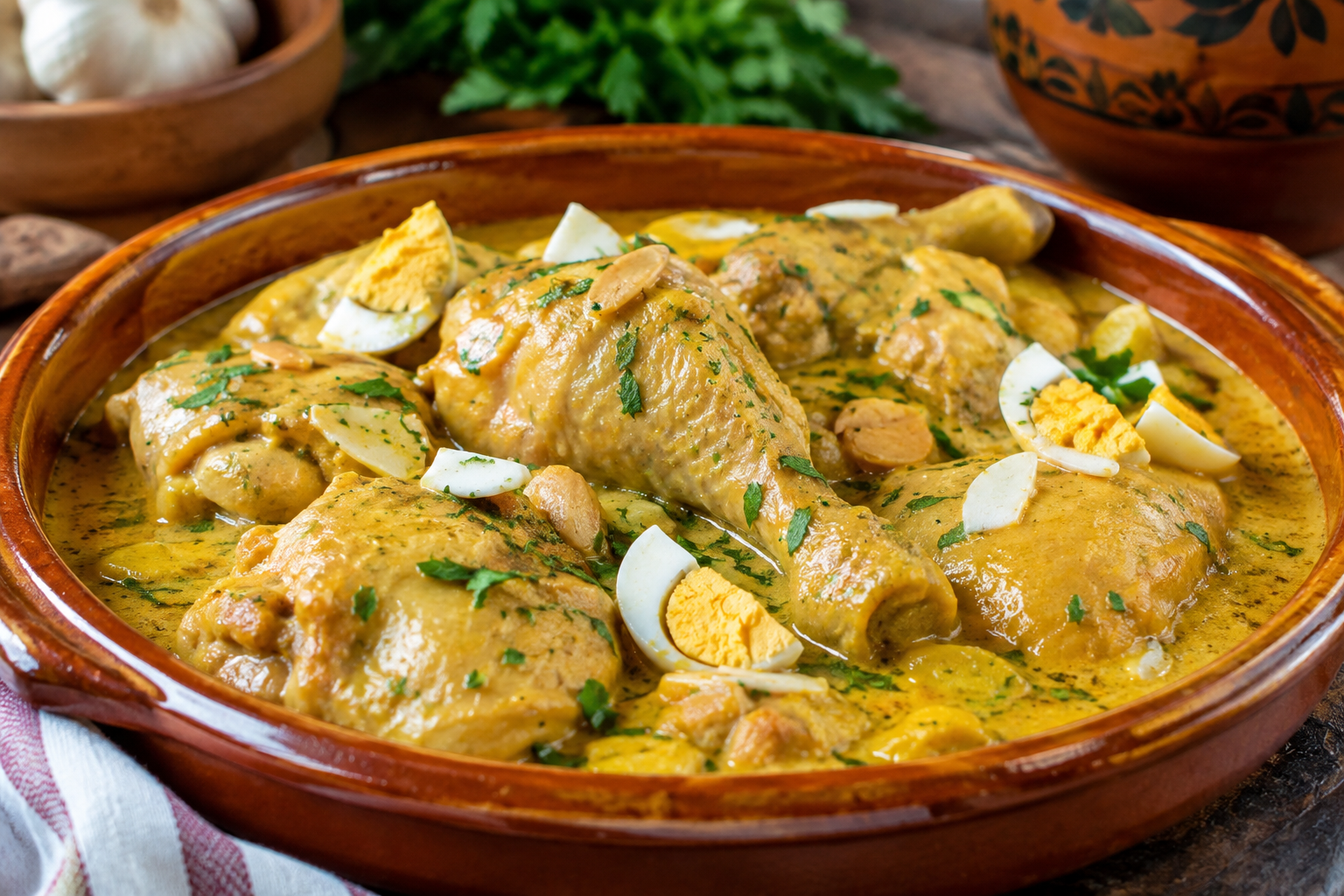
Before we get to the cooking, it is worth knowing just what you are making, because pepitoria is no ordinary chicken stew but a dish with genuine royal credentials. Its pedigree is part of its charm.
It was a queen’s favorite. Pollo en pepitoria is famously said to have been a beloved dish of Queen Isabella the Second of Spain, gracing royal tables in the nineteenth century, so when you make it you are cooking something that once pleased a monarch. That regal association has followed the dish ever since, lending an everyday braise an air of quiet grandeur. I find there is something lovely about setting down a pot of it and knowing that the same combination of flavors once graced a palace in Madrid. It is not a fussy or aristocratic dish in the making, which is part of its charm, but it carries that whisper of the court in its history, and telling people the story as they eat only makes it taste better.
Its roots run to al-Andalus. Long before it reached any palace, the technique came to Spain from the Moorish kitchens of al-Andalus, the Muslim civilization that flourished in the south for centuries. The dish appears in Spanish cookbooks going back four hundred years and more, which means you are cooking a recipe older than your grandparents by centuries. When I make it, I like to think of all the hands that have made it before mine, in Andalusian courtyards and Castilian kitchens, each cook grinding the same almonds and blooming the same saffron. Few things connect you to a place and its past quite so directly as cooking one of its oldest recipes exactly as it has always been made.
What Pepitoria Actually Means
The word itself puzzles many people, and understanding it helps explain the character of the dish, because pepitoria refers not to the chicken but to the extraordinary sauce that defines it. The name is really about the technique.
The sauce is the star. Pepitoria describes a way of building a sauce by grinding almonds together with hard-boiled egg yolks and saffron, then using that paste to thicken and color the cooking liquid into something rich and golden. It is the sauce, not the bird, that makes the dish what it is, and the same technique can dress other meats too.
A word for a wonderful jumble. Charmingly, the term pepitoria is also used in Spanish to describe a mixture of many different things thrown together without much order, which suits a dish built from such a varied handful of ingredients. There is something fitting in a name that celebrates the beautiful jumble of almonds, saffron, egg, wine, and chicken all melding into one. That, in the end, is what the dish does, taking a handful of ordinary things and coaxing them into a sauce far greater than the sum of its parts. Once you understand that pepitoria is a method rather than a single fixed recipe, you also see why it appears in so many slightly different versions across Spain, each family swearing by their own small variations while sharing the same golden heart.
The Soul of the Dish Is the Picada
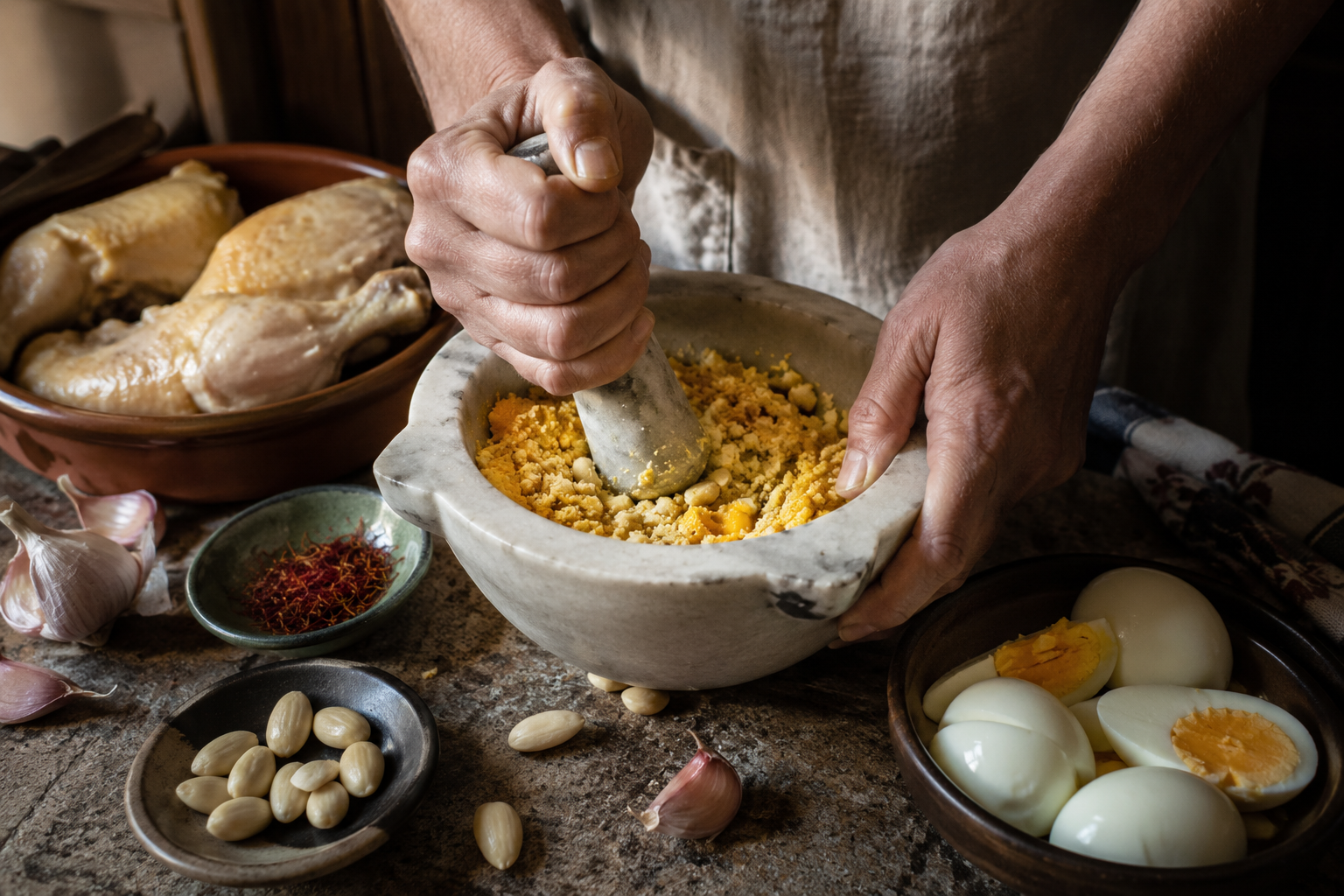
If there is one step that transforms this from a plain braise into something memorable, it is the making of the picada, the ground paste that thickens the sauce. This is where the magic happens.
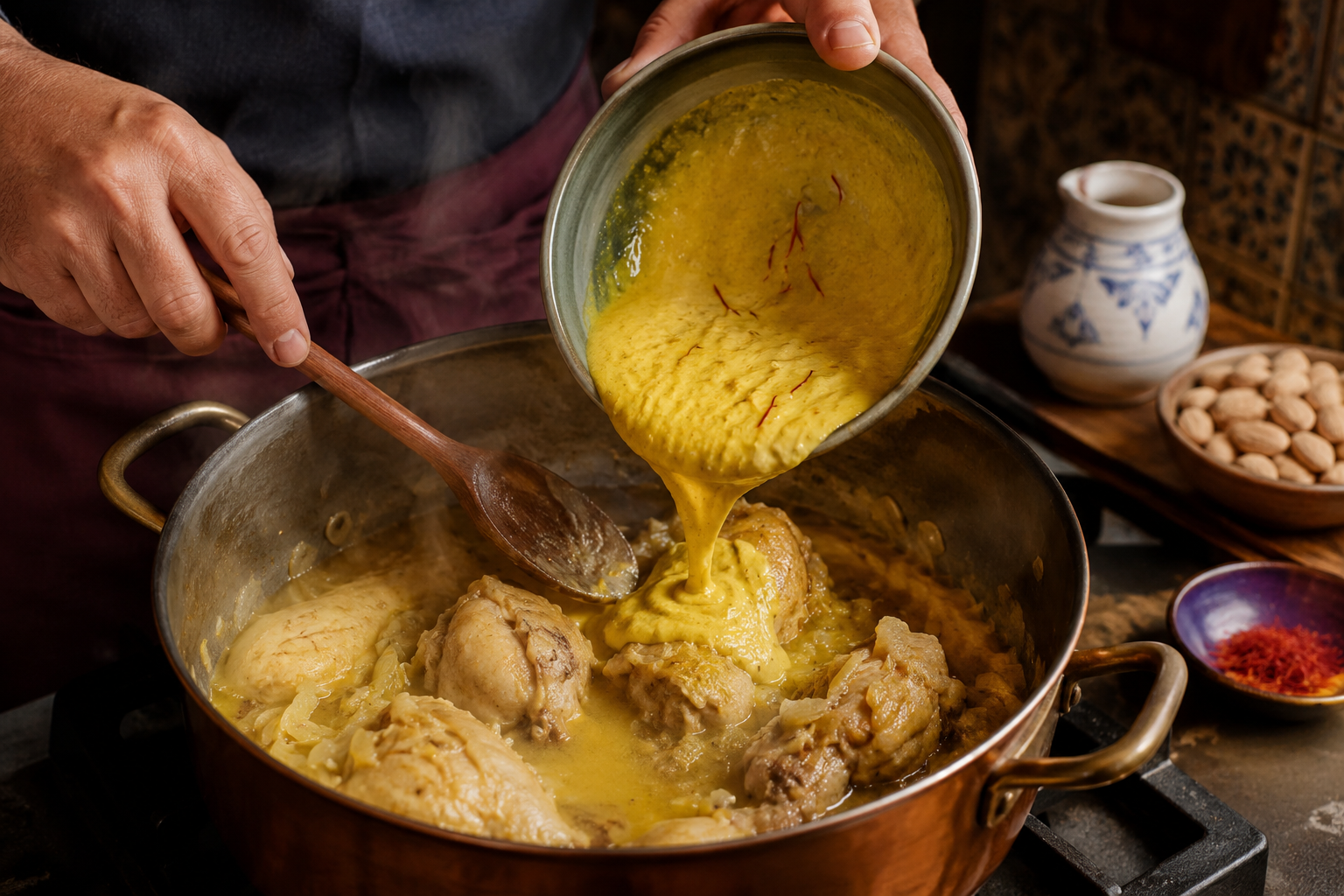
Almonds and egg yolk do the work. Instead of flour or cream, the sauce is thickened with a paste of toasted almonds, fried bread, garlic and egg yolks, all ground together until smooth. This gives the sauce a body and a nutty depth that no ordinary thickener could match, and it is the secret behind the dish’s luxurious texture.
Grinding is the tradition. Traditionally this paste is pounded by hand in a mortar, and there is real pleasure in the rhythm of it, though a small food processor does the job in seconds if you prefer. However you make it, this little paste is the heart of the dish, so grind it properly smooth, because I still reach for the mortar and pestle when I have the time. There is a meditative quality to pounding the almonds and egg yolks together, watching them turn from rubble into a pale, fragrant paste. On a busy evening the food processor is no shame at all, and the sauce forgives you either way. What matters is that the paste dissolves into the liquid completely, thickening it into something glossy that clings to every piece of chicken for the silkiest result.
Why Saffron and Almonds Belong Together
The flavor of pepitoria rests on a pairing that feels almost ancient, because saffron and almonds together are the signature of Spain’s Moorish culinary inheritance. Together they define the taste.
Saffron gives color and soul. The pinch of saffron that goes into the sauce provides not only its glorious golden hue but a distinctive, faintly floral aroma that is central to the whole dish, so it is worth using real saffron rather than a cheap substitute. A little goes a long way, and its perfume is what makes the sauce smell so unmistakably special.
Almonds bring richness and history. The toasted almonds lend the sauce a gentle, nutty sweetness and a velvety body, and they carry within them the long story of Arab influence on Spanish cooking. Between them, the saffron and the almonds turn a simple pot of chicken into something that tastes of another time and place entirely. This is the great gift of Spanish cooking inherited from al-Andalus, the way spices and nuts that arrived centuries ago became so woven into the food that we no longer think of them as foreign at all. Saffron and almonds simply taste like home to me now, and nowhere do they sing together more beautifully than in this sauce. If you have good saffron, this is the dish to spend it on.
The Chicken and the Slow Braise
With the flavor foundations understood, the cooking itself is refreshingly straightforward, a gentle braise that rewards patience far more than skill. Anyone can master it.
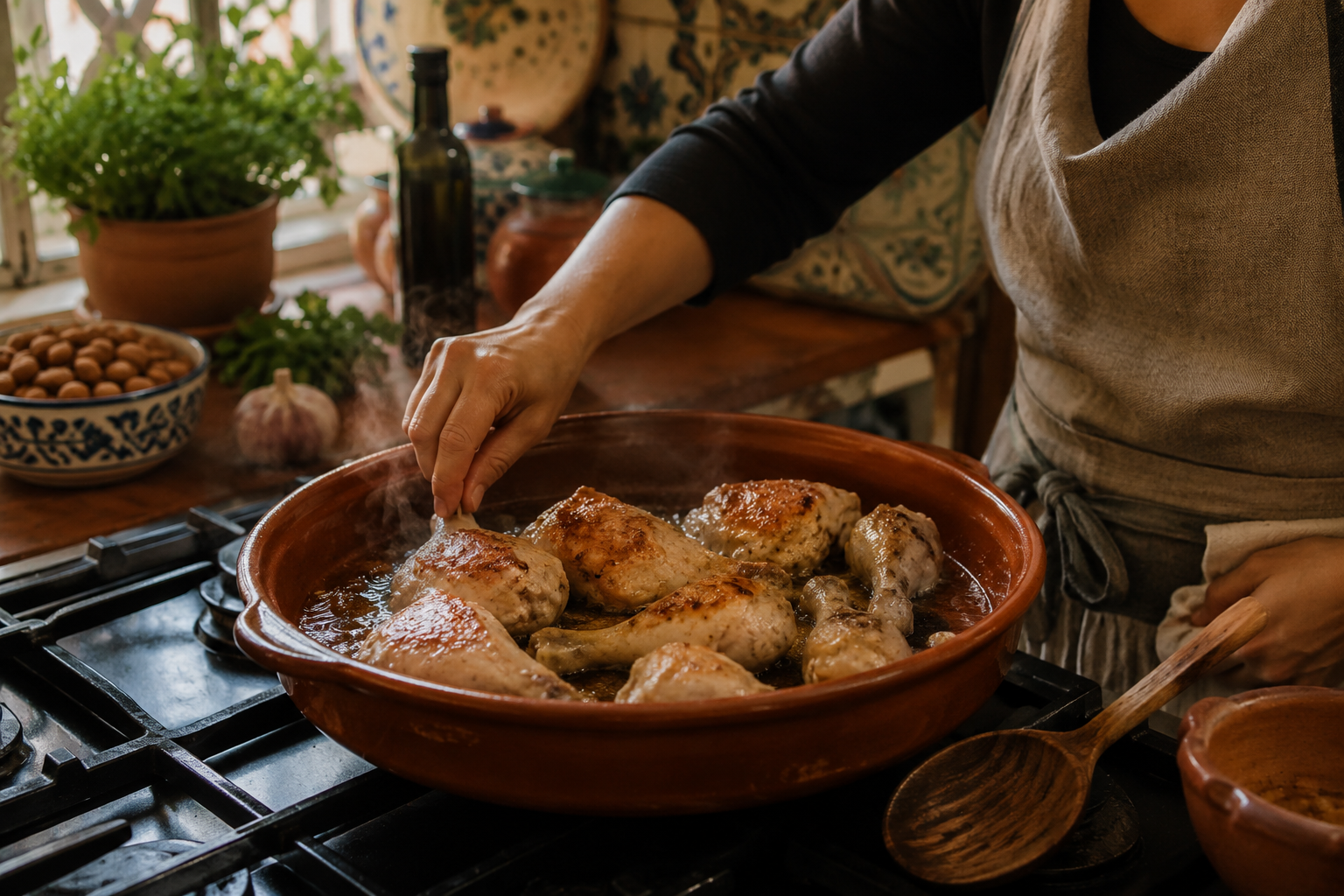
Brown, then simmer gently. You begin by browning the chicken in olive oil for color and flavor, then soften onion and garlic, add a splash of white wine and some stock, and let everything simmer quietly until the meat is meltingly tender. It is a forgiving process that mostly looks after itself, leaving you free to prepare the picada while it cooks.
Bone-in chicken gives the best flavor. bone-in, skin-on chicken, or even hen, enriches the sauce as it simmers as it simmers, so thighs and drumsticks work beautifully here. The slow braise coaxes deep flavor from the meat and leaves it falling from the bone, ready to soak up that golden sauce. Do not rush this stage. The chicken needs time to grow tender and to lend its flavor to the liquid that will become the sauce, so let it bubble away gently while you get on with the picada. If you try to hurry it over high heat, the meat toughens and the sauce never develops the depth that makes the dish special. Patience here is repaid many times over at the table.
How I Like to Serve It
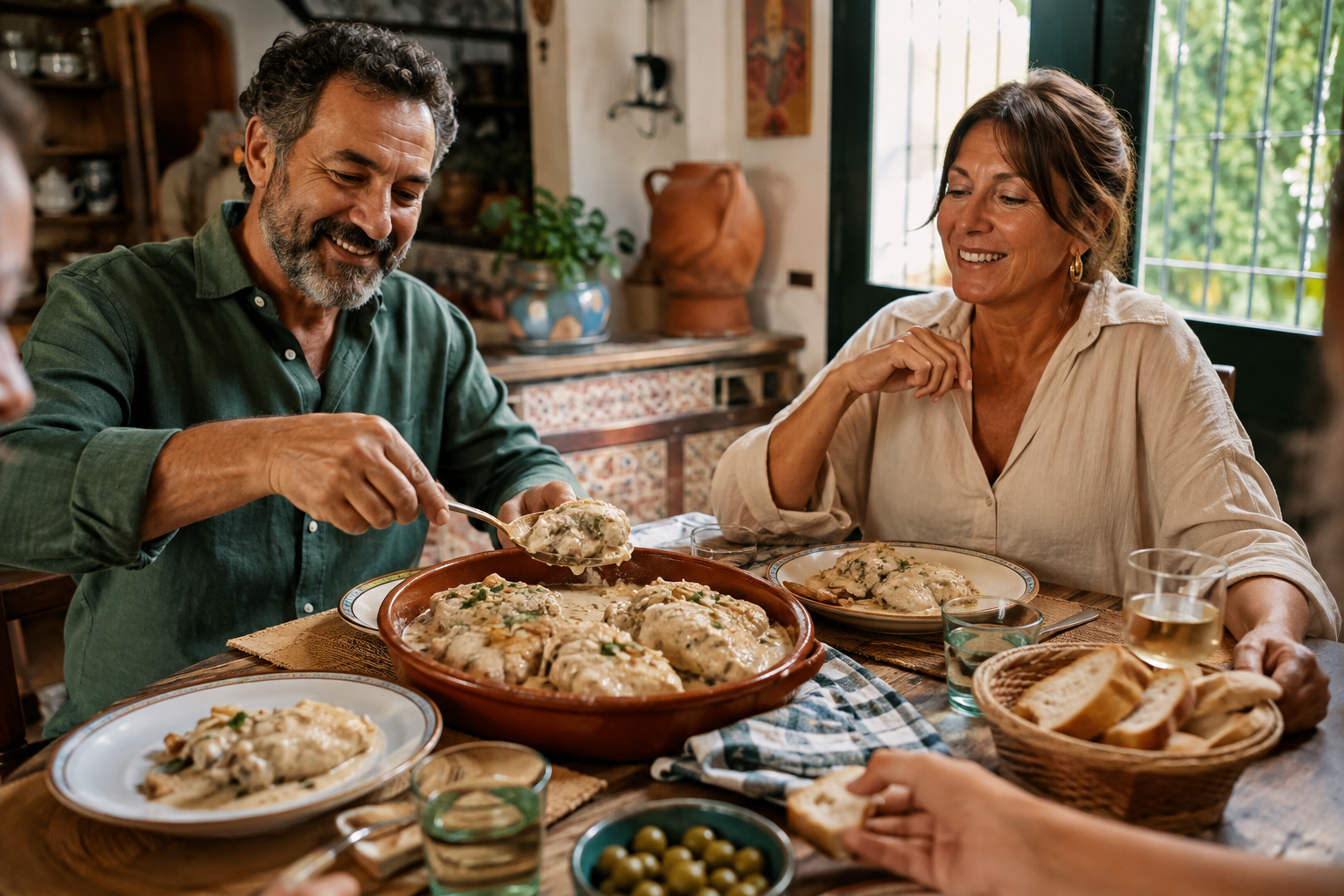
Once the sauce is thick and the chicken tender, the finishing touches and the serving are where the dish comes into its own, and a few simple flourishes make all the difference. Presentation completes it.
Save the egg whites for the top. Since you use only the yolks in the sauce, chop the leftover egg whites and scatter them over the dish with extra almonds and parsley, so nothing is wasted and the plate looks beautiful. That final scatter of white, gold and green makes a humble braise look like a feast. I love this thrifty little detail, the way the dish uses every part of the egg, yolks melted into the sauce and whites crowning the top. It feels like the wisdom of old cooking, when nothing was wasted and beauty was found in the practical. A sprinkle of parsley and a few whole toasted almonds finish it, and suddenly the pot that fed a monarch looks the part on your own table.
Bread or rice to catch the sauce. This dish is really all about that glorious sauce, so serve it with plenty of crusty bread for mopping, or a mound of simple rice to soak it up, and you will not want to leave a drop behind. In my house it is often the bread that disappears fastest, as everyone chases the last of the golden sauce around their plate. That, for me, is the mark of a dish that has worked, when the plates come back not just empty but wiped clean. If I want to make more of a meal of it, a simple green salad alongside is all it needs, something sharp to balance the richness of the sauce. A glass of Spanish red, a Garnacha or a Monastrell, rounds the whole thing off beautifully.
Why It Is Worth Making
Taken together, pollo en pepitoria is proof that the most impressive dishes are often not the most complicated, but the ones with the deepest roots. It rewards you far beyond the effort it asks.
It punches above its weight. For a dish made from chicken, almonds, eggs, and a pinch of saffron, pepitoria delivers a result that tastes and looks genuinely luxurious, so it is perfect for impressing guests without a fortune or a whole day in the kitchen. It is the kind of recipe that earns you a reputation as a serious cook for very little actual work. I have served it to guests who assumed I had spent all afternoon on it, when in truth most of that time was the chicken quietly simmering while I did other things. That is the quiet genius of a good braise, that it demands presence rather than skill, and gives back far more than it takes.
It connects you to something older. More than that, cooking it links you to centuries of Spanish history, so every time you make it you are keeping a small piece of that heritage alive. That, to me, is the real reward of pepitoria, a plate of the past made delicious in the present. Recipes are among the most durable things a culture makes, outlasting buildings and borders, passed hand to hand across generations who never meet. When you cook this one in your own kitchen, wherever in the world that is, you become part of that long chain, keeping a small flame alight. And the wonderful thing is that you get to eat the result, so the history goes down warm and golden and delicious, which is surely the best way to honor it.
Pollo en Pepitoria Recipe
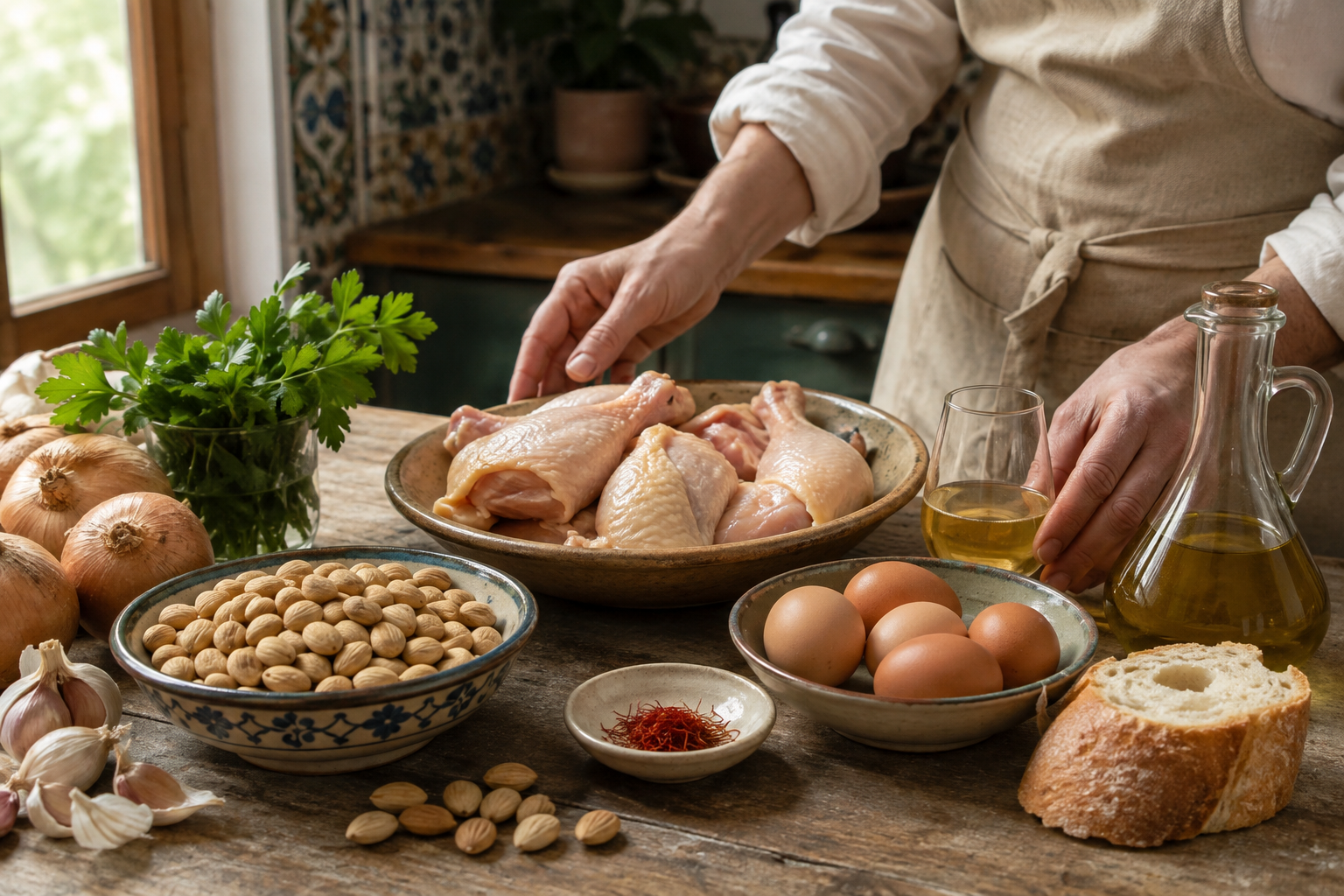
Ingredients
Bone-in, skin-on chicken thighs and drumsticks, about 1.2 kg (roughly eight pieces)
Olive oil, 3 tablespoons
Large onion, one, finely chopped
Garlic cloves, four (two for the sauce base, two for the picada)
Blanched almonds, 60 grams (about half a cup), plus a few extra for garnish
Slice of rustic bread, one, preferably a little stale
Eggs, two, hard-boiled
Dry white wine, 120 millilitres (half a cup)
Chicken stock, 500 millilitres (about two cups)
Bay leaves, two
Saffron, a generous pinch of threads
Fresh parsley, a small handful, chopped
Salt and black pepper, to taste
Method
Boil the eggs for eight minutes, then cool, peel, and separate the yolks from the whites. Keep the yolks for the picada and chop the whites for the garnish.
Warm a little of the stock and steep the saffron threads in it to release their color and aroma. Set aside.
Season the chicken with salt and pepper. Heat the olive oil in a wide heavy pan and brown the chicken pieces well on all sides. Remove and set aside.
In the same oil, gently toast the almonds, the bread, and two garlic cloves until golden, taking care not to burn them. Remove and set aside for the picada.
Lower the heat, add the chopped onion and remaining garlic to the pan, and cook slowly until soft and golden. Add the bay leaves.
Pour in the white wine and let it bubble for a couple of minutes to cook off the alcohol. Return the chicken to the pan and add the stock. Cover and simmer gently for about twenty minutes.
Make the picada by grinding the toasted almonds, bread, garlic, egg yolks, and the saffron stock into a smooth paste, using a mortar or a small food processor, loosening with a spoonful of the cooking liquid if needed.
Stir the picada into the pan and simmer everything, uncovered, for a further fifteen minutes, until the sauce is thick and golden and the chicken is tender.
Taste and adjust the seasoning. Serve scattered with the chopped egg whites, extra toasted almonds, and fresh parsley, alongside rice or crusty bread.

About the Author: Ruben, co-founder of Gamintraveler.com since 2014, is a seasoned traveler from Spain who has explored over 100 countries since 2009. Known for his extensive travel adventures across South America, Europe, the US, Australia, New Zealand, Asia, and Africa, Ruben combines his passion for adventurous yet sustainable living with his love for cycling, highlighted by his remarkable 5-month bicycle journey from Spain to Norway. He currently resides in Spain, where he continues sharing his travel experiences with his partner, Rachel, and their son, Han.