
Spend a summer afternoon anywhere in Greece and you will notice that almost everyone is holding the same thing. Not a phone, not a book, but a tall, frosted glass of iced coffee, sweating gently in the heat, crowned with a layer of foam. Greeks do not merely drink cold coffee in summer, they live around it, spending whole afternoons nursing a single glass on a plastic chair by the sea, in the shade of a café awning, or up on a shaded balcony above a busy street. It is less a beverage than a way of passing the hot hours, a small ritual of stillness in the heat. And there are, at the very center of it, two great drinks at the center of this ritual, the frappé and the freddo, each with its own history, method and devoted fans. If you have ever been confused about the difference, or wondered how to make them yourself, this is the explanation, along with the simple way to prepare each one at home.
What makes these two drinks worth understanding is that they are not just refreshments but little windows into modern Greek life, one a nostalgic icon born by accident decades ago, the other a sleeker newcomer that has taken over the cafés. Between them they tell the story of how Greece drinks, and once you know how each works, you can recreate a genuine taste of a Greek summer wherever you happen to be. The techniques are simple, but the small details make the difference between a proper Greek cold coffee and a sad glass of watery iced instant.
Here is what these two drinks actually are, where they came from, the clever reason each one foams the way it does, and exactly how to make both at home. This is a relaxed bit of coffee culture rather than anything complicated, and the joy of it is how much pleasure comes from so little effort, so let me walk you through the two cold coffees that carry Greece through its long, hot summers.
The Frappé, Greece’s Accidental Icon

The older of the two drinks, and for decades the undisputed king of the Greek summer, is the frappé, and its origin is one of the happiest accidents in coffee history. It was never meant to exist at all.
It was born from a lack of hot water. The story goes that in the late 1950s, at a trade fair in Thessaloniki, a coffee-brand representative wanted a hot cup, found no hot water, and improvised, shaking instant coffee with cold water and ice, and stumbled upon something unexpectedly delicious. That improvised drink became a national obsession, and for decades the frappé was simply what a cold coffee meant in Greece. It is a wonderful thought that a drink now so bound up with national identity began as pure accident, the solution to a small inconvenience at a trade fair. Nobody set out to invent it, and yet it answered a need so perfectly, for something cold and reviving and easy in a hot country, that it spread across the whole of Greece and became, within a generation, an inseparable part of how the country experiences summer.
It is inseparable from summer itself. For generations of Greeks, the frappé is the taste of the season, the drink you make before the beach, order at a seaside café, and sip through the drowsy hours after a nap, so it carries a powerful nostalgia alongside its refreshment. It is bound up with plastic chairs and sea breezes and long unhurried conversations, the very texture of a Greek summer captured in a single glass. Ask any Greek of a certain age about the frappé and you will likely get not a recipe but a memory, of a grandmother’s kitchen, a childhood beach, an afternoon that seemed to last forever. The drink is woven so deeply into the rhythm of the season that to hold one is to be transported, even for people who have since moved on to fancier coffees, back to a simpler and slower version of summer.
Why Instant Coffee Is the Secret
Here is the detail that surprises people, and it is the key to the whole drink, the fact that the frappé depends on instant coffee not as a shortcut but as the essential ingredient that makes it work. You truly cannot make a proper frappé any other way.
Instant coffee is what creates the foam. When you shake instant coffee granules with cold water, tiny particles in the instant coffee act as foaming agents, producing a thick, stable, golden foam that can last for many minutes, so the instant coffee is doing something fresh coffee simply cannot. This is the rare case in the coffee world where instant is not a compromise but truly the superior choice for the job.
Fresh espresso will not do the same thing. If you try to make a frappé with freshly brewed espresso, you get a few bubbles that collapse at once rather than the lasting foam of a true frappé, so the whole character of the drink comes from that humble jar of instant. Understanding this saves you from the common mistake of thinking better coffee would make a better frappé, when in fact it would ruin the very thing that defines it. It is a lovely little inversion of the usual rules, in which the humble, mass-produced product turns out to be exactly right for the job and the premium alternative simply wrong. The frappé is proof that in cooking, as in much else, the best ingredient is not always the most expensive or the most refined, but the one that actually does what the dish requires. It is also, quietly, the reason the frappé caught on so widely in the first place. Because it needs only a jar of instant coffee, some water, and ice, anyone could make one anywhere, on a boat, at a remote beach, in the simplest kitchen, without any special machine. That democratic simplicity, as much as the taste, is what carried it into every corner of Greek life.
The Freddo, the Modern Champion
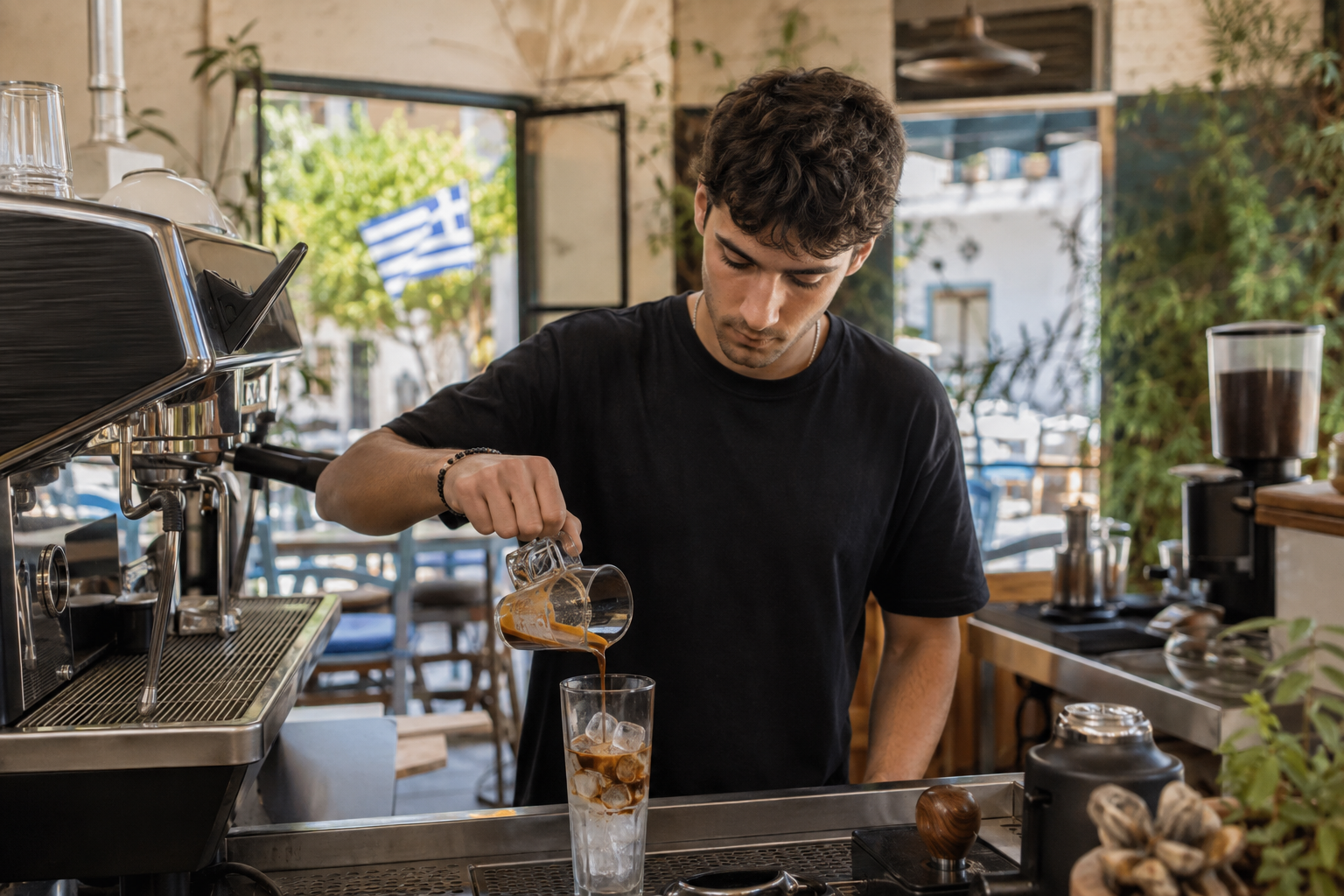
If the frappé is the nostalgic icon, the freddo is the sleek modern rival that has, over the last few decades, quietly overtaken it in Greece’s cafés. It arrived with the espresso machine and never looked back.
It rose with espresso culture. When espresso machines spread through Greek cafés from the 1990s, baristas created a cold espresso drink to rival the frappé, and this freddo, bolder and more intensely coffee-flavored, became the default cold coffee in city cafés, so it represents the more contemporary face of Greek coffee. Where the frappé speaks of the past, the freddo speaks of a Greece plugged into wider Europe. Its rise tracks a broader shift in Greek café life, away from the older world of instant coffee and the traditional briki-brewed cup toward the espresso-based drinks that dominate cafés across the continent. Walk into a stylish café in Athens or Thessaloniki today and the freddo espresso is very often the default order, the drink young Greeks reach for without a second thought, in the way their parents once reached for a frappé. Part of the fun of ordering either drink in Greece is the little vocabulary of sweetness that comes with it, since you specify not just the drink but exactly how sweet you want it and whether it should have milk. A medium-sweet coffee with milk is the runaway favorite, and learning the words to ask for your own preference is one of those small keys that make a café in Greece feel a great deal friendlier and more your own.
It comes in two forms. The freddo appears either as a freddo espresso, cold foamy espresso over ice, or a freddo cappuccino, crowned with cold silky frothed milk, so you can choose between a purer coffee hit and a creamier, milkier version. The two share a base but offer quite different experiences, one bracing and direct, the other smooth and indulgent. The freddo espresso is for people who want their coffee to taste unmistakably of coffee, cold and strong and clean, while the freddo cappuccino softens all of that under a cool cloud of milk foam for those who prefer something gentler. Between them they cover most of what a person might want from a cold coffee, which is a large part of why the freddo family has come to rule the modern Greek café.
How the Freddo Gets Its Foam
The freddo has its own clever trick for achieving a luxurious texture, quite different from the frappé’s, and worth understanding if you want to make one properly. It relies on temperature and technique rather than instant coffee.
Blending hot espresso with ice creates the froth. To make a freddo, hot espresso is blended hard with a little ice, and the dramatic meeting of hot coffee and cold ice, along with the vigorous mixing, whips air into the espresso to create a fine, pale foam, so the froth comes from method rather than from any special ingredient. That pale crown is an easy way to tell a freddo from a frappé, whose foam is golden brown.
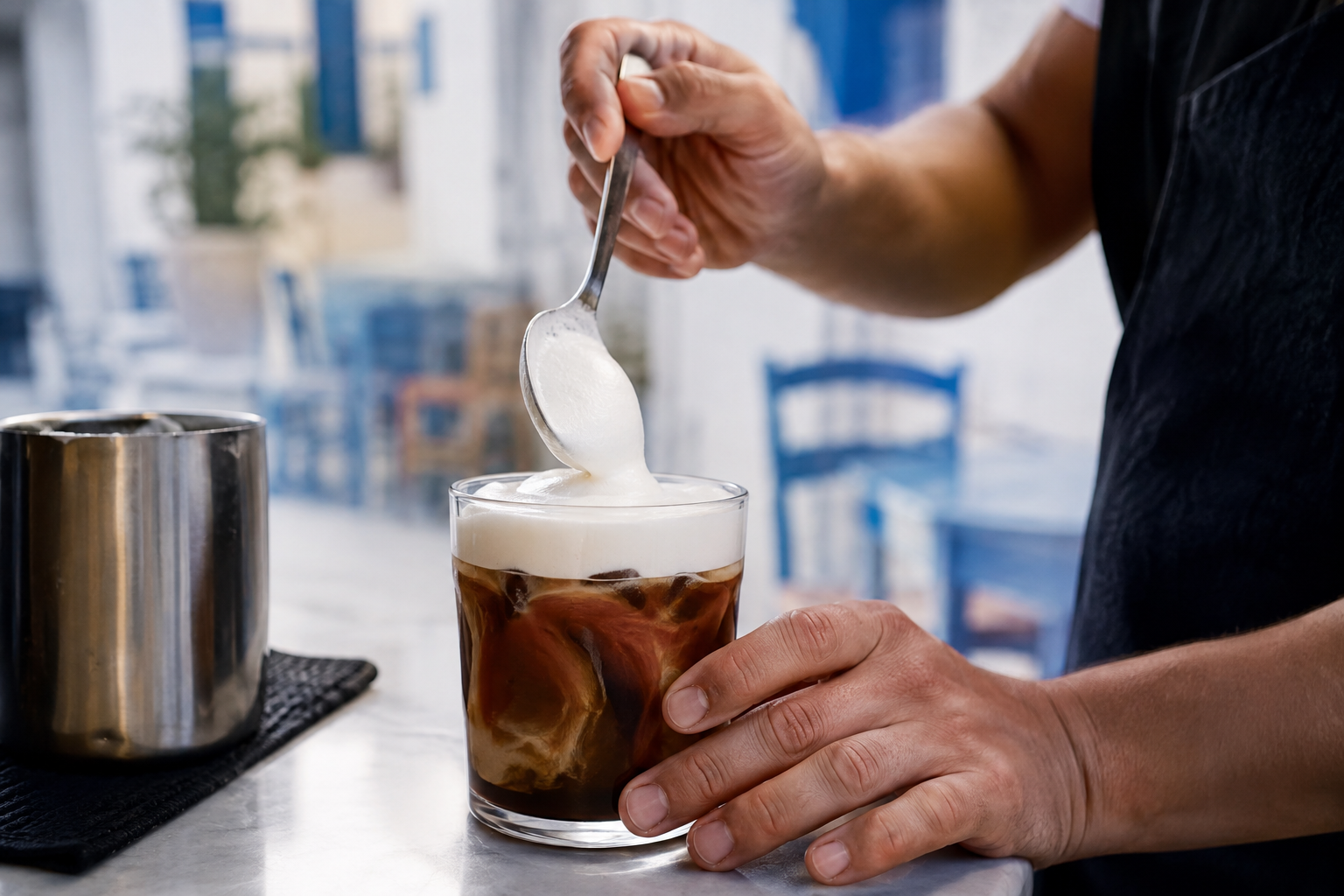
The cappuccino version adds cold milk foam. For a freddo cappuccino, you top the iced espresso with cold-frothed milk, whipped from cold milk and ice into a silky foam the Greeks call afrogala, so the drink gains a creamy crown that sits beautifully atop the darker coffee below. This cold milk foam is a small art of its own, and it is what gives the freddo cappuccino its lovely two-toned look and its indulgent texture. Done well, the afrogala should be thick enough to sit proudly on top of the coffee rather than sinking into it, forming a distinct pale layer that you sip the dark espresso through. Getting it right at home takes a little practice with a frother, but even an imperfect attempt tastes wonderful, and the visual drama of that milky crown over the deep coffee is half the pleasure of the drink. If the frappé is the drink of improvisation and nostalgia, the freddo cappuccino is the drink of a little care and craft, the one you make when you want to feel you have produced something worthy of a good café. Neither is difficult, but they scratch slightly different itches, which is exactly why so many Greeks are happy to have both in their repertoire.
Making a Frappé at Home
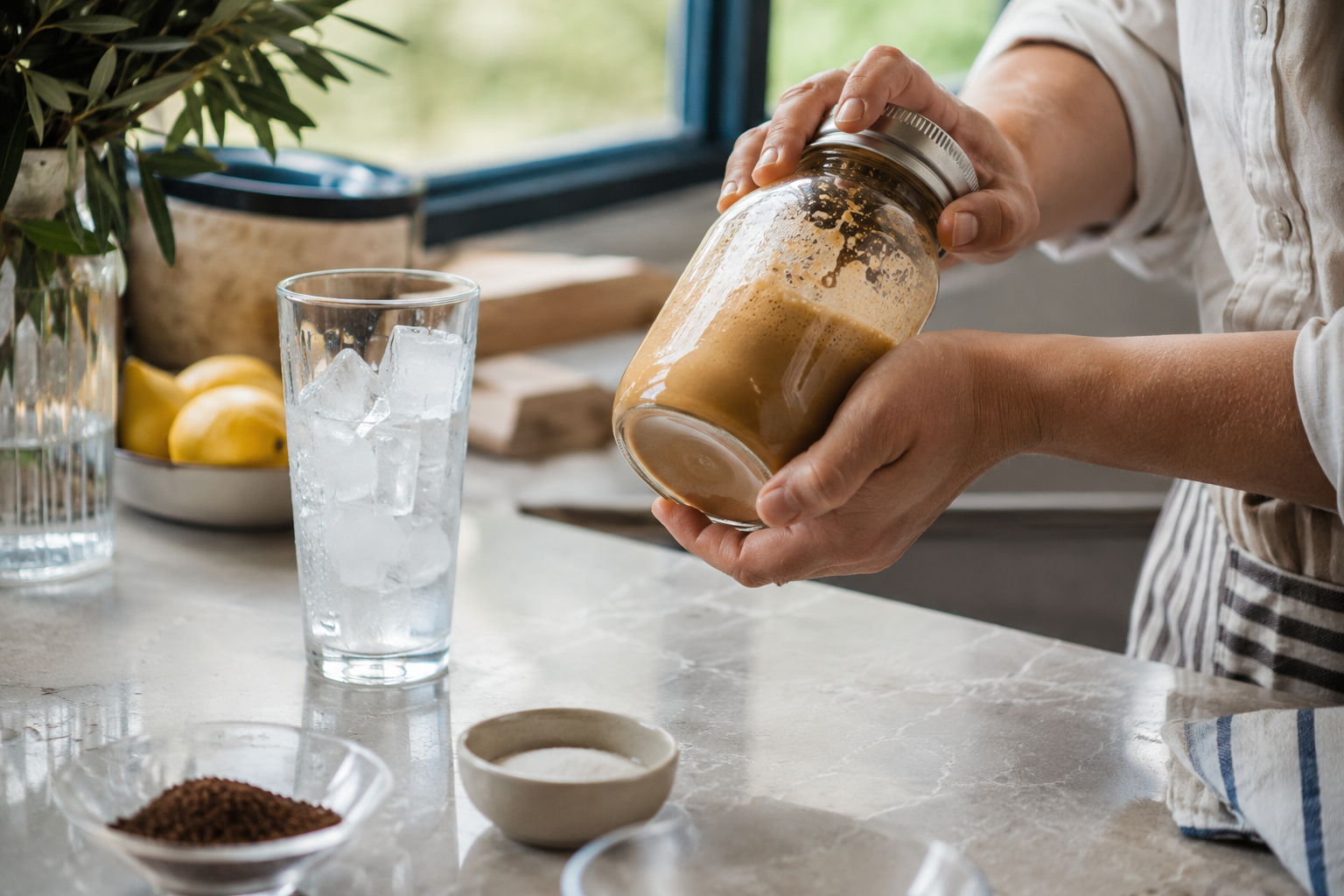
The wonderful thing about both drinks is that they are genuinely easy to make at home, and the frappé could hardly be simpler, needing only instant coffee, water, ice and a way to shake it. Here is the method.
Greek Frappé

Makes 1 / about 5 minutes
- 1 to 2 teaspoons of instant coffee
- Sugar to taste, from none to a couple of teaspoons
- A little cold water, plus more to top up
- Ice cubes
- Cold milk or evaporated milk, optional
Put the instant coffee, sugar and a small splash of cold water into a shaker or tall glass. Shake hard, or whip with a handheld frother, for around thirty seconds until you have a thick golden foam. Fill a tall glass with ice, pour the foam over it, and top up with cold water, adding a little milk if you like. Serve with a straw.
Making a Freddo at Home
The freddo takes just a little more equipment, since you need a way to make espresso, but it is still very achievable in a home kitchen, and rewards you with a more intense, café-style drink. Here is how it goes.
Freddo Espresso and Freddo Cappuccino
Makes 1 / about 5 minutes
- 1 double shot of hot espresso
- Sugar to taste, added while hot so it dissolves
- Ice cubes
- Cold milk, only for the cappuccino version
Pull a double shot of espresso and stir in sugar if you want it while it is still hot. Add a couple of ice cubes and blend, shake, or whip vigorously until it turns foamy and pale, then pour over a glass of fresh ice. For a freddo espresso, stop there. For a freddo cappuccino, whip cold milk with a little ice into a thick foam and spoon it over the top.
The Coffee That Defines a Greek Summer

The lasting charm of these two drinks is that between them they capture something essential about how Greece lives in summer, turning cold coffee into a slow, sociable, deeply pleasurable ritual that fills the long hot afternoons. Whether you reach for the nostalgic golden foam of a frappé or the bold pale crown of a freddo, you are taking part in a daily tradition that millions of Greeks quietly treasure.
What makes them worth learning is that they ask so little and give so much, a few humble ingredients and a vigorous shake yielding a drink that tastes of sunshine and ease. The frappé rewards you with nostalgia and a golden foam that only instant coffee can produce, while the freddo offers a bolder, more modern pleasure crowned in pale froth, and both cost almost nothing and take only minutes to make. That accessibility is the quiet secret of Greek cold coffee, that these are not precious café creations to be admired from afar but everyday drinks anyone can throw together with the most basic equipment. A shaker or a cheap handheld frother is really all you need for a frappé, and a modest espresso maker opens the door to the freddo, which means the whole of this delicious summer tradition sits well within reach of an ordinary home kitchen.
So the next time the weather turns hot and you crave something cold and reviving, skip the expensive café drink and make yourself a proper Greek cold coffee instead. Shake up a frappé the way it was invented by accident all those years ago, or blend a freddo the way the modern Greek cafés do, find yourself a shady spot and a comfortable chair, put your feet up with no particular plan for the next hour, and let yourself sink slowly into the unhurried rhythm of a proper Greek summer afternoon. It is one of the simplest and most reliable pleasures I know, costing next to nothing and asking almost no skill, and it travels with you anywhere you can find a little ice and a little coffee and a few quiet minutes to enjoy it.

About the Author: Ruben, co-founder of Gamintraveler.com since 2014, is a seasoned traveler from Spain who has explored over 100 countries since 2009. Known for his extensive travel adventures across South America, Europe, the US, Australia, New Zealand, Asia, and Africa, Ruben combines his passion for adventurous yet sustainable living with his love for cycling, highlighted by his remarkable 5-month bicycle journey from Spain to Norway. He currently resides in Spain, where he continues sharing his travel experiences with his partner, Rachel, and their son, Han.