
Last updated on September 5th, 2026 at 05:02 am
Imagine a recipe for mashed potatoes that called for a full pound of butter for every two pounds of potatoes. To an American eye trained on nutrition labels and portion warnings, the number looks like a misprint, or a joke, or something a cautious food editor would quietly flag and cut in half before publishing. Yet that ratio is not a mistake but the precise, celebrated formula behind the most famous mashed potatoes in the world, the pommes purée of the legendary French chef Joël Robuchon, a dish so sublime it helped win him the title of Chef of the Century. The gap between the American instinct to recoil from that much butter and the French willingness to embrace it is a small window into two very different philosophies of food.
Robuchon’s mashed potatoes are proof of a principle that French cooking has always understood and American food culture often forgets, that some dishes are meant to be gloriously, unapologetically rich, and that the richness is the entire point. The pound of butter is not an excess to be trimmed but the defining feature, the thing that transforms humble boiled potatoes into one of the most luxurious mouthfuls in all of cooking. Understanding why a great French chef would put that much butter in mashed potatoes, and why it works so brilliantly, is a lesson in what makes food transcendent.
Here is the story of the most famous mashed potatoes in the world, the astonishing butter ratio at their heart, why that much butter creates something magical rather than merely heavy, what the whole thing reveals about French and American attitudes to indulgence, and the full recipe so you can make them yourself. This is a piece of culinary appreciation rather than an everyday recommendation or nutritional advice, since this is unabashedly a rich, special-occasion dish, but the story of Robuchon’s potatoes, and the making of them, is one every lover of food should know.
The Most Famous Mashed Potatoes in the World
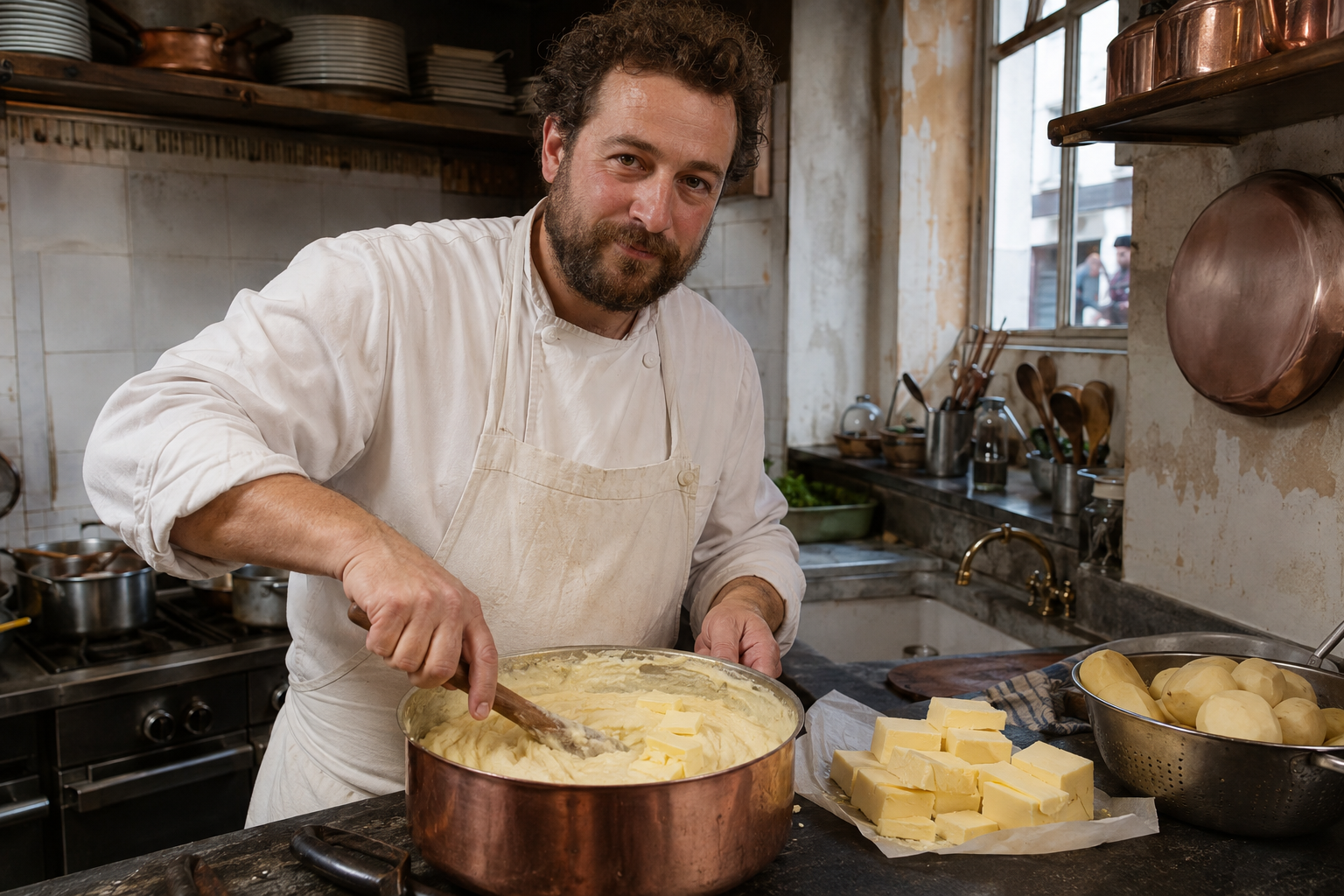
To understand the butter, you first have to understand the dish and the man, because these are no ordinary mashed potatoes but arguably the most celebrated version of the dish ever made. Joël Robuchon was one of the greatest chefs of the twentieth century, a Frenchman who at his peak held more Michelin stars than any other chef in the world and was crowned Chef of the Century, and among all his sophisticated creations, it was a dish of mashed potatoes that became his signature.
The story is a striking one. When Robuchon served his purée de pommes de terre at his Paris restaurant in the early 1980s, this humble-sounding dish astonished a dining world that thought it knew what mashed potatoes were, so silky and rich and refined was his version that it became legendary, demanded by customers at every restaurant he opened around the globe thereafter. Robuchon himself acknowledged the dish’s importance to his fame, crediting these mashed potatoes with making his reputation.
What makes the tale so appealing is the humility of the dish itself. Here was one of the most decorated chefs in history, capable of the most elaborate haute cuisine, and his most famous creation was made from just four simple ingredients, potatoes, butter, milk and salt, elevated to greatness through technique and one audacious proportion. The most luxurious mashed potatoes on earth are, at heart, a peasant dish taken to its most refined possible extreme. Anyone can make mashed potatoes, which is what makes Robuchon’s version so remarkable, since he took the most ordinary comfort food imaginable and, without a single luxury ingredient, made it into something people would travel across the world to taste. The genius was not truffles or gold leaf but what he did with butter, potato and technique.
The Ratio That Would Get Flagged
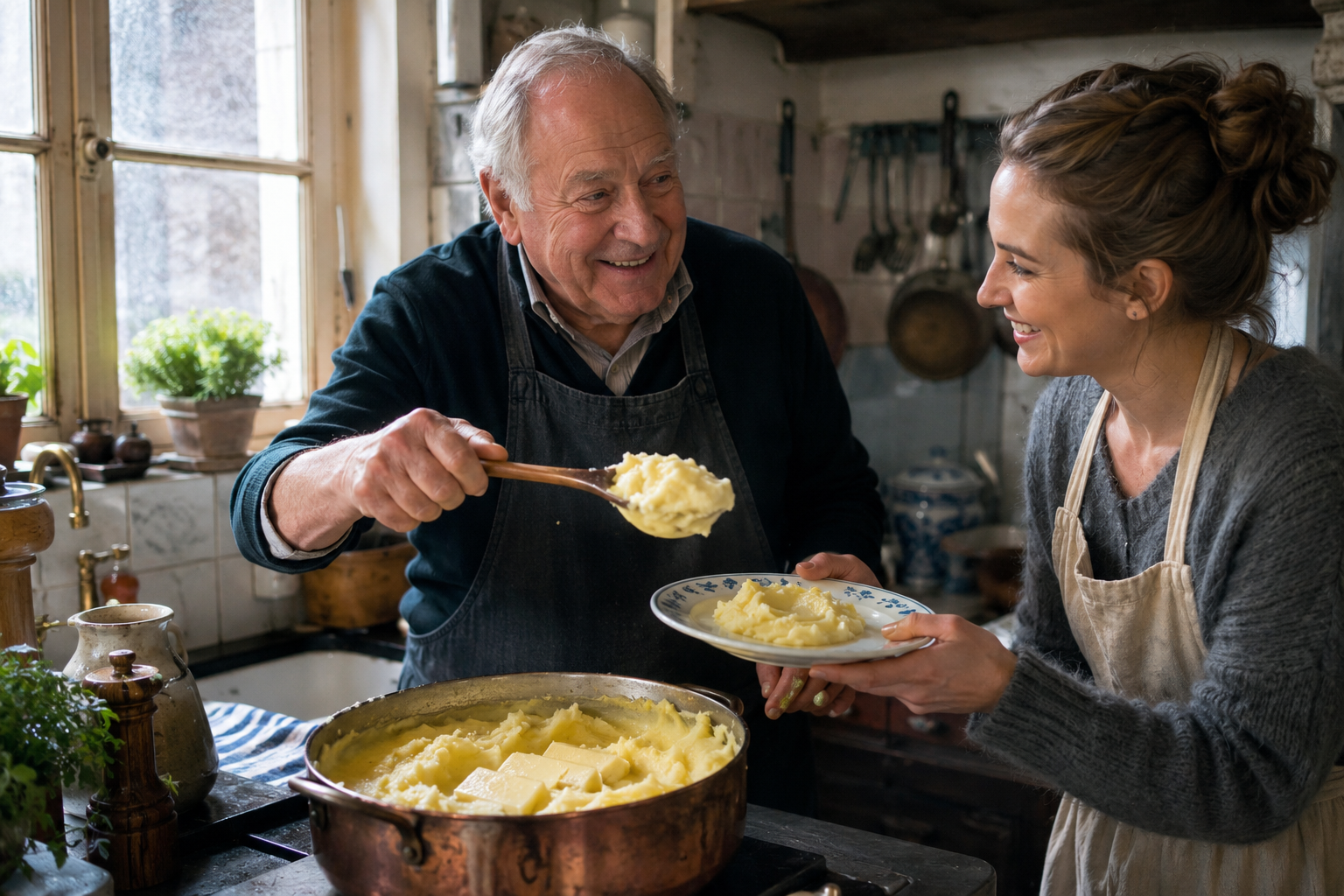
Now the number itself, the one that stops Americans in their tracks, which is the ratio of butter to potato at the heart of the recipe. Robuchon’s pommes purée uses a full pound of butter for every two pounds of potatoes, a two-to-one ratio of potato to butter, which means the butter makes up a full third of the finished dish by weight, an amount that seems almost impossible until you see it stated plainly.
Put in everyday terms, the quantity is truly startling. A pound of butter is four American sticks, so a batch of these potatoes made with two pounds of spuds contains four entire sticks of butter melted and beaten into the mash, a quantity that no American home recipe would dare print without expecting readers to assume a typo. This is the number that would get quietly halved by a nervous editor, the ratio that looks less like a recipe than a dare.
Yet this exact proportion is the essence of the dish rather than an excess to be corrected. The pound of butter is not incidental to Robuchon’s potatoes but the very thing that makes them what they are, and reducing it would not make the dish healthier so much as make it a different, lesser dish entirely, no longer the famous purée but ordinary mashed potatoes again. The ratio that looks like a mistake is in fact the precise, deliberate secret of the most admired mashed potatoes ever made. It is worth pausing on how deliberate that precision is, because Robuchon was famous for his exactitude. He arrived at a pound of butter to two pounds of potato not by excess but by relentless refinement, testing until he found the exact proportion at which the potatoes became sublime, so the number that reads as reckless is the product of obsessive care.
Why So Much Butter Works
The natural question is how such an enormous quantity of butter produces something sublime rather than something greasy and overwhelming, and the answer lies in what the butter does to the texture and how the technique handles it. The huge amount of butter, properly incorporated, transforms the potatoes into an incredibly smooth, silky, creamy purée, giving them a texture and richness that a normal amount of butter simply cannot achieve.
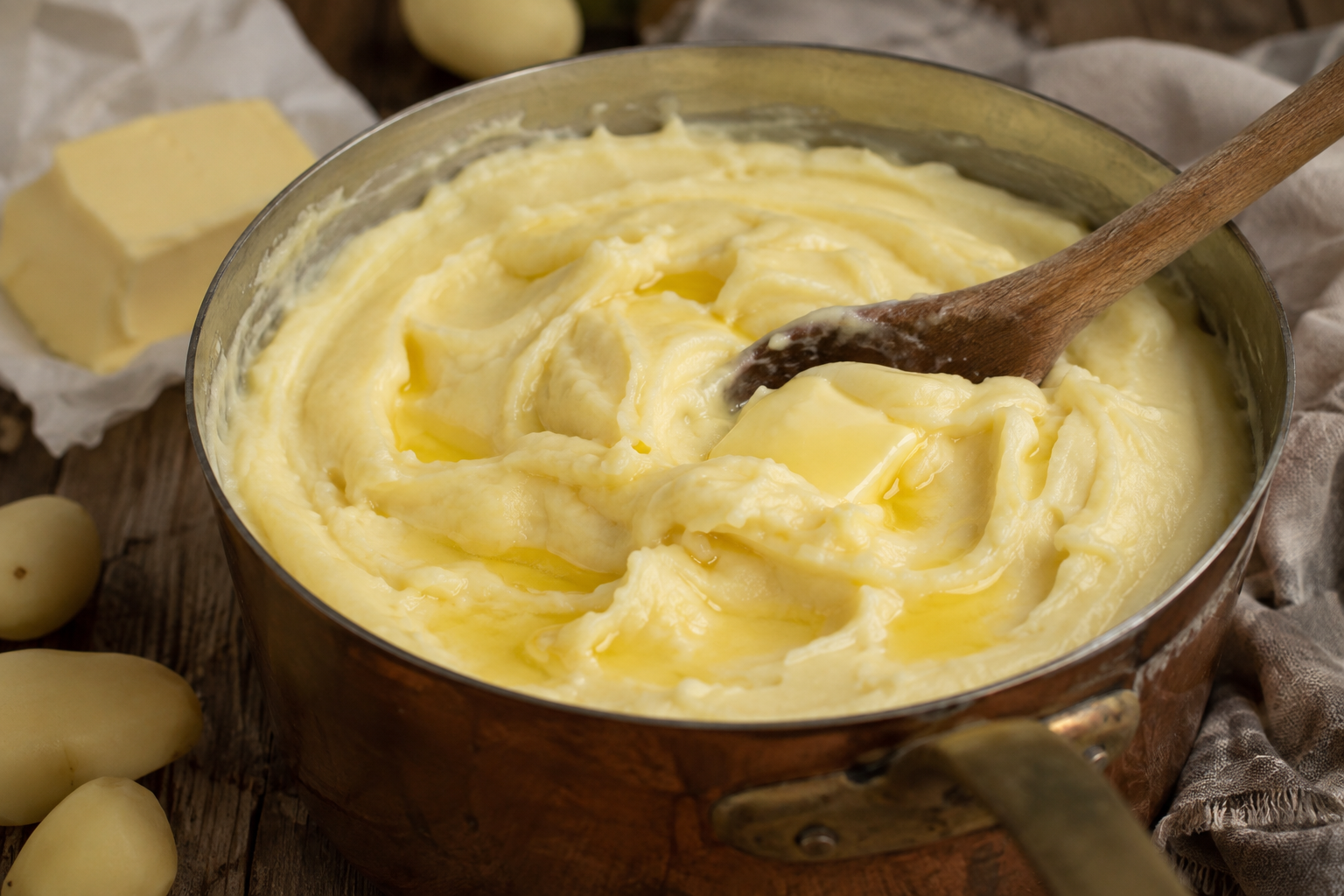
The magic is in the emulsion. When cold butter is beaten vigorously into hot riced potatoes, the fat emulsifies into the starch, coating every particle and creating a purée that is glossy, cohesive and almost impossibly velvety, more like a rich sauce than like ordinary mash. The result is not a bowl of potatoes swimming in grease but a unified, luxurious whole, in which the butter has become one with the potato rather than sitting on top of it.
This is why the technique matters as much as the ratio. Robuchon’s method, boiling the potatoes in their skins, peeling them hot, passing them through a fine food mill, and then beating in the cold butter bit by bit before finishing with milk and sieving the whole to silk, is precisely engineered to incorporate all that butter into a flawless emulsion. The pound of butter works because the technique makes it work, turning what could be a greasy mess into the smoothest, richest purée imaginable. This dependence of the ratio on the method is the part most home cooks miss when they hear the number. Simply dumping a pound of melted butter into ordinary mash would produce something oily and broken, which is what makes the technique inseparable from the recipe.
The French Philosophy of Richness

Robuchon’s potatoes embody a broader French attitude toward food that stands in sharp contrast to the American one, a philosophy in which richness, when it is the point of a dish, is embraced wholeheartedly rather than apologized for. The French tradition holds that certain dishes are meant to be indulgent, that butter and cream are to be celebrated in their proper place, and that a dish like pommes purée should be exactly as rich as it needs to be to achieve perfection.
This is not recklessness but a considered stance. The French approach tends to favor rich food in modest portions, eaten with full enjoyment, rather than eating larger amounts of lighter, compromised versions, so a small serving of gloriously buttery purée is savored as the treat it is, its richness accepted as intrinsic to the experience. The pleasure and the quality come first, and the richness is understood as part of what makes the dish worth eating at all.
The American instinct often runs the other way, and the contrast is illuminating. American food culture, more anxious about fat and calories, tends to want to lighten rich dishes, to find the low-fat version, to flag and trim the butter, which can produce a healthier dish but often a sadder and less satisfying one. Robuchon’s potatoes are a rebuke to that instinct, a reminder that some things are meant to be rich, and that stripping the richness away can destroy the very thing that made them worth making.
A Dish to Respect, Not to Fear
It should be said plainly that pommes purée is not an everyday food, and the dish belongs in its proper context as the special indulgence it is. This is unmistakably a rich, decadent, special-occasion dish, not a weeknight staple, and no one, French or otherwise, is suggesting you eat a pound of butter’s worth of mashed potatoes every day, so the sensible way to regard it is as an occasional luxury rather than routine fare.
Seen that way, the dish loses any air of guilt and becomes simply a pleasure. Enjoyed now and then, in a modest portion, as the centerpiece of a special meal or a holiday table, Robuchon’s potatoes are a sublime treat that harms no one and delights everyone, exactly the kind of glorious indulgence that a good life makes room for on occasion. The richness that alarms in the abstract becomes a joy in its proper place.
This is really the reconciliation of the two attitudes. You can respect the astonishing butter ratio as the secret of a magnificent dish while also understanding that such richness belongs to special moments rather than daily eating, taking the French appreciation of the indulgence and the American awareness of moderation and holding both at once. The dish need not be feared as a nutritional catastrophe nor eaten with abandon, but enjoyed, occasionally and fully, for the marvel that it is.
Making It Yourself
For anyone tempted to experience these legendary potatoes firsthand, the good news is that the dish, while demanding care, is entirely achievable at home, and it is well worth making at least once. The essentials are a good buttery potato variety like Yukon Gold, a proper pound-to-two-pounds ratio of butter to potato, cold butter beaten into hot potatoes, and a food mill or ricer to achieve the necessary smoothness, since a food processor would turn the potatoes to glue.
The technique rewards patience and precision. Boiling the potatoes whole in their skins keeps them from getting waterlogged, ricing them while hot and drying them out slightly concentrates their flavor, and beating in the cold butter gradually and vigorously creates the crucial emulsion, with a final pass through a fine sieve giving the ultimate silkiness. It is more work than ordinary mashed potatoes, but the result is on another plane entirely.
Here, then, is the famous dish itself, scaled for the home kitchen, with the legendary ratio intact and every step of the technique laid out. Make it once and you will understand why a pound of butter can be a masterstroke rather than a mistake.
Pommes Purée, Robuchon-Style Mashed Potatoes serves 6 as a rich side
Ingredients:
- 2 pounds Yukon Gold potatoes, unpeeled and scrubbed
- 1 pound cold unsalted butter, cut into small cubes
- about 120ml whole milk, warmed
- salt, to taste
Method:
- Put the whole unpeeled potatoes in a large pot, cover with cold salted water, and bring to a gentle simmer.
- Cook until a knife slips in and out easily, about twenty-five minutes, keeping the water at a bare simmer rather than a hard boil.
- Drain the potatoes and let them cool just enough to handle, then peel off the skins while they are still hot.
- Pass the hot potatoes through a food mill or ricer back into the warm pot, never a food processor, which would turn them to glue.
- Set the pot over low heat and, working in several additions, beat in the cold cubed butter with a wooden spoon, stirring vigorously until each addition is fully absorbed before adding the next.
- Once all the butter is incorporated into a glossy, smooth purée, beat in enough warm milk to loosen it to a soft, silky consistency.
- For the ultimate texture, pass the purée through a fine sieve, then season with salt to taste and serve at once, while hot.
The whole thing hangs on the ratio and the reasons behind it, the pound of butter to two pounds of potato that defines the dish and the careful method that turns that butter into silk rather than grease. Keep the potatoes hot, beat the cold butter in hard, and resist the urge to reduce the quantity, and the famous purée is well within your reach.
What the Butter Teaches
The lasting lesson of Robuchon’s mashed potatoes is that the amount of butter that would get an American recipe flagged is, in the hands of a master and in the context of French culinary philosophy, not an excess but a masterstroke. The pound of butter that looks like a mistake or an indulgence too far is the precise, deliberate secret behind the most celebrated mashed potatoes in the world, proof that richness, used with skill and purpose, can be transcendent rather than merely unhealthy.
What the dish really teaches is a more generous way of thinking about indulgence. Rather than reflexively fearing and trimming every rich ingredient, we might learn from the French to embrace richness where it belongs, in special dishes made properly and enjoyed fully, understanding that some of the greatest pleasures of the table come precisely from an unapologetic commitment to butter and cream and their glories. The pommes purée is a monument to that idea, a humble dish made sublime by the very quantity of butter that timid cooking would reject.
So the next time you encounter a recipe whose richness makes you flinch, remember Robuchon’s potatoes and the pound of butter that made a chef’s reputation. Some dishes are meant to be rich, and the richness is the point, and the willingness to embrace that, in the right moment and the right measure, is part of what separates cooking that merely feeds from cooking that delights. The most famous mashed potatoes in the world are made of little more than potatoes and an almost outrageous amount of butter, and they are, by common consent, among the most delicious things a person can eat. Sometimes the number that should be flagged is exactly the number that makes the magic, and the wisest cooks know which numbers those are.

About the Author: Ruben, co-founder of Gamintraveler.com since 2014, is a seasoned traveler from Spain who has explored over 100 countries since 2009. Known for his extensive travel adventures across South America, Europe, the US, Australia, New Zealand, Asia, and Africa, Ruben combines his passion for adventurous yet sustainable living with his love for cycling, highlighted by his remarkable 5-month bicycle journey from Spain to Norway. He currently resides in Spain, where he continues sharing his travel experiences with his partner, Rachel, and their son, Han.