
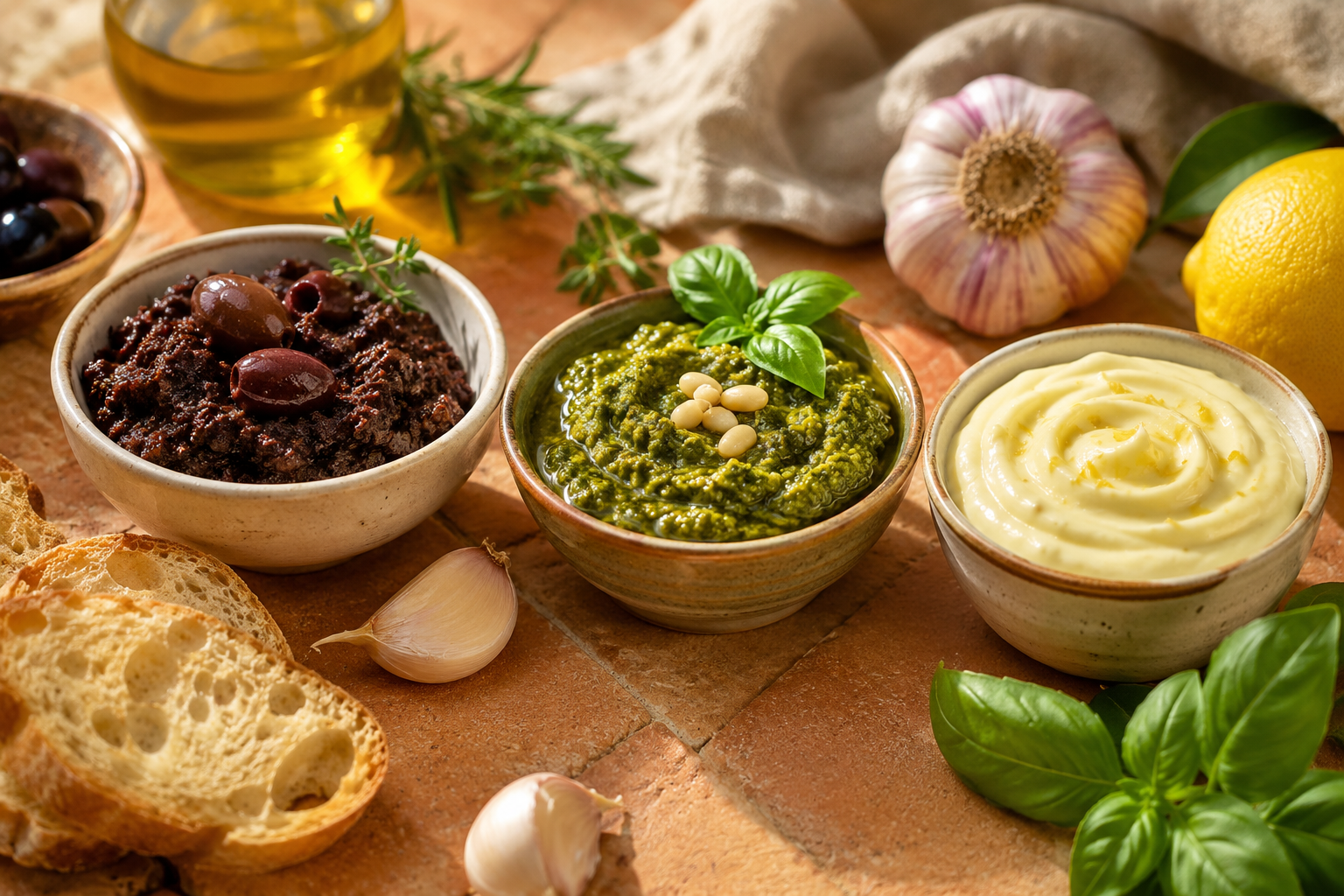
A plain summer table is a solvable problem, and Provence solved it centuries ago. In the sun-soaked south of France, three simple sauces turn bread, vegetables, fish and eggs into a feast, each one built from a short list of Mediterranean ingredients pounded together into something far greater than its parts. They are tapenade, pistou and aïoli, and once you can make all three, a bare table of raw ingredients becomes a spread that tastes like a holiday.
None of them is complicated, and that is the point. These are peasant sauces in the best sense, born of a landscape rich in olives, garlic, basil and good oil, designed to make humble food sing without fuss or expense. A jar of tapenade, a bowl of pistou and a dish of aïoli are the Provençal answer to the question of what to do with a table full of plain summer things, and the answer is always the same, which is to add garlic, oil and a little skill.
Here is what each of these three sauces is, where it comes from, how it differs from its more famous cousins, and how to make it at home, complete with a recipe for each. This is a trio of genuine Provençal classics, and learning them gives you a permanent fix for a dull table, three sauces that between them can rescue almost anything the summer garden and the market throw at you.
The Provençal Way of the Sauce
Before the individual sauces, it helps to understand the tradition they share, because they are cut from the same cloth. All three are cold sauces, made without cooking, built on the holy trinity of the Provençal kitchen, which is olive oil, garlic and the products of a hot Mediterranean sun. They are condiments in the truest sense, made to be spread, dolloped and dipped rather than simmered.
They also share a method that shapes their character, which is the mortar and pestle. Traditionally these sauces are not blended but pounded, the ingredients crushed and worked together by hand in a heavy mortar, and the pounding is not mere nostalgia. Bruising basil and crushing garlic by hand releases their oils differently from the violent chop of a blade, and the old method is still prized for the texture and depth it gives. A food processor works, but the mortar is the soul of it. The word behind two of the three sauces even carries this in its bones, since both pistou and the act of pounding share a root meaning to crush. To make these sauces the old way is to feel why they taste as they do, the garlic smearing to paste against the stone, the basil bruising rather than tearing, the oil slowly loosening it all into something that a blender can approximate but never quite equal.
What unites them most of all is their purpose, which is to make simple food delicious. Provençal cooking is not fussy haute cuisine but sun-drenched country food, and these sauces are its secret weapons, the concentrated bursts of flavor that turn a piece of bread or a boiled vegetable into something you remember. Master the trio and you hold the essence of how Provence eats, which is well, simply and with a great deal of garlic. There is a philosophy of thrift and abundance woven through all of it. Provence was never a rich region in the way of the great French food capitals, and its cooking grew out of making the most of what the land and sea gave freely, which was olives, garlic, herbs, oil and sunshine. These sauces are the distilled expression of that outlook, taking the cheapest and most plentiful things and turning them into the highlight of the table.
Tapenade, the Olive Spread
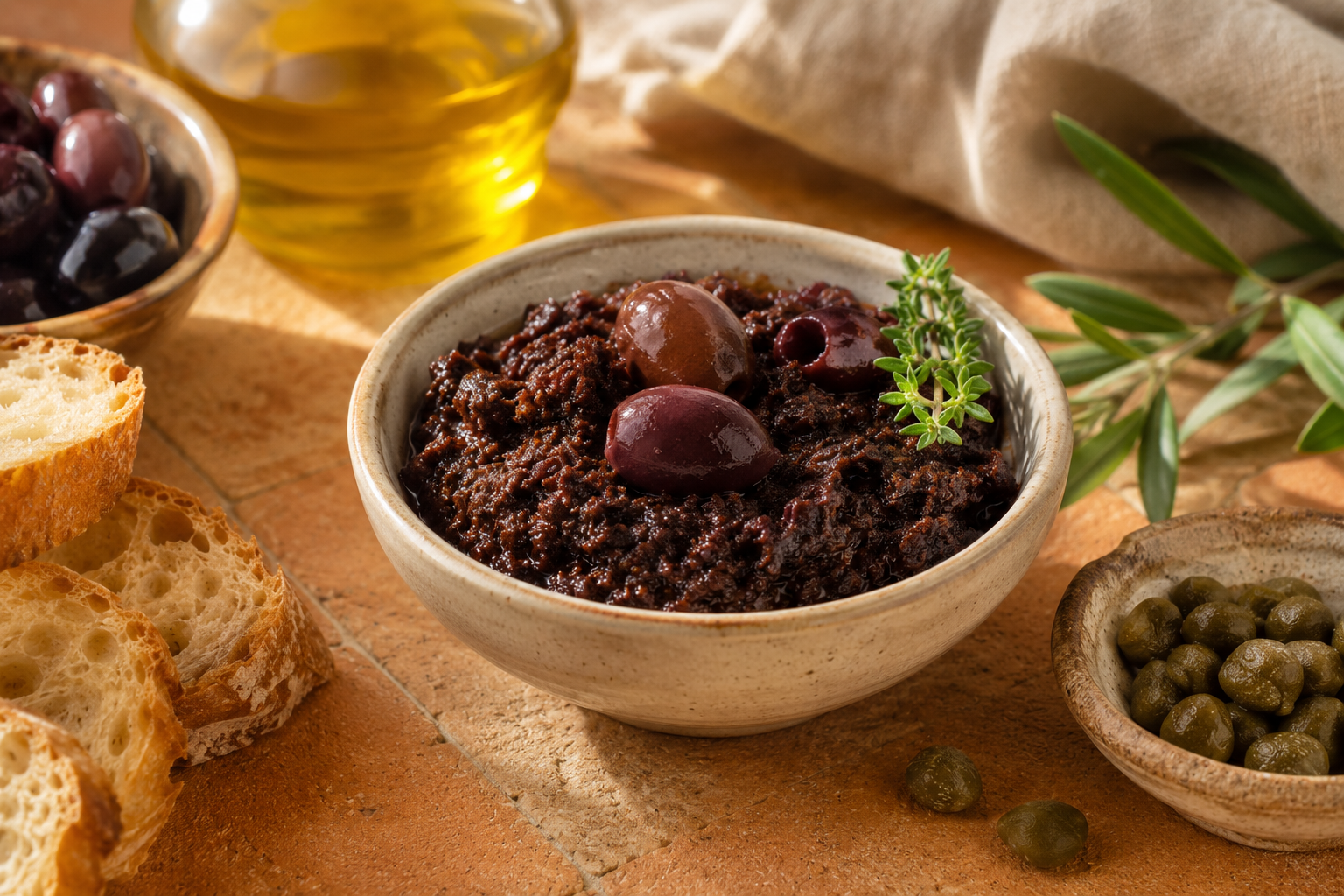
The first of the three is tapenade, a dark, glossy, intensely savory paste of olives that is the quintessential taste of a Provençal apéritif. Spread on a slice of toasted baguette with a glass of something cold, it is how the south of France begins a meal, and a small dish of it appearing on the table is an open invitation to relax into the evening.
Despite its name, tapenade is not really about the olives alone. The word comes from the Provençal word for capers, tapeno, because capers are essential to it, and the classic tapenade is a blend of olives, capers, anchovies, garlic and olive oil pounded into a rough paste. The anchovies are the secret, dissolving into the mix to add a deep savory saltiness that you do not taste as fish so much as feel as depth, and they are what separate a real tapenade from a mere olive purée.
It is endlessly useful once you have it. Beyond the classic role spread on toasts as an apéritif, tapenade is wonderful stirred into pasta, spooned over grilled fish or chicken, tucked into a sandwich, or used to dress hard-boiled eggs and roasted vegetables. Black olives make the familiar dark version, though a green olive tapenade is equally traditional, and a little lemon juice or a pinch of herbes de Provence can brighten it. It keeps for days in the fridge under a film of oil, ready to rescue a plain plate at a moment’s notice. A word on the olives is worth adding, since they are most of the sauce. The best tapenade starts with good, flavorful olives with real character rather than the bland pitted kind sold for pizza, and the small black Niçoise olives of Provence itself or a good Kalamata will give you far more depth. Because the recipe is so short, every ingredient in it shows, and the difference between a dull tapenade and a great one is mostly the quality of what went into the mortar.
Tapenade makes about one bowl
Ingredients:
- 200g pitted black olives, such as Kalamata or Niçoise
- 2 tablespoons capers, drained
- 4 anchovy fillets in oil
- 1 clove garlic, peeled
- 4 tablespoons extra virgin olive oil
- a squeeze of lemon juice
- black pepper
Method:
- Put the garlic, capers and anchovy fillets in a mortar or food processor and pound or pulse to a rough paste.
- Add the olives and work them in, keeping some texture rather than reducing everything to a smooth purée.
- Drizzle in the olive oil gradually, pounding or pulsing, until you have a thick, spreadable paste.
- Sharpen with a squeeze of lemon and season with black pepper. Anchovies and capers are salty, so taste before adding any salt.
- Serve on toasted baguette slices, keeping any leftovers in the fridge under a thin film of olive oil.
Pistou, the Basil Sauce
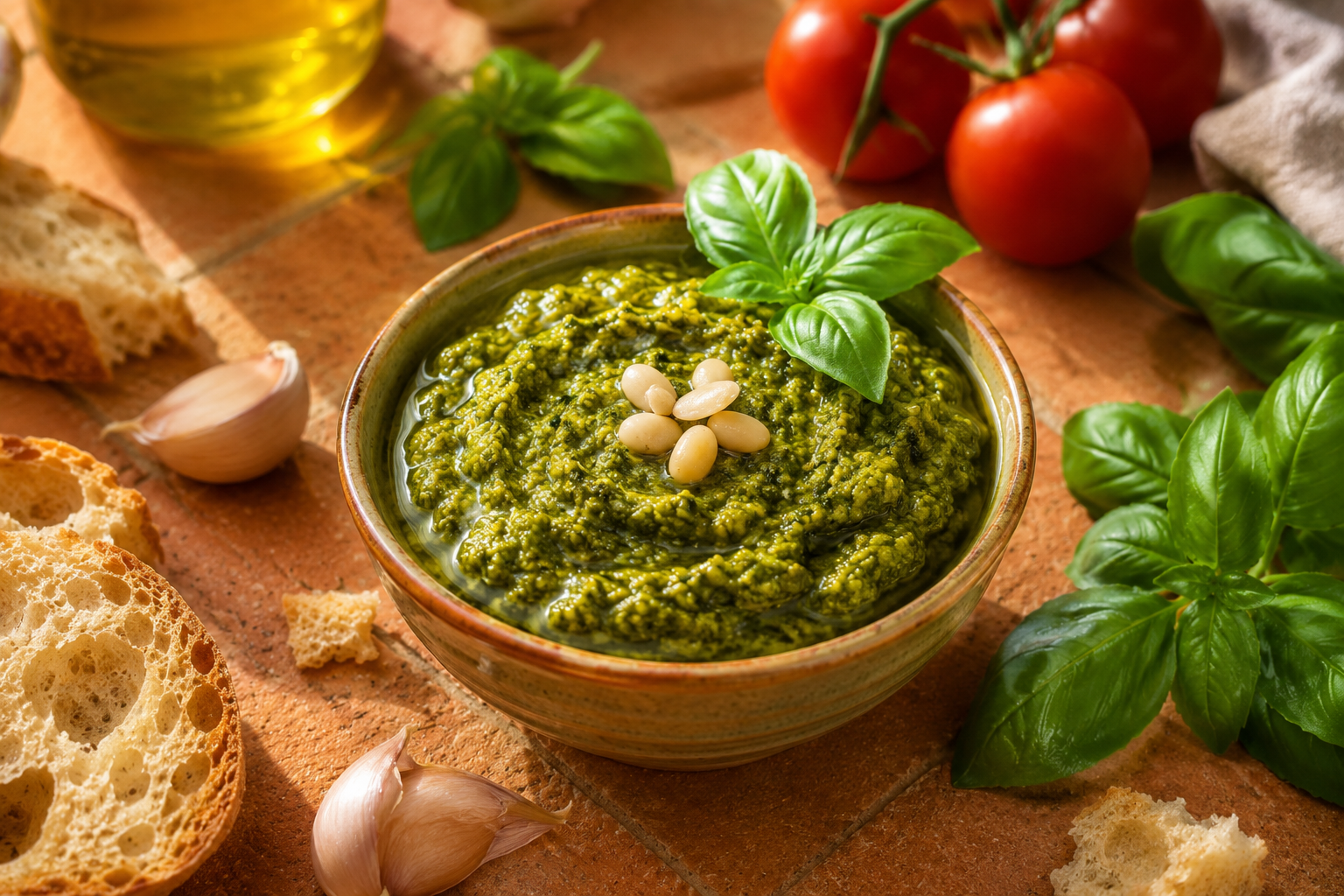
The second sauce is pistou, the Provençal cousin of Italian pesto and, to many who know it, the better of the two for a summer table. It is a fragrant, intensely green sauce of fresh basil, garlic and olive oil, pounded into a loose paste that carries the whole scent of a Provençal summer in a single spoonful. Its name comes from a word meaning to pound, a reminder of how it is meant to be made.
The crucial thing to know is how it differs from pesto, because the difference is the whole identity of the sauce. Classic pistou contains no cheese and no nuts, none of the pine nuts and parmesan that define Genoese pesto, keeping instead to the pure, clean simplicity of basil, garlic and oil. This makes it lighter and looser than pesto, more like a fragrant green oil than a thick paste, and it also makes the traditional version naturally vegan. Some modern cooks stir in a little cheese, but the purists rightly consider that an Italian intrusion. The reason to keep it pure goes beyond tradition. Without cheese and nuts to weigh it down, pistou stays bright and loose and tastes overwhelmingly of fresh basil, which is exactly what you want when you are stirring it into a hot summer soup or draping it over ripe tomatoes. The cheese that makes pesto rich would only mute the clean green freshness that is the whole appeal of the French version.
Its most famous home is in a bowl of soup. Pistou is the soul of soupe au pistou, the classic Provençal summer vegetable and bean soup, into which a generous dollop of the raw sauce is stirred at the table, blooming in the heat and perfuming the whole bowl. But it is far more versatile than that, magnificent tossed through pasta, spread on bread, spooned over grilled fish or tomatoes, or stirred into anything that wants a hit of fresh summer basil. Where pesto clings, pistou drizzles, which makes it the more adaptable of the two.
Pistou makes about one small bowl
Ingredients:
- 2 large bunches fresh basil, leaves picked
- 3 cloves garlic, peeled
- 120ml extra virgin olive oil
- half a teaspoon sea salt
Method:
- Pound the garlic with the salt in a mortar until it becomes a smooth paste.
- Add the basil leaves a handful at a time, pounding and grinding until they break down into a fragrant green pulp.
- Work in the olive oil gradually, mixing until you have a loose, coarse, vivid green sauce.
- Taste and adjust the salt, and use a little more oil if you want it looser.
- Stir into vegetable soup at the table, toss through pasta, or spread on bread. It keeps a couple of days in the fridge under oil, or freezes well.
Aïoli, the Garlic Emulsion
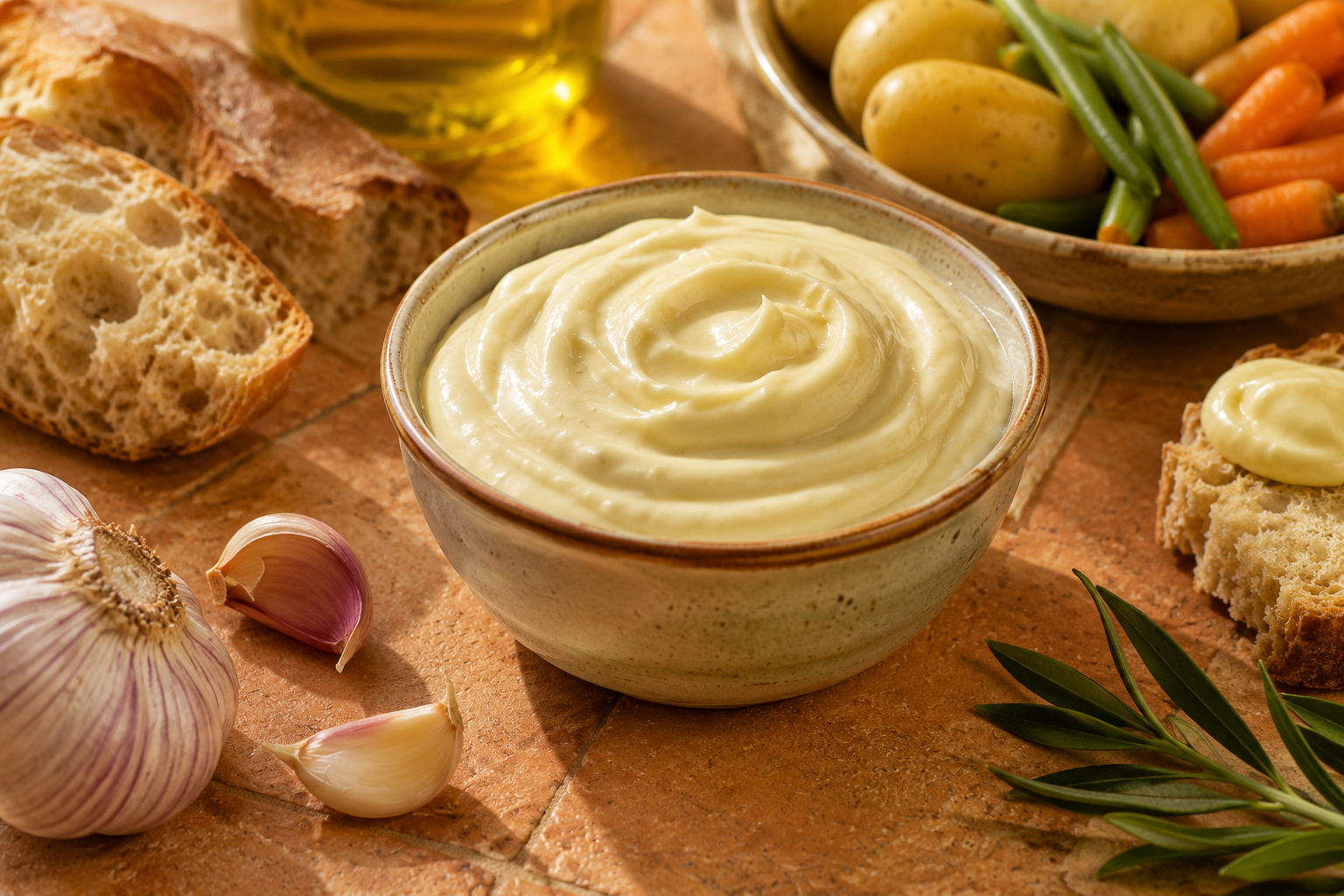
The third and most magnificent of the trio is aïoli, a thick, golden, powerfully garlicky emulsion of garlic and olive oil that is essentially a garlic mayonnaise, though calling it that undersells it. The name says exactly what it is, since it comes from the Provençal words for garlic and oil, and at its purest that is all it contains, pounded and emulsified into a shimmering, pungent cream that is one of the glories of southern French cooking.
Traditional aïoli is a test of patience and technique. In its oldest form it is nothing but garlic crushed to a paste and then emulsified drop by drop with olive oil, worked in a mortar until it thickens into a stiff, glossy sauce, though most modern cooks stabilize it with an egg yolk, which makes it far easier and closer to a garlic mayonnaise. The essential act is the slow emulsification, adding the oil in a thin trickle while working constantly so it binds rather than splits, exactly as with mayonnaise. This is the step that intimidates people, and it need not. The single rule that prevents disaster is to go slowly at the start, adding the oil almost drop by drop until the emulsion has clearly formed, and only then speeding up to a thin stream. Rush the beginning and the sauce will split into an oily mess, but respect that slow start and even a first-timer can produce a thick, glossy aïoli that looks far harder to make than it was.
Its grand role is the centerpiece of a feast. The grand aïoli is a celebrated Provençal dish in which a big bowl of the sauce anchors a spread of poached salt cod, boiled vegetables, hard-boiled eggs and sometimes snails, a communal summer feast built entirely around dipping simple things into garlic. Beyond that showpiece, aïoli is superb with any grilled or poached fish, dolloped into fish soup, spread on bread, or served as a dip for raw and cooked vegetables. It is the ultimate fixer of a plain table, capable of turning a plate of boiled potatoes into something people fight over.
Aïoli makes about one bowl
Ingredients:
- 4 cloves garlic, peeled
- 1 egg yolk
- 250ml mild extra virgin olive oil
- a squeeze of lemon juice
- salt
Method:
- Pound the garlic with a pinch of salt in a mortar until it becomes a completely smooth paste.
- Work in the egg yolk until smooth and combined.
- Begin adding the olive oil a few drops at a time, working constantly, until the mixture starts to thicken and emulsify.
- Once it has taken, pour the remaining oil in a thin steady trickle, still working constantly, until you have a thick, glossy sauce.
- Season with salt and a little lemon juice. If it splits, start again with a fresh yolk and beat the broken sauce into it slowly.
- Serve with vegetables, fish, eggs or bread.
How to Build a Table Around Them
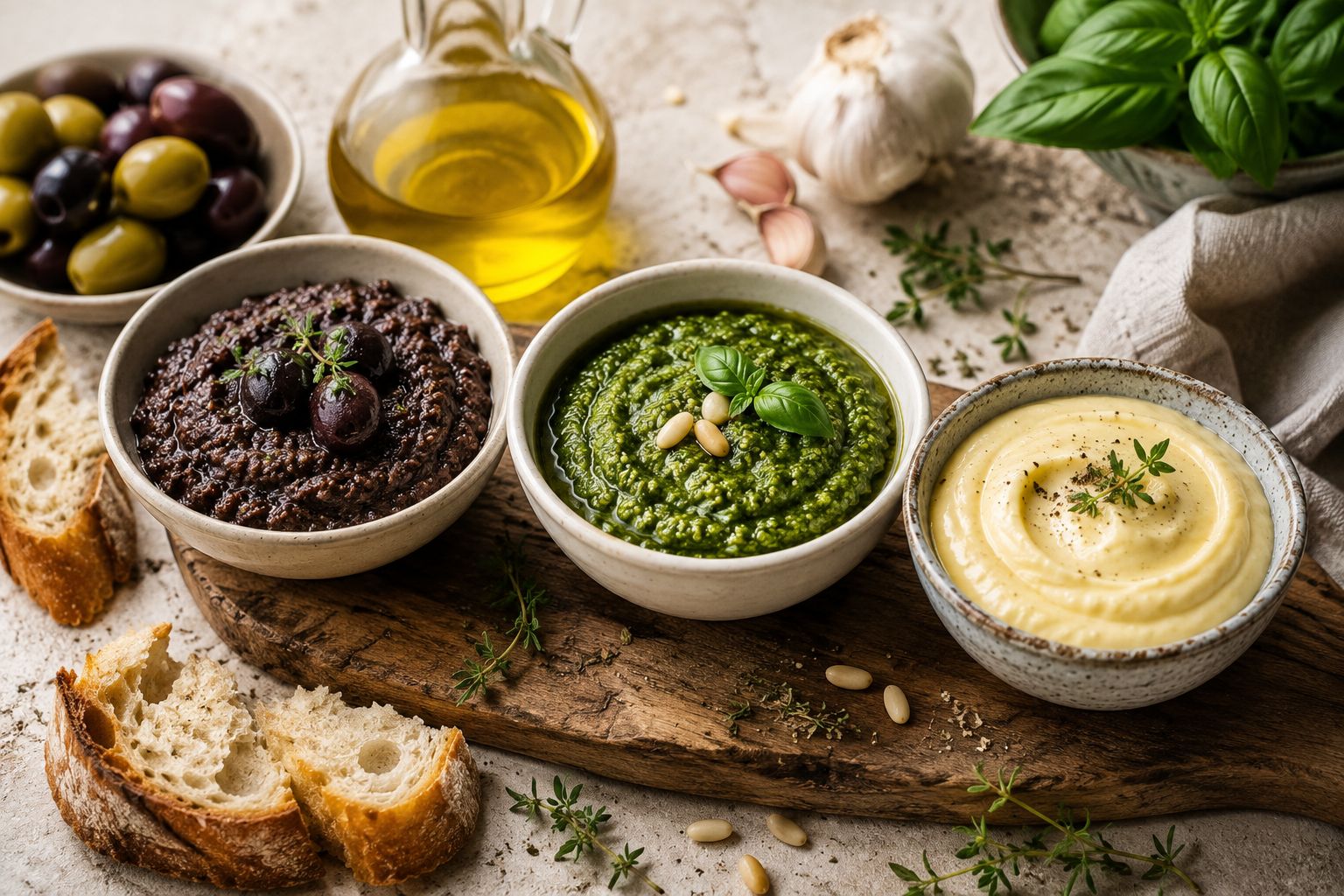
The real magic of these three sauces is what they let you do with almost no cooking, and this is where they earn their place in a summer kitchen. With tapenade, pistou and aïoli in the fridge, a trip to the market for vegetables, bread, eggs and a piece of fish becomes the basis of a whole meal, since the sauces do the work of transforming plain ingredients into something worth sitting down to.
Picture the table they build. A basket of toasted baguette and a bowl of tapenade to start, a platter of boiled and raw vegetables with eggs and fish around a great bowl of aïoli for the centerpiece, and a pot of summer vegetable soup finished with pistou, or simply pistou tossed through pasta alongside. None of it requires real cooking beyond boiling and grilling, and yet together it is a feast, colorful and generous and full of sunshine.
This is the deep lesson of the Provençal table, that you do not need elaborate technique or expensive ingredients to eat wonderfully in summer, only a few good raw materials and the sauces that bring them to life. Olives become tapenade, basil becomes pistou, garlic becomes aïoli, and a plain table becomes a Provençal one. Learn these three, keep them on hand through the warm months, and you will never again look at a pile of simple summer ingredients and wonder what to do with them. The answer, as Provence has always known, is sauce. Keep a jar of each in the door of the fridge through July and August and you will find yourself eating better with less effort than at any other time of year. A market haul of vegetables, a good loaf, a few eggs and whatever fish looked fresh become, with a spoonful of the right sauce, a table worth lingering at. That is the quiet genius of Provençal summer cooking, and these three sauces are the whole of the trick.

About the Author: Ruben, co-founder of Gamintraveler.com since 2014, is a seasoned traveler from Spain who has explored over 100 countries since 2009. Known for his extensive travel adventures across South America, Europe, the US, Australia, New Zealand, Asia, and Africa, Ruben combines his passion for adventurous yet sustainable living with his love for cycling, highlighted by his remarkable 5-month bicycle journey from Spain to Norway. He currently resides in Spain, where he continues sharing his travel experiences with his partner, Rachel, and their son, Han.