
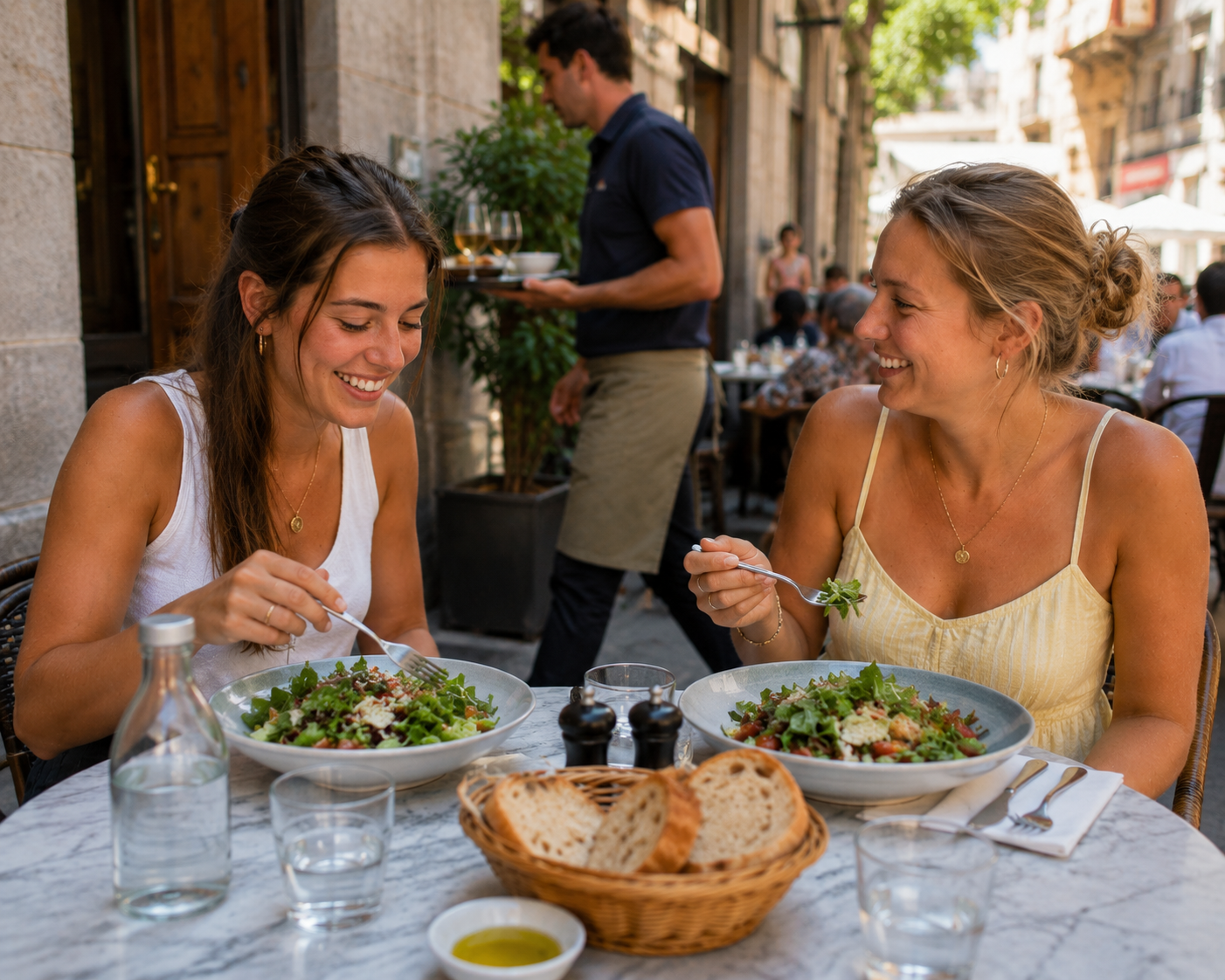
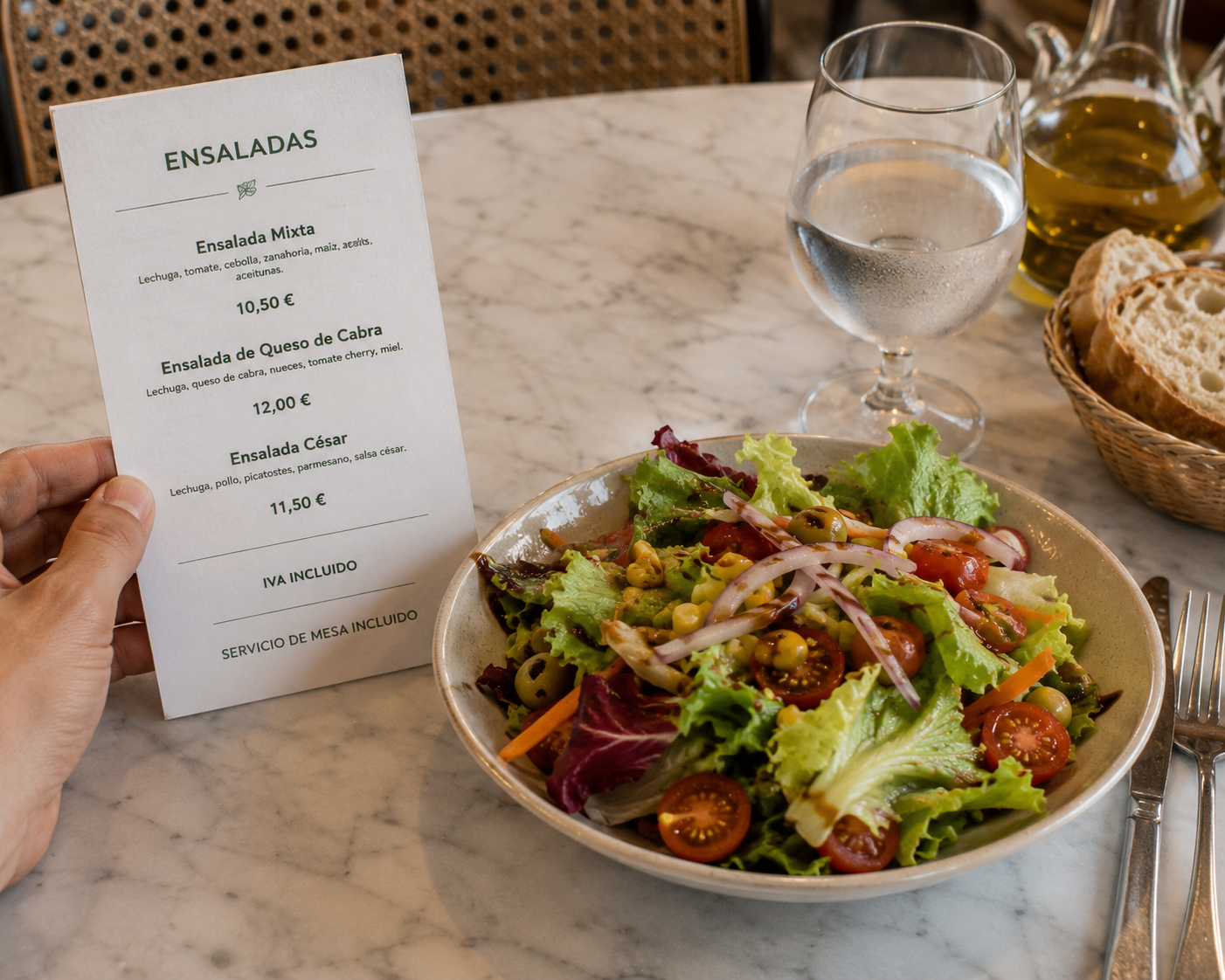
An American sits down at a restaurant in Madrid, sees a salad on the menu for twelve euros, and braces for the familiar ritual. The number on the menu, they have learned over a lifetime, is a polite fiction, a starting figure to which tax will be added and onto which a tip of twenty percent or more must be stacked before the true cost is known. So they do the math in their head and assume the twelve-euro salad will cost them closer to sixteen. Then the bill comes, and it says twelve euros, and nothing else. The menu was telling the truth the whole time. It is a small revelation, and it repeats itself every time the bill arrives. The reflexes of a lifetime keep bracing for the addition, and the addition keeps not coming, until eventually the newcomer relaxes into a truth that seems almost too simple to trust, which is that in Europe the price of a thing is the price of the thing.
This is one of the quiet culture shocks of eating in Europe, and it runs deeper than it first appears. In most of Europe the price printed on the menu is the price you pay, full stop, with the tax already inside it and no obligatory tip waiting to ambush you at the end. The number is not a base figure to be built upon but the actual, final, total cost of the thing, and learning to trust it takes an American surprisingly long.
Here is how European menu pricing really works, why the printed number is the real number, how tax and tipping differ so sharply from the American model, and how to translate prices between the two systems. This is general information for travelers and new arrivals rather than tax or financial advice, and details vary by country, but the underlying principle holds across the continent.
The Price Is the Price

Start with the core fact, because it is the one that takes adjusting to. In most European countries, the price displayed on a menu, a shelf or a tag is legally required to be the full price the consumer pays the consumer pays, with all taxes included. What you see is what you owe. There is no separate line added at the register, no percentage tacked on at the end, no gap between the advertised number and the total.
This flows from consumer protection rules rather than mere custom. EU consumer rules require that prices shown to consumers be inclusive of tax, so that the figure on display is the one that will be charged, and this principle covers restaurants, shops and services alike. The law treats a hidden addition to an advertised price as a form of deception, and so the advertised price simply has to be the real one.
The effect on daily life is a kind of calm that Americans do not realize they lack. A price tag in a European supermarket is the price at the till. A coffee chalked on a board at three euros costs three euros. A menu that lists a dish at fourteen means fourteen, and you could pay with a fourteen-euro note if such a thing existed and walk out square. The number never lies, and after a while you stop bracing for the trick that never comes. That bracing is so deeply trained into Americans that dropping it takes real time. For weeks a newcomer will still mentally add a phantom twenty or thirty percent to every menu price out of pure reflex, quietly over-budgeting for meals that come in exactly as advertised. Only slowly does the truth sink in that the defensive math is no longer needed, and the price on the page can simply be read and believed. There is a broader lesson buried in this small adjustment. So much of the friction of American consumer life comes not from high prices but from opaque ones, from the constant low-grade suspicion that the advertised number is a lure and the real number is hidden. A system that prints the true price removes that suspicion entirely, and the calm it leaves behind is worth more than the euros saved.
The Tax Is Already Inside
The mechanism behind this is a tax that works very differently from the American one. Europe funds a large share of public spending through value-added tax, or VAT, a consumption tax applied at each stage of production and folded into the final consumer price rather than added visibly at the point of sale. By the time a dish reaches a menu, its VAT is already baked into the number.
This is the opposite of the American sales tax model, and the difference is more than cosmetic. In the United States, sales tax is added at the register and varies by state, county and city, and is deliberately kept separate from the shelf price, so that the advertised number is almost never the number you pay. An American is trained from childhood to treat the price tag as incomplete, a figure awaiting an addition that changes from place to place.
The European approach makes the opposite choice, hiding the tax inside the price rather than displaying it alongside. Whether that is more transparent or less is a matter of real debate, since the American system shows you exactly what the government is taking while the European system spares you the mental arithmetic. But for the diner and the shopper, the practical result is unambiguous, because in Europe the sticker is the total and in America it is only the beginning. It is worth noting that VAT rates in Europe are often high, higher than most American sales taxes, and frequently sit around twenty percent or more on many goods. The point is not that the tax is small but that it is invisible at the point of sale, absorbed into a single honest number rather than revealed as an addition. Europeans pay plenty of tax on their meals. They simply never have to calculate it at the table.
The Tip That Isn’t Required
The second half of the American price ritual is the tip, and here the gap is even wider. In the United States, tipping is not really optional at all but a core part of how restaurant workers are paid, with a customary rate that has climbed to twenty percent or more, expected as a matter of course and resented when withheld. The menu price is only the foundation on which this substantial and semi-obligatory addition is built.
Europe runs on a completely different arrangement. Restaurant staff in most of Europe are paid a proper wage that does not depend on tips to reach a livable level, which removes the entire economic function that makes American tipping compulsory. Because the workers are already paid, the tip reverts to what its name suggests, a small optional token of appreciation for good service rather than a mandatory surcharge that keeps the staff solvent.
What this looks like in practice is modest and relaxed. In most of Europe a tip is appreciated but never demanded, and the norm is to round up the bill or leave a small amount, perhaps five to ten percent for truly good service in a nice restaurant, and often nothing at all for a casual coffee or a quick lunch. Sometimes a service charge is already included and printed on the bill, in which case no further tip is expected. Nobody chases you to the door, and no algorithm on a screen suggests you are a bad person for declining. This changes the entire emotional texture of paying a bill. In America the arrival of the check begins a small performance of calculation and judgment, the mental percentage, the guilt, the awareness of being assessed, whereas in Europe the bill is simply the agreed price, paid and done. The relief of that difference is hard to appreciate until you have lived on both sides of it.
Translating the Nineteen-Dollar Salad

Put these pieces together and you can finally translate prices honestly between the two systems, which most travelers never learn to do. The naive comparison looks at a twelve-euro salad in Madrid and a nineteen-dollar salad in New York, converts the currency, and concludes the prices are roughly comparable. That comparison is badly wrong, because it compares a final price with a starting one.
Do the real arithmetic and the gap widens dramatically. The nineteen-dollar American salad is not nineteen dollars. Add sales tax of, say, eight percent, and a tip of twenty percent, and the actual cost lands near twenty-four or twenty-five dollars. The twelve-euro Madrid salad, meanwhile, is twelve euros, tax in and tip optional, and if you leave nothing extra it stays exactly twelve. The true prices are not close at all.
This is the translation every American should learn before comparing costs across the Atlantic. A European menu price is a final, all-in number, while an American menu price is a pre-tax, pre-tip subtotal that will grow by roughly a quarter to a third before you escape. To compare them fairly you must inflate the American figure by around twenty-five to thirty percent and leave the European one untouched, and only then are you comparing like with like. This is why Americans so often report that Europe feels cheaper to eat in than the exchange rate alone would suggest, even in expensive cities. They are unconsciously comparing a European final price against an American subtotal, and the hidden American additions quietly close or reverse a gap that looked wide on paper.
Why Europe Prices This Way
The reasons behind the European system are worth understanding, because they are deliberate rather than accidental. The tax-inclusive rule exists to protect consumers, on the principle that people have a right to know the true cost of something before they decide to buy it, and that an advertised price which is not the real price is inherently misleading. Transparency, in this view, means showing the final number, not a hopeful fraction of it.
The tipping difference flows from a broader philosophy about wages. The European model places the responsibility for paying workers on the employer rather than the customer, treating a living wage as the employer’s obligation rather than a burden shifted onto the diner’s goodwill. Tipping culture, in the European view, outsources the payment of staff to chance and social pressure, which the wage system is designed to avoid.
Together these produce a restaurant experience with less anxiety folded into it, and that is not a small thing. The absence of surprise additions and the removal of the tipping calculation take a low, constant background stress out of eating out, the running mental math and mild social dread that Americans carry without noticing. In Europe the price is agreed before you eat and settled without drama after, and the meal is the point rather than the arithmetic.
The Screen That Asks for Twenty Percent
Nowhere is the contrast sharper than in what has happened to American tipping in recent years, a phenomenon a European visitor finds genuinely bewildering. The payment tablet swiveled around at the counter, presenting a menu of tip options that now routinely start at twenty percent and climb from there, has spread to coffee shops, takeaway counters and even self-service kiosks where no table service occurred at all. The prompt arrives before the coffee, watched by the person who will make it.
This is often called tip creep, and it has pushed the expected rate steadily upward while expanding the situations in which a tip is solicited. What was once a reward for table service has become a near-automatic surcharge on almost any transaction, applied to the pre-tax total, and declining it in front of a waiting employee carries a small sting of social guilt that the whole interface is designed to produce.
To a European this looks like a system quietly transferring the cost of paying staff onto customers through social pressure, one screen at a time. The European sitting at that counter, accustomed to a printed price that is simply paid, experiences the swiveling tablet as a strange and slightly coercive ritual, a request for extra money for a service that in their own country is already covered by the price and the wage behind it.
The gap is widening rather than closing, which makes the translation more important than ever. As American tipping expectations creep upward and spread into more corners of daily commerce, the real cost of an American meal drifts further above its menu price, while the European number stays exactly where it is printed. The twelve-euro salad holds its ground while the nineteen-dollar one keeps quietly growing.
What Americans Should Do
For a traveler or a new arrival, adjusting to all this is mostly a matter of unlearning old reflexes. The first lesson is simply to believe the menu, since the number really is the number and the instinct to pad it in your head is a habit you can safely drop. Budget for the price you see, not an inflated version of it, and enjoy the small pleasure of a bill that matches the menu.
On tipping, the safe approach is to follow the local norm rather than importing American habits, which can even cause confusion or discomfort. Rounding up or leaving a small amount for good service is gracious and appreciated, while tipping twenty percent everywhere marks you instantly as an American and is unnecessary. Check the bill for an included service charge, leave a little if you were well looked after, and feel no guilt about leaving nothing for a coffee.
The deeper adjustment is psychological, and it is a pleasant one. Eating out in Europe asks you to trust the printed price and to let go of the defensive arithmetic that American dining trains into everyone, and once you do, a small daily friction simply disappears. The twelve-euro salad costs twelve euros. The bill holds no surprises. After a lifetime of menus that lied by design, there is something quietly liberating about a number that finally tells the truth, and it is one of the many small ways that ordinary life in Europe runs a little calmer than it does back home.

About the Author: Ruben, co-founder of Gamintraveler.com since 2014, is a seasoned traveler from Spain who has explored over 100 countries since 2009. Known for his extensive travel adventures across South America, Europe, the US, Australia, New Zealand, Asia, and Africa, Ruben combines his passion for adventurous yet sustainable living with his love for cycling, highlighted by his remarkable 5-month bicycle journey from Spain to Norway. He currently resides in Spain, where he continues sharing his travel experiences with his partner, Rachel, and their son, Han.