
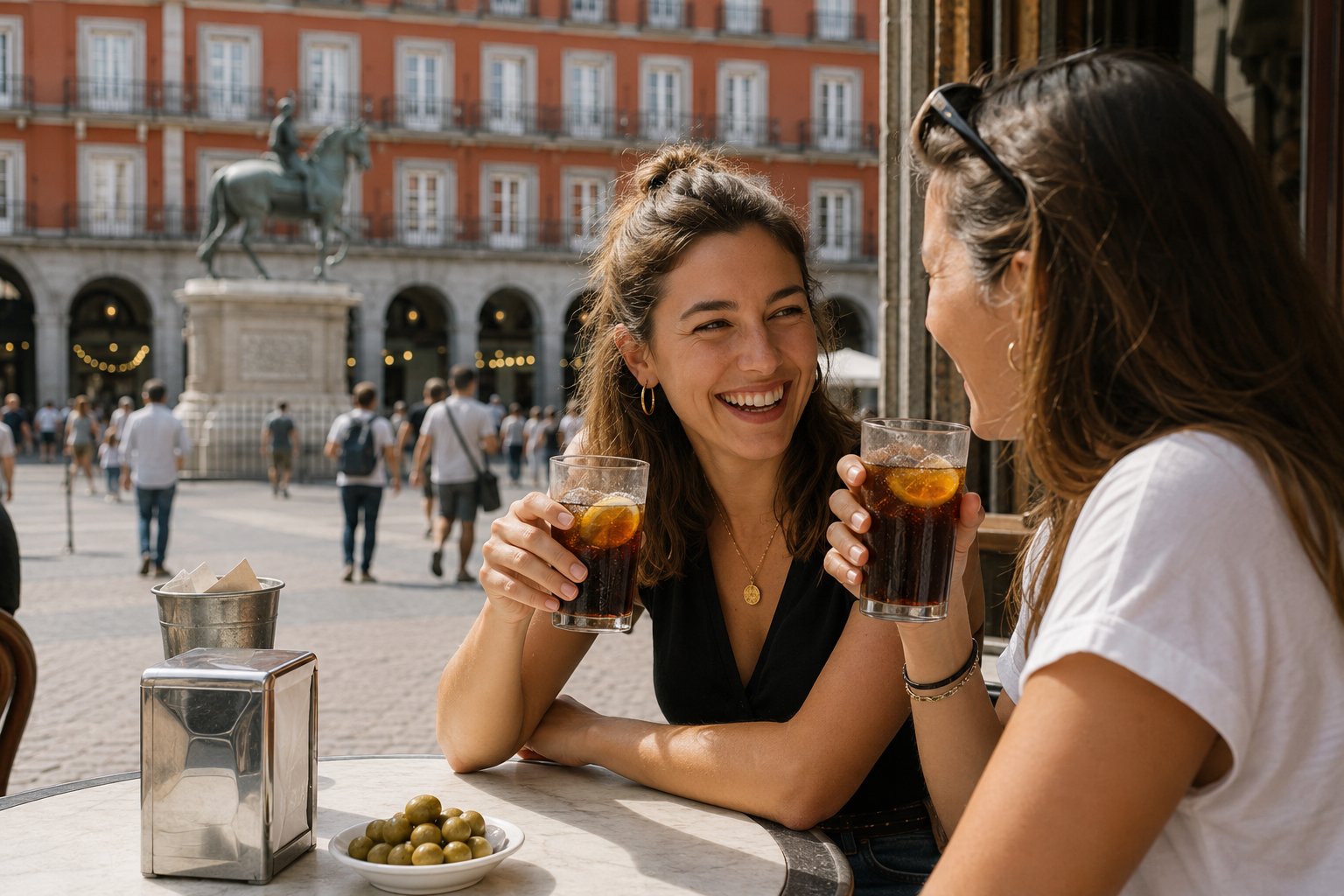
Order a Coca-Cola at a bar in Madrid, poured cold from a glass bottle over ice with a slice of lemon, and something is different. Americans notice it within about two sips and usually reach for the same explanation, which is that European Coke uses real sugar because high-fructose corn syrup is banned over here. The first half of that sentence is true. The second half is not, and the real reason is a far better story involving sugar beets, a production quota and forty years of American farm policy.
High-fructose corn syrup has never been banned in the European Union. It is legal, it is manufactured in Europe, and it appears in European food under a name most visitors would not recognize. What happened instead is that Brussels spent decades capping how much of it could be produced in order to protect European sugar farmers, and by the time that cap came off, the entire continent’s supply chains, factories and habits were built around sugar and never moved.
Here is why HFCS barely exists in European sodas, what is really in the Coke you drink in Madrid, and how much of the taste difference is the sweetener rather than everything else about the way it reaches you. This is general information rather than nutritional advice, and the health comparison at the end may not be the one you are expecting.
It Was Never Banned

Start by killing the myth, because it is the most widely believed thing in this entire subject. There is no European ban on high-fructose corn syrup. It exists in the EU under the name isoglucose, defined in European legislation as a glucose-fructose syrup containing more than 10% fructose, and it is also sold and labeled as glucose-fructose syrup. It is legal, it is produced commercially, and European companies hold the plants that make it.
There is even a naming quirk worth knowing. The American product is made from maize, which is why it is called high-fructose corn syrup, while European glucose-fructose syrups are typically made from wheat or maize starch depending on the region. The molecule does not care which crop it came from. It is the same process, an enzymatic conversion of glucose into fructose, running in European factories under a European name. Europeans encounter it constantly without noticing, because glucose-fructose syrup turns up across European confectionery, sauces, baked goods and processed foods where it does jobs beyond sweetening, stopping sweets crystallising and keeping them from sticking to their wrappers. The continent that supposedly banished corn syrup has it in the cupboard under a different label. What it does not have is corn syrup in its cola.
So the answer to why Spanish Coke uses sugar is not that a regulator forbade the alternative. Nothing forbade it. The reason is economic, and it was engineered deliberately over decades by an agricultural policy that had nothing to do with health and everything to do with protecting the people who grow sugar beet across northern Europe. That distinction matters more than it might seem. A ban implies a judgment about safety, and European regulators never made one, because the question in front of them was never whether isoglucose was dangerous, but whether French, German and Polish beet farmers could survive a cheaper competitor, and the answer Brussels gave had nothing to do with anybody’s liver.
The Quota That Did the Work

Here is the mechanism nobody puts in the headline. Under the old EU sugar regime, the production of isoglucose was capped by quota at roughly 5% of total EU sugar production. Not taxed, not discouraged, not labeled with a warning. Simply capped, as a matter of agricultural policy, to keep the European beet sugar industry from being undercut by a cheaper industrial sweetener.
That cap was decisive because of a technical detail. Soft drinks need a sweetener with a fructose content of at least about 42% to hit the sweetness profile the drink is designed around, and the American standard for sodas is HFCS 55, which is 55% fructose and 42% glucose. Under the quota, European glucose-fructose syrup at those fructose levels was simply not available in sufficient quantity to sweeten a continent’s worth of soda, so the beverage industry used what was abundant and reliable, which was sucrose.
The numbers show how completely it worked. Europe ended up with one of the lowest penetration rates of high-fructose syrup anywhere, at under about 3% of combined sugar and HFS consumption, while in the United States, where no production limits exist, HFCS grew to something like 40 to 50% of total sugars consumption, with soft drinks as its single biggest application. Two continents, the same technology, opposite outcomes, decided by a quota. It is one of the cleaner natural experiments in food policy. Nothing about European chemistry, taste buds or public health knowledge differed from the American version. The only variable that mattered was a number in an agricultural regulation, and that number determined what a continent of half a billion people would taste in their soft drinks for the next thirty years.
The Quota Ended and Nothing Changed
The strangest part of the story is what happened when the cap came off. The EU sugar regime ended in October 2017, abolishing production quotas on both sucrose and isoglucose, and analysts widely expected European isoglucose production to expand sharply into the space the quota had been holding shut. Europe was finally free to sweeten its sodas the American way.
It largely did not happen. Sucrose remained the dominant sweetener in European soft drinks after 2017 and remains so today, because the quota had done something more durable than restrict supply. It had built an entire ecosystem, with beet processing infrastructure, established supply relationships, factory formulations, consumer expectations and label conventions all settled around sugar over several decades. Thirty years of policy had made sugar the default, and defaults are heavy things to move. The economics had shifted too. The reforms that ended the quota also pushed European sugar prices down, which narrowed the cost advantage that made isoglucose attractive in the first place, so the great post-2017 switch that analysts predicted arrived at a moment when the prize had shrunk. A cheaper sweetener is only worth a reformulation if it is meaningfully cheaper.
There was also the matter of what European consumers had come to want. By 2017 the European market had, if anything, turned against industrial-sounding sweeteners rather than toward them, and a manufacturer proposing to reformulate a beloved product away from sugar and toward glucose-fructose syrup would have been picking a fight for no obvious gain. The quota created a preference, and then the preference outlived the quota. There is a lesson buried in that for anyone who thinks markets sort these things out quickly. A rule that lasted decades did not merely suppress a product, it rearranged the industry around its absence, and when the rule vanished the arrangement stayed exactly where it was. Policy shapes taste, and then taste enforces the policy long after the policy is gone.
Why America Went the Other Way

The mirror image is just as artificial, and Americans rarely realize it. The United States did not choose corn syrup because it tastes better or because the market naturally selected it. It chose corn syrup because two separate arms of American farm policy made sugar expensive and corn cheap, and the beverage industry did the obvious arithmetic.
On one side sit tariff-rate quotas on imported sugar, a long-standing protection that keeps American sugar prices well above world levels. On the other sit subsidies supporting American corn, produced in vast quantity in the Midwest. Between them the price signal is unmistakable, and Coca-Cola switched its flagship American formula to high-fructose corn syrup in the 1980s for reasons that appear on a spreadsheet rather than a taste panel.
So the transatlantic difference in your glass is not a story about European wisdom versus American recklessness, but two protectionist agricultural policies pointing in opposite directions. Europe protected its beet farmers and got sugar in its soda. America protected its sugar growers with tariffs while subsidizing its corn growers, and the perverse result was that protecting sugar made sugar too expensive to use, and the corn syrup walked in through the gap. Neither policy was designed with the drinker in mind, which is worth sitting with. The composition of the most popular beverage on earth, in two of its largest markets, was determined almost entirely by farm lobbies protecting different crops, and the taste that Americans now cross an ocean to rediscover is a byproduct of a European beet subsidy. Nobody chose any of this for flavor.
What Is in the Madrid Glass
So the Coke you order in a Madrid bar is sweetened with sucrose, ordinary sugar, most likely from European beet, and that is a genuine difference from the American flagship formula. Sucrose is glucose and fructose bonded together in a one-to-one ratio, meaning 50% fructose. HFCS 55 is 55% fructose and 42% glucose, unbonded and floating free.
The compositional gap is therefore small. Five percentage points of fructose and a chemical bond separate the two sweeteners, which is a real difference and a much smaller one than the discourse implies. Whether that alone produces a perceptible taste change is genuinely contested, and blind testing on the question has been mixed rather than decisive. Some tasters describe sugar-sweetened cola as cleaner and crisper with less syrupy body. Others cannot reliably pick it out at all.
And a great deal else about that Madrid Coke is different in ways that have nothing to do with sweetener. It probably came from a glass bottle rather than a can or plastic, which changes perceived taste, since glass is inert while cans carry a polymer lining and plastic breathes slightly and lets carbonation drift. It was probably colder, poured over more ice, served with lemon, and consumed in a bar rather than from a warm cup in a car. The water is different, the carbonation may be handled differently, and the bottle likely turned over faster in a busy bar than a supermarket twelve-pack does at home. Attributing all of that to fructose percentages is a stretch. This is why the Madrid Coke experience is so hard to reproduce at home even with the right bottle. Buy an imported glass-bottle sugar Coke in an American kitchen and much of the magic goes missing, because the sweetener was only ever one variable among the temperature, the glass, the ice, the lemon, the bar and the fact that you were on holiday. Memory is a powerful flavoring.
The Health Answer Nobody Wants

Here is where the story disappoints almost everyone, and it needs saying plainly. The evidence does not support the idea that high-fructose corn syrup is meaningfully worse for you than sugar. The two are compositionally near-identical, roughly half fructose and half glucose in both cases, and the body absorbs and metabolizes them in substantially the same way.
The professional consensus has been consistent on this. The American Medical Association has concluded that HFCS is no more likely to contribute to obesity than table sugar or other full-calorie sweeteners, dietetic bodies have described HFCS as nutritionally equivalent to sucrose, and a Tufts nutrition scientist put it bluntly in 2025, saying both are about 50% fructose and 50% glucose with identical metabolic effects. A systematic review comparing the two found no significant differences in weight, body mass index, waist circumference, cholesterol, triglycerides or blood pressure, with one inflammatory marker as a possible exception.
Which points at the real answer. The problem with sweetened soda is the sugar itself and how much of it people drink, not which industrial process produced the sugar, and swapping one for the other changes the ingredient list rather than the health outcome. A cane-sugar Coke can raise the same risks as a corn-syrup Coke, because the meaningful variable is quantity. The Madrid Coke is not health food. It is a Coke, and the Spaniards drinking it have no illusions on that point. It is worth being clear about why this matters rather than merely being pedantic. If you believe corn syrup is the villain, then swapping it out feels like solving the problem, and you can drink the same volume of sugar with a clear conscience. That belief is comfortable and wrong, and it is precisely the kind of thing that lets an industry reformulate a label while changing nothing that counts.
The American Coke Came Around Anyway

The story has a recent twist that makes the whole thing sharper. In July 2025, after a public push from President Trump and sustained campaigning against corn syrup by Health Secretary Robert F. Kennedy Jr., Coca-Cola announced it would launch a US cane-sugar version of its flagship cola, which began appearing in select cities that October and expanded in glass bottles by December.
The detail everyone missed is that the flagship did not change. Coca-Cola’s chief executive described it explicitly as an and strategy rather than an or strategy, saying the company would continue using a great deal of the corn syrup it already uses, and the cane-sugar version was framed as an addition to the range rather than a replacement. American Coke is still overwhelmingly sweetened with high-fructose corn syrup, and the corn industry pushed back hard against even the partial move. The Corn Refiners Association warned that a shift toward cane sugar would cost American food manufacturing jobs, depress farm income and widen the trade deficit, which is a revealing objection. The argument over what sweetens Coke has never really been a health debate at all. It is a fight between two agricultural constituencies, conducted in the language of wellness.
Which means Americans can now buy, at some expense and in select places, a version of what a Spaniard gets by default for about two euros at any bar. The sweetener that Americans travel to Madrid to taste is not a European regulatory achievement or a health decision. It is the accidental legacy of a beet subsidy, a production quota that expired nearly a decade ago, and a continent that simply never got around to changing what was already working. The Coke tastes different in Madrid, and it is worth ordering one. Just not for any of the reasons you were told.

About the Author: Ruben, co-founder of Gamintraveler.com since 2014, is a seasoned traveler from Spain who has explored over 100 countries since 2009. Known for his extensive travel adventures across South America, Europe, the US, Australia, New Zealand, Asia, and Africa, Ruben combines his passion for adventurous yet sustainable living with his love for cycling, highlighted by his remarkable 5-month bicycle journey from Spain to Norway. He currently resides in Spain, where he continues sharing his travel experiences with his partner, Rachel, and their son, Han.