
There is a tin in every Spanish supermarket, stacked by the dozen near the olives, that costs about two euros and delivers more pleasure than most appetizers on an American restaurant menu. Inside are a handful of plump mussels bathed in an orange-tinted marinade of olive oil, vinegar and paprika, ready to be tipped onto a plate and eaten with bread and a cold drink. It is called mejillones en escabeche, and once you understand it, the eighteen-dollar seafood starter starts to look like a swindle.
This is not a sad pantry compromise or a poor substitute for something fresh. In Spain, high-quality tinned seafood, known as conservas, is a genuine delicacy, treated with a seriousness that baffles visitors who grew up thinking canned meant cheap. The best conservas are prized, gifted, collected and served in proper bars, and mejillones en escabeche is one of the great everyday examples, a two-euro tin that eats like a restaurant dish.
Here is what mejillones en escabeche really is, where the technique comes from, why the humble tin so thoroughly outclasses the pricey appetizer, and how to make your own at home. This is a beloved staple of Spanish life, part food and part small daily luxury, and it deserves to be understood rather than dismissed as mere canned fish.
What Is in the Tin
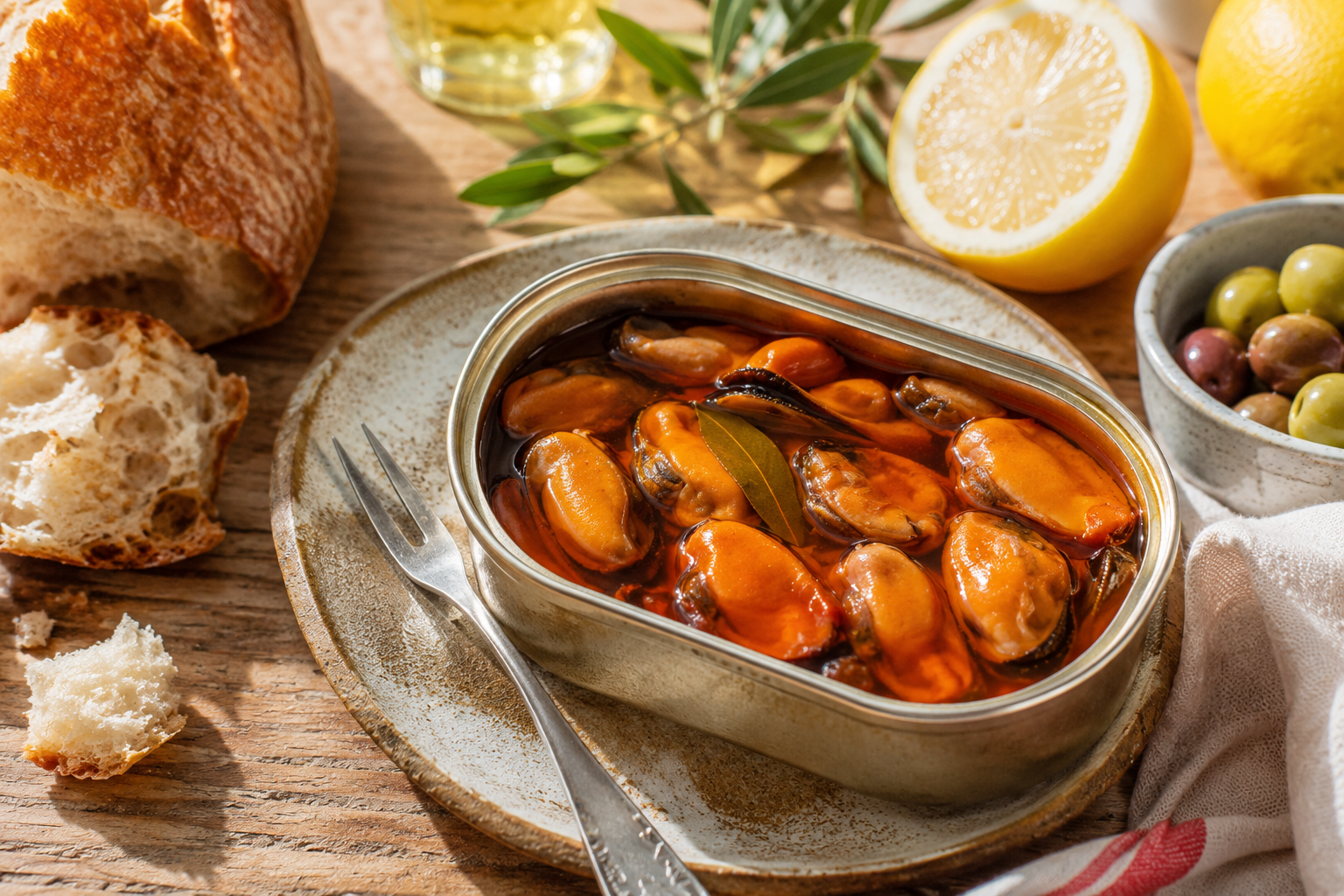
Strip it down and the dish is simplicity itself. Mejillones en escabeche is mussels that have been cooked, shelled and then preserved in escabeche, a marinade built from olive oil, vinegar and aromatics, most importantly the smoky Spanish paprika called pimentón that gives the sauce its characteristic warm orange color. Garlic, bay leaf and peppercorns round it out, and sometimes onion or a little carrot.
The result is a small marvel of balance. The mussels are tender and briny and sweet, the marinade is tangy from the vinegar and rich from the oil, with the paprika lending a gentle smoky warmth, and the whole thing lands somewhere between sweet, sour and savory in a way that makes you reach immediately for the next one. It is bright and bold without being heavy, which is exactly what you want from something eaten before a meal.
The mussels themselves are the reason the good tins are worth seeking out. Spain, and Galicia in particular, produces some of the finest mussels in the world, grown on ropes in the cold Atlantic rías and prized for their size and flavor, and the best conservas are made from exactly these. A tin of good Galician mejillones is not scraps sealed in a can but excellent shellfish preserved at its peak, which is the whole secret of why they taste so good. The rope-growing method matters to the flavor in a way worth knowing. Galician mussels are farmed on hanging lines in the nutrient-rich estuaries where river meets sea, which lets them grow plump and clean and full of flavor, and Spain produces a staggering quantity of them this way. When a cannery starts with shellfish this good, the tin has a head start that no amount of restaurant plating can match.
The Ancient Art of Escabeche
The technique behind the tin is far older than the tin, and it carries real history. Escabeche is one of the oldest preservation methods in Spanish cooking, a way of keeping food edible long before refrigeration existed, and it works on a simple principle of chemistry. You cook the food, then submerge it in a mixture of oil, vinegar and spices, and the acid of the vinegar and the fat of the oil create an environment hostile to bacteria that would otherwise spoil it.
The name itself tells the story of Spain. The word escabeche derives from the Arabic sikbaj, a reminder of the centuries of Arab influence on the Iberian kitchen, and the method traveled and rooted itself deep in Spanish gastronomy. Before refrigerators, escabeche was a fundamental way of preserving fish, game and poultry, letting a catch or a kill last for weeks rather than spoiling in days, which in a hot country was no small thing.
That heritage is why escabeche tastes the way it does. The dish is not merely flavored, it is cured by its own marinade, and the deep, developed, sweet-and-sour character comes from food and acid and oil sitting together and marrying over time. When you eat mejillones en escabeche you are tasting a technique that predates modern kitchens by centuries, one that turned the problem of preservation into one of the most delicious traditions in Spanish food. Escabeche is not limited to mussels, either, which hints at how central the technique is. The same method preserves sardines, tuna, partridge, chicken and rabbit across the Spanish regions, and Castilla-La Mancha in particular is famous for its escabeches, so the mussel version sits within a whole family of dishes built on the same clever chemistry. Learning to love mejillones en escabeche is a doorway into an entire Spanish tradition.
Why the Tin Beats the Restaurant
Now to the heart of the matter, which is how a two-euro tin outclasses an eighteen-dollar appetizer. The first reason is the quality of what goes in. A good Spanish cannery packs its tins with excellent mussels at their peak and preserves them properly, so the raw material in that cheap tin is often better than the frozen or mediocre shellfish sitting behind many a restaurant menu’s markup.
The second reason is that the escabeche only improves with time. A restaurant appetizer is assembled to order and eaten immediately, but a tin of mejillones has been marinating in its escabeche for weeks or months, the flavors deepening and marrying the entire time, so you are eating a dish at the peak of its development rather than one thrown together minutes ago. Time is an ingredient here, and the tin has had plenty of it.
The third reason is the sheer economics of the thing. The eighteen dollars on a restaurant bill pays for rent, staff, plating and margin as much as for the food, while the two-euro tin pays for the mussels and the marinade and almost nothing else. You are cutting out the entire apparatus of the restaurant and buying the delicious part directly, which is why the value is so lopsided. The tin is not a cheaper version of the appetizer. It is often a better one, sold honestly at what the food is truly worth.
How Spain Eats Them
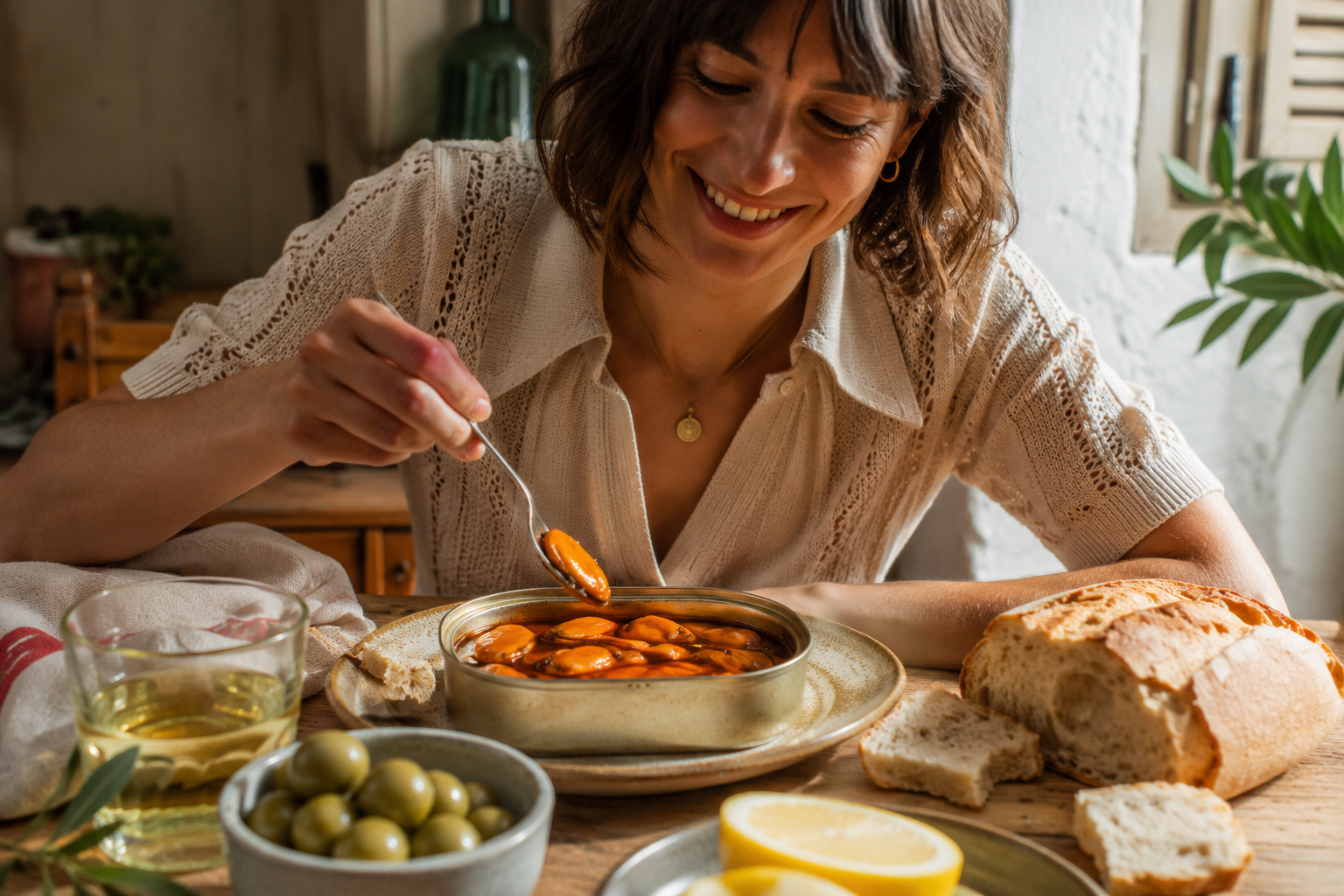
Understanding how the Spanish serve these is half the pleasure, because the ritual is as good as the food. The classic way could not be simpler. You open the tin, tip the mussels and their marinade onto a small plate, and eat them with good bread and a cold drink, using the bread to mop up every drop of the escabeche, which many people consider the best part.
The traditional accompaniment is almost comically humble and completely right. Across Spain these are eaten with patatas fritas, plain potato chips, the crisp saltiness playing perfectly against the tangy mussels, and it is entirely normal to scoop a mussel and a bit of marinade onto a chip and eat them together. A cold beer, a vermut, or a glass of white wine completes the picture. This is bar food and home food at once, unpretentious and beloved.
The setting is the aperitivo, the sacred Spanish pause before a meal. Tinned seafood like this is a cornerstone of the pre-lunch or pre-dinner ritual, laid out with olives and chips and drinks while people talk and pick and unwind, and mejillones en escabeche is one of its stars. It is not a dish you labor over but one you simply open and share, which is precisely why it fits the relaxed, sociable rhythm of Spanish eating so perfectly. This is the deeper reason the dish matters beyond its taste. Mejillones en escabeche is not really about the mussels alone but about the pause they belong to, the unhurried Spanish habit of stopping before a meal to share small good things with company. The tin is an invitation to that ritual, which is a large part of why a country famous for its food holds this simple canned dish in such affection.
The Conservas Culture
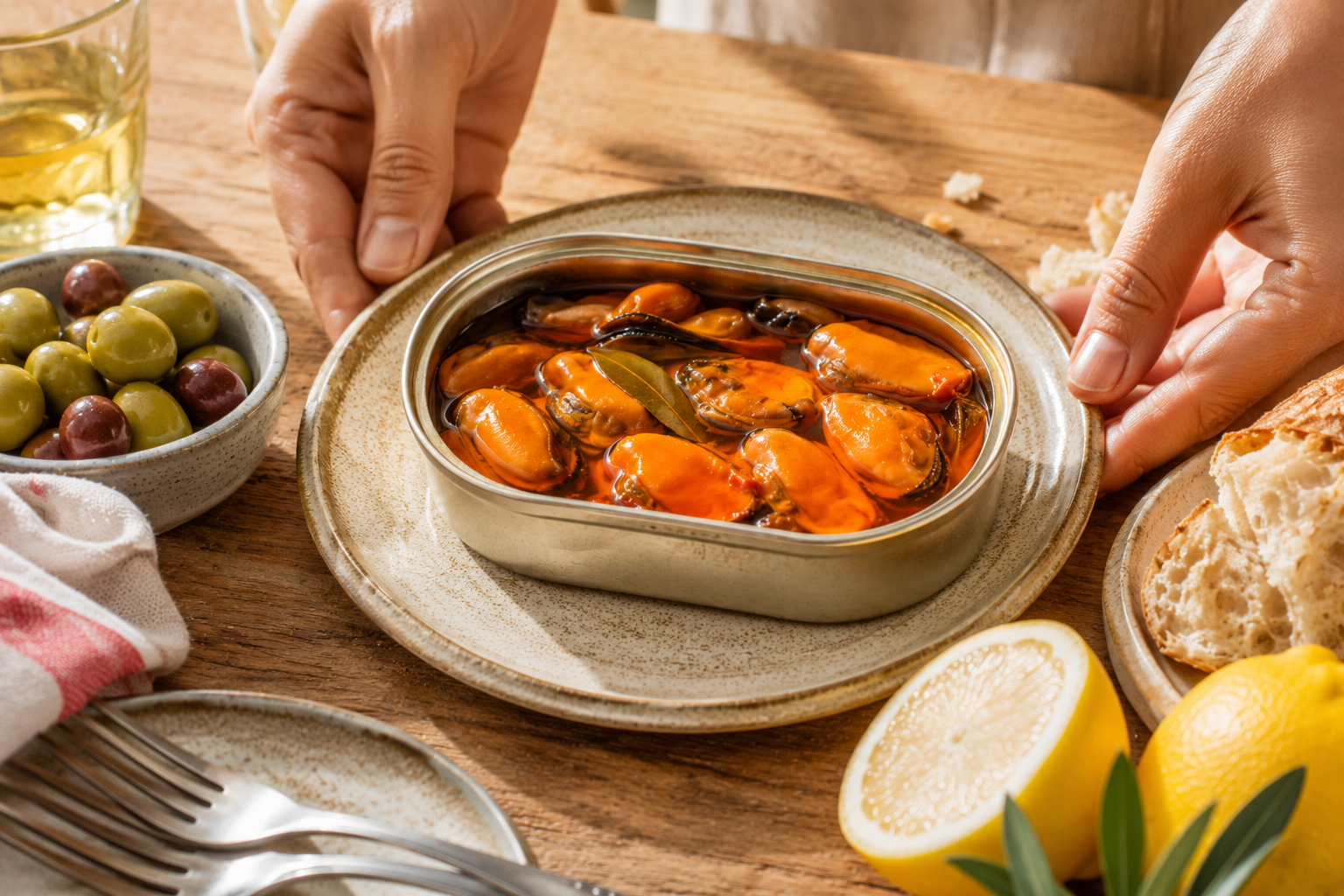
To really understand why a Spaniard reaches happily for a tin, you have to understand the culture of conservas, which has no true equivalent in American eyes. In Spain, high-end tinned seafood is not an emergency ration but a respected category of fine food, with celebrated producers, loyal followings and a place on the tables of serious restaurants. Tinning is treated as a craft that captures seafood at its best rather than a way to sell its worst.
This respect runs surprisingly deep. There are conservas bars devoted almost entirely to serving good tins, opened at the counter and tipped onto plates, and the finest examples are given as gifts and laid down almost like wine, since certain tinned seafoods are said to improve for years in the can. A gift of good conservas is a thoughtful present in Spain, not a joke, which tells you how far the culture sits from the American idea of canned food.
The reasons are partly historical and partly geographic. Spain has an enormous coastline and a deep fishing tradition, and canning grew up along the northern coast as a way of carrying that bounty inland and through the seasons, refined over generations into something closer to an art. What began as preservation became a cuisine in its own right, and mejillones en escabeche is one of its most democratic and beloved members.
For a visitor, grasping this is the key that unlocks the whole thing. Once you stop seeing the tin as a lesser version of fresh and start seeing it as its own excellent category, the Spanish supermarket aisle transforms from a place of cheap convenience into a treasure chest. The two-euro mussels are not slumming it. They are a small, proud expression of one of the things Spain does best.
Buying a Good Tin
Since the whole thing rests on quality, it helps to know what to reach for. Look for tins from Galicia or from a reputable Spanish conservera, since the good producers take real pride in their work and it shows in the tin. Larger mussels generally signal better quality, the marinade should list real ingredients rather than fillers, and a slightly higher price within the conservas aisle usually buys noticeably better shellfish.
It is worth knowing that a whole spectrum exists above the everyday tin. While a basic supermarket tin at around two euros is already excellent, Spain also produces premium conservas that climb well up in price, made from the largest hand-selected mussels by celebrated houses, and these are genuine gourmet items rather than pantry staples. You can spend a little or a lot, and even the little end vastly outperforms its price.
The good news for anyone outside Spain is that these travel. Because they are shelf-stable tins, quality Spanish mejillones en escabeche are exported widely and can be found in specialty shops, delicatessens and online, often imported directly from Spain, so you do not need to be in Madrid to enjoy them. A small stash in the pantry means a restaurant-quality appetizer is always minutes away, which is a fine thing to have on hand.
Making Your Own at Home
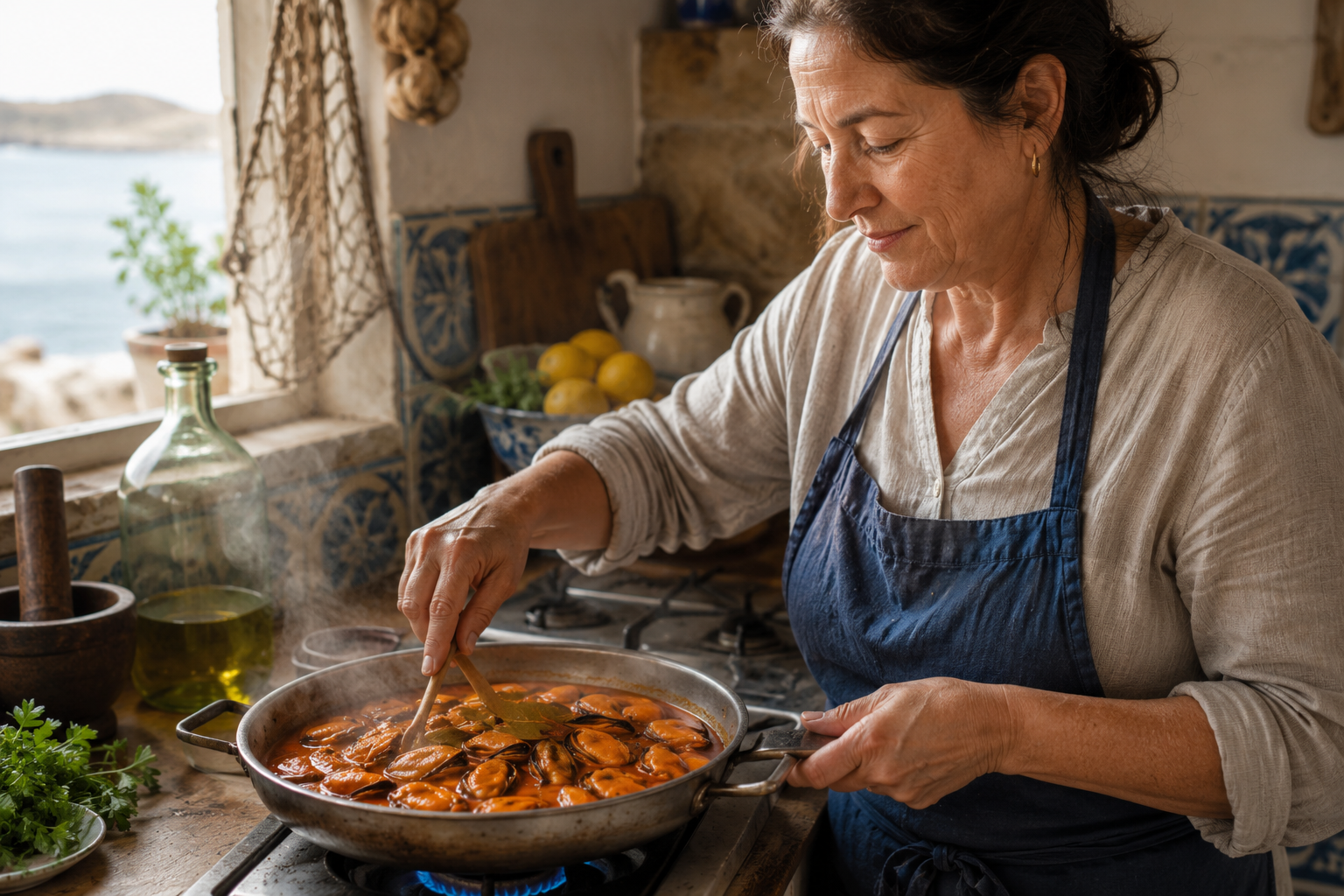
For all that the tins are superb, making mejillones en escabeche yourself is deeply rewarding and not difficult, and it lets you eat them fresh and warm from the marinade. The process has two simple stages. First you steam fresh mussels open in a little white wine and remove them from their shells, discarding any that refuse to open. Then you build the escabeche, gently cooking garlic and bay in olive oil, and here comes the one crucial trick.
The paprika must go in off the heat. Pimentón scorches almost instantly if it hits hot oil, turning bitter in seconds, so the pan comes off the flame before the paprika goes in, and only then, once it has bloomed in the warm oil without burning, do you add the vinegar and return it briefly to the heat. This single detail separates a beautiful escabeche from a ruined one, and it is the thing home cooks most often get wrong.
The final and most important instruction is to wait. Mejillones en escabeche are good after an hour but far better after a day or two in the fridge, once the mussels have soaked up the marinade and the flavors have married, exactly as the tinned ones do over their longer life. Patience is the last ingredient, and it is what turns a nice plate of marinated mussels into the real thing.
Mejillones en Escabeche serves 4 as a tapa
Ingredients:
- 1kg fresh mussels in the shell
- 120ml dry white wine
- 150ml extra virgin olive oil
- 4 cloves garlic, sliced
- 2 bay leaves
- 1 tablespoon sweet pimentón (Spanish paprika)
- 80ml white wine vinegar
- half a teaspoon black peppercorns
- salt to taste
Method:
- Clean the mussels, scraping the shells and pulling off the beards, and discard any that stay open when tapped.
- Heat the white wine in a large pot over high heat, add the mussels, cover and cook for a few minutes until they open. Discard any that stay shut.
- Remove the mussels from their shells, straining and reserving a few spoonfuls of the cooking liquid.
- In a wide pan over medium-low heat, warm the olive oil and gently cook the sliced garlic, bay leaves and peppercorns until the garlic is lightly golden.
- Take the pan off the heat and stir in the pimentón, letting it bloom in the warm oil without burning.
- Add the vinegar and a couple of spoonfuls of the reserved mussel liquid, return to low heat, and simmer gently for a few minutes.
- Add the mussels, turn to coat them, season with salt, and cook for two to three minutes.
- Let cool, then refrigerate in a covered jar for at least a day before eating, with bread and potato chips.
Mejillones en escabeche is one of those small Spanish pleasures that quietly rearranges your expectations. Once you have tipped a two-euro tin onto a plate, mopped the paprika-stained oil with bread, and understood that this modest thing is genuinely better than most of what arrives on a restaurant appetizer plate, the whole hierarchy of fancy and cheap starts to wobble. Spain figured out centuries ago that the finest food is often the simplest, that a preserved mussel can be a delicacy, and that the good life is frequently sold in a tin near the olives for the price of a coffee. Open one, and you will taste the argument for yourself.

About the Author: Ruben, co-founder of Gamintraveler.com since 2014, is a seasoned traveler from Spain who has explored over 100 countries since 2009. Known for his extensive travel adventures across South America, Europe, the US, Australia, New Zealand, Asia, and Africa, Ruben combines his passion for adventurous yet sustainable living with his love for cycling, highlighted by his remarkable 5-month bicycle journey from Spain to Norway. He currently resides in Spain, where he continues sharing his travel experiences with his partner, Rachel, and their son, Han.