
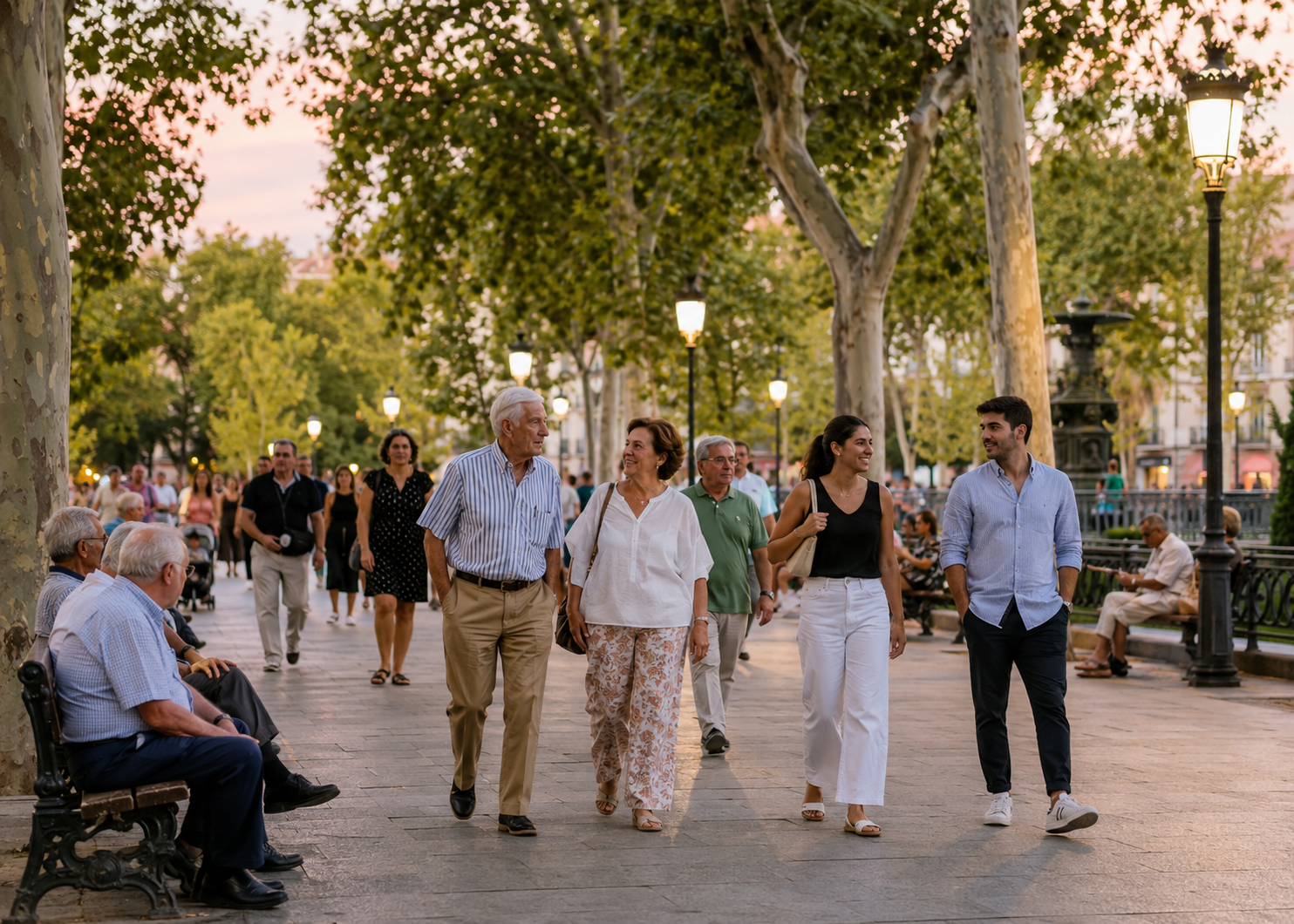
The Spanish town empties into the street at dusk. Not to go anywhere in particular. The families come down from the flats, the older couples take each other’s arms, the children run ahead and circle back, and the whole population drifts up and down the same few streets in the cooling air. This is el paseo, the evening walk, and it happens almost every day in almost every town in the country.
An American watching it for the first time often misreads it as an event, some festival or procession that must have a reason. It is nothing so special. It is just the evening, taken on foot, in company, the way it has been taken for generations. The walk has a name because it is a fixture, not an occasion.
What is newer is that the habit now has a science case sitting behind it. A short walk after a meal, it turns out, does something measurable and useful to the body, and the Spanish have been doing the useful thing every evening for centuries without waiting for a study to grant them permission.
What El Paseo Really Is
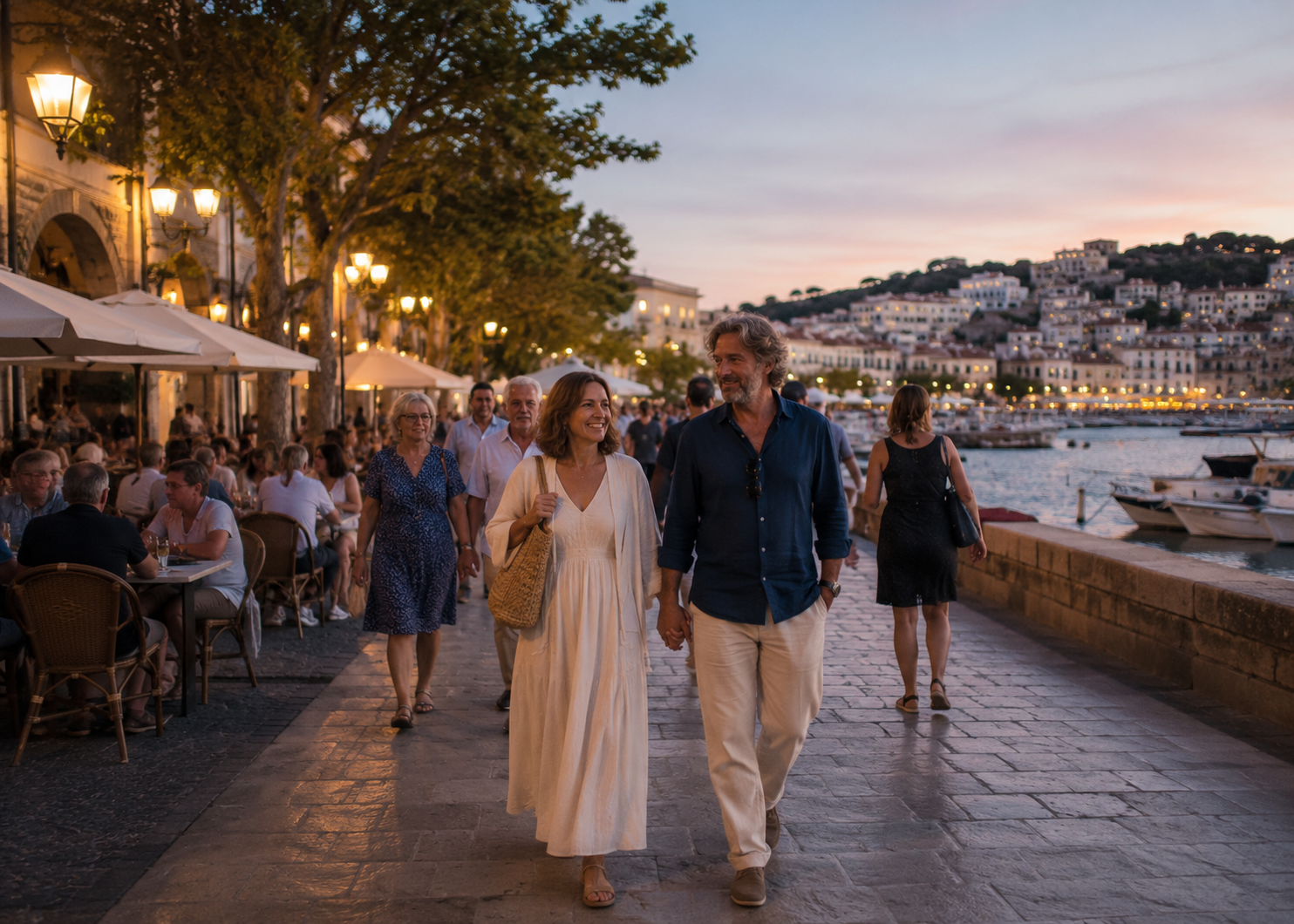
El paseo is the evening promenade, the ritual of going out to walk slowly through the town in the hours between the end of the workday and the start of dinner. In a country where dinner rarely begins before nine, that leaves a long, soft stretch of evening to fill, and filling it on foot, among neighbors, is what a great many Spaniards do with it.
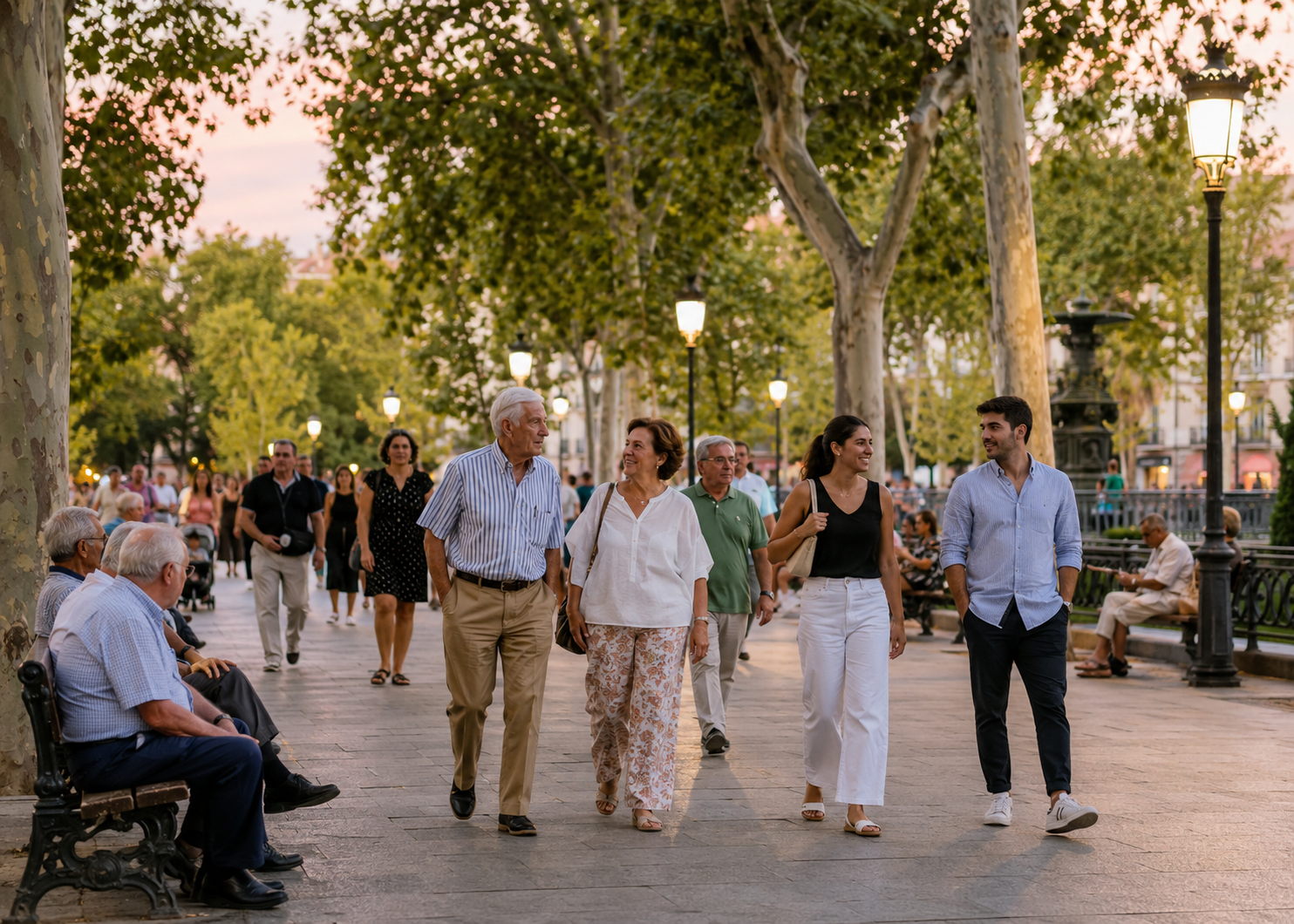
In our neighborhood in Madrid the loop runs down to a small plaza and back, and by nine in the evening it holds the same faces it held the night before, the retired men settled on the benches, the couples doing their slow circuits, the children on scooters weaving through all of it. Newcomers stand out for about a week and then get absorbed into the pattern like everyone else.
It is unhurried on purpose. Nobody out there is exercising in any sweating, striving sense. People are dressed for being seen, they stop constantly to talk, and the pace is set by the slowest member of whatever group has gathered. The point is the being out and the being together, with the walking as the medium rather than the goal.
The route is usually the same worn loop, the main street or the central plaza or the seafront promenade, walked up one side and back down the other. Everyone is doing the same loop at the same time, which is the whole design. You see the same faces, you nod, you fold a neighbor into your group for a lap and peel off again a little later. A town on its paseo is a town quietly taking attendance.
There is a companion ritual at the table called la sobremesa, the long sit after a meal when nobody rushes to clear the plates and the talk runs on over the last of the wine. The paseo and the sobremesa are two halves of one instinct, the refusal to treat eating and moving as chores to be finished quickly on the way to something more important. One keeps you at the table past the food. The other gets you up from it and out the door.
The Same Walk Has Cousins Everywhere
The Spanish did not invent the evening walk, and they are not alone in keeping it. In Italy the identical ritual is the passeggiata, the after-work and after-dinner stroll through the piazza, dressed nicely and moving slowly, walked for the pleasure of walking and of being seen doing it. Greece has its volta. Across the Mediterranean and out into Latin America, some version of the communal evening walk turns up wherever the climate makes the outdoors pleasant at dusk.
The habit is older than any of these names for it. The evening promenade was a fixture of European town life for centuries, the hour when people of every class came out to see and be seen before the streetlights and the automobile rearranged the evening, and versions of it survive today from inland villages to the seafront paseos marítimos of the Spanish coast.
What these places share is not only the walk but the shape of the whole evening around it. Meals come late, the hours after work run social rather than solitary, and the town center is somewhere people go rather than somewhere they drive through on the way home. The walk is just the visible edge of a way of organizing time that treats the evening as something to be spent among others, slowly, on foot.
It is worth noticing how much of this overlaps with the regions that keep surfacing in longevity research. The parts of the world where people reach great age tend to be places where gentle, daily movement is folded into ordinary life rather than bolted on at a gym, and where the old stay woven into the social fabric instead of retreating from it. The evening walk manages both at once. It moves the body a little and keeps the person connected, every single day, without anyone having to decide it counts as exercise.
The Study That Caught Up to the Habit
In 2022 a research team at the University of Limerick in Ireland published a review in the journal Sports Medicine with a title lifted from an old proverb, asking whether a person should rest a while after dinner or walk a mile. They pooled the results of seven studies comparing what happens to the body when you sit after a meal against what happens when you get up and move lightly instead.
The finding was clean. Light walking after eating did a measurably better job of steadying blood sugar than either sitting or standing still did. The post-meal rise in glucose, the surge that follows any substantial meal, was noticeably flattened by getting up and strolling, and the effect appeared even with a very small amount of walking.
The pooled trials pointed the same way, which is what gives the finding its weight. Standing up after a meal helped a little, and walking helped clearly more. The researchers were careful to note that the useful walking was light, the sort of easy movement anyone can manage rather than brisk exercise, and that short bouts spread through the time right after eating did more than one longer session earlier or later in the day.
That last part is what made the study travel around the world. The benefit did not demand a workout or even a full el paseo. As little as two to five minutes of easy walking after a meal was enough to bend the glucose curve downward. A short amble to the corner and back, taken at the pace of a Spanish grandmother in no particular hurry, sits comfortably inside the range the researchers found useful.
The lead author, Aidan Buffey, put it in about the plainest terms available, that breaking up the stretch of sitting right after you eat is a small change carrying an outsized payoff. It is the rare piece of health advice that asks for almost nothing, no equipment, no membership, no carved-out hour, only a few minutes on your feet at the exact moment you would otherwise drop into a chair.
Why a Short Walk Moves Blood Sugar
The mechanism is simple enough to picture. When you eat, carbohydrates break down into glucose, which pours into the bloodstream and sends blood sugar climbing. The body answers with insulin, the hormone that moves that glucose out of the blood and into cells to be used or stored. In a healthy system the spike rises and falls smoothly. In a strained one it climbs too high and lingers too long, and years of those exaggerated spikes are part of the long road toward type 2 diabetes.
Walking interrupts the sequence at exactly the right moment. Working muscles pull glucose straight out of the blood to fuel themselves, and they can do it without waiting for much insulin at all. So a body in gentle motion after a meal has a second route for clearing the sugar, one that runs alongside the insulin system and lifts some of the burden off it. The spike ends up lower and shorter because the legs are quietly burning off the surplus as it arrives.
The counterintuitive part is that none of this takes real effort. You are not trying to burn the meal off in any dramatic way. You are just giving the big muscles of the legs something light to do during the twenty or thirty minutes when the glucose is flooding in fastest, and that modest demand is enough to reshape the curve.
Part of why it works is a quirk of muscle chemistry. Contracting muscles can wave glucose in through transporters that open in response to movement alone, without waiting for insulin to unlock the door. That side door is why a walk helps even bodies that have started to handle insulin poorly, and it is why the effect is of real interest for heading off and managing type 2 diabetes rather than being a benefit only for the already healthy.
It also explains why the timing matters more than the intensity. A hard gym session three hours after dinner does less for that particular meal’s spike than a slow stroll taken while the food is still being digested. The window is the thing that counts, and the window swings open the moment you set down your fork.
It Was Never Only About the Blood Sugar
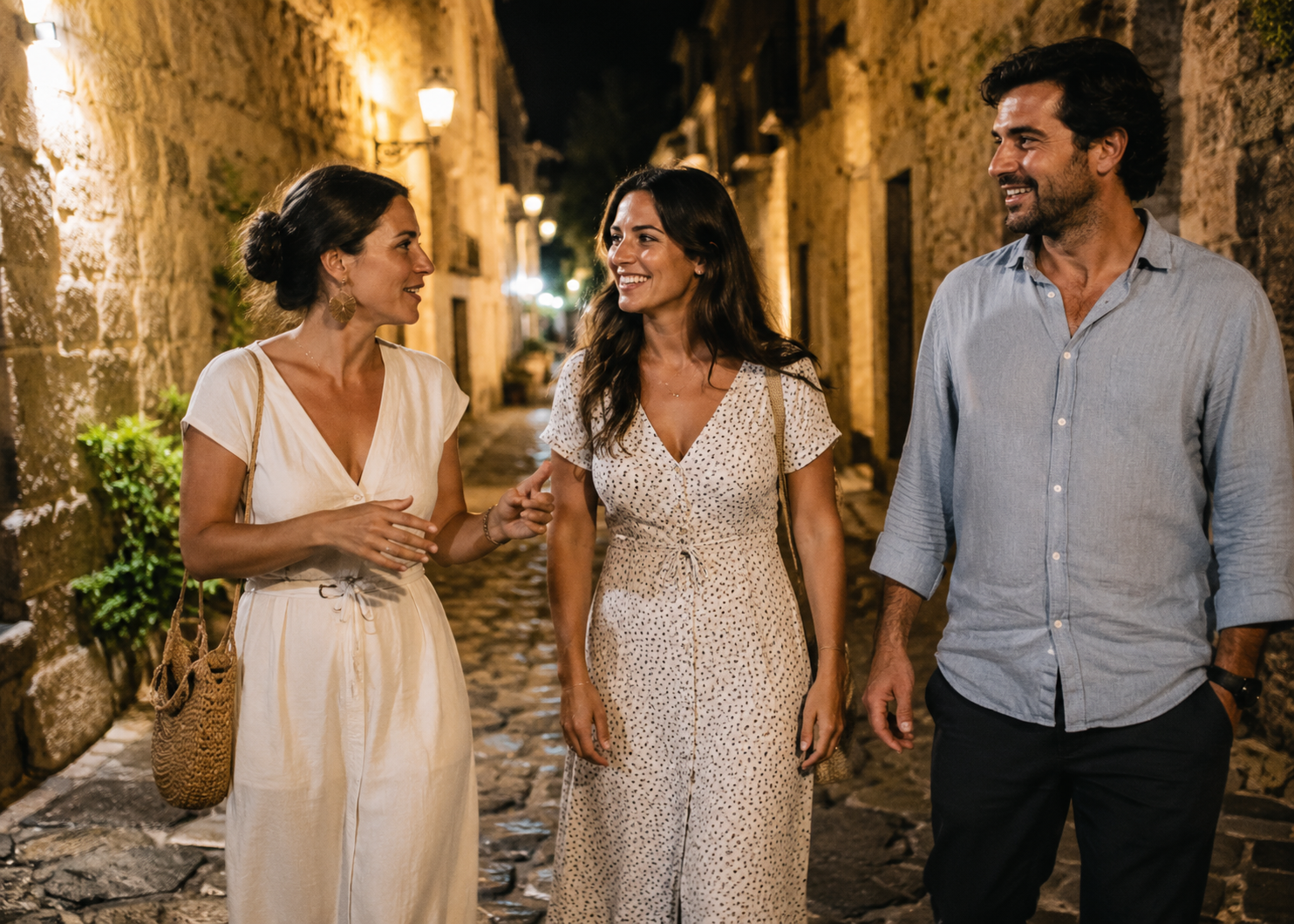
Long before anyone measured a glucose curve, the paseo was doing other work, and that work may well be the larger share of why it matters. The walk is a daily dose of low-grade social contact, the sort that researchers who study loneliness and aging keep finding to be quietly protective. You leave the house, you see people, you trade a few words, and you come back home having been part of the town for an hour.
For older people the daily contact is anything but trivial. A large part of the health penalty of aging alone comes from the slow narrowing of a person’s world, the days that slide by without a single real exchange. A ritual that pulls everyone out onto the same street at the same time, the widowed and the retired included, amounts to a standing appointment with other human beings, built into the calendar so firmly that an absence gets noticed and asked about.
There is a gentler benefit in the evening light and the winding down. A slow walk in the fading day is close to the least stimulating way to close an evening, which makes it good preparation for sleep rather than an enemy of it. The eyes read the dimming light, the legs do their easy work, the talk drains off the day’s tension, and by the time the late Spanish dinner arrives the nervous system has already begun to settle.
No one of these effects is dramatic by itself. A single evening walk changes nothing. The paseo, though, is never a single walk. It is the same walk repeated a few thousand times across a decade, and habits at that scale are where most of health quietly lives, in the small things done reliably rather than the large things attempted once.
The Version That Fits an American Evening
You do not need a plaza, or an hour, or a whole town walking with you to get the part that helps. The science is clear that the useful dose is small. A walk of ten or fifteen minutes after dinner captures most of the glucose benefit, and even the two-to-five-minute version the study singled out beats the usual alternative of sitting straight back down.
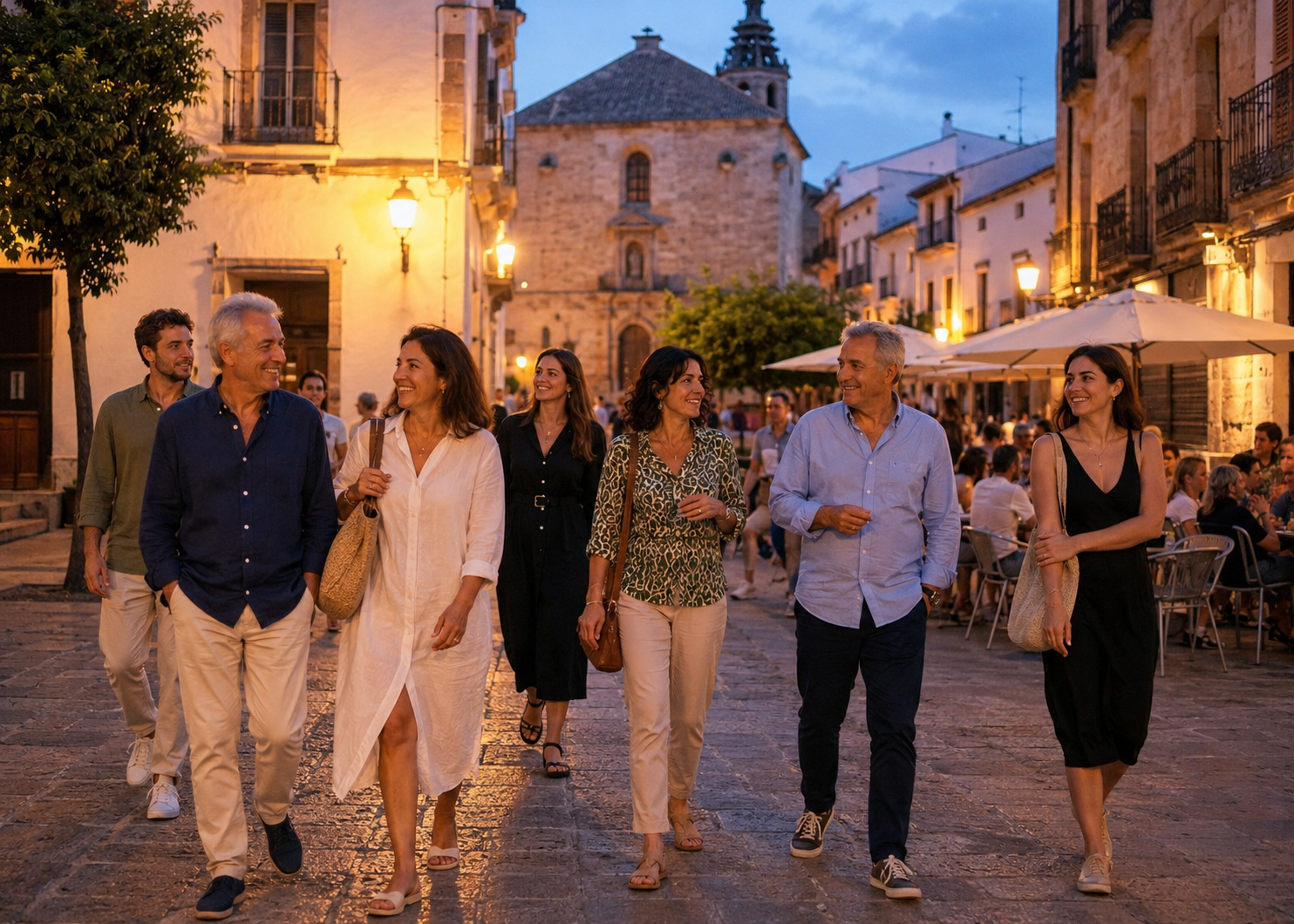
A couple of small tricks make it stick where willpower fails. Shoes left by the door keep the leaving frictionless, and a fixed turnaround point, a particular tree or a corner shop, settles the nightly question of how far to go before it can even be asked. Walking with someone helps most of all, since the company does the motivating and the walk becomes a conversation that happens to be moving.
The honest limits are worth stating plainly, in one place. This is not a cure for anything, and no amount of strolling undoes a genuinely poor diet or a serious metabolic condition. Most of the underlying studies are short-term and modest in size, measuring the response to a single meal rather than years of hard outcomes, so the long-run promise is inferred more than it is proven. What the research does support is narrow and reliable: a light walk after eating blunts the blood sugar spike from that meal, cheaply and repeatably. That is the whole of the claim, and it is still well worth having.
The real obstacle for most Americans is not the walk itself but an evening with no room built in for it. Dinner is often the handoff to the couch and the screen, the meal that resolves into sitting. The Spanish evening is assembled the other way around, the sitting done at the long table and the rising done afterward, out into the street. Taking on the paseo is less about finding time to exercise than about rearranging the twenty minutes right after dinner so they happen standing up and outdoors.
Start After Tonight’s Dinner
The simplest way in is to pick one meal and walk after it, beginning tonight. Not a march and not a workout, just up the street and back at a pace that feels like no effort at all. Ten minutes is plenty, and the corner and back is not nothing.
Do it after the same meal every day and within a week it stops being a decision, which is the only mechanism by which any of this ever sticks. The Spanish did not build the paseo out of willpower. They inherited an evening shaped so that the walk was the path of least resistance, and the health simply came along for the ride, a side effect of a pleasant thing done daily.
That is the part most worth stealing, more than the exact count of minutes. Arrange the end of your evening so that walking is easier than not walking, and the blood sugar, the sleep, and the small daily contact with the world past your front door will mostly take care of themselves.

About the Author: Ruben, co-founder of Gamintraveler.com since 2014, is a seasoned traveler from Spain who has explored over 100 countries since 2009. Known for his extensive travel adventures across South America, Europe, the US, Australia, New Zealand, Asia, and Africa, Ruben combines his passion for adventurous yet sustainable living with his love for cycling, highlighted by his remarkable 5-month bicycle journey from Spain to Norway. He currently resides in Spain, where he continues sharing his travel experiences with his partner, Rachel, and their son, Han.