
On a side street off a Roman piazza, a curved iron spout pours a steady arc of cold water into a drain, and has been doing so, day and night, for longer than anyone walking past has been alive. It never shuts off. The water is clean, it is free, and it is the same water that runs into the taps of the apartments overhead. Fifty feet away, at a kiosk beside a monument, a tourist is paying €5, about $5.50, for a plastic bottle of the same thing.
That gap is one of the quiet absurdities of travel in Europe, and it is entirely avoidable. Rome, and a string of other European cities, gives away excellent drinking water on nearly every street, through public fountains that most visitors walk past without recognizing for what they are. Learn to spot them and the bottled-water economy that preys on tourists simply stops applying to you.
The bottled-water business depends on that not-knowing. Kiosks and vending machines cluster exactly where the fountains are easiest to miss, beside the monuments and inside the airport terminals, selling convenience to people who have no idea the free version is a few steps away.
Here is how the free-water networks of Europe work, city by city, and how to drink from them like someone who lives there.
Rome’s 2,500 Big Noses
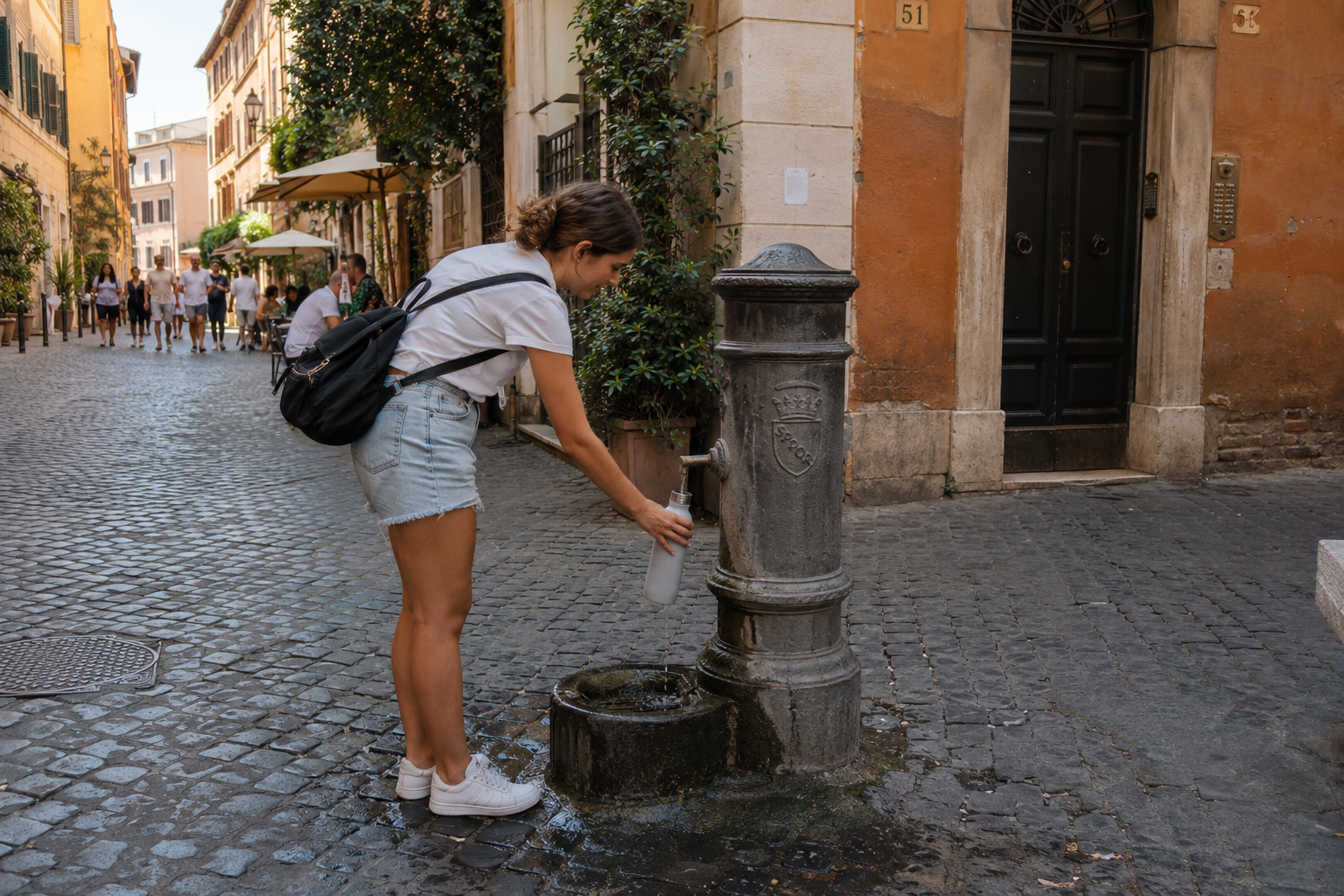
Rome’s fountains have a name, the nasoni, which means “big noses,” after the long curved spout that gives each one its profile. There are roughly 2,500 of them scattered across the city, on street corners, in parks, tucked beside piazzas, though at their peak there were closer to five thousand. They are cast iron, about waist to chest height, and heavy, and they have been a fixture of Roman life since the city began installing them in 1874.
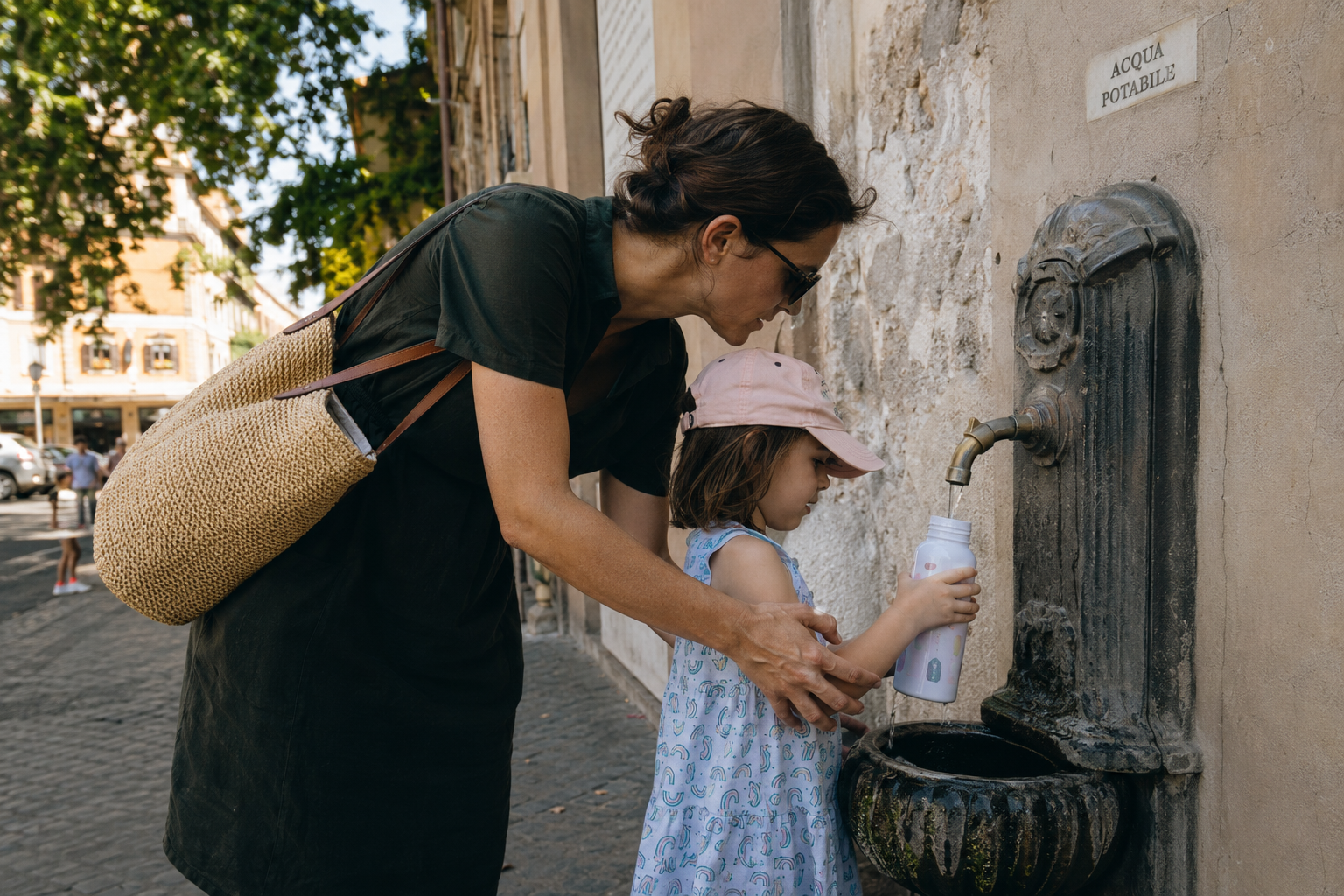
The water is not a lesser grade meant for washing. It is acqua potabile, the identical drinking water piped into Roman homes, drawn from springs in the mountains around the city through aqueducts, some of which trace their logic back to ancient Rome. It runs continuously by design, because the constant flow keeps the water from stagnating in the pipes, so what looks like waste is really the system keeping itself fresh.
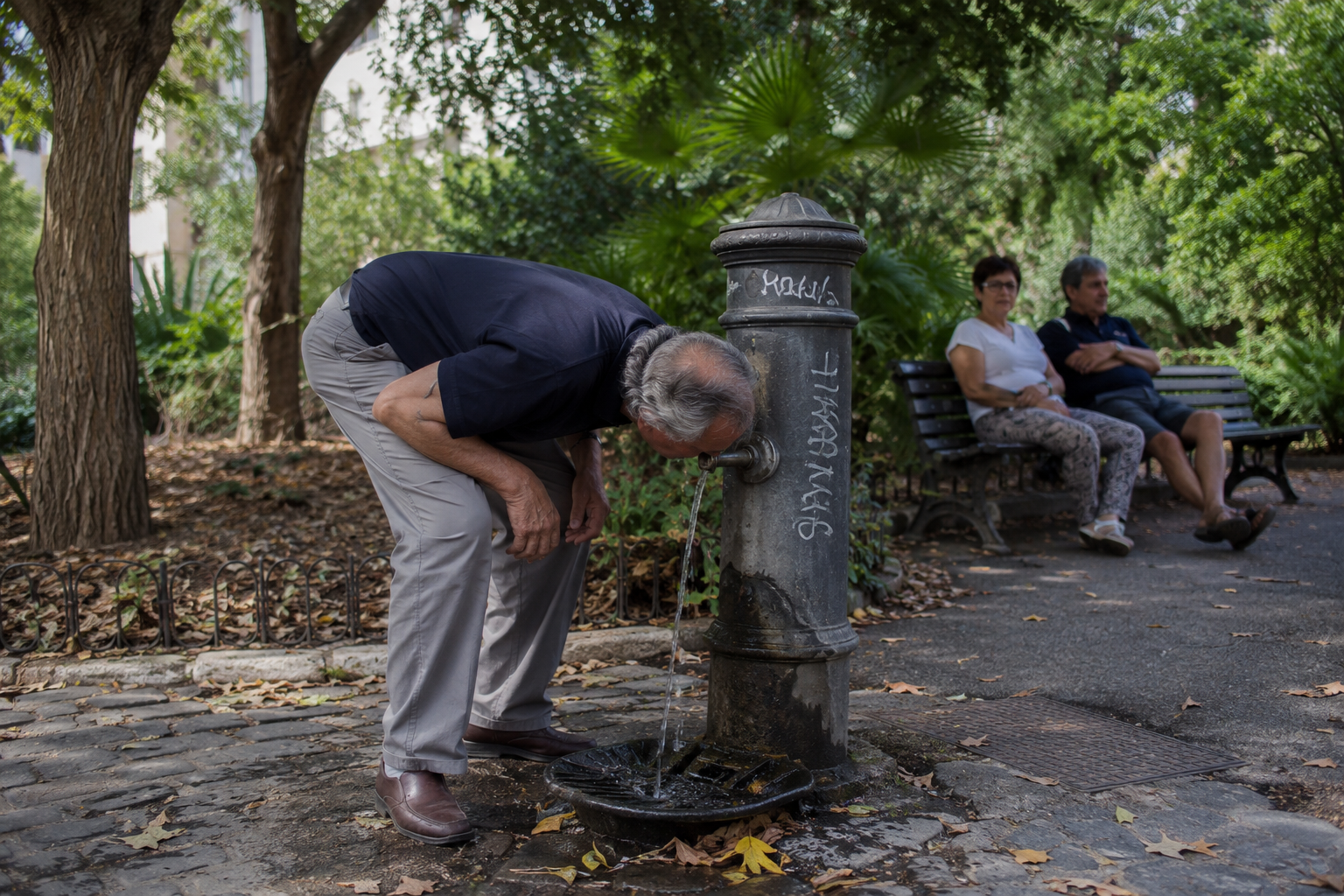
Drinking from one takes a small trick that locals learn as children. The spout points down, too low to get your mouth under comfortably, so you place a finger or thumb over the end of the spout to block it. The water then jets up through a small hole in the top of the spout, arcing neatly into your mouth like a drinking fountain back home. You never put your mouth on the metal itself, which is both more hygienic and how you can tell a tourist from a Roman at a glance.
The nasoni were built as an act of public welfare, a way to give every citizen free, clean water at a time when not every home had it, and Rome has kept the tradition running for a century and a half. The city celebrated the fountains’ 150th anniversary in 2024, which tells you how deep the habit runs. Romans call their city La Regina dell’Acqua, the Queen of Water, and the nasoni are the everyday face of that title.
Rome has fancier public fountains too. In 1926 the architect Pietro Lombardi designed a set of decorative neighborhood fountains, the fontanelle rionali, each shaped to echo something about its district, a stack of books by the university quarter and amphorae in the old riverside area among them, and several still run today. Many nasoni also have a small basin at the base meant for dogs, which in a Roman July is no small mercy. The fountains have been switched off only once in recent memory, during a severe drought in 2017, and the public outcry was loud enough that they came back on quickly.
Paris and Its Green Wallace Fountains
Paris runs a parallel system with a very different look. The famous ones are the Wallace fountains, the deep-green cast-iron structures scattered across the city, each crowned by four draped caryatids holding up the dome. There are more than a hundred of them, and they are as much a part of the Paris streetscape as the newsstands and the Métro signs.
They exist because of one man. Sir Richard Wallace, a wealthy Englishman living in Paris, financed and donated the first fountains in 1872, after the upheavals of the Franco-Prussian War and the siege had left the city short of clean drinking water and driven many of the poor toward cheap wine instead. Designed by the sculptor Charles-Auguste Lebourg, the fountains gave free water to anyone who needed it, and the four figures on the largest model were meant to represent kindness and simplicity, charity and sobriety.
The Wallace fountains are only the headline act. Paris runs a much larger network under its water utility, with well over a thousand drinking points across the city, including newer designs and, delightfully, several fountains that dispense chilled sparkling water for free, the first installed in a park in the east of the city. Paris even added dozens of new fountains for the 2024 Olympic Games. On top of the fountains, any French café or restaurant will bring you a free carafe d’eau, a jug of tap water, if you ask, which is a small custom worth knowing anywhere in the country.
The numbers behind the Paris network are worth a moment. There are around a hundred and ten historic Wallace fountains, plus hundreds of simpler push-button fountains in parks and squares, plus a scattering of artesian wells drawing water from deep beneath the city, plus the seventy new Mât-Source fountains installed as a legacy of the 2024 Games. Taken together they make Paris one of the best-watered cities in Europe for anyone carrying an empty bottle.
Switzerland Runs on Fountains
If Rome and Paris are generous, Zurich is on another level entirely. The Swiss city has more than 1,200 public drinking fountains, which works out to one at what feels like every square and street corner, and the water in nearly all of them is cold and fresh, drawn from spring or lake sources of famously high quality. The city employs a team whose job is to keep testing them, and any fountain that fails is switched off until it is fixed.
This is a Swiss habit rather than a Zurich quirk. Across Switzerland, public fountains flow with drinkable water almost everywhere, in cities and villages alike, and the working rule for a traveler is simple. If water is running from a public spout and there is no sign telling you otherwise, you can drink it. The only thing to watch for is the occasional Kein Trinkwasser sign, meaning not drinking water, which you find mostly on farms and in the countryside.
For a visitor, the effect is that you never need to buy water in Switzerland, which matters in one of the most expensive countries in Europe, where a bottle from a shop can cost several francs. Carry an empty bottle, fill it at the nearest fountain, and repeat all day for nothing.
The fountains double as street furniture and civic art. Many are centuries old, carved with stone figures and painted crests and set at the squares Zurichers use as meeting points, so filling a bottle at one is a small brush with the city’s history as much as a free drink. The practical upshot is simple. Carry an empty bottle, ideally a sturdy metal one, and Switzerland covers your hydration for the whole trip at no cost, which is worth real money in a country where almost nothing else is.
Where the Free Water Flows Thickest
A 2026 study that counted public fountains per square kilometer across more than fifty European destinations put some order to all this, and the results are worth carrying in your head. Barcelona came out on top with the densest network of any city measured, roughly eighteen fountains per square kilometer, its fonts spread across parks, tourist zones, and the main walking routes. Zurich followed with about eleven per square kilometer and Paris with around ten, so the three cities a traveler is most likely to visit are also among the easiest places on the continent to drink for free.
The pattern is not random. The cities that top the list tend to be places with a long civic tradition of public water and a climate that makes hydration a daily concern, which is why Spanish and French cities cluster near the top. Vienna deserves its own mention here, since the Austrian capital pipes superb mountain spring water down from the Alps through dedicated aqueducts, and its public fountains and taps run with some of the best city water anywhere.
The lesson for a traveler is to check before assuming. A city near the top of that list rewards a reusable bottle and a little map-checking; a city lower down means carrying a topped-up bottle from the start, especially in a heatwave or on a long day of sightseeing.
Why Cities Gave Their Water Away
The instinct to hand out free water in public is old, and it comes from a specific era of European history. Most of these networks were built in the second half of the nineteenth century, when rapidly growing cities faced real crises of public health, and clean drinking water was understood as both a humanitarian necessity and a matter of civic pride.
Rome’s nasoni, Paris’s Wallace fountains, and the fountain systems of a dozen other cities all date to roughly the same window, and they share a founding logic. A city that could deliver clean water to every corner, free, to rich and poor alike, was a city demonstrating that it worked, that it cared for its people, and that it had mastered the engineering to do so. The fountains were monuments to competence as much as to charity.
That origin is why the water is reliably good rather than an afterthought. These systems were built by cities that took their water seriously, often drawing on mountain springs and aqueducts rather than treated river water, and the quality has been maintained ever since because the fountains remain a point of local pride. When a Roman or a Zuricher tells you the fountain water is better than the bottled kind, they are usually right.
The engineering behind them reaches back a very long way. Rome once fed hundreds of public basins from a web of aqueducts, and the modern nasoni are the direct descendants of that system, many still cast with the letters SPQR, the ancient motto of the Senate and People of Rome. To drink from one is to use a piece of civic infrastructure whose logic is two thousand years old, updated for a city with plumbing but never abandoned.
What Not to Drink, and How to Find It
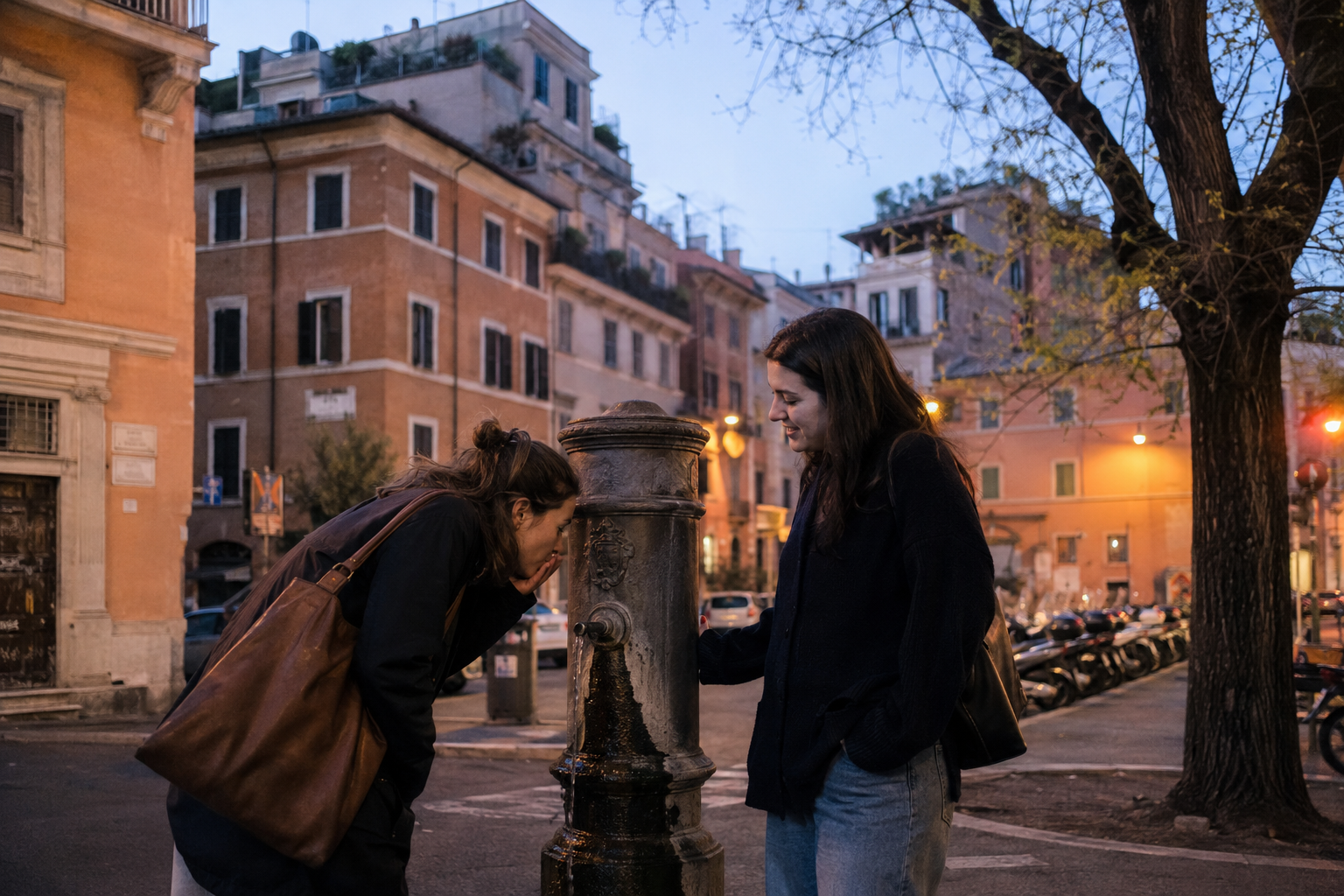
A few rules keep you safe and dry-mouthed rather than caught out. The single most important one in Rome is the difference between a nasone and a monumental fountain. The grand decorative fountains, the Trevi above all, run on recirculated water that is not for drinking, and dipping your bottle in one will get you a fine, not a refill. The small iron nasoni beside them are the ones built for drinking, and there is almost always one within a short walk of any famous fountain.
Across Italy and much of Europe, the phrase to watch for is acqua non potabile, or its local equivalent, meaning the water is not safe to drink. It is rare, and it is always signposted, so the working assumption at an ordinary public fountain is that the water is fine unless a sign says otherwise. When in doubt, a running fountain with no warning and locals filling bottles at it is about as safe a bet as travel offers.
Rome layers something modern on top of the old iron. The city utility runs a scattering of water stations called Casa dell’Acqua, water houses, that dispense chilled still and sparkling water for free, several of them near the Colosseum and other busy spots, and a few even offer a phone-charging point while you fill up. And for the rule that decorative fountains are off-limits, there is one charming exception worth knowing, the boat-shaped Barcaccia at the foot of the Spanish Steps, which was designed to be drunk from and still can be.
Finding fountains is easier than it used to be. Several free apps map public water points across European cities, and Rome’s water utility runs one, Waidy Wow, that pinpoints every nasone and water station in the city. Other apps cover the continent more broadly, marking verified fountains, refill stations, and even the free sparkling-water points. A minute with one of these before you head out for the day means you are never far from a refill.
The €5 Bottle You Never Have to Buy
The math is almost comic once you see it. A bottle of water near a major tourist site runs €2 to €5, roughly $2 to $5.50, and a family working through several a day on a hot week can spend a genuinely silly amount on something flowing free from the iron spout around the corner. Multiply that across a trip and the bottled-water tax on not knowing about the fountains adds up to real money.
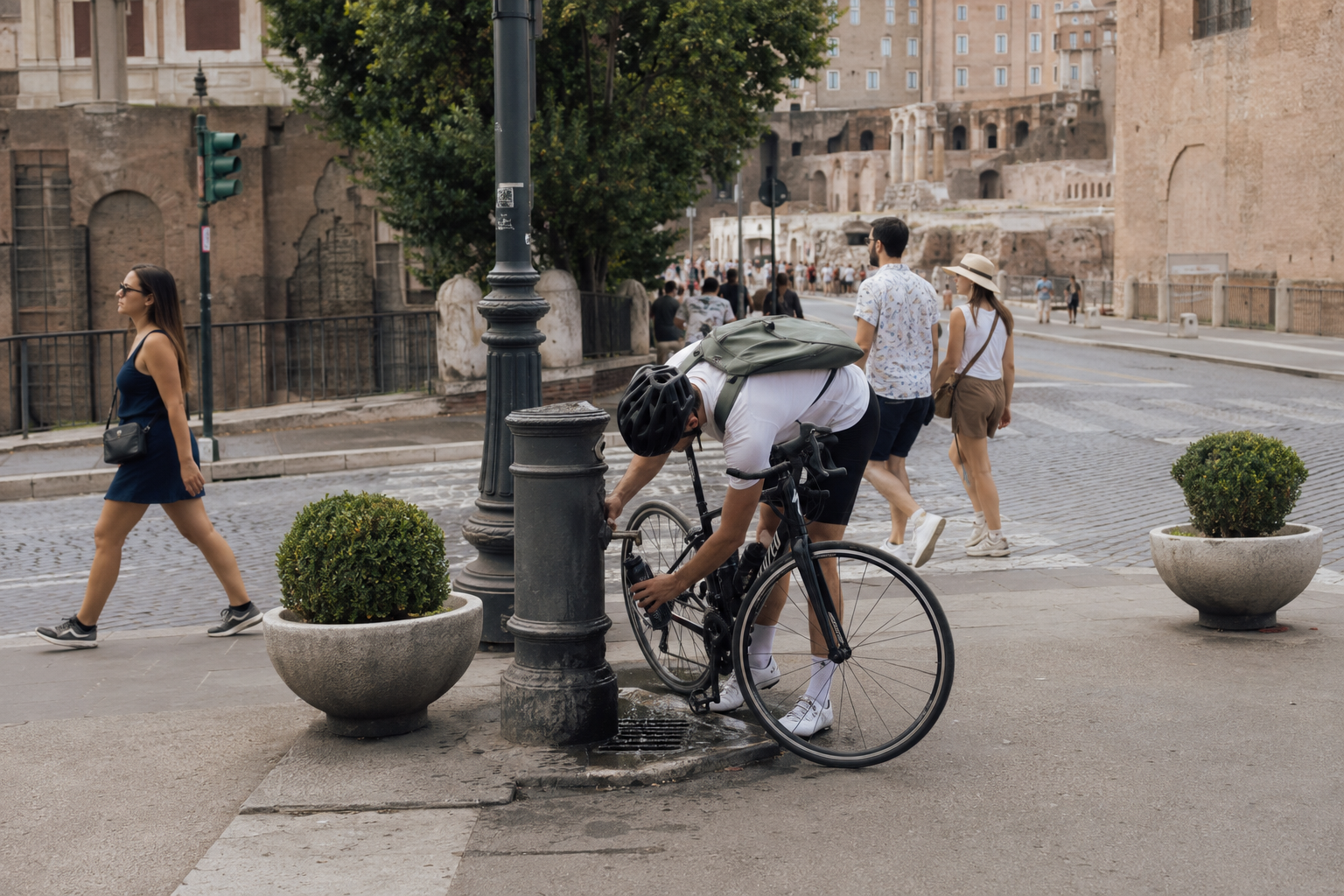
The fix costs nothing but a reusable bottle in your bag. Fill it in the morning, refill it at the nasoni and Wallace fountains and Swiss spouts as you go, and the entire bottled-water economy that clusters around monuments and airports stops taking your money. You also stop generating the small mountain of plastic that a bottle-a-stop habit produces, which the cities themselves increasingly cite as the reason they keep the fountains flowing. A collapsible or metal bottle weighs almost nothing in a day bag and retires the whole problem for a trip.
So pack the empty bottle, learn to block the spout of a nasone with your thumb, and glance at a fountain map before you set out. Rome has been giving its water away for a century and a half, Paris and Zurich and Barcelona right alongside it, and the only travelers who pay €5 for it are the ones who never noticed the fountain.

About the Author: Ruben, co-founder of Gamintraveler.com since 2014, is a seasoned traveler from Spain who has explored over 100 countries since 2009. Known for his extensive travel adventures across South America, Europe, the US, Australia, New Zealand, Asia, and Africa, Ruben combines his passion for adventurous yet sustainable living with his love for cycling, highlighted by his remarkable 5-month bicycle journey from Spain to Norway. He currently resides in Spain, where he continues sharing his travel experiences with his partner, Rachel, and their son, Han.