
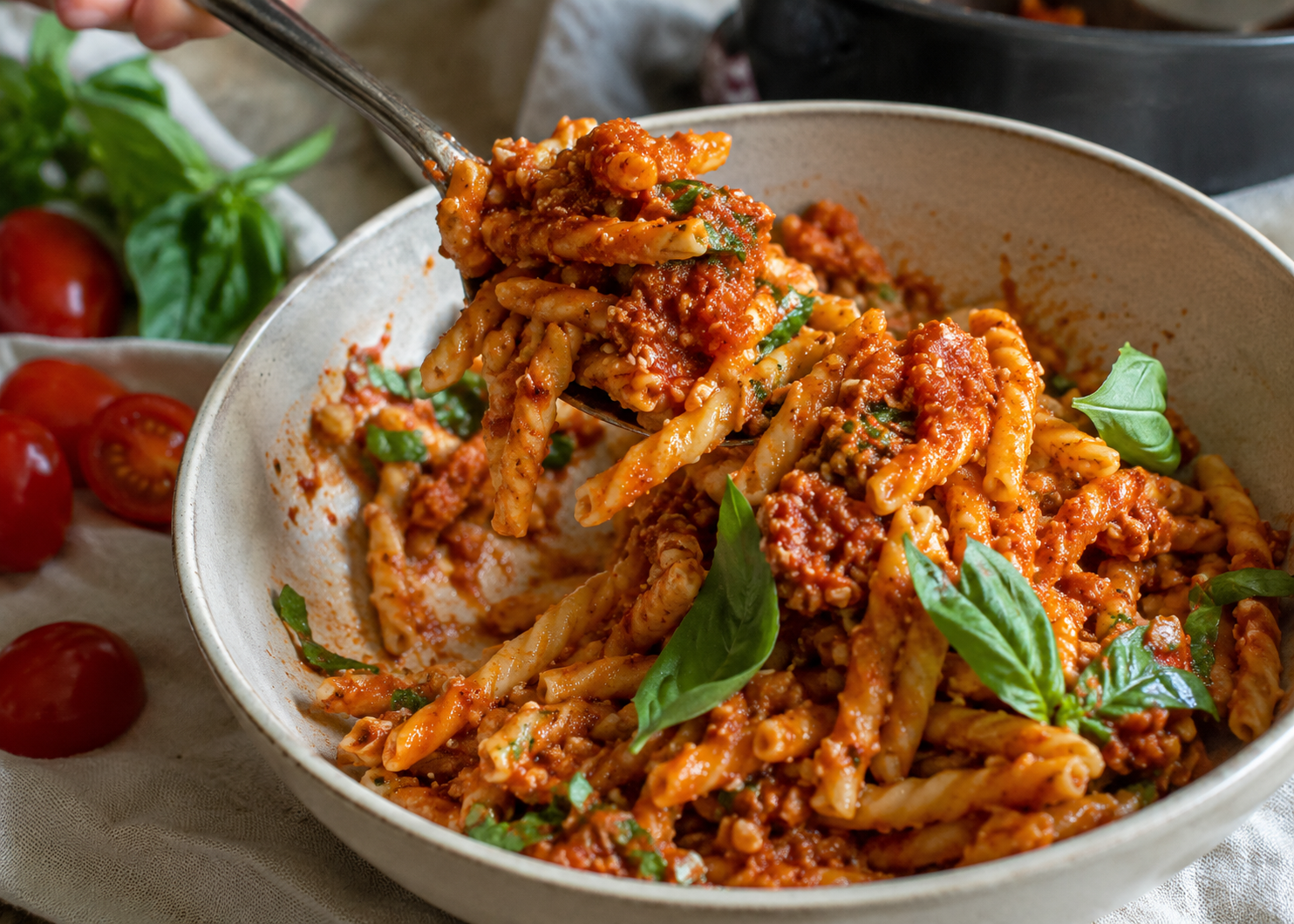
Say the word pesto and most people picture one thing: the bright green Genoese sauce of basil, pine nuts, and Parmesan from the north of Italy. But travel to the far western tip of Sicily, to the port city of Trapani, and you will find a different pesto entirely. It is red, not green. It is built on almonds, not pine nuts. And it makes no apologies for either.
This is pesto alla trapanese, Sicily’s own answer to the famous sauce of Liguria, and it is every bit as authentic and traditional as its northern cousin. The almonds are not a budget substitute for pricey pine nuts, and the tomatoes are not an improvisation. Both are deliberate, rooted in Sicilian soil and Sicilian history, and together they make a sauce that deserves to be far better known than it is.
The Pesto That Isn’t Green
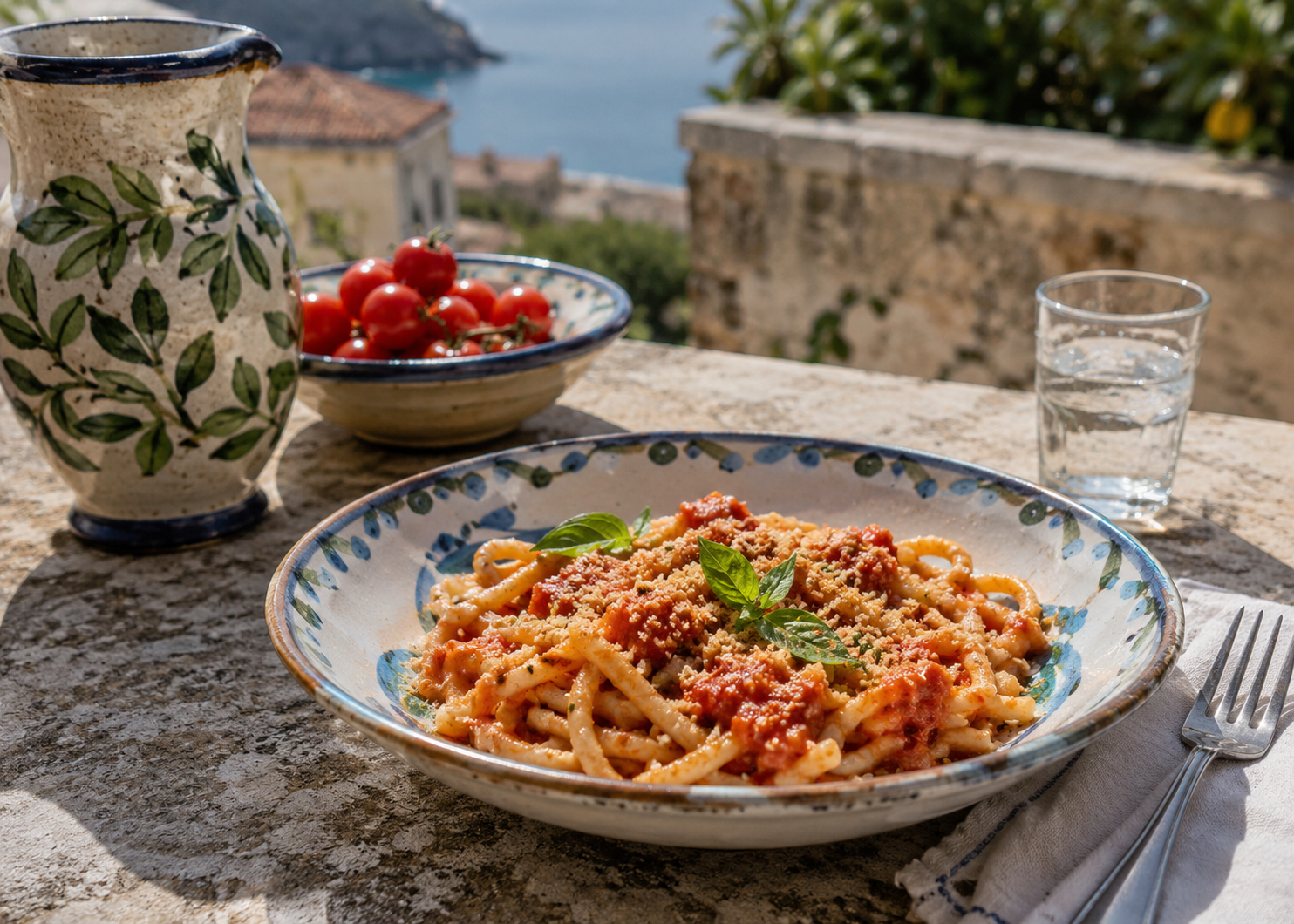
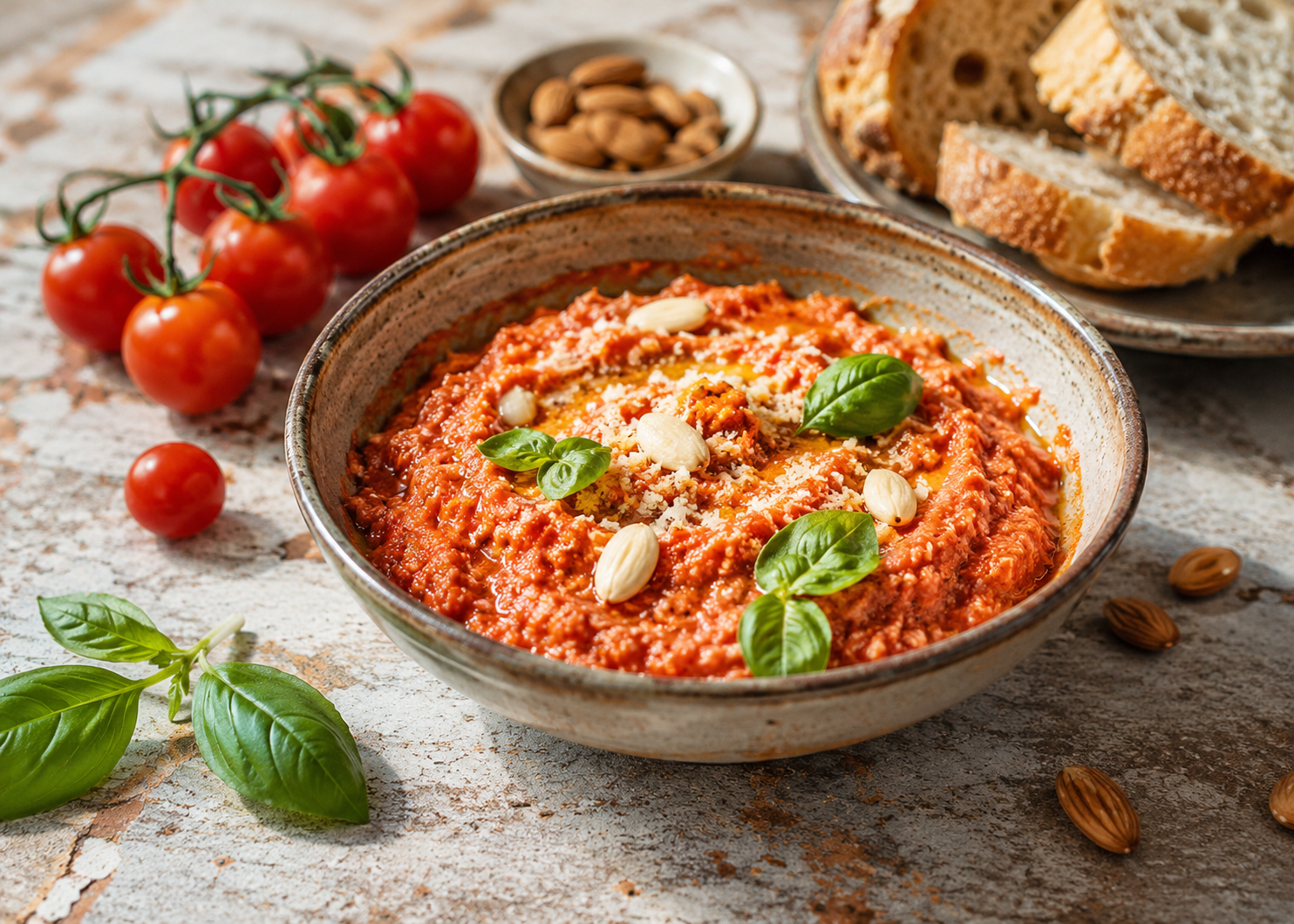
Trapani sits on Sicily’s western coast, a city long famous for its salt pans and its tuna fishing. To that list it has added a sauce, one that turns the familiar idea of pesto on its head. Where Genoese pesto is a smooth emerald green, pesto alla trapanese is a rustic, pinkish red, flecked with basil and studded with ground almond.
The dish has deep roots. It is thought to have grown out of an old Sicilian condiment called agliata, essentially garlic pounded with other ingredients, and in the local dialect the pesto is still sometimes called agghiata trapanisa. Over time it settled into the form known today: ripe tomatoes, almonds, fresh basil, garlic, olive oil, and a hard, salty pecorino, pounded or blitzed into a coarse, fragrant sauce. It is so identified with the region that Sicily officially recognises it as a traditional local food product.
What strikes you first is how different it feels from northern pesto despite the shared name and shared spirit. It is lighter and tangier, thanks to the tomatoes, and nuttier and more rustic, thanks to the almonds. It tastes unmistakably of summer and of the south, of sun-ripened fruit and toasted nuts rather than the cool, herbal green of the north. It is, in short, its own thing, and gloriously so.
It is worth stressing that this is not a fringe or forgotten recipe. In and around Trapani it is an everyday sauce, as normal on a summer table as basil pesto is in Genoa, made in home kitchens and served in trattorias without any sense of novelty. The novelty is only for those of us who grew up thinking pesto came in one colour.
How Genoa’s Pesto Became Sicilian
The link between the two pestos is not a coincidence, and the story of how one became the other is a lovely piece of maritime history. Trapani was a major port, and ships sailing between Genoa and the eastern Mediterranean regularly stopped there to resupply on their long routes.
According to the traditional account, it was the Genoese sailors who brought their beloved basil pesto with them into the port of Trapani. The local Sicilian cooks, encountering the northern sauce, did what good cooks always do: they made it their own using what grew abundantly around them. Sicily had no great supply of Ligurian pine nuts, but it had almonds in enormous quantity, the island being one of the great nut-growing regions of the Mediterranean. And it had magnificent tomatoes. So the pine nuts became almonds, the tomatoes were added, and a new sauce was born from the meeting of two cuisines.
That origin explains why the two pestos are at once so similar and so different. Both share the same bones, fresh basil and garlic pounded with nuts, cheese, and olive oil into a raw, uncooked sauce. But the Sicilian version bent those bones toward the flavours of the south. It is a perfect little example of how food travels and transforms, a Ligurian idea reincarnated in Sicilian ingredients, and it has been Trapani’s own for centuries.
Whether every detail of the sailor story is literally true is, in a sense, beside the point. What matters is that it captures a real historical current, the constant traffic of goods and ideas around the Mediterranean that made Sicilian food the rich crossroads cuisine it is. Trapanese pesto is a delicious souvenir of that traffic.
Almonds, Not Pine Nuts, and No Apologies
Here is the heart of the matter, and the reason the almonds deserve a defence they should never actually need. In a world that treats Genoese pesto as the definitive, correct version, the almonds in trapanese pesto are sometimes mistaken for a cheap workaround, a poor cook’s substitute for the real thing. That is exactly backwards.
The almonds are not standing in for pine nuts; they are the intended ingredient, chosen because Sicily is awash in superb almonds and always has been. They give the sauce a rounder, sweeter, more substantial character than pine nuts ever could, and a pleasant coarse texture that suits the rustic style. Far from being a compromise, they are the whole point, and any Trapanese cook would be baffled by the suggestion that their pesto is somehow a lesser knock-off of the northern one. It is not a version of Genoese pesto at all. It is a sauce in its own right that happens to share a technique.
The tomatoes tell the same story. They are the other great departure from the northern template, and they are what make the sauce sing with summer freshness and gentle acidity. Together, the almonds and tomatoes are not deviations to be excused but the very identity of the dish. So when you make it, make it proudly. Reach for the almonds and the ripe tomatoes with full confidence, because there is nothing here to apologise for and everything to celebrate.
How to Make It Well
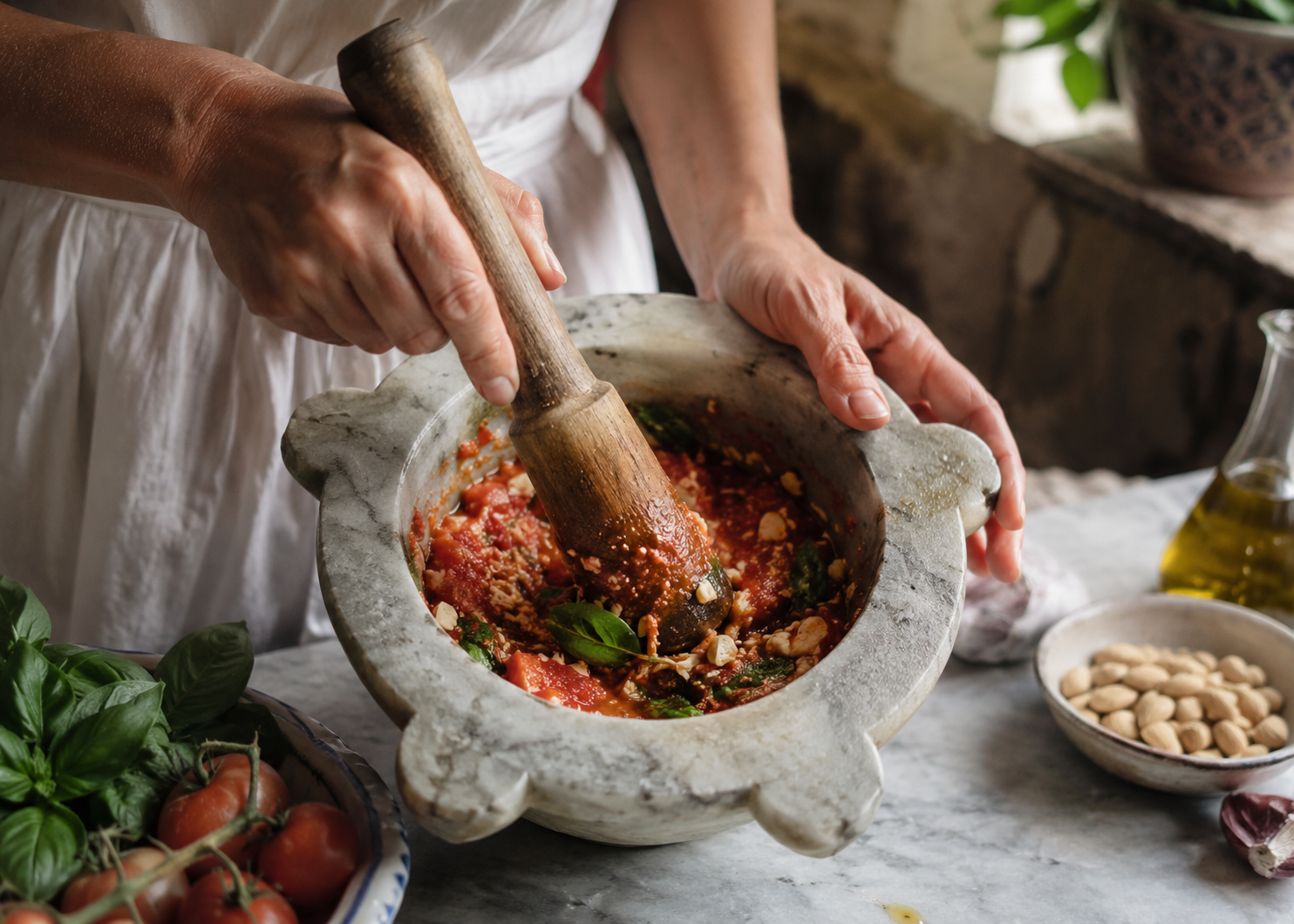
Making pesto alla trapanese is quick and requires no cooking of the sauce itself, but a few points of technique separate a good one from a great one. The most traditional method is a mortar and pestle, and the word pesto itself comes from the Italian for to pound, so purists insist on it. A food processor works perfectly well too, as long as you keep a light hand.
The key discipline is to keep the sauce coarse, never blitzing it to a smooth paste. You want texture: little nubs of almond, flecks of basil, the soft pulp of tomato. Blanching and peeling the tomatoes and the almonds first gives a smoother, sweeter result, since almond skins can be slightly bitter, though many cooks happily skip that step for a more rustic sauce. Garlic and salt go in first, then the almonds, then the basil, tomatoes, and olive oil, with the pecorino folded in at the end.
Then comes the pairing. The classic partner is busiate, the coiled, spiral Sicilian pasta whose twists trap the sauce beautifully, though any sturdy shape with ridges or curls will do. Toss the raw sauce through the hot, just-drained pasta with a splash of the starchy cooking water to loosen it, and never cook the sauce in a pan, which dulls its fresh flavour. A scattering of toasted breadcrumbs over the top, a very Sicilian touch, adds a lovely crunch, along with a little extra pecorino.
Beyond the Pasta Bowl
Although pesto alla trapanese was born to dress pasta, it would be a shame to confine it there, because the sauce is far more versatile than its origins suggest. Once you have a bowl of it, it becomes a small Sicilian secret weapon in the kitchen.
Spread it on toasted bread as a bruschetta or crostini topping and it makes an instant, vivid appetiser. Spoon it over grilled or seared fish and seafood, where its almond-and-tomato richness is especially good with scallops or prawns, and it turns a plain fillet into something memorable. It works alongside grilled meats and vegetables, stirred into warm grains, or even swirled through a simple soup. Anywhere you might want a hit of concentrated summer, it delivers.
It also has the advantage of keeping well, which pesto is not always known for. Stored in a jar under a thin film of olive oil, it holds in the fridge for several days, its flavour deepening rather than fading. That makes it worth doubling the batch: dress your pasta tonight, and spend the rest of the week finding new places to put the leftovers. It is the kind of thing that quietly improves almost everything it touches.
Bringing It Together
For a sauce with so much history, pesto alla trapanese is remarkably fast, a genuine fifteen-minute affair once the pasta water is on. That combination of deep tradition and weeknight ease is a large part of why it deserves a place in your repertoire, especially in high summer when tomatoes and basil are at their peak.
Make it when the tomatoes are ripe and the basil is fragrant, keep the sauce coarse and uncooked, toss it through good pasta, and finish it with breadcrumbs and cheese. Do that, and you will have a taste of western Sicily on your table in the time it takes to boil the water. It is proof that authenticity is not about following one canonical recipe but about honouring a place and its ingredients, almonds, tomatoes, and all, with no apologies required.
Pesto alla Trapanese (Sicilian Almond and Tomato Pesto)
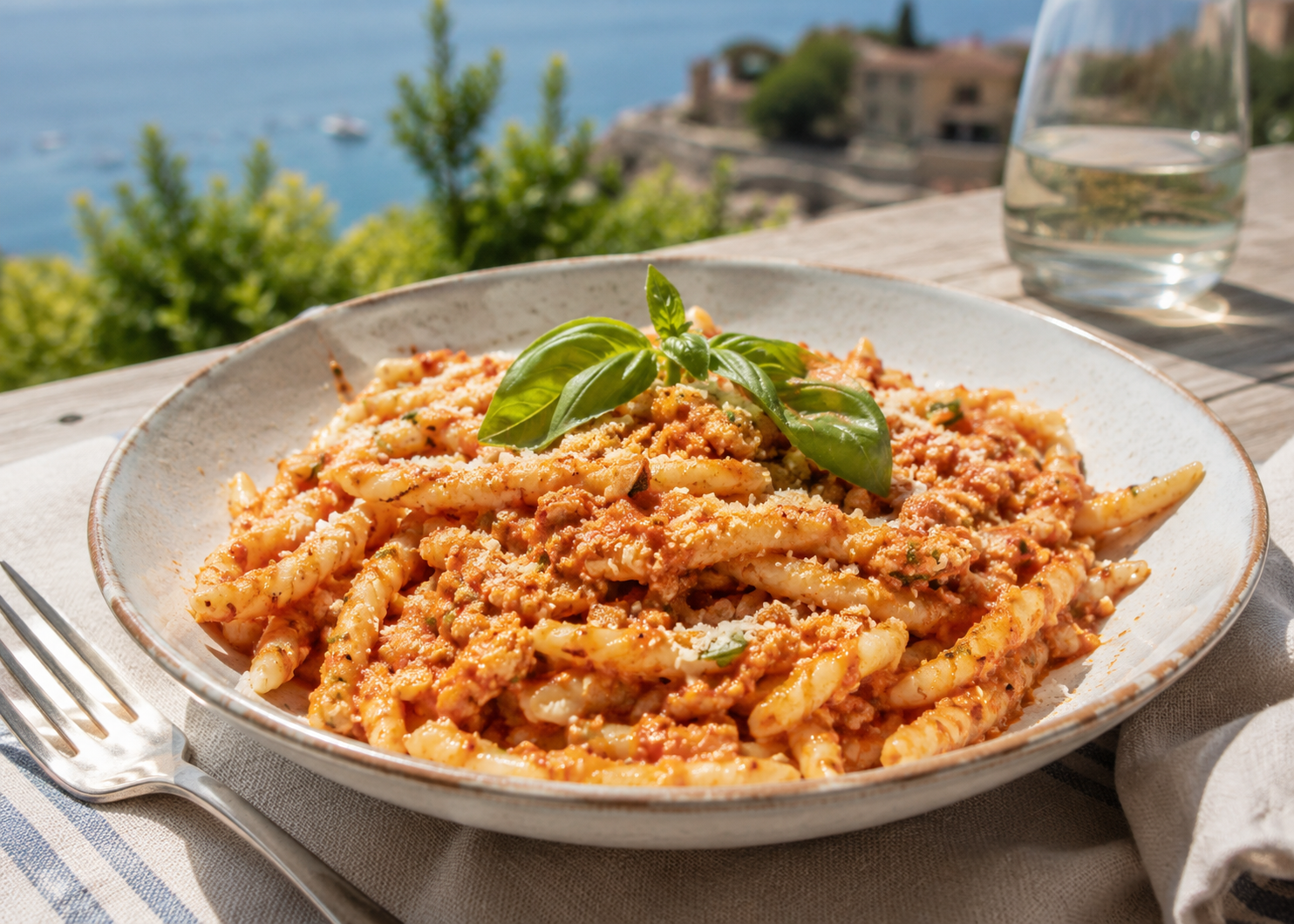
The red pesto of Trapani in western Sicily: ripe tomatoes, almonds, basil, garlic, and pecorino pounded into a raw, coarse sauce, tossed through pasta. No pine nuts, no cooking, ready in 15 minutes.
Serves: 4 · Prep: 15 minutes · Cook: pasta only
Ingredients
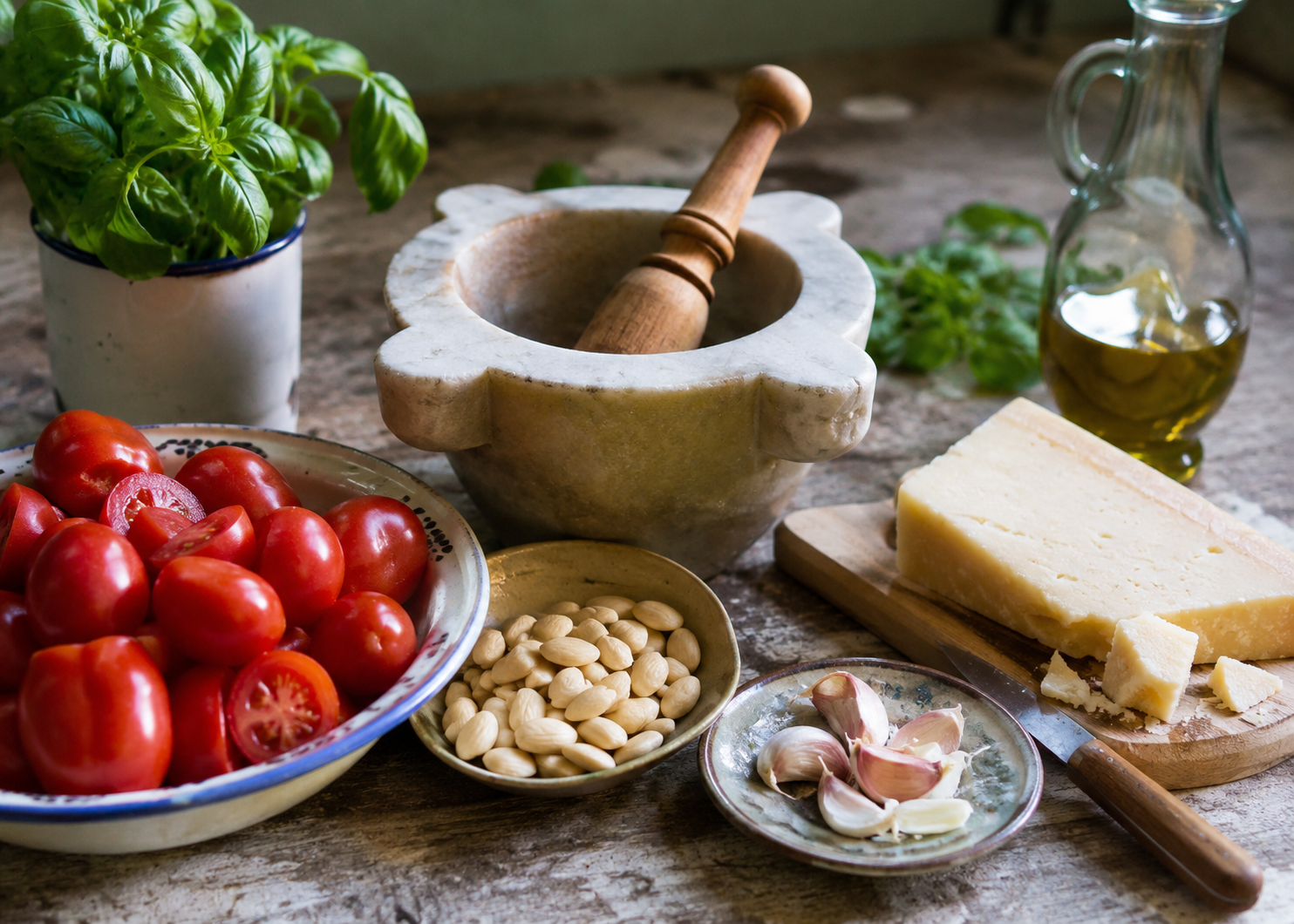
- 400 g (14 oz) ripe cherry or plum tomatoes
- 100 g (¾ cup) blanched almonds
- 40 g (1 large bunch) fresh basil leaves
- 1 to 2 garlic cloves
- 60 ml (¼ cup) extra-virgin olive oil, plus more as needed
- 50 g (½ cup) grated pecorino, plus extra to serve
- Salt, to taste
- Pinch of chilli flakes (optional)
- 400 g (14 oz) busiate, fusilli, or other ridged pasta
- Toasted breadcrumbs, to serve
Method
- Bring a small pot of water to the boil. Cut a small X in the base of each tomato and blanch for about 1 minute, then lift out, cool, and slip off the skins. Halve and remove excess seeds.
- If you like, lightly toast the almonds in a dry pan until fragrant, then cool. This is optional but adds depth.
- In a mortar and pestle or a food processor, pound or pulse the garlic with a pinch of salt. Add the almonds and work to a coarse meal.
- Add the basil, then the tomatoes and olive oil, and pound or pulse to a coarse, textured sauce. Do not blend it smooth.
- Stir in the pecorino and the chilli flakes if using. Taste and adjust salt and oil.
- Meanwhile, cook the pasta in well-salted water until al dente. Reserve a cup of the cooking water, then drain.
- Toss the hot pasta with the raw sauce, loosening with a splash of pasta water until it coats every strand. Do not cook the sauce.
- Serve at once, topped with toasted breadcrumbs and extra pecorino.
Notes
- A mortar and pestle is traditional and gives the best texture, but a food processor works if you pulse gently and keep the sauce coarse.
- Busiate, the coiled Sicilian pasta, is the classic pairing, but any ridged or twisted shape holds the sauce well.
- The sauce keeps in the fridge for up to a week; cover the surface with a thin layer of olive oil.
- For a variation, swap some or all of the almonds for Sicilian pistachios.

About the Author: Ruben, co-founder of Gamintraveler.com since 2014, is a seasoned traveler from Spain who has explored over 100 countries since 2009. Known for his extensive travel adventures across South America, Europe, the US, Australia, New Zealand, Asia, and Africa, Ruben combines his passion for adventurous yet sustainable living with his love for cycling, highlighted by his remarkable 5-month bicycle journey from Spain to Norway. He currently resides in Spain, where he continues sharing his travel experiences with his partner, Rachel, and their son, Han.