
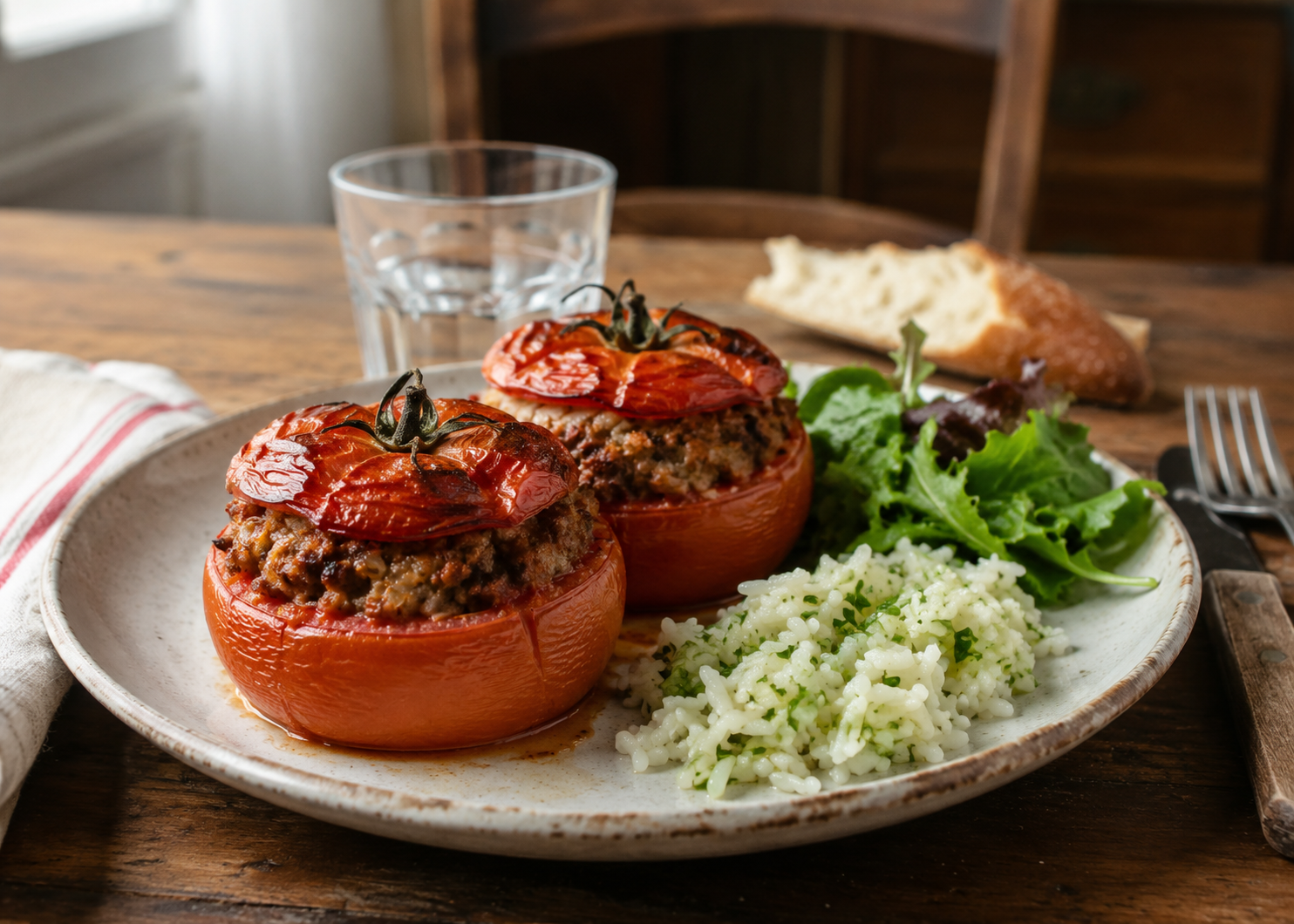
On Monday, the French fridge holds the ghost of Sunday. A few slices of roast, the last of a boiled dinner, a heel of bread going stale in the bread bin. In many homes, all of it has a destination: it is about to become tomates farcies, stuffed tomatoes, one of the great thrifty comfort dishes of French home cooking.
This is peasant food in the best sense, born not in a restaurant kitchen but in the daily problem of not wasting good food. Ripe summer tomatoes are hollowed out, filled with a savoury mixture of meat, bread, and herbs, and roasted until the tomatoes slump and sweeten and the tops turn golden. Served on a bed of rice to catch every drop of the juices, they turn the modest remains of one meal into something that tastes like it was the plan all along.
A Dish Invented to Use Up Sunday
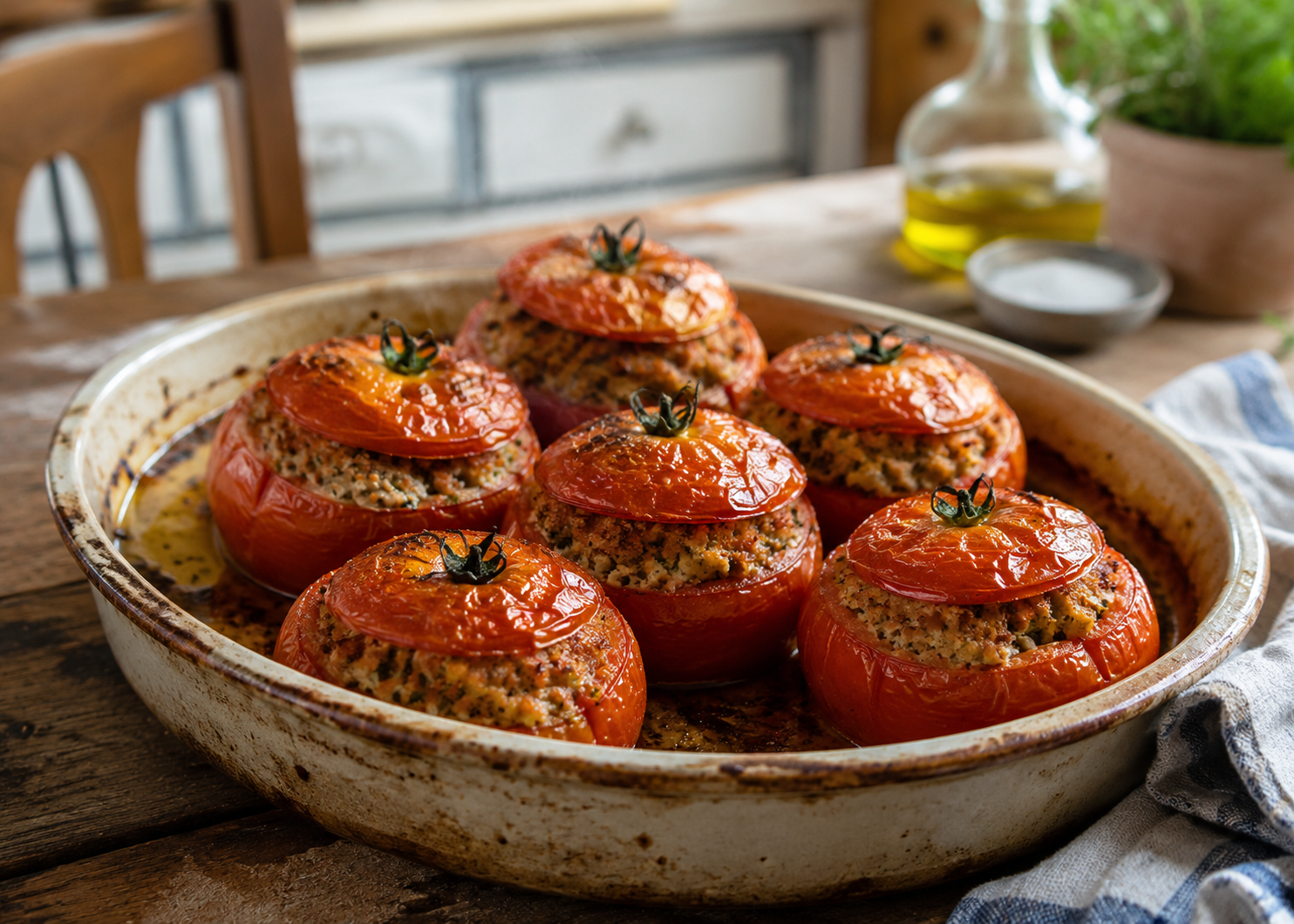
Tomates farcies were not designed to be elegant. They were designed to be sensible. The dish comes, most famously, from Provence and the south of France, where stuffed vegetables of every kind are a summer staple, but versions turn up across the country, and they all share the same frugal DNA.
In the old days, the filling was simply whatever meat was left over. The classic source was the boiled dinner, the pot-au-feu, whose leftover meat was too good to throw away but not enough for a meal on its own. Chopped up, bound with stale bread soaked soft in milk, seasoned with onion, garlic, and herbs, it became a stuffing with a second life. The stale bread was not a compromise but a feature, adding lightness and soaking up the meat and tomato juices as everything roasted.
Nothing was wasted, right down to the tomato itself. The pulp scooped from the middle did not go in the bin; it went into the bottom of the baking dish, where it melted into a simple sauce around the tomatoes as they cooked. This is cooking shaped by households that could not afford to throw food away, and the deliciousness is almost a happy accident of that thrift. The dish tastes generous precisely because it was built to be economical.
There is a lesson in that worth holding onto in a modern kitchen. So much home cooking now starts from a shopping list and a recipe, buying exactly what a dish demands and no more. Tomates farcies runs the other way, starting from what already exists and building a meal around it, and food made that way often has more soul than food bought precisely to spec.
Why You Will Never Find It in a Restaurant
There is a telling fact about tomates farcies: you do not really see them on French restaurant menus. This is emphatically a home dish, a family supper, the kind of thing cooked in domestic kitchens and passed down rather than plated for paying guests.
Where you will find them, in France, is at the butcher. Walk into a French boucherie in summer and you will often see trays of tomatoes already stuffed with the shop’s own seasoned meat, farcis ready to carry home and slide into your own oven. It is a dish woven into the ordinary rhythm of French domestic life, sold as a convenience for a weeknight rather than presented as a chef’s creation.
That domesticity is part of its charm and part of why it varies so much from house to house. Ask ten French cooks and you will get ten slightly different fillings, because the recipe was never fixed by a restaurant or a canon. It is a family recipe, meaning it belongs to whoever is making it, adjusted to their taste and, crucially, to whatever they happened to have left over. Mine will not be exactly like a grandmother’s in Nice, and that is entirely the point.
That looseness is liberating once you accept it. There is no authoritative version to get wrong, no single correct filling to measure yourself against. The dish asks only that you hollow a tomato, fill it with something savoury and well seasoned, and roast it kindly. Everything past that is yours to decide, which is exactly why it has survived in home kitchens for so long.
The Two Ways to Fill Them
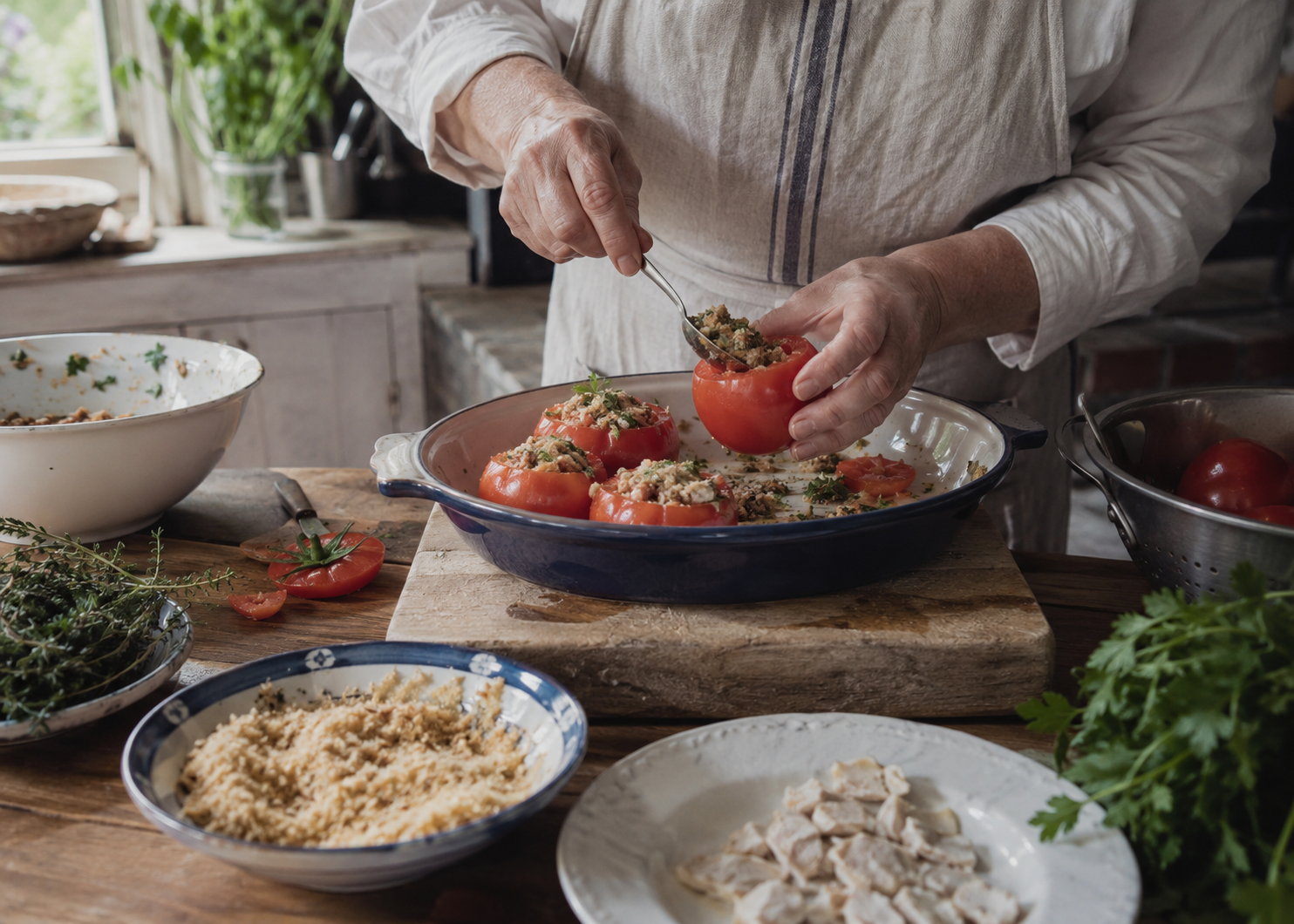
There are, broadly, two routes to the stuffing, and both are authentic. The first is the true leftovers version, the original: any cooked meat you have, from a roast, a stew, or a boiled dinner, chopped finely and used as the base. This is the thriftiest and arguably the most traditional path, the one the dish was invented for.
The second, and the one most people cook today, uses fresh meat, most often sausage meat. Good sausages with their casings slipped off, or plain sausage meat from the butcher, give a well-seasoned, juicy filling with almost no effort, since the sausage has already done the seasoning for you. Many cooks mix the sausage meat with a little ground beef or pork for balance. Either way, the fresh-meat version is reliable and forgiving, and it is what I would start with if you have never made the dish before.
Whichever meat you use, the supporting cast stays the same. Stale bread soaked in milk keeps the filling tender rather than dense, the trick French and Italian cooks alike use for meatballs. Onion and garlic soften in a little oil first. An egg binds everything, fresh parsley brightens it, and a spoon of herbes de Provence carries that unmistakable southern French scent of thyme, rosemary, and savory. It is a simple mixture, and it comes together in one bowl with your hands. You genuinely cannot get it very wrong, which is a rare and reassuring thing to be able to say about a recipe.
The Little Tricks That Make Them Work
Tomates farcies are easy, but a few small techniques separate a triumphant tray from a collapsed, watery one, and they are worth knowing before you start. None is difficult, and all of them are the kind of thing a French home cook does without thinking.
The first is to respect the tomato walls. When you cut the top off, saving it as a little hat, or chapeau, and scoop out the seeds and pulp, take care not to pierce through the sides or base, or the filling will leak and the tomato will collapse in the heat. A grapefruit spoon or melon baller makes this gentle work. Salting the hollowed insides and turning the tomatoes upside down for a few minutes draws out excess water, which keeps the finished dish from going soggy.
The second is the bread and the pulp. Soak the bread properly in milk until it is soft, and squeeze out the excess before mixing, so the filling is moist but not wet. Never discard the scooped-out pulp; chop it and spread it in the bottom of the dish with a splash of water or wine, where it becomes the sauce. And serve the tomatoes on rice, which is the classic and correct accompaniment, because rice is the perfect vehicle for soaking up the sweet, savoury juices that pool beneath them. A crusty baguette does the same job if you prefer.
It Is Not Only Tomatoes
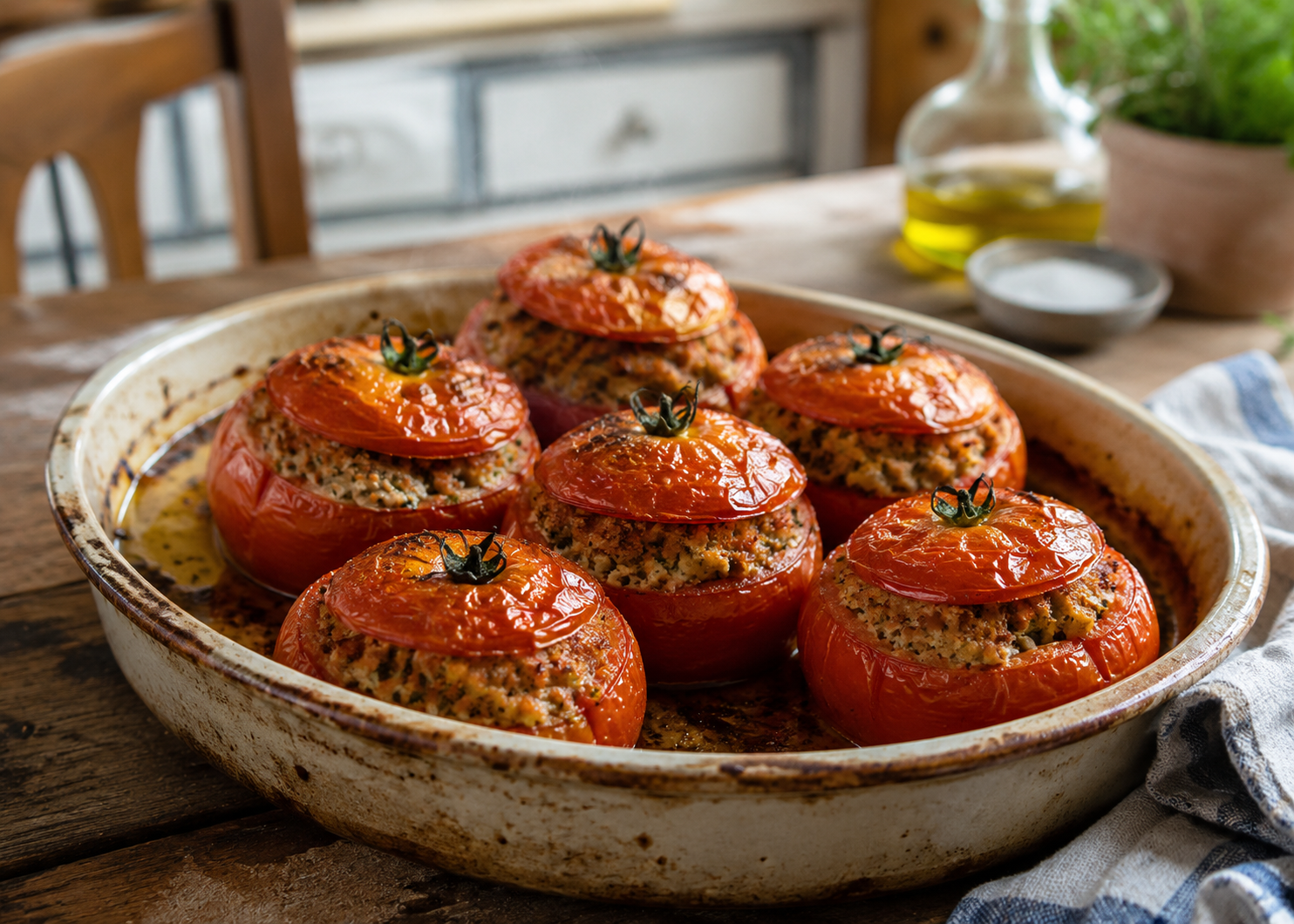
Once you understand the stuffed tomato, you have understood a whole family of French dishes, because in Provence the same idea is applied to almost every summer vegetable. The dish belongs to a tradition called petits farcis, little stuffed things, and the tomato is only its most famous member.
The same seasoned filling goes just as happily into hollowed courgettes, sweet peppers, small onions, and aubergines. Cooks often make a mixed tray, a few of each, from a single batch of stuffing, so a Provençal petits farcis is really a colourful assortment of stuffed vegetables roasting together in one dish. Each brings its own character: peppers turn sweet and soft, courgettes stay delicate, onions go almost jammy.
This is worth knowing because it makes the recipe endlessly flexible. If your tomatoes are small, or you have filling left over, which happens often, you can stuff whatever else is in the vegetable drawer and roast it alongside. The dish was born from using things up, and this is simply that same spirit extended across the whole garden. One bowl of filling, whatever vegetables you have, and an hour in the oven is the entire idea.
Making Them at Home
So here is the dish, in the fresh-sausage-meat version that is the easiest place to begin, with the leftover-meat variation noted for when you have a Sunday roast to use up. It is a genuinely forgiving recipe, hard to ruin and easy to make your own, exactly as a good family dish should be.
Make it in high summer, when tomatoes are ripe and cheap and full of flavour, because a great tomates farcies depends entirely on a great tomato. Choose firm, round ones of roughly equal size so they cook evenly, and if any wobble, shave a sliver off the base so they stand upright in the dish. Then let the oven do the work while the kitchen fills with the smell of roasting tomatoes and herbs, which is one of the more welcoming smells a home can hold.
Tomates Farcies (French Stuffed Tomatoes)
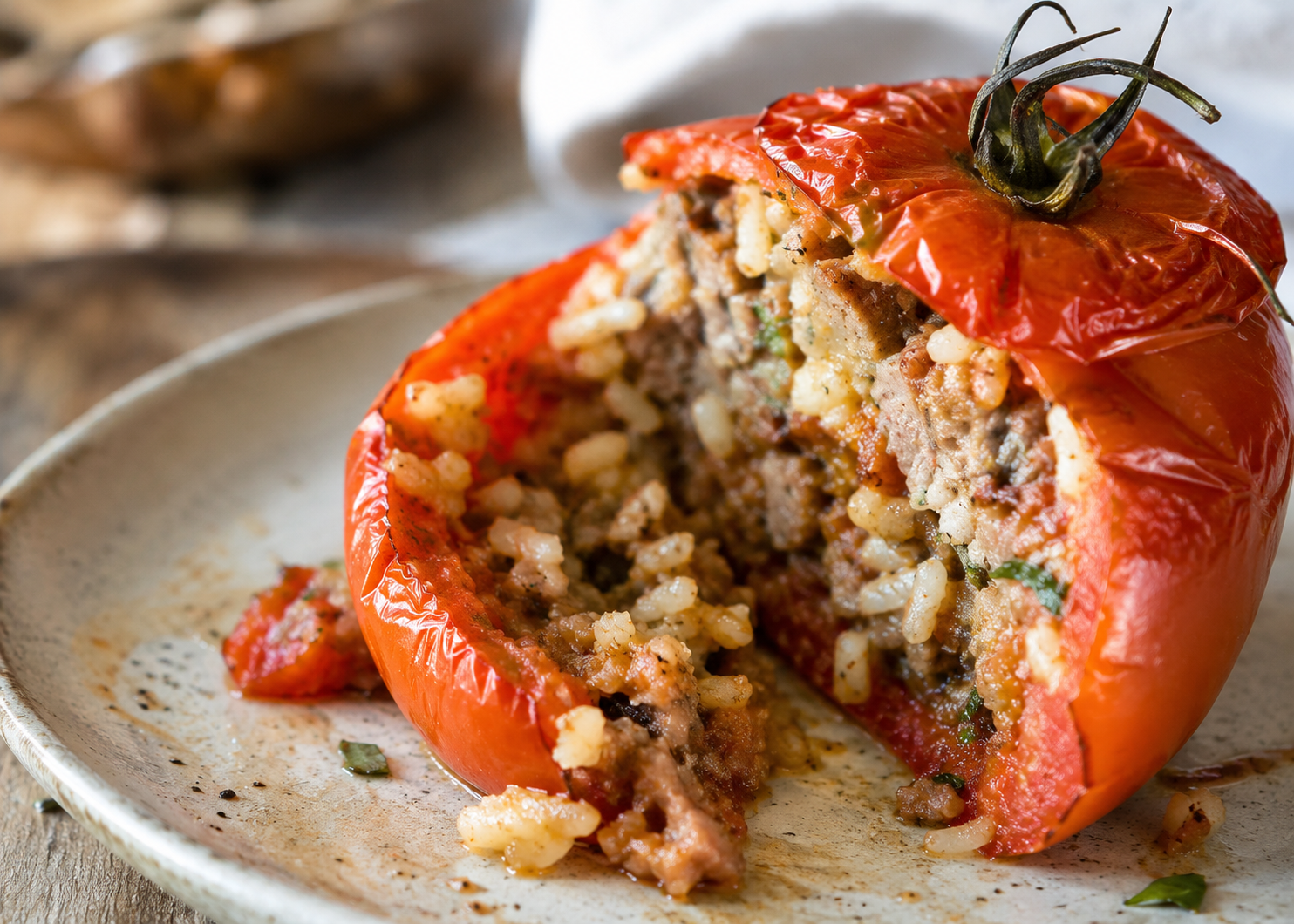
Ripe summer tomatoes stuffed with seasoned meat, bread, and herbs, then roasted on their own sweet juices and served over rice. A thrifty French home classic built to use up whatever Sunday left behind.
Serves: 4 · Prep: 30 minutes · Cook: 1 hour · Total: 1 hour 30 minutes
Ingredients
- 8 medium-large ripe tomatoes, ideally on the vine
- 400 g (14 oz) sausage meat, or good sausages with casings removed
- 200 g (7 oz) ground beef or pork (optional, for a mixed filling)
- 2 thick slices stale bread, cut into cubes
- 100 ml (⅓ cup plus a splash) milk, for soaking the bread
- 1 onion, finely chopped
- 3 garlic cloves, finely chopped
- 1 egg
- Small handful fresh parsley, chopped
- 1 tsp herbes de Provence
- 3 tbsp olive oil
- Salt and freshly ground black pepper
- 200 g (1 cup) long-grain rice, to serve
Method
- Preheat the oven to 200°C (400°F). Wash the tomatoes and slice the top off each one, keeping the tops as little hats. Scoop out the seeds and pulp with a spoon, taking care not to pierce the walls or base. Reserve the pulp. Season the hollow insides with salt and sit the tomatoes upside down to drain while you make the filling.
- Put the bread cubes in a bowl with the milk and leave to soak until soft. Squeeze out and discard the excess milk.
- Warm 1 tablespoon of the oil in a small pan and soften the onion over medium heat until golden, about 8 minutes. Add the garlic for the final minute, then let it cool slightly.
- In a large bowl, combine the sausage meat (and ground meat, if using), the soaked bread, the onion and garlic, the egg, parsley, herbes de Provence, and a good pinch of salt and pepper. Mix well with your hands.
- Turn the tomatoes right side up in an oiled baking dish. Fill each generously with the meat mixture, mounding it slightly, then set the tomato hats back on top.
- Chop the reserved pulp and scatter it around the tomatoes with a splash of water. Drizzle everything with the remaining oil.
- Bake for 45 to 60 minutes, until the tomatoes are soft and browned and the filling is cooked through, basting once with the juices halfway. Meanwhile, cook the rice.
- Rest for 5 minutes, then serve the tomatoes on a bed of rice with the pan juices spooned generously over the top.
Notes
- Leftover-meat version: replace the sausage meat with around 500 g of finely chopped cooked meat from a roast, stew, or boiled dinner. This is the original, thriftiest form of the dish.
- Vegetarian version: fill the tomatoes with a mixture of cooked rice, sautéed mushrooms, and lentils, seasoned the same way.
- Make-ahead: assemble the stuffed tomatoes a day in advance, keep covered in the fridge, and bake just before serving.
- Choose firm, ripe tomatoes of similar size, and trim a sliver off the base of any that will not stand upright.

About the Author: Ruben, co-founder of Gamintraveler.com since 2014, is a seasoned traveler from Spain who has explored over 100 countries since 2009. Known for his extensive travel adventures across South America, Europe, the US, Australia, New Zealand, Asia, and Africa, Ruben combines his passion for adventurous yet sustainable living with his love for cycling, highlighted by his remarkable 5-month bicycle journey from Spain to Norway. He currently resides in Spain, where he continues sharing his travel experiences with his partner, Rachel, and their son, Han.