
Watch a Spanish grandmother make pollo al ajillo and you will not see her reach for a recipe card, a scale, or a measuring spoon. She browns the chicken in olive oil until the kitchen smells of it, throws in more garlic than seems reasonable, splashes in wine from the bottle already open, and lets the pan do the rest. There is no written method because there does not need to be one. The dish lives in her hands.
Pollo al ajillo, garlic chicken, is one of the most beloved and most humble dishes in all of Spanish cooking. It is a staple of tapas bars from Madrid to the villages of Andalusia and, more importantly, of ordinary home kitchens across the country. It uses a handful of cheap ingredients and a single pan, and it delivers a depth of flavour that tastes like it took hours. Here is how to make it, and how to make it well.
The Dish With No Written Recipe
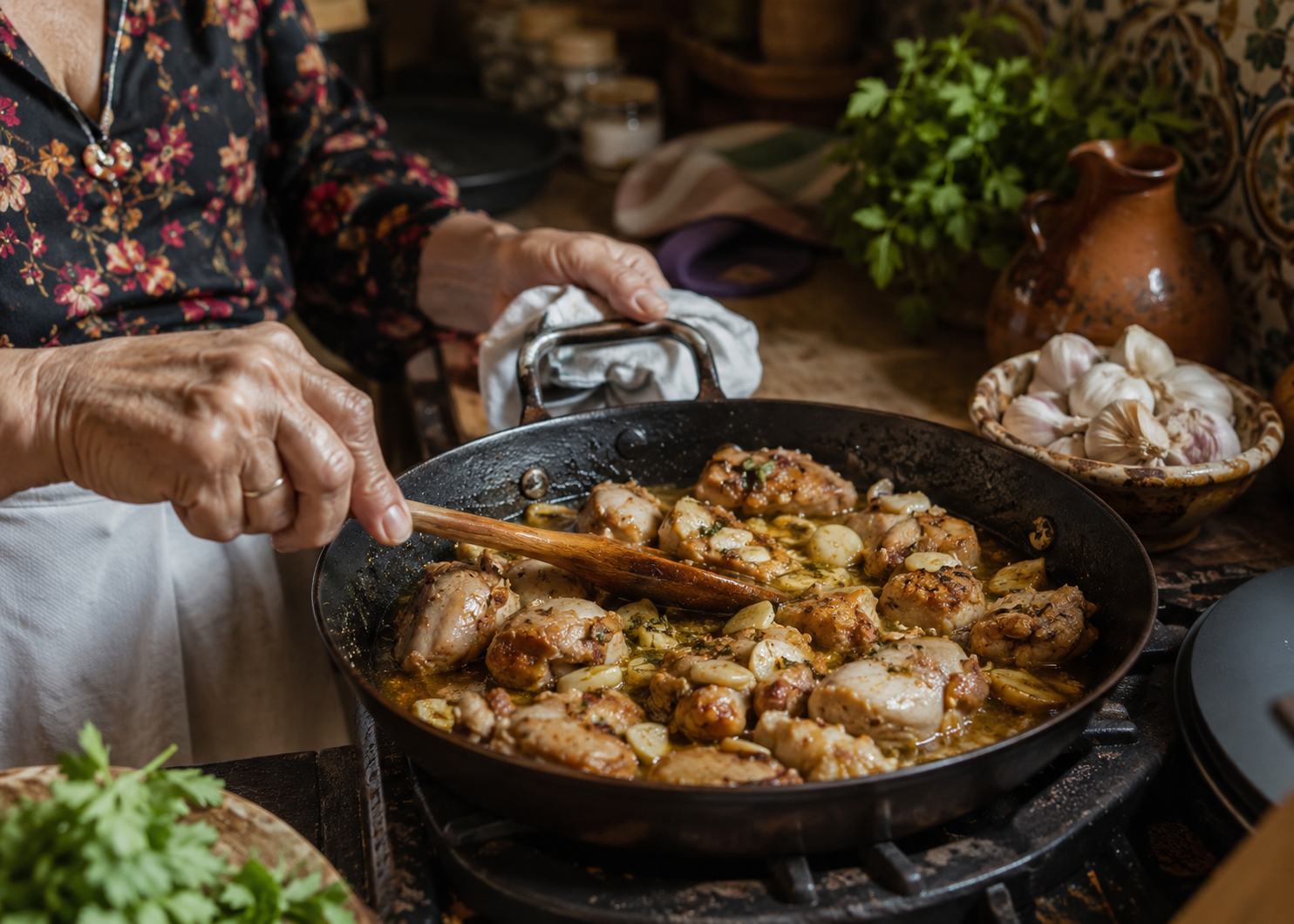
The reason pollo al ajillo has no fixed recipe is that it was never learned from one. It is a dish passed down by watching, from grandmother to mother to daughter, absorbed in the kitchen rather than copied from a page. Everyone’s is a little different, and everyone’s is correct.
At its heart there are only three real ingredients: pollo, chicken; ajillo, garlic; and vino blanco, white wine, or the sherry that many cooks prefer. Everything else, the olive oil, the bay leaf, the parsley, is supporting cast. This radical simplicity is exactly why it belongs to home cooks rather than restaurants. There is nothing to hide behind, no elaborate technique or long list, just good chicken, a lot of garlic, and a splash of something to make a sauce.
That simplicity is also why it survives and spreads. A dish you can make from what is already in the kitchen, in one pan, in half an hour, is a dish that gets cooked on ordinary Tuesdays for generations. It is comfort food in the truest sense, the kind of thing a Spanish cook makes without thinking because their hands already know the way. Learning it is less about following steps than about understanding a few simple ideas.
What Al Ajillo Actually Means
The key to the whole dish is in its name. In Spanish cooking, when something is done al ajillo, it means it is cooked with a generous amount of garlic and usually braised in wine. It is less a single recipe than a formula, a way of cooking that can be applied to almost anything.
The most famous example is probably gambas al ajillo, prawns sizzled in garlicky olive oil, a tapas-bar classic the world over. But the same treatment works beautifully on mushrooms, on rabbit, and, of course, on chicken. Understanding this is freeing, because it means pollo al ajillo is not a rigid dish to be memorised but an idea to be applied: take your ingredient, cook it with plenty of garlic and a splash of wine, and you are already most of the way there.
The style has deep roots in the south, in Andalusia, where garlic and olive oil are the twin pillars of the kitchen. It is peasant cooking elevated by nothing more than good ingredients and confidence. There is no cream, no stock cube, no shortcut; the flavour comes entirely from browning the chicken properly, cooking the garlic to sweetness, and letting the wine pull everything together into a sauce. Master that logic and you can cook the dish forever without ever needing it written down.
A Tapas Bar and a Home Table
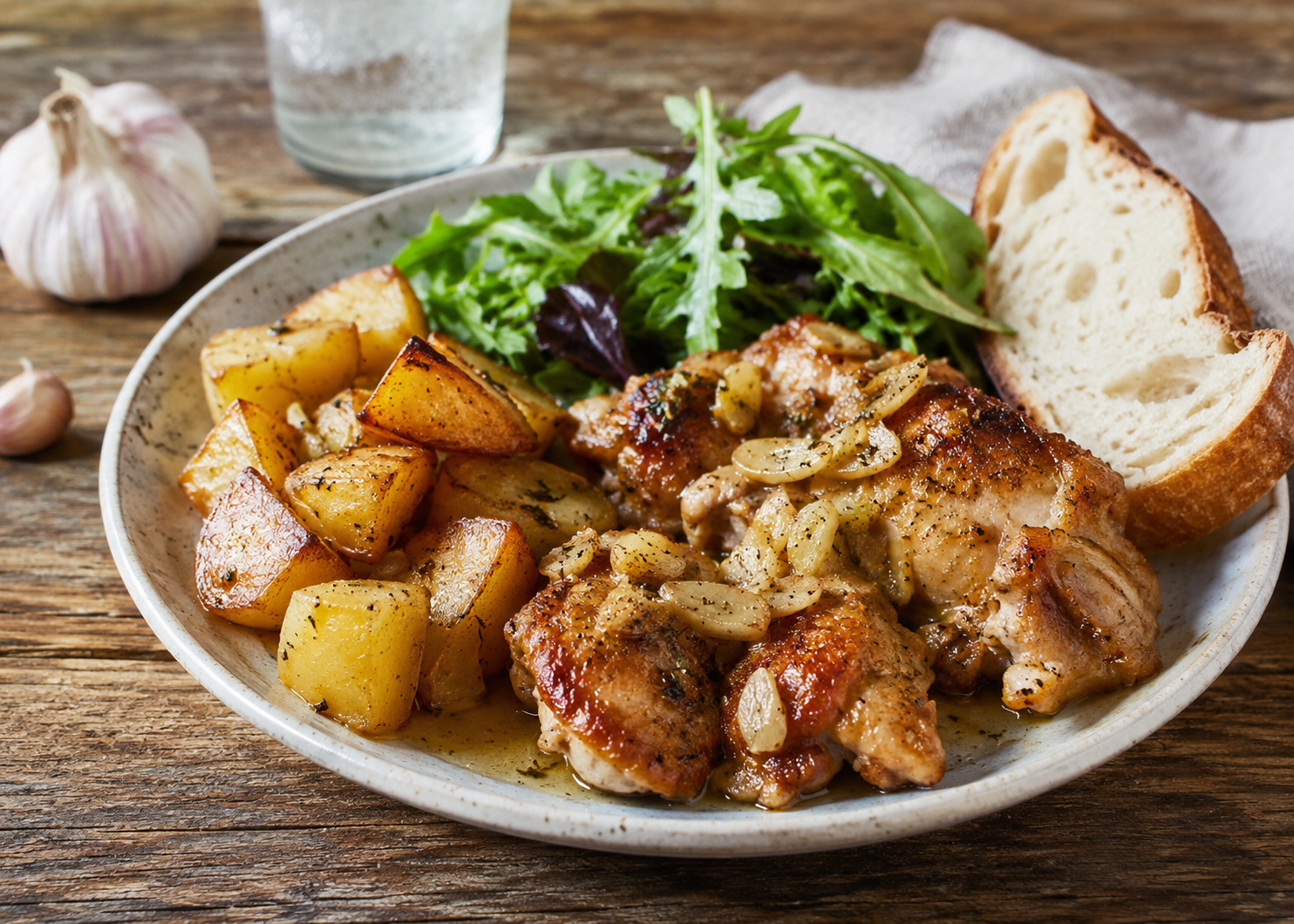
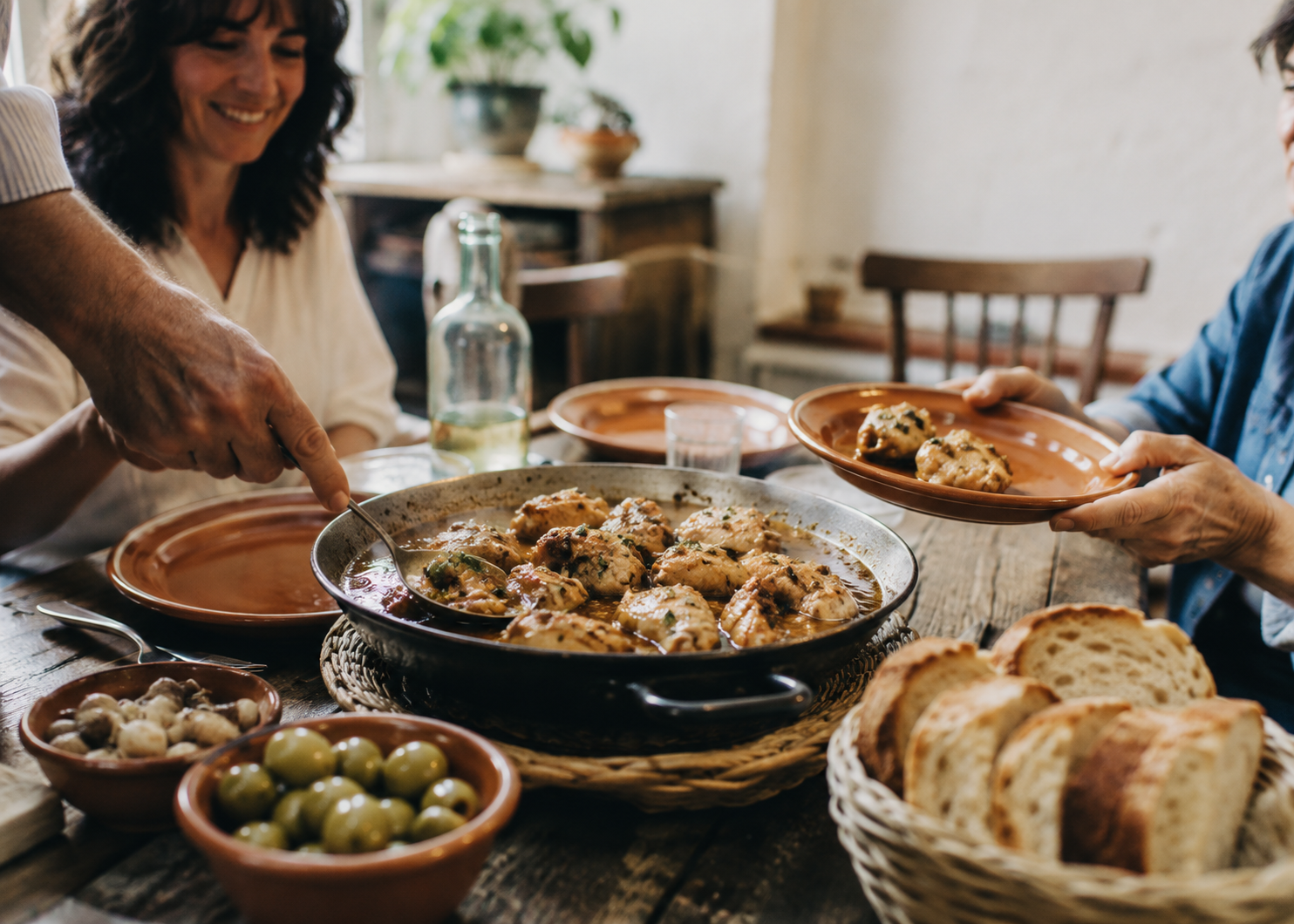
Part of what makes pollo al ajillo so loved is that it lives two lives at once. In a tapas bar, it arrives sizzling in a little earthenware dish, a cazuela, as a small ración to share over drinks, the garlic still spitting in the oil. At home, it becomes a full family dinner, a panful of chicken with a puddle of golden sauce in the middle of the table.
Both versions are the same dish, and both revolve around the same small ritual: the bread. No Spaniard eats pollo al ajillo without a piece of bread in hand to drag through the sauce, and the little cloves of soft, sweet garlic get squeezed from their skins and smeared onto it. Half the pleasure of the dish is in that mopping, which is why nobody minds that the sauce is really just oil, garlic, and wine reduced together.
You meet it everywhere in Spain, which is part of its charm. It is on the menu of the humblest roadside bar and cooked in the grandest home kitchen, and it tastes essentially the same in both, because there is not much to get wrong once the garlic behaves. It is not a special-occasion dish or a showpiece. It is simply one of the things Spain cooks when it wants to eat well without any fuss.
The One Mistake That Ruins It
If there is a single thing that separates a great pollo al ajillo from a disappointing one, it is the garlic, and specifically not burning it. Garlic turns bitter the instant it blackens, and burnt garlic will taint the whole sauce with a harsh, acrid note that no amount of wine can rescue.
The fix is simple attention. Cook the garlic only until it is golden and fragrant, never dark brown, and take it off the heat the moment it gets there. Many Spanish cooks use a clever trick: they cook the garlic cloves whole, still in their skins, lightly smashed. The skin protects the clove from scorching while it releases its flavour into the oil, and the soft, sweet, roasted garlic can then be squeezed out later, onto a piece of bread or back into the sauce. Others fry sliced garlic first, remove it before it can burn, and return it near the end.
Beyond the garlic, the other common error is the chicken itself. Use bone-in, skin-on pieces, thighs and drumsticks rather than breast, because they stay juicy through the cooking while breast dries out and turns stringy. Brown them properly, taking the time to get real colour on the skin, because that browning is where a huge amount of the flavour comes from. Rush that step and the dish tastes flat no matter what else you do.
Sherry or White Wine
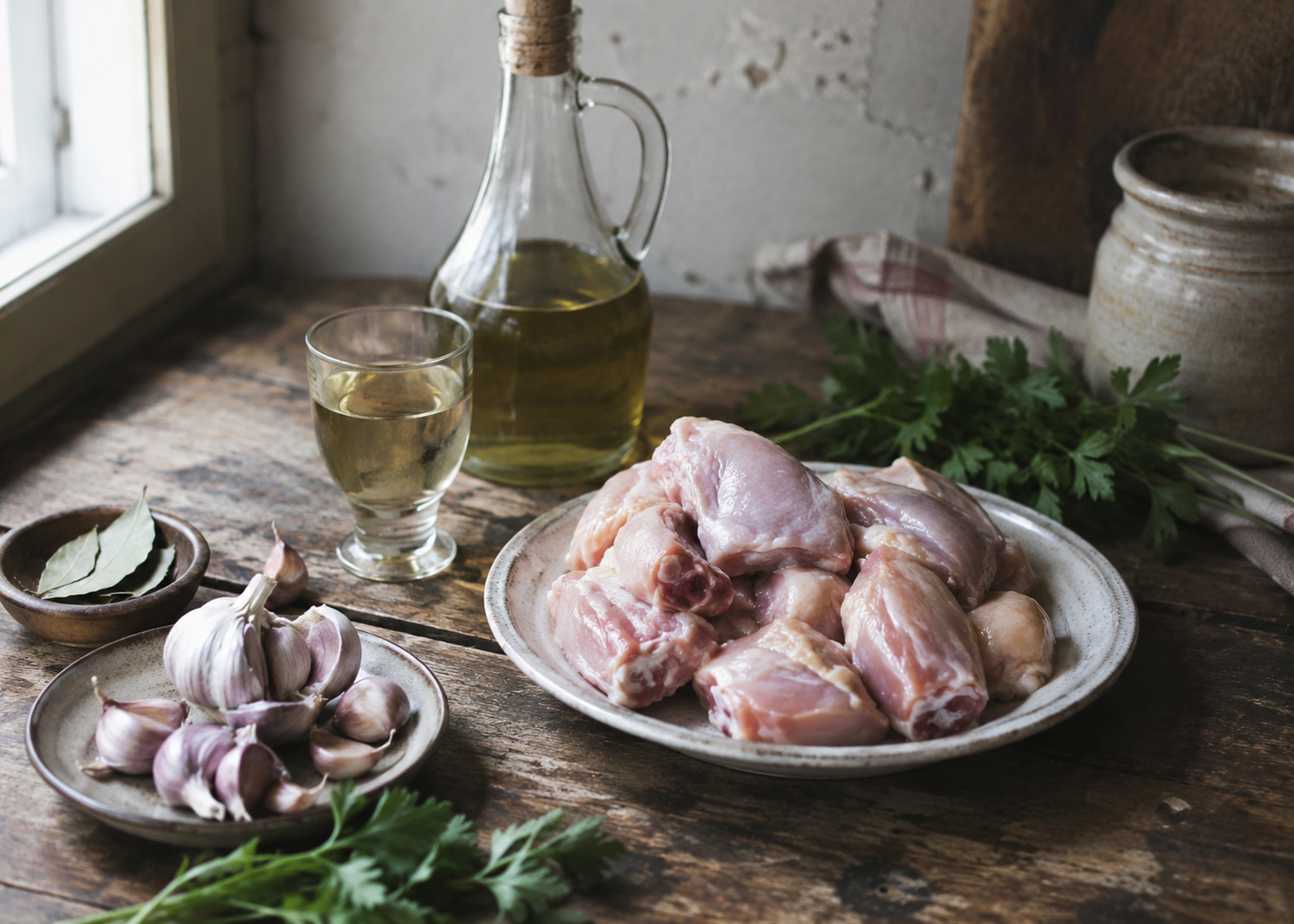
The one genuine choice in the dish is what to pour in for the sauce, and it comes down to sherry or white wine. Both are traditional, and the difference is worth understanding so you can pick.
Dry sherry, especially a fino or Manzanilla from Andalusia, is the most distinctly Spanish option and arguably the most authentic. It brings a nutty, savoury depth that white wine cannot quite match, and it is what many grandmothers in the south would reach for. Outside Spain, though, good dry sherry can be harder to find or feel too precious to pour into a pan, which is why the everyday alternative exists.
Dry white wine is the common substitute, and it makes an excellent pollo al ajillo, brighter and more acidic than the sherry version but every bit as good in its own way. If you cook without alcohol, chicken broth stands in fine. Whichever you choose, its job is the same: to deglaze the pan, lifting all the browned flavour stuck to the bottom, and to reduce into a glossy sauce that coats the chicken. And whatever you do, have bread on the table, because the sauce is half the point, and mopping it up with good crusty bread is how the dish is meant to be finished.
What to Serve With It
The honest answer to what goes with pollo al ajillo is bread, and then almost anything. Because the sauce is the soul of the dish, the first requirement is always something to soak it up, and a good crusty loaf does that better than anything else.
If you want to make more of a meal of it, potatoes are the classic partner, either roasted alongside or fried, and rice works too, spooned under the chicken to catch the juices the way it does with so many Spanish dishes. A simple green salad on the side, dressed with just olive oil and vinegar, cuts nicely through the richness. Keep the accompaniments plain, because the chicken and its garlicky sauce are meant to be the star and want no competition.
To drink, a glass of the same dry sherry you cooked with is a lovely and very Spanish choice, though a cold beer or a simple white wine is just as welcome. None of it is complicated, and none of it should be. This is a dish that asks only for bread, something to drink, and people around the table who are not in a hurry.
Making It at Home
So here is the method, written down at last, though the whole spirit of the dish is that you will soon stop needing it on the page. Cook it a few times and your hands will learn the rhythm on their own: brown, garlic, wine, reduce, bread on the table.
The quantities below are a starting point, not a rule. Add more garlic if you love it, which you should. Reach for sherry if you have it and white wine if you do not. The one thing that genuinely matters is not burning the garlic. Everything else is yours to adjust until the dish tastes like your own.
Pollo al Ajillo (Spanish Garlic Chicken)
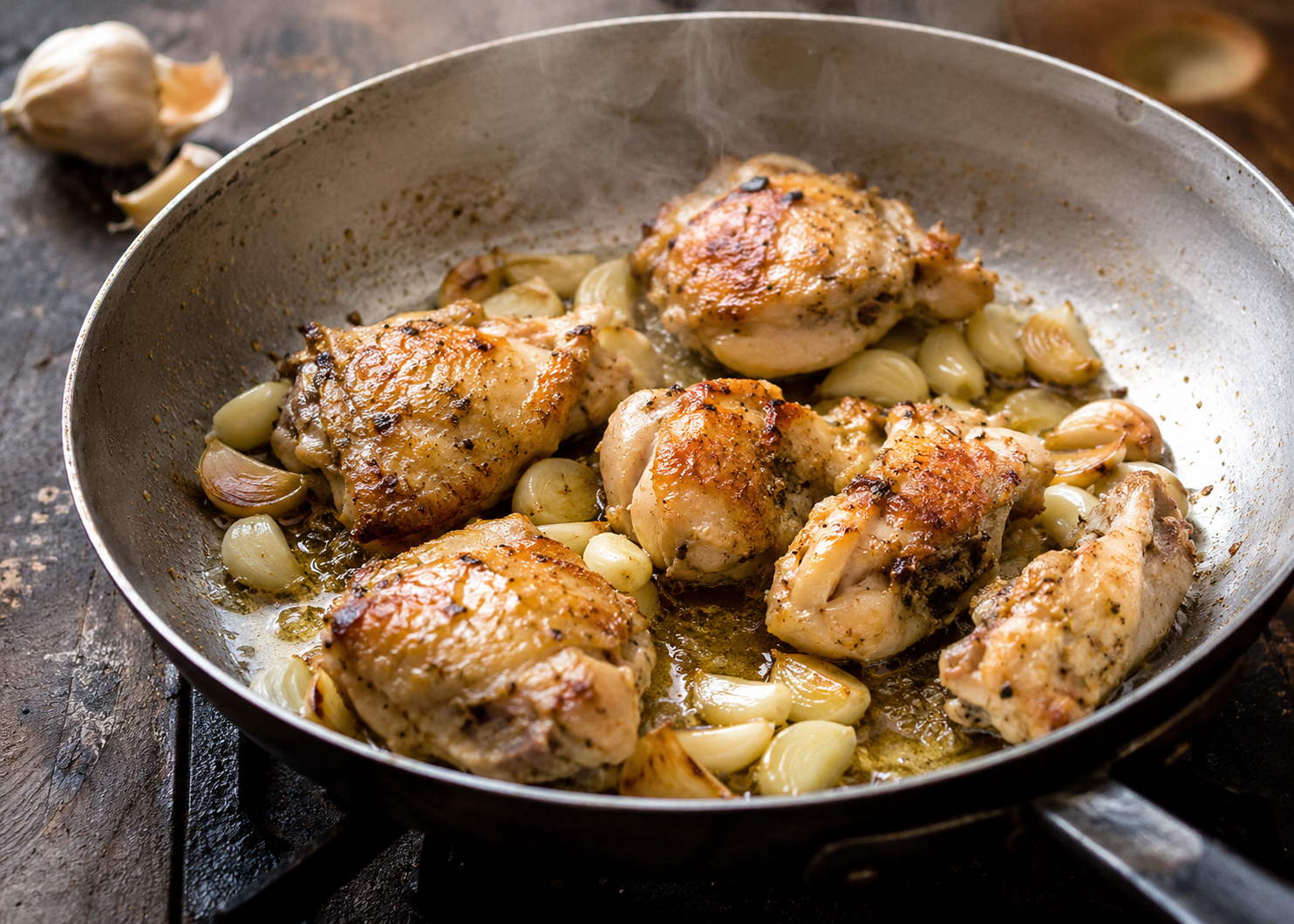
Bone-in chicken browned in olive oil, simmered with a whole head of garlic and a splash of sherry or white wine, and finished with parsley. A one-pan Spanish classic best served with bread to soak up the sauce.
Serves: 4 · Prep: 10 minutes · Cook: 30 minutes · Total: 40 minutes
Ingredients
- 1 kg (2¼ lb) bone-in, skin-on chicken thighs and drumsticks, or a whole chicken cut into pieces
- 5 tbsp olive oil
- 1 whole head of garlic (about 12 cloves), sliced, or the cloves lightly smashed in their skins
- 150 ml (⅔ cup) dry white wine, or fino or Manzanilla sherry
- 2 bay leaves
- 1 sprig fresh rosemary or thyme (optional)
- Small handful fresh parsley, chopped
- Salt and freshly ground black pepper
- Squeeze of lemon (optional)
- Crusty bread or potatoes, to serve
Method
- Pat the chicken dry and season all over with salt and pepper.
- Heat the olive oil in a large, deep skillet over medium-high heat. Brown the chicken in batches, skin-side down first, until deeply golden on both sides. Transfer to a plate.
- Lower the heat to medium. Add the garlic to the same oil and cook gently until golden and fragrant, never letting it brown or burn. If you like, lift the garlic out and set it aside at this point.
- Return the chicken to the pan, add the bay leaves and herbs, and pour in the wine or sherry, scraping up the browned bits from the bottom.
- Cover, reduce the heat to low, and simmer for about 20 minutes, turning the pieces once, until the chicken is cooked through. Return the garlic to the pan if you removed it.
- Uncover, raise the heat to medium-high, and let the sauce bubble and reduce for about 5 minutes, until glossy and slightly thickened.
- Remove from the heat, discard the bay leaves, and scatter over the parsley with a squeeze of lemon if using.
- Serve hot with plenty of crusty bread for the sauce, squeezing the soft roasted garlic from its skin onto the bread as you go.
Notes
- Never let the garlic blacken; burnt garlic turns the whole sauce bitter. Golden and fragrant is the target.
- Use bone-in, skin-on thighs and drumsticks, not breast, which dries out over the simmer.
- Sherry is the most traditional and distinctly Spanish choice; dry white wine is the easy everyday substitute, and chicken broth works without alcohol.
- For a smokier version, stir a teaspoon of sweet pimentón into the oil with the garlic. The same method also makes conejo al ajillo, the classic garlic rabbit.

About the Author: Ruben, co-founder of Gamintraveler.com since 2014, is a seasoned traveler from Spain who has explored over 100 countries since 2009. Known for his extensive travel adventures across South America, Europe, the US, Australia, New Zealand, Asia, and Africa, Ruben combines his passion for adventurous yet sustainable living with his love for cycling, highlighted by his remarkable 5-month bicycle journey from Spain to Norway. He currently resides in Spain, where he continues sharing his travel experiences with his partner, Rachel, and their son, Han.