

On Tuesday mornings, Susan does the Mercado Central run: two kinds of tomatoes, a bag of clementines, whatever fish the woman at stall 87 says is good, and a coffee standing up on the way out, all of it for less than the parking would have cost at her old supermarket in Ohio.
Susan is 63, from the Cleveland suburbs, and she has lived in Valencia since April 2024 on $2,380 a month, her Social Security check plus a small pension from twenty-two years in a school district office. She is a composite, drawn from the American retirees we know and have talked with in Spain, and every number in her budget below is a real, current market number. The point of building her is to answer the question the income figure always raises: not whether $2,380 is enough for Valencia, but where it actually goes once the honeymoon ends and the real bills arrive.
Two years in, she can tell you to the euro.
The Number Behind The Number
Start with the quiet math nobody puts in a headline. At recent exchange rates, $2,380 converts to roughly €2,180, and that conversion is the single most important line in Susan’s budget, because it moves without her permission. When the dollar weakens five cents against the euro, her income drops about $100 a month in purchasing power while nothing else changes. She learned to watch the rate the way Ohio taught her to watch the weather.
Her defense is boring and effective. She keeps three months of expenses in euros in her Spanish account at all times and converts quarterly through a transfer service rather than her bank, which saves her the several percent the old wire transfers used to skim. When the rate is good she converts extra; when it is bad she spends down the euro cushion and waits. It is the closest thing her retirement has to active management, and it takes twenty minutes a quarter.
The banking itself took a month to understand and now runs itself. Spanish utilities and insurance insist on domiciliación, direct debit from a Spanish account, so she keeps a no-fee local account for the bills and the rent, feeds it from her US accounts through the transfer service, and touches none of it manually. The one thing she never did, on firm advice, was try to run a Spanish life from an American bank card, which works right up until the moment a utility company needs an IBAN.
The second piece of quiet math is the visa. Spain’s non-lucrative visa asks for more monthly income than Susan’s checks provide on their own, around €2,400 at current thresholds, and she qualified the way many retirees do, by showing savings to cover the gap, a lump sum in her accounts that satisfied the consulate. That savings cushion still exists, and it is what turns her budget from tightrope to comfortable. Anyone planning this move on Social Security alone should hear that part first.
Rent: The Contract That Saved Her

Susan pays €780 a month for a one-bedroom with a small balcony in Benimaclet, the old-village-turned-neighborhood near the university lines, fifteen minutes from the center by tram.
That number is the envy of every American who arrived after her, and the reason is timing plus paperwork. She signed a proper long-term contract, the Spanish LAU lease that locks in five years with rises capped to an index, in spring 2024, and then Valencia’s rental market went vertical. Rents in the city rose almost 9 percent in the last year alone, and her same flat lists today closer to €950. Her contract is the moat around her whole budget.
Benimaclet itself is half the value. The old village core keeps a plaza, a Friday market, and bars where the menú costs what it should, students keep the streets alive, and the tram puts the old town fifteen minutes away, which lets her live at neighborhood prices with city access. Newcomers chasing the postcard tend to pay Ruzafa or El Carmen prices, €1,200 and up now, for the privilege of living inside the noise they will spend year two escaping.
The lesson she repeats to newcomers is unglamorous: the single most valuable thing you will do in your first month is sign a real annual contract, not a seasonal one, not eleven months, not a friendly arrangement, and have a gestor read it before you do. The €200 that review cost her has returned itself roughly twenty times.
The Full Monthly Ledger

Here is where the €2,180 goes in an ordinary month, two years in:
- Rent: €780
- Utilities: €130 (electricity with summer air conditioning, water, gas, averaged across the year)
- Private health insurance: €115 (full coverage, no copay, required for her visa renewals at age 63)
- Groceries: €300 (Mercadona for the base, Mercado Central for the pleasure)
- Phone and fiber internet: €40
- Transport: €25 (the SUMA card covers metro, tram, and bus; she walks most days)
- Eating out and café life: €220 (menús del día at €13-15, the Friday vermut, coffees that cost €1.60)
- Taxes set aside: €250 (the line nobody warned her about, explained below)
- Travel pot: €150 (one flight to Ohio a year, plus cheap trains around Spain)
- Everything else: €140 (pharmacy, haircuts, gifts, the gym at the municipal polideportivo)
Two absences from that list do real work. There is no car line, which she still calls her raise, and no cable television line, because the plaza does what the recliner used to. Clothing barely features, partly the climate, partly a city where her daily life runs on comfortable shoes and no occasions that require Ohio’s department-store wardrobe.
Total: roughly €2,150, against €2,180 coming in. It works, in a city where the sun is free and the tram costs a euro, with almost nothing left over in an ordinary month, which is why the savings cushion matters and why she laughs at the blogs that describe her income level as living like royalty. It is not royalty. It is a comfortable, walkable, unhurried life with a real budget discipline underneath it.
The first year carried setup costs the monthly ledger never shows, and she tells people to plan for them out loud: about $1,800 for the immigration lawyer and visa paperwork, several hundred more in apostilles, translations, and FBI checks, the flights, the two months of pricier temporary housing while she hunted for the real flat, and roughly €3,500 furnishing it, since Spanish rentals come anywhere from furnished to four bare walls. Year one cost her about $8,000 beyond the monthly budget, which is the number the savings cushion is really for.
The Tax Surprise Nobody Blogs About
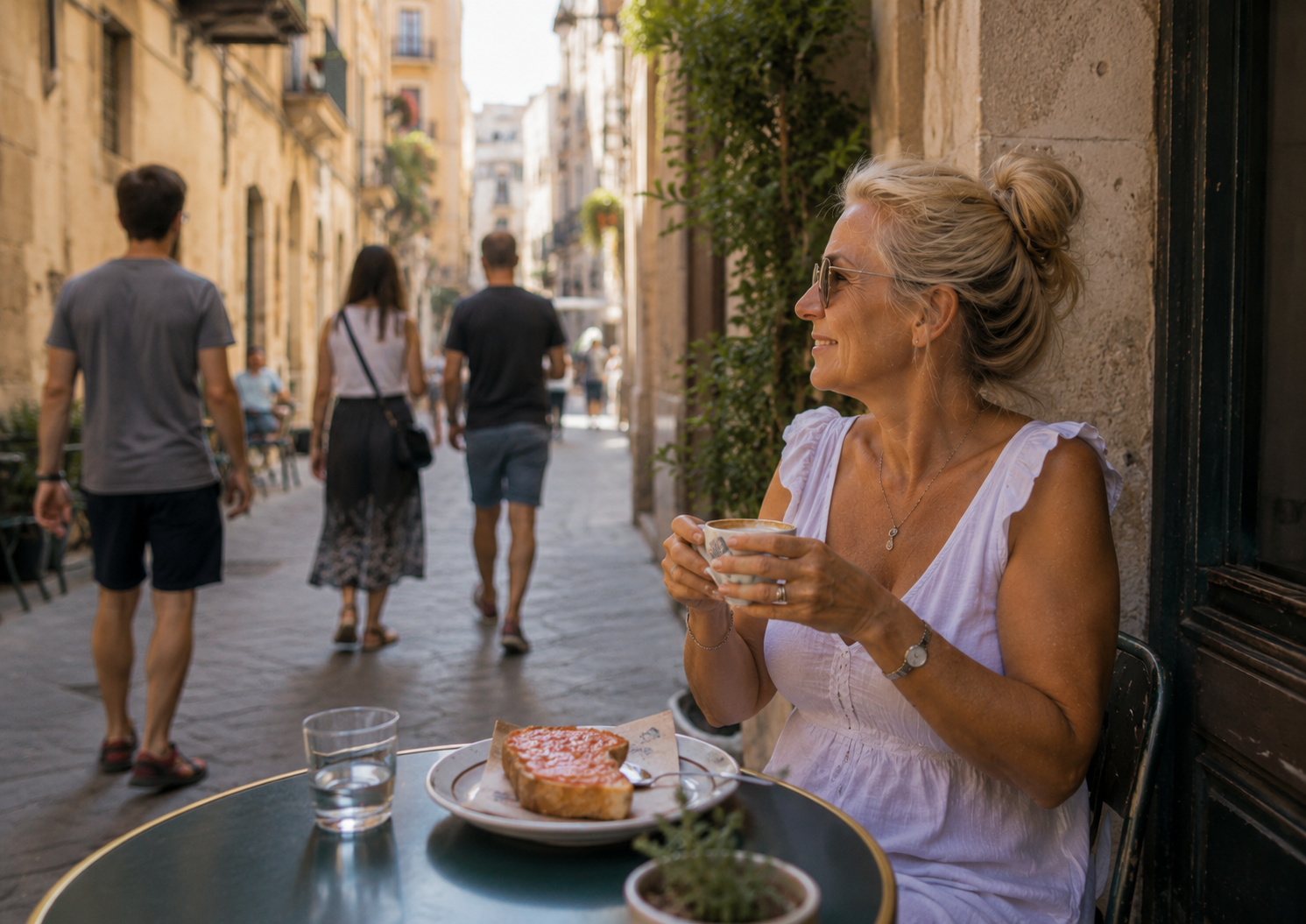
The €250 tax line deserves its own section, because it is the number that ambushes American retirees and the one most happily omitted from the retire-to-Spain content industry.
Once Susan passed 183 days a year in Spain, she became a Spanish tax resident, and Spain taxes residents on worldwide income, including US Social Security and her pension. She files a Spanish return each spring through a gestor who charges her €150 for it, pays Spanish income tax on her retirement income, and uses the US-Spain tax treaty to avoid being taxed twice on the same money. The net effect at her income level is a real but survivable bill, roughly €3,000 a year, which is exactly why €250 sits in her monthly ledger.
There is one more form with an American reputation, the Modelo 720, the declaration of foreign assets over €50,000 that Spain requires of residents. It taxes nothing by itself, but it must be filed, the penalties for ignoring it used to be famous, and it is the single document that most reliably sends new arrivals to a professional. Her gestor files it with her return, and she describes it as paying €150 a year to sleep well.
She is not resentful about it, and says so in a way that surprises people. The tax buys her residence in a country where her insurance costs €115 instead of the $740 a month she was quoted for a bridge plan in Ohio before Medicare age. She ran that comparison once on a napkin and never complained again.
What Got Cheaper Than She Expected
The napkin math has a whole column of happy surprises, and the biggest one had four wheels.
Susan sold her Honda before flying over and never replaced it. The car payment, insurance, gas, and maintenance had cost her close to $700 a month in Ohio, a figure she only fully saw once it stopped. In Valencia the tram, her feet, and the occasional €7 taxi replaced all of it, and the city is flat enough that half her errands happen by bicycle along the Turia.
The €300 grocery line deserves translation, because the number sounds like deprivation to American ears and is the opposite. It is roughly €70 a week, and in Valencia that buys fish twice a week from the market, a standing olive oil habit, more produce than two people could finish, real bread daily, and the wine and cheese that would sit behind glass at Ohio prices. She spends less than half her old grocery budget and eats, by her own accounting, twice as well.
Healthcare astonished her in the other direction. Beyond the €115 policy, a private specialist visit runs about €60 when she books one directly, a dental cleaning €50, and prescriptions cost a fraction of their American prices. Food does the same quiet work daily: the €300 grocery line buys a quality of produce, fish, and olive oil that her Ohio supermarket either did not stock or priced as luxury.
What Valencia Gives Her For Free

A fair accounting includes the column money cannot see. The Turia gardens, the nine-kilometer park in the old riverbed, is her gym, her commute, and her social club, and it costs nothing. The beach is twenty minutes away by bike. The March madness of Fallas fills the city with sculptures and fireworks for three weeks, admission free, and the everyday street life, the plazas, the market theater, the evening paseo, supplies the entertainment budget that cable television and door-to-door driving used to consume in Ohio.
The climate is a budget line disguised as scenery. Valencia’s 300 days of sun mean her heating costs in winter round to almost nothing, a few weeks of a low radiator against the Ohio gas bills that used to own her January, and the outdoor life that replaces paid entertainment runs eleven months a year. She counts the weather as roughly a hundred saved dollars a month and considers that estimate conservative.
There is also a discount horizon she is openly waiting for. At 65, Spain starts treating her as a pensioner regardless of passport, with reduced museum entries, the Renfe Tarjeta Dorada that cuts train fares across the country, and the municipal activity programs that fill Valencia’s civic centers with yoga, painting, and choir at prices near zero. Retiring here at 63, she says, means the deals actually improve as you age, which is the opposite of how her Ohio budget was trending.
Her social life runs on a Spanish conversation exchange on Mondays, an American women’s group that meets for the menú del día on Thursdays, and the neighbors in her building, who adopted her the week she correctly complimented the señora on the third floor’s balcony geraniums. Loneliness, the thing she feared most in the move, turned out to be more expensive in Ohio than in Spain.
The Honest Column

Two years also taught her the costs that do not shrink. Her granddaughter in Cleveland is now seven, and one flight a year is the budget’s answer to a heart that would prefer four; the video calls help and do not fix it. August in Valencia is genuinely hot and humid, 33 degrees with wet air off the Mediterranean, and her €130 utility average hides an August electricity bill that makes her wince. The bureaucracy remains a part-time job, with TIE renewals, appointment systems that open at midnight, and a Spanish tax calendar she will never love. And the door she walked through is narrowing behind her: the rent that anchors her budget does not exist for 2026 arrivals, who should honestly budget €950 to €1,100 for her same neighborhood, and Valencia’s days as a bargain are visibly numbered as the city becomes the destination everyone recommends.
The visits column cuts both ways too. Living somewhere beautiful means everyone she has ever met now plans to come, and year one taught her to set the rules early: the sofa bed exists, the tour-guide service does not exceed two days, and nobody gets picked up at the airport at 3am twice. She says it with a laugh and means every word.
There is also an American clock ticking quietly toward her 65th birthday: Medicare. It does not cover care outside the United States, which leaves retirees abroad weighing whether to pay Part B premiums for coverage they cannot use in Spain or skip it and face penalties if they ever move back. She has not decided, files it under year-three problems, and mentions it because none of the blogs that sold her Valencia ever did.
She would still sign every paper again, and says the only real mistake was waiting until 61 to start.
What She Tells People Who Ask
Susan’s advice has boiled down, over two years, to four sentences. Come with a cushion beyond the visa minimum, because the exchange rate and the setup year will both take bites you cannot schedule. Sign the real five-year contract and pay the gestor. Budget for taxes from month one, and get the healthcare comparison in writing before you let the insurance number scare you.
And then her fifth sentence, the one she delivers with the clementines on the counter and the balcony doors open in February: the money question is answerable, and the answer is yes, carefully. The better question, she says, is why she spent four years researching a decision that took two months to feel like home. Then she pours the coffee, which cost her €1.60, and lets the balcony answer the rest.

About the Author: Ruben, co-founder of Gamintraveler.com since 2014, is a seasoned traveler from Spain who has explored over 100 countries since 2009. Known for his extensive travel adventures across South America, Europe, the US, Australia, New Zealand, Asia, and Africa, Ruben combines his passion for adventurous yet sustainable living with his love for cycling, highlighted by his remarkable 5-month bicycle journey from Spain to Norway. He currently resides in Spain, where he continues sharing his travel experiences with his partner, Rachel, and their son, Han.