
In the spring of 2025, the share of Europeans holding a positive opinion of the United States fell to 29 percent, down from 47 percent the previous autumn. That is one of the sharpest drops Eurobarometer has ever measured across a single winter, and by last November the European Council on Foreign Relations found that only 16 percent of EU citizens still described the United States as an ally.
So this is an odd week to write about admiration. The Fourth of July arrives in a year when the transatlantic mood is as cold as it has been in most people’s memory, and a European skimming the headlines could be forgiven for assuming there is nothing left on the American side worth a kind word.
That assumption is wrong, and the same surveys that record the collapse also show why. When Europeans are asked about Washington’s tariffs, its interest in Greenland, or its handling of Ukraine, the numbers fall off a shelf. When the same people are asked about American universities, American research, or American culture, the numbers barely move. The souring is pointed at a government and its policies, and it can turn on the next election. The admiration underneath it is older than any administration and does not track the polls.
Watched from a flat in Spain, where opinions about America are offered freely whether or not you asked, here is what still gets admired, even now.
The Universities Everyone Pretends Not To Care About

A Spanish parent will tell you the American college system is insane. The debt, the sports teams that function like small corporations, the idea of paying north of $60,000 (about €55,000) a year when a public university in Madrid or Bologna costs a fraction of that. They are not wrong about any of it. Then their son gets an offer from a research group in Boston and the whole speech evaporates.
Pew Research Center has asked people in sixteen advanced economies to rate American higher education, and in fifteen of them, half or more call it above average. In Spain, more than half rate the American standard of living as at least above average too, one of the few countries where that is true. The admiration is not for the football or the fraternities. It is for the laboratories.
What Europeans notice, and quietly envy, is the concentration of money and ambition in one place. American research universities pull in scientists from everywhere, hand them budgets that continental institutions cannot match, and let them chase problems for years. European researchers have crossed the Atlantic for those labs for decades, and pay is only part of the pull. The bigger part is that the work they want to do, at the scale they want to do it, can often only be done there.
The applications tell the same story from the other direction. British admissions figures for the 2025-26 cycle recorded 6,680 American applicants to UK universities, a record, while European students keep filling seats in California, New York, and Massachusetts. The traffic runs both ways because the appeal is real on both sides. But the gravitational pull toward American research campuses has not weakened, whatever people think of the current White House.
The Companies Everyone Complains About And Uses Anyway

A Spaniard will spend a full afternoon explaining why American technology firms are a menace, the data harvesting, the tax arrangements, the way they hollowed out the high street. He will do this on an iPhone, over a Google search, having set the meeting up on WhatsApp, which Meta owns. The complaint and the dependence sit in the same person without friction.
Pew’s surveys find American technological achievement rated above average almost everywhere, and ordinary European life quietly confirms it. The operating systems, the search, the maps, the cloud that much of the continent’s business runs on, nearly all of it built by American companies. Brussels has noticed. The Digital Markets Act, in force across the EU since 2024, exists largely to pry open the grip of a handful of American platforms, and you do not write a law that size about firms you could simply ignore.
The pattern repeats at the level of ambition. A promising Spanish or German startup that wants big capital and global scale still tends to look west, and many end up raising, incorporating, or listing in the United States rather than at home, which means the talent Europe trains is often talent America ends up employing.
What gets admired, under the grumbling, is the capacity to build the thing first. Europe has superb engineers and real research, and it still watches the defining consumer technology of each decade get invented and scaled somewhere between San Francisco and Seattle. The regulation is well-founded and mostly sensible, and it lands overwhelmingly on American firms, because those are the ones large enough to require it.
The Idea That Your Life Is Yours To Build
Ask a European and an American the same question, whether success is mostly determined by forces outside your control, and you get two different countries. In work by the Real Instituto Elcano drawing on values surveys, around two-thirds of Americans reject the idea that their fate is out of their hands. In Germany and Italy, around two-thirds accept it.
This is the trait Europeans find most foreign and, when they are honest, most attractive. The Spaniard saves against catastrophe because he assumes the system will eventually fail him. The American borrows against a future he simply assumes will arrive. One posture looks reckless from Madrid and the other looks defeated from Denver, and both are rational given the histories behind them.
You feel it in small encounters. An American in a Getafe bar will describe a business idea to a stranger with no apparent fear of sounding foolish. The Spaniard at the next stool admires the nerve even as he decides the plan is mad. There is a lightness in the American assumption that things are fixable, that a bad year is a setback rather than a verdict, that you are allowed to start again at fifty.
Optimism is not a personality you are issued at birth. It is a permission structure, built from a culture that treats reinvention as normal instead of suspicious. Europeans who spend time in the States often come back a little envious of it, then a little worried they have caught it.
The Ramps
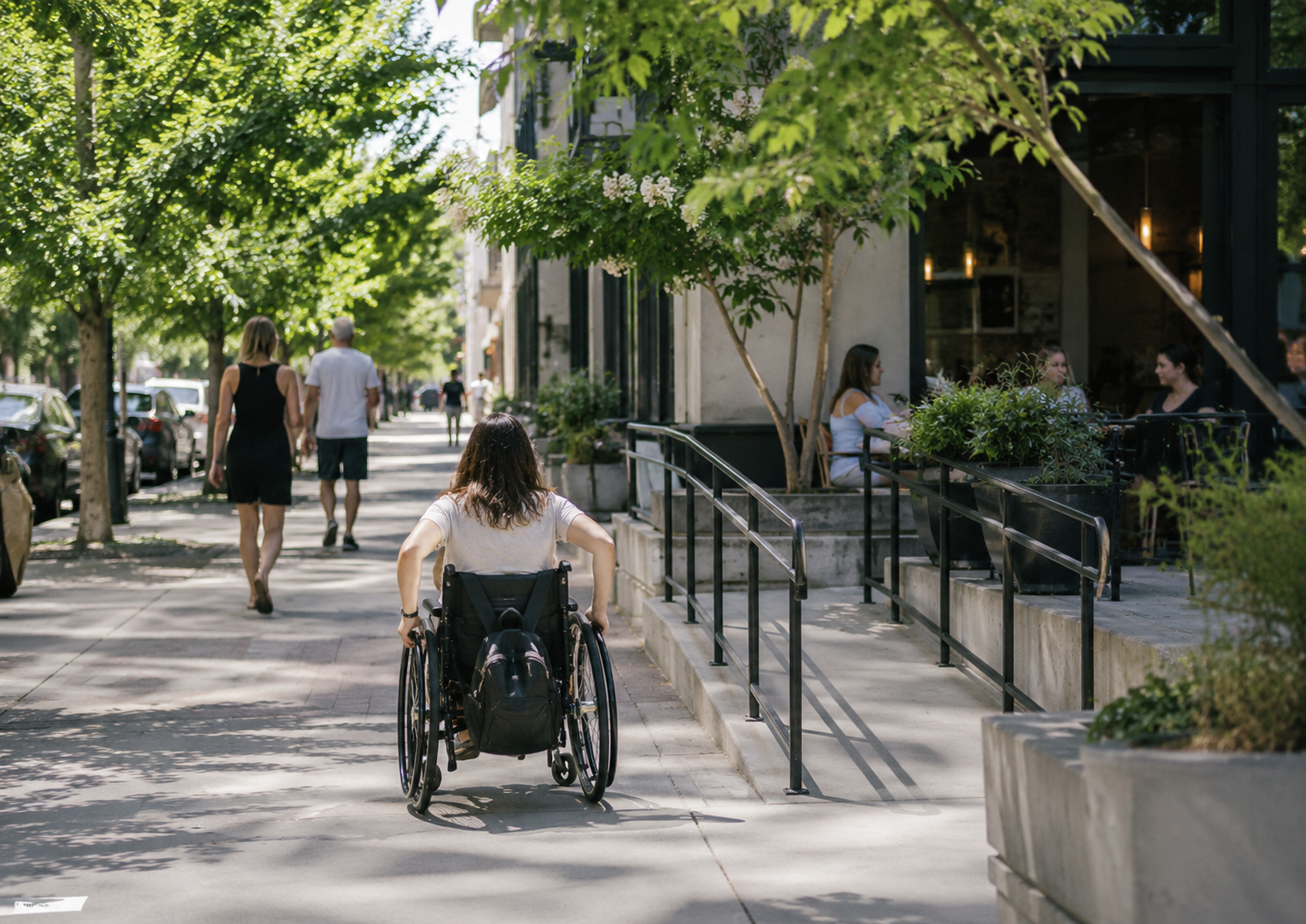
Here is the one that surprises people. Ask Europeans on the internet what small American thing they wish they had at home, and near the top of every list is disability access.
The Americans with Disabilities Act passed in 1990, and it changed the physical texture of American life in a way visitors register instantly. Ramps, elevators, curb cuts, accessible bathrooms in ordinary buildings, all of it treated as a legal baseline rather than a favor. A wheelchair user can arrive at a theater, a shop, or a county office in most of the country and assume they will get in.
Europe, for all its social spending, has nothing so uniform. The medieval streets are part of it, but only part. A traveler in a wheelchair learns to call ahead everywhere on the continent, to expect the beautiful old building with the impossible stairs, to plan a day around which stations have working lifts. The American default of “you can get in” is a quietly radical piece of civic design, and Europeans who need it notice its absence the moment they land back home.
It is a strange thing to admire a country for its bathrooms and building codes. But the people who say it mean it more seriously than any compliment about skyscrapers. It is the difference between being welcome in theory and being able to walk through the door.
A Country That Invented The National Park
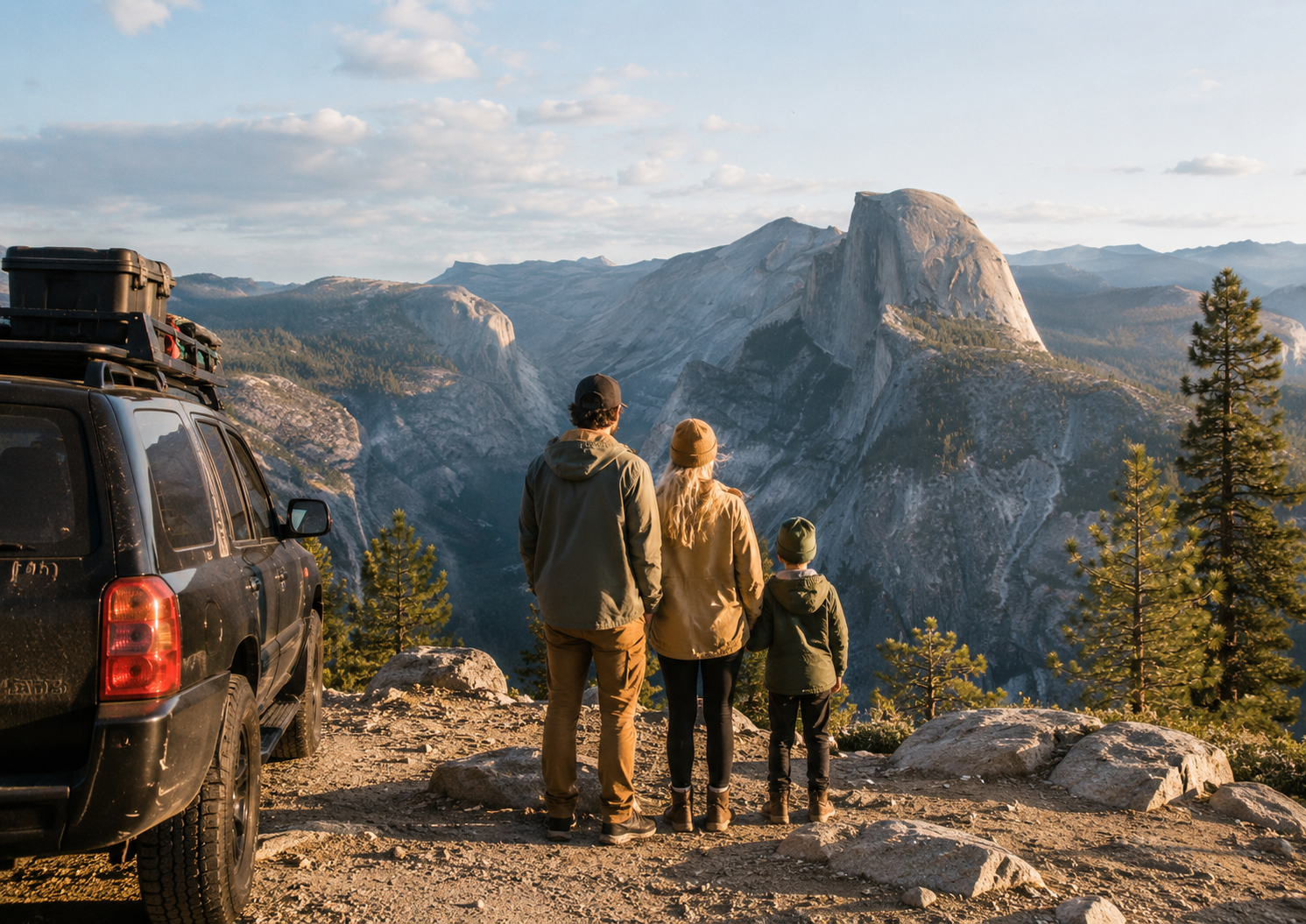
Yellowstone became the world’s first national park in 1872, and the idea it introduced, that a government would fence off enormous tracts of wilderness and keep them for everyone, was genuinely new. Europe had royal hunting forests and private estates. America had the notion that the most spectacular land in the country belonged to the public and should stay that way.
Europeans took the idea and ran with it, and now the model is everywhere. But the origin still registers. A Spanish family planning the trip of a lifetime does not dream about Paris. They dream about the American West, about Yellowstone and the Grand Canyon and Yosemite, about distances and skies that do not exist on this continent. The road trip through the parks is one of the most durable European fantasies about America, and it has survived every political low point of the last fifty years.
There is admiration in it for the scale of the land and admiration for the decision to protect it. The American park system, whatever its funding fights, remains a working argument that a country can hold something in common and not sell it. For Europeans watching a lot of shared things get privatized at home, that argument lands harder than it used to.
Culture That Needs No Translation
American culture arrives without asking permission and without needing a subtitle. Pew found that in several countries, including Spain, a quarter or more of people rate American cultural exports as the best in the world, and nowhere does more than a small fraction call them below average.
You can dislike the politics and still have grown up on the music, the films, the shape of a diner counter in a photograph. A teenager in Cuenca knows the reference points of Los Angeles better than those of Lisbon. The reach is so total that Europeans stopped noticing it as foreign influence and started treating it as weather.
What gets admired is not just the volume but the confidence. American culture assumes it will travel, and it usually does, because it was built to be legible to strangers. Jazz did it first, then Hollywood, then everything that followed. The exports carry a version of the country that is warmer and more generous than the one in the news, which is part of why affection for the culture keeps surviving disgust with the government.
The Friendliness That Reads As Fake Until It Isn’t

Europeans arrive in the States braced for the famous American friendliness, certain it is hollow. The cashier who asks how your day is going, the stranger who tells you their whole life story in a checkout line, the waiter performing delight. It feels like theater to a Spaniard, who reserves warmth for people he actually knows.
Then something happens. The car breaks down, the plans fall apart, a person needs help far from home, and the same easy American openness turns out to have a second setting. The stranger who over-shares is also the stranger who drives you to the mechanic. The ease of welcome, the thing that looked like performance, becomes the thing that gets you through a bad afternoon in an unfamiliar place.
Recent visitors have been rediscovering this in public, posting about free refills and friendly strangers and the sheer enthusiasm of ordinary Americans, surprised that the country in front of them is not the one they were shown. It is a low-stakes discovery and a real one. The warmth is not performance. Europeans simply expect it to be rationed and saved for the inner circle, and they are thrown when Americans spend it on strangers first.
The Giving That Confuses Everyone
Europeans find American charity a little baffling and a little suspect. Why lean on the goodwill of the wealthy for things a functioning government ought to provide? It is a fair question, and it leaves the numbers untouched.
Americans give away more of their money than almost anyone. Total charitable giving in the United States runs at roughly 2 percent of GDP, a level the annual Giving USA report has tracked as broadly stable for decades, and one that sits well above private giving rates in France, Germany, and Spain. Around 61 percent of Americans report donating to charity in a given year. The giving is not only money either. Americans volunteer their time at rates near the top of the wealthy world, staffing the food banks, school boards, and hospital fundraisers a Spaniard would expect the town hall to run.
The habit has deep roots. Andrew Carnegie built more than 2,500 public libraries with his steel fortune, several of them in Britain, on the stated principle that a rich man who dies rich dies disgraced. That idea, that private wealth carries a public duty you discharge yourself rather than hand to the state, still shapes how Americans give.
Some of the gap is structural. A large share of American giving flows to churches, and Europeans fund through taxes and the state much of what Americans cover by donation. That is a difference in how two systems handle need, not proof that one people is warmer than the other.
The reflex is still worth admiring on its own terms. The instinct to fund the local food bank, the school library, or the hospital wing, and to treat that as an ordinary civic act rather than an eccentric one, runs stronger and wider in America than in most of Europe. Writing a large personal check to a public cause is unremarkable there in a way it still is not here.
What The Neighbor With The Grand Canyon Photo Would Tell You
There is a man in the building who will give you twenty minutes on everything wrong with American foreign policy, unprompted, most mornings. He means all of it. He also has a framed photograph in his hallway from a trip he took to Arizona in the nineties, and if you get him talking about that instead, his whole face changes.
That is the thing the polls miss when they only ask about governments. On the Fourth of July, in a year when the numbers say Europeans have never trusted Washington less, the admiration that survives is the kind that does not need Washington’s permission. The universities keep pulling the best minds. The parks stay public. The music still crosses every border without a passport. A country is not the same thing as its current administration, and Europeans, who have watched their own governments come and go for a very long time, understand that distinction better than almost anyone.

About the Author: Ruben, co-founder of Gamintraveler.com since 2014, is a seasoned traveler from Spain who has explored over 100 countries since 2009. Known for his extensive travel adventures across South America, Europe, the US, Australia, New Zealand, Asia, and Africa, Ruben combines his passion for adventurous yet sustainable living with his love for cycling, highlighted by his remarkable 5-month bicycle journey from Spain to Norway. He currently resides in Spain, where he continues sharing his travel experiences with his partner, Rachel, and their son, Han.