
Watch a trained French cook make scrambled eggs and your first instinct, if you grew up cooking eggs the American way, is that something has gone wrong. The heat is far too low. The eggs sit there barely moving while the cook stirs and stirs, patient to the point of looking idle. There is no sizzle, no browning, no confident push of a spatula. And then, while the eggs still look not quite done, glistening and loose, the cook pulls them off the heat entirely and serves them.
An American line cook doing it the way most Americans do, cranking the burner, pouring the eggs into a hot pan, pushing them around fast until they puff up firm and a little browned at the edges, would, in a serious French kitchen, be quietly corrected. Not because the American is incompetent, but because almost every instinct in that method runs against what the French believe a good egg is.
This is one of those differences that seems tiny and turns out to be a whole philosophy. The French cook eggs low, slow, and gently, and stop early, where Americans tend to cook them hot, fast, and hard, and finish firm. The gap between those two approaches is the difference between two entire ideas of what cooking is for.
We cooked eggs the fast, hot way for years and thought ours were good. The first time we ate them done properly slowly, soft and silky and barely set, it was a small embarrassment to realize how much better they could be, and how little it took, just a lower flame and the patience to wait.
The French Way, Step By Slow Step

The defining feature of the French method is gentleness, almost to a degree that tests an impatient cook. Eggs are treated as one of the most delicate things in the kitchen, because they are.
For scrambled eggs, the French approach is famously slow. The heat is kept low, sometimes very low, the pan often pulled on and off the flame or set over a water bath, and the eggs are stirred constantly and softly the whole time. The goal is tiny, soft curds in a creamy, almost custardy mass, closer to a loose sauce than to the dry, fluffy piles most Americans picture. A little butter goes in, sometimes a touch of cream at the end to stop the cooking, and the eggs come off the heat while they still look slightly underdone, because they keep cooking on the way to the plate.
The result is rich, silky, barely set, and pale gold, with no brown anywhere on it. To a French cook this is simply what scrambled eggs are. The American version, firm and dry and browned, would read to them not as a different style but as eggs that were overcooked and a little ruined.
The Omelette That Has No Color
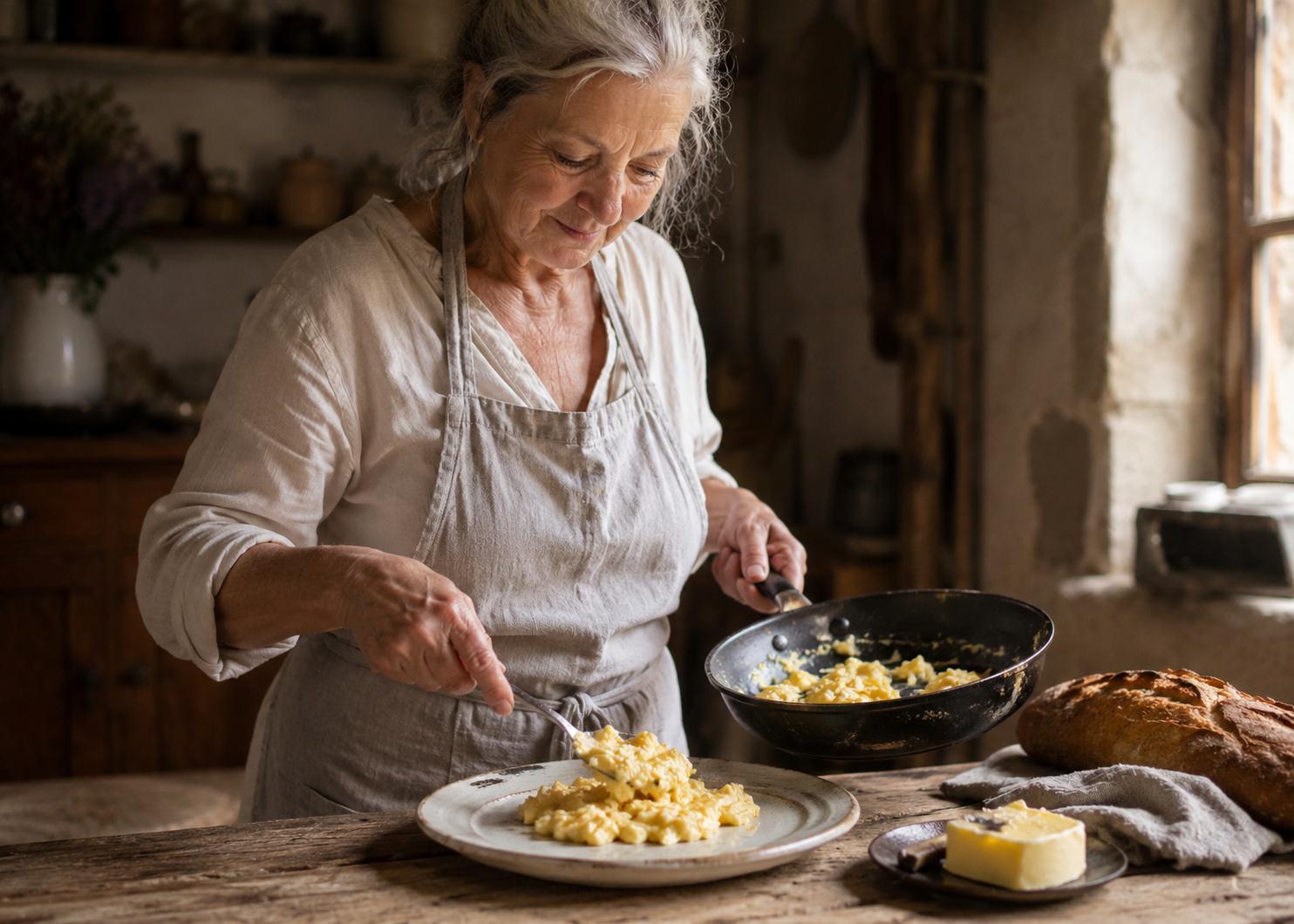
Nowhere is the difference sharper than in the omelette, which in France is close to a test of whether a cook can cook at all.
A classic French omelette is pale yellow, with no browning whatsoever. It is cooked fast but over controlled heat, stirred and shaken constantly for the first moments, then rolled, not folded, into a neat oval, and the interior is left soft and slightly runny, what the French call baveuse. There is no crisp edge, no golden-brown exterior, no firm set center. A perfect French omelette is smooth, blond, and tender, and it takes real skill precisely because nothing is allowed to brown or toughen.
The American omelette is often the opposite, cooked hotter, browned on the outside, folded over a filling, and set firm throughout. There is nothing wrong with it on its own terms, and plenty of people prefer it. But present it in a French culinary exam and it fails, because the browning that an American might call done is exactly what a French chef calls a mistake. Jacques Pépin’s famous demonstration of the classic French omelette, blond and rolled and soft, is the standard, and color on the egg is the clearest sign the standard was missed.
Eggs Are How The French Judge A Cook

There is a reason the omelette carries so much weight, and it is not really about the omelette. In the French tradition, eggs are how you find out whether someone can actually cook.
The plain omelette is a classic test in French kitchens, the dish a chef might ask a prospective cook to make to size them up in a single attempt. It hides nothing. There is no sauce to cover a mistake, no long cooking to develop forgiving flavor, no garnish to distract. It is just eggs, butter, heat, and the cook’s hands, and it exposes everything about their control in about ninety seconds. You cannot fake a French omelette. Either the heat was managed and the timing was right and it comes out pale and tender and rolled, or it does not, and the failure is visible to anyone.
That is why this seemingly humble dish sits so high in French cooking. Eggs are unforgiving enough that mastering them proves a cook can do everything else. A culture that judges its cooks by their eggs is a culture that takes eggs very seriously indeed, and the gentleness is the whole reason they make such a good test.
Why Brown Is The Enemy
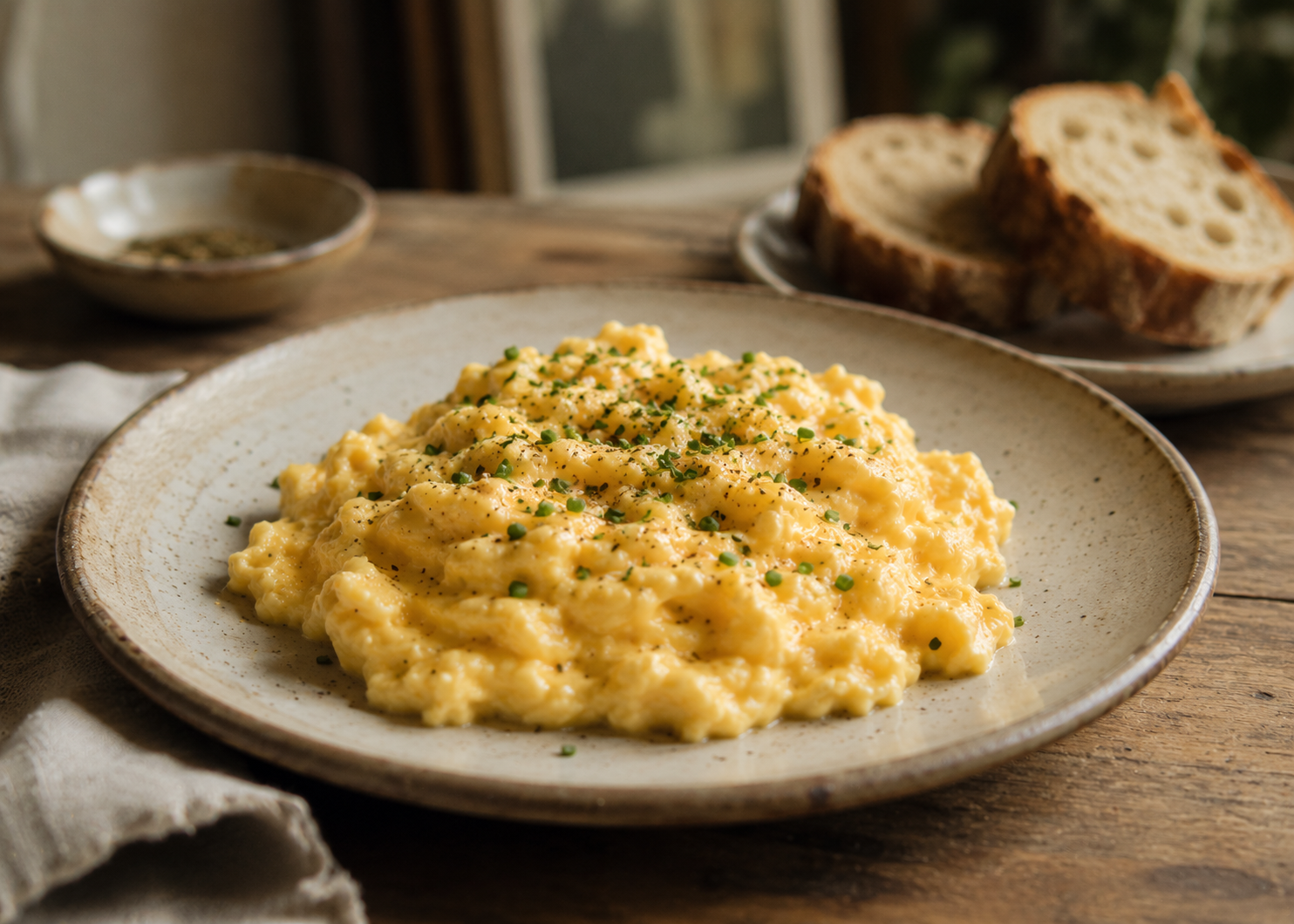
To understand why the French are so insistent, you have to understand what browning does to an egg, because their rule is not arbitrary fussiness. It is based on what heat does to the food.
An egg is mostly delicate protein and a lot of water, and it overcooks almost instantly. The window between perfectly tender and rubbery is a matter of seconds, which is why gentle, slow heat matters so much. Low heat gives you control over those seconds. High heat takes it away, racing the egg past tender into tough before you can stop it.
Browning is the visible sign of that race being lost. When egg proteins get hot enough to brown, they have also seized up and toughened, and they take on a faintly sulfurous, overcooked flavor that the gentle method avoids entirely. The French are not chasing paleness for its own sake. Pale is just the proof that the egg was cooked gently enough to stay tender. The brown is the proof that it was not. What the French are really protecting is texture, and color is simply the tell.
The same logic explains why the French pull eggs off the heat early. Egg proteins keep cooking from residual heat after they leave the pan, the way a roast keeps cooking as it rests, so eggs that look perfect in the pan will be overdone by the time they reach the fork. The French cook for the plate, not the pan, stopping while the eggs still look slightly wet because they know the last few seconds of cooking happen off the heat. It is the same carryover principle a careful cook uses with meat, applied to something far more fragile and far less forgiving.
The Whole French Repertoire Is Gentle
Scrambled eggs and the omelette are only the most visible cases. Look across French egg cookery and the same soft, careful hand shows up everywhere, almost as a rule.
There are oeufs en cocotte, eggs baked slowly in a ramekin with cream until the white is just set and the yolk still runs. There is the oeuf mollet, an egg boiled to the precise point where the white is firm and the yolk stays liquid, a matter of seconds of margin. There is the gently poached egg, slipped onto a salad or a piece of toast, its soft yolk meant to become part of the dish. In every one of them, the prize is the same: an egg cooked just to the edge of done and no further, with the yolk kept soft wherever possible.
You will look a long time for a traditional French egg dish that wants the egg cooked hard, dry, and browned. The cuisine simply does not value that texture in an egg. Across the whole repertoire, the French treat the egg as something to be coaxed barely to setting and then stopped, and the consistency of that instinct is the real tell of how the culture sees the ingredient.
Butter Is Not Optional
One more thing separates the French egg from the American one, and it is sitting right there in the pan. The French cook eggs in butter, generously, and the butter is part of the point rather than just a way to stop sticking.
A real amount of butter, melted gently and not allowed to brown, does two things. It keeps the heat moderate and even, buffering the eggs from the harsh direct contact that would toughen them, and it folds richness and silk into the finished egg. The butter is not there to grease the pan. It is an ingredient. The slight glossiness and the soft, almost creamy quality of properly cooked French eggs come in large part from butter worked in at low temperature.
This is why French eggs taste richer even when nothing exotic has been added. It is butter and patience, not a secret. And it is one more reason the high, fast American heat works against the result, because butter browns and burns at exactly the temperature the French method is careful never to reach.
Two Philosophies In A Frying Pan
This small disagreement about eggs is really a window onto a much larger difference in how the two cooking cultures think, and it shows up far beyond breakfast.
The French approach to eggs is built on restraint, patience, and precision, the belief that the cook’s job is to treat a delicate ingredient delicately and exert fine control over exactly what happens to it. It is slow on purpose. It values the perfect tender texture over speed, and it treats the egg as something that can be ruined by haste. It is cooking as careful technique.
The American approach tends to prize speed, heat, and confidence, getting good food on the plate fast, with a browned, hearty, satisfying result. It is not worse, and for many dishes the high-heat, fast-cooked instinct is exactly right. But applied to eggs, the most fragile thing in the kitchen, that instinct works against the ingredient. The French slowness that looks like inefficiency is really just the method matching the delicacy of what is being cooked, and the egg is where the two philosophies collide most clearly.
It is worth being fair to the American instinct, because it is not wrong, only misapplied here. The same high, confident heat that toughens an egg is exactly what gives a steak its crust, a stir-fry its char, a burger its sear. American cooking is genuinely brilliant at the things that want fire and speed. Eggs simply are not one of those things, and the French, who are merciless about eggs, happen to be right about this particular fragile ingredient.
The Recipe: A Classic French Omelette
This is the dish at the center of it all, the one whose browning would get an American chef corrected. It takes a little practice, so do not expect perfection on the first try, but the method is simple and the rules are few: moderate heat, constant motion at the start, and no color anywhere. Master this and the soft-scrambled version below comes for free.
Makes: 1 omelette (serves 1)
Time: about 5 minutes
Ingredients
- 3 large eggs
- 1 tablespoon (15 g) unsalted butter
- Salt, to taste
- Fresh chives or fine herbs, chopped (optional)
Method
- Crack the eggs into a bowl, add a pinch of salt, and beat thoroughly with a fork until completely uniform, with no streaks of white remaining.
- Set a nonstick or well-seasoned pan over medium heat, not high. Add the butter and let it melt and gently foam, but do not let it brown.
- Pour in the eggs. Right away, stir briskly with a fork or spatula while shaking the pan, keeping everything moving, for the first twenty to thirty seconds, until you have small, soft curds in a still-wet mass.
- Stop stirring and let the eggs settle for a few seconds into an even layer. The top should still look slightly underdone. Do not let the bottom take on any color.
- Scatter the herbs over, if using. Tilt the pan away from you and, with the fork or spatula, fold or roll the omelette over onto itself into a neat oval, keeping the inside soft and creamy.
- Roll it out onto a plate, seam-side down. It should be pale yellow with no browning at all. Serve immediately.
For soft French scrambled eggs instead, beat the eggs, melt a little butter in the pan over low heat, pour them in, and stir slowly and constantly, scraping the bottom and sides so nothing sets, until they come together into small, creamy curds. Pull them off the heat while they still look slightly too wet, since they finish cooking in their own warmth, and a final tiny knob of butter or splash of cream stops them at perfect.
What The Egg Teaches
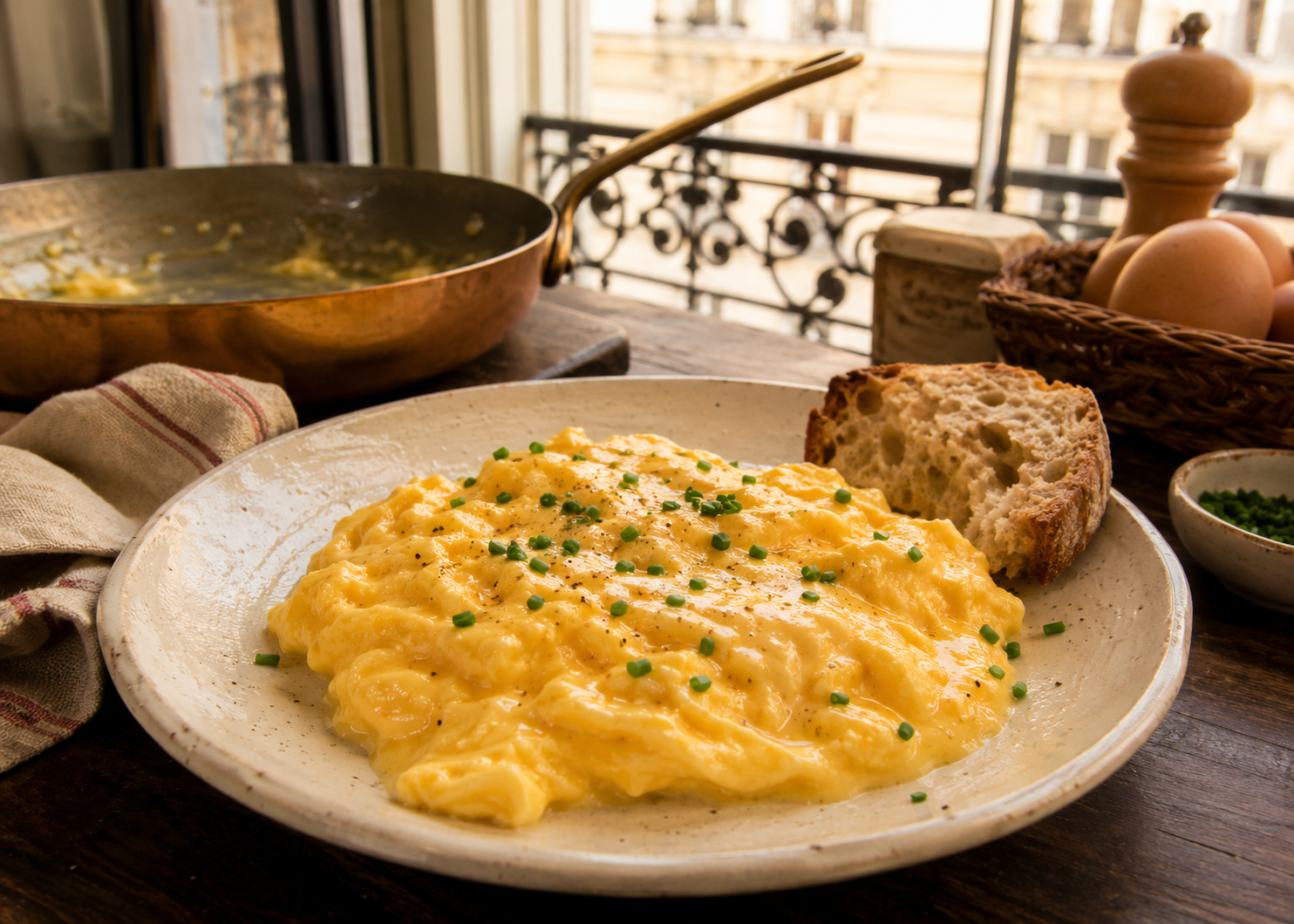
So the French really do cook eggs in a way that would get an American corrected in a professional French kitchen, and now you know it is not snobbery. It is a hard-won understanding that the most delicate ingredient in the kitchen rewards the gentlest hand, and punishes the hot, fast, confident approach that serves so many other foods so well.
The lesson reaches past eggs. It is a reminder that the right technique depends entirely on the ingredient, that the heat and speed that make a great seared steak will wreck a soft egg, and that sometimes the most impressive thing a cook can do is slow down and do almost nothing, carefully. The browned, firm American egg is not a failure of effort. It is, if anything, too much effort applied too fast. The pale, soft French one is what happens when a cook finally trusts that with eggs, less heat and more patience is the whole art. Try it once, low and slow and pulled early, and the old way will be hard to go back to. It is the rare upgrade in the kitchen that costs nothing, requires no new ingredient, and asks only that you turn the heat down and wait.

About the Author: Ruben, co-founder of Gamintraveler.com since 2014, is a seasoned traveler from Spain who has explored over 100 countries since 2009. Known for his extensive travel adventures across South America, Europe, the US, Australia, New Zealand, Asia, and Africa, Ruben combines his passion for adventurous yet sustainable living with his love for cycling, highlighted by his remarkable 5-month bicycle journey from Spain to Norway. He currently resides in Spain, where he continues sharing his travel experiences with his partner, Rachel, and their son, Han.