
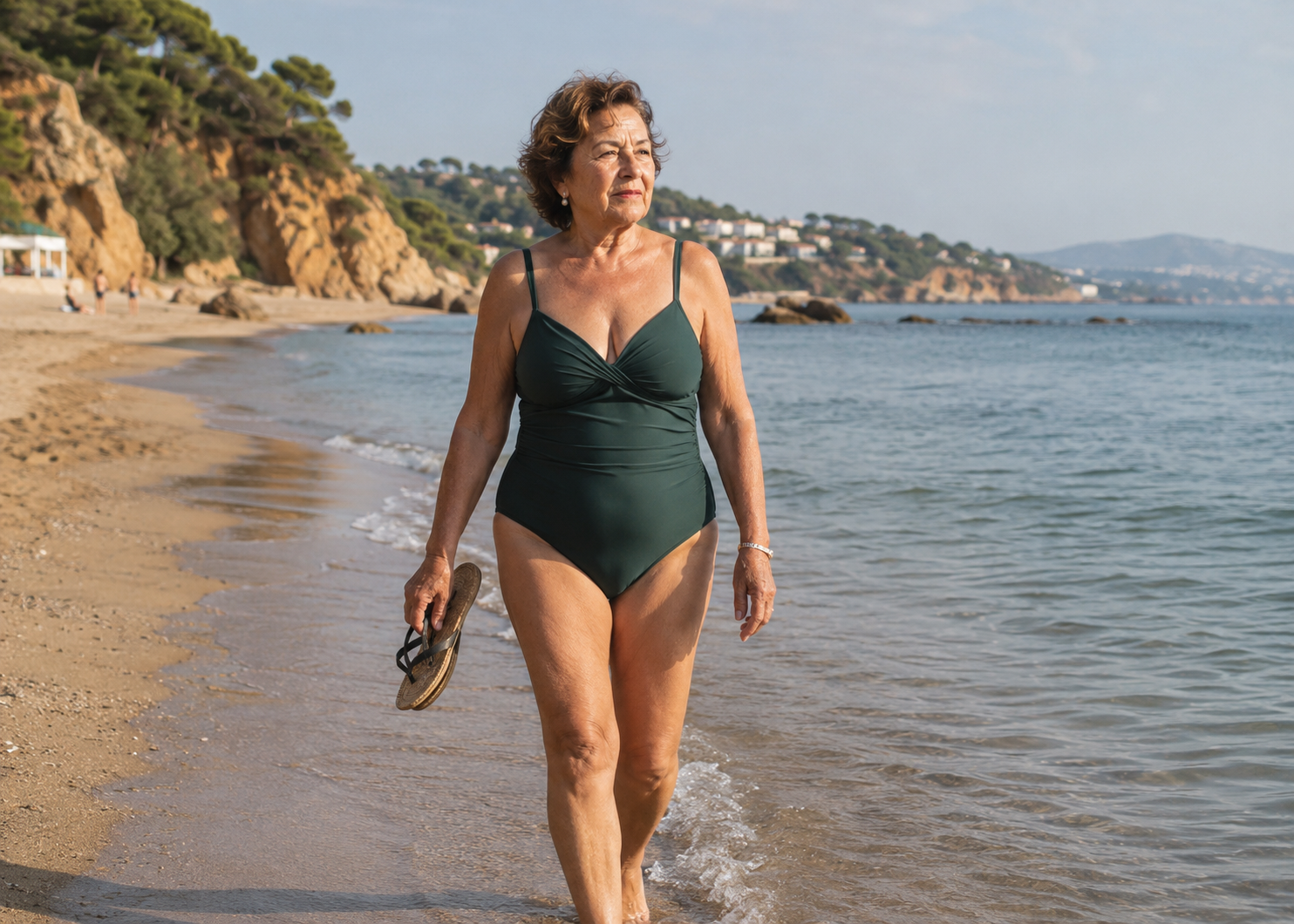
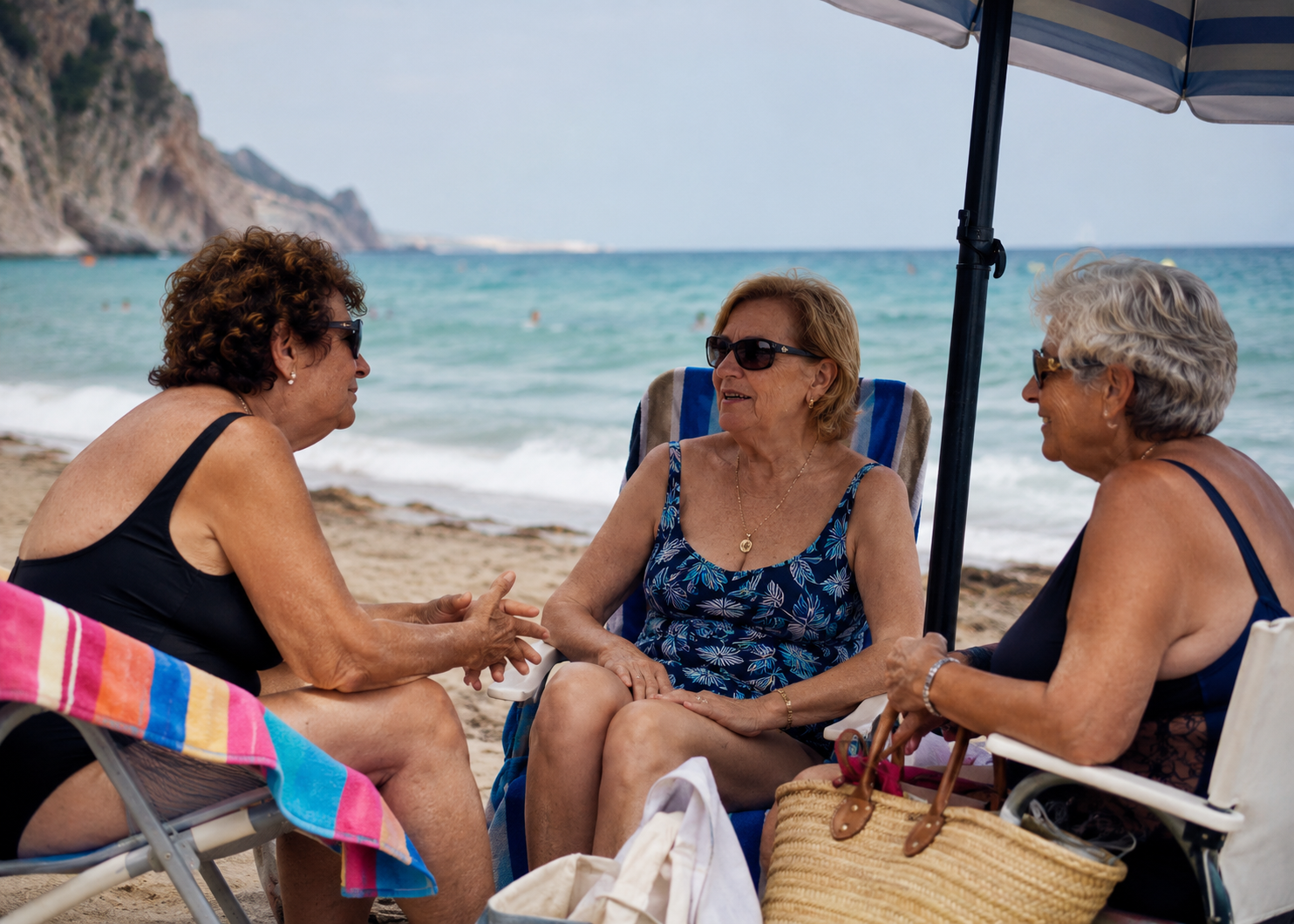
On any Spanish beach in summer you will see something that quietly astonishes Americans. A woman of seventy, in a swimsuit, walking to the water with the unhurried ease of someone who has never once wondered whether she is allowed to be there. No cover-up clutched around her, no towel held strategically, no visible calculation about who might be looking. She is simply at the beach in her body, the body of a woman who has lived seventy years, entirely at peace with the fact. And a few towels over, an American woman of forty sits wrapped in a sarong, waiting for the beach to empty before she will walk to the sea.
The contrast is real and it is worth understanding, because it says something about two cultures’ relationship with the aging body, and the Spanish version is the healthier one by far. Spanish women, on the whole, carry far less shame about their bodies on the beach than American women, and they carry less of it at every age, the difference only widening as the years pass, until the Spanish grandmother is sunning herself with total ease while her American counterpart has long since retreated into cover-ups or stopped coming to the beach at all. This is not about how anyone looks. It is about how a culture teaches women to feel, and there is a great deal an American can learn from the Spanish way.
What You Actually See On A Spanish Beach
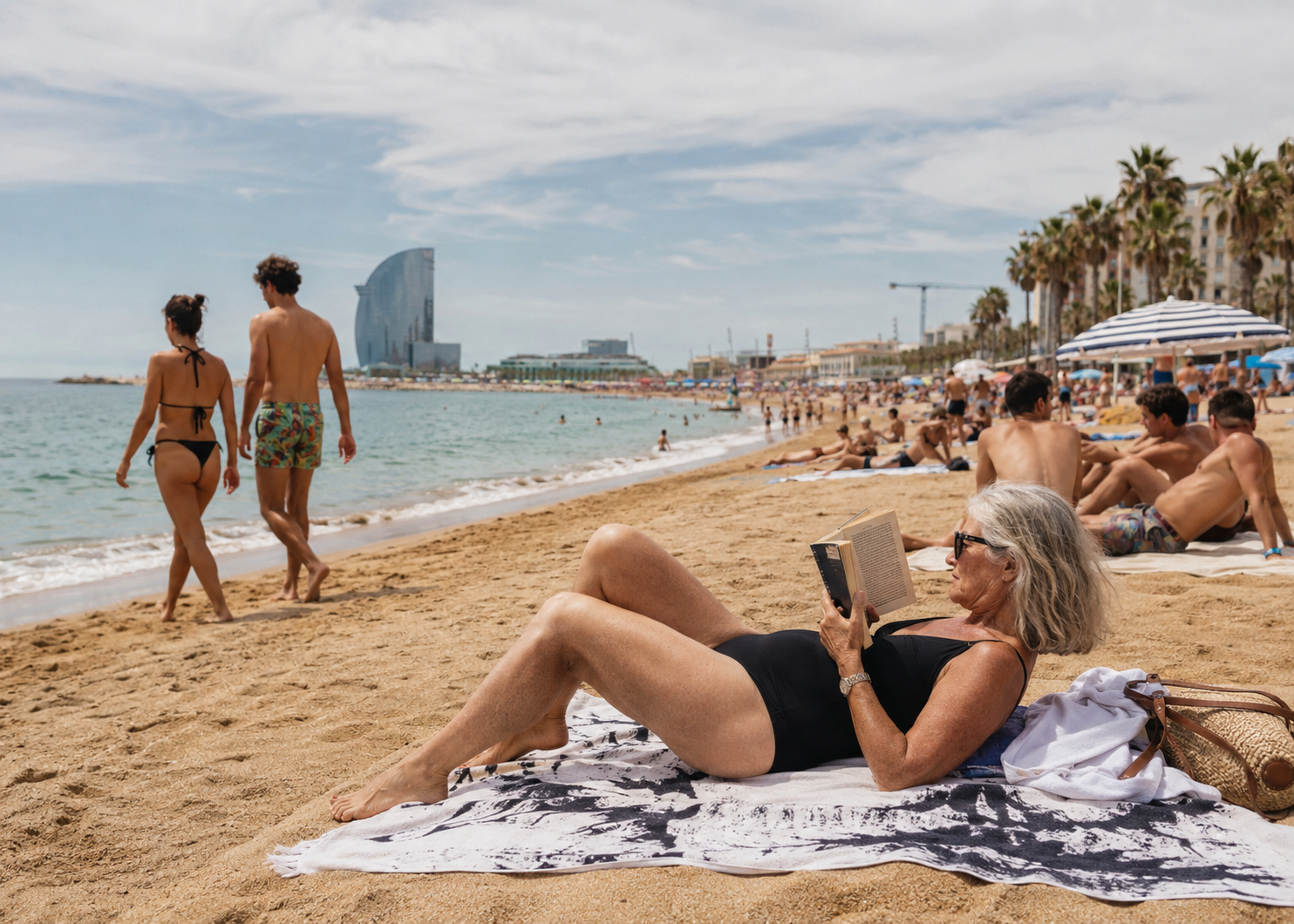
To be clear about the observation, it helps to describe what is actually there, since it genuinely surprises Americans the first time.
On Spanish beaches, women of all ages and all body types are simply present, in swimwear, at ease, the eighty-year-old and the teenager and everyone between sharing the sand without the visible self-consciousness that pervades American beaches, the older women in particular displaying a relaxed confidence that has nothing to do with conforming to any ideal of youth or thinness. There is no apparent sense that the beach belongs only to certain bodies, no evident hierarchy of who has earned the right to be seen in a swimsuit, just women of every shape and age comfortably occupying the space, sunning, swimming, talking, living, in whatever body they have, with a casualness that reads to American eyes as almost radical. The older Spanish woman especially embodies this, present and unbothered in a way that defies the American expectation that aging should mean retreat from being seen.
This is not a matter of Spanish women all conforming to some standard that makes confidence easy, since the women on the beach span every body type exactly as anywhere, but of a culture that simply does not attach the same shame to the ordinary aging body, that does not teach women their bodies become unacceptable to display past a certain age or size. The result is a beach full of women at ease in themselves, and the contrast with the American beach, where so many women of all ages perform various rituals of concealment and apology for their bodies, is stark and immediate. What you see on a Spanish beach is, in essence, what an absence of body shame looks like in practice, women simply being in their bodies in public without the layer of anxiety that American culture adds, and it is genuinely striking to witness.
Where The American Shame Comes From
To understand the contrast, it helps to see where the American body anxiety originates, since it is learned, not natural, and the Spanish absence of it shows it is not inevitable.
American culture teaches women, relentlessly and from a young age, that their bodies are objects to be judged against a narrow and largely unattainable ideal, that worth is tied to appearance, that aging is a kind of failure to be fought and concealed, and that the body in a swimsuit is a thing to be assessed and found wanting unless it meets the standard. This message arrives through advertising, media, an enormous industry built on female body insecurity, and a culture that prizes youth and thinness above almost everything, and it lands on women early and never lets up, producing the anxiety, the cover-ups, the calculation, the retreat from the beach, the sense that being seen in a swimsuit is an audition one is destined to fail. The American woman’s beach anxiety is not a personal failing but a cultural inheritance, taught and reinforced relentlessly, a shame manufactured and sold.
The crucial point is that this shame is learned and cultural, not natural or universal, which the Spanish beach proves simply by existing, since Spanish women, raised in a different culture, do not carry the same burden, demonstrating that the American body anxiety is a product of American culture rather than an inevitable feature of being a woman with a body. This should be liberating to recognize, since a shame that was taught can be questioned and unlearned, and the existence of whole cultures where women do not carry it shows that it is not a fixed truth about female embodiment but a particular and changeable cultural construction. The American woman wrapped in her sarong is not responding to a real fact about her body but to a cultural message she was taught, and seeing that the message is cultural, not universal, is the first step toward setting it down.
The Spanish Relationship With The Body
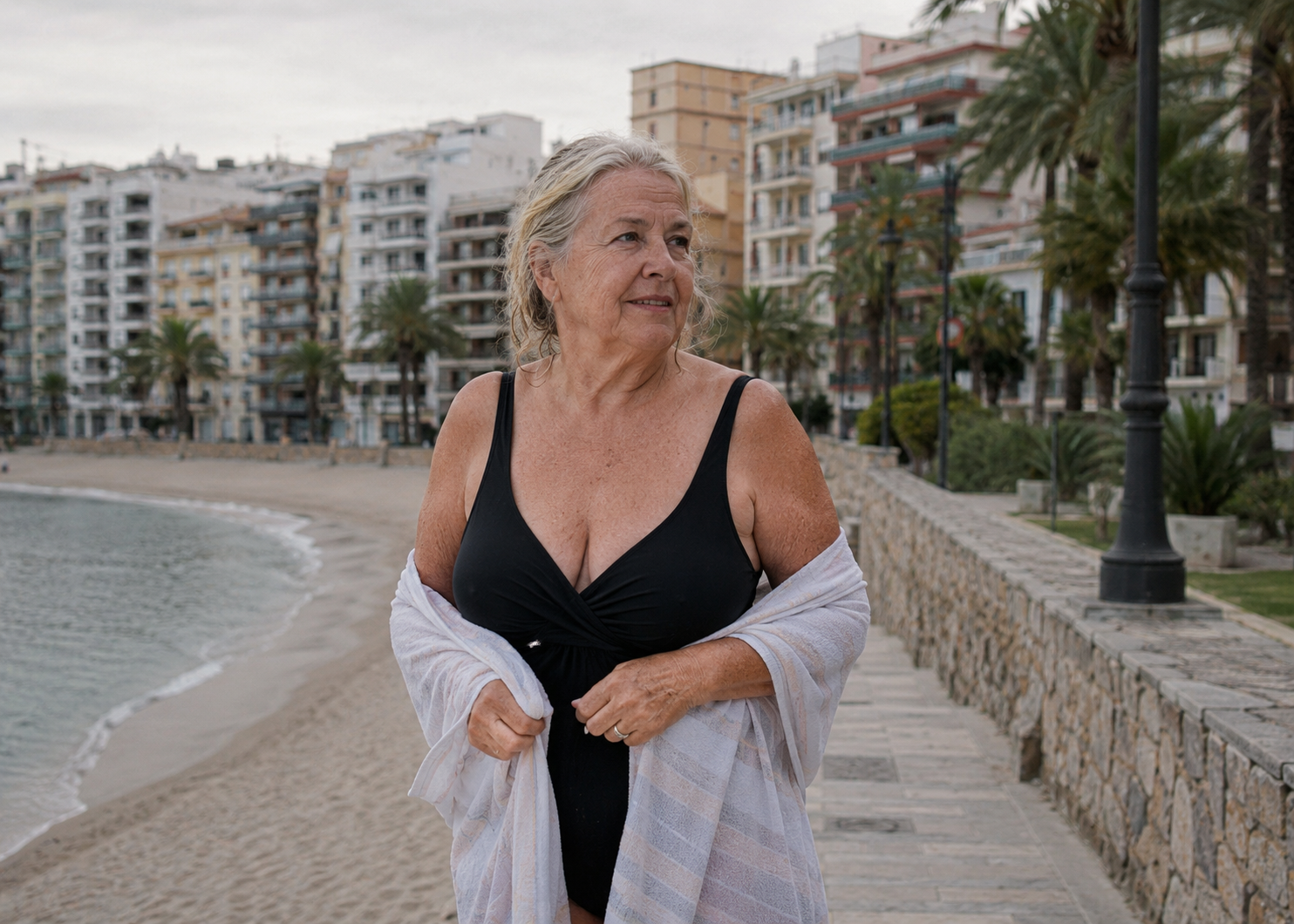
The Spanish approach grows from a different cultural relationship with the body, age, and pleasure, and understanding it shows what the alternative looks like.
Spanish culture, and Mediterranean culture broadly, tends to hold a more relaxed and accepting relationship with the body, treating it less as an object of constant judgment and more as the ordinary vessel of a life to be enjoyed, with food, sun, sea, and physical pleasure approached without the guilt and anxiety that pervade the American relationship with all of them. The body is for living in, for swimming and eating and being in the sun and growing old, not a project to be perfected or an object to be judged, and this more accepting baseline extends naturally to the beach, where the body simply is what it is and is entitled to be present and to enjoy the water and the sun regardless of its conformity to any ideal. Aging within this frame is not a failure or a retreat but simply the natural course of a life, the older body as entitled to the beach and its pleasures as any other, which is why the Spanish grandmother sits in the sun with such ease.
There is also a Spanish cultural confidence that is less tied to appearance and more to presence, personality, and the enjoyment of life, an ease in oneself that does not depend on meeting a physical ideal, and this too shows on the beach, where the confidence on display is not the confidence of women who all happen to look a certain way but the confidence of women raised to feel entitled to their own lives and bodies regardless of looks. This is the deeper thing the American can learn, not a beach behavior to copy but a whole relationship with the body to consider, one that treats the body as the ordinary good vessel of a life to be enjoyed rather than an object of endless judgment, and that grants the aging body the same right to pleasure and presence as the young one. The Spanish ease is the visible sign of this healthier underlying relationship with the body and with age.
What This Has To Do With Aging Well
The contrast matters most around aging, since this is where the two cultural approaches diverge most sharply and where the Spanish way offers the most.
The American approach to women’s aging is largely one of loss and concealment, the aging body framed as something to fight, hide, and apologize for, the older woman encouraged to become less visible, to retreat from the beach and other arenas of display, to mourn her younger appearance, a framing that makes aging a long sad diminishment of one’s right to be seen and to enjoy one’s body. The Spanish approach, by contrast, allows the older woman to remain fully present, entitled to the beach, the sun, the swimsuit, the pleasures of embodiment, without the sense that age has disqualified her, which makes aging a continuation of a life fully lived in the body rather than a retreat from it. This difference has real consequences for how women experience the second half of their lives, the Spanish frame allowing a continued ease and pleasure and presence that the American frame, with its shame and concealment, tends to foreclose.
For an American woman, particularly one considering the second half of life, this is perhaps the most valuable thing the Spanish beach has to teach, that aging need not mean retreat and concealment and apology, that another culture’s women grow old remaining fully present and at ease in their bodies, and that this is a choice and a frame available to anyone willing to question the inherited shame. The vision of the seventy-year-old Spanish woman walking to the sea with total ease is not just a charming cultural observation but a genuine alternative model of how to age as a woman, present rather than hidden, at peace rather than at war with the body, enjoying rather than mourning, and it is a model an American can choose to adopt. The deepest lesson of the Spanish beach is that there is another way to grow old in a body, and it is a far happier one.
What An American Can Actually Take From This
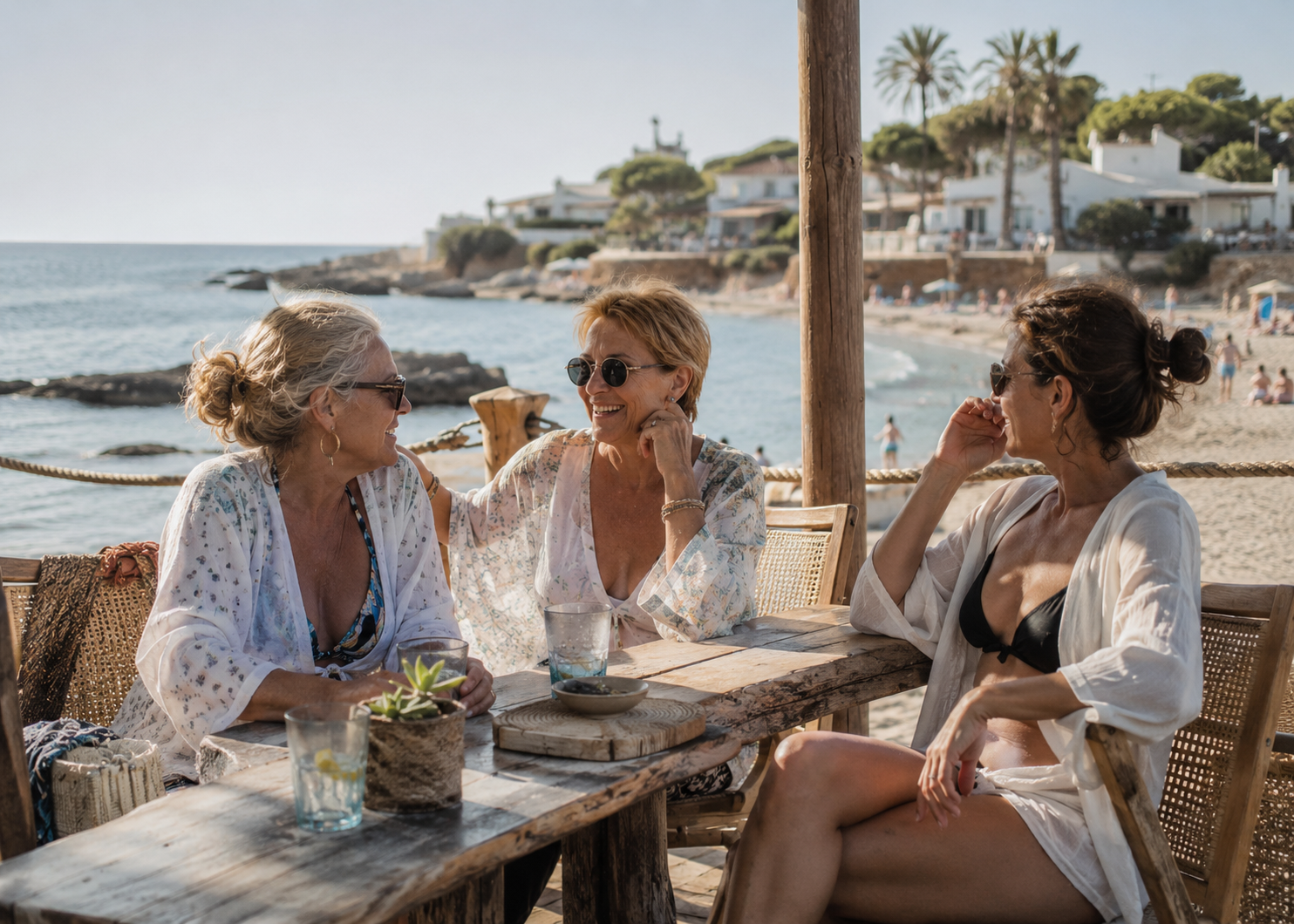
The point of the contrast is not to admire the Spanish from afar but to draw something usable from it, and there is a real and practical lesson available.
The usable lesson is not about appearance or behavior but about permission, the recognition that the shame so many American women carry about their bodies, especially as they age, is a learned cultural burden rather than a truth, and that it can therefore be questioned, set down, and replaced with the more accepting relationship that other cultures model. An American woman does not need to move to Spain to begin adopting the Spanish frame, to start treating her body as the ordinary good vessel of her life rather than an object of judgment, to grant herself the same right to the beach and the sun and the pleasures of embodiment that the Spanish grandmother takes for granted, to refuse the inherited message that aging means concealment. This is internal work, a shift in how one relates to one’s own body, and it is entirely available to anyone willing to recognize the manufactured shame for what it is and choose a healthier relationship instead.
The Spanish beach, in the end, is valuable to an American less as a place than as a proof, the living demonstration that women can and do grow old at complete ease in their bodies, that the anxiety is not inevitable, that another way exists and is being lived right there on the sand. To take that proof home, to let it loosen the grip of the inherited shame, to begin granting oneself the ease that the Spanish woman was simply given by her culture, is the real gift of the observation, worth far more than any tip about swimwear or beach behavior. The woman of seventy walking unhurried to the Spanish sea is showing every American woman watching that there is another way to inhabit a body and another way to age, and that it is available, and that it is better, which is a thing genuinely worth crossing an ocean, or simply changing one’s mind, to learn.
A Word On What This Is Not
It is worth being clear about what this observation is not saying, since the contrast can be misread, and the real point is gentler and more useful than the misreadings.
This is not a claim that Spanish women are better or that American women are doing something wrong, since the American woman’s beach anxiety is not a personal failing but a response to a relentless cultural message she did not choose, and the point is never to add another layer of judgment, you should feel more confident, on top of the shame already there. Nor is it a prescription about how anyone should look, dress, or present at the beach, since the entire lesson is the opposite, that the beach belongs to every body exactly as it is, and that the goal is not a new standard to meet but the removal of the standard altogether, the freedom to be present in one’s body without it being an audition at all. The observation is an offering, not an instruction, a glimpse of a kinder way that one can accept or not, never another rule to live up to.
The gentlest and truest version of the point is simply this, that the shame is optional, that it was taught and can be questioned, and that somewhere on a Spanish beach right now a woman of seventy is demonstrating that a life lived at ease in one’s body, all the way to the end, is genuinely possible. Whatever an American woman does with that, whether she takes up the Spanish ease all at once or loosens the inherited anxiety a little at a time or simply files it away as something to consider, the value is in the knowing that the other way exists and is available, that the cover-up and the calculation and the retreat are not the only options. The Spanish beach offers permission, not pressure, the permission to set down a burden that was never necessary, and that permission is the whole of the gift, freely given, to be taken up however and whenever one likes.
Why This Matters For The Whole Second Half Of Life
The beach is really a stand-in for something larger, the question of how a woman gets to live in the second half of her life, and that is where the observation finally points.
The way a culture treats the aging body on the beach reflects how it treats the aging woman everywhere, in how visible she is allowed to be, how entitled to pleasure and presence and enjoyment, how much she is encouraged to keep living fully versus to recede, and the Spanish ease on the beach is one visible expression of a culture that lets older women remain vivid, present, and entitled to their lives. The American woman who absorbs the Spanish lesson is really learning something about more than swimwear, learning that the second half of life can be lived in full presence and pleasure rather than in the diminishment and concealment that American culture often scripts for aging women, that she is entitled to remain visible and alive and at ease in her body and her life for all of it. The beach is the easy-to-see instance of a much larger permission.
This is why the observation belongs in any honest conversation about aging well and about the appeal of the Mediterranean life that draws so many, since part of what draws people to places like Spain is exactly this less anxious, more accepting, more pleasure-affirming relationship with the body and with age, a culture that lets people grow old remaining present and at ease. For the American woman contemplating the second half of her life, whether in Spain or anywhere, the deepest takeaway is that another relationship with her aging body and her continued presence in the world is available, modeled vividly on every Spanish beach, and that choosing it, granting herself the ease and the permission and the right to remain fully alive in her body for the whole of her life, is one of the most valuable things she can carry away from any encounter with the Spanish way of living. The woman walking to the sea is showing the whole of it, and the whole of it is worth learning.

About the Author: Ruben, co-founder of Gamintraveler.com since 2014, is a seasoned traveler from Spain who has explored over 100 countries since 2009. Known for his extensive travel adventures across South America, Europe, the US, Australia, New Zealand, Asia, and Africa, Ruben combines his passion for adventurous yet sustainable living with his love for cycling, highlighted by his remarkable 5-month bicycle journey from Spain to Norway. He currently resides in Spain, where he continues sharing his travel experiences with his partner, Rachel, and their son, Han.