
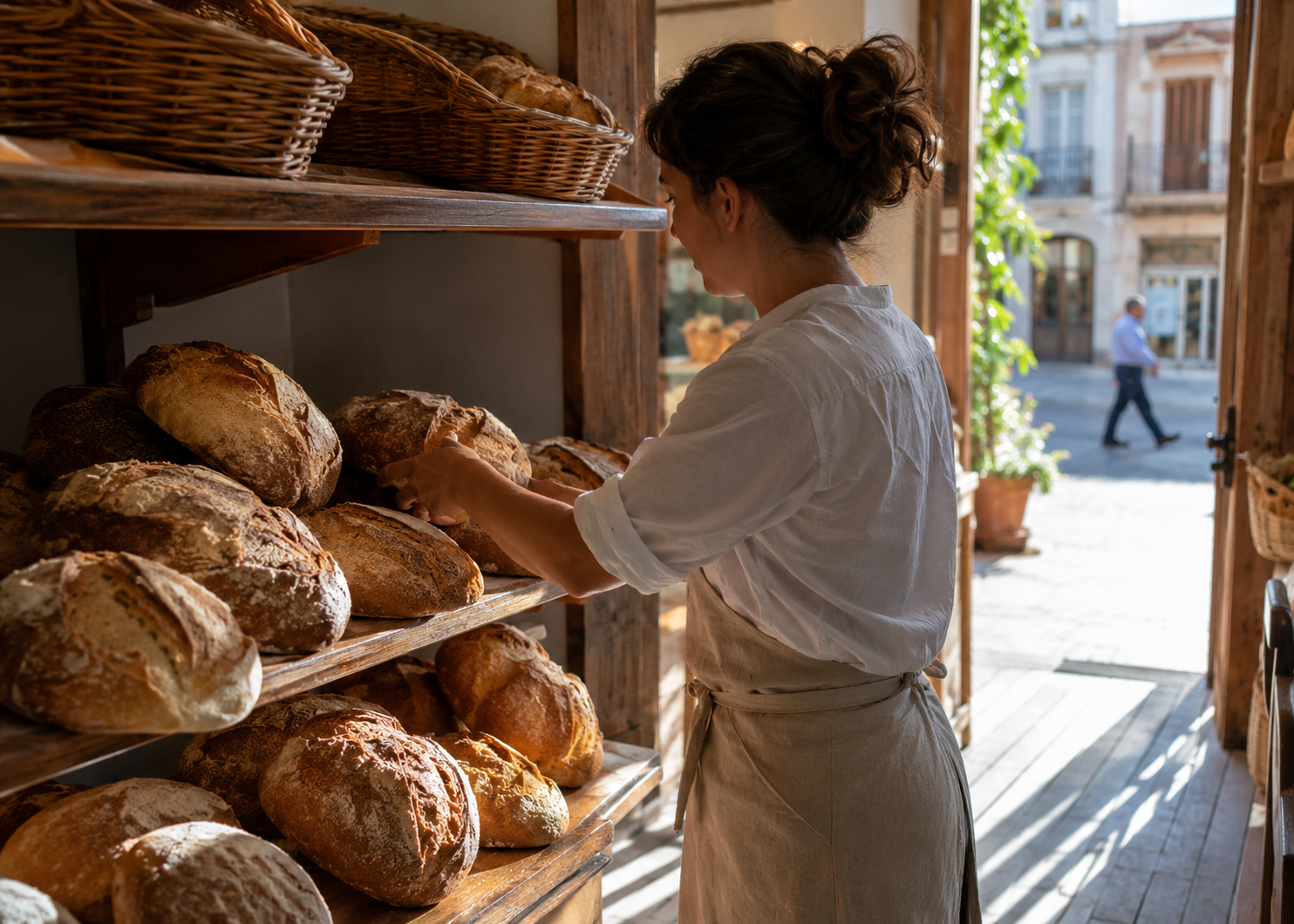
The Spanish bread that goes stale by midweek is not failed bread. It is the way bread is supposed to behave when it is made the traditional Spanish way, with the four ingredients that have defined bread for thousands of years and nothing else. The bread that stays soft for two weeks in an American kitchen is a different product entirely, one whose long shelf life is achieved through chemistry that the traditional Spanish baker would not recognize as bread-making. The cultural difference between the two approaches reveals something Americans typically miss about how food works when it is not engineered for industrial distribution.
Let’s walk through what makes Spanish bread go stale so fast, what is actually in industrial American bread that keeps it soft for weeks, how the stale bread becomes the foundation of Spanish cuisine rather than the failure American eyes see, and what Americans living in or visiting Spain should understand about the daily bread rhythm.
What Spanish Bread Is Actually Made From
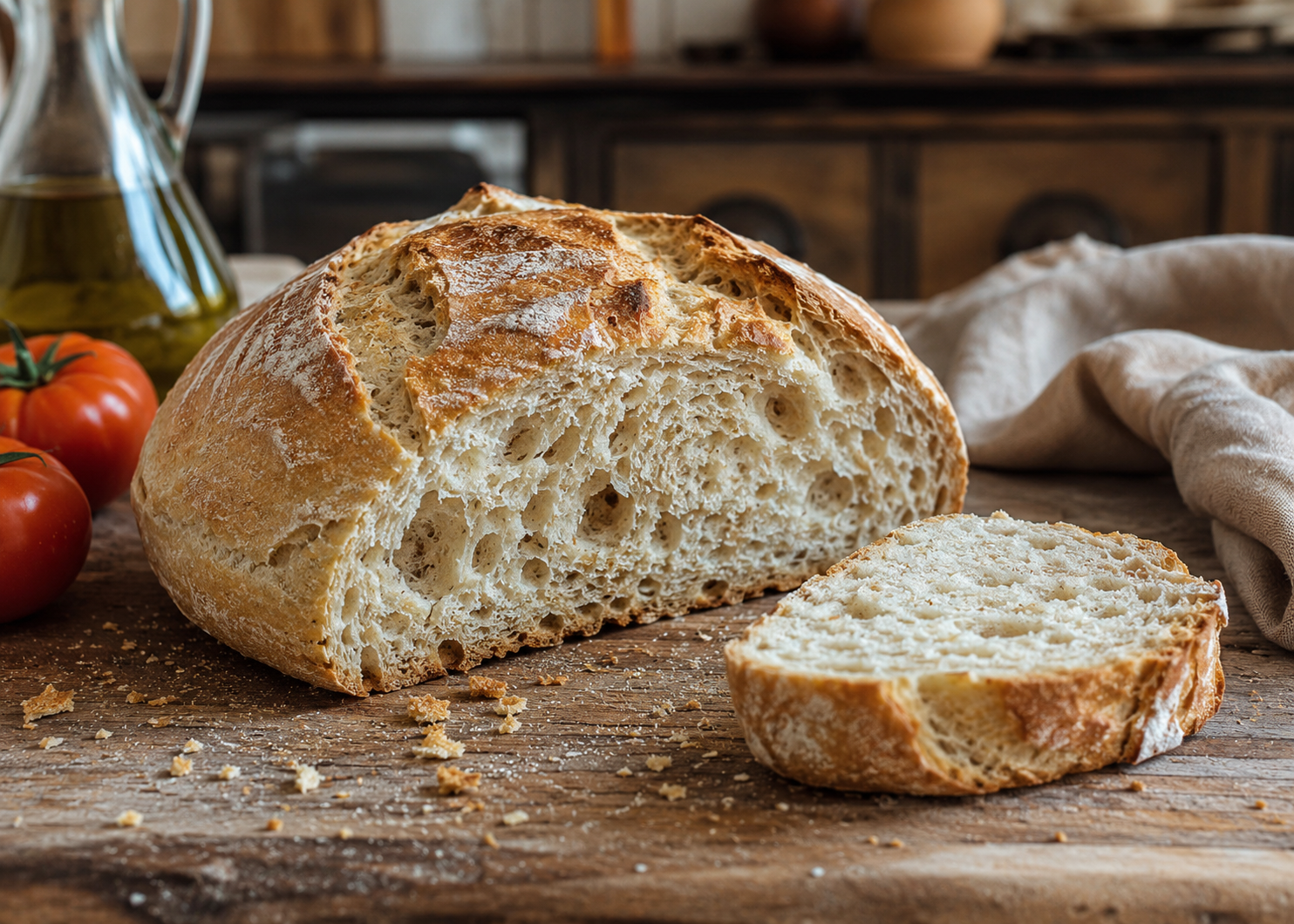
Traditional Spanish bread, the kind sold at the panadería that has been on the same street for generations, has an ingredient list that fits in one short sentence.
Flour, water, salt, yeast. Sometimes a small amount of olive oil in certain regional varieties. That is the entire list. The bread that the New Jersey plumber bought on Monday contained those four or five ingredients and nothing else. No preservatives. No dough conditioners. No added sugars. No high-fructose corn syrup. No mono- and diglycerides. No calcium propionate. No sorbic acid. No moisture retention agents. No emulsifiers. No anything beyond what flour and water and salt and yeast produce when they are combined and baked.
The flour is typically simple wheat flour. Sometimes harina de fuerza, the stronger bread flour, sometimes ordinary harina común. For specific regional breads, semolina, rye, or other flours appear. The flour is what it says it is: ground wheat. Not enriched with vitamins added back in after they were milled out. Not bleached chemically. Not treated with chlorine dioxide or benzoyl peroxide the way some industrial American flours are. Spanish bread flour is the same wheat flour that has been used in European bread for millennia.
The water is water. No purpose beyond hydrating the flour and dissolving the salt and yeast.
The salt is salt. Sometimes Spanish sea salt, sometimes ordinary table salt. The function is flavor and yeast control. Nothing more.
The yeast is traditional baker’s yeast or, for the better breads, sourdough starter. The masa madre, the Spanish sourdough culture, has been kept alive in some Spanish bakeries for decades or longer. The starter contains wild yeasts and lactobacilli that produce the flavor complexity that defines artisanal Spanish bread. The fermentation is slow, often spanning twelve to twenty-four hours, which produces the open crumb structure and the deep flavor.
The result, baked fresh that morning, is genuinely excellent bread. Crusty exterior. Open chewy crumb. Real wheat flavor. The kind of bread that needs nothing on it to be satisfying, though Spanish culture provides plenty of things to put on it. The result also begins to go stale within hours of leaving the oven. By Tuesday it has hardened noticeably. By Wednesday it is firm enough to require effort. By Thursday it is genuinely stale in the way the New Jersey plumber discovered.
What Industrial American Bread Is Actually Made From
The bread the New Jersey plumber was accustomed to in New Jersey had a substantially longer ingredient list.
Standard American supermarket sandwich bread typically contains, beyond the basic four ingredients, some combination of: high-fructose corn syrup or other sweeteners, soybean oil or other vegetable oils, calcium propionate or other preservatives, mono- and diglycerides, sorbic acid, calcium sulfate, soy lecithin, datem (diacetyl tartaric acid ester of monoglycerides), enzymes, sometimes azodicarbonamide (the additive discussed in the bread piece earlier in this conversation), L-cysteine, ammonium sulfate, ascorbic acid added as a dough conditioner, and various other agents. The ingredient list often runs to twenty or thirty items.
Each addition serves a specific industrial purpose. Calcium propionate retards mold growth. Mono- and diglycerides serve as emulsifiers that keep the crumb soft. Datem strengthens the dough for high-speed industrial baking. Sorbic acid extends shelf life. The sweeteners feed the yeast faster and produce browner crusts. The whole apparatus is designed to produce bread that can survive a multi-day distribution chain and sit on a supermarket shelf for two weeks while still appearing fresh and soft.
The result is bread that stays soft for an unusually long time. A loaf of standard American sandwich bread purchased on Monday will still be sliceable and apparently fresh-feeling the following Monday. The softness does not indicate freshness. It indicates the successful operation of the chemistry that maintains softness. The bread is not fresh in the sense the Spanish baker would recognize. It is preserved in a state that resembles freshness.
The crumb structure differs fundamentally. Spanish artisanal bread has an open, irregular crumb with visible bubbles and chewy texture. Industrial American bread has a uniform fine crumb that the dough conditioners and high-speed mixing produce. The Spanish bread chews like bread. The American bread chews like something engineered to chew softly across days without changing.
The flavor differs equally. Spanish bread tastes of wheat and fermentation. Industrial American bread tastes mildly sweet and largely neutral, with the chemistry’s flavor profile dominating over what little wheat character survives the process. The Spanish bread is food. The American bread is bread-shaped product engineered for shelf life.
This is not to say all American bread fits this description. American artisanal bakeries produce real bread on the Spanish model, with short ingredient lists and short shelf lives, and that bread behaves the way Spanish bread behaves. The category being discussed is the standard supermarket sandwich bread that defines most Americans’ bread experience. That category and the traditional Spanish category are different products that happen to share a name.
How Spanish Cuisine Built Itself Around Stale Bread
The Spanish baker who told the New Jersey plumber to buy bread every day was operating within a culinary framework where stale bread is not failure but raw material for some of Spain’s most beloved dishes.
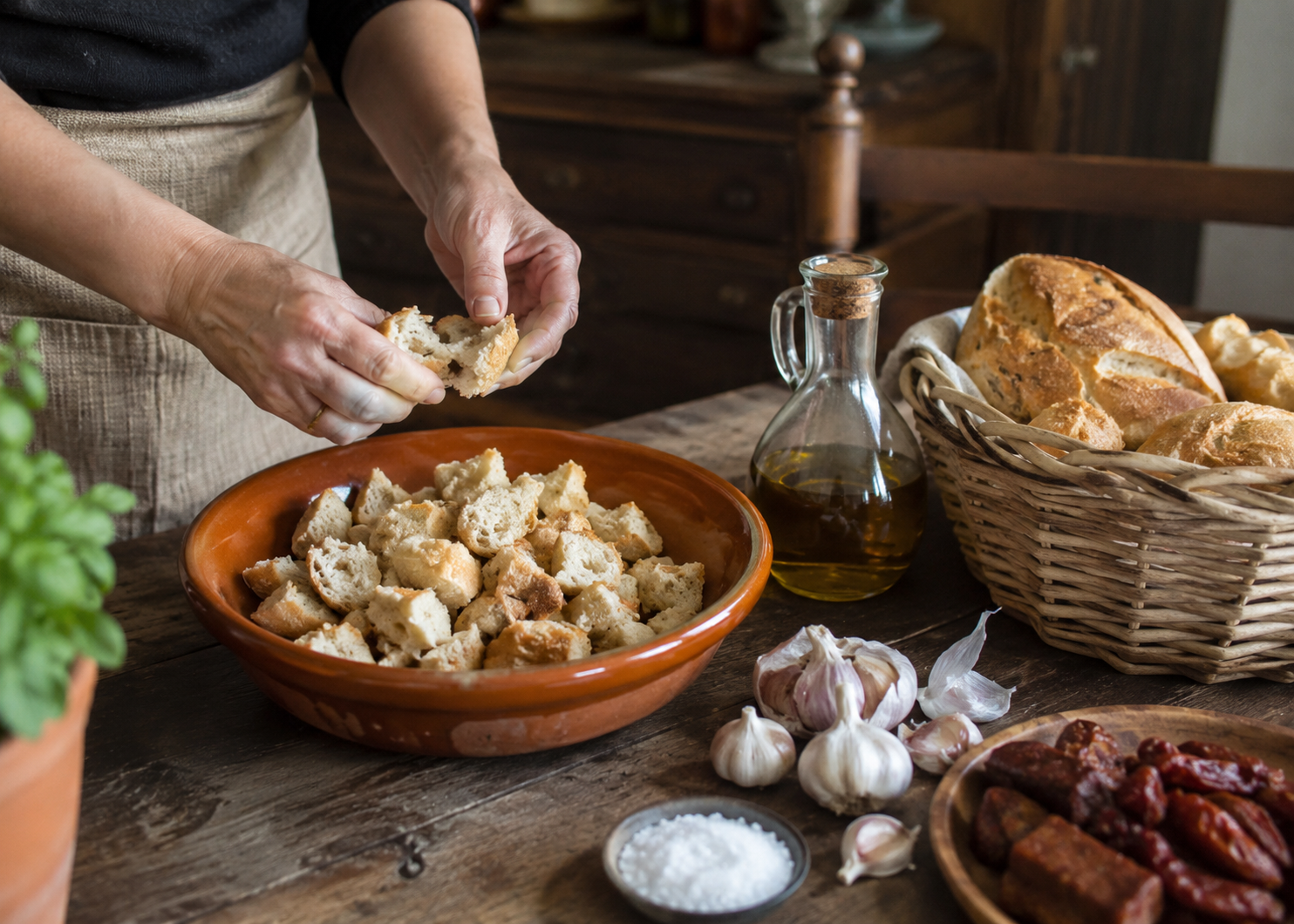
Migas is stale bread broken into pieces and fried with garlic, olive oil, and various additions. Originally a shepherd’s dish made from the bread that had hardened across a week of work in the hills, migas has become a staple of Spanish home cooking and tapas culture. Different regions make migas differently, with chorizo, with grapes, with peppers, with morcilla, with whatever the local tradition includes. The base is always stale bread that would have been thrown away in cultures that did not know what to do with it.
Torrijas is stale bread soaked in milk and eggs and fried, then dusted with sugar and cinnamon. Spanish French toast, essentially, except that the dish predates the French version and was invented specifically to make use of the bread that had hardened too much to slice. Torrijas appears across Spain during Semana Santa and at other religious holidays, treated as a celebratory food rather than as humble leftover use.
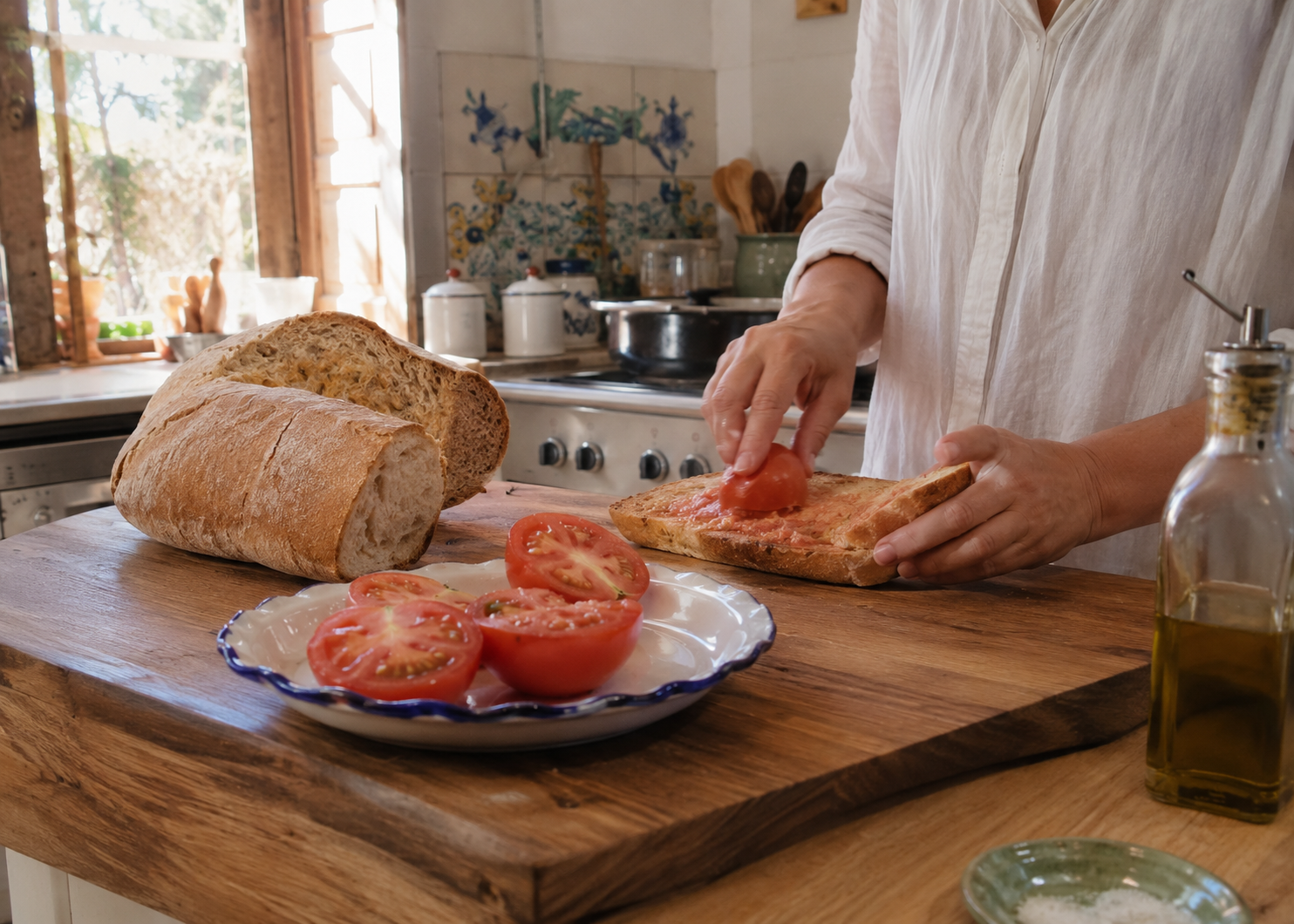
Pa amb tomàquet is Catalan bread rubbed with tomato. The bread is typically slightly stale, which holds the tomato pulp better than fresh soft bread would. Drizzled with olive oil and salt, it becomes one of the foundational tastes of Catalan cuisine. The slight staleness is part of why it works.
Sopa de ajo, Castilian garlic soup, uses stale bread as the thickening and substance of the soup. Cubes of hardened bread, garlic, paprika, olive oil, sometimes egg and chorizo. The dish exists because Castile had stale bread and cold winters and the genius to combine them into something that warms a person from the inside.
Picatostes are cubes of stale bread fried in olive oil, used as garnish for soups and salads or eaten as a snack. Spanish croutons, but better, because the bread that hardens slowly in the Spanish style holds its structure when fried in ways that softer bread does not.
Andalusian gazpacho contains stale bread. The cold tomato soup that Americans encounter as just blended vegetables traditionally includes bread as a thickening agent. The bread that has gone hard disappears into the soup, providing body and substance, contributing to the velvety texture the dish should have.
The Spanish cuisine that built itself around stale bread is not making the best of a problem. It is treating stale bread as one of the ingredients of the cuisine, with specific dishes that exist precisely because the bread does what it does. The cultural framework in which bread goes stale fast produced the cuisine in which stale bread becomes the foundation of valued dishes. The two go together. A culture in which bread did not stale would not have produced migas, torrijas, sopa de ajo, picatostes, the bread component of gazpacho, or pa amb tomàquet.
What The Daily Bread Rhythm Looks Like In Practice
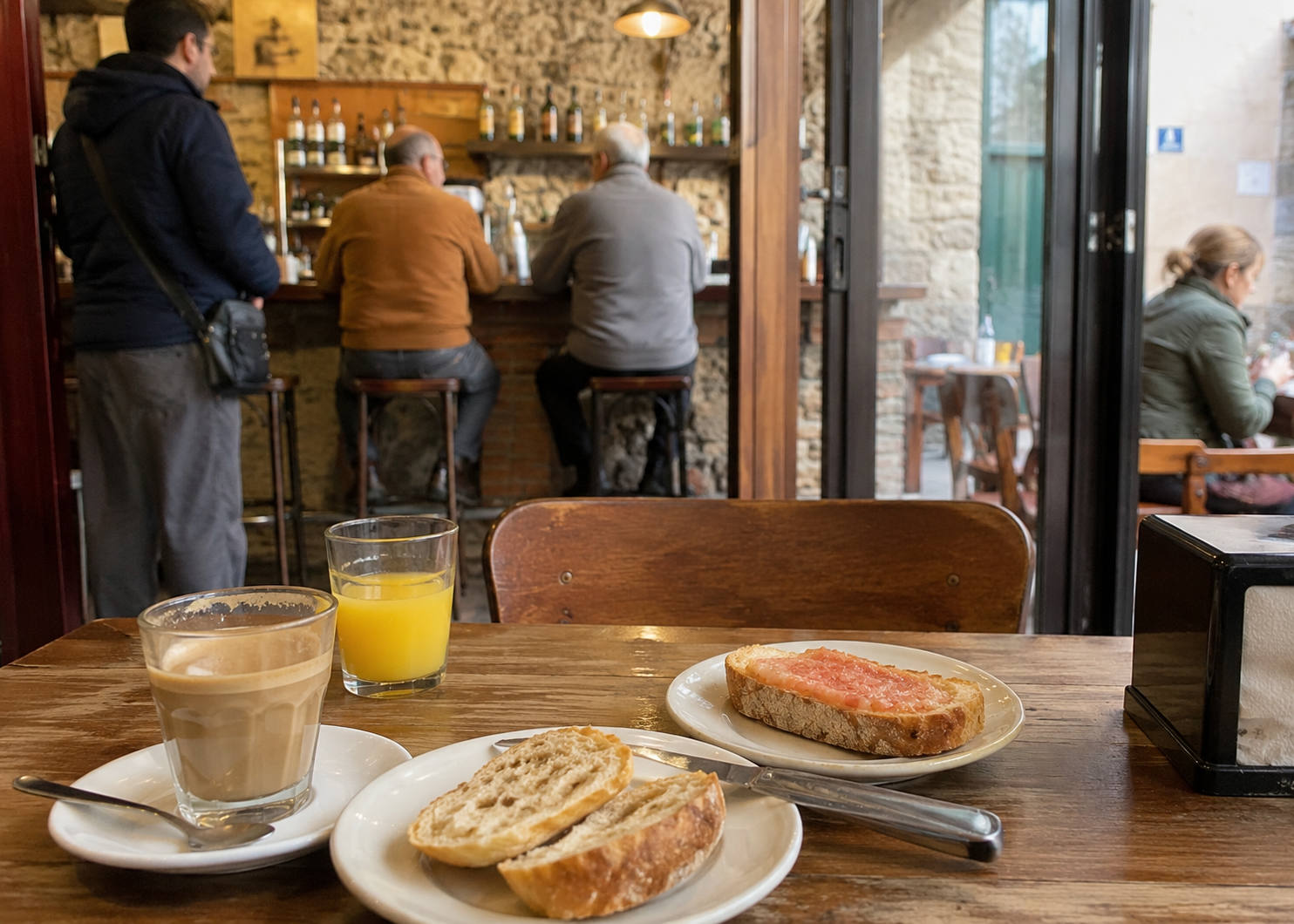
The Spanish system that the New Jersey plumber had to learn is structured around the assumption that bread is a daily purchase.
Most Spanish towns have a panadería within walking distance of every neighborhood. The bread is baked in the morning, sometimes also in the afternoon for the evening bread. The walking distance to fresh bread is part of how Spanish urban planning works. The panadería is not a destination; it is a daily errand.
The walk to the panadería is itself part of daily life. Older Spaniards in particular structure their mornings around the bread purchase, often combined with stops at the fishmonger, the butcher, the fruit stand. The daily errand round produces small social interactions, modest physical activity, and the connection to the neighborhood that defines Spanish small-town and small-neighborhood life. The bread is not just food. It is the occasion for daily community contact.
The bread bought in the morning is eaten across the day. Breakfast toast. Lunch alongside the meal. Sometimes a small piece in the afternoon. By evening the bread has begun to harden but is still usable, and dinner uses what remains. Tomorrow morning, another fresh loaf from the panadería. The cycle is daily, predictable, and structured into how Spanish kitchens work.
Larger Spanish families buy more bread. A family of five may purchase two loaves daily, sometimes three. A retiree living alone buys a smaller loaf or, in some panaderías, half a loaf. The bakers adjust their morning production to the predictable demand of their neighborhood, which they know intimately after years of running the shop.
Industrial pre-sliced bread exists in Spanish supermarkets. The pan de molde, the soft sliced bread for sandwiches in the American style. It exists alongside the traditional bread, not in place of it. Many Spaniards buy pan de molde for specific purposes (children’s sandwiches, certain breakfast applications) while continuing to buy traditional pan from the panadería for everything else. The two breads serve different functions in the same kitchen.
Foreigners adapt to the rhythm at different speeds. Americans typically take several weeks to several months to adjust to daily bread shopping. The adjustment becomes habit once it becomes habit. By month three or four, most Americans in Spain have internalized the daily bread walk and no longer think of it as inconvenient. The New Jersey plumber, by month two, was making his morning walk to the panadería automatically and had stopped trying to make bread last across days.
What Americans Should Understand About The Trade-Off
The American bread system and the Spanish bread system are genuinely different approaches with different costs and benefits. Understanding the trade-off honestly is more useful than treating one as superior.
The American system optimizes for convenience and shelf life. A single weekly grocery trip can buy bread for the week. The bread sits on the counter until needed. The system fits American life patterns built around weekly bulk shopping and the absence of daily food errands. For the American who works ten-hour days and shops once a week, the long-shelf-life bread is not a problem to be solved. It is a feature that enables a particular lifestyle.
The Spanish system optimizes for quality and freshness. The bread is genuinely better at the moment of eating, but it requires the daily errand and the structural shopping pattern that Spanish life supports. For the American living in Spain, the system fits the slower rhythm of Spanish daily life and produces meaningfully better bread. For the American trying to import the Spanish bread system into American life without changing the surrounding patterns, the system creates friction.
The chemical additives in industrial American bread are not categorically harmful at typical consumption levels. Most are recognized as safe by US food regulators. Some are restricted or banned in the EU, as the earlier piece on azodicarbonamide discussed. The general picture is that industrial American bread is not poison, but it is also not the same product as traditional Spanish bread, and the long shelf life comes with chemistry that some people find worth avoiding for various reasons.
The Spanish bread is more nutritionally dense. The longer fermentation in proper sourdough breaks down some of the harder-to-digest components of wheat, including some FODMAPs that affect a substantial subset of people. For Americans with mild digestive sensitivities to industrial bread, the Spanish version often produces fewer symptoms. This is not universal, but it is common enough to be worth noting for Americans who have assumed all bread affects them the same way.
The daily walk to the panadería has its own value. The modest physical activity, the social contact, the connection to the neighborhood. These compound across years into the lifestyle features that Spanish culture is sometimes credited with for the country’s relative longevity and quality of aging. The bread rhythm is one specific implementation of a daily pattern that produces broader benefits.
Most Americans in Spain eventually prefer the Spanish system. The conversion is not ideological. It is the result of eating the bread for a few months and recognizing that the Spanish version is better. The daily walk that initially feels inconvenient becomes a daily pleasure. The bread that goes stale by Wednesday becomes the foundation of dishes the American had not known existed. The system reveals itself across time as more than the sum of its individual features.

About the Author: Ruben, co-founder of Gamintraveler.com since 2014, is a seasoned traveler from Spain who has explored over 100 countries since 2009. Known for his extensive travel adventures across South America, Europe, the US, Australia, New Zealand, Asia, and Africa, Ruben combines his passion for adventurous yet sustainable living with his love for cycling, highlighted by his remarkable 5-month bicycle journey from Spain to Norway. He currently resides in Spain, where he continues sharing his travel experiences with his partner, Rachel, and their son, Han.