
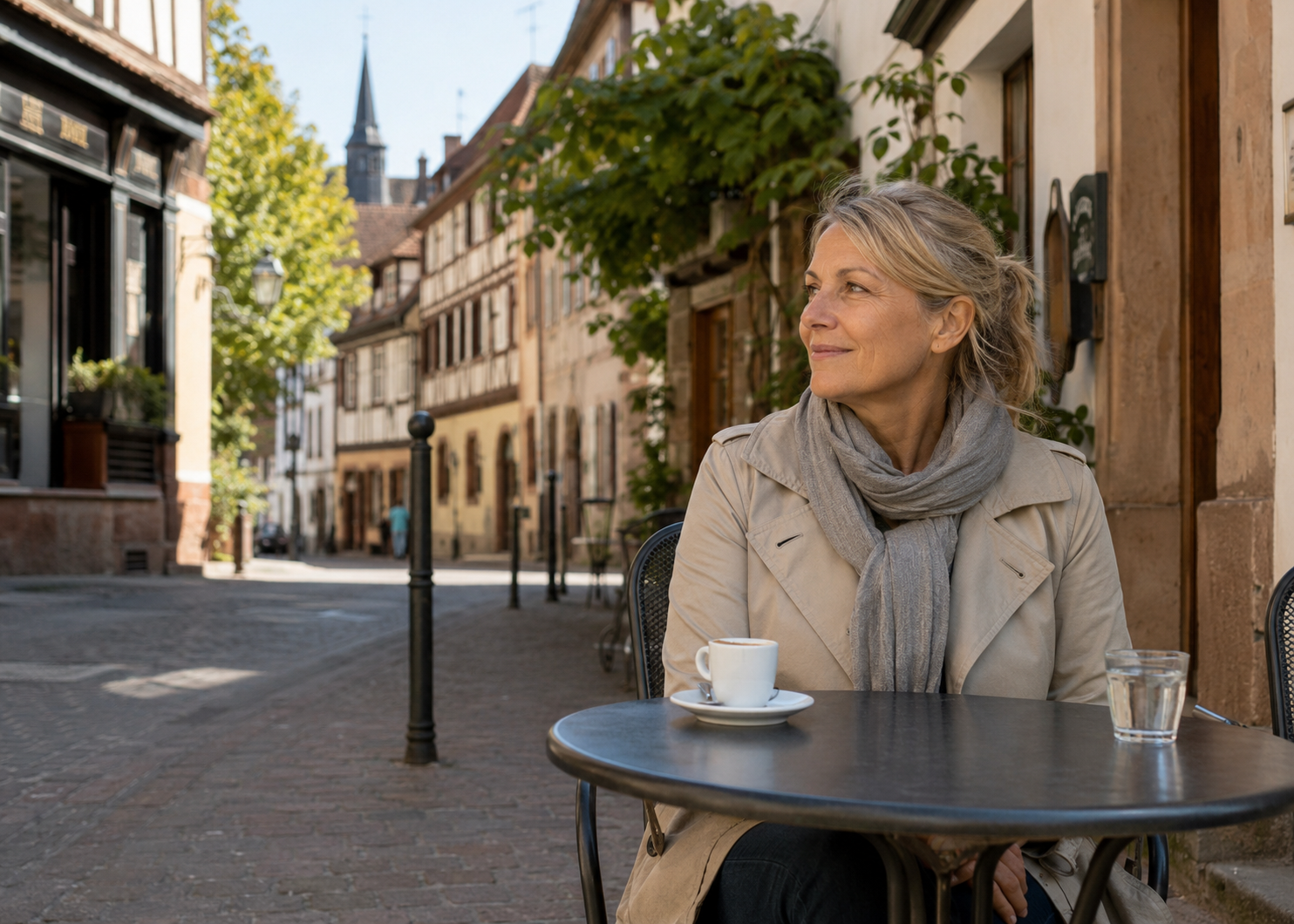
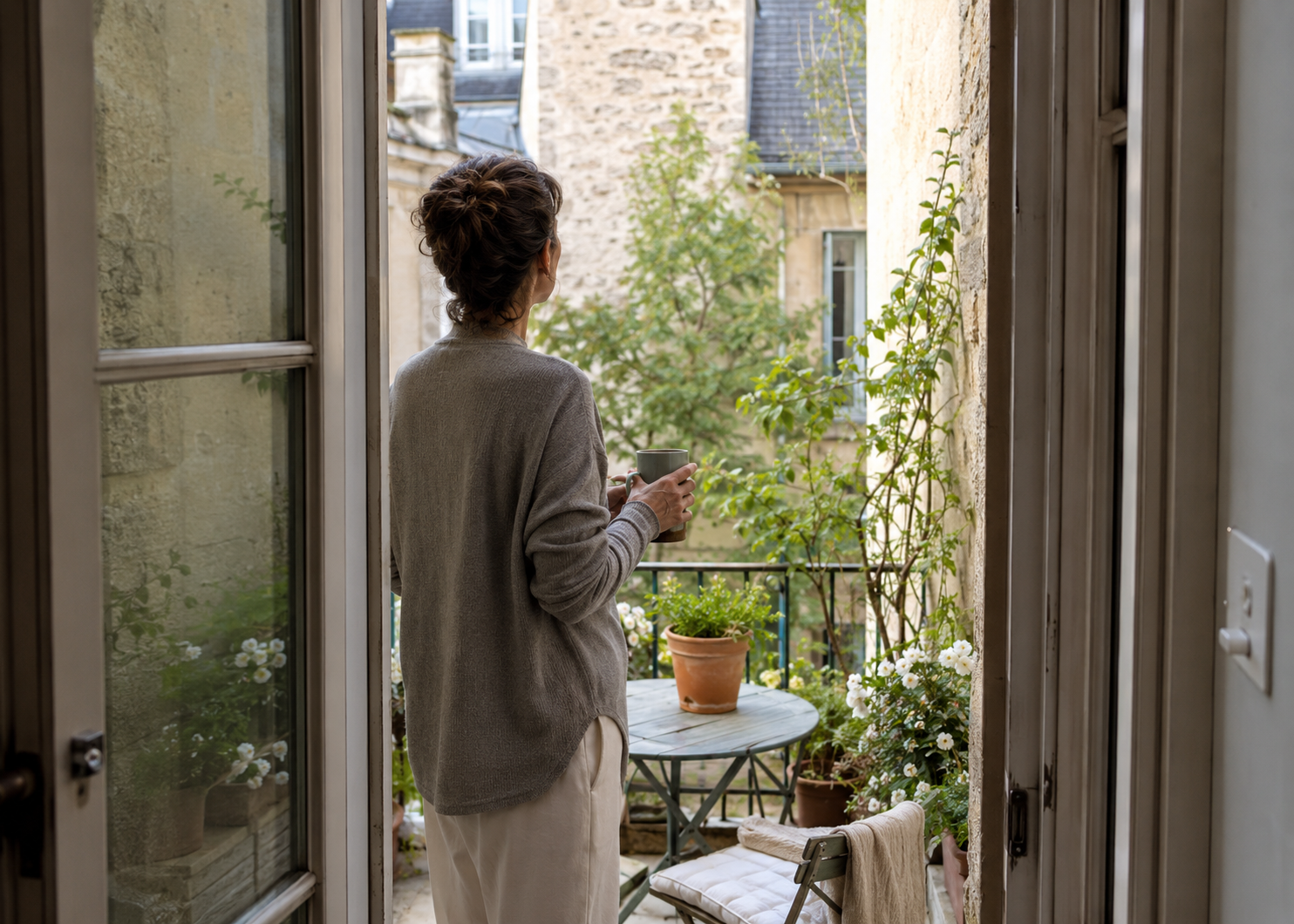
A retired teacher in a small town in Provence wakes at 7:00am most mornings. She does not turn on her phone. She does not check her email. She does not turn on the news. She opens her shutters, puts on a sweater if needed, and walks outside. She walks for 15 to 25 minutes through her village before returning home for breakfast and her first coffee. She has done this every morning for 40 years.
She does not experience morning anxiety. She does not need anxiety medication. She does not have the racing thoughts and chest tightness that increasingly characterize American mornings for adults in their fifties and sixties. Her morning physiology operates differently than her American counterpart’s morning physiology, and the difference is partly attributable to what happens in the first 30 minutes after waking.
This piece walks through what the French habit of going outside before coffee actually involves, what the research shows about morning behaviors and anxiety patterns, what the 30-day pattern reveals for adults who shift from American screens-and-coffee-first mornings to French outside-first mornings, and what individual American adults can do with this information. Anyone with diagnosed anxiety disorder, taking prescribed anxiety medications, or in mental health treatment should discuss any changes with their physician or therapist. The information here describes patterns observed across populations and is not medical advice for any specific individual. Anxiety medication discontinuation against medical advice can produce dangerous withdrawal effects and must always happen under physician supervision.
What The French Morning Habit Actually Is

The French morning pattern has specific features that distinguish it from American mornings.
The morning begins outside. Within 15 to 30 minutes of waking, the French adult is outside. Not for exercise specifically. A walk to the boulangerie. A walk through the village. A walk to the market. The outside time has practical purposes (often acquiring breakfast) but the structural feature is the outside exposure in the first 30 minutes of waking.
Phones and screens are deferred. The French morning typically does not begin with phone checking, email scanning, or news consumption. The first hour of the day is screen-free for many French adults. Phones are checked later in the morning, after the morning structure has established itself.
Coffee comes after the walk. The first coffee of the day happens after returning home from the morning errand. The coffee is part of breakfast, not part of the awakening process. The American pattern of coffee within minutes of waking is not the French pattern.
Breakfast is light but real. Bread with butter, possibly jam. A small pastry occasionally. Coffee or tea. Fresh fruit sometimes. The breakfast happens at a table with proper structure, not consumed while moving or working.
The morning has shape. Wake. Open shutters. Brief preparation. Outside walk. Return home. Breakfast with coffee. Reading or light activity. The day proceeds. Each element happens in sequence rather than overlapping.
News exposure is bounded. When news is consumed, it is consumed deliberately at a specific time rather than as continuous background. The morning paper at the breakfast table is read once. The morning radio program plays for a defined period. The American pattern of continuous news exposure across the entire morning is not the French pattern.
Work begins after the morning structure completes. Even for working adults, the morning structure happens before work tasks begin. The transition to work is a deliberate shift rather than a continuous extension of waking.
The combined pattern produces a morning that has clear structure, includes outside exposure early, defers screen and news input, and supports a calm transition from sleep to daily activity. The morning operates as a transitional period rather than as the first phase of work.
What The Research Shows About Morning Behaviors And Anxiety
The research on morning behaviors and anxiety patterns has produced specific findings relevant to the French habit.
Morning light exposure regulates cortisol patterns. The body’s natural cortisol awakening response peaks 30 to 45 minutes after waking. Outside light exposure during this period supports proper cortisol regulation. Cortisol that rises and falls in healthy patterns produces less anxiety than cortisol that remains elevated or peaks inappropriately.
Morning light exposure regulates circadian rhythms. The eye’s exposure to outdoor morning light, even on cloudy days, signals the circadian system. The signal is much stronger than indoor lighting provides. Stronger circadian signaling produces better sleep at night, better wake-up alertness, and better overall mood regulation.
Morning movement reduces cortisol elevation. Even light movement (walking) in the morning produces modest cortisol moderation compared to sedentary morning patterns. The movement engages the parasympathetic nervous system in ways that purely sedentary mornings do not.
Morning screen exposure increases anxiety. Research on morning screen use has found consistent associations with increased anxiety, racing thoughts, and difficulty with mood regulation across the day. The immediate exposure to news, social media, email within minutes of waking produces sustained activation patterns that do not resolve quickly.
Caffeine timing affects anxiety patterns. Coffee consumed immediately upon waking, before the natural cortisol awakening response has completed, can produce anxiety patterns that delayed coffee does not produce. The coffee that comes 60 to 90 minutes after waking integrates with normal cortisol patterns rather than disrupting them.
Structured morning routines reduce anxiety baseline. Predictable morning structures, regardless of specific content, produce lower anxiety than chaotic or unstructured mornings. The mind knowing what comes next reduces low-grade stress.
Connection with outside nature produces measurable anxiety reductions. Even brief exposure to natural environments (trees, sky, fresh air, natural light) produces measurable reductions in anxiety markers compared to indoor-only mornings. The mechanism is partly evolutionary and partly direct nervous system effects of natural environment exposure.
Social contact during morning errands produces secondary benefits. The greetings, the brief conversations, the recognition by neighbors and shopkeepers. These small social contacts produce mood benefits that solo indoor mornings do not produce.
What The 30-Day Pattern Reveals
For Americans who shift from screens-and-coffee-first mornings to outside-first mornings for 30 days, the pattern observed across adopters is consistent enough to describe.
Days 1 to 7: difficulty with the new pattern. American adults are deeply habituated to morning phone checking and immediate coffee. The shift to outside-first feels unnatural and effortful. Many adopters report initial difficulty maintaining the practice through the first week.
The first morning without checking the phone is particularly difficult. The work emails that have accumulated overnight, the social media notifications, the news updates. The brain that has been trained to engage with these immediately upon waking experiences resistance to the deferred pattern.
Days 7 to 14: pattern adjustment. By the second week, the new morning structure begins to settle. The outside walk becomes anticipated rather than effortful. The deferred phone checking becomes more comfortable. Some adopters report sleeping slightly better even within the first two weeks.
Days 14 to 21: anxiety reduction emerges. The morning anxiety that prompted the experiment begins to noticeably reduce for many adopters. The racing thoughts upon waking diminish. The chest tightness reduces. The sense of being behind from the moment of waking shifts toward a calmer initial state.
Days 21 to 30: settled new pattern. By the end of the first month, the new morning structure has become habitual. The old pattern feels uncomfortable when occasionally revisited. The accumulated anxiety reduction stabilizes at a new lower baseline.
The pattern is not universal. Some adopters see substantial anxiety improvements. Some see modest improvements. Some see no change. Some have underlying conditions (clinical anxiety disorders, depression with anxiety features, trauma-related anxiety) that the morning pattern alone cannot address. The 30-day trial reveals individual response rather than producing guaranteed outcomes.
Sleep effects often improve. The combination of morning light exposure and reduced morning stimulation often produces meaningful sleep improvements within 3 to 4 weeks. The improved sleep further reduces anxiety in compounding fashion.
Energy patterns shift. Adopters often report better morning energy and reduced afternoon crashes. The natural cortisol pattern that the morning structure supports operates more effectively across the entire day.
Mood baseline shifts upward. Beyond specific anxiety reduction, general mood improvements are often reported. The cumulative effect of better sleep, better light exposure, better cortisol regulation, and reduced morning stimulation produces broader mood benefits.
Why The Mechanism Works

The mechanism by which morning behavior changes affects anxiety operates through multiple physiological pathways simultaneously.
Cortisol regulation. The body’s morning cortisol response is biological and necessary. The cortisol that rises appropriately and falls appropriately produces calm wakefulness. The cortisol that is disrupted by immediate caffeine, immediate screens, or immediate stress produces patterns associated with anxiety. The French morning pattern supports natural cortisol regulation.
Parasympathetic engagement. Outside walking, fresh air, natural light, and absence of screen demands all engage the parasympathetic nervous system. The parasympathetic engagement in the morning establishes a calm baseline that supports lower anxiety across the day.
Circadian rhythm reinforcement. Outside morning light is the strongest signal the circadian system receives. Strong daily signaling produces stable circadian rhythms which produce stable mood patterns. Disrupted circadian rhythms reliably produce mood disturbance including anxiety.
Reduced stimulant overload. Coffee on an empty stomach within minutes of waking, while still in the cortisol awakening response, produces stimulant patterns that exceed what the body would naturally produce. The combined cortisol-plus-caffeine spike can produce anxiety-like sensations even in adults who do not have clinical anxiety.
Reduced information overload. The first conscious minutes of the day, before the brain has fully transitioned from sleep, are particularly vulnerable to overwhelming input. Phone notifications, news, email, social media in this window produce sustained activation that does not easily resolve. The French pattern defers this input until the brain has stabilized into waking.
Physical movement. Even light morning walking produces endorphin release and mood regulation effects. The walking is not exercise in the intensity sense, but it provides movement benefits that purely sedentary mornings do not.
Social and environmental connection. The morning walk through a village or neighborhood, the greetings, the natural environment, the engagement with the world outside the home. The connection produces mood benefits that isolated indoor mornings do not produce.
Predictability and structure. The brain that knows what to expect produces less stress response. The structured French morning provides this predictability. The unstructured American morning where the day’s stressors arrive within minutes of waking does not provide it.
What This Pattern Means For American Adults

For American adults considering whether the French morning pattern could reduce their morning anxiety, several practical implications follow.
Defer phone use for the first 30 minutes. The single highest-return change is keeping the phone out of the first 30 minutes of waking. Charge the phone outside the bedroom if necessary to prevent reflexive checking. The 30-minute deferral is the entry point to broader morning structure.
Go outside within the first 30 minutes. Even 5 to 10 minutes initially. A walk around the block. Standing on the porch with a cup of tea. The outside exposure during the cortisol awakening response is the second highest-return change. Build the duration gradually.
Defer coffee for at least 60 minutes after waking. The body’s natural cortisol awakening response operates better without immediate caffeine input. The coffee that comes after the walk integrates with normal cortisol patterns rather than disrupting them.
Skip news for the first 60 to 90 minutes. News consumption upon waking produces anxiety patterns that defer news consumption does not. Save news for later in the morning, after the morning structure has settled.
Build morning structure deliberately. A predictable sequence: wake, brief preparation, outside walk, return home, breakfast with coffee, transition to day. The structure itself produces benefits independent of specific components.
Eat breakfast at a table. Even a simple breakfast eaten at a table with attention produces different effects than breakfast consumed while moving or working. The sitting and the attention support proper digestion and proper morning transition.
Adjust the structure to your local environment. Not all American adults have walkable neighborhoods. Some can walk to nearby parks. Some can drive briefly to walkable areas. Some need to use balconies, porches, or yards. The principle is outside exposure rather than specific walking routes. Adapt to what is available.
Maintain the pattern for at least 21 to 30 days before evaluating. The full effects take time to emerge. Three weeks is the minimum for evaluating whether the pattern produces meaningful effects. Earlier evaluation often misses the actual outcome.
Consult your physician or therapist before any medication changes. This is the critical safeguard. The morning pattern may reduce anxiety symptoms substantially, but adults on prescribed anxiety medications must discuss any changes with their prescribing professional. Anxiety medication discontinuation can produce dangerous withdrawal effects, particularly for SSRI/SNRI antidepressants used for anxiety, benzodiazepines, and other medication classes. Any medication changes require professional supervision.
Continue mental health treatment as prescribed. If you are in therapy or other mental health treatment, the morning pattern supplements rather than replaces this treatment. The pattern is one component of mental health support, not a substitute for professional mental health care.
Track your responses. Note morning anxiety levels at baseline and across the 30 days. Concrete tracking reveals what is actually changing for your specific physiology. Without tracking, the subtle changes may not be visible.
What This Pattern Recognizes About Morning Anxiety More Broadly

The American morning pattern that produces increasing anxiety for adults in their fifties and sixties did not exist in 1985. It has been built across the past 30 years through specific cultural and technological shifts.
The smartphone has placed morning information access in the bedroom. The 24-hour news cycle has created continuous stress input. The work email expectation has placed work demands in the first conscious minutes. The decline of morning routines that included outdoor activity, breakfast at tables, and bounded information exposure has been gradual and largely invisible.
The cumulative effect is that American mornings now reliably produce anxiety patterns that French mornings reliably do not produce. The difference is not genetic. It is structural. The same physiological systems operating in the two contexts produce different outcomes because the inputs are different.
For American adults experiencing morning anxiety, the recognition is that the anxiety may be substantially driven by the morning pattern rather than by underlying mental health conditions. The pattern can be changed. The change does not require medication for many adults. For others, the change supports medication rather than replaces it.
The 30-day trial allows individual testing of whether this is true for the specific individual. The trial is low-cost. The shift is from screens-and-coffee-first mornings to outside-first mornings. The structural change does not require new equipment, new diet, or major lifestyle disruption. It requires sequence shifts in the first hour of the day.
For adults whose morning anxiety substantially improves across 30 days, the implication is that the morning pattern was producing the anxiety. The pattern can be maintained. The anxiety can be substantially reduced through the structural change rather than managed through medication that addresses symptoms while the underlying pattern continues.
For adults whose morning anxiety does not substantially improve, the implication is that the underlying issue may require additional support. These adults should continue working with their physicians and mental health professionals. The trial reveals which category any specific adult is in.
The Provence retiree walking outside her village at 7:15am is not exercising anxiety management. She is having her morning. The walking, the fresh air, the deferred coffee, the structured sequence. These are not interventions. They are what morning is in her cultural framework.
The cumulative effect across her lifetime of mornings is the absence of the chronic morning anxiety that increasingly defines American mornings. The absence is not luck. It is the consequence of a pattern that supports rather than disrupts the physiological systems that regulate morning state.
For American adults willing to test the pattern, the structural change is accessible. The 30 days of consistent practice reveals what the change produces for specific individual physiology. The result is personal data about how the morning pattern affects the specific individual’s anxiety, mood, energy, and sleep.
The French habit of going outside before coffee is not magic. It is a specific structural choice about how to organize the first hour of the day. The choice produces specific physiological outcomes in the populations that maintain it. The same choice is available for American adults willing to adopt it, with the same physiological outcomes available to those whose underlying physiology responds to the structural change.
For adults considering whether to test this, the cost is genuinely low. Defer the phone. Go outside. Drink coffee after the walk. Maintain for 30 days. The result is personal data about personal physiology and personal morning patterns. The data either points toward structural change or points toward continued professional support. Either outcome is useful information when integrated with appropriate medical guidance.
The French morning pattern operates as a coordinated system that produces calmer mornings as byproduct. The American morning pattern operates as a coordinated system that produces anxious mornings as byproduct. Both are real. Both are systems. The system in operation produces the outcome the system is designed to produce. For American adults whose mornings are producing anxiety, the question is whether to continue the system that is producing the outcome or to test an alternative system that has produced different outcomes for the populations that maintain it.

About the Author: Ruben, co-founder of Gamintraveler.com since 2014, is a seasoned traveler from Spain who has explored over 100 countries since 2009. Known for his extensive travel adventures across South America, Europe, the US, Australia, New Zealand, Asia, and Africa, Ruben combines his passion for adventurous yet sustainable living with his love for cycling, highlighted by his remarkable 5-month bicycle journey from Spain to Norway. He currently resides in Spain, where he continues sharing his travel experiences with his partner, Rachel, and their son, Han.