
Americans have pot roast, the Sunday standby of beef and vegetables cooked slow until tender. France has its own version, older and in its way cleverer, called pot-au-feu, literally pot on the fire, a dish of tough beef and marrow bones gently simmered with vegetables in a big pot of water for about four hours. The difference from pot roast is the water, because where the American dish braises beef in a little liquid, the French one simmers it in a lot, which means pot-au-feu produces not just tender meat and vegetables but a magnificent clear broth, and that broth is the secret that keeps on giving, becoming tomorrow’s soup and the base of meals for days.
Pot-au-feu is one of the great one-pot dishes of French home cooking, a national institution really, humble and nourishing, that yields two or three meals from a single pot and wastes nothing. It is slow but almost entirely hands-off, and it rewards the cook with meat, vegetables, and a broth that is practically a pantry staple in itself. Here is what pot-au-feu is, how it differs from pot roast, why it takes four hours, and how the broth becomes tomorrow’s lunch. This is a recipe and a bit of French food history, offered to put a brilliant, thrifty classic on your table.
What Pot-au-Feu Is
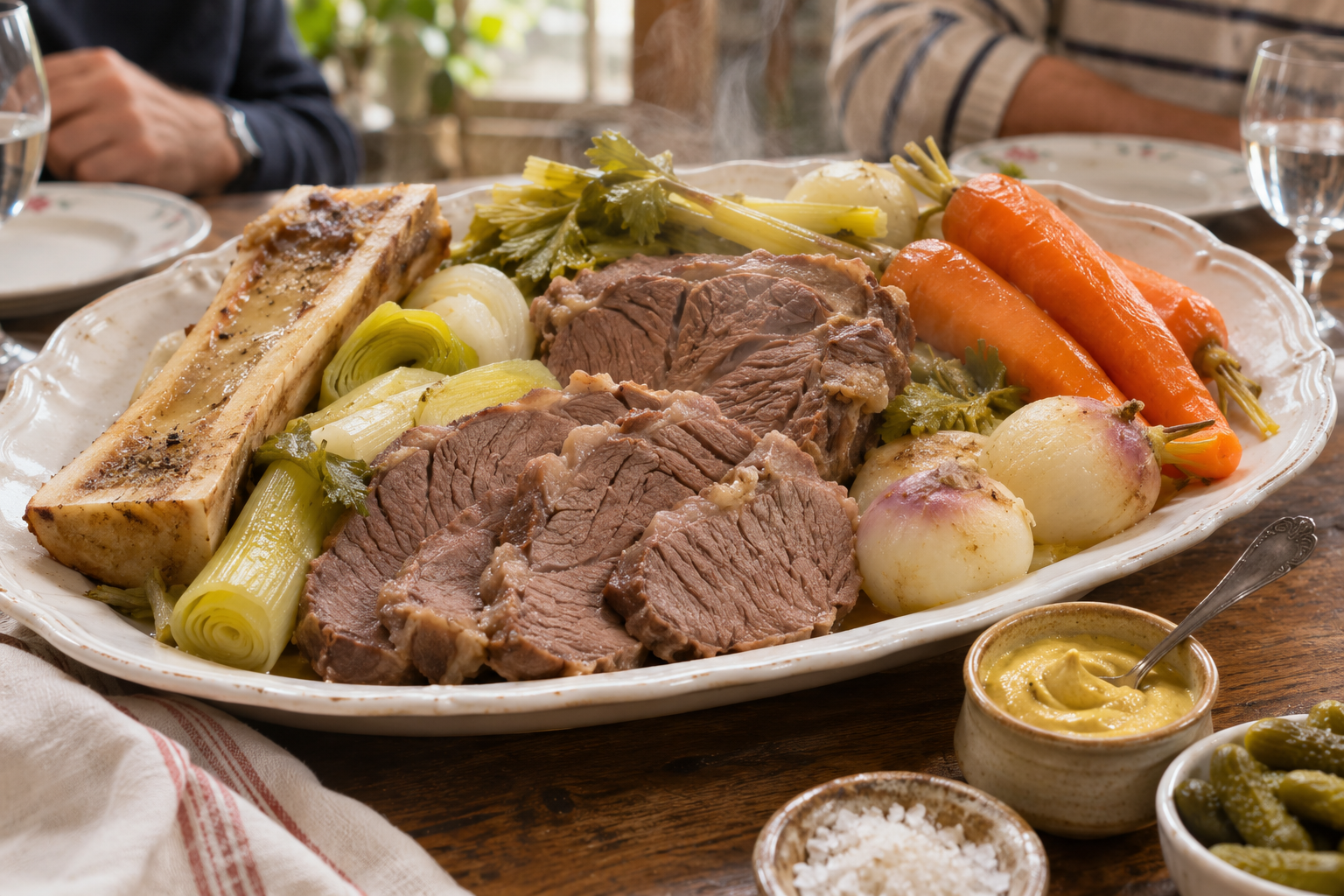
Pot-au-feu is, at its simplest, beef and vegetables simmered in water into a two-part meal: a clear, rich broth and the tender boiled meat and vegetables themselves. Tough, flavorful cuts of beef, often along with marrow bones, go into a big pot with plenty of water and a selection of vegetables, carrots, leeks, turnips, celery, and an onion, and the whole thing simmers gently for hours until the meat is meltingly tender and the water has become a deeply flavored broth. From one pot come two distinct things, a soup and a main course.
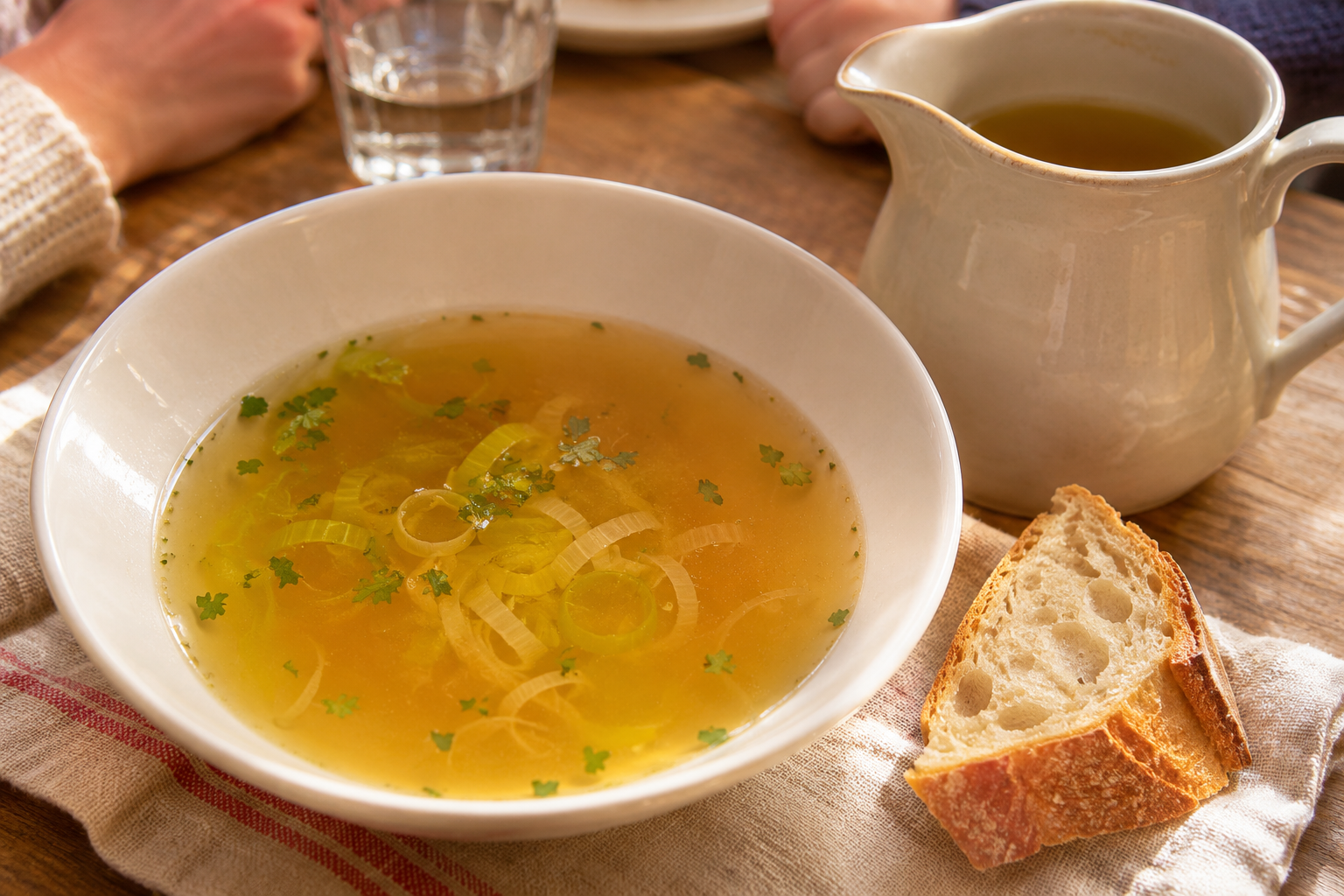
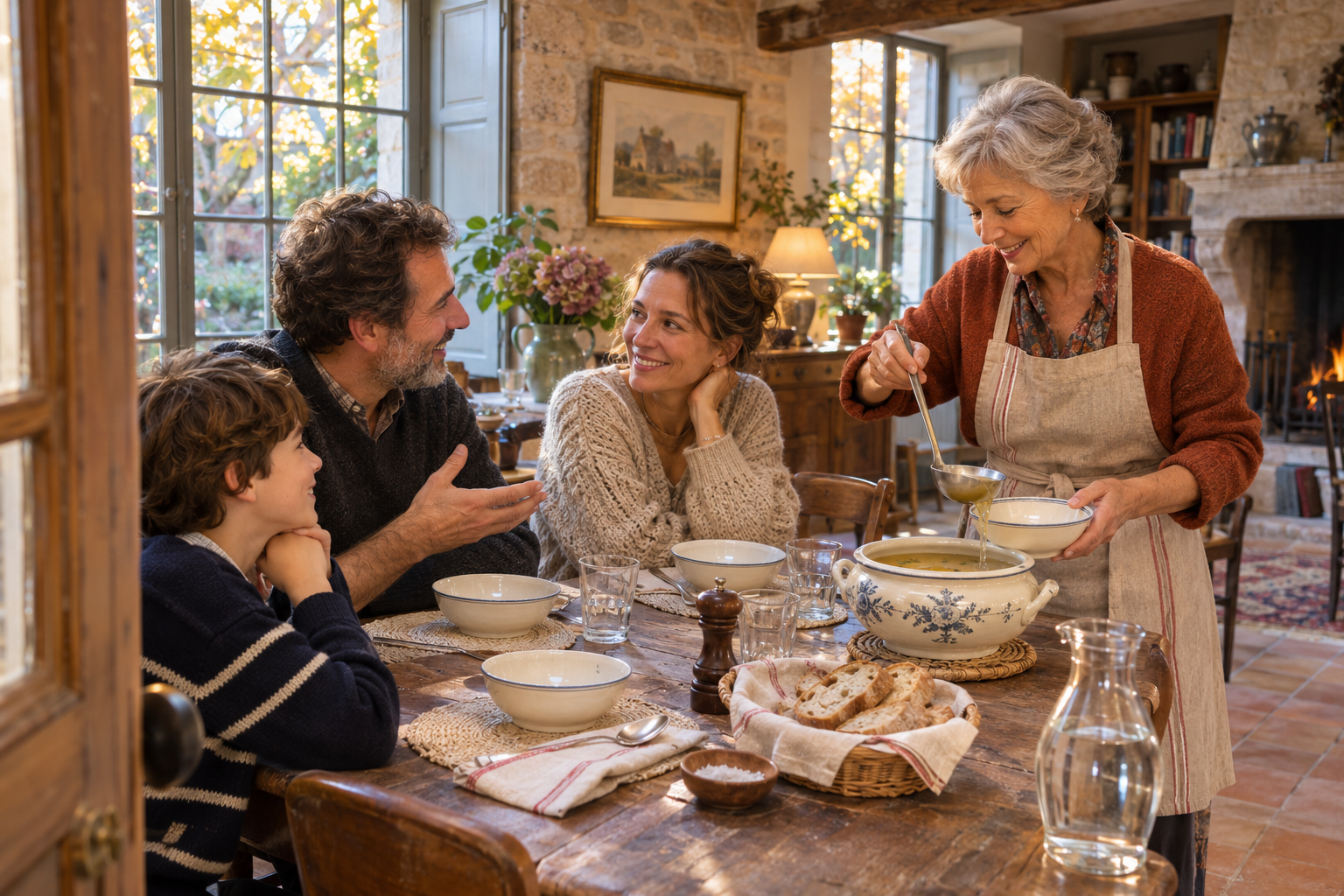
The traditional way to eat it reflects that duality. The broth is served first, on its own as a soup, often poured over bread or with a little pasta, a clear golden consomme rich with the flavor of the long simmer. Then the meat and vegetables are served as the main course, the beef sliced, the vegetables arranged alongside, eaten with coarse salt, mustard, cornichons, and perhaps a dab of horseradish. One cooking, two courses, which is part of the dish’s elegant economy.
Pot-au-feu is deeply woven into French home life, a classic Sunday or family dish, unpretentious and nourishing, the kind of thing that has fed French families for centuries and that many consider one of the truest expressions of French home cooking. It is not restaurant food or fancy cuisine, it is the honest, slow, comforting food of the home, built from humble cuts and ordinary vegetables, and valued precisely for that homely richness. To eat pot-au-feu is to eat the way France has eaten forever.
France’s Answer to Pot Roast
Comparing pot-au-feu to the American pot roast is illuminating, because the two are cousins that take opposite approaches to the same idea of slow-cooked beef and vegetables. American pot roast is a braise, the beef cooked in a relatively small amount of liquid, often with the lid on, so the meat essentially steams and stews in its own concentrated juices and a bit of stock or wine, producing tender meat and a thick, intense gravy. The liquid is a sauce, and there is not much of it.
Pot-au-feu takes the other path, simmering the beef in a large quantity of water, so that rather than a small amount of concentrated gravy you get a whole pot of clear broth, and the water is not a sauce but a prize in its own right. This is the key difference: pot roast is about the meat and its gravy, while pot-au-feu is equally about the meat and the broth, treating the cooking liquid as a central product of the dish rather than a sauce clinging to the beef. The Frenchman wants the bouillon as much as the boeuf.
That difference changes everything about how the dish is used, because the generous broth makes pot-au-feu a two- or three-meal dish rather than a single serving, as we will see. Where a pot roast is eaten and done, a pot-au-feu leaves you with a pot of broth that becomes soups and bases for days, which is why the French dish is so prized by thrifty home cooks. Same basic idea, beef and vegetables cooked slow, but the French insistence on the broth turns one dinner into a small series of meals, which is the genius of it.
Why It Takes Four Hours
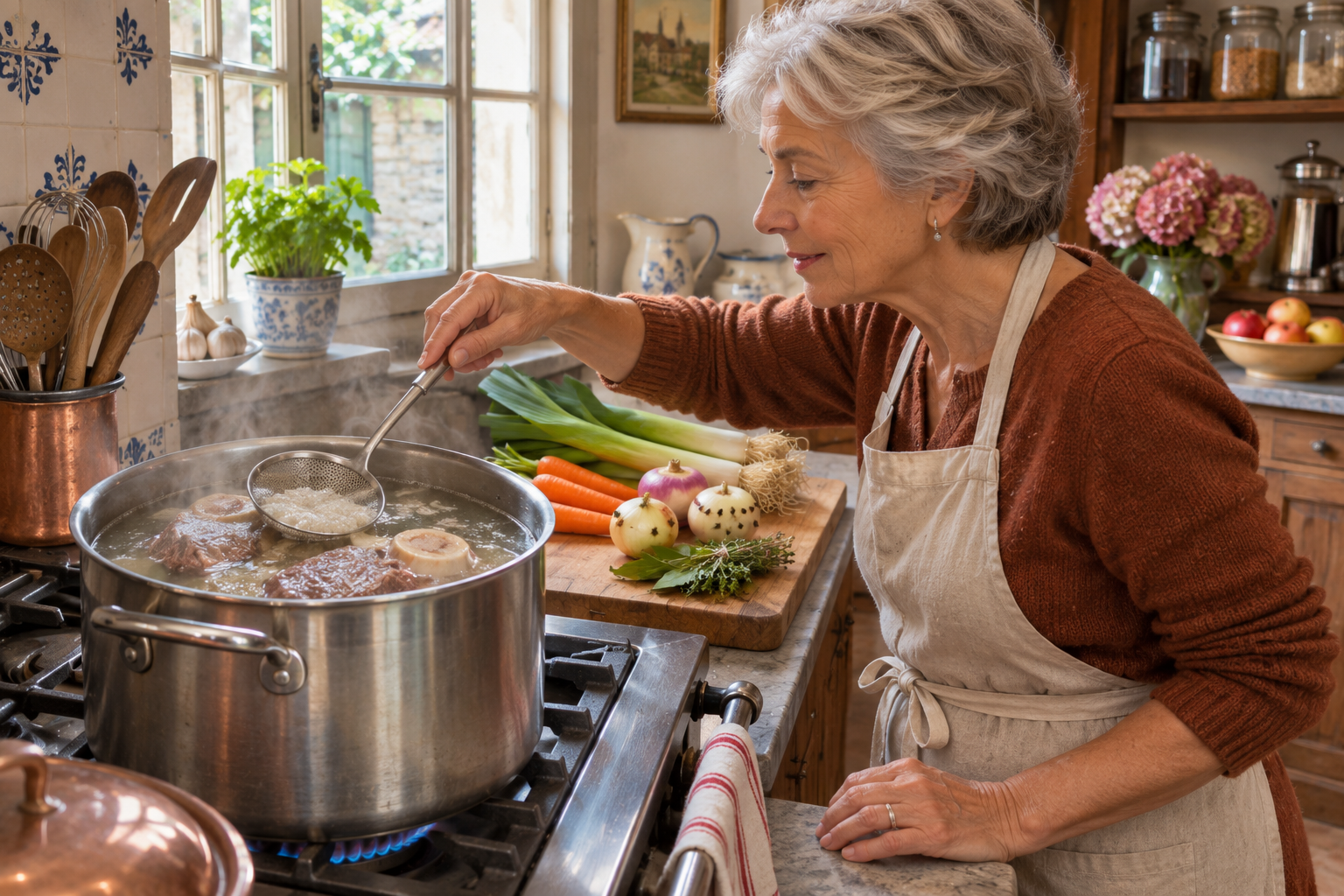
The four hours are not fussiness, they are physics, the same physics behind any slow-cooked beef dish. Pot-au-feu uses tough, inexpensive cuts of beef, the hard-working muscles full of connective tissue and collagen, which are cheap and deeply flavorful but require long, gentle cooking to break down into tenderness. A fast-cooked tough cut is a chewy disaster, while the same cut simmered slowly for hours becomes meltingly tender as the collagen turns to gelatin, which is why the dish needs its time.
The gentle simmer is crucial, not a hard boil, because a rolling boil would toughen the meat and cloud the broth, while a bare, patient simmer coaxes the beef to tenderness and keeps the broth clear and clean. This is the technique at the heart of pot-au-feu, long slow heat that transforms cheap tough meat into something tender and turns plain water into rich clear broth, and it cannot be rushed. The four hours are the dish doing its slow work, mostly untended, on the back of the stove.
The reward for the time is twofold, both the tender meat and the deeply flavored broth, because the long simmer that softens the beef is also what extracts all that flavor into the water. You cannot get the broth without the time, and you cannot get the tender meat without it either, so the four hours produce both prizes at once. It is slow cooking at its most classic and most rewarding, almost entirely hands-off, asking only patience, and giving back a pot that will feed you for days.
The Broth That Becomes Tomorrow’s Lunch
Here is the feature that makes pot-au-feu so beloved by thrifty cooks: the broth and the leftovers become meal after meal, so a single pot stretches far beyond the first dinner. The clear broth, served as a soup on the first night, is only the beginning, because what remains becomes the foundation of the days that follow, a rich homemade stock ready to turn into other soups, to cook rice or vegetables, or simply to be enjoyed again as a bowl of bouillon. That pot of broth is a pantry treasure.
The leftover meat and vegetables have their own second lives, and French cooking has traditional dishes built specifically around pot-au-feu leftovers. The boiled beef can be chopped and turned into a hachis parmentier, the French shepherd’s pie, or sliced into a salad with vinaigrette and cornichons, or reheated in its broth, so the meat that was the main course on Sunday becomes a different dish on Monday. Nothing is wasted, and the leftovers are not sad scraps but the raw material for genuinely good second meals.
This is the real economy and genius of pot-au-feu, that one long cooking session yields a soup, a main course, and the makings of several more meals, which is why generations of French families have relied on it. In an age of expensive food and busy weeks, a dish that produces dinner, tomorrow’s lunch, and a stock for the days after, all from humble cuts and ordinary vegetables in one pot, is enormously valuable. The broth that becomes tomorrow’s lunch is not a bonus but part of the whole design, the reason pot-au-feu is cherished as much for what it leaves behind as for what it puts on the table that night.
The Condiments Matter
An easily overlooked part of pot-au-feu is how the boiled meat and vegetables are eaten, because the dish is traditionally served with a little array of sharp condiments that cut the richness and lift the plainness of the boiled beef. The classics are coarse salt, flaky or crystal salt sprinkled on the meat, mustard, a good strong Dijon, and cornichons, the tart little pickled gherkins, and often a dab of horseradish too. These are not optional extras but part of how the dish is meant to be eaten.
The reason they matter is that boiled beef, for all its tender comfort, is a gentle, mild thing, and the bright, sharp, salty, tangy condiments are what give each bite contrast and interest, waking up the plain meat and vegetables. A forkful of tender beef with a smear of mustard, a bite of cornichon, and a few grains of coarse salt is a completely different and far more exciting mouthful than the beef alone. This is a classic French approach, letting humble, gently cooked food be enlivened at the table by sharp accompaniments rather than by heavy saucing. So when you serve pot-au-feu, do not forget the mustard pot, the cornichons, and the coarse salt, because they are as much a part of the dish as the broth and the beef.
Make It: Pot-au-Feu
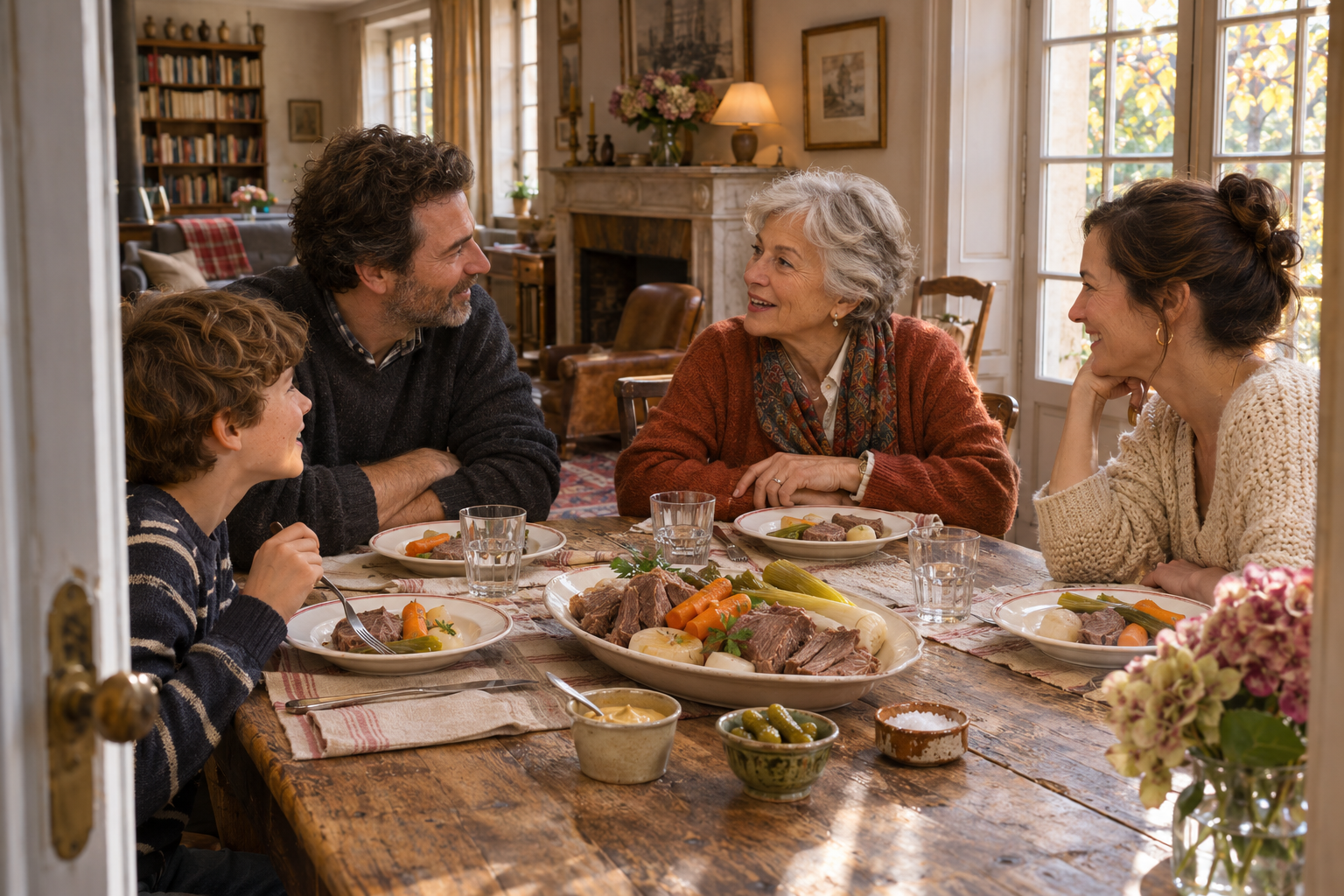
This serves several with leftovers, which is the point. Use tough, flavorful beef cuts and marrow bones if you can get them, keep the simmer gentle for a clear broth, and plan to eat the broth first and the meat and vegetables after. Save every drop of broth for the days ahead.
Ingredients
- about 1.5kg tough beef cuts (such as shin, chuck, short rib, or a mix), plus a marrow bone or two
- 4 carrots, peeled
- 3 leeks, trimmed and cleaned
- 3 turnips, peeled and halved
- 2 celery stalks
- 1 onion, peeled and studded with 2 cloves
- a bouquet of herbs (bay, thyme, parsley stalks)
- salt and a few black peppercorns
- to serve: coarse salt, mustard, cornichons, crusty bread
Instructions
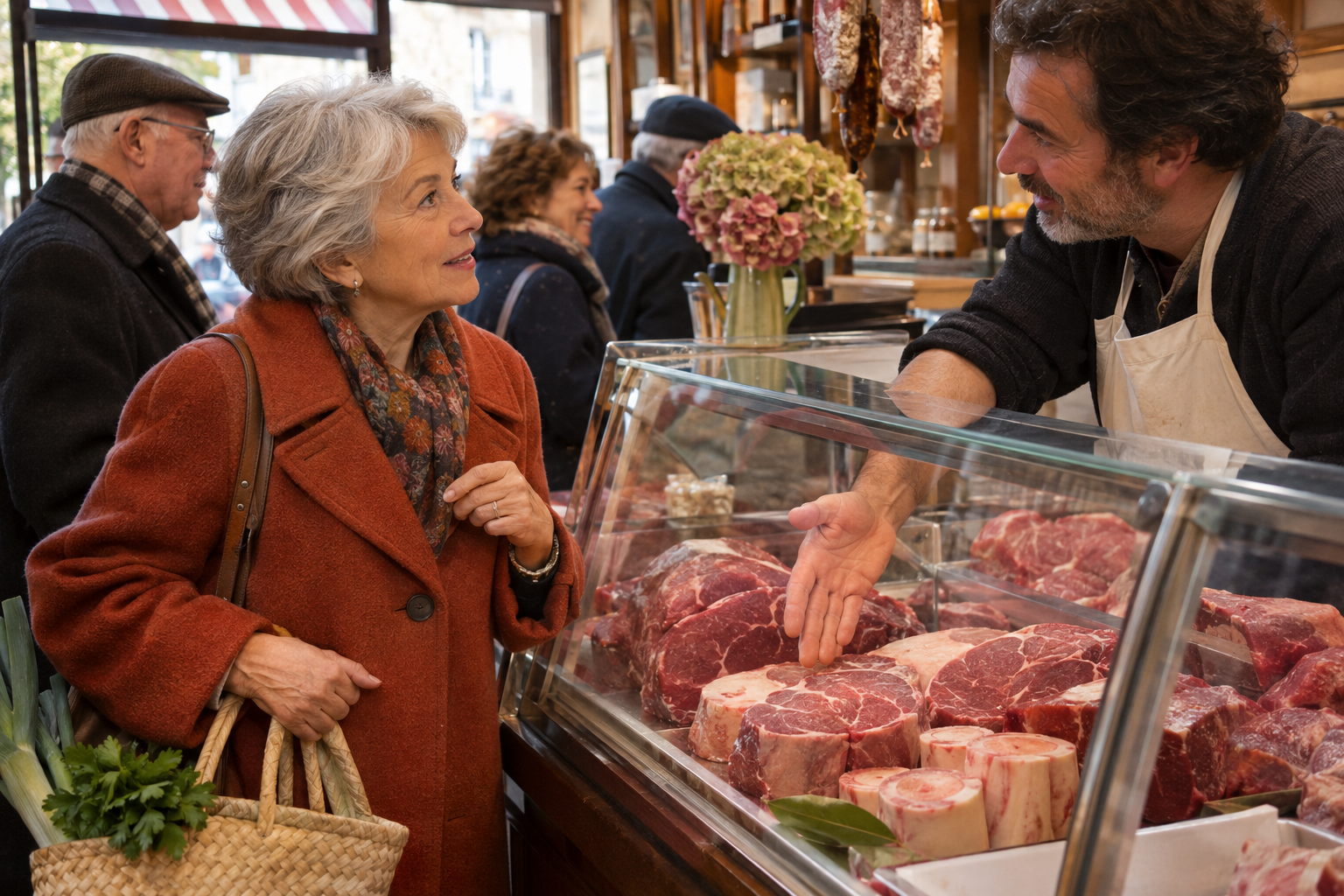
Put the beef and bones in a large pot, cover generously with cold water, and bring slowly to a boil. As it heats, skim off the foam that rises to the surface, which keeps the broth clear, and keep skimming until little more appears.
Once skimmed, lower the heat to a bare, gentle simmer, add the clove-studded onion, the bouquet of herbs, the peppercorns, and a little salt, and let it simmer quietly, partly covered, for about three hours, topping up with hot water if needed to keep the meat covered. Do not let it boil hard, because a gentle simmer is what gives tender meat and a clear broth.
After about three hours, when the beef is becoming tender, add the carrots, leeks, turnips, and celery, and continue simmering gently for another forty-five minutes to an hour, until the vegetables are tender and the beef is meltingly soft. Taste the broth and adjust the salt.
To serve traditionally, first ladle the clear broth into bowls as a soup, perhaps over a little bread. Then lift out the meat and vegetables, slice the beef, and serve it with the vegetables, the marrow scooped onto toast, and coarse salt, mustard, and cornichons alongside.
Save all the remaining broth, meat, and vegetables, because the broth becomes tomorrow’s soup and stock, and the leftover beef becomes a hachis parmentier or a salad. One pot, four hours, and meals for days.

About the Author: Ruben, co-founder of Gamintraveler.com since 2014, is a seasoned traveler from Spain who has explored over 100 countries since 2009. Known for his extensive travel adventures across South America, Europe, the US, Australia, New Zealand, Asia, and Africa, Ruben combines his passion for adventurous yet sustainable living with his love for cycling, highlighted by his remarkable 5-month bicycle journey from Spain to Norway. He currently resides in Spain, where he continues sharing his travel experiences with his partner, Rachel, and their son, Han.