
Vienna takes its cakes seriously, more seriously than almost anywhere, and no cake is more serious than the Sachertorte, the dense dark chocolate cake with apricot jam and a smooth chocolate glaze that is practically a national monument. It is so serious, in fact, that two of the city’s grandest institutions, the Hotel Sacher and the pastry house Demel, went to war in the courts over it, in a legal battle that ran for about seven years and became known as the sweetest dispute in Vienna’s history. They fought over who could call theirs the original, and over a difference so small it comes down to where the apricot jam goes, and the case ended with the court splitting the honors between them. It is the perfect rivalry: two famous houses, one beloved cake, a genuine difference you can taste, and a quarrel serious enough to reach a courtroom.
The wonderful thing about the Sachertorte feud is that it is real, documented, and still simmering, and that the difference the two sides fought over is something you can actually choose between in your own kitchen. Pick your side, Sacher or Demel, and you are choosing where the jam sits and how the cake is built, a small decision that Viennese partisans will defend to this day. Here is what the Sachertorte is, the story of the courtroom war, how to tell the two versions apart, which side to pick, and a recipe that lets you settle the argument at home. This is a bit of culinary history and a recipe, offered in good fun.
What the Sachertorte Is
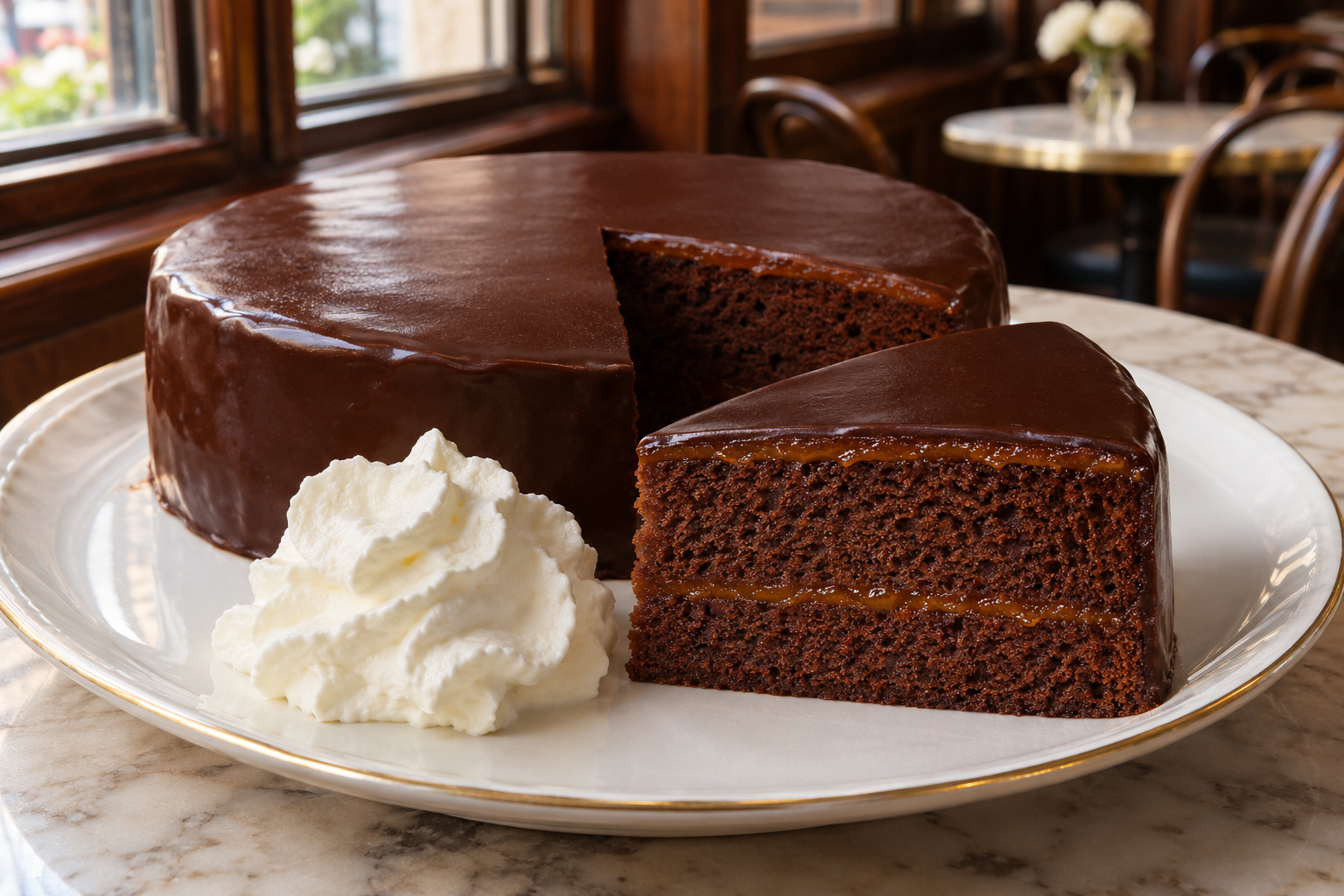
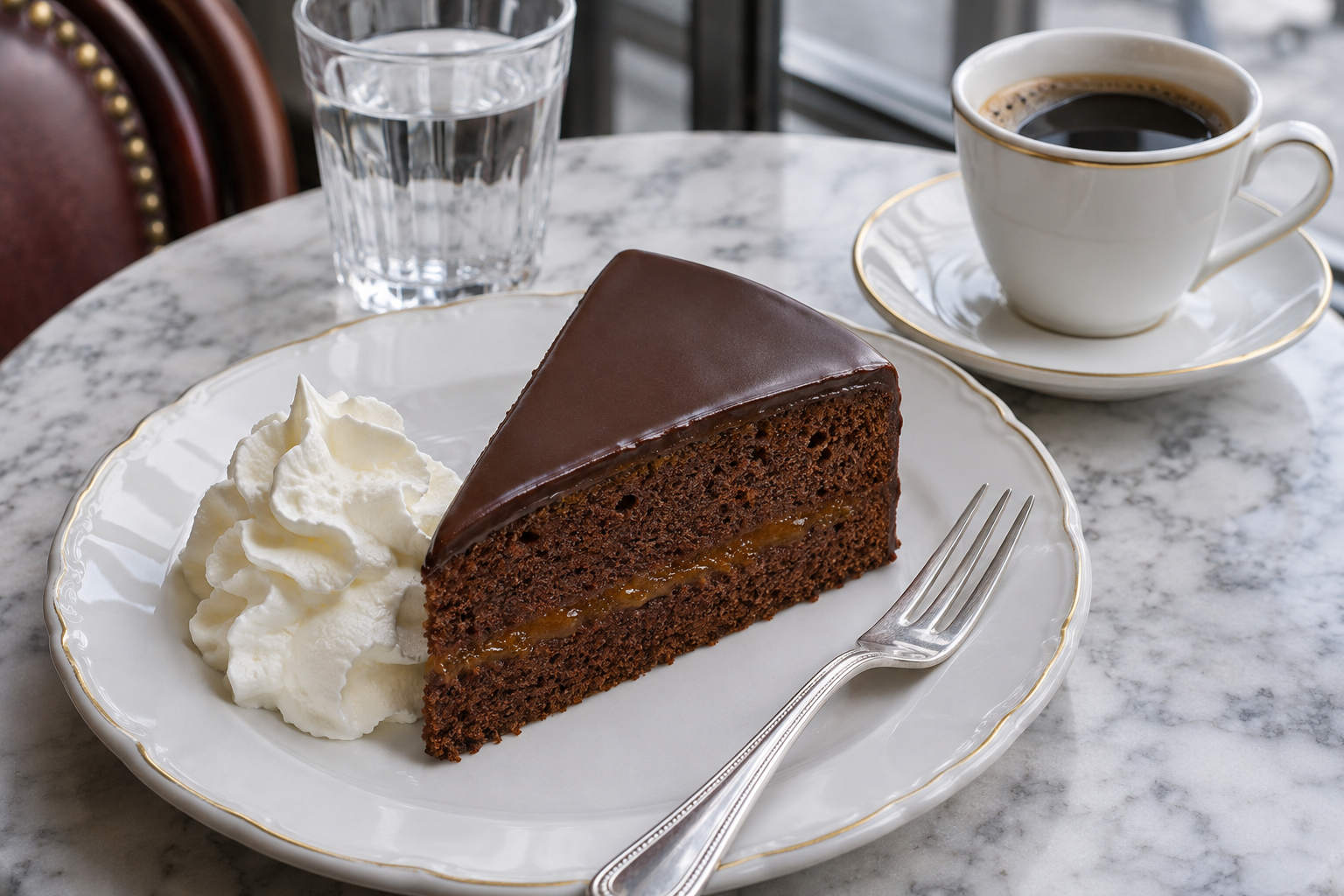
The Sachertorte is a chocolate cake with a particular architecture, and understanding its parts is the key to the whole rivalry. At its base is a dense, not-too-sweet chocolate sponge, firmer and less airy than an American layer cake, made with good dark chocolate and given structure by whipped egg whites. Over and through this cake goes a layer of apricot jam, the fruity, slightly tart counterpoint that cuts the richness of the chocolate, and the whole thing is enrobed in a smooth, glossy dark chocolate glaze that sets into a firm shell. It is served, almost always, with a generous dollop of unsweetened whipped cream on the side, the plain cream balancing the intensity of the cake.
The cake dates to the early-to-mid nineteenth century and is credited to Franz Sacher, who as a young apprentice is said to have created it, in the most repeated version of the story, for the household of the Austrian statesman Prince Metternich, though the exact date and details are hazy and undocumented. From that origin it grew into the signature cake of the Hotel Sacher, the grand establishment his descendants ran, and into one of the defining pastries of Vienna’s famous coffee-house culture. It is the cake you are handed with a strong coffee in a marble-and-velvet Viennese cafe, a small dense wedge of chocolate history.
What makes the Sachertorte distinctive, beyond its fame, is that restraint and balance, the way it is rich but not sugary, chocolatey but cut with fruit, substantial but refined. It is not a towering frosted confection but a serious, grown-up cake, and its character comes precisely from the interplay of the firm chocolate sponge, the tart apricot, and the glossy dark glaze, held in balance and finished with plain cream. That balance is what two Vienna houses came to blows over, because the question of exactly how to build it, and above all where to put the apricot jam, turned out to be something worth going to court about.
The Story of the Courtroom War
The rivalry has deep roots, because the two houses at its center are linked by history. Eduard Sacher, son of the cake’s creator Franz, trained in his youth at Demel, the renowned Vienna pastry house, before the family cake became the glory of the Hotel Sacher. So both institutions had a genuine claim to a connection with the Sachertorte, Demel through Eduard’s time there and the hotel through the family itself, and when hard times and changing ownership muddied who held what rights, the stage was set for a fight over the cake they both considered theirs.
The dispute first flared in the 1930s, when Demel began selling its own version of the cake, and it erupted into a full legal battle in the years after the Second World War, as the Hotel Sacher sought to protect the name and Demel insisted on its own claim. The question before the court was who had the right to call their cake the “Original Sacher-Torte,” and the fight became a protracted, famous affair, dragging on for years, roughly seven of them in the postwar phase, before it was finally resolved in 1963. It was, in the telling that Vienna loves, a war fought with lawyers over a cake, two proud houses spending years and fortunes on the honor of the apricot jam.
The resolution was a classic split decision, which is part of why the rivalry lives on rather than ending. The court essentially gave the Hotel Sacher the right to the name “Original Sacher-Torte,” while Demel was permitted to continue making and selling its own version, marked differently, so that both cakes survived, both legitimate in their way, neither able to erase the other. The feud was settled in law but preserved in fact, leaving Vienna with two rival Sachertortes to this day, which is exactly the kind of outcome that keeps a rivalry delicious. You can still walk into both houses and eat the cake each fought for.
How to Tell the Two Apart
Here is the heart of the matter, the actual difference the two houses fought over, and it is beautifully simple: it comes down to where the apricot jam goes. The Hotel Sacher’s Original Sacher-Torte is built as two layers, the cake sliced horizontally with a layer of apricot jam in the middle, between the two halves, as well as a thin coating of jam over the top beneath the glaze. Demel’s version, by contrast, is a single layer, not split, with the apricot jam spread only on top, directly under the chocolate glaze, and no jam running through the middle. Two layers with jam inside, or one layer with jam only on top: that is the whole of the great Vienna cake war.
This tiny structural difference is the thing partisans taste and defend, because it changes the cake. The Sacher two-layer version, with jam running through the center, gives you a stripe of fruit in every bite, the apricot woven into the middle of the cake, while the Demel single-layer version concentrates the jam in one band just beneath the glaze at the top, so the fruit sits as a distinct layer rather than running through. It is a subtle difference in how the chocolate and the apricot meet your palate, and whether you prefer the jam threaded through or crowning the top is, genuinely, the choice at the center of the rivalry.
The two houses also mark their cakes so you know which you are eating, a nod to the court-ordered distinction. The Hotel Sacher finishes its cake with a round chocolate medallion bearing its seal, while Demel marks its version with a distinctive triangular seal reading “Demel’s,” so the two are identified at a glance even before you taste the jam. This small ceremony of the seals is the visible legacy of the lawsuit, the formal way Vienna keeps the two rival originals straight, and it turns every slice into a quiet declaration of which side of the feud you are being served.
Pick Your Side
So which side do you pick, Sacher or Demel? The case for the Sacher, the two-layer original, is that the jam running through the middle integrates the fruit into the cake, giving you apricot in the heart of every bite and a more interwoven balance of chocolate and fruit throughout. It is the version that won the name in court, the official “original,” and partisans of the hotel will tell you that threading the jam through the center is the proper, more harmonious way to build the cake, the apricot present all the way down rather than sitting on top. If you like the fruit distributed through the cake, you are a Sacher partisan.
The case for the Demel, the single-layer version with jam only on top, is that it keeps the chocolate sponge whole and unbroken, letting the dense cake speak for itself, with the apricot concentrated as a clear bright band just under the glaze rather than diffused through the middle. Demel’s defenders argue their way honors the cake’s older, simpler form and gives a cleaner contrast, the pure chocolate of the sponge below and the sharp fruit stripe at the top, each distinct. If you like the chocolate undivided and the apricot as a defined layer rather than a thread, you are a Demel partisan.
Honestly, the difference is small enough that most people could be happy with either, which is the charm of the rivalry rather than a reason to dismiss it, because the fun is in having a side at all. Picking Sacher or Demel is less about a dramatic difference in taste than about aligning yourself with one of two proud Vienna houses and their century-long quarrel, a bit of harmless partisanship over a genuinely lovely cake. When you make it at home, you get to choose, jam through the middle for Team Sacher or jam only on top for Team Demel, and declare your allegiance in apricot. That is the whole delicious point.
A Cake Woven Into Vienna
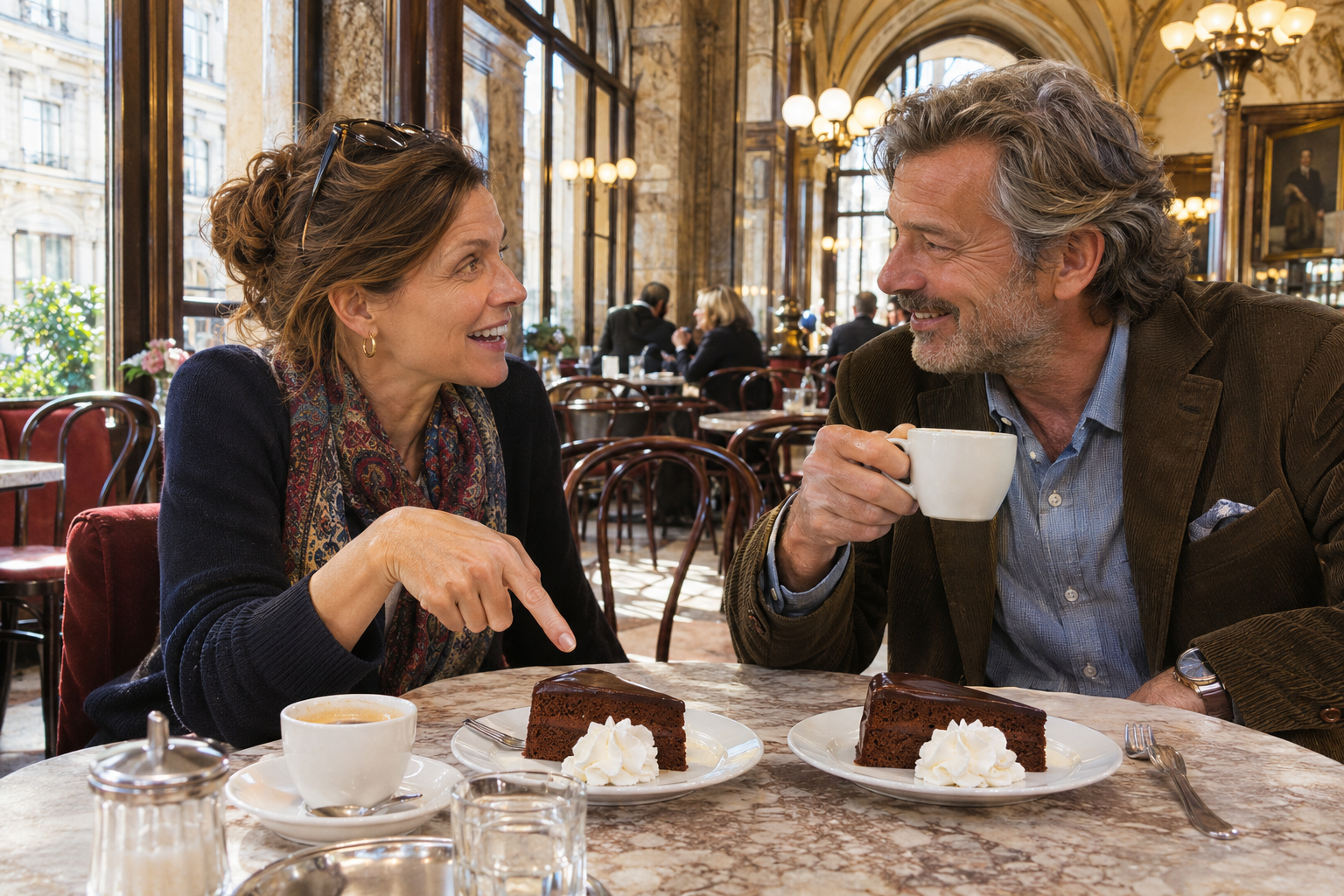
The Sachertorte is not just a cake but a piece of Vienna’s identity, inseparable from the city’s legendary coffee-house culture, where the ritual of a slice of cake and a strong coffee, taken slowly in a grand old cafe, is a central pleasure of life. To eat a Sachertorte in Vienna, at the Hotel Sacher or at Demel, with its mandatory dollop of unsweetened cream and a cup of coffee, is to take part in a tradition that is quintessentially Viennese, unhurried, civilized, a little formal, and deeply pleasurable. The cake carries the whole atmosphere of the city’s cafe life in a single dark wedge.
That cultural weight is part of why the rivalry could ever have reached a courtroom, because the Sachertorte is not a trivial dessert to the Viennese but a matter of civic pride and heritage, worth defending. A city that treats its coffee houses as cultural institutions, as Vienna genuinely does, is a city that will go to law over the right to its signature cake, and the seven-year battle makes perfect sense in that light. The feud is not silly, it is the natural expression of how seriously Vienna takes the pleasures of its table, which is one of the lovable things about the place.
For the visitor, the lovely thing is that you can still take both sides, visiting the Hotel Sacher for the official original and Demel for the rival version, tasting the famous difference for yourself and picking your side on the spot. And for the home baker far from Vienna, you can recreate the whole argument in your own kitchen, baking the cake and choosing where the jam goes, bringing a slice of Vienna’s grandest rivalry to your own table. Either way, the Sachertorte offers not just a wonderful cake but a story to eat it with, which is the best kind of dessert there is.
Make It: Sachertorte
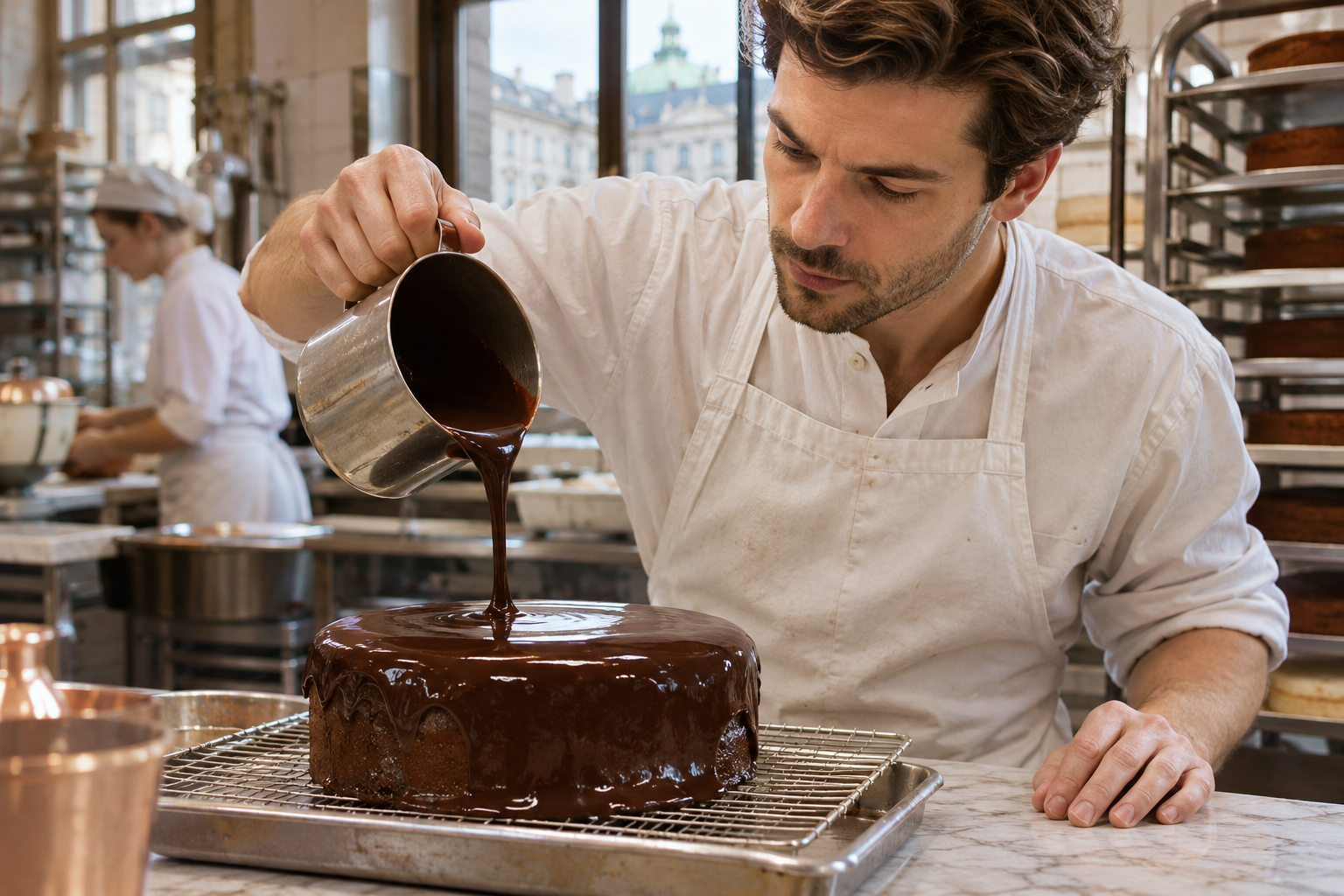
This makes one cake and lets you pick your side: build it with jam through the middle for the Sacher style, or keep it a single layer with jam only on top for the Demel style. It takes some care but no exotic skill. Serve with plenty of unsweetened whipped cream, as Vienna demands.
Ingredients
For the cake:
- 130g dark chocolate, chopped
- 150g butter, softened
- 100g icing sugar
- 6 eggs, separated
- 100g caster sugar
- 150g plain flour
- a pinch of salt
For the filling and glaze:
- about 200g apricot jam
- 200g dark chocolate, chopped
- 200g sugar
- 150ml water
To serve:
- unsweetened whipped cream
Instructions
Heat the oven to 170C and line a round cake tin. Melt the 130g of dark chocolate gently and let it cool a little. Beat the softened butter with the icing sugar until pale and light, then beat in the egg yolks one at a time, followed by the melted chocolate.
In a clean bowl, whisk the egg whites until foamy, then add the caster sugar gradually and whisk to stiff, glossy peaks. Fold a spoonful of the whites into the chocolate mixture to loosen it, then gently fold in the rest in batches, alternating with the sifted flour and salt, keeping as much air as possible so the sponge stays light.
Pour the batter into the tin and bake for around 45 to 55 minutes, until a skewer comes out clean. Let it cool in the tin briefly, then turn out onto a rack to cool completely. The cake should be firm and dense, not fluffy.
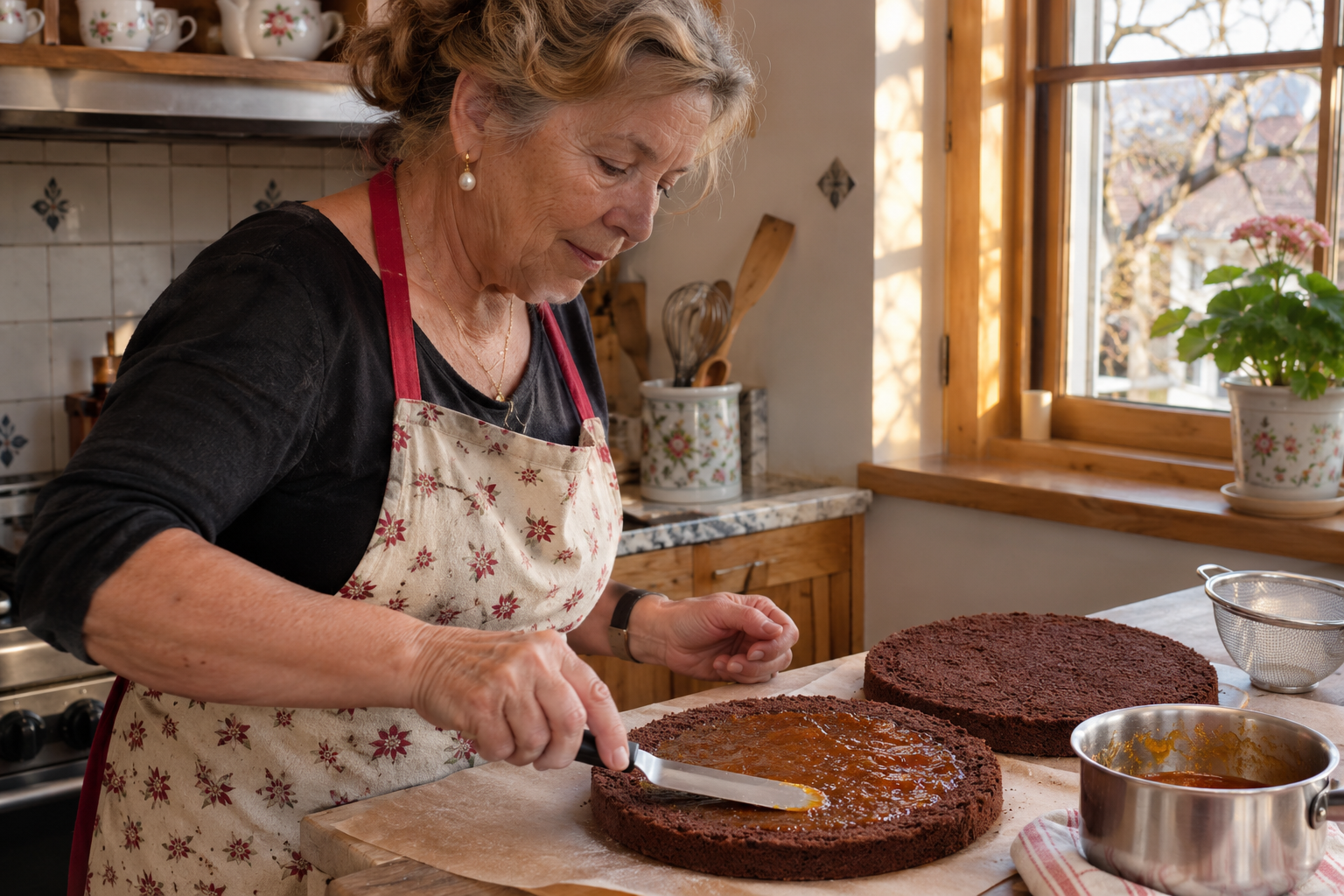
Now choose your side. Warm the apricot jam with a splash of water and pass it through a sieve so it is smooth and spreadable.
For the Sacher style, slice the cooled cake horizontally into two layers, spread jam over the cut surface, sandwich the layers back together, and then spread a thin coat of jam over the whole outside. For the Demel style, leave the cake as a single layer and simply spread a thin coat of apricot jam over the top and sides. Either way, let the jam set for a few minutes.
For the glaze, put the 200g of dark chocolate, the sugar, and the water in a pan and heat gently, stirring, until the sugar dissolves and the mixture thickens slightly to a pourable, glossy glaze. Let it cool just until it coats the back of a spoon, then pour it over the jam-coated cake all at once, letting it flow over the top and down the sides, smoothing as little as possible so it stays glossy. Let the glaze set completely.
Serve each slice with a generous spoonful of plain, unsweetened whipped cream alongside, and a strong coffee if you want to do it properly. Whether your jam runs through the middle or sits only on top, you have settled the great Vienna cake war in your own kitchen, and picked your side.

About the Author: Ruben, co-founder of Gamintraveler.com since 2014, is a seasoned traveler from Spain who has explored over 100 countries since 2009. Known for his extensive travel adventures across South America, Europe, the US, Australia, New Zealand, Asia, and Africa, Ruben combines his passion for adventurous yet sustainable living with his love for cycling, highlighted by his remarkable 5-month bicycle journey from Spain to Norway. He currently resides in Spain, where he continues sharing his travel experiences with his partner, Rachel, and their son, Han.