
Your first Thanksgiving abroad sneaks up on you. The fourth Thursday of November arrives like any other day in Europe, because here it is any other day, and suddenly you feel the distance from home more sharply than you have all year. Everyone back in the States is gathering around a loaded table with the people they have known their whole lives, and you are in a foreign country where nobody even knows it is a holiday. It is the loneliest the expat life can feel.
And then something wonderful happens, something that turns out to be one of the quiet gifts of living abroad. Americans scattered across a city find each other, and they build a Thanksgiving from scratch, a potluck of homesick strangers that becomes, over the years, a family of its own. The holiday that is supposed to be about the family you were born into becomes, abroad, a celebration of the family you choose.
Here is how Americans in Europe build their Thanksgiving table out of nothing, why the potluck is the heart of it, how a gathering of near-strangers turns into something that feels like home, and why expat Thanksgiving is so often the most meaningful one of all. It is less about the turkey than about who ends up around it, and that, it turns out, is the most Thanksgiving thing of all.
The Holiday That Does Not Exist Here
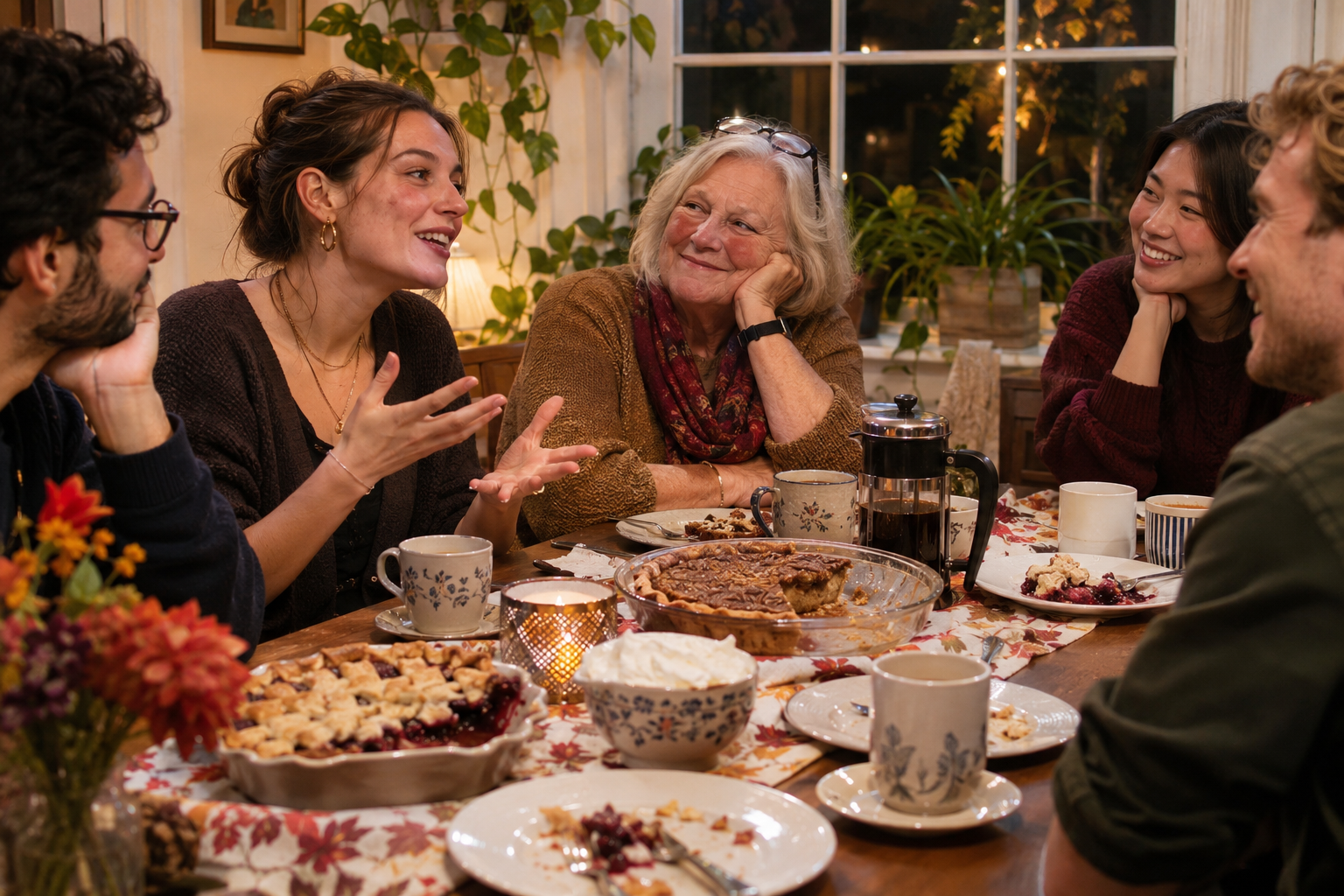
The first thing to understand about Thanksgiving abroad is that it does not exist as a holiday at all. It is a thoroughly American occasion, unknown to the calendars of Spain, France, Italy, or anywhere else in Europe, which means that on the day itself, life around you carries on exactly as normal.
This is disorienting in a way that is hard to explain to people back home. There is no day off, so you and everyone you know are at work or school; there are no turkeys in the supermarket, no Thanksgiving displays, no sense anywhere that the day is special; and the people around you, your European colleagues and neighbors, have no idea that for you this is one of the biggest days of the year. You carry the weight of the holiday entirely on your own, in a place that does not share it, which throws the distance from home into sharp relief. The family gathering you grew up with is happening thousands of miles away, and here it is just Thursday.
For the expat, this creates a real risk of a sad, lonely, homesick Thanksgiving, marking the day by yourself in a country that does not mark it at all. Left unaddressed, the fourth Thursday of November can become the hardest day of the expat year, the one where the romance of living abroad gives way to a plain ache for home and family. The whole challenge of expat Thanksgiving is how to meet that ache, and the answer that Americans abroad have found, again and again, is both simple and quietly beautiful.
The Potluck Solution
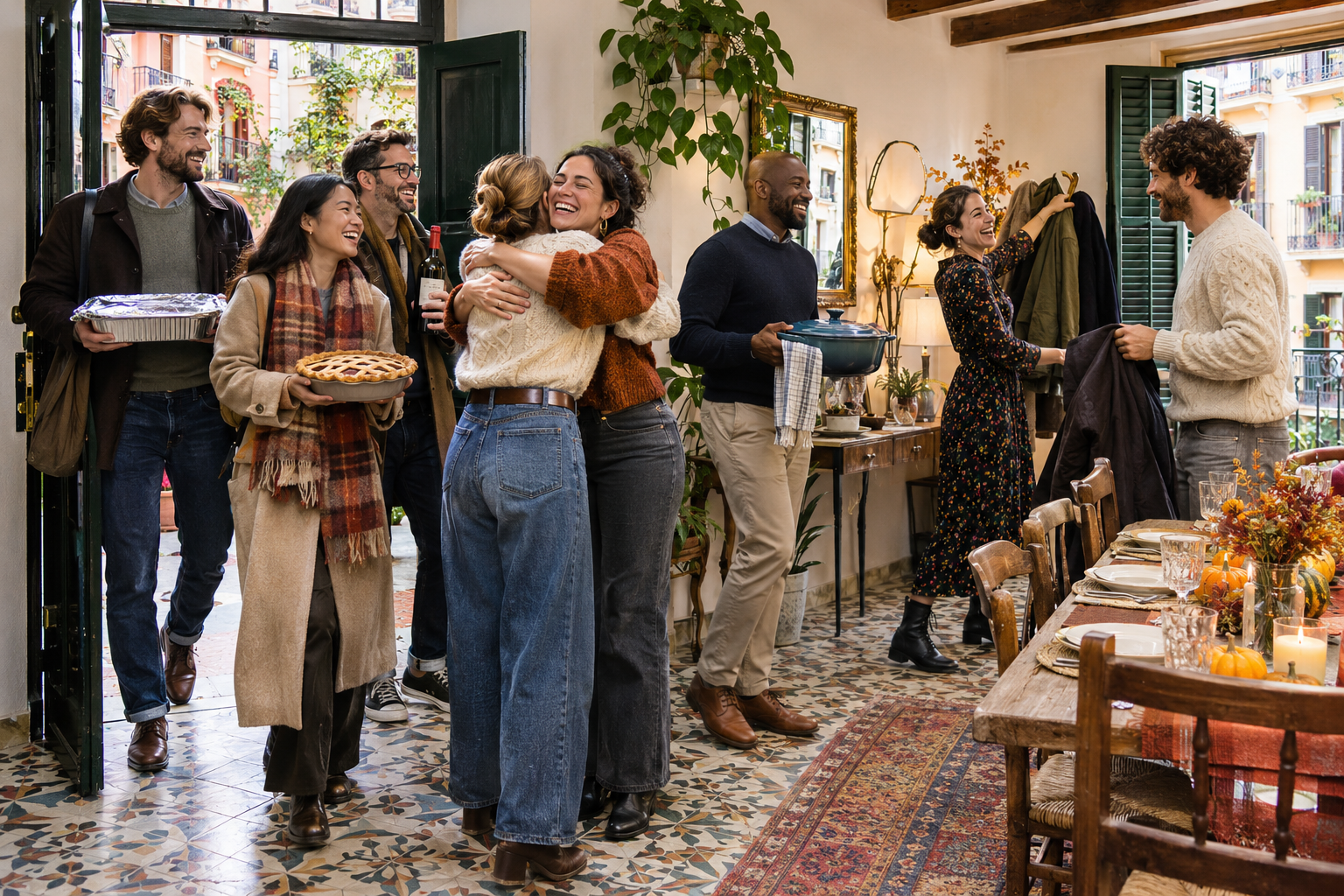
The solution expats land on is almost always the same: the potluck. Rather than one person attempting the enormous task of a full Thanksgiving dinner alone in a small foreign kitchen, everyone who comes brings a dish, and together they assemble a feast that no one could have managed on their own.
The potluck is perfectly suited to the expat situation for practical reasons as much as sentimental ones. It spreads the considerable work and cost of a Thanksgiving spread across many hands and wallets, which matters when ingredients are expensive or hard to find and kitchens are small.
It makes a proper feast possible even when no single host has the oven space, the equipment, or the budget for the whole thing. And it gathers people, giving everyone a reason to come and a way to contribute, so that the meal becomes a genuinely collective creation rather than one exhausted host’s heroic effort. Somebody roasts the bird, somebody brings a side, somebody turns up with a pie, and a table materializes that no one person could have made. The scattered contributions, assembled, somehow add up to a feast, which is its own small marvel every year.
There is something fitting, too, about a holiday of gratitude and sharing being built this way, out of everyone’s shared contribution. The potluck Thanksgiving is collaborative by its nature, a table that exists only because a dozen people each brought something to it, which is a lovely embodiment of the spirit of the day. For expats, it is not just the practical answer to the problem of cooking a feast abroad; it is the form the holiday naturally takes when it is rebuilt from scratch by people who need each other to make it happen.
Strangers at First
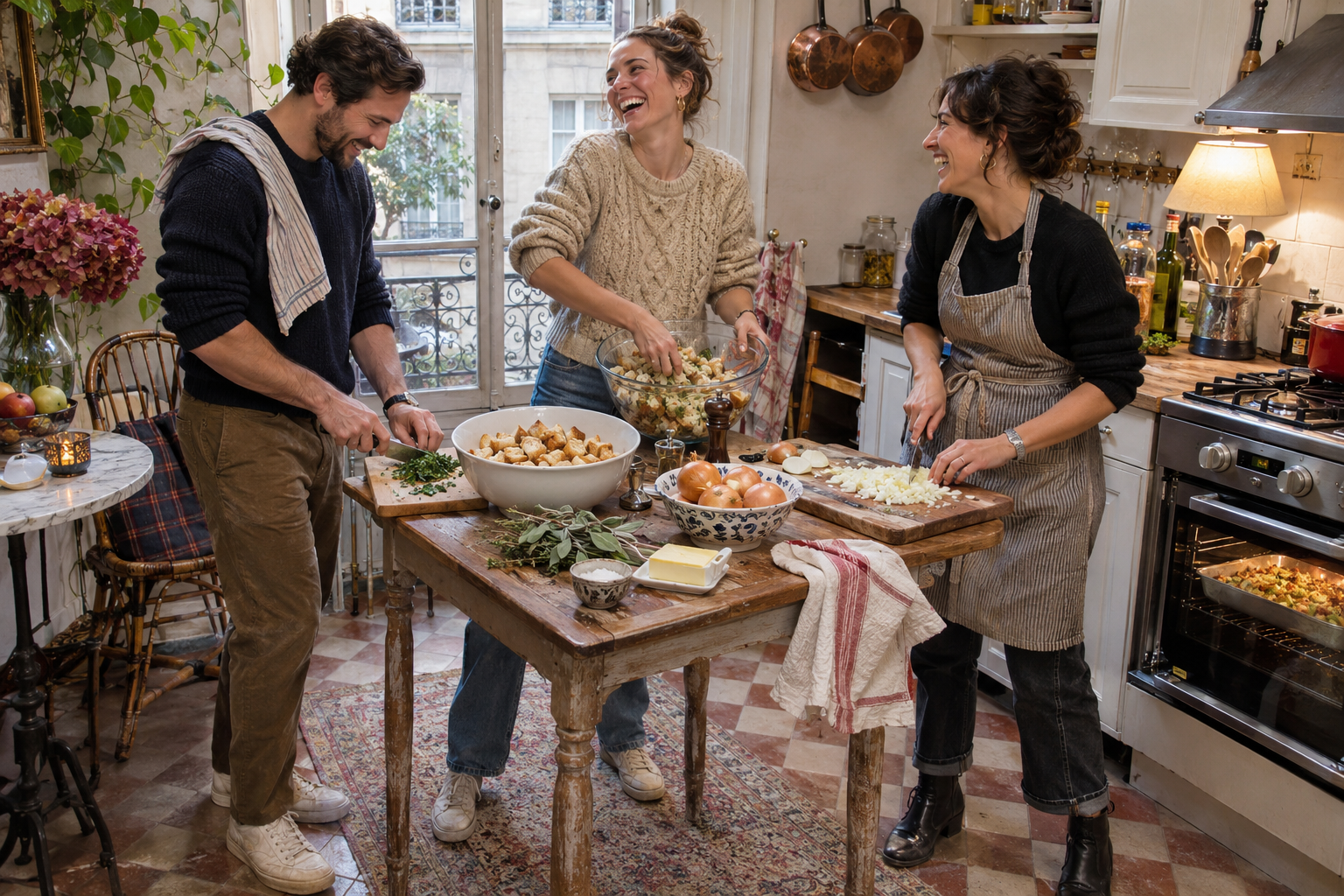
Here is the part that makes expat Thanksgiving genuinely remarkable, and genuinely different from the holiday back home: the people around the table often barely know each other. This is not the family you have known your whole life; it is a gathering of whoever happens to be around and far from home.
The guest list at an expat Thanksgiving is improvised and wonderfully random. It might include coworkers you know only from the office, friends of friends you have just met, the other American parents from your child’s school, expats of various nationalities you have crossed paths with, a neighbor, a language exchange partner, someone’s visiting cousin. What binds this unlikely assembly together is not blood or long friendship but a shared circumstance: you are all, in one way or another, far from your own homes and families, and you have found each other in a foreign city. That shared displacement is the invitation, and it turns out to be a more powerful one than you would expect, because everyone arrives a little grateful simply not to be spending the day alone.
So you sit down to the most family-centered holiday of the American year surrounded by people who, a year or two ago, were strangers. It should feel strange, and at the first one it sometimes does, but it very quickly stops feeling that way, because the whole situation, everyone a little homesick, everyone far away, everyone grateful to have somewhere to go, dissolves the usual distance between people who do not know each other well. You are strangers at the start of the meal and something warmer by the end, which is the beginning of the transformation that gives this piece its title.
The Mix Is the Magic
One of the unexpected joys of an expat Thanksgiving is that it is almost never purely American, and the international mix turns out to be part of what makes it so special. Living abroad, your circle is full of people from everywhere, and they end up at your Thanksgiving table too.
The result is a joyful cultural mashup unlike any Thanksgiving back home. Alongside the Americans are often Brits, Spaniards, Italians, and others, some of them experiencing the holiday for the very first time, curious and delighted to be included in this strange and lovely American ritual. The Americans find themselves explaining the whole thing, the Pilgrims, the gratitude, the absurd quantity of food, to fascinated newcomers, and the guests from other countries bring their own dishes, which may have nothing to do with traditional Thanksgiving fare, so that the turkey shares the table with a Spanish tortilla, an Italian pasta, a French tart, or a dish from somewhere else entirely. The meal becomes a glorious international potluck that is Thanksgiving in spirit and the whole world in its food.
Far from diluting the holiday, this mixing enriches it enormously. There is something deeply in the spirit of Thanksgiving about a table that welcomes everyone, shares across cultures, and turns a national holiday into a gathering of many nations, and it gives the expat version a warmth and a texture the homogeneous family holiday back home can lack. You are not just preserving an American tradition in exile; you are opening it up, sharing it, and letting it become something new and more generous in the sharing. The mix is not a compromise forced by circumstance; it is, quite often, the best part.
Reinventing the Traditions
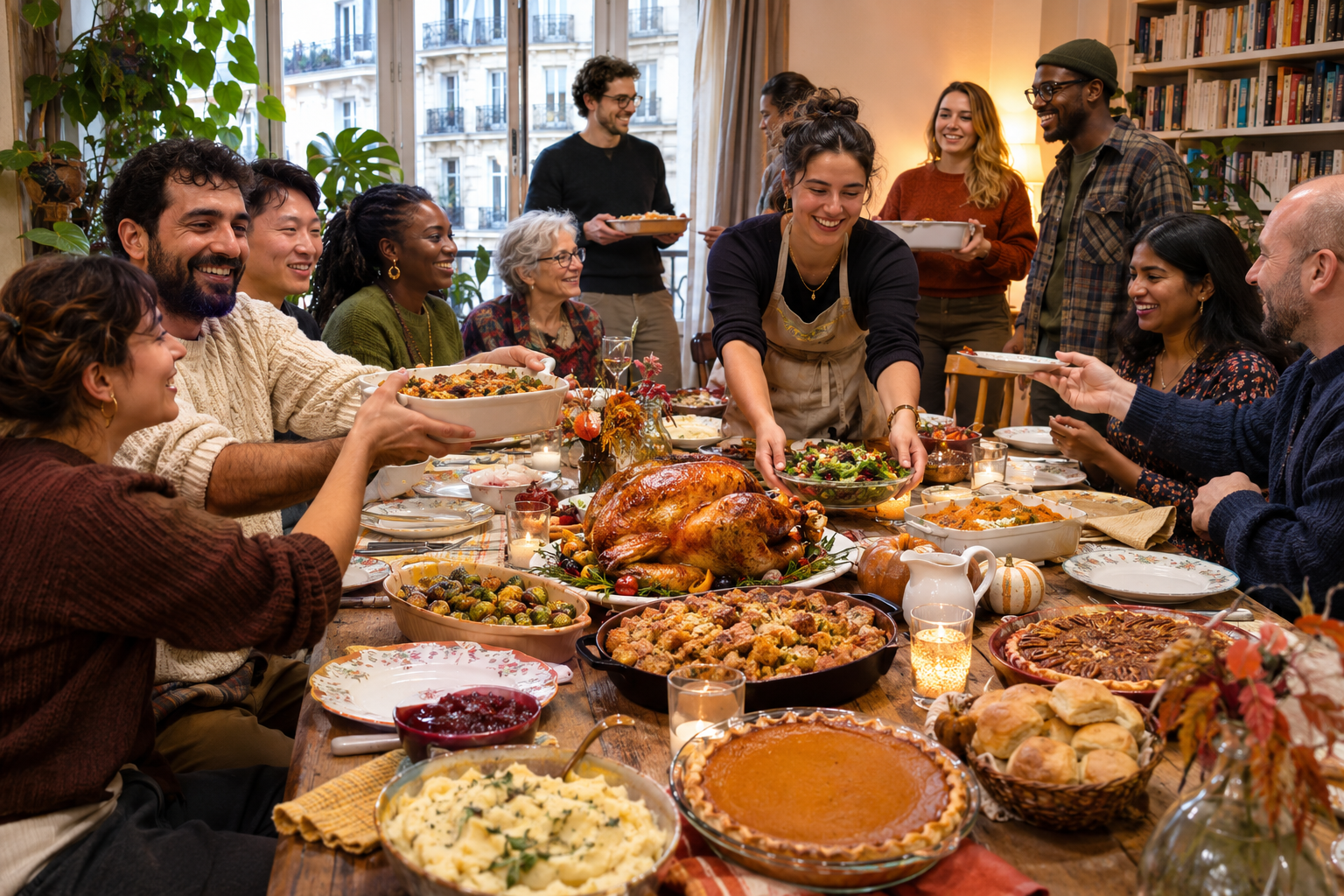
Because so little of the traditional Thanksgiving can be bought off the shelf in Europe, the food itself gets reinvented, and out of that necessity grow new traditions all your own. The expat table is a creative one, shaped by what the local shops actually offer rather than by what the American recipe demands.
The reinventions are now familiar to anyone who has done a few Thanksgivings abroad. With no frozen birds in the supermarket, you order a fresh turkey from a butcher and roast it the European way, without the brine; with no cranberries anywhere, you make a tart quince sauce instead, and often come to prefer it.
With no canned pumpkin to be found, you roast fresh squash the way French cooks do, for a better pie, and the green bean casserole gives way to fresh Spanish green beans with jamon. Each gap in the shops becomes an invention, and the invented versions are frequently better than the originals they replace, so that the expat Thanksgiving table, far from being a diminished copy, becomes its own distinct and often superior tradition.
Beyond the food, whole new rituals take shape, specific to your group, your city, your chosen gathering. Maybe your Thanksgiving is always on the Saturday rather than the Thursday, because nobody has the real day off, or it is at the same friend’s apartment every year, or it has its own particular mix of dishes and people that has evolved over time.
These are traditions you build rather than inherit, made by this particular community in this particular place, and there is a special richness in that. You are not just keeping the old traditions alive abroad; you are authoring new ones, and they belong to you in a way the inherited ones never quite did.
Why It Becomes Family
All of this, the potluck, the strangers, the international mix, the invented traditions, adds up to something more than a nice meal, and it is worth naming plainly: these gatherings, over the years, turn the people around the table into a kind of family. This is the quiet miracle at the center of expat Thanksgiving.
The reasons it happens are not mysterious. Take a group of people who are all far from their own families, gather them for a holiday that is explicitly about gratitude and togetherness, let them share the homesickness and the effort and the joy of building a feast together, and repeat it year after year, and real bonds form. The people you spend your first lonely, homesick, improvised Thanksgiving with, the ones who made sure you were not alone that day, become, over time, the people you turn to, the chosen family of your life abroad. Shared displacement is a powerful glue, and a shared table at the hardest moment of the year is where it sets.
There is a lovely circularity to it that is hard to miss. Thanksgiving is the holiday of family above all, and abroad, cut off from the family you were born into, it becomes the occasion on which you build a new one, a family of fellow travelers, strangers who became your people. Many expats will tell you that these found-family Thanksgivings are among the most meaningful of their lives, more moving in their way than the inherited gatherings back home, precisely because this family was chosen and built rather than simply given. The holiday that was supposed to remind you of what you left behind ends up giving you something new to be grateful for.
Building Your Own Table
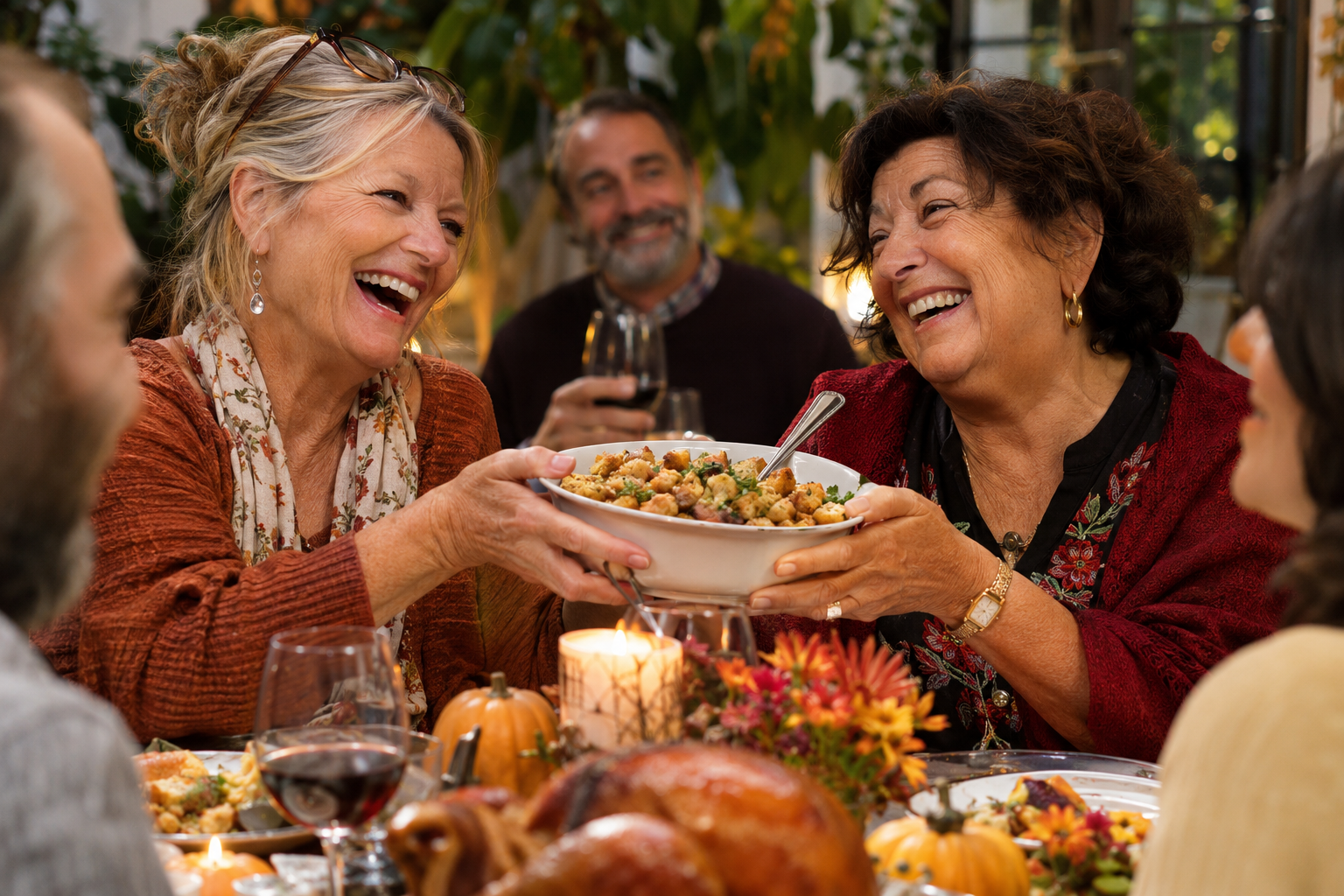
So if you are facing your first Thanksgiving abroad, or your fifth and still doing it alone, here is the encouragement to take from all of this: do not spend the day by yourself, homesick and far from home, when you could be building a table instead. The gathering does not require family, or tradition, or even much planning; it requires only that you reach out.
The practical steps are simple and within anyone’s reach. Decide to host a potluck, or find one to join, and then invite people, widely and without shyness: other American expats, yes, but also coworkers, neighbors, parents from your kids’ school, friends of friends, and the curious locals who would be delighted to be included in something new. Ask everyone to bring a dish, roast or order whatever bird you can, reinvent the sides with what your shops offer, and let the day become whatever it becomes. It does not have to be perfect or complete or exactly like home; it only has to gather people, which is the entire point.
Because in the end, that is the real lesson of Thanksgiving abroad, and maybe of Thanksgiving anywhere: the holiday was never really about the turkey, or the trimmings, or getting the traditions exactly right.
It was about gathering, gratitude, and belonging, about not being alone, and all of that is available to you in any city in the world, as long as you are willing to build the table and invite people to it. Reach out, gather whoever is around, and let the strangers become family. It may just turn out to be the Thanksgiving you are most grateful for of all, and the table you build abroad can be every bit as meaningful as the one you left.
The Dish to Bring
When you go to that table, whether you are hosting or joining, bring a dish, because the bringing is the whole point of a potluck. And if you want the one dish that belongs at every Thanksgiving and travels to a potluck better than almost anything, make the stuffing.
Stuffing is the ideal thing to carry across town to a shared table. It can be made entirely ahead, it reheats happily, and it survives the journey in a covered dish without complaint, which is more than can be said for a carved turkey or a delicate pie. It is also a dish nearly everyone loves and expects, so turning up with it makes you an instant hero of the gathering.
And like everything else on the expat table, it gets quietly reinvented abroad. The bagged, seasoned stuffing cubes that American recipes assume simply do not exist in European shops, so you make it the old way, from a good local loaf dried out and torn into pieces, and it is all the better for it. Here is how. This piece is a warm encouragement, and a recipe, for anyone spending the holiday far from home; the table you build abroad can be every bit as meaningful as the one you left.
Make It: Thanksgiving Bread Stuffing
Here is a classic bread stuffing made the expat way, from scratch with a good local loaf, serving about eight as a side. It is the perfect potluck dish: make it a day ahead, and reheat it, covered, when you arrive.
Ingredients
- 1 large rustic loaf (about 500g), a day or two old, torn or cut into bite-sized pieces
- 100g butter
- 2 onions, finely chopped
- 3 to 4 celery stalks, finely chopped
- 3 cloves garlic, minced
- a generous handful of fresh herbs (sage, thyme, and parsley), chopped
- about 500ml chicken or vegetable stock, warm
- 2 eggs, beaten
- salt and black pepper
- optional: a handful of cooked chestnuts, or crumbled cooked sausage, or a diced apple
Instructions
- If your bread is not already quite stale, dry it out: spread the pieces on a tray and leave them out overnight, or bake them in a low oven (about 150 degrees Celsius / 300 Fahrenheit) for 15 to 20 minutes until dry but not browned. Put the dried bread in a large bowl.
- Melt the butter in a large pan over medium heat. Add the onions and celery and cook gently for about 10 minutes, until soft and translucent. Add the garlic and cook for another minute.
- Tip the buttery vegetables over the bread, add the chopped herbs and any optional extras, and season well with salt and plenty of black pepper. Toss everything together.
- Pour the warm stock over the mixture a little at a time, tossing as you go, until the bread is evenly moistened but not soggy; you may not need all of it. Then stir through the beaten eggs, which will bind the stuffing as it bakes.
- Transfer the stuffing to a buttered baking dish. At this point you can cover and refrigerate it for up to a day if making ahead.
- Bake at about 180 degrees Celsius (350 Fahrenheit) for 35 to 45 minutes, until the top is golden and crisp and the inside is set and moist. If transporting it, bake it at home, then cover and reheat at your destination. Serve warm.

About the Author: Ruben, co-founder of Gamintraveler.com since 2014, is a seasoned traveler from Spain who has explored over 100 countries since 2009. Known for his extensive travel adventures across South America, Europe, the US, Australia, New Zealand, Asia, and Africa, Ruben combines his passion for adventurous yet sustainable living with his love for cycling, highlighted by his remarkable 5-month bicycle journey from Spain to Norway. He currently resides in Spain, where he continues sharing his travel experiences with his partner, Rachel, and their son, Han.