
On Christmas Eve in Greece, a very particular bread comes out of the oven. It is round and golden and fragrant with spices you may not recognize, and across its top lies a cross made of dough, with a single walnut pressed into the very center.
This is christopsomo, which means Christ’s bread, and it is one of the most meaningful foods on the Greek Christmas table. It is not an everyday loaf or a sweet treat you can buy whenever you like. It is baked once a year, with care and intention, as a sacred part of the season.
That rarity is part of its power. Because it appears only at Christmas, and only once, the baking of the christopsomo becomes an event in the household, a marker that the holy days have arrived. The smell of it in the oven, warm with mastic and mahleb and orange, is for many Greeks the very smell of Christmas, bound up with family and faith and the turning of the year.
Behind its simple round shape lies an ancient tradition, a set of unusual aromatic spices, and a whole language of symbolism. Here is what christopsomo is, the meaning of the cross and the walnut, how families make it their own, the spices that make it unlike any other bread, the blessing it carries, and how to make one yourself. It is one of the most beautiful and meaningful breads anyone bakes anywhere.
Christ’s Bread
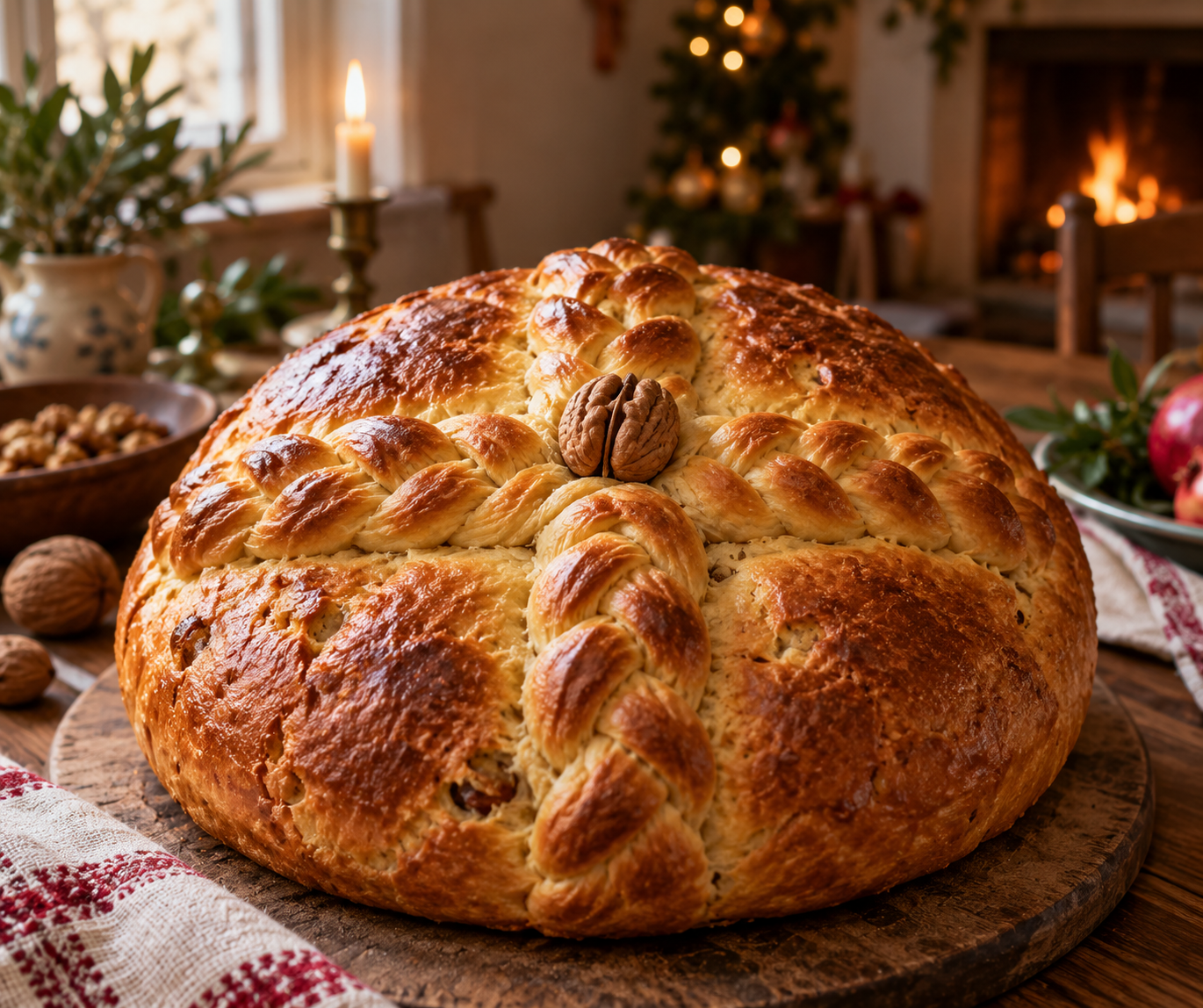
Christopsomo is a round, enriched bread, lightly sweet but not a cake, closer in spirit to a festive loaf than to a dessert. Its name says exactly what it is: the bread of Christ, baked to celebrate his birth.
The tradition is an old one, woven deep into Greek Orthodox life, and the bread is typically made on Christmas Eve, or the day before, to be served and shared on Christmas Day. It is prepared with real care, because this is not just food but a blessing in loaf form, meant to bring good fortune to the household in the year ahead.
For Greeks, bread has always carried deep meaning, often called the staff of life, and in the Christian tradition Christ himself is spoken of as the bread of life.
A special loaf baked to honor his birth, then, sits at the very heart of the celebration, both literally on the table and symbolically at the center of the day. It is no accident that the most important bread of the Greek year is the one made for Christmas.
The Cross and the Walnut
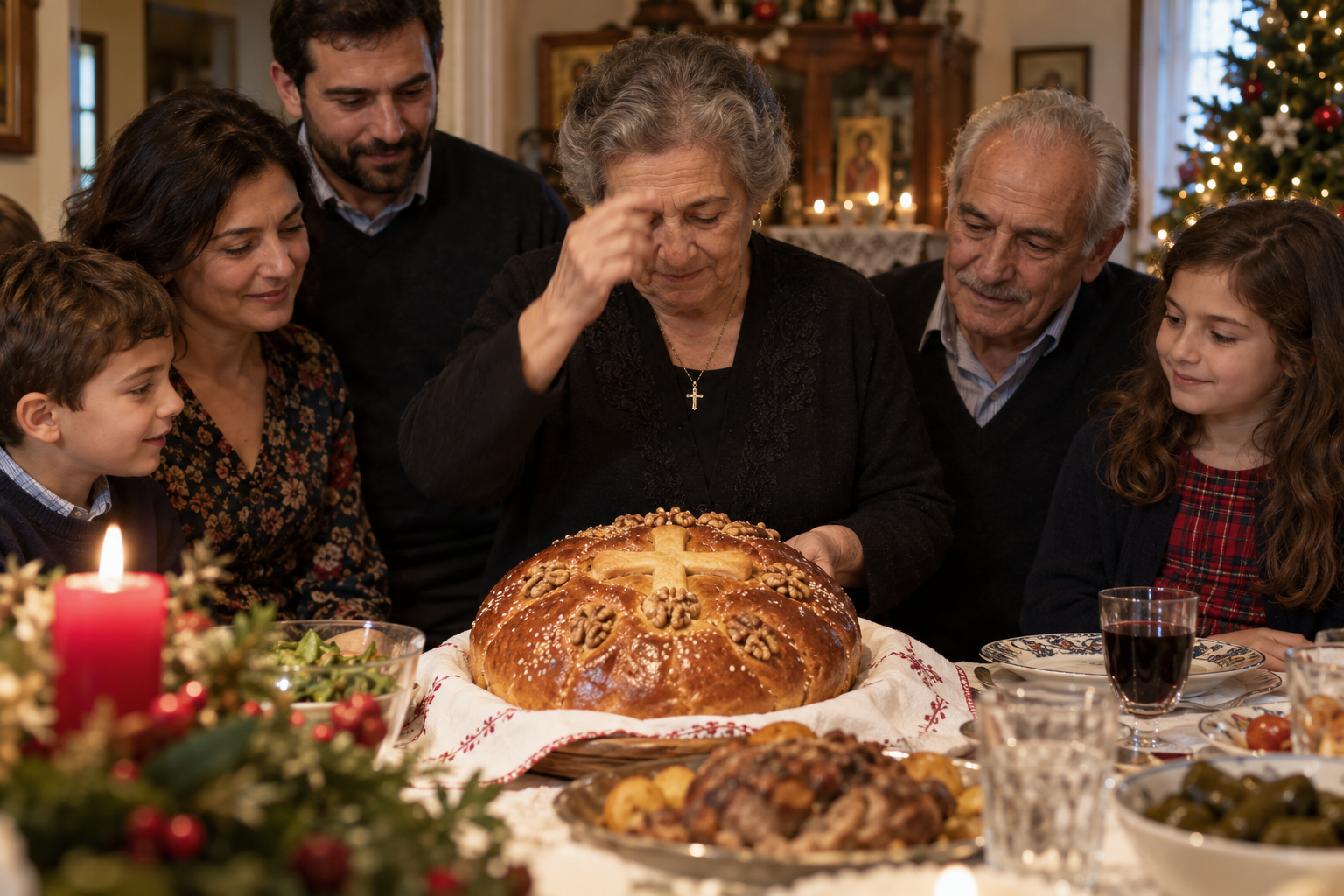
What makes christopsomo instantly recognizable is its decoration, and every element of it carries meaning. Across the top of the round loaf, the baker lays strips or braids of dough shaped into a cross, or sometimes the letter X, which stands for the Greek letter chi, the first letter of the word Christos, Christ.
At the center of that cross sits a single walnut, very often a whole one still in its shell, pressed firmly into the dough before baking. The walnut is not just decoration either; it has long been a symbol of fertility, wisdom, and good fortune, a small token of blessing set right at the heart of the loaf.
Many families add further touches, scattering sesame seeds over the top, pressing in whole cloves, or using extra bits of dough to form shapes meaningful to the household. The whole surface becomes a kind of edible blessing, a bread decorated not for looks but for faith and good wishes for the year to come.
Decorated by the Family
In the old village tradition, the decoration of christopsomo went far beyond the cross and the walnut, and it was deeply personal. Families would shape extra pieces of dough into symbols that meant something to their own household, and press them onto the loaf before baking.
A farming family might form little shapes of their animals, a sheaf of wheat, or a plough; a family with vineyards might shape grapes or vines. Each loaf became a small portrait of the family’s life and livelihood, and a prayer for that livelihood to flourish in the year ahead. The bread carried not just a general blessing but the specific hopes of the people who made it.
This is part of what makes christopsomo such a personal and loving thing to bake. It is not mass-produced or bought in a hurry; it is made by hand, at home, with each family adding its own meaning, which is why the tradition has endured so tenderly across the generations. Even a simple cross-and-walnut loaf carries that spirit of a bread shaped by the people it will feed.
Spiced With Mastic and Mahleb
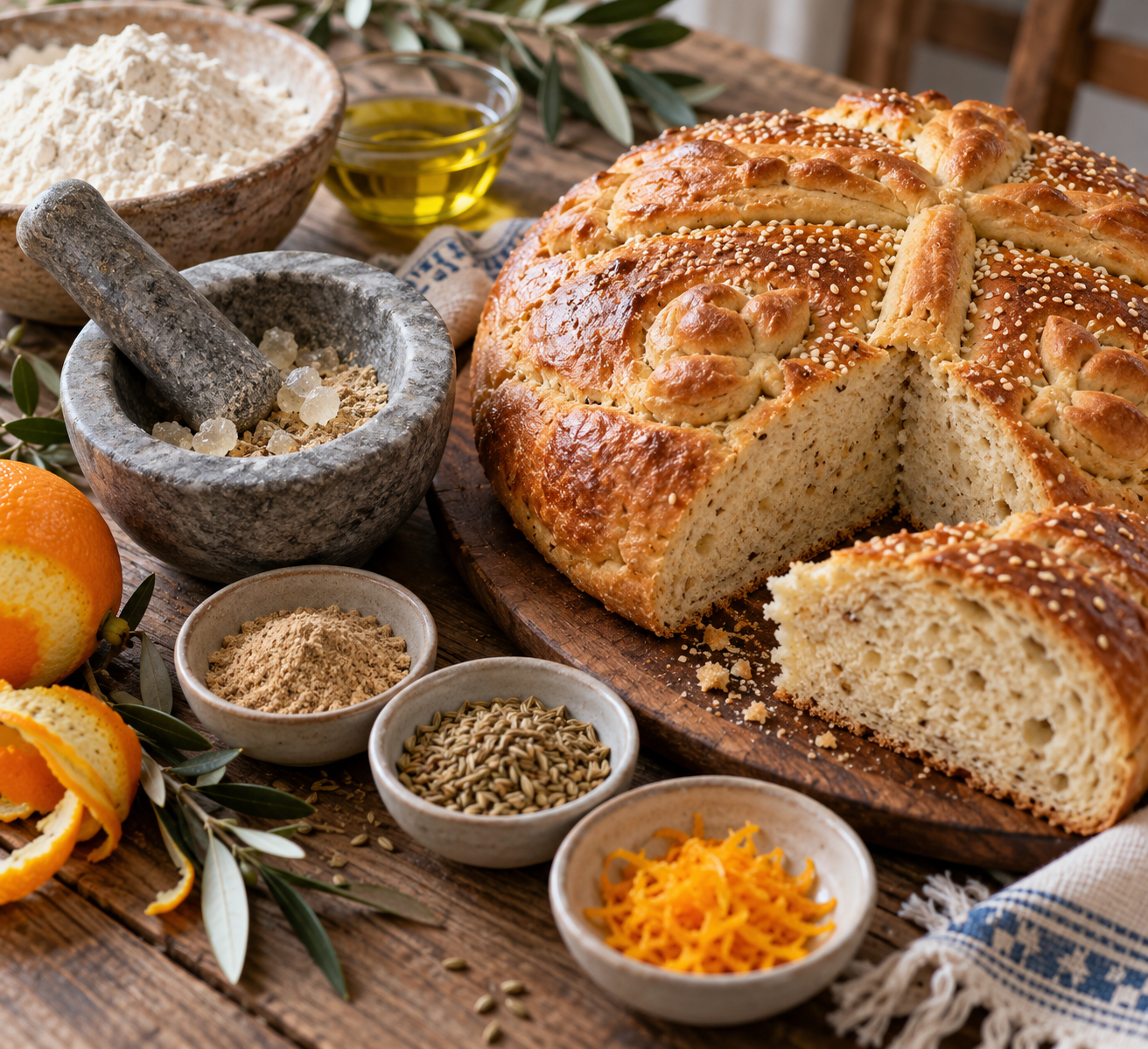
Open a christopsomo and the first thing you notice is the smell, warm and aromatic and quite unlike ordinary bread, and that comes from a trio of distinctive Greek spices. The two most special are mastic and mahleb, names many people outside Greece have never heard.
Mastic, sometimes called the tears of Chios, is a resin harvested from mastic trees grown on the Greek island of Chios, and nowhere else. It has a mild, sweet, faintly pine-like flavor, and in the Orthodox tradition it carries associations of purity. Mahleb, also spelled mahlepi, is a fragrant spice ground from the seeds inside cherry pits, lending a delicate, almost almond-and-cherry aroma.
Alongside these, christopsomo is usually flavored with anise and with orange, both the juice and the zest, and sometimes with cinnamon or cloves.
Together these aromatics give the bread its rich, exotic, festive scent, the smell of a Greek Christmas. For anyone who grew up with it, a single whiff of mastic and mahleb is enough to summon every Christmas of their childhood at once, which is a large part of why the spices are never left out.
A Bread Made for Blessing
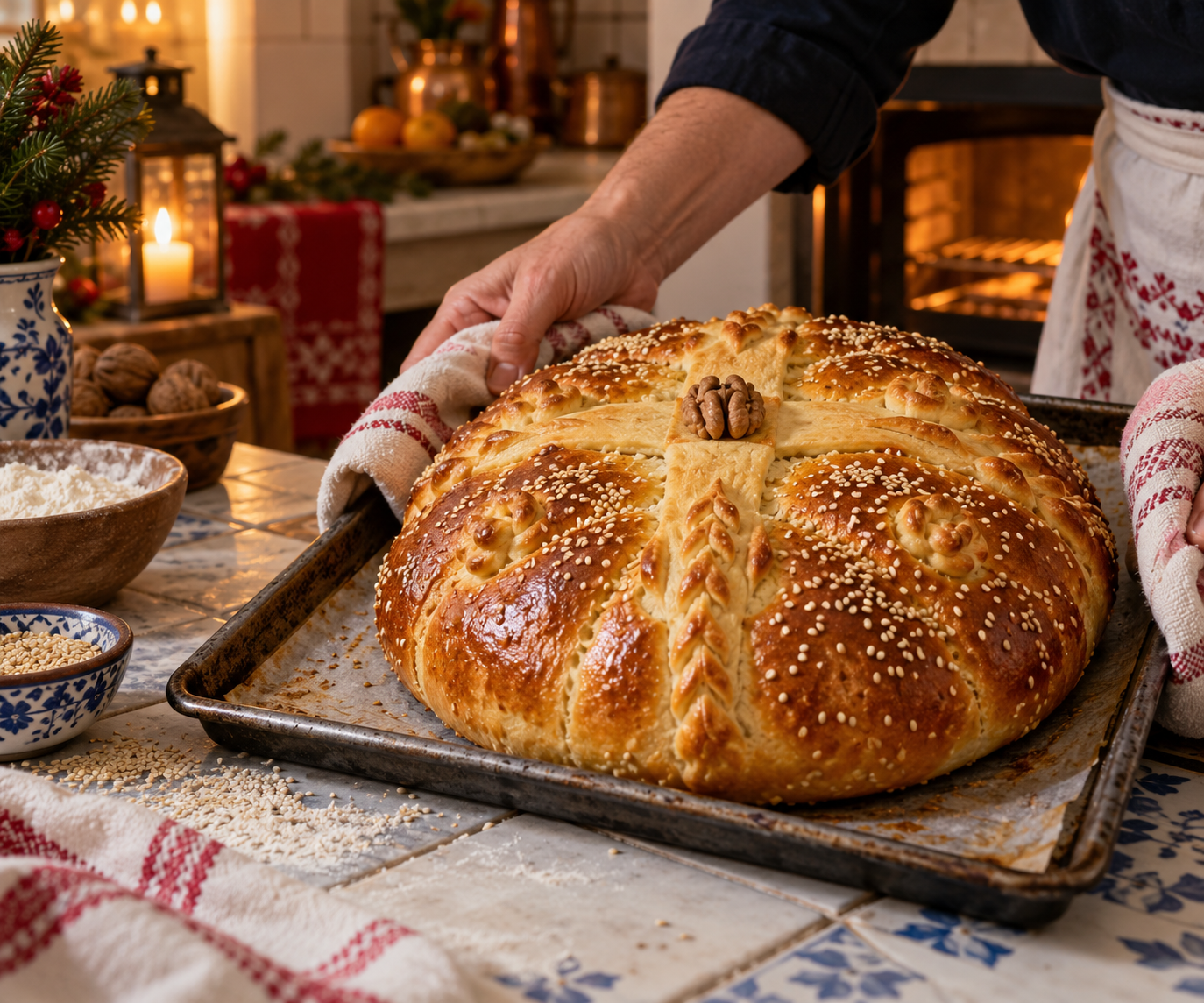
More than its spices or its shape, what defines christopsomo is the reverence with which it is made and eaten. This is a sacred bread, prepared thoughtfully and treated with real respect, because it is believed to carry a blessing for the home and the family through the coming year.
The ritual continues at the table. On Christmas Day, the head of the household traditionally makes the sign of the cross over the loaf before cutting it, and the bread is shared among the family with a sense of occasion, the first pieces sometimes set aside with particular meaning. It is a moment of blessing as much as a course of the meal.
Christopsomo belongs to a wider family of Greek ceremonial breads, each tied to its own holy day, such as the vasilopita baked for the New Year with a coin hidden inside, and the tsoureki of Easter. Each marks a sacred moment of the year with a special loaf. Christopsomo is the Christmas member of that family, baked for one night a year, carrying the weight of centuries of tradition in a single round, cross-topped loaf.
One of a Family of Holy Breads
Christopsomo does not stand alone in Greek life; it belongs to a whole family of ceremonial breads, each tied to its own sacred moment of the year, and seeing it among its relatives helps explain its special weight. For Greeks, bread and the holy calendar are deeply intertwined.
At New Year comes the vasilopita, baked with a coin hidden inside, and whoever finds the coin in their slice is promised good fortune for the year ahead. At Easter there is tsoureki, the sweet, braided, spiced bread that breaks the long Lenten fast. And in church, the prosphoro, the offering bread, is baked for the liturgy itself. Each marks its moment with a loaf made specially, with care and meaning.
Christopsomo is the Christmas member of this family, and arguably the most richly symbolic of them all, with its cross and its walnut and its ancient spices. To bake one is to take part in a very old Greek understanding, that the most sacred moments of the year deserve their own bread, made by hand at home and shared with blessing. It places the humble act of baking right at the center of the holy days.
There is something quietly moving in that, in a world of bought and mass-produced food, about a bread that must be made by hand, at home, once a year, for a specific sacred night. The effort is the point. A christopsomo cannot be rushed or outsourced; it asks for time, care, and intention, and in giving those it becomes an offering as much as a food, which is exactly what it is meant to be.
Baking a christopsomo of your own, even far from Greece, is a lovely way to bring a little of that reverence into your own Christmas. It takes some time and a few unusual spices, but the result is a beautiful, fragrant, meaningful loaf unlike anything else on the holiday table. Shaping the cross, pressing in the walnut, and pulling the finished bread from the oven to fill the house with the scent of mastic and orange is a small act of care that turns baking into something close to a blessing.
Make It: Christopsomo
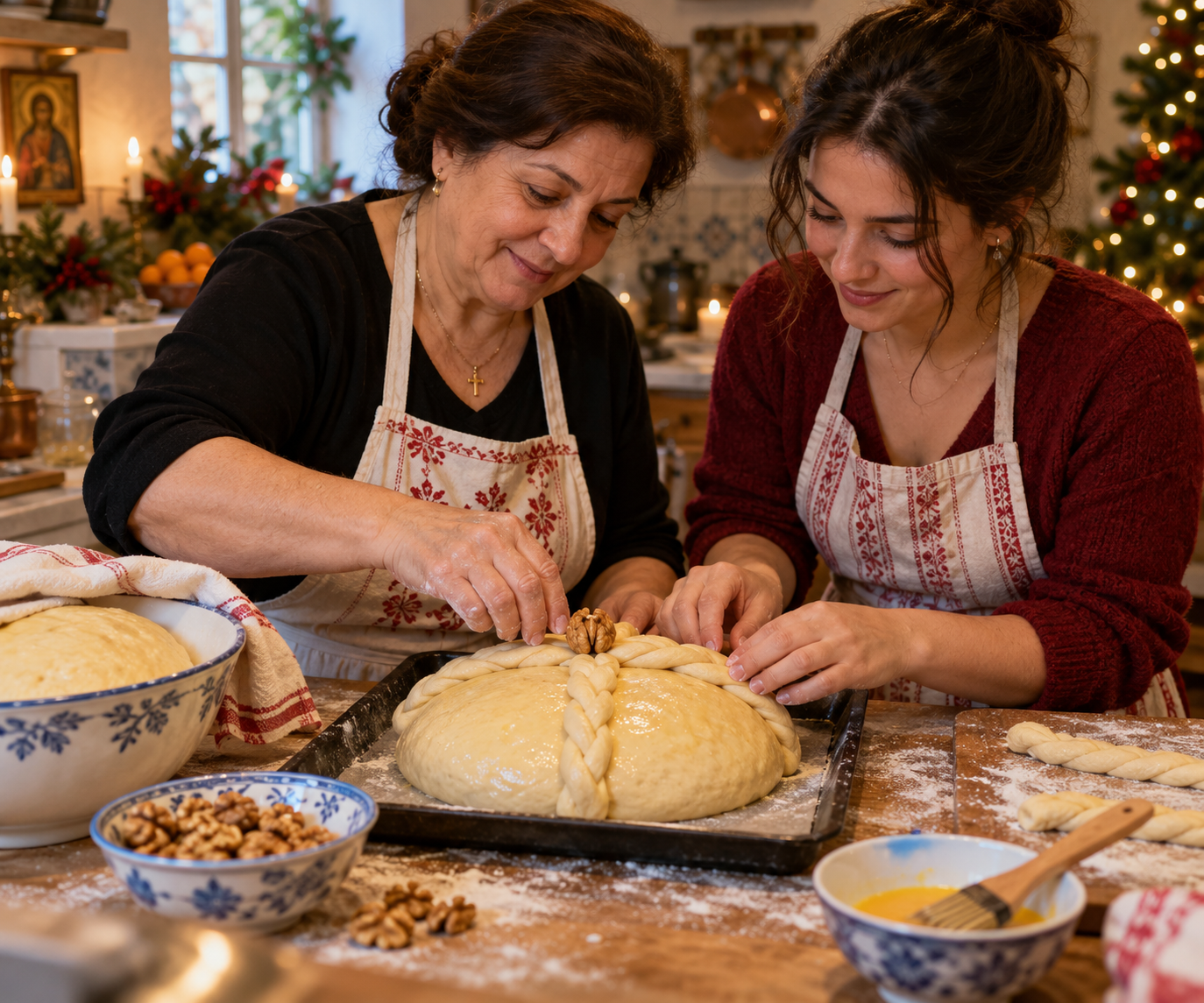
Here is a traditional version, making one round loaf. Mastic and mahleb are the authentic flavors and worth seeking out at a Greek or Middle Eastern grocer, but if you cannot find them, extra anise and orange will still give a lovely festive bread.
Ingredients
- 4 cups (500g) bread flour
- 7g instant yeast
- 1/3 cup sugar
- 1/2 teaspoon salt
- 1/2 teaspoon ground mahleb (mahlepi)
- a few small pieces of mastic, ground with a little sugar
- 1/2 teaspoon ground anise
- zest of 1 orange
- 1/2 cup warm milk
- 1/4 cup orange juice
- 1/4 cup olive oil
- 2 eggs
- 1 whole walnut, for the center
- beaten egg or honey-water, for glazing
- sesame seeds, optional
Instructions
- In a large bowl, combine the flour, yeast, sugar, salt, ground mahleb, ground mastic, anise, and orange zest.
- Add the warm milk, orange juice, olive oil, and eggs, and mix and knead into a smooth, soft dough, about 10 minutes. Cover and let it rise until doubled, about 1 to 2 hours.
- Punch the dough down and set aside two small pieces for the cross. Shape the larger piece into a smooth round loaf and place it on a lined baking tray.
- Roll the two reserved pieces into ropes, lay them across the loaf to form a cross, and press a whole walnut into the center where they meet.
- Cover loosely and let the loaf rise again until puffy, about 45 minutes. Meanwhile heat the oven to 180 degrees Celsius (350 Fahrenheit). Brush the top with beaten egg or honey-water, avoiding the cross if you like it paler, and scatter with sesame seeds if using.
- Bake for about 35 to 40 minutes, until deep golden and cooked through. Cool before cutting, and serve on Christmas Day with the traditional blessing.

About the Author: Ruben, co-founder of Gamintraveler.com since 2014, is a seasoned traveler from Spain who has explored over 100 countries since 2009. Known for his extensive travel adventures across South America, Europe, the US, Australia, New Zealand, Asia, and Africa, Ruben combines his passion for adventurous yet sustainable living with his love for cycling, highlighted by his remarkable 5-month bicycle journey from Spain to Norway. He currently resides in Spain, where he continues sharing his travel experiences with his partner, Rachel, and their son, Han.