
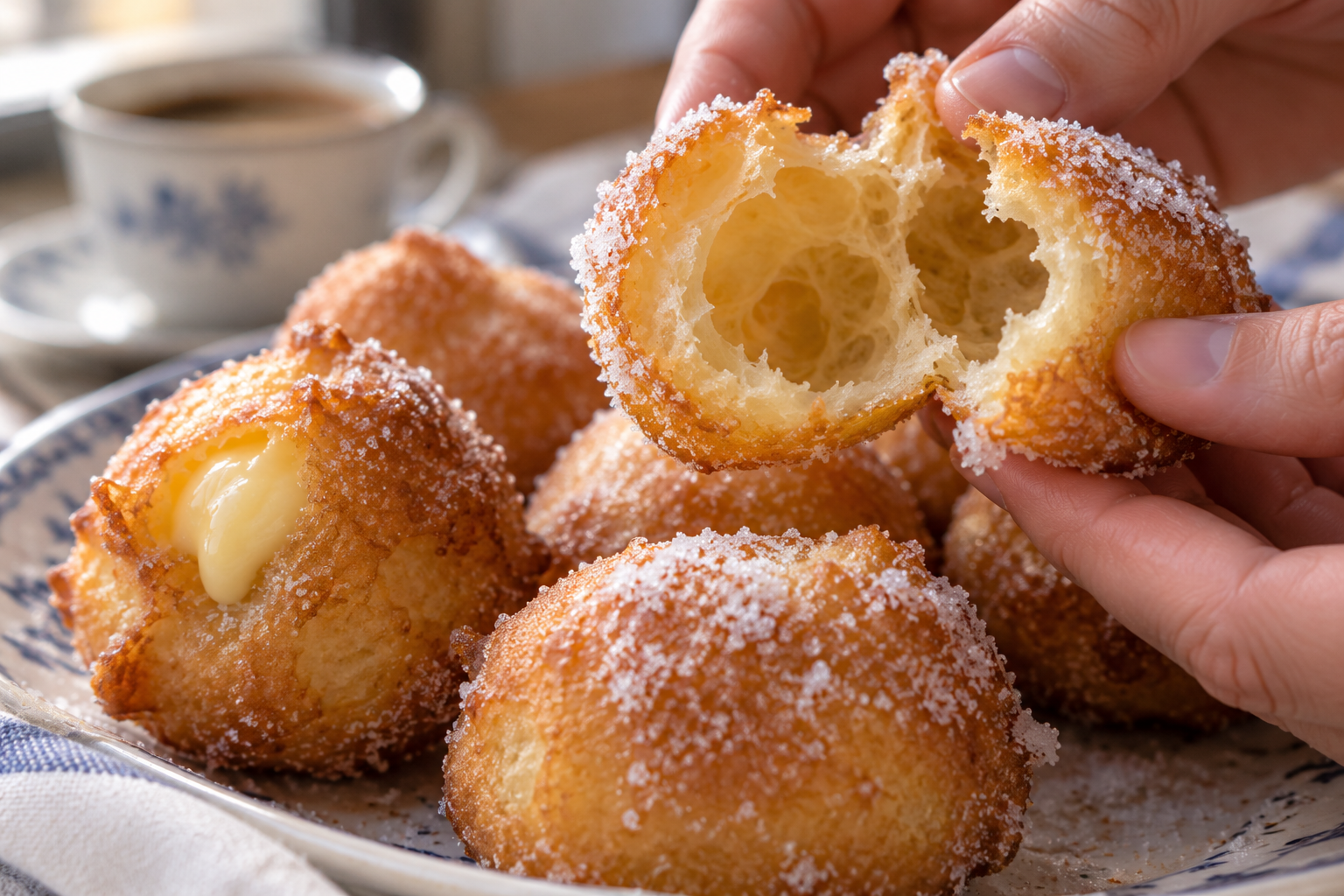
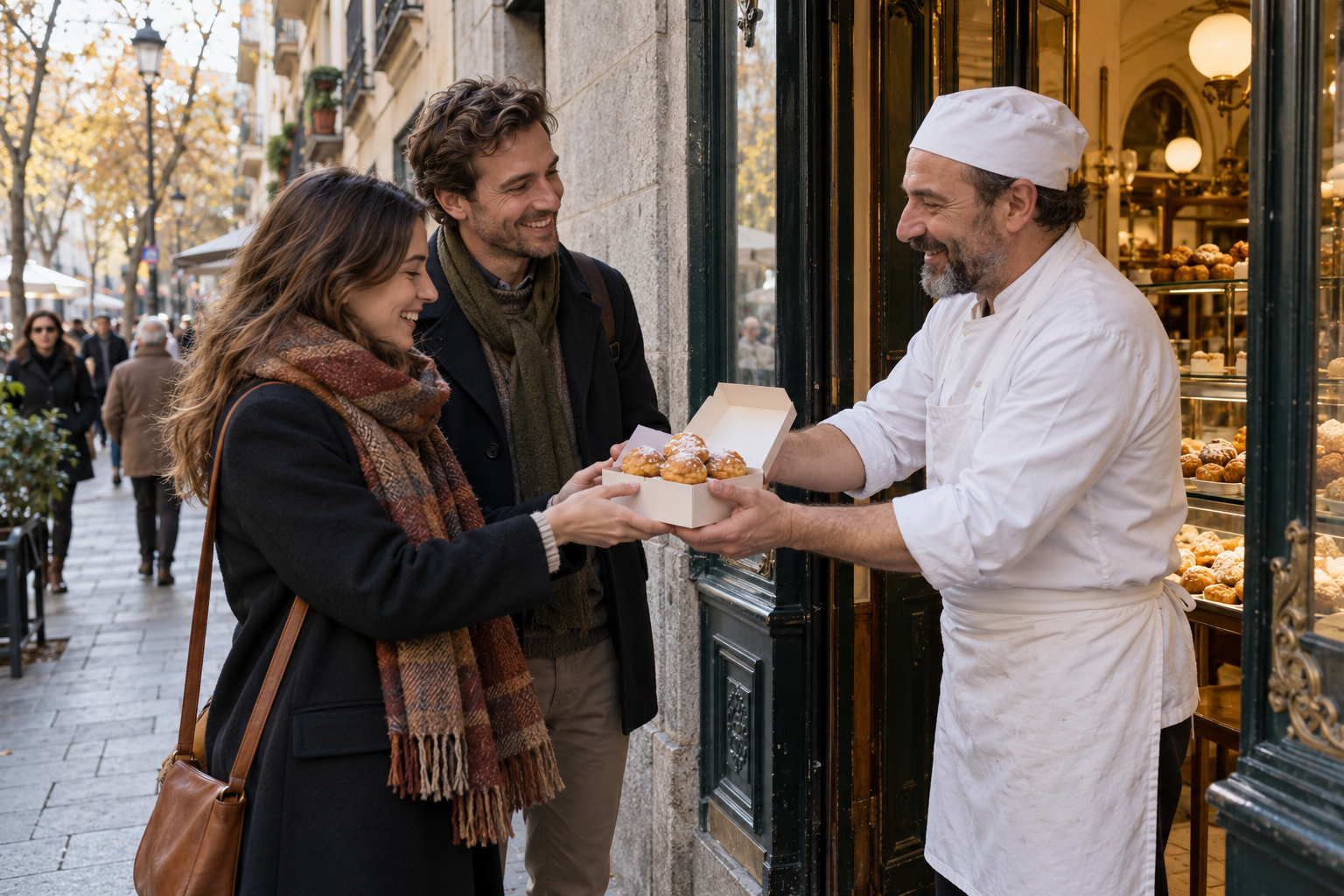
For most of the year you will not find them anywhere. Then, for a handful of days around the first of November, the bakery windows of Madrid fill with small, pale-golden little puffs, piled in glistening heaps and dusted with sugar, and Madrilenos line up to buy them by the dozen. They are bunuelos de viento, which translates, wonderfully, as wind fritters, and they are one of the sure signs that All Saints’ Day has arrived. Bite into one and you understand the name instantly: beneath a thin, crisp, fried shell, the inside is almost entirely hollow, a pocket of air, so that the whole thing seems to be made of not much more than wind and sugar. For one short week a year, these airy puffs are everywhere, and then they are gone. Here is what bunuelos de viento are, why they appear for only a week, the All Saints’ tradition behind them, how they achieve their magical hollowness, and how to make them at home.
What follows is the puff that is mostly air, why they appear for only one week, their place in the day of the dead, how they puff, and the recipe.
The Puff That Is Mostly Air
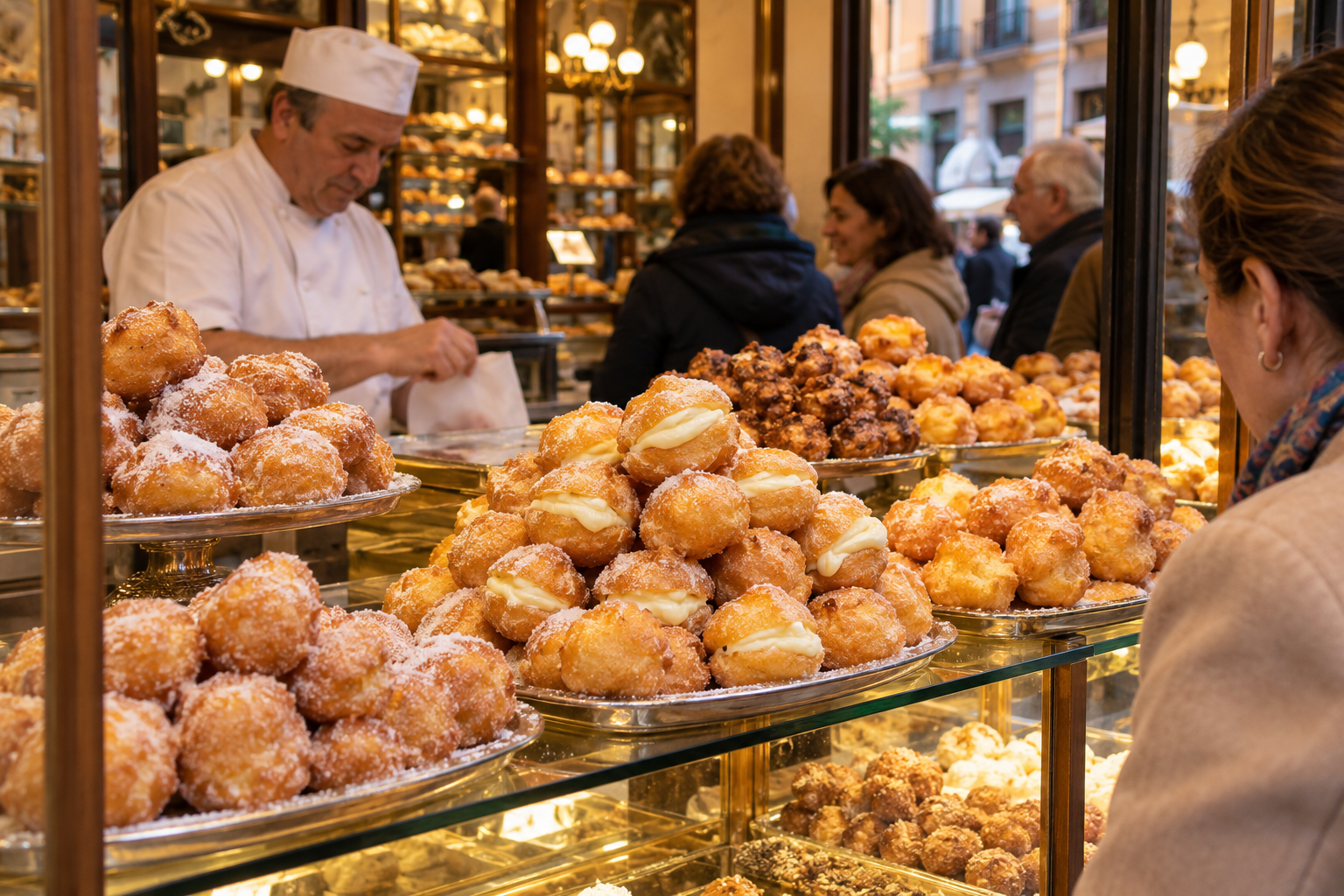
A bunuelo de viento is a small fried fritter, crisp outside and hollow within, dusted with sugar and, more often than not, filled with something creamy. They are made from a soft dough closely related to the one used for cream puffs and eclairs, a cooked paste of flour, water or milk, butter, and eggs, and when spoonfuls of this dough hit hot oil, something delightful happens: they puff up dramatically, turning themselves over in the oil many times their original size. The result is a fritter that is shatteringly crisp on the outside and almost empty within, a pocket of warm air wrapped in a thin, sweet, fried shell.
That hollowness is the whole point and the source of the name. De viento, of wind, captures exactly the sensation of eating one: it is so light, so airy, so close to weightless, that it seems to dissolve into nothing more than sweetness and air as you bite it. Traditionally the hollow center is then filled, piped full of pastry cream, whipped cream, chocolate, or the same sweet egg-yolk cream that fills the saints’ bones, turning the empty puff into a rich little treat. Plain and simply sugar-dusted, or filled with cream, the bunuelo de viento is a small masterpiece of contrast and texture, the shattering crisp against the pillowy soft, the sweetness against the near-nothingness of all that air, and it is almost physically impossible to eat just one, which is a large part of why people buy them by the box rather than the piece. They disappear from the plate at an alarming, delightful rate.
A Fritter With Cousins Everywhere
It is worth knowing that the bunuelo de viento is one member of a very large and very old family, because the word bunuelo covers a whole world of fried sweet dough across Spain and the wider Spanish-speaking world. Fried dough is one of humankind’s oldest treats, and Spain alone has many kinds of bunuelo: in Valencia, around the spring festival of Las Fallas, people eat bunuelos de calabaza, pumpkin fritters, by the bagful; across Latin America, bunuelos appear at Christmas in their own local forms, often crisp and drenched in syrup or dusted with cinnamon sugar. The fried-dough fritter is a thread that runs through a great many cultures and celebrations, each with its own version.
What makes the bunuelo de viento distinctive within that big family is its particular lightness and its particular season. Where other bunuelos can be dense, doughy, or heavy with syrup, the wind fritter is defined by its airy, hollow interior, and where others belong to Christmas or spring or no season at all, this one belongs firmly and only to the first days of November. So while a visitor might see the word bunuelo and assume it is all the same thing, a Spaniard knows that the bunuelo de viento is a specific, seasonal, All Saints’ creature, as distinct from the pumpkin fritters of Valencia as a Christmas cookie is from an Easter one. It is a reminder of how precisely traditional foods map onto the calendar, each one keeping to its own moment in the year.
Why They Appear for Only One Week
The thing that gives bunuelos de viento so much of their charm is their strict seasonality. Unlike many sweets you can buy year-round, these are tied almost exclusively to the season of Todos los Santos, All Saints’ Day, appearing in the pastry shops only for the days immediately around the first of November and then vanishing until the following autumn. For most of the year a Madrileno simply cannot buy one; then, for a brief, anticipated window, every pasteleria is suddenly full of them, and people flock to get their fill while they can.
This fleeting availability turns the bunuelo into something more than a sweet; it becomes a marker of the calendar, a taste that means the season has come. Their arrival in the windows is one of the small annual signals that the season has turned toward All Saints’ and the remembering of the dead, as reliable as the shortening days. Part of the pleasure, and part of why the queues form, is precisely that you cannot have them whenever you like, so each year’s first bunuelo carries a little flush of seasonal anticipation, the satisfaction of a treat that keeps you waiting eleven months for its return. In a modern world where almost every food is available all the time, year-round, on demand, there is something genuinely lovely and increasingly rare about a sweet that stubbornly insists on belonging to one week alone and refuses to be an everyday thing. The bunuelo de viento keeps its mystery precisely by keeping its distance for eleven months of the year.
Wind, Bones, and the Dead
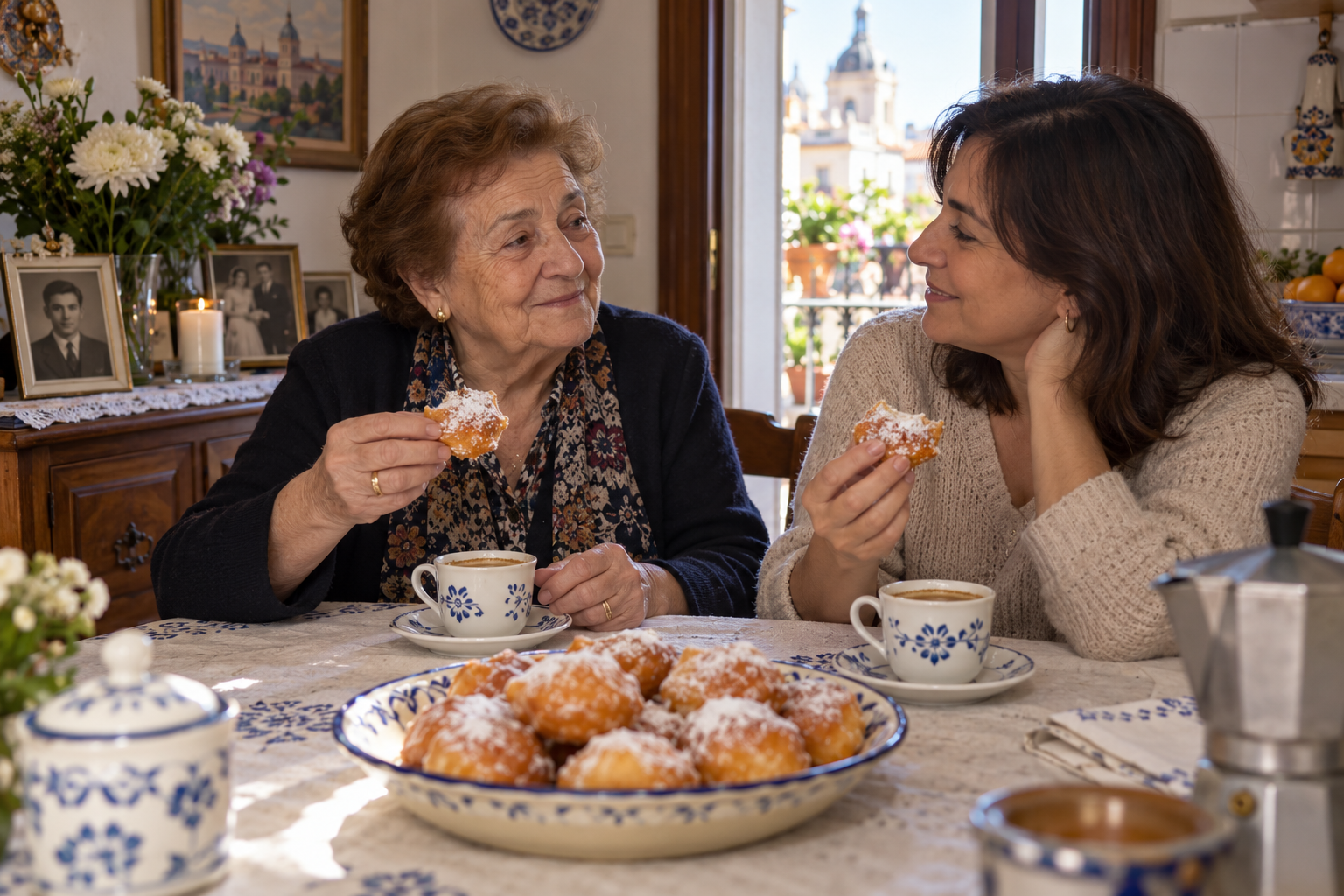
Like the huesos de santo they sit beside in the shop windows, bunuelos de viento are bound up with the first days of November and their focus on the dead. All Saints’ Day and the Day of the Dead that follows it are when Spain honors and remembers those who have died, with cemetery visits, flowers, family gatherings, and these particular traditional sweets, so the bunuelo is not merely a seasonal fried treat but a small part of a centuries-old observance. The two sweets together, the airy wind fritters and the bone-shaped marzipan, form the heart of the All Saints’ confectionery tradition.
There is even a piece of folklore that gives the bunuelo a gentle connection to the day’s deeper meaning. A charming old belief holds that each bunuelo eaten on the day frees a soul from purgatory, a sweet, hopeful little notion that ties the simple act of enjoying a fritter to the remembrance of the departed, and that, true or not, captures the warm spirit in which Spain approaches this season. Far from being somber or frightening, the day mixes genuine remembrance with family, warmth, and good things to eat, and the bunuelo de viento sits right at that intersection of the tender and the festive. Eating one is a small, light, sweet way of marking a day that is, underneath everything, fundamentally about love and memory rather than fear or spectacle, which is perhaps why something so physically insubstantial, so close to being made of nothing at all, manages to carry such a surprisingly happy weight of tradition and meaning. The lightest of sweets turns out to hold quite a lot.
How They Puff
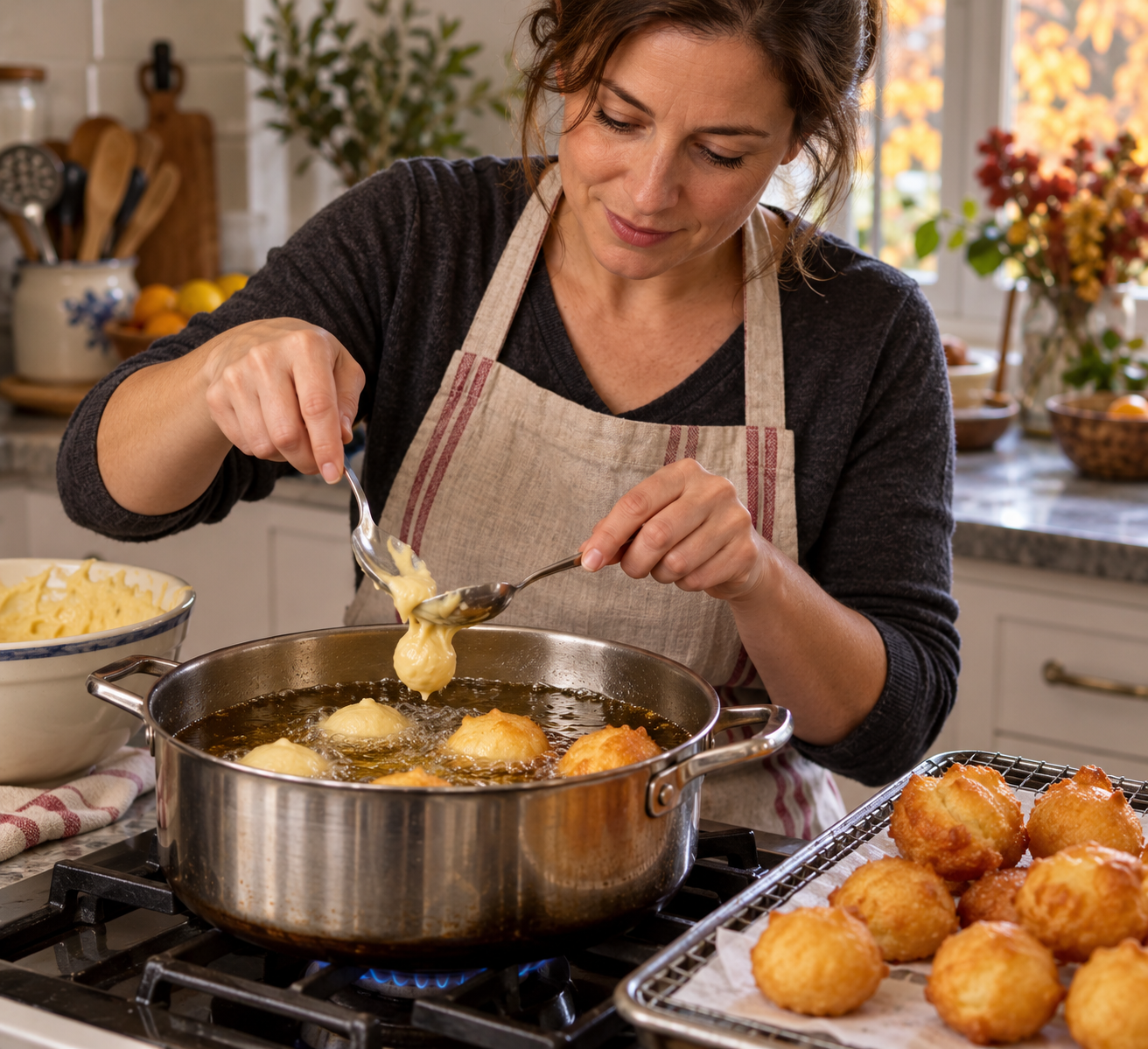
The near-magical hollowness of a bunuelo de viento is not luck; it is the predictable result of a clever dough and hot oil, and understanding it makes them far less intimidating to attempt. The dough is a choux paste, the same behind profiteroles and eclairs, made by cooking flour into a mixture of water or milk and butter on the stove, then beating in eggs off the heat until you have a smooth, thick, glossy paste. The secret to the puff is in that paste: it holds a lot of moisture and a lot of egg, and when it meets hot oil, the moisture flashes to steam while the eggs set around it, inflating each fritter into a hollow balloon from the inside out.
In practice, you drop small spoonfuls of the dough into oil heated to the right temperature, not too hot or they brown before they puff, and then you watch them perform: they swell, and many will dramatically flip themselves over in the oil as one side puffs faster than the other, which is part of the fun and a sign that they are working. You fry them until they are golden and crisp all over, lift them out to drain, and then, once cool enough, you dust them with sugar or pipe them full of cream. It is genuinely satisfying to make, because the transformation is so visible and so dramatic, a humble spoon of paste becoming a weightless golden puff in under a minute, and it needs no special equipment beyond a pot of oil. For a sweet that seems so delicate, bunuelos de viento are forgiving and fun to cook at home.
Make It: Bunuelos de Viento
Here is a classic recipe, making roughly two dozen small fritters. You can serve them simply dusted with sugar, or fill them with pastry cream for the fuller traditional treat.
Ingredients
- 250ml water (or half water, half milk)
- 60g butter
- 1 tablespoon sugar, plus more for dusting
- a pinch of salt
- zest of half a lemon (optional)
- 150g plain flour
- 4 eggs
- oil, for deep frying
- pastry cream or whipped cream, optional, for filling
Instructions
- In a saucepan, bring the water (or water and milk), butter, sugar, salt, and lemon zest to a boil, until the butter has melted.
- Lower the heat, add all the flour at once, and stir vigorously with a wooden spoon until the mixture comes together into a smooth ball of dough that pulls away from the sides of the pan. Cook it for another minute, stirring, then remove from the heat and let it cool for a few minutes.
- Beat in the eggs one at a time, mixing thoroughly after each, until you have a smooth, thick, glossy paste. It should be soft but hold its shape.
- Heat a deep pot of oil to a moderate frying temperature, around 170 degrees Celsius (340 Fahrenheit), not too hot. Drop in small spoonfuls of the dough, a few at a time so you do not crowd the pot.
- Fry, turning as needed, until the bunuelos have puffed up, often flipping themselves, and are deep golden and crisp all over. Lift them out and drain on paper towels.
- While still warm, roll or dust the bunuelos generously in sugar. If filling, let them cool, then use a piping bag to fill each hollow puff with pastry cream or whipped cream. Serve the same day, ideally soon after frying.

About the Author: Ruben, co-founder of Gamintraveler.com since 2014, is a seasoned traveler from Spain who has explored over 100 countries since 2009. Known for his extensive travel adventures across South America, Europe, the US, Australia, New Zealand, Asia, and Africa, Ruben combines his passion for adventurous yet sustainable living with his love for cycling, highlighted by his remarkable 5-month bicycle journey from Spain to Norway. He currently resides in Spain, where he continues sharing his travel experiences with his partner, Rachel, and their son, Han.