
Living as a Filipina in Spain, I get to eat both of them, and I have come to love the quiet joke buried in my own two kitchens. On one side is the lechon of my childhood, the whole pig turning over coals at every Filipino fiesta, its skin shattering like glass.
On the other is the cochinillo of my adopted country, the tiny Segovian suckling pig so tender they cut it with the edge of a plate. For years I thought of them as two completely different dishes from two completely different worlds. They are not. They are, in a real sense, the same dish, carried from Spain to the Philippines down four centuries of colonial history, split into two gloriously different traditions, and now arguing across an ocean about who makes the better crackling. Here is the shared root that binds them, the wider empire they belong to, the two roast pigs they became, and the delicious crackling argument between Manila and Segovia. It is one of my favorite stories to tell at a table with both kinds of pork belly on it.
What follows is the one word and colonial trail they share, the restraint of Segovian cochinillo, the fire and fiesta of Filipino lechon, the crackling argument between them, and a home recipe to get the crackling yourself.
One Word, One Colonial Trail
Start with the word, because the word is the whole clue. Lechon is Spanish, not Filipino. It comes from leche, the Spanish word for milk, and it originally meant a milk-fed suckling pig, a piglet still young enough to be nursing. When Spain colonized the Philippines in the sixteenth century, it carried not just a language and a religion across the Pacific but a whole way of cooking, and among the things that made the journey was the roast pig and its Spanish name.
The very same thing happened across the rest of the empire, which is exactly why you find lechon, under one spelling or another, as a treasured dish in Puerto Rico, Cuba, and much of Latin America too, wherever Spanish ships and Spanish priests and Spanish cooks happened to land. One small piglet, one small word, carried astonishingly far. Spain scattered the dish, and the word, across three continents.
But here is the lovely twist, the thing that makes this more than a simple story of borrowing. In the Philippines, the word did not stay put; it grew. Lechon loosened from its narrow Spanish meaning of suckling pig and came to mean the whole roast pig at any size, and even the act of roasting over fire itself. That is why Filipinos say lechon baboy for a whole roast pig, lechon manok for roast chicken, and lechon baka for a whole roast cow, and why a genuine Filipino suckling pig has to be specified as lechon de leche, which in the original Spanish would be a funny redundancy, a milk pig of milk. Spain gave the Philippines the word; the Philippines gave the word a bigger, bolder, entirely new life. That single linguistic fact is the colonial trail in miniature, and it is why a Filipino fiesta pig and a Castilian restaurant delicacy are, against all appearances, cousins.
The Rest of the Pig’s Empire
It is worth pausing to notice that the Philippines and Segovia are only two stops on a much longer trail, because the Spanish roast pig put down roots wherever Spain went. The same word, the same tradition, sailed to the Caribbean and across Latin America, so that lechon is a passionately beloved centerpiece in Puerto Rico and Cuba too, where it takes on yet another character entirely, deeply marinated in garlic, citrus, and sour orange and slow-roasted over hardwood, a cousin to the Filipino pig that shares its name but tastes nothing like it. Across the whole former empire, you find the same Spanish word anchoring wildly different pigs.
That is what makes this such a satisfying story rather than a simple one. Spain did not so much spread a single fixed dish as plant a seed that grew into a whole family of roast pigs, each one shaped by the fire, the flavors, and the festivities of the place it landed in. The humble milk-fed piglet of Castile became the smoky fiesta hog of Manila, the citrus-soaked Nochebuena roast of San Juan, and more besides, every one of them crackling-skinned, every one of them the heart of a celebration, every one of them carrying that same little Spanish word for a nursing pig. Seen that way, the argument between Manila and Segovia is really just one lively conversation within a very large and very happy family, all of them gathered, across centuries and oceans, around the same irresistible idea of a pig roasted until its skin sings.
Cochinillo, and the Plate That Carves It
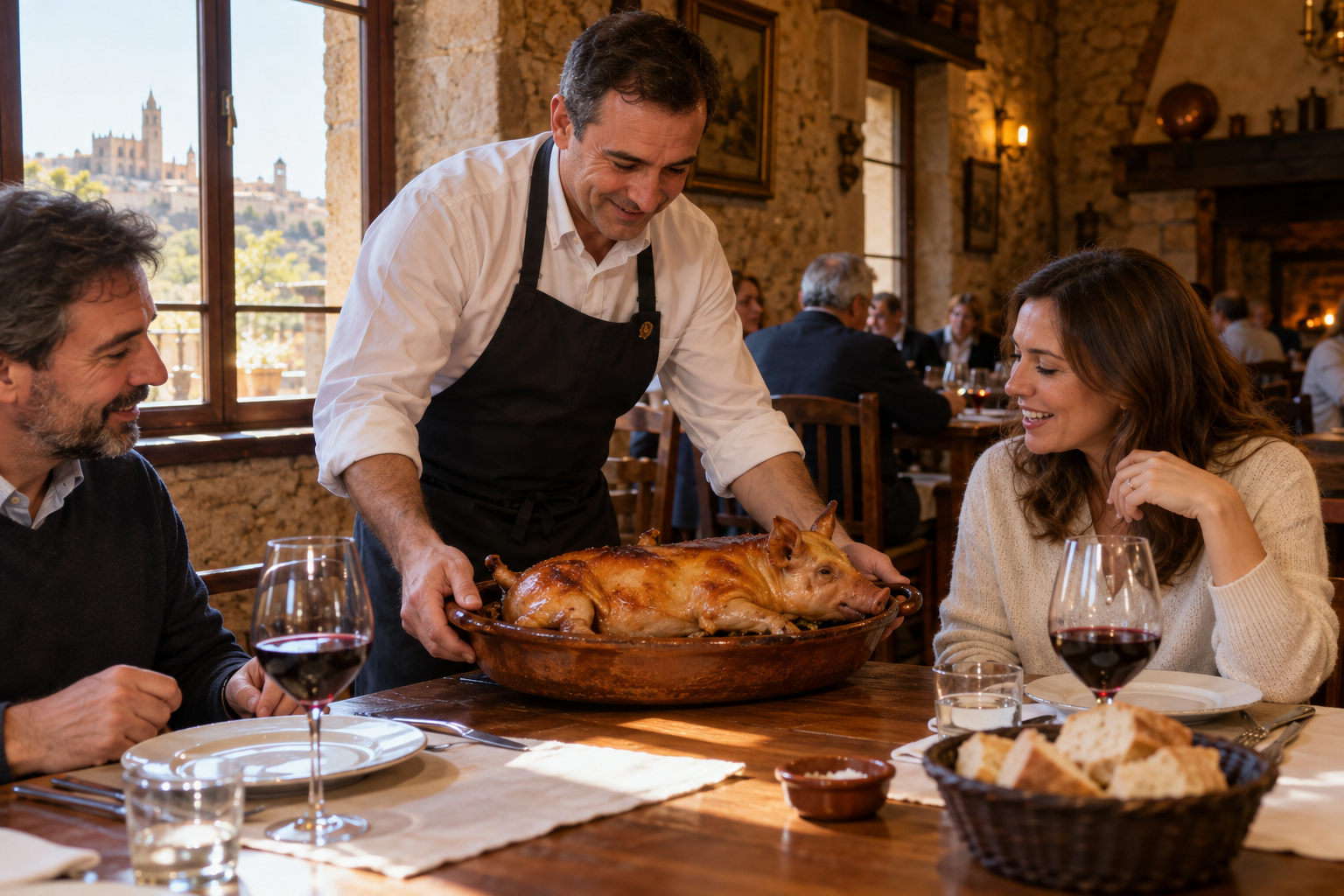
Follow the trail back to its source, to Castile, and you find the pig in its oldest, most restrained form: cochinillo asado, the roast suckling pig of Segovia. This is the dish at its most purist. Cochinillo is a true suckling piglet, milk-fed and slaughtered at only around three weeks old, a tiny animal that is split so it lies flat, placed skin up in a shallow earthenware dish, and roasted whole in a fierce wood-fired oven with almost nothing added, just water, salt, and a little lard.
There are no bold aromatics, no stuffing, no smoke, nothing to distract from the thing itself. The result is a pig whose skin crisps to a thin, glassy, amber shell that cracks at the lightest touch, and whose meat, from such a very young animal, turns so soft, pale, and delicate that it practically dissolves on the tongue, barely needing to be chewed at all. Tenderness, not smoke or spice, is the entire pursuit of the Segovian version. It is, you might say, the most restrained member of the entire lechon family, a dish built on the quality of a very young piglet and the mastery of a wood oven, and nothing else.
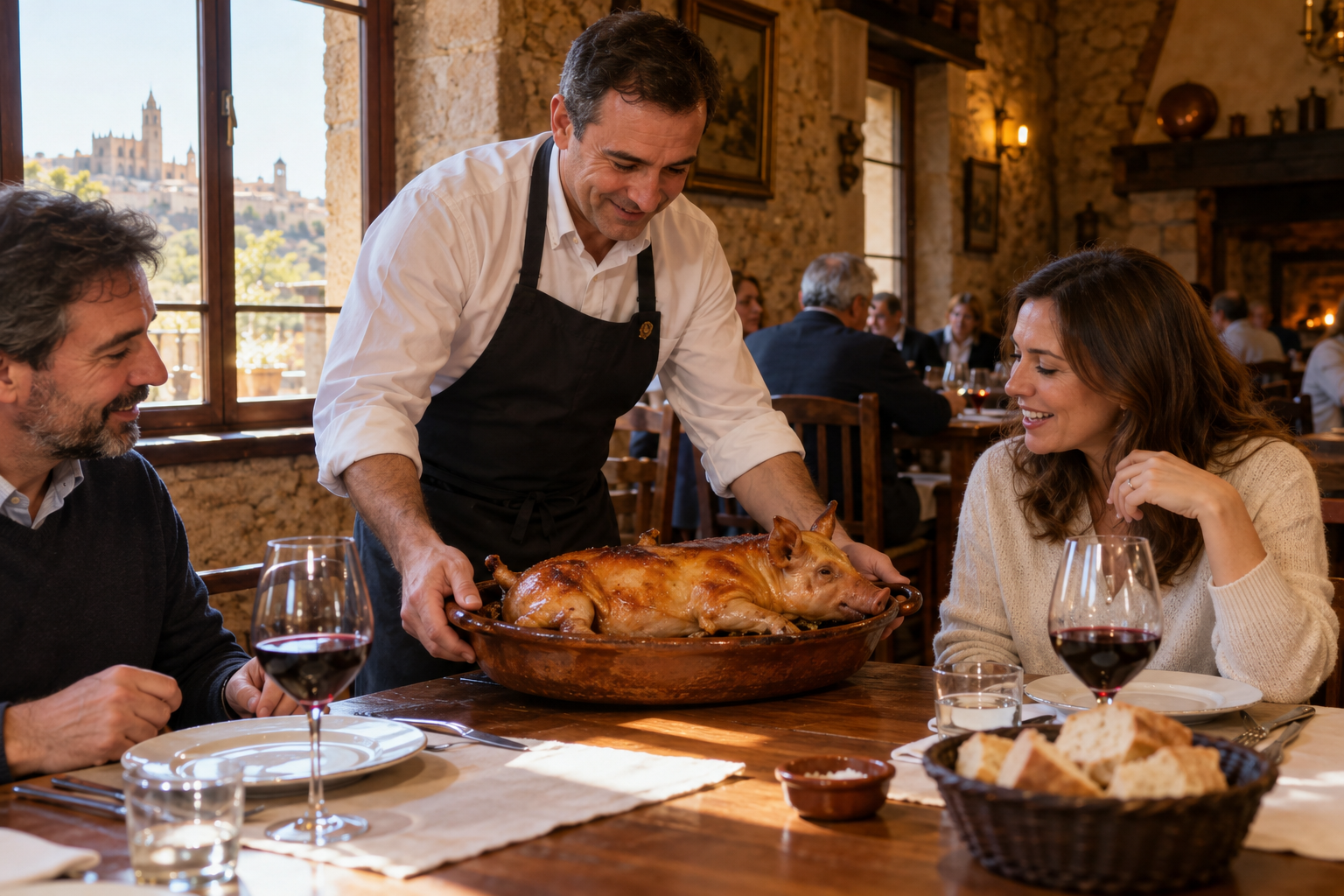
Segovia, a small city in the Castilla y Leon region, has somehow become the world capital of this one dish, its ancient roasting houses building the reputation of cochinillo de Segovia over generations until it earned its own protected regional status. And it comes with one of the great pieces of culinary theatre. In the 1930s, a Segovian innkeeper named Candido, at what is now the famous Meson de Candido in the shadow of the Roman aqueduct, began carving his cochinillo not with a knife but with the edge of a plain ceramic plate, slicing clean through the impossibly tender piglet to prove, dramatically, just how soft it was. The story goes that one day, his hands greasy from the roast, the plate slipped and flew from his grip and smashed on the floor, and the accident became tradition: to this day the cochinillo is carved with a plate, and the plate is then triumphantly thrown down and broken. It is proof, performance, and a very Castilian sense of occasion, all in one shattering gesture.
Lechon, and the Fire and Fiesta of Manila
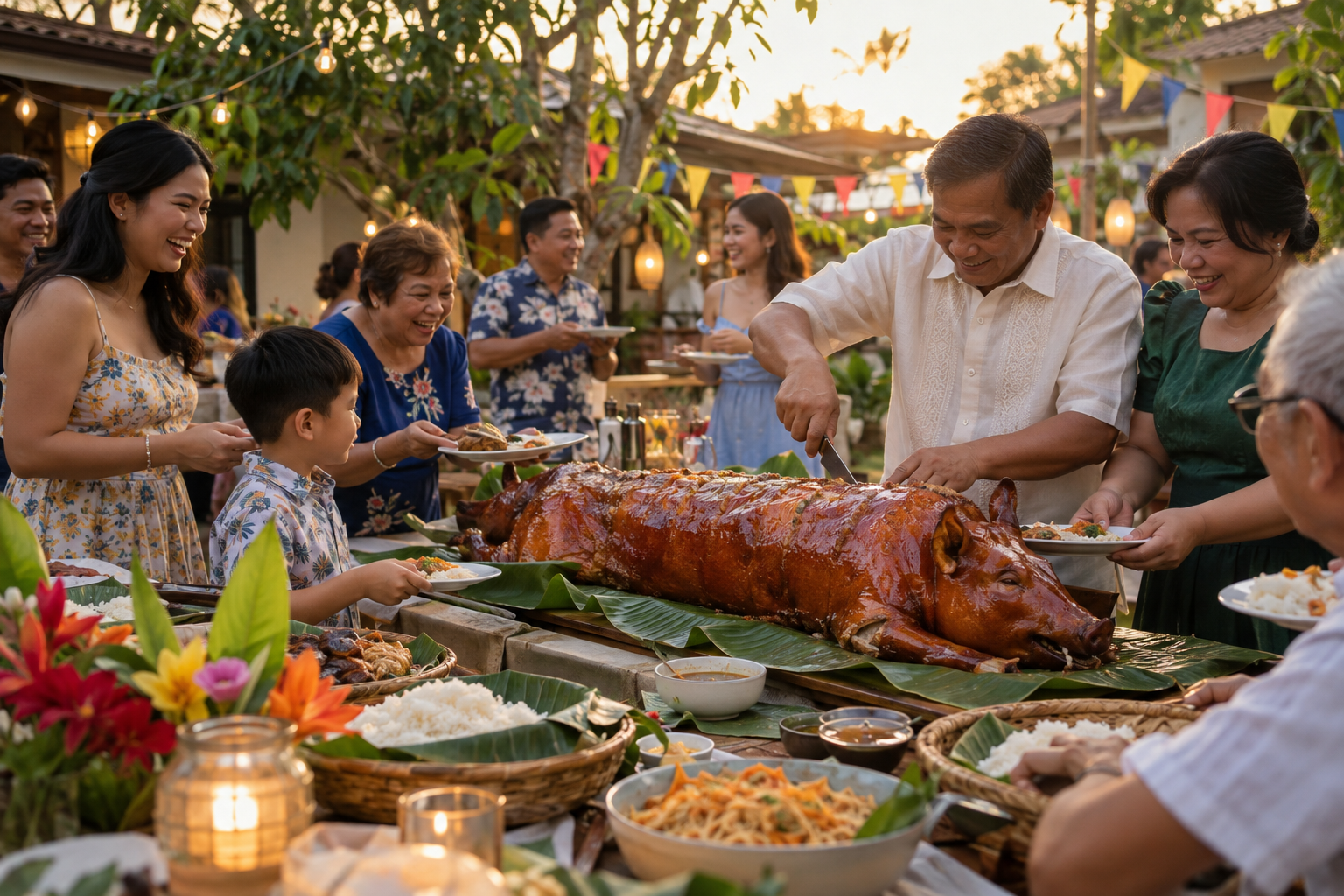
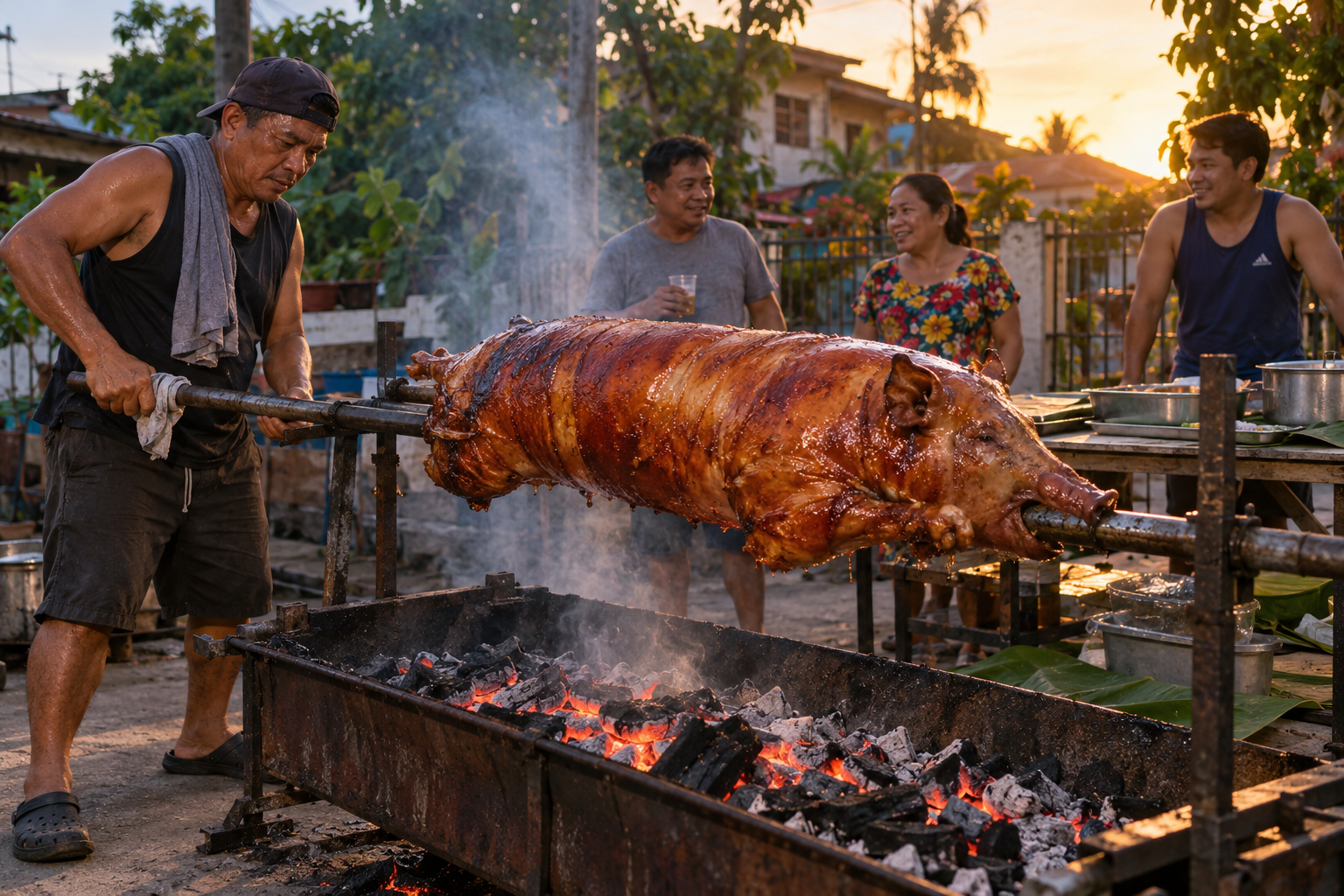
Now follow the trail the other way, across the ocean to the Philippines, and watch what the same humble Spanish piglet became in the hands of a different culture. Filipino lechon is a world away from the restrained little cochinillo of Segovia. It is, most often, not a tiny suckling pig at all but a whole full-grown animal, and it is spit-roasted over live charcoal, frequently the charcoal of coconut husks, turned patiently by hand for four, five, six hours until the entire skin blisters and crackles into the deep golden, shatteringly crisp crackling that is the whole point of the exercise. Where cochinillo is about restraint, lechon is about fire, smoke, and sheer abundance, a whole pig cooked over coals in the open air.
And where the Spanish piglet is left almost unseasoned, the Filipino pig is perfumed from the inside out. The cavity is stuffed with aromatics, lemongrass above all, along with garlic, scallions, and bay leaves, so that the smoke and the herbs work their way into the meat as it turns.
There are two great schools of it. Cebu lechon, from the Visayas, is so thoroughly seasoned inside that it needs no sauce at all and is widely considered the finest, the version Anthony Bourdain famously called the best pig he had ever tasted. Manila lechon, from Luzon, is often plainer in the meat and served instead with a rich, sweet, liver-based lechon sauce poured over it. But whichever school you belong to, Cebu or Manila, the role of the pig is the same and it is close to sacred: lechon is the undisputed centerpiece of every important Filipino celebration, the whole glistening, bronzed pig carried out on its board to a chorus of gasps and raised phones at weddings, baptisms, town fiestas, and Christmas Eve, the single dish that announces, without a word, that this is a day that truly matters. No lechon, no real party. It is not restaurant food; it is communal, celebratory, whole-village food, and it is impossible to imagine a true Filipino feast without it.
The Crackling Argument
So here is the argument, carried out across an ocean between two cities that both worship the crispy-skinned roast pig and descend from the very same Spanish word. On one side stands Segovia, arguing for restraint: take the youngest, most tender milk-fed piglet, add almost nothing, roast it with the quiet skill of a wood oven, and let its glassy skin and melting meat speak for themselves, so delicate you can carve it with a plate. On the other side stands Manila, and Cebu behind it, arguing for abundance: take a whole big pig, stuff it with lemongrass and garlic, turn it for hours over smoking coconut-husk coals, and produce something robust, smoky, aromatic, and gloriously crackling, a pig built not for a quiet dinner but for a roaring fiesta.
Who wins? The honest and happy answer, from someone lucky enough to eat both, is that they are not really competing at all; they are cousins who grew up on opposite sides of the world and became magnificently different people.
Cochinillo is a jewel, precise and refined, a special-occasion treasure best eaten in a Segovian roasting house with a glass of Ribera del Duero. Lechon is a celebration you can smell from halfway down the street before you even arrive, generous and smoky and loud and communal, the crackling, beating heart of a Filipino party that draws everyone toward it. It is not a dish you eat so much as a dish you gather around. One prizes the tenderness of the meat; the other prizes the shatter of the skin. One is theatre on a plate; the other is joy on a spit. And both, astonishingly, grew from the same small Spanish piglet and the same Spanish word that sailed to the Philippines five hundred years ago.
When I eat lechon in Manila or cochinillo in Segovia, I am tasting two ends of the same long colonial thread, and the only sane verdict is to love them both. The pig, in the end, is the point, and on that Manila and Segovia have never once disagreed.
Make It: Lechon-Style Crispy Roast Pork Belly
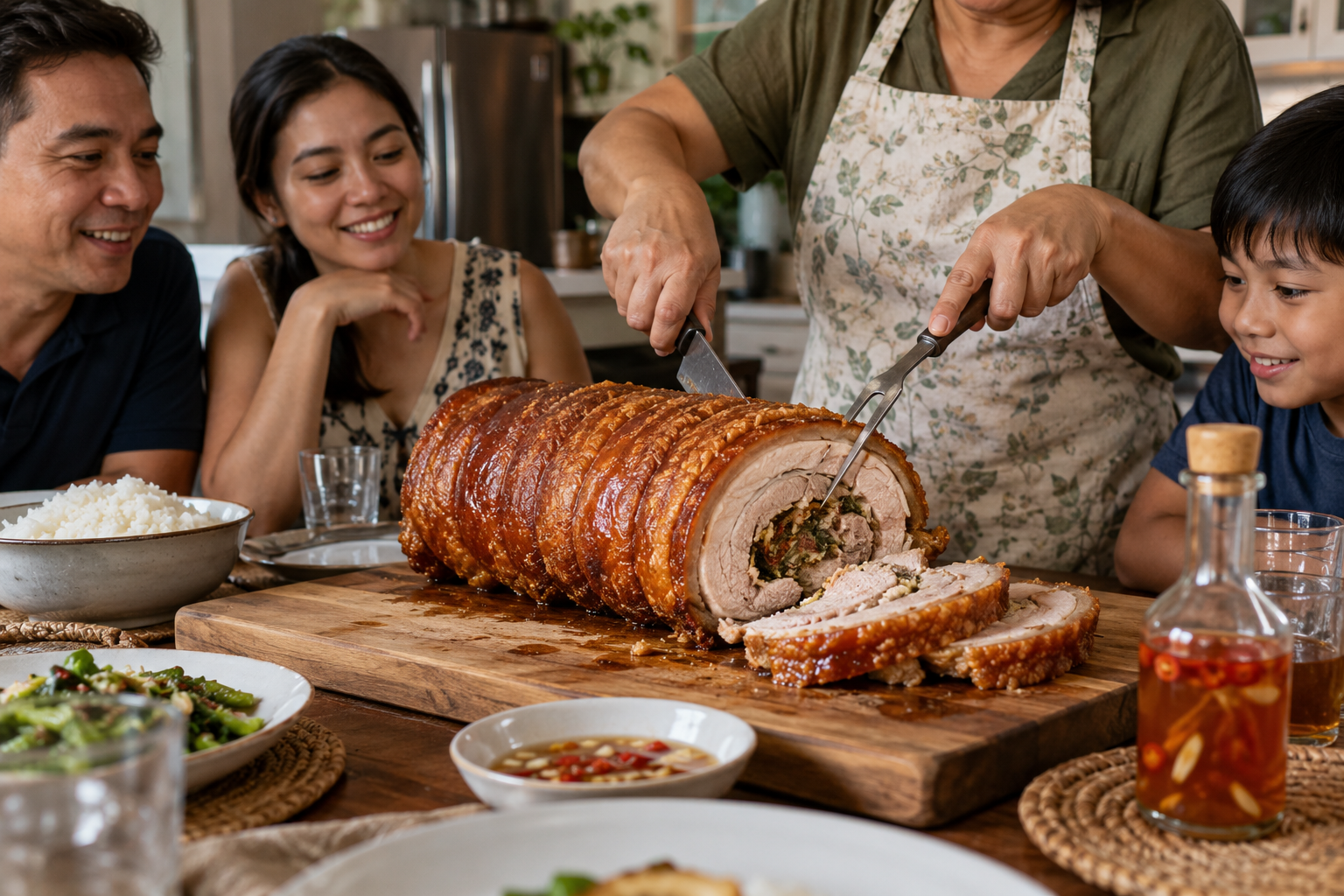
A whole lechon needs a spit and a crowd, and a true cochinillo needs a milk-fed piglet and a Segovian wood oven, so neither is a weeknight project. But you can get that glorious shattering crackling at home with a lechon-style roast pork belly, the beloved shortcut Filipinos call lechon belly, which delivers the crisp skin and lemongrass perfume of the real thing in an ordinary oven. This serves about six as a centerpiece.
You will need a slab of pork belly with the skin on, around two to three pounds, kept in one piece. For the inside seasoning you will need a generous bunch of lemongrass (tanglad), bruised and chopped, a whole head of garlic peeled and smashed, a thumb of ginger sliced, a few bay leaves, several chopped scallions, salt, and plenty of black pepper. For the skin you just need salt and a little white vinegar.
Lay the pork belly skin side down and season the meat side very well, rubbing in salt and pepper, then scatter the lemongrass, garlic, ginger, bay leaves, and scallions all over the meat. Roll the belly up tightly into a log with the aromatics inside and the skin on the outside, and tie it firmly with kitchen string at intervals. Pat the skin completely dry, rub it all over with a little vinegar, and then rub it generously with salt, working it in; for the best crackling, leave it uncovered in the fridge overnight so the skin dries out thoroughly, which is the real secret to crisp skin.
When you are ready to roast, bring the pork to room temperature and heat your oven to a moderate temperature, around 325 degrees Fahrenheit. Pat the skin dry once more, set the rolled belly on a rack in a roasting pan, and roast slowly for about two to two and a half hours, until the meat is tender. Then turn the oven up high, to around 450 degrees, and roast for another twenty to forty minutes, watching closely, until the skin blisters, bubbles, and turns into deep golden, crackling crackling. If parts of the skin are stubborn, a few minutes under the broiler will finish them, but watch it like a hawk so it crisps rather than burns. Let it rest for at least fifteen minutes, then slice through that shattering crust into rounds, revealing the lemongrass-scented meat within. Serve it as it is, Cebu style, or with a Filipino lechon sauce or a sharp garlic vinegar for dipping, and listen for the crackle that proves you have brought a little of the fiesta, and the whole long colonial trail, into your own kitchen.

About the Author: Ruben, co-founder of Gamintraveler.com since 2014, is a seasoned traveler from Spain who has explored over 100 countries since 2009. Known for his extensive travel adventures across South America, Europe, the US, Australia, New Zealand, Asia, and Africa, Ruben combines his passion for adventurous yet sustainable living with his love for cycling, highlighted by his remarkable 5-month bicycle journey from Spain to Norway. He currently resides in Spain, where he continues sharing his travel experiences with his partner, Rachel, and their son, Han.