
There is a particular moment that stops first-time visitors to certain Spanish cities in their tracks: you order a beer, the bartender sets it down, and then, without a word and without charge, places a small plate of food beside it, free. A few slices of ham, a dish of fried fish, a little mound of stewed something on bread, a saucer of olives, whatever the bar felt like giving you.
You did not order it, and you will not be charged for it; it simply comes with the drink, as naturally as the glass itself. This is the free tapa, one of the great traditions of Spanish life, and Americans tend to arrive with one of two wrong ideas about it: either that it happens everywhere in Spain, or that it has died out entirely, and both are wrong in instructive ways. The truth, in 2026, is more specific and more interesting than either, and it rewards the traveler who knows the lay of the land. The free tapa is alive and well, but only in particular cities, and knowing which ones can turn a drink into dinner. Here is how the custom actually works, the cities where it still thrives, where it has quietly vanished, and a classic free tapa you can make at home to taste what all the fuss is about. Get it right and a night out in the right city becomes one of the best-value meals in Europe.
What follows is how the free tapa works, the undisputed capital of the custom, the other cities that keep it alive, where it has disappeared, and a recipe to bring it to your own kitchen.
How the Free Tapa Actually Works
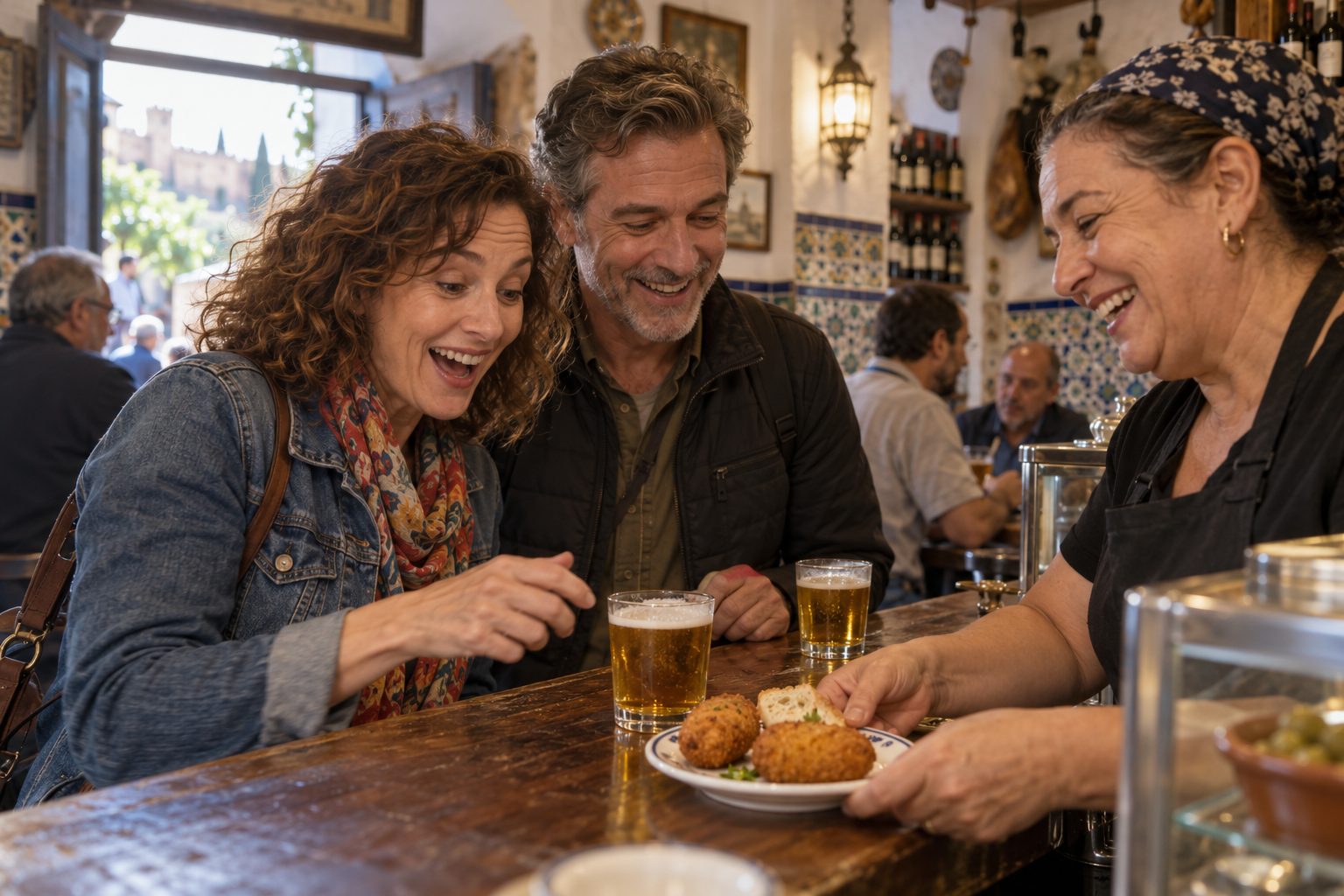
So the mechanism is beautifully simple, and it is well worth understanding before you go, because it is different from how tapas work in most of the country, where you order from a menu and pay for each plate. In a free-tapa city, you order a drink and the bar brings you a tapa of its own choosing, at no extra cost. You do not pick it from a menu; the bar decides what you get, and part of the fun is the surprise. A good bar takes a quiet pride in its tapas, and regulars come to know which places reward a second and third round with something special. Order a second drink and a second tapa appears, usually something different from the first, and so it goes, so that three or four drinks over an evening can leave you genuinely fed.
This is the heart of the custom and the reason it is such a joy: the tapa is bundled into the price of the drink, so the food is, in the truest sense, free. You are not choosing and paying for small plates; you are being fed, a little more with each round, as a matter of course.
It shapes a whole style of going out, the tapeo, in which the idea is not to settle in one bar but to have one drink and its tapa at each of several, moving on to the next, sampling a different free bite at every stop. A crucial point for visitors to grasp is that this is a custom, not a law; despite a persistent myth, no Spanish law requires bars to give free tapas, and the tradition survives purely because the bars in certain places choose to keep it, with the cost of the food folded into drink prices and fierce local competition keeping both reasonable. Where the custom holds, a bar that stopped giving tapas, or gave stingy ones, would simply lose its customers to the generous place next door, and that competition is what keeps the whole tradition honest and alive. Understanding that it is a living custom, upheld city by city and bar by bar rather than guaranteed anywhere, is the key to knowing where to find it, because it means the free tapa is not a Spanish feature but a local one, thriving in some places and absent in others. Treat it as a map to be read rather than a right to be assumed, and you will eat very well indeed.
Granada: The Undisputed Capital

If there is one city that is synonymous with the free tapa, it is Granada, universally agreed to be the capital of the custom and the place where it is most generous, most reliable, and most woven into daily life. In Granada, essentially every drink at a traditional bar comes with a free tapa, and the portions are famous for their generosity, to the point that three or four drinks can genuinely add up to a full and satisfying meal, which makes Granada one of the cheapest places in Spain to eat and drink well. Order a cana, and a plate arrives: it might be fried fish, a montadito of pork, a little stew, croquettes, whatever the bar has decided to serve that round, and the next drink brings something new.
There is a 2026 caveat worth knowing, because even in Granada the custom faces some pressure. With tourist numbers at record highs, a handful of tourist-zone bars have begun replacing the free tapa with a paid token or voucher system, where you pay a euro or two for a tapa, which is not the real tradition. The authentic free-tapa bars, though, remain plentiful across the city’s distinct tapas neighborhoods, and the rule of thumb is to walk a little away from the biggest tourist crush and into the areas where locals drink. A few streets’ distance from the main sights is usually all it takes to find the real thing, generous and free.
A further tip from those who know the city: come a bit later in the evening, when the bars are serving their regulars, because that is when they put the most effort into their tapas. In Granada, the tradition is not merely surviving but flourishing, and it remains the single best place in Spain to experience the free tapa at its most generous. For many visitors, an evening of Granada tapas-hopping is the meal they remember longest from a whole trip to Spain.
The Other Cities That Keep It Alive
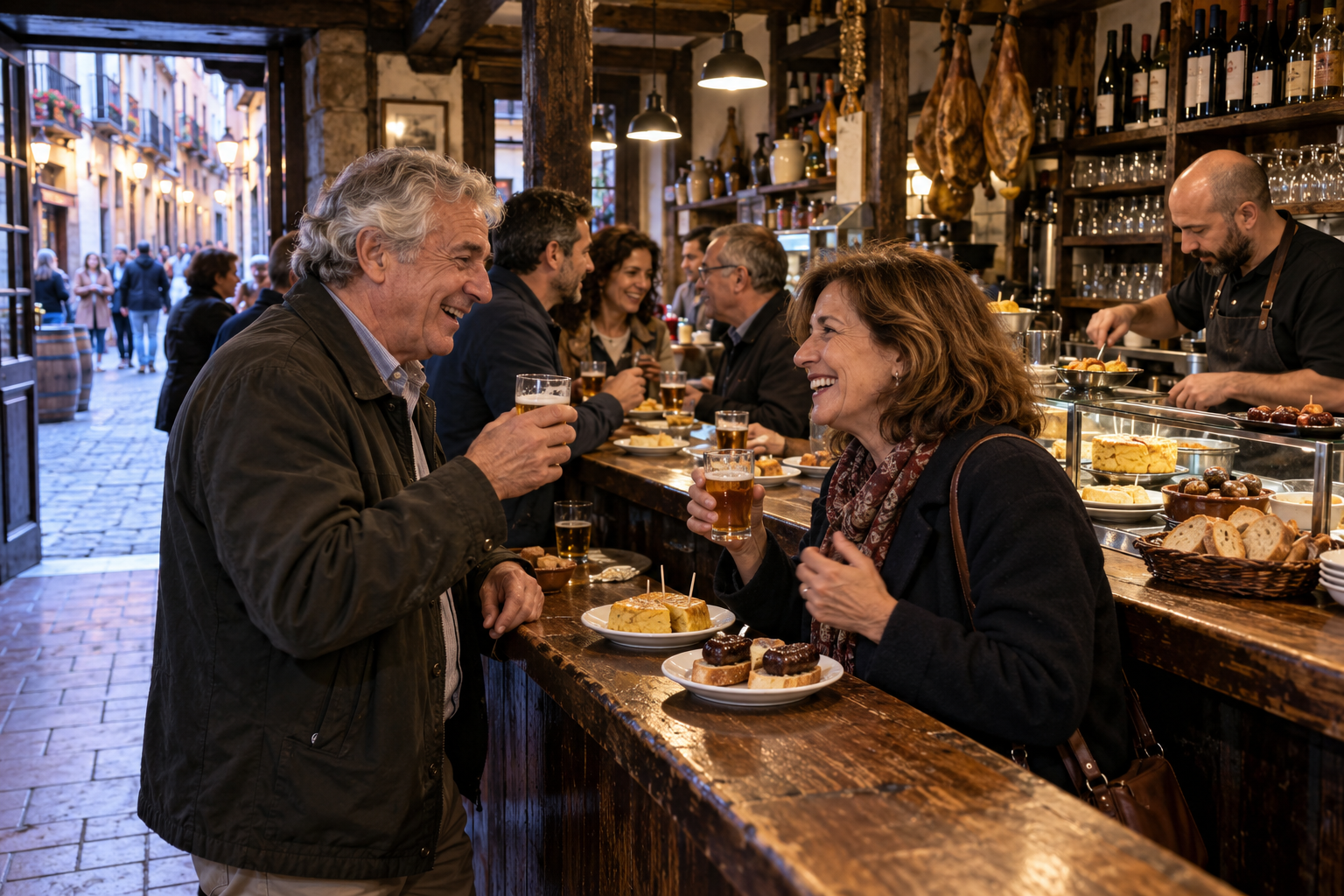
Granada is the champion, but it is not alone, and the custom survives most strongly in three regions: eastern Andalusia, Castilla y Leon, and Galicia. Within those, several cities are genuinely worth seeking out. In Andalusia, beyond Granada, both Jaen and Almeria are celebrated free-tapa cities, with Jaen known for hearty plates like migas and morcilla, and Almeria for generous portions by the coast, though its drinks run a touch pricier to compensate. Neither draws the tourist crowds of the big Andalusian names, which is exactly why the tradition stays strong in both. Up in Castilla y Leon, Leon is one of the finest foodie cities of the Spanish north and a free-tapa stronghold, with cheap drinks and excellent bites, while Avila serves notably large, filling tapas and Salamanca, full of students, keeps a beer-and-free-pincho under a couple of euros.
Each of these places has its own character and its own signature plates, and the free tapa in each reflects the local cooking, so the custom doubles as a free tour of regional food. What arrives beside your beer in Leon is not what arrives in Almeria, and tasting the difference from city to city is half the point.
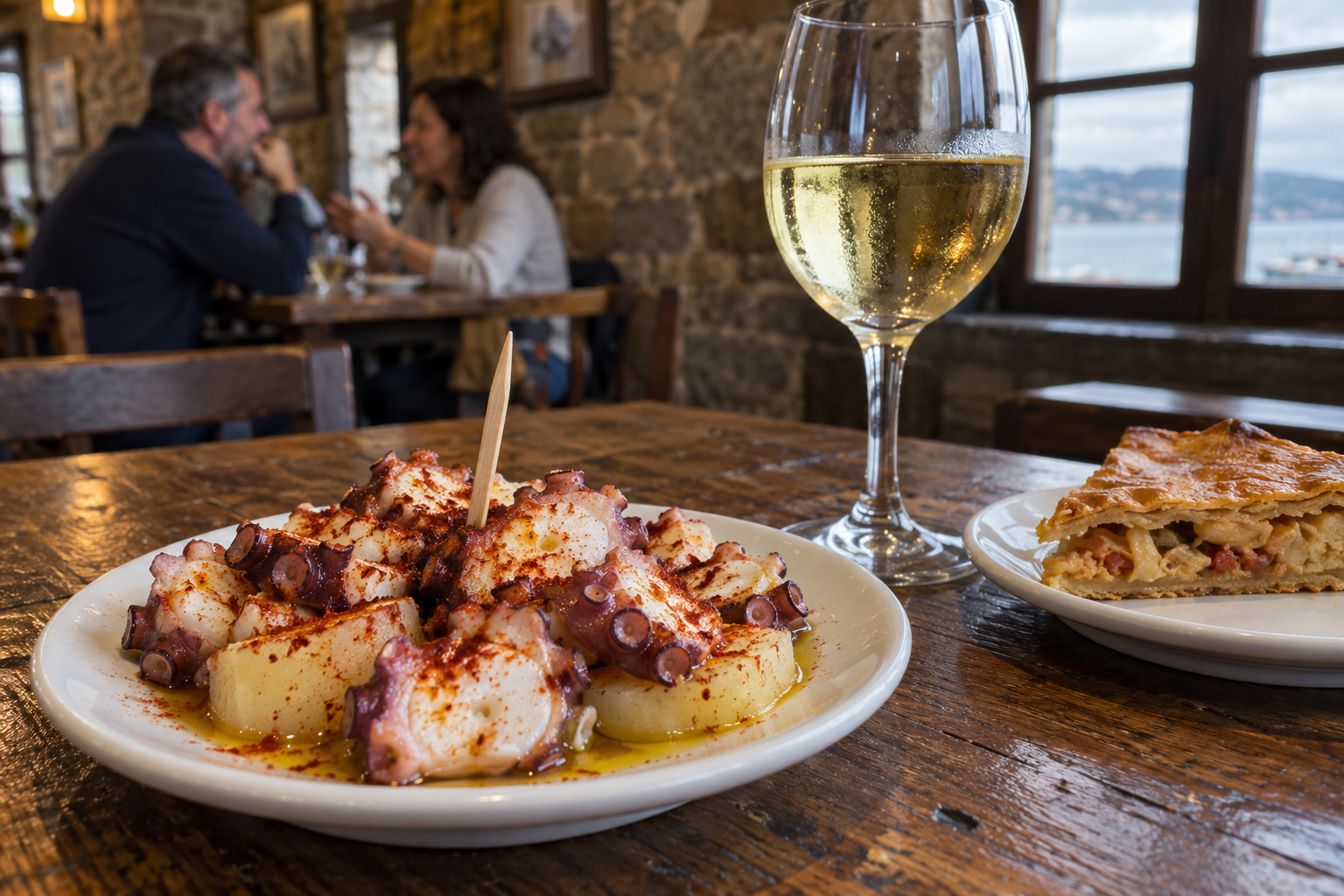
Galicia, in the northwest, keeps a gentler version, where a glass of the local Albarino wine or a beer often comes with a free snack, frequently something from the sea, a few boiled prawns, a slice of empanada, a little octopus. It is less systematic than Granada’s, but the spirit of feeding you alongside your drink is the same. The common thread is that these are not, for the most part, the big-name tourist cities but the proud regional ones, where the tradition is sustained by locals rather than marketed to visitors, which is precisely why it survives there in its genuine form. For a traveler, this is wonderful news: it means that some of the best-value, most authentic eating in Spain is to be found not in the obvious destinations but in a scatter of mid-sized cities where ordering a drink still, gloriously, means being fed. These are exactly the places that reward going a little off the usual tourist track, and the free tapa is reason enough to do it.
Where It Has Disappeared
Just as important as knowing where the free tapa thrives is knowing where it does not, because assuming it exists everywhere in Spain is the mistake that leads to disappointment and overpaying. In much of the country, and especially in the biggest and most-visited cities, tapas are now simply food you order and pay for, like anywhere else. The small-plate format survives everywhere, but the free part, the plate that arrives unbidden with your drink, is the thing that has narrowed to a handful of regions. Seville, despite its deep tapas culture, charges for them. Madrid has largely moved to paid tapas. Barcelona, in Catalonia with its own food traditions, barely practices the free-tapa custom at all, listing tapas on a menu to be ordered and billed.
The Basque Country is a special case worth clarifying, because its famous pintxos are emphatically not free: you take what you want and pay for each, and the system, delicious as it is, is the opposite of the free tapa.
Valencia, too, generally charges. And across the board, in the heavily touristed zones of any city, including the beach resorts, bars that once gave a free tapa have often quietly stopped, calculating that visitors will pay without the inducement that keeps locals loyal. There is a useful warning buried in all this: if a bar loudly advertises free tapas to tourists, you are probably about to pay for them anyway, through inflated drink prices. The genuine free-tapa bars rarely advertise the fact at all, because to the locals it is simply how a bar works, not a selling point. The free tapa, real and generous, is a regional tradition to be sought in the right places, not a nationwide guarantee, and knowing the difference is the difference between a cheap feast and a tourist trap. Go to Granada or Leon expecting it and you will be delighted; go to Seville or Barcelona expecting it and you will be quietly disappointed, so it pays to know which Spain you are in.
Make the Free Tapa at Home
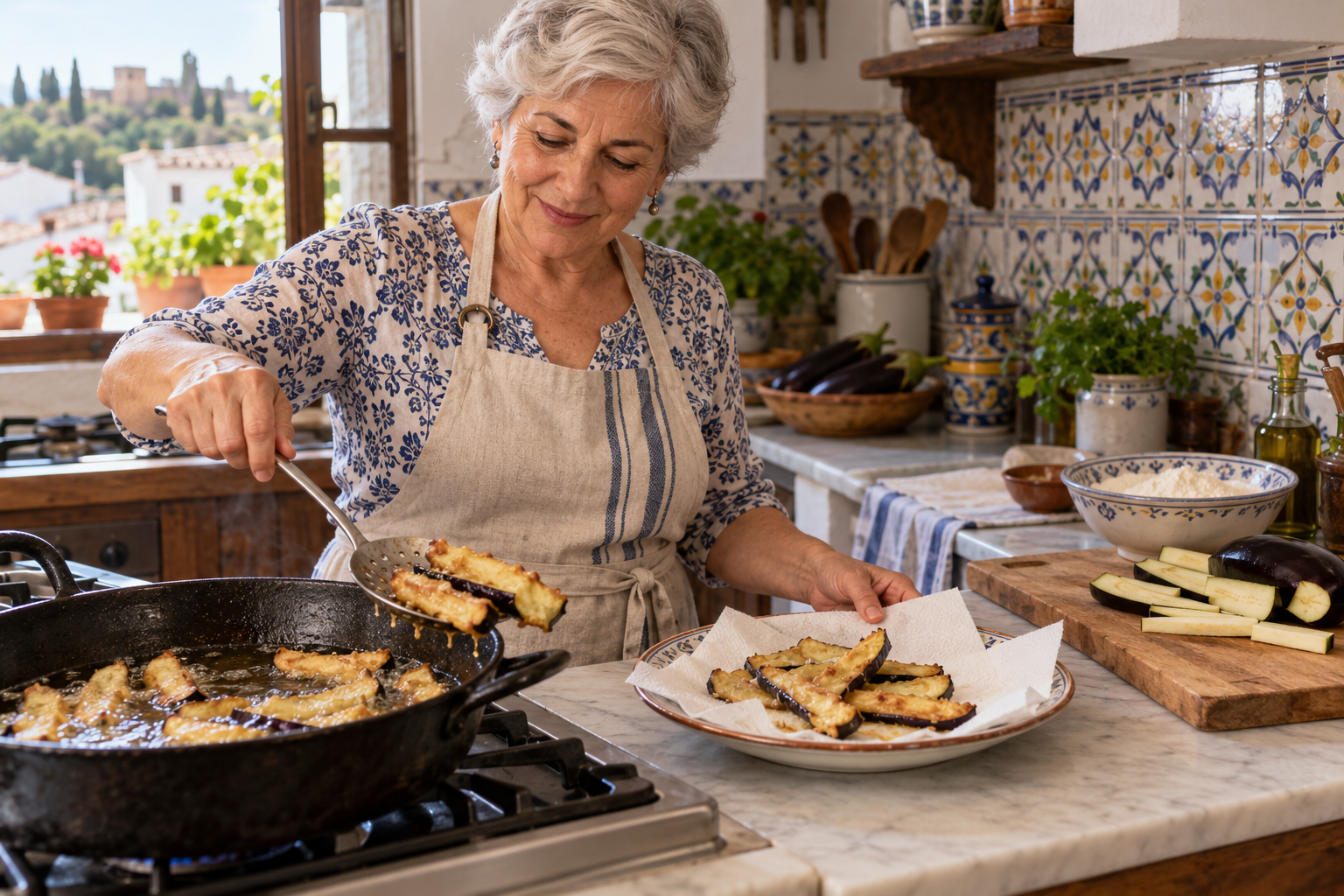
You do not have to be in Granada to enjoy a classic free tapa, and one of the most iconic Andalusian bar snacks is berenjenas con miel, fried aubergine drizzled with cane syrup, a magical combination of hot, crisp, savory, and sweet that turns up free with a drink all over the south, and that sounds odd on paper until the first bite converts you completely. It is simple, vegetarian, and genuinely addictive, and it brings a taste of the free-tapa tradition straight to your own table. If you have ever had it on a bar in the south, one bite will take you straight back; if you have not, it is a fine introduction to why the free tapa is worth crossing a country for.
Berenjenas con Miel
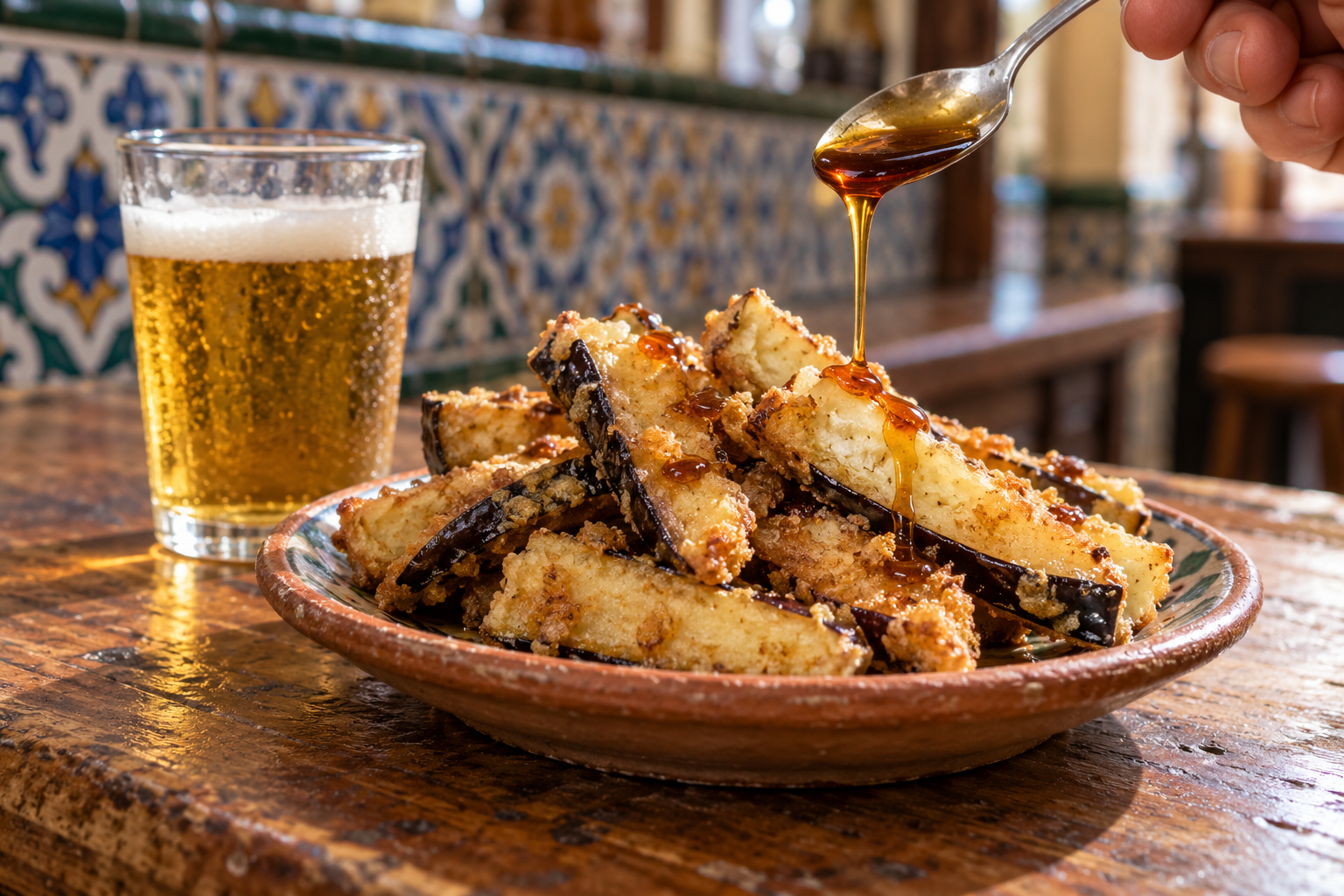
Crisp fried aubergine with a drizzle of dark syrup, the salty-sweet tapa of Andalusian bars. Serves 4 as a tapa. About 15 minutes active, plus a little salting time.
Ingredients:
- 2 medium aubergines (eggplants)
- Salt
- 250 ml (about 1 cup) milk, optional, for soaking
- 150 g (about 1 and a quarter cups) plain flour, for coating
- Sunflower or other neutral oil, for frying
- 4 to 5 tablespoons miel de cana (Spanish cane syrup) or dark honey, molasses, or maple syrup as a substitute
Instructions
- Cut the aubergines into thin batons or rounds, about a centimeter thick, sprinkle them generously with salt, and leave them in a colander for 20 to 30 minutes to draw out moisture and any bitterness, then pat them dry. If you like, soak them in milk during this time, which keeps the inside creamy, then drain and pat dry.
- Heat a generous depth of oil in a deep pan to a brisk frying heat, hot enough that a scrap of aubergine sizzles at once.
- Toss the aubergine pieces in the flour to coat them all over, shaking off the excess, so they have a thin, even dusting.
- Fry the pieces in batches, without crowding the pan, until deep golden and crisp on the outside and soft within, a few minutes a batch, then lift onto paper towels to drain and sprinkle with a little more salt.
- Pile the hot fried aubergine onto a plate and drizzle generously with the cane syrup or honey just before serving, so it is salty, crunchy, and sweet all at once.
Serve immediately, while hot and crisp, ideally with a cold beer or a glass of wine, exactly as it would arrive, free, on a bar in Granada.
The trick that makes it sing is the contrast: the aubergine must be properly crisp and well salted so that the dark, almost bitter sweetness of the cane syrup plays against it rather than drowning it. If you cannot find miel de cana, which is a Spanish sugarcane molasses rather than bee honey, a dark honey or a little molasses thinned with honey does the job, and the dish still delivers that surprising, irresistible sweet-and-savory hit that has kept it on Andalusian bar counters for generations.

About the Author: Ruben, co-founder of Gamintraveler.com since 2014, is a seasoned traveler from Spain who has explored over 100 countries since 2009. Known for his extensive travel adventures across South America, Europe, the US, Australia, New Zealand, Asia, and Africa, Ruben combines his passion for adventurous yet sustainable living with his love for cycling, highlighted by his remarkable 5-month bicycle journey from Spain to Norway. He currently resides in Spain, where he continues sharing his travel experiences with his partner, Rachel, and their son, Han.