

In the heart of Madrid, in neighborhoods where a modest apartment now rents for fifteen hundred euros a month or more, a small and dwindling number of people are paying something closer to three hundred, or five hundred, for a home in the same building, on the same street, sometimes behind an identical door one floor up. They are not getting away with anything, and their landlords, for the most part, cannot do much about it. They are living under a law written in 1964, a system of rent so old and so protective that it has quietly survived into the present, letting a handful of long-term tenants pay a fraction of what their neighbors do. It is called renta antigua, old rent, and it has returned to the headlines in Spain through the painful case of an elderly woman evicted after seventy years in the same flat. So here is what this strange, vanishing kind of tenancy actually is, how a lease signed decades ago can still freeze a rent today, why so few remain, and what it reveals about Spain and its housing. It is one of those quirks that turns out to open a window onto the whole country.
What follows is the law that froze the rent, how a lease outlived the people who signed it, the startling gap between these rents and the market, why they are disappearing, and what the whole phenomenon says about Spain.
The Law That Froze the Rent

The renta antigua tenancies are the survivors of an old legal world, one governed above all by Spain’s Urban Leases Act of 1964, and understanding that law is the key to the whole mystery. The defining features of the 1964 regime were extraordinarily protective of the tenant. The first was the prorroga forzosa, the forced extension, which meant a tenant could renew the lease, in effect indefinitely, for as long as they wished to stay, so that a rental was not a fixed-term arrangement but something close to a permanent right to remain, a home the tenant could keep for as long as they lived and wished to stay. In practice it turned renting, for these tenants, into something almost like a form of ownership without the price. The second was that the rent could rise only within very narrow limits, barely keeping pace with inflation if at all, so that over the decades these rents stayed low while the market around them climbed.
The combination was powerful. A tenant who signed a lease under this system in, say, the 1960s or 1970s gained something close to a lifetime home at a rent that would be frozen, in real terms, for good. At the time it was simply a normal rental; only the passing decades, and the soaring of Spanish property, turned it into the extraordinary bargain it now appears.
These contracts, all signed before May 1985, when a later reform ended the forced-extension system for new leases, became a class of their own, a protected island of cheap, secure tenancies governed by the old rules even as Spain’s housing market transformed around them. A later overhaul of Spanish rental law in 1994 modified and began to wind down the old regime, but it largely left the existing pre-1985 contracts standing under their original protections, which is why, more than sixty years after the 1964 law and forty years after the last such lease was signed, a few of them are still in force today. The law changed for everyone new, but it let the old promises run out slowly rather than breaking them all at once. The rents are low not because anyone is being generous, but because a law from 1964 says they must stay that way, and because the Spanish state, for most of the time since, chose to keep protecting the people who held those leases.
How a Lease Outlived the People Who Signed It

The obvious question is how a contract from the 1960s or 1970s could still be running in 2026, when the people who originally signed it may be long gone, and the answer lies in a mechanism called subrogation. Under the old regime, a renta antigua lease was not strictly personal to the original tenant; in certain circumstances it could pass, on the tenant’s death, to a family member, a spouse or a child, who would then continue the tenancy under the same protected terms. The lease, in other words, could be inherited, carrying its frozen rent forward into a new generation.
This is what allowed these tenancies to span lifetimes. The 1964 system permitted up to two subrogations in certain cases, meaning a single contract could, in principle, pass down through a family across many decades, the original tenant to a spouse, the spouse to a child, each continuing to pay a rent anchored to a bygone era. A flat first rented by a young couple after the war could still, generations later, be home to one of their descendants paying an almost symbolic sum. The rent on the lease might be a number that made sense in pesetas in 1968 and makes almost no sense in a modern Madrid at all. The 1994 reform tightened these rules significantly, limiting further subrogations and setting the old contracts on a path to eventual extinction, so the days of endless inheritance are over. A contract can no longer be handed down forever; the chain now has an end, even if that end may be years away for the current holders.
But the mechanism explains the mystery: a renta antigua flat occupied today is very often not a recent deal but the latest chapter of a contract that has been passed carefully down a family for fifty or sixty years, its frozen rent an heirloom of sorts, handed from one generation to the next along with the keys.
The €500 Flat in a €1,500 City

The result of all this is a gap that can take an outsider’s breath away. In Spain’s big cities, Madrid and Barcelona above all, a renta antigua tenant might pay around three hundred euros a month while a comparable flat fetches fifteen hundred or more, which is to say roughly five times as much. And that is the typical case; the extremes are wider still, with some paying seven, eight, even ten times less than their market-rate neighbors for an equivalent home. In the most expensive central districts, the gap between the renta antigua rent and what the flat could fetch on the open market is simply enormous, the difference between a rent a pensioner can pay and one only a well-off professional could. It is the same four walls, the same street, the same city, priced as if in two different centuries.
These are, needless to say, extraordinarily good deals for the tenants who hold them, a piece of old Madrid frozen in amber while the city around it became one of Europe’s hot property markets. For the landlords, they are the opposite, a source of real grievance, because an owner saddled with a renta antigua tenant may be receiving a rent that does not even cover the building’s costs, let alone reflect the property’s value, with little legal means of raising it. An estimate circulated in 2024 put the number of renta antigua rentals still active across Spain at somewhere around a hundred and twenty-six thousand, a substantial figure but a shrinking and residual one, scattered through the older buildings of the cities, each a small time capsule of a vanished rental world. For the lucky few inside them, it means a home in the center of a great city at a price no one else could dream of, a last fragment of an older, cheaper Spain surviving inside the expensive new one.
If This Sounds Familiar, It Should
Americans reading this may feel a flicker of recognition, because the renta antigua has a close cousin that many will know by reputation: the fabled rent-controlled apartment of New York City. The trope is familiar from a hundred films and family stories, the relative who pays a few hundred dollars for a Manhattan apartment worth thousands, a lease inherited and clung to across generations, a sweetheart deal from a bygone regulatory era that somehow survived into the present. The parallel is genuinely close, because both are the remnants of mid-century rent-control systems designed to protect tenants, both freeze rents far below the market, and both can, under the old rules, be passed down within a family.
The resemblance is a useful bridge for understanding, because it means the renta antigua is not some uniquely Spanish oddity but one national version of a phenomenon that appeared across much of the world in the twentieth century, when governments, often in the aftermath of war or crisis, stepped in to cap rents and protect tenants, and then found those protections lingering for generations afterward. New York has its rent-controlled and rent-stabilized apartments, other countries have their own frozen-tenancy relics, and Spain has its renta antigua. The impulse to shield tenants from the full force of the market, and the long afterlife of that impulse once the rules change, turn out to be nearly universal. Each works a little differently in the legal detail, but the shape is the same: a protected, below-market tenancy, a huge gap with the open market, an inheritance passed carefully down a family, and a slow fade as the old contracts expire. If you have ever marveled at a friend’s impossibly cheap rent-controlled New York apartment, you already understand, in your bones, what a renta antigua flat in central Madrid is.
Why They Are Disappearing

These tenancies are, however, on their way out, slowly but surely, and the reasons are built into the law and into life itself. No new renta antigua contracts have been created since 1985, so the pool can only shrink, never grow. The 1994 reform limited the inheritance that kept them alive, closing off the endless chain of subrogations, which means that as the current tenants and their eligible heirs age and pass away, the contracts extinguish one by one and the flats return to the market. Each one that ends is gone for good, returned to the market at a rent the next tenant will find all too familiar. The whole category is, in effect, in a long, slow fade toward disappearance, a cohort of contracts quietly thinning year by year until, before many more decades pass, the last of them will be gone and the renta antigua will belong entirely to history.
The human cost of that fade is exactly what has brought the subject back into the Spanish news, through the case of an eighty-seven-year-old woman who had lived in the same flat for seventy years, paying a renta antigua of around five hundred euros, before being evicted after the property was bought by an investment fund that sought to raise her rent many times over. Her story became a symbol, the slogan of a housing protest, precisely because it captured the collision at the heart of the renta antigua’s decline: a tenant with a lifetime’s roots in a home, protected by a decades-old law, versus a modern market in which that same flat is worth a fortune. As the old contracts end, whether through the passing of a tenant or the determined efforts of a new owner, the people inside them, often elderly and having known no other home for most of their lives, face the loss of something that was never meant to be temporary. The disappearance of renta antigua is not just a legal footnote but, for those living it, a wrenching personal upheaval, the loss of the only home many of them have ever known, at the age when such a loss is hardest to bear.
What It Tells You About Spain
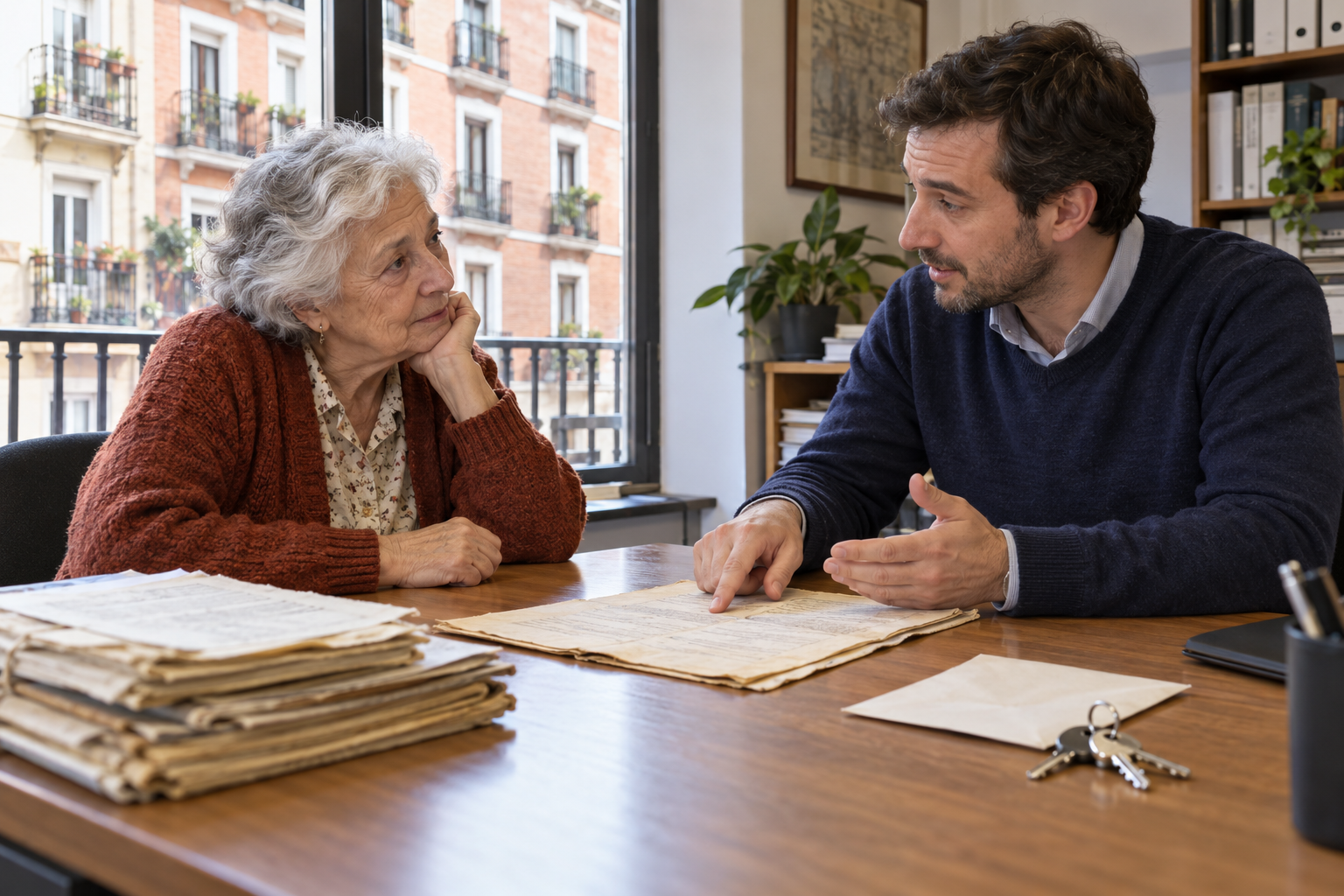
For an outsider, and especially for the many foreigners drawn to Spain, the renta antigua is worth understanding not because you could ever get such a deal, you cannot, as no new ones have existed for forty years, but because of what it reveals about the country and its relationship to housing. It is a window into a Spanish tradition of strong tenant protection, a legal culture that long treated a rented home as something closer to a secure, permanent right than a temporary commercial arrangement, and that history still colors Spanish attitudes toward housing and security today. The renta antigua is the extreme, almost fossilized expression of that protective instinct, and even as it fades, the instinct behind it very much survives, visible in the tenant protections and housing debates that fill the Spanish news today.
It also speaks directly to Spain’s current housing tensions, because the renta antigua sits at the sharpest edge of the argument about who housing is for. On one side is the deep Spanish impulse to protect people’s homes and keep them affordable and secure; on the other is a market in which property has become immensely valuable and landlords and investment funds want to realize that value. The old frozen rents, and the evictions that increasingly end them, are where those two forces meet most painfully, which is why a single elderly woman’s eviction could become a national cause. For a newcomer trying to understand Spain, the renta antigua is a small, vivid lesson: that behind the sunny image of cheap, easy living lies a complicated, contested, and deeply felt history about housing, security, and the cost of a home, one that is very much alive in the Spain of today. Learn the story of the five-hundred-euro flat, and you have learned something essential about how Spain thinks, and argues, about home.

About the Author: Ruben, co-founder of Gamintraveler.com since 2014, is a seasoned traveler from Spain who has explored over 100 countries since 2009. Known for his extensive travel adventures across South America, Europe, the US, Australia, New Zealand, Asia, and Africa, Ruben combines his passion for adventurous yet sustainable living with his love for cycling, highlighted by his remarkable 5-month bicycle journey from Spain to Norway. He currently resides in Spain, where he continues sharing his travel experiences with his partner, Rachel, and their son, Han.