
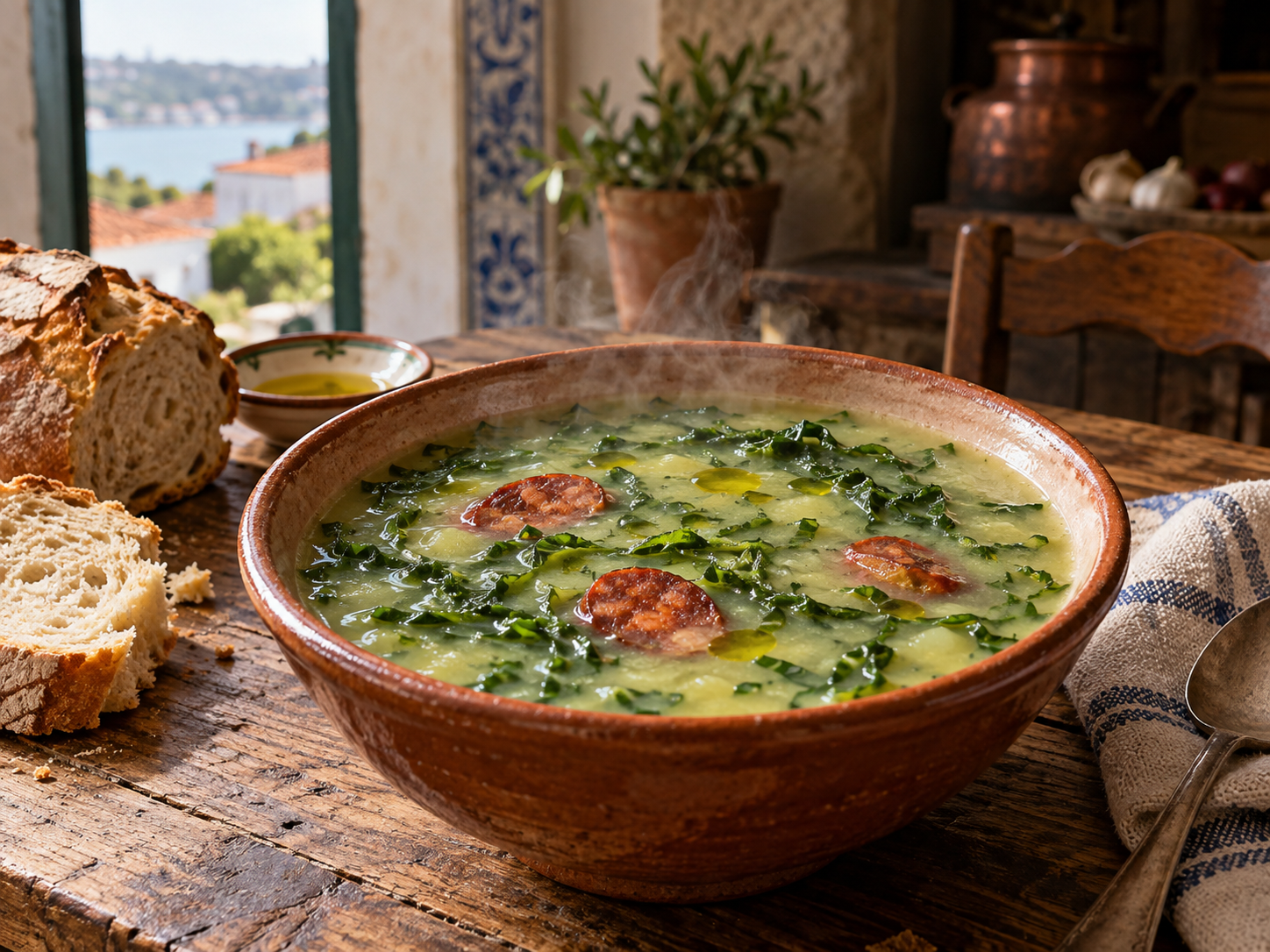
If you asked a Portuguese person to name the soup that tastes most like home, the answer would almost certainly be caldo verde. This is Portugal’s national soup, a humble bowl of potato and finely shredded greens that turns up everywhere from grand hotel dining rooms to village festivals to the ordinary weeknight table, and it is beloved out of all proportion to how genuinely simple it is to make. That simplicity is the wonder of it, because caldo verde is built on essentially four ingredients, potatoes, greens, a little smoky sausage, and good olive oil, and yet it produces something so comforting and satisfying that a whole country has taken it firmly to heart. It is proof, one more time, that the most cherished food is often the plainest, and it is exactly the sort of warming, unfussy bowl you find yourself wanting as the evenings turn cold. There is nothing to intimidate a nervous cook here, no technique to master beyond a bit of slicing, which is part of why it belongs in everyone’s repertoire.
What follows is why this modest soup became a nation’s favorite, the four ingredients at its heart, the one rule that makes it authentic, and exactly how to make it.
A Nation in a Bowl
Caldo verde comes from the north of Portugal, from the green, rainy region of Minho, but it long ago spread to become the soup of the whole country, eaten from top to bottom of Portugal and wherever Portuguese communities have settled around the world. It appears at the biggest occasions and the smallest alike, ladled out at weddings and village saints’ festivals, served as a first course in restaurants, and made in home kitchens as a simple, nourishing supper. Few dishes are so woven into a national life, equally at home at a celebration and at a Tuesday dinner.
Part of why it holds that place is that it is humble peasant food at its very best, born of exactly the ingredients a northern Portuguese family would always have to hand: potatoes from the ground, greens from the garden, a little precious sausage, and the good olive oil that is the lifeblood of the kitchen. It fed ordinary people well and cheaply for generations, and it never lost that honest character even as it climbed onto the fanciest menus. A restaurant may serve it in a fine bowl with a flourish, but it is still the same soup a farmer’s wife made from what the garden gave her, and everyone at the table knows it. When a Portuguese person eats caldo verde, they are tasting something that connects the grandest banquet to the poorest cottage, a genuine and democratic dish that truly belongs to every single person.
It carries memory as much as flavor, the taste of a grandmother’s kitchen and of a hundred family gatherings over the years, which is a weight no fancier soup could hope to hold. That is a rare and lovely thing for a bowl of soup to carry, and it is a large part of why the country claims it as its own.
Four Ingredients
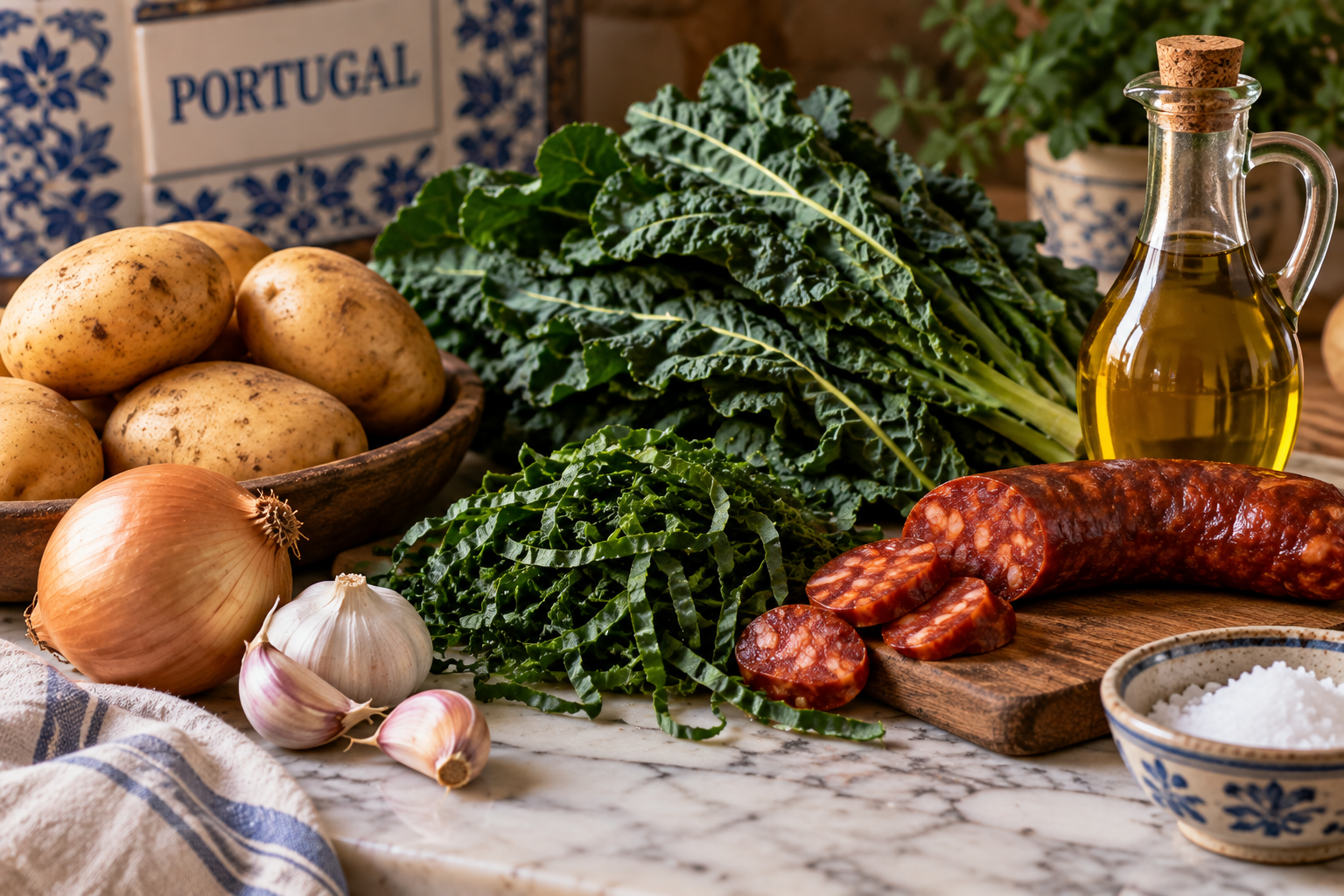
The heart of caldo verde is how astonishingly little goes into it, and understanding the four core ingredients is understanding the whole soup. First come the potatoes, which do far more than add substance, since they are cooked until soft and then blended into a smooth, velvety base that gives the soup its creamy body without a drop of cream. Starchy potatoes are the trick, breaking down into a silky puree that carries everything else.
Second are the greens, and this is where the soup gets both its name and its soul. The traditional green is couve galega, a Portuguese kale-like cabbage, though ordinary kale or collard greens stand in perfectly for it, and it is precisely what makes the caldo verde, which literally means the green broth. Third is the sausage, a few slices of smoky Portuguese chourico, or linguica, which lend the whole pot their garlicky, paprika-scented depth, with Spanish chorizo the usual and reliable substitute abroad. And fourth is the olive oil, not an afterthought but a genuinely defining ingredient, both cooked into the soup and drizzled generously over each bowl at the end, where good Portuguese oil brings a peppery richness that ties it all together. Potatoes, greens, sausage, oil, with only onion, garlic, and salt as supporting players. That is the entire cast, and it is genuinely all the soup needs to be wonderful.
The lesson buried in that short list is that quality matters more than quantity when the ingredients are so few, so it is worth using a good starchy potato, fresh greens, a proper smoky sausage, and the best olive oil you can, since each one has nowhere to hide.
The One Rule: Slice the Kale Thin
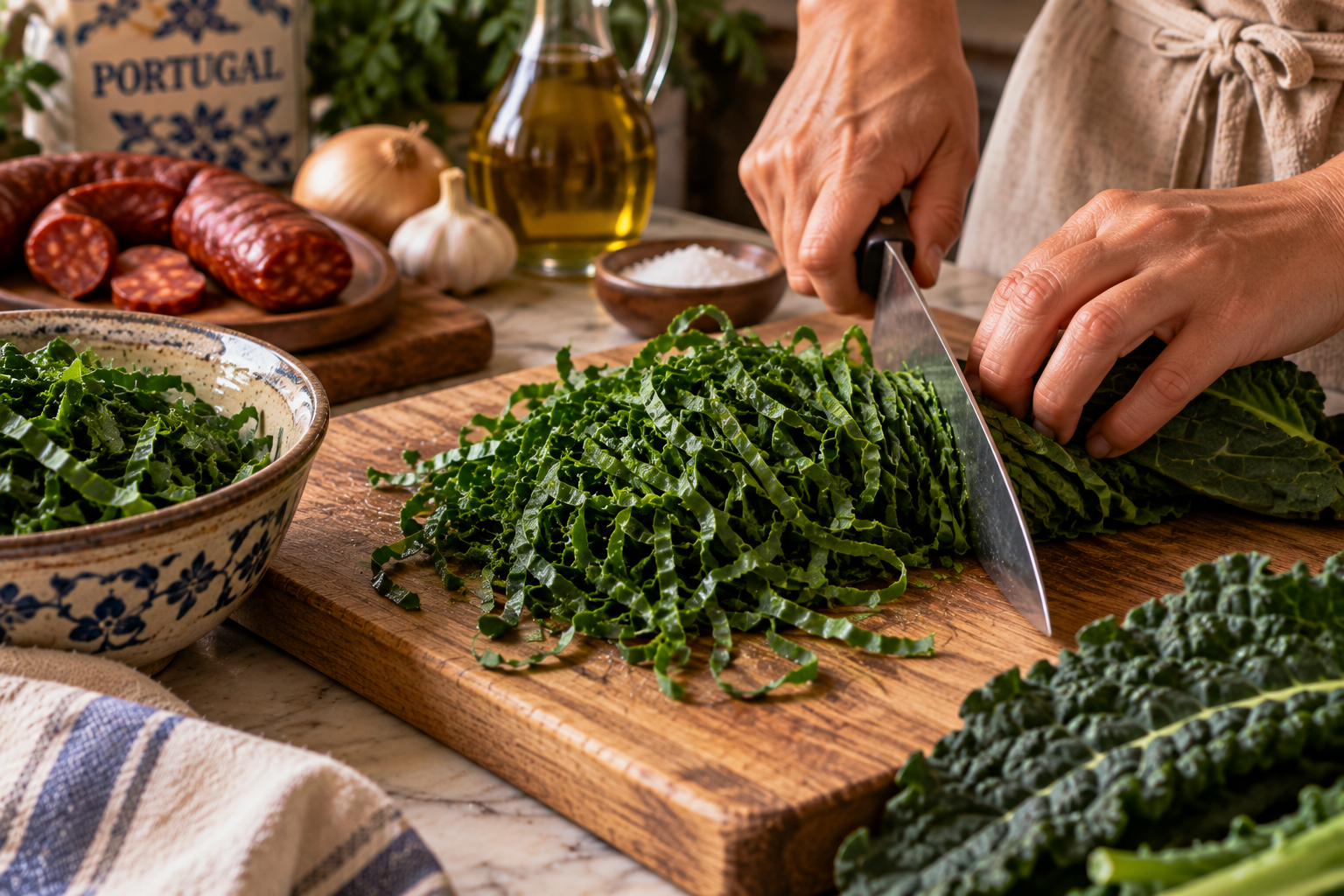
For all its simplicity, caldo verde has one rule that is treated with real seriousness, and getting it right is the difference between the real thing and a mere potato-and-greens soup. The greens must be sliced into extremely thin ribbons, almost thread-like strands, rather than chopped into ordinary pieces. This is not a fussy detail but the very signature of the dish, and the Portuguese are emphatic about it: if the kale is not cut whisker-thin, they will tell you plainly that it is not caldo verde at all.
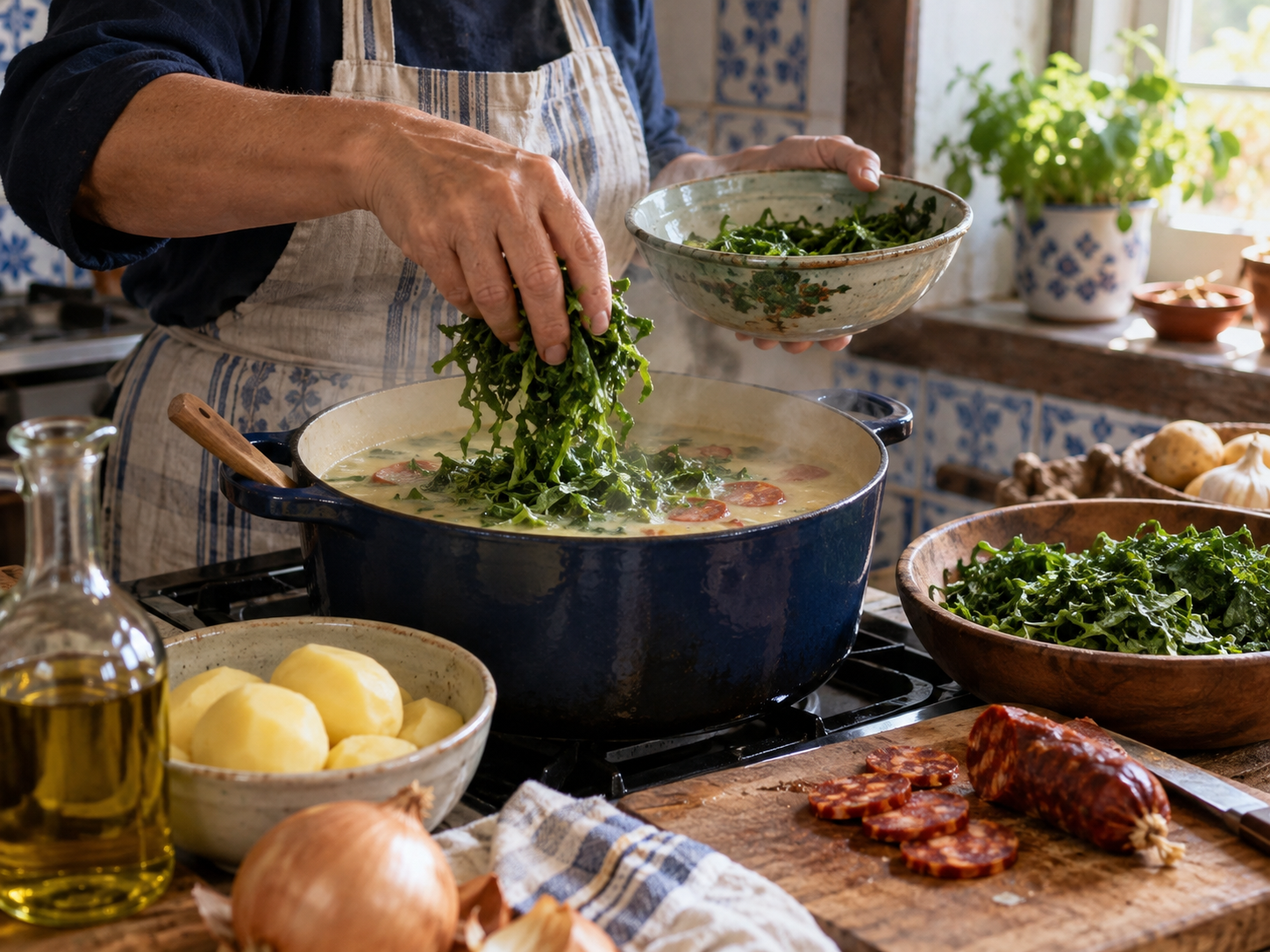
The technique is easy once you see it. You strip the leaves from their tough stems, stack them, roll them up tightly into a cigar, and then slice across the roll as finely as your knife will allow, producing a pile of long, delicate green threads no wider than a blade of grass. Those fine ribbons are what let the greens soften quickly and fold into the pale soup like green silk, cooked just briefly so they stay tender and vividly green rather than turning drab and heavy. Overcook them, or cut them too coarse, and the soup loses both its bright color and its delicate texture, sliding from elegant to stodgy, which is exactly what the thin slicing is there to prevent.
Resist any temptation to shortcut this with rough chopping or bagged pre-cut greens, because the texture and the look, those slender threads suspended in the smooth potato base, are central to what caldo verde is. It is a small piece of knife work that carries the whole character of the dish, and it takes only a couple of minutes to do. Once you have rolled and sliced a few leaves you will have the knack of it, and the sight of those fine green threads is oddly satisfying, the moment the soup starts to look like the real thing.
The Soup for a Cold Night
Beyond its national status and its clever simplicity, caldo verde earns its place for the plainest reason of all: it is exactly what you want to eat when the weather turns. Warm, filling, gently smoky, and mild, it is the definition of comfort in a bowl, the sort of thing that thaws you from the inside after a cold, wet day. The mildness matters, since it is a soup that soothes rather than challenges, gentle enough that children love it and plain enough that you could happily eat it several times a week without tiring of it. It is light enough to open a meal as a first course and hearty enough, with good bread, to be a whole supper on its own, which is part of why it slots so easily into Portuguese life at any hour. It turns up as readily at midnight after a festival as at lunch on an ordinary Wednesday, always welcome and never out of place.
It has the practical virtues that keep a dish in regular rotation, too. It costs very little to make, leaning on potatoes and greens with only a little sausage for flavor, so it feeds a family or a crowd cheaply.
It is nourishing, built on greens that are among the healthiest things you can eat, so it does you good as well as comforting you. And it keeps and reheats well, the flavors settling and deepening overnight, so a big pot made on Sunday is a gift to the days that follow. If anything the greens and sausage give up a little more of their flavor to the base by the second day, so the leftovers are no consolation prize. Serve it the traditional way, with a chunk of dense Portuguese cornbread called broa to sop up the last of it, or any good crusty bread, and you have a complete, satisfying, deeply Portuguese meal for almost no money and very little effort. A glass of simple Portuguese red or a cold vinho verde alongside, and you have something close to a small taste of Portugal at your own table, whatever the weather is doing outside. It is the kind of soup that quietly earns a permanent spot in your cold-weather cooking.
Making Caldo Verde
Here is a classic caldo verde, serving four to six. The potato base blends smooth, and the kale must be sliced whisker-thin.
Ingredients
- 600 g starchy potatoes, peeled and roughly chopped
- 1 onion, chopped
- 3 cloves garlic, chopped
- 5 tablespoons olive oil, plus more to finish
- 1.5 liters water or light chicken or vegetable broth
- 200 g kale or collard greens, stems removed and sliced whisker-thin
- 150 g Portuguese chourico, or Spanish chorizo, sliced
- Salt, to taste
Instructions
- In a large pot, warm 2 tablespoons of the olive oil and briefly brown the sliced chourico, then remove and set the slices aside.
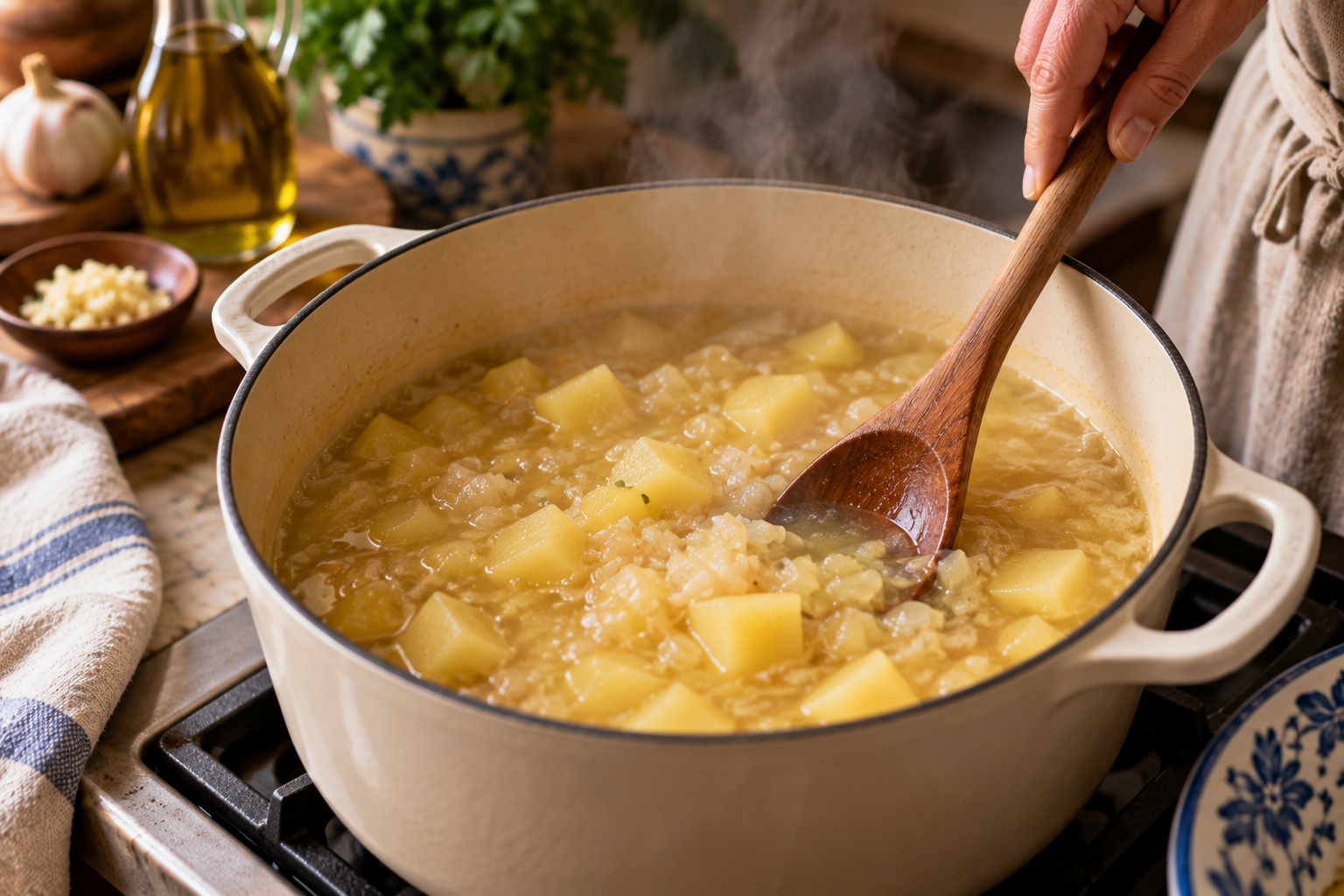
- Add the potatoes, onion, and garlic to the pot with the water or broth and a good pinch of salt. Bring to a boil, then simmer until the potatoes are completely soft, about 20 minutes.
- Blend the soup until perfectly smooth and velvety, using an immersion blender in the pot or a jug blender in batches, then return it to a low heat.
- Stir in the remaining olive oil and check the seasoning, adding a little water if the base is too thick.
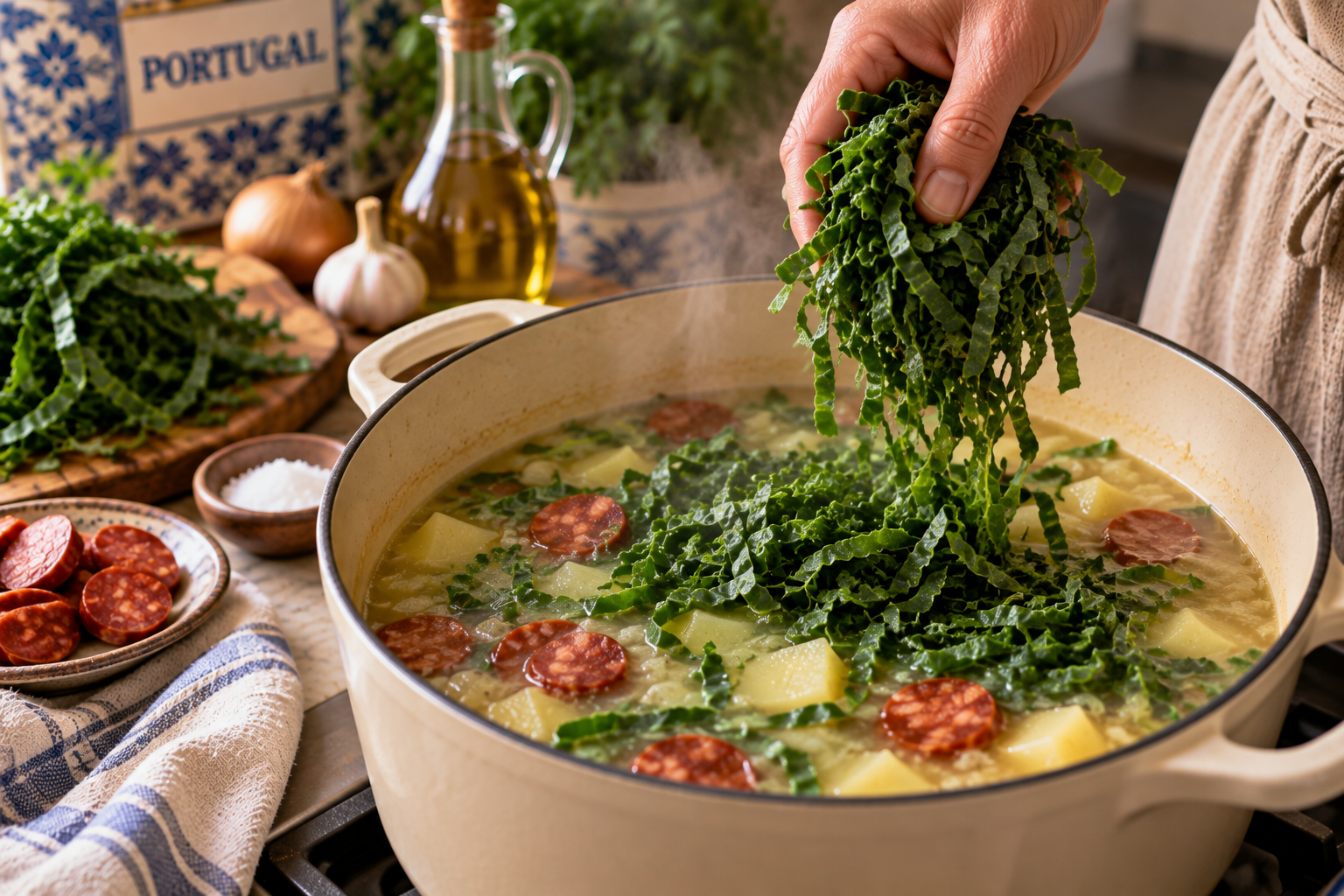
- Add the whisker-thin greens and simmer gently for just 5 to 10 minutes, until they are tender but still bright green.
- Return the reserved chourico slices to the pot to warm through.
- Serve hot in bowls, each finished with a generous drizzle of good olive oil, with crusty bread or Portuguese cornbread alongside.
And do not skip the final drizzle of olive oil at the table, since that raw, peppery thread of good oil over the hot soup is not a garnish but part of the dish itself, the last of the four simple things that make caldo verde what it is.

About the Author: Ruben, co-founder of Gamintraveler.com since 2014, is a seasoned traveler from Spain who has explored over 100 countries since 2009. Known for his extensive travel adventures across South America, Europe, the US, Australia, New Zealand, Asia, and Africa, Ruben combines his passion for adventurous yet sustainable living with his love for cycling, highlighted by his remarkable 5-month bicycle journey from Spain to Norway. He currently resides in Spain, where he continues sharing his travel experiences with his partner, Rachel, and their son, Han.