
You arrive at a hotel in Rome or Madrid or Lisbon, tired out from the journey, and the receptionist asks for your passport. Not just to glance at, but to take away to the desk, where they tap at a keyboard or run it through a scanner while you stand there wondering, for a moment, whether you should be worried.
It is one of the small anxieties of European travel for Americans, who are not used to handing their most important document to a stranger behind a counter, and and the questions flicker through your tired mind: Why exactly do they need it? What are they doing with it? Will I get it back? The genuinely reassuring answer is that this is a completely routine and legal part of checking in all across Europe, done for specific and sensible reasons, and that you have clear rights about how far it can go. Understanding what is actually happening turns a moment of unease into something you can handle with confidence. It is one of those small pieces of travel knowledge that quietly removes a recurring low-level worry, replacing a vague suspicion with a clear sense of what is normal and what is not.
What follows is why they ask for it, what they are legally required to do with the information, what they are not allowed to do, your rights over your own data, and how to handle the whole thing calmly.
Why They Ask at All
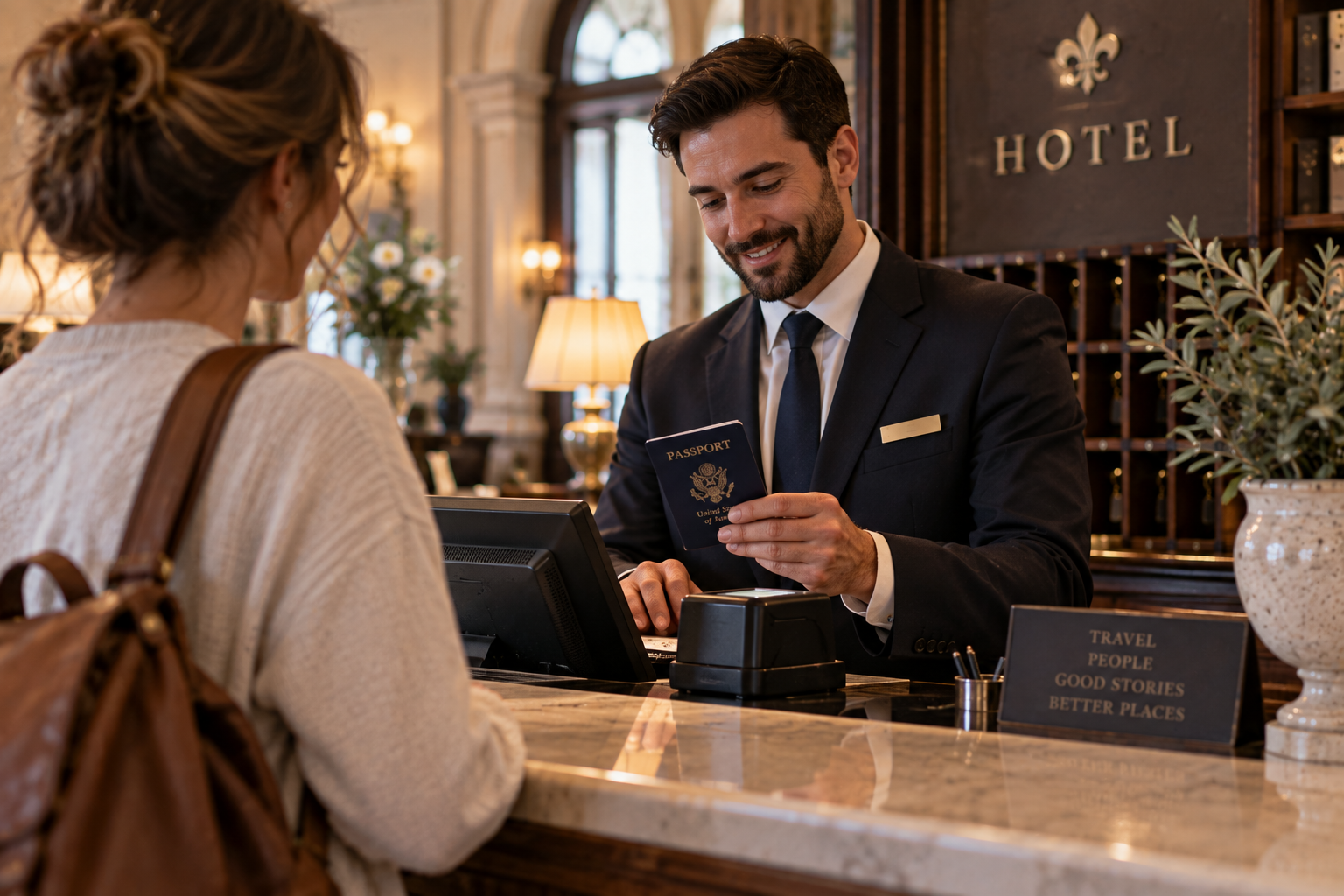
The first thing to know is that the hotel is not being nosy or difficult, but complying with the law. Across most of Europe, national laws require accommodation providers, hotels, guesthouses, and short-term rentals alike, to register their guests and report certain identity details to the authorities, usually the police. This is a long-standing legal obligation, not a hotel’s own policy or whim, and the staff member asking for your passport is, more often than not, simply doing something the law flatly requires them to do, often within a tight deadline of a day or so after you arrive.
The reasons behind these laws are a mix of security and administration. The core purpose is public safety and law enforcement, letting authorities know who is staying where, so that guest records can be checked against databases of wanted criminals and missing persons, and so that in an emergency like a fire, the authorities have a record of who was in the building. It is the same logic that sits behind a great deal of European administration, a preference for knowing and recording that can feel heavy to an American but is simply the background texture of life there.
In some countries the same registration also feeds the local tourist tax. Every country has its own system with its own name, from Spain’s guest-registration regime to Italy’s police portal to France’s fiche de police, but the underlying idea is the same across the continent, and it is why you will meet this request almost everywhere you stay in Europe. The specifics of which fields are required and how they are reported vary from border to border, but the traveler’s experience is identical: hand over the passport, wait a moment, get it back. It is one of the genuine differences between American and European travel, and once you know it is universal and legally mandated, it stops feeling personal or suspicious. Americans are simply not used to the idea that where they sleep is registered with the state, but in much of Europe it is an unremarkable fact of life that locals never think twice about.
What They Are Legally Required to Do

Understanding what the hotel actually has to do with your passport is the key to the whole thing, because the legal requirement is narrower than it might appear. What the law obliges the hotel to do is record specific pieces of information, your full name, your nationality, your date of birth, and your document type and number, along with the dates of your stay, and to transmit those details to the authorities. It is the data they need, the particular fields, not your passport itself and not necessarily an image of it.
That distinction matters enormously, and it is the single most useful thing to understand. The hotel’s genuine obligation is to capture and report a defined set of facts about you, which they can do simply by reading your passport and typing the details into their system, after which the document has served its purpose and can be handed straight back. They are also required to keep the registration record for a set period that varies by country, often a few years, so that it is available if the authorities ever need it. That retention is of the data, though, the recorded fields in their system, not of your passport or, ideally, an image of it, which is a distinction that matters more than it might seem.
But the core act is the recording and reporting of data, a quick administrative step, and once you see it that way, the request loses most of its mystery. They need the numbers off your passport, and a moment to enter them, and that is genuinely all the law requires. Everything beyond that, the taking away, the holding, the full scan filed forever, is either habit, laziness, or overreach rather than legal necessity, which is precisely why knowing the difference is useful.
What They Are Not Allowed to Do

Just as important as what hotels must do is what they may not do, because this is where travelers’ rights are strongest and least understood. First and most simply, a hotel is not allowed to keep your physical passport. They may look at it and record the details, but the document is yours, and holding onto it, whether out of habit or as supposed security for your bill, is not something they are entitled to do. If a hotel ever suggests keeping your passport in a drawer until checkout, you can and should politely decline and ask for it back once they have taken the details. This practice, once common in some places, has no legal basis, and a reputable hotel will not insist on it; your passport is not a deposit, and you should never treat it as one to be surrendered.
There is a subtler and increasingly important point about copies. Under European data-protection law, the GDPR, a hotel is generally not supposed to keep a full photocopy or scan of your passport, because doing so collects far more personal data than the registration law actually requires, which is only the specific fields.
Data-protection authorities have made this explicit and have even fined hotels for hoarding passport scans they had no need to retain, in some cases substantial fines running into the tens of thousands. The regulators have been clear that collecting a full image of your identity document, when the law only calls for a handful of fields, is a breach rather than a courtesy. The principle is that they should collect the minimum necessary, the required details, rather than a complete image of your identity document sitting in a file or on a server, where it becomes a target for data breaches. Passport scans have a way of leaking, from small guesthouses with a shared folder to the biggest hotel chains with global servers, and every stored copy is one more chance for your identity to end up somewhere it should not. So while the request for your details is legitimate, an insistence on a full scan stored indefinitely goes beyond what the law asks, and you are within your rights to question it.
Your Rights Over Your Own Data

Putting those points together, you have more say in this exchange than most travelers realize, and exercising it politely is entirely reasonable. You are within your rights to ask the hotel simply to record the details and hand your passport straight back, rather than taking it away or holding it, and a properly run establishment can meet that request without any trouble, since the data goes into the same system either way. The phrase to have ready is a friendly version of please take the details you need and return it to me, which frames you as someone who understands the system rather than someone being difficult. Said with a smile, it is the kind of request a good front desk meets without a second thought, because it asks them to do exactly what the law wants and nothing more.
If a hotel does want to make a copy, you can reasonably ask what will happen to it and how long it will be kept, and you can decline an unnecessary full scan, since the law wants the data transmitted, not a photograph of your passport archived forever. None of this means being confrontational, which rarely helps and can sour a stay before it begins. It simply means knowing that the legitimate requirement is the recording of certain fields, that your physical passport must be returned to you promptly, and that a full stored copy is not something you are obliged to provide. Most hotels handle all of this correctly and quickly, and you will never need to say a word, but knowing your rights means that on the rare occasion something feels off, you can address it calmly and from a position of understanding rather than anxiety. Confidence, in the end, comes from knowing what is normal, and the traveler who understands the rules is far harder to fluster than the one who does not.
It Is Not Just Hotels Anymore
One thing worth knowing, especially if you favor short-term rentals over hotels, is that this registration requirement has been spreading well beyond the front desk. In a number of European countries, the same obligation to collect guest identity details and report them to the authorities now extends to Airbnbs, guesthouses, and other short-term rentals, and in some places the rules were recently tightened and the amount of data collected expanded. So the host who asks for your passport details before or at check-in, or the online form that requests them ahead of your stay, is very often complying with exactly the same kind of law as a hotel, not running some private scheme of their own.
This matters for two reasons. First, it means you should not be surprised or alarmed when a private host or a rental platform asks for identity information, since it is increasingly a legal requirement rather than a red flag, and the same principles apply about recording data rather than hoarding full copies. Second, the same rights travel with you: a private host is no more entitled to keep your passport or to retain an unnecessary full scan than a hotel is, and the same data-protection rules apply to what they collect and how long they hold it. If anything, the shift toward digital pre-arrival forms makes it more worth glancing at what you are being asked to upload and why, since a form that demands a complete passport image stored indefinitely is asking for more than the law requires. The underlying lesson is the same whether you stay in a grand hotel or a spare room: the registration is legitimate, the data is what is needed, and the document itself stays yours.
How to Handle It Calmly

With all of that in mind, the practical approach is simple and low-stress. Expect the request, because it is coming almost everywhere you stay in Europe, and treat it as the routine administrative step it is rather than a red flag. When you check in, hand over your passport, let them record the details, and ask for it back once they are done, which in the vast majority of cases they will do without prompting, returning it to you within a minute or two. That brief handover is the whole of it, a small formality rather than the ordeal a nervous first-timer might imagine. There is no need for suspicion in the ordinary case, since this is simply how European hospitality works. The overwhelming majority of hotels do exactly the right thing, quickly and courteously, and the whole exchange is over before you have finished looking around the lobby.
A few small habits make it smoother still.
It helps to build in a moment of patience at check-in, especially after a long flight, since the registration is a required step and cannot be skipped, and travelers who arrive expecting to be handed a key the instant they walk in are the ones who get frustrated.
Keep your passport genuinely accessible rather than buried at the bottom of a bag, since you will need it and an online booking alone does not satisfy the legal registration. Many travelers assume that because they booked and paid through a big platform they have already provided everything needed, but the in-person identity check is a separate legal step that the booking does not replace. If you are ever uneasy, a polite question about what happens to your data is perfectly acceptable, and carrying your own photocopies changes nothing about the legal requirement but can offer peace of mind.
It also helps to keep a photo of your passport’s main page on your phone and a paper copy tucked separately in your luggage, which is good practice for any traveler regardless of check-in rules, since it makes replacing a lost passport far easier. Above all, remember that this is not a scam or an imposition but a normal, lawful, near-universal part of staying in Europe, and that with your details recorded and your passport back in your pocket, you are simply, and properly, checked in. Understood this way, the request that once made you uneasy becomes just another small, familiar rhythm of European travel, no more alarming than showing a boarding pass, and you can hand over your passport, watch the details go in, take it back, and get on with your trip.

About the Author: Ruben, co-founder of Gamintraveler.com since 2014, is a seasoned traveler from Spain who has explored over 100 countries since 2009. Known for his extensive travel adventures across South America, Europe, the US, Australia, New Zealand, Asia, and Africa, Ruben combines his passion for adventurous yet sustainable living with his love for cycling, highlighted by his remarkable 5-month bicycle journey from Spain to Norway. He currently resides in Spain, where he continues sharing his travel experiences with his partner, Rachel, and their son, Han.