
You move to Switzerland, settle into your apartment, and go to take out the trash, and you run straight into one of the country’s great culture shocks. You cannot just throw your garbage out. Household waste has to go into a specific, official, surprisingly expensive bag, and if you use any other kind of bag, you are breaking the law and can be fined. And should you try to sneak your rubbish out in an ordinary sack, there is a real chance someone will open it, find your name inside, and bill you for it.
This is the Swiss pay-per-bag garbage system, and to a newcomer it sounds absurd, charging people by the bag to throw things away, and dispatching inspectors to rifle through improperly disposed trash. But it is one of the cleverest and most effective waste systems in the world, and it goes a long way toward explaining why Swiss streets, towns, and public spaces are so famously, almost unnervingly clean.
Here is how the Swiss trash rule actually works, why the wrong bag can cost you, the remarkable role of the so-called trash detectives, and what this one garbage rule reveals about Switzerland and its spotless streets.
The Bag Is the Tax
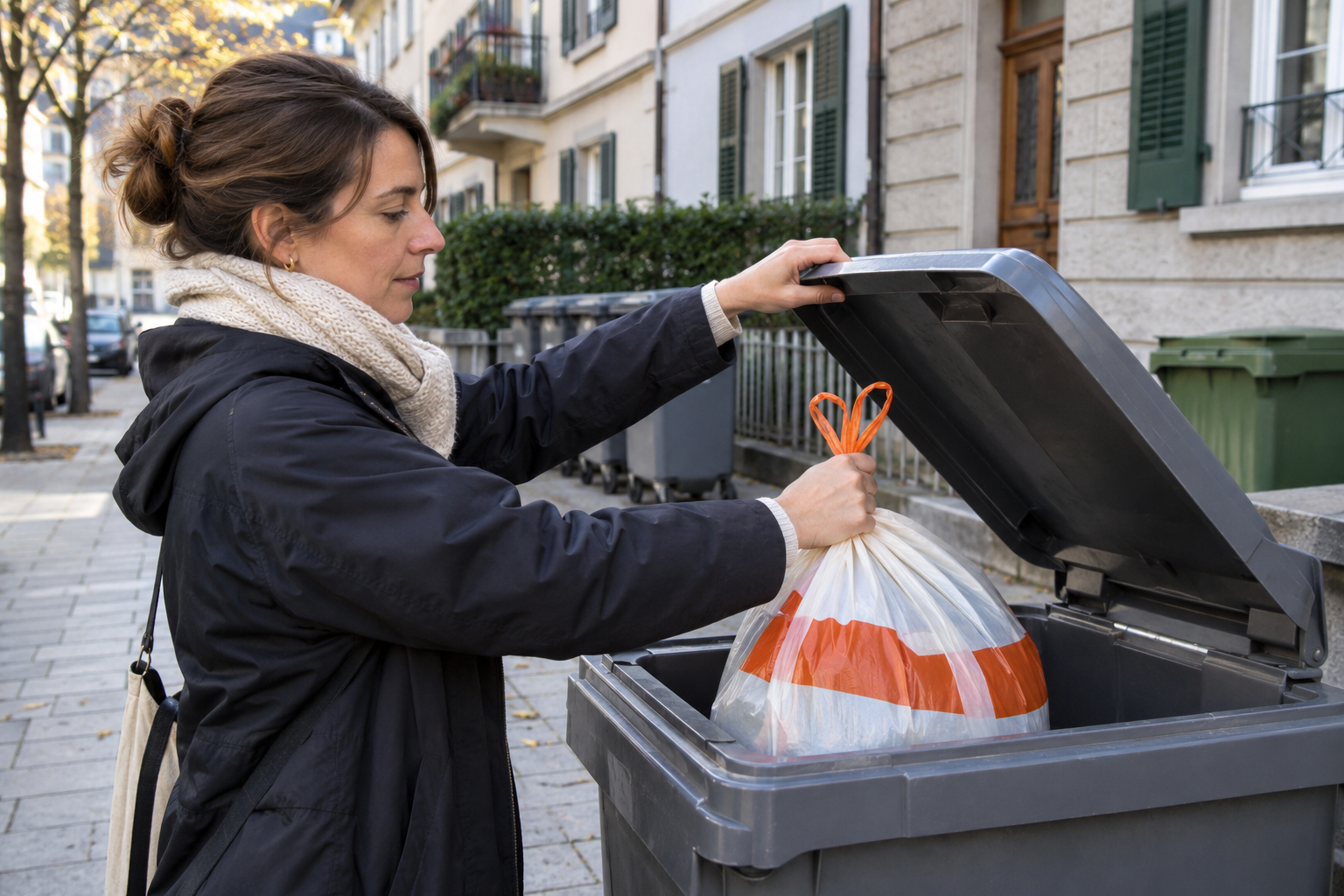
The heart of the system is a simple but radical idea: in Switzerland, you do not pay for garbage disposal through your general taxes, as in much of the world. You pay for it directly, per bag, every time you throw something away, and the mechanism is the official garbage bag itself.
In most Swiss communes, household waste must be placed in an official, municipality-specific taxed bag, known by local names like the Zuri-Sack in Zurich or the Bebbi-Sagg in Basel, which you buy at supermarkets and kiosks. These bags are expensive, a thirty-five-litre bag typically costing something like two Swiss francs, many times the price of an ordinary bin liner. That price is not really the cost of the plastic; it is a waste tax built into the bag, covering the collection, transport, and incineration of whatever you put inside it. When you buy the bag, you are pre-paying the full cost of disposing of its contents.
This turns every bag of trash into a small, direct, visible expense, which is exactly the point. Under the usual flat-fee or tax-funded system, throwing away one bag or ten costs you the same, so there is no personal incentive to make less waste.
The Swiss per-bag system changes that completely: the more you throw away, the more bags you buy, and the more you pay. Suddenly, reducing your garbage saves you real money, every single week, which is a powerful and constant nudge that a flat fee can never provide. The bag is the tax, and the tax is the lever.
Use the Wrong Bag and Pay
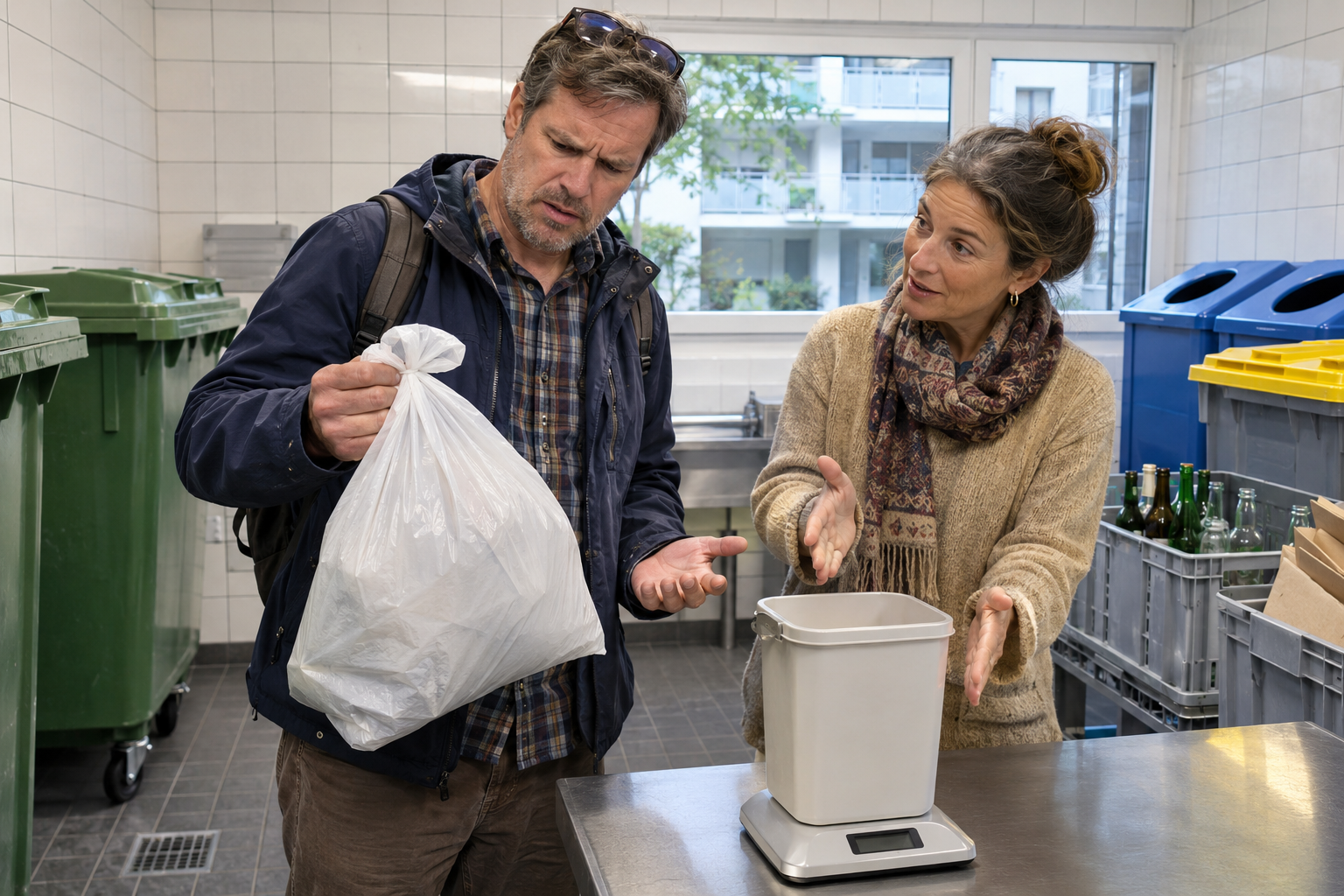
For the system to work, the official bag has to be mandatory, and so using any other bag for your household trash is not merely frowned upon but genuinely illegal, a form of tax evasion. You cannot simply buy a roll of cheap black bin bags and put your rubbish out in those to avoid the expensive official ones.
Doing so carries real penalties. Putting out household waste in a non-official bag, or dumping it improperly, is actively enforced and can bring fines typically ranging from around a hundred to several hundred Swiss francs, depending on the commune and the offense. The logic is strict and consistent: the official bag is how you pay the waste tax, so putting your trash out in anything else is dodging that tax, and the authorities treat it accordingly. There is no winking at it, no grace for the newcomer who did not know; the wrong bag is an offense, and a fined one.
This is what gives the system its teeth, and what makes it so different from the voluntary, lightly-enforced recycling schemes of many other countries. In Switzerland, correct waste disposal is not a polite request but an enforced rule with a price attached to getting it wrong. For a newcomer, this is often the first hard lesson in how seriously the Swiss take their systems: the bag is not a suggestion, and the fine is not a bluff.
The Trash Detectives
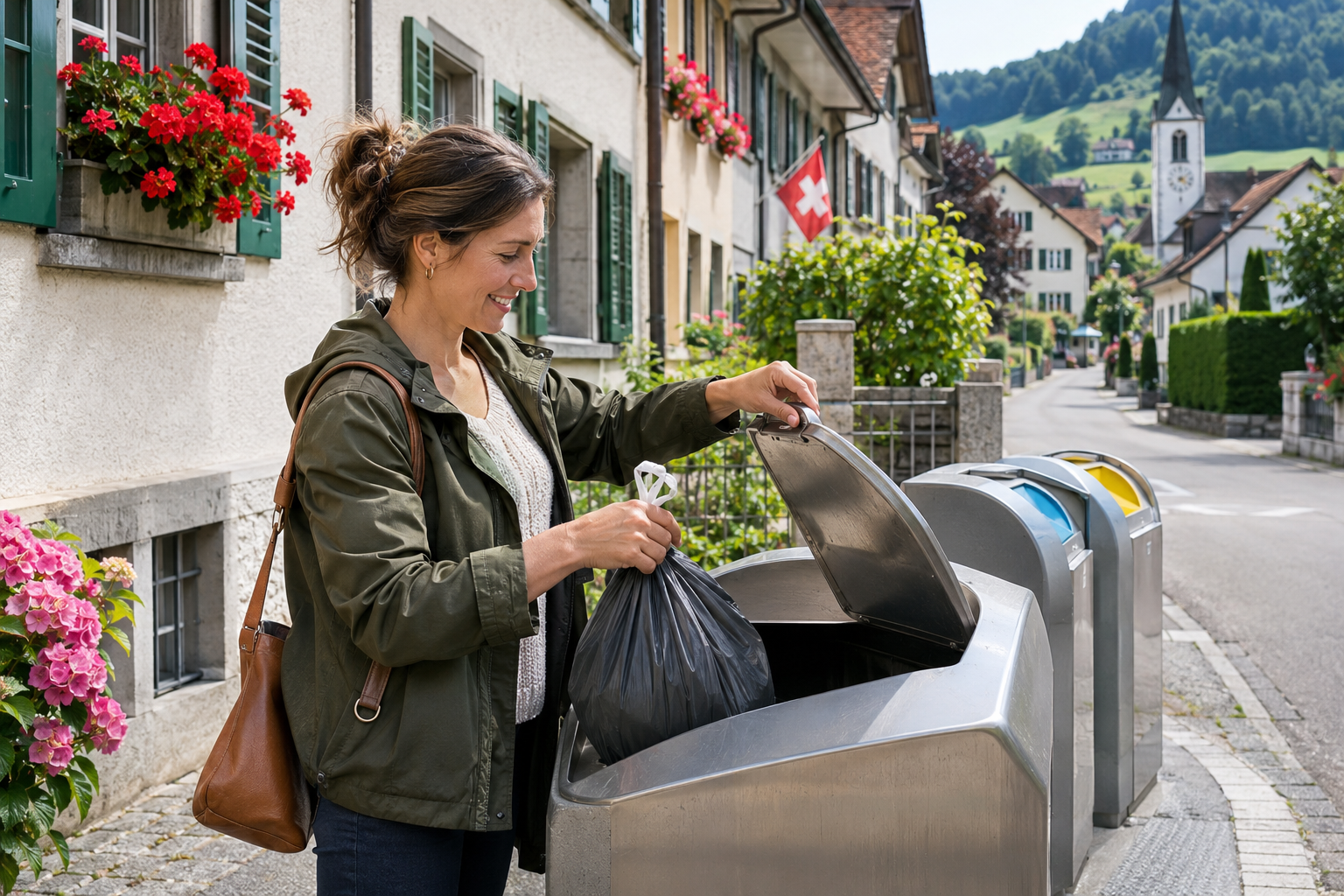
Here is the detail that genuinely astonishes outsiders, and that has given the Swiss system a slightly mythical reputation: the enforcement includes opening the garbage. When improperly bagged or illegally dumped trash turns up, the authorities do not simply shrug; they investigate, and the investigation can be remarkably hands-on.
The method is almost comically thorough. Communes employ inspectors, sometimes nicknamed the trash detectives, who will actually open up a wrongly disposed bag of rubbish and search through it for anything that identifies its owner, an addressed envelope, a letter, a label, a receipt with a name on it. Having traced the trash back to a specific household through the mail inside it, they issue the fine directly to the culprit. People genuinely do get caught and fined this way, their own discarded post betraying them, which is both a little dystopian and extraordinarily effective at making sure nobody risks the wrong bag.
This fits into a broader Swiss culture in which your neighbors, too, notice and mind these things, and in which the correct handling of waste, noise, and shared space is taken seriously enough to be socially policed. The trash detective is the formal end of a whole spectrum of attention, from the official who opens your bag to the neighbor who leaves a pointed note about it. It can feel intrusive to an outsider, this willingness to go through someone’s garbage to enforce a bag rule, but it is a large part of why the system achieves near-total compliance. When your own rubbish can be traced back to you, you simply buy the right bag.
Recycling Is Free
The system would be merely punitive if that were the whole of it, but there is a crucial other half that makes it fair and effective: while throwing away general trash is expensive, recycling is free and easy. This is the balance that makes the whole thing work.
Everything that can be recycled can be disposed of at no charge. Paper, cardboard, PET plastic bottles, aluminum, glass sorted by color, batteries, electronics, and textiles can all be dropped off free, at ubiquitous collection points and in supermarkets, as often as you like. So while the expensive official bag punishes you for general waste, the free recycling rewards you for diverting everything you can out of that bag. The two work together as a single incentive: every item you recycle is an item you do not have to pay to throw away, which makes diligent sorting not just virtuous but economical.
This is the genius of the design, and the reason the pay-per-bag system drives recycling so powerfully. It does not merely ask people to recycle out of goodwill; it makes recycling the cheaper choice, every single week, by making general trash expensive and recycling free. Faced with that arithmetic, the Swiss have become meticulous, almost ritualistic sorters of their waste, separating their glass by color and their plastics by type as a matter of course, because doing so quite literally saves them money. The expensive bag and the free recycling are two halves of one elegant machine.
Polluter Pays
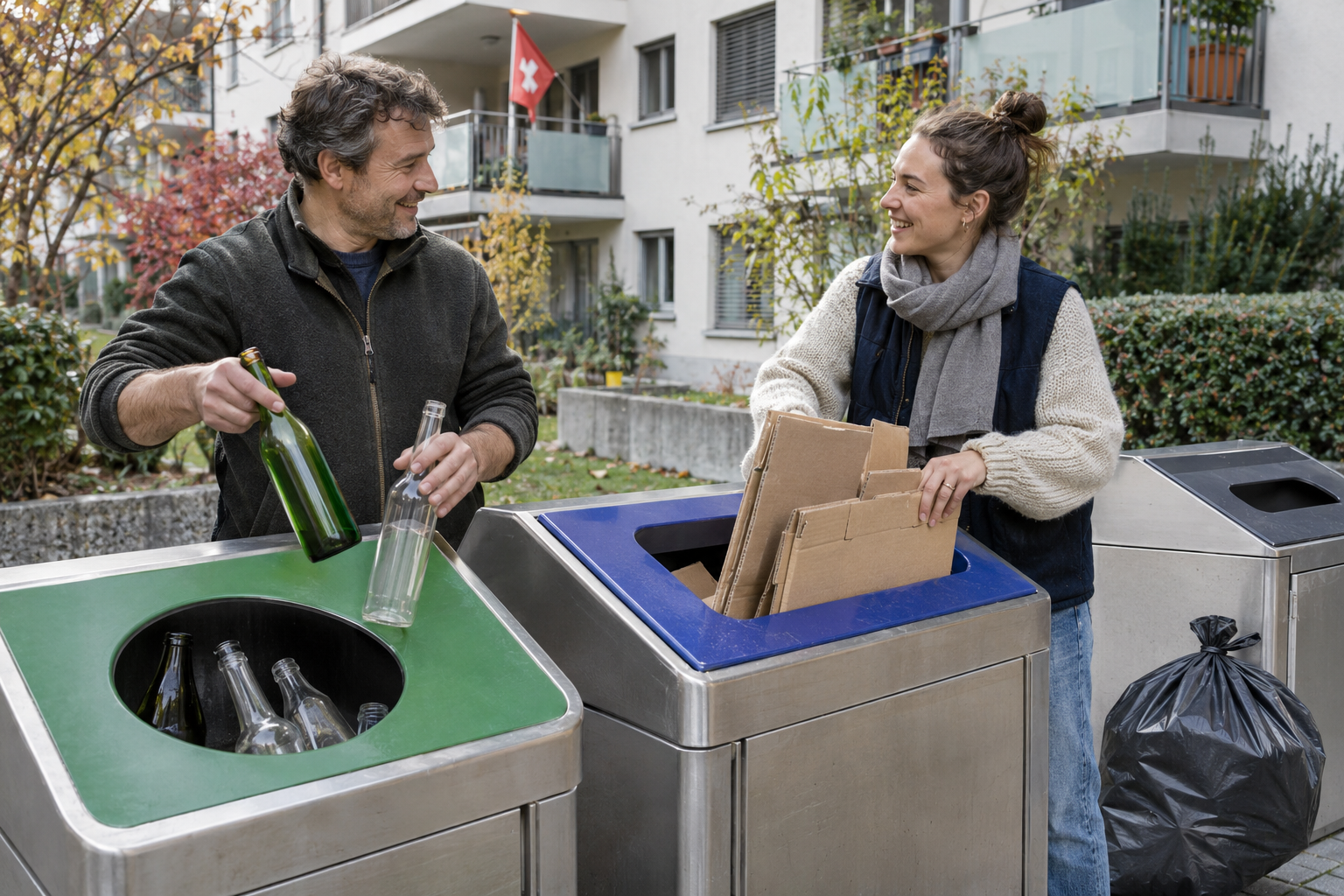
Underpinning the whole system is a principle the Swiss take seriously across much of life: the polluter pays, known in German as the Verursacherprinzip. The idea is that the person who creates the waste should bear its cost, directly and in proportion, rather than spreading it across everyone equally.
The results of applying this principle to garbage have been striking. By making people pay per bag, Switzerland created a direct, personal, financial incentive to produce less waste and recycle more, and the behavior shifted dramatically in response. The country’s recycling rate roughly doubled over a couple of decades under this system and now sits around half of all municipal waste, well above the European average, a level of recycling that voluntary appeals and flat fees had never come close to achieving. People recycle because it pays, which turns out to be a far more reliable motivator than virtue alone.
This is the deeper lesson buried in the Swiss garbage bag, and it reaches well beyond Switzerland. A great many environmental behaviors that we try to encourage through exhortation, education, and goodwill would shift far more powerfully if the economics were rearranged to make the desired choice the cheaper one. The Swiss did not lecture their citizens into recycling; they priced general waste honestly and let self-interest do the rest, and the result is one of the best recycling rates in the world. Make the polluter pay, directly and visibly, and behavior follows, which is a principle worth noticing far beyond the bins of Bern.
The Honest Catch
Before anyone holds Switzerland up as a zero-waste paradise, honesty requires a caveat, because the system is more impressive at driving recycling than at eliminating waste. The Swiss recycle a great deal, but they also throw away a great deal.
The awkward truth is that despite its excellent recycling rate, Switzerland is among the larger producers of waste per person in Europe, generating a substantial quantity of rubbish per capita each year. The pay-per-bag system is superb at ensuring that a high share of that waste gets recycled rather than dumped, and at keeping the streets clean, but it has not made the Swiss a low-waste society in absolute terms; a wealthy, high-consuming country still generates a lot of garbage, however diligently it sorts it. The system manages waste brilliantly without necessarily reducing consumption, which is a real and worth-noting limitation.
There is also the matter of what the system is like to live under, which is not for everyone. It is strict, bureaucratic, and unforgiving, part of a wider Swiss culture of rules, order, and social policing that can feel oppressive to newcomers used to more relaxed ways, the expensive bags, the enforced sorting, the fines, the inspectors, the neighborly notes. The spotless result is real, but it is bought with a level of regulation and mutual surveillance that some find admirable and others find exhausting. The clean streets have a cost that is not only measured in francs.
The Garbage Rule That Explains Swiss Streets
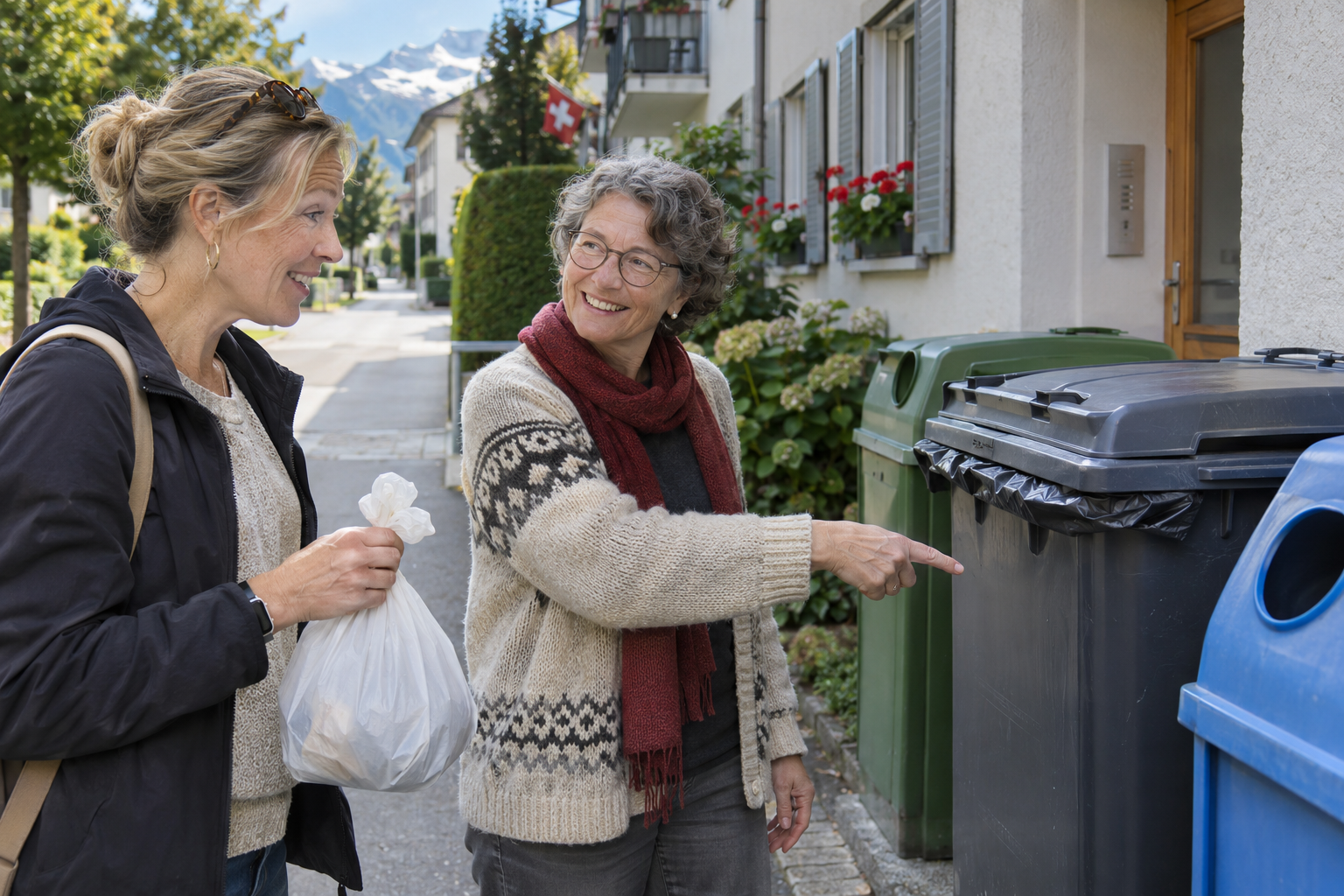
Step back, and this single garbage rule turns out to explain a great deal about the Switzerland that visitors marvel at, above all the extraordinary cleanliness of its streets, towns, and public spaces. The spotless Swiss street is not an accident of national character; it is, in significant part, the product of this system and the culture around it.
The connection is direct. When every bag of trash costs real money, when the wrong bag brings a fine, when recycling is meticulous and free, and when the whole apparatus is backed by enforcement and social attention, the result is a population that handles its waste with a care bordering on reverence, and public spaces that stay clean because almost nobody mishandles their garbage. The pay-per-bag rule is of a piece with the broader Swiss, and more widely northern European, ethos of order, cleanliness, and personal responsibility for shared resources, the same instinct that leads Germany to forbid washing your car at home for fear of polluting the groundwater. These are societies that have made protecting the shared environment a personal, enforced, everyday duty, and their streets show it.
For a visitor or a newcomer, the practical takeaway is simple: learn the bag early, because it is one of the first things you will get wrong and one of the first things that will cost you.
But the larger lesson is more interesting, and it is the one the Swiss garbage bag teaches so well. A clean country is not conjured by wishing for it or asking nicely; it is built, deliberately, out of systems that make the right behavior the easy and economical one and the wrong behavior genuinely costly. Switzerland priced its garbage honestly, enforced the price seriously, and got, in return, some of the cleanest streets on earth. The spotless Swiss street begins, improbably, with an expensive plastic bag.

About the Author: Ruben, co-founder of Gamintraveler.com since 2014, is a seasoned traveler from Spain who has explored over 100 countries since 2009. Known for his extensive travel adventures across South America, Europe, the US, Australia, New Zealand, Asia, and Africa, Ruben combines his passion for adventurous yet sustainable living with his love for cycling, highlighted by his remarkable 5-month bicycle journey from Spain to Norway. He currently resides in Spain, where he continues sharing his travel experiences with his partner, Rachel, and their son, Han.