
Somewhere along the way, Americans decided breakfast should be a daily menu, a fresh choice made every groggy morning between eggs and cereal and pastry and yogurt and whatever the drive-thru is selling. Much of Europe never got that memo. Across the continent, a great many people eat more or less the same breakfast every single day, a bit of bread, some cheese or ham, yogurt and fruit, a coffee, the exact same plate they had yesterday and will have tomorrow, and they do not experience this as boring at all. For thirty days I did the same, eating one fixed breakfast every morning, and the two things that changed were smaller and larger than I expected: one fewer decision at the start of every day, and, quietly, a small shift on the scale.
What follows is why a fixed breakfast simplifies your morning, what the science of decision-making really says, what thirty days of sameness did, and why Europeans have quietly had this right all along. The short version is that the least interesting meal of the day turned out to be the most worth simplifying.
The Tyranny of the Morning Choice

It sounds trivial until you notice it, but choosing what to eat every single morning is a small tax you pay before you are even properly awake. Standing in front of the fridge deciding, weighing whether to have the healthy thing or the quick thing or the treat, is a real if tiny act of deliberation, repeated every day of your life, and it happens at the exact hour when you are least equipped for it. The American approach treats this daily choice as freedom, but freedom to decide the same low-stakes question over and over is not much of a gift. Multiply one small breakfast decision by three hundred and sixty-five mornings a year and it becomes a surprising amount of low-grade mental effort spent on something that, in the end, barely matters, effort that could simply be spared.
The European fixed breakfast quietly removes the whole thing. When breakfast is simply what breakfast is, the same every day, there is nothing to decide, no fridge to stand in front of, no small negotiation with yourself about virtue and convenience, just the plate you always have, assembled on autopilot while your mind is elsewhere or nowhere. That absence of choice, which sounds like a loss, turns out to feel like a relief, because the morning gets simpler and one recurring little decision disappears from a life that has plenty of bigger ones to make. It is the same quiet satisfaction as a tidied desk or a made bed, a small piece of the day put in order and settled before the day itself can complicate it.
What the Science of Deciding Really Says

There is a popular idea called decision fatigue that gets wheeled out to explain habits like this, the notion that every choice you make drains a limited reserve of willpower, so that eliminating trivial decisions preserves mental energy for important ones. It is the reasoning behind the famous stories of executives who wear the same outfit every day to spare themselves the choice. It is an appealing idea, and there is something real underneath it, but honesty requires noting that the science is messier than the tidy version suggests.
The original theory, that willpower works like a fuel tank that each decision drains, has actually failed to hold up well in large, careful replication studies studies, so the neat battery metaphor is not settled psychology. What does survive is gentler and still useful, that the sheer volume of decisions can wear on the quality of our choices over a demanding day, and that reducing the number of trivial decisions is a sensible way to lighten the load.
So the honest version is not that a fixed breakfast recharges some willpower battery, but simply that having one less thing to decide makes the morning easier and frees a little attention, which is a real benefit even without the dramatic mechanism. You do not need the shaky theory to feel the genuine relief of one fewer choice. That is worth stressing, because a lot of self-improvement advice leans on the willpower-battery idea as if it were proven fact, and it is not, but the practical habit survives the theory’s troubles intact. Whether or not deciding literally drains some inner fuel, having fewer trivial things to decide plainly makes life simpler, and simpler is enough of a reason on its own.
What Thirty Days of Sameness Did

The lived experience of eating the same breakfast for a month was, above all, calming, in a way I did not anticipate. Mornings got smoother and faster, because the most decision-heavy meal of the day became a non-event, something my hands did while my brain stayed on other things, and there was a small but real pleasure in the reliability of it, the same good plate waiting every day like a fixed point. Far from feeling deprived of variety, I found the sameness restful, one settled thing in a day full of unsettled ones. There is a reason the word routine, which we often use as a mild insult, is also a thing people reach for when life feels chaotic, because a fixed point you can count on is genuinely steadying, and the morning plate became exactly that, a small daily anchor dropped before the day’s uncertainties began.
Then there was the scale, which the title promises, so here is the honest account. Over the month my weight drifted down slightly, a small and gradual change rather than a dramatic one, and the likely reason is not mysterious. A fixed, sensible breakfast is a moderate breakfast by default, without the variety that quietly nudges people to eat more, and eating the same thing removes the little indulgent decisions, the pastry today, the bigger portion tomorrow, that add up unnoticed. The change was modest and I would not oversell it, but a repeated, moderate, unglamorous breakfast turns out to be a gently slimming thing precisely because it is so unexciting, and it happened without any effort or restraint at all.
Why Sameness Quietly Curbs Appetite

There is a real and rather elegant reason a monotonous breakfast can lead to eating a little less, and it has a name, sensory-specific satiety. In plain terms, variety stimulates appetite, since the more different tastes and textures a meal offers, the more we tend to eat, because each new flavor reawakens the appetite that the last one had begun to satisfy, which is exactly why there is famously always room for dessert. A breakfast that is the same every day offers no such novelty, so appetite settles sooner and stays settled.
This is the quiet opposite of the endless-variety approach that much of modern food culture pushes, where more choice and more novelty are always presented as better. For sheer volume of eating, sameness is the gentler path, because a familiar plate does not tempt you onward the way a buffet of options does, and you finish it satisfied rather than lured into more. None of this requires forbidding anything or eating less on purpose, it is simply that a predictable breakfast does not have the built-in nudge toward overeating that a constantly varied one does. The monotony that sounds like a sacrifice is doing you a small quiet favor. It is worth being honest that this effect is gentle rather than powerful, one modest input among many that shape how much a person eats, and nobody should expect a repetitive breakfast to work weight-loss magic. But it points in a consistent, sensible direction, and it costs nothing, which is about the best you can ask of any small dietary habit.
The Paradox of Too Much Choice
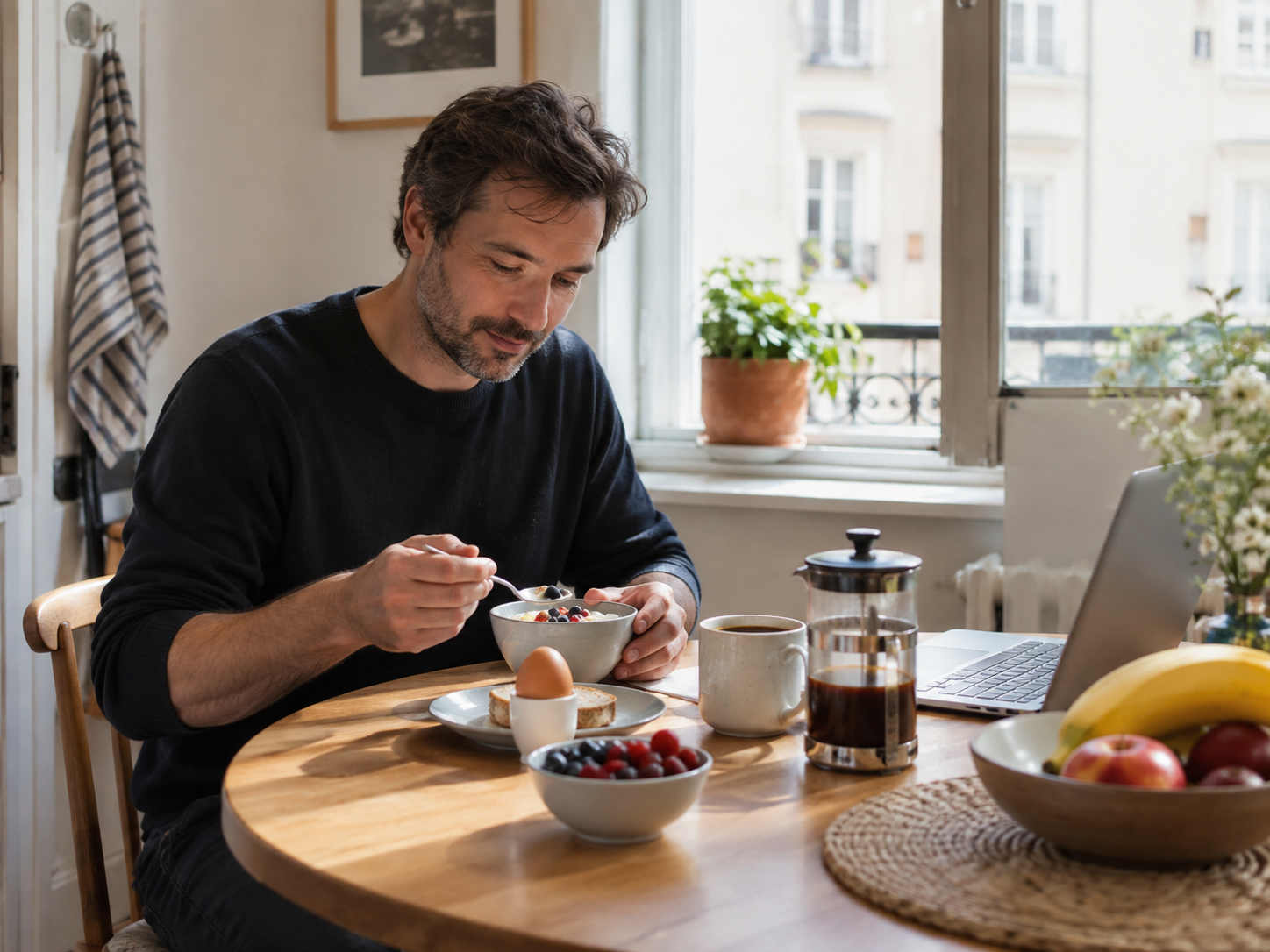
There is a deeper idea lurking under the fixed breakfast, which is that more choice is not always more freedom, and often it is the opposite. Psychologists have long observed a paradox of choice, the finding that when people face too many options they tend to feel more anxious, more prone to second-guessing, and less satisfied with whatever they finally pick than people choosing from a smaller set. A supermarket cereal aisle with fifty boxes does not liberate you, it slightly stresses you, and then leaves you wondering whether you chose right.
The endless-breakfast approach is a small daily dose of exactly that. Every morning you are handed a menu of options and asked to optimize, healthy or indulgent, quick or proper, and every choice carries a faint residue of doubt about whether it was the right one. Fixing your breakfast removes the whole apparatus, the options, the optimizing, the second-guessing, and replaces it with a settled default that you never have to evaluate again. What looks from the outside like giving something up is really shedding a small recurring burden, and the calm that follows is the quiet proof that the choice was never the gift it pretended to be. Sometimes the most freeing thing you can do with a decision is to make it once, permanently, and never make it again. This is the logic behind every good default a person builds into their life, from a set gym time to a standing order at the coffee shop, and breakfast is simply one of the easiest and most rewarding places to apply it.
The European Breakfast, Considered
Seen this way, the traditional European breakfast starts to look less like a lack of imagination and more like accumulated good sense. In much of Europe breakfast is a modest, consistent, unfussy affair, some good bread, a little cheese or cured meat, yogurt, fruit, a strong coffee, taken much the same way day after day, and it is treated as a small reliable ritual rather than a daily culinary decision. It is not a meal Europeans agonize over or reinvent, it is simply what one has in the morning.
That consistency carries all the benefits at once, one less decision, a moderate and predictable amount of food, and the calm of a settled routine, without anyone having designed it for those reasons. It grew up as tradition and habit, and it happens to align neatly with what both the psychology of decisions and the science of appetite would recommend. That is the pattern with so much of European daily life, that habits kept for their own quiet reasons turn out, on inspection, to be the sensible thing all along. The American vision of breakfast as a field of infinite daily choice looks, from this angle, less like abundance and more like an unnecessary complication, a small problem invented each morning that Europe simply declines to have. There is a broader lesson in that, about how often what we call more choice is really just more to manage, and how a culture that has quietly kept some things simple can end up, without trying, both calmer and better off.
Why Breakfast Is the Right Place to Start

Of all the meals to fix, breakfast is the smartest choice, and not by accident. It comes at the start of the day, when you are least awake and least equipped to make good decisions, so it is exactly the meal where removing the choice buys the most relief. It is also the meal most people already eat somewhat repetitively, since few of us reinvent breakfast the way we might dinner, which means fixing it firmly costs almost nothing in variety you would actually miss.
Breakfast is low-stakes in flavor terms too, a functional meal for most people rather than a culinary event, which makes it the natural candidate for autopilot while you keep the freedom to be adventurous at lunch and dinner. You are not condemning yourself to a monotonous life of eating, you are simply moving one small, early, unglamorous decision off your plate and keeping all the interesting ones. That targeted quality is what makes the fixed breakfast such an easy win, a large gain in morning ease for a trivial loss of variety at the meal that needed it least, which is why it is the one habit from this whole experiment I kept without a second thought.
How to Try It Without the Boredom
If a fixed breakfast appeals, the trick is to choose one you genuinely like enough to happily eat most days, because the whole thing collapses if your chosen breakfast is a chore. Pick something you find quietly satisfying, yogurt with fruit and nuts, eggs with toast, oats with berries, good bread with cheese, whatever you would be content to see every morning, and make it your default rather than a decision. It should be a small pleasure you look forward to, not a virtuous punishment you endure.
You do not have to be rigid about it either, since the point is to remove the daily deliberation, not to take a vow, so keeping the same breakfast on ordinary weekdays and letting weekends or travel be different preserves most of the benefit while leaving room for variety when you actually want it. The aim is to turn the most decision-heavy meal of the day into a settled habit, freeing your mornings and quietly steadying your eating, and to discover, as the Europeans long ago did, that having one thing you never have to decide is not a loss of freedom but a small daily gift of ease. Of all the European habits worth borrowing, this may be the easiest to try and the quickest to reward you, since it asks nothing and gives back a calmer start to every single morning, which across a life is not a small thing at all.

About the Author: Ruben, co-founder of Gamintraveler.com since 2014, is a seasoned traveler from Spain who has explored over 100 countries since 2009. Known for his extensive travel adventures across South America, Europe, the US, Australia, New Zealand, Asia, and Africa, Ruben combines his passion for adventurous yet sustainable living with his love for cycling, highlighted by his remarkable 5-month bicycle journey from Spain to Norway. He currently resides in Spain, where he continues sharing his travel experiences with his partner, Rachel, and their son, Han.